Cape May

Cape May
(RE BERG-ANDERSSON)

Sunday, June 19, 2022

A Hot Time in the Garden

“Summer’s lease hath all too short a date.”

-- William Shakespeare

I went looking for a summer quote to start this blog post, and this one of the Bard's was the closest to what I feel about summer. It is all too short ... but not short enough.

Spider mites (Margo D. Beller)

Most people love summer for the heat, being out of school, time down the shore. Not me. The overabundance of heat, humidity and insects tends to keep me indoors if I can help it. 

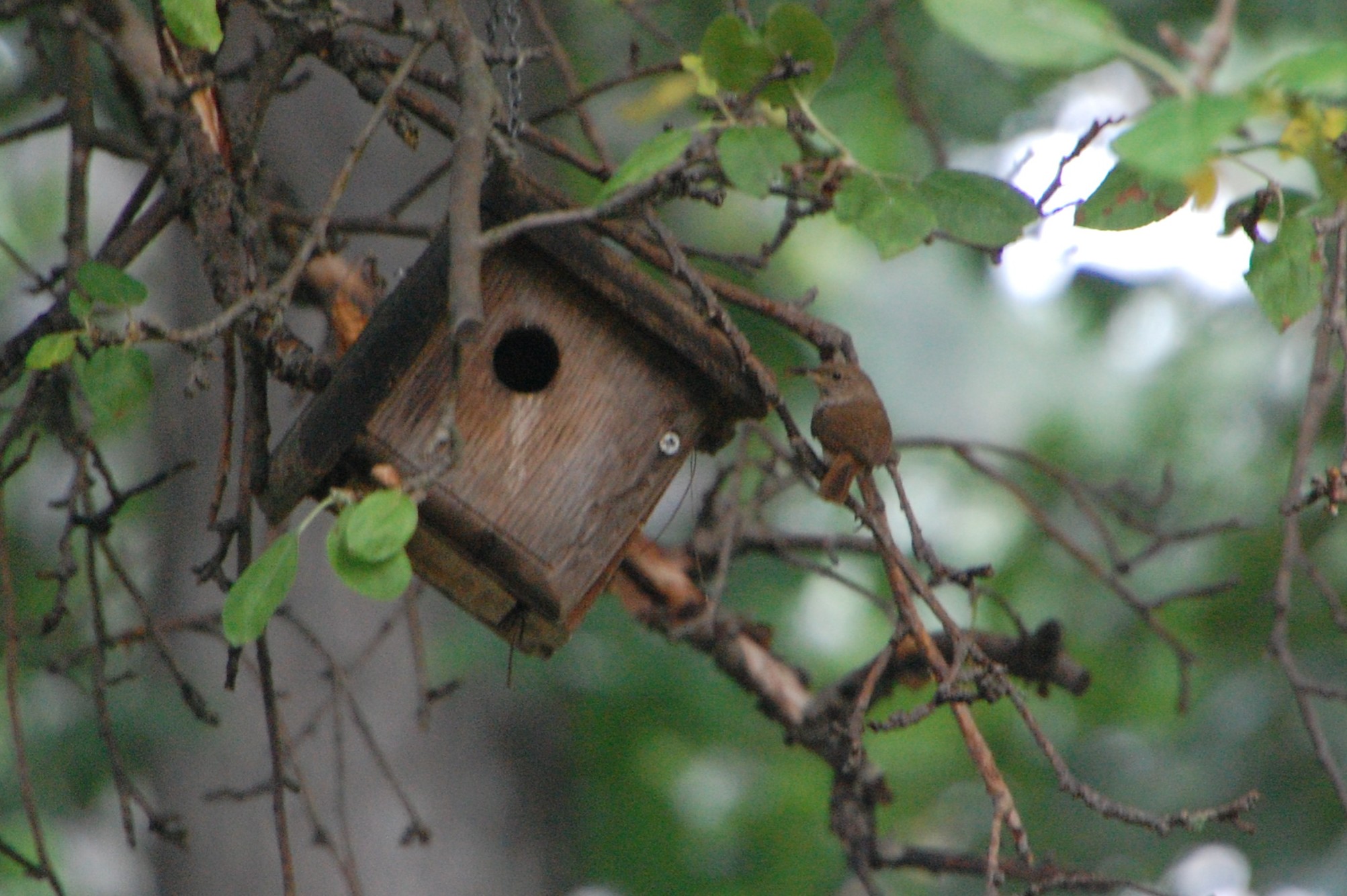
I don't need to look for birds now. The birds can get along without me quite well, and there are plenty I can hear in the early morning cool from my porch - robins, catbirds, cardinals, mockingbird, the occasional house finch, flicker or goldfinch. (The house wrens are silent, however, making frequent trips to the box to feed their young.)

Overgrown apple tree
(Margo D. Beller)

But with summer comes too many garden chores, and if I don't work in the garden on a regular basis - heat or no - I have big problems.

The flowers are lovely, yes, but the weeds are also growing - everywhere, including behind the deer netting. Last year, when I was sick, I could do nothing in the garden. As a result, there were so many weeds everywhere, including growing between the paving stones on the front walkway so you couldn't see the bricks. This year I've been out frequently with a spray bottle of vinegar and salt to keep that from happening again.

Overgrown cedar (Margo D. Beller)

There are, as usual, too many insects. They feed the birds but they also attack garden plants and sometimes me. The red spider mites showed up earlier than usual to attack the yellow daisies. For these pests I use a spray bottle of water and, wearing rubber gloves, carefully run my fingers up the stem and crush as many of these pests as I can (and then rinse the red residue off the gloves).

In some areas of the yard, my pulling weeds angers the resident no-see-ums, which bite me so fiercely the affected areas feel like they are on fire. This is despite my wearing coverings from head to toe and going out early to work when it is cooler and shady.

And don't get me started on mosquitoes.

Overgrown pear tree (Margo D. Beller)

The ground ivy grows everywhere, no matter how much I pull up. Its more noxious cousin, poison ivy, has been coming up in nearly inaccessible places, such as under the hedge. I can yank up handfuls of ground ivy but for poison ivy I need to cover each hand with a plastic bag to pull the stuff out without giving myself a rash, and even then I make sure to wash my hands and lower arms with cold water and soap as soon as possible.

The blue spruce is tall and stately, but it is in an area of the yard where it does not affect the house. The dogwood that was planted nearby at the same time as the spruce has reached its full height, but it is a runt compared with the tall oak trees overhead. But other trees should've been pruned years ago. The arborvitae (white cedar) planted near the front door is now so tall I could reach it from my second-floor office window. The pear tree grew so tall its fruit-laden upper branches were resting on the porch roof. The apple tree is in dire need of a haircut, too.

Ground ivy on the wrong side of the fence
(Margo D. Beller)

Yesterday, an unusually cool and windy day, I took my 14-foot extension lopper and cut down as many of the pear branches as I could reach. But the other pear branches plus those of the other too-tall trees will need professional help this year. As will the house, which needs washing and gutter clearing. And there's that deer fencing I must re-do when it gets cooler so I can get at the weeds, put down mulch and dig a new border to minimize the mess next year (I hope).

Summer can't end soon enough.


Saturday, June 11, 2022

Watching and Waiting

Thanks to technology, it is possible to put the smallest of cameras into a nest box to record what is going on inside. Do a search of "nest box cameras" and you'll find all the latest models. Do another search of "watching nest webcams" and you'll find links to cameras put into or near nests by Audubon, the American Eagle Foundation and others. Thanks to webcams you can see into the nests of barn owls, bluebirds and American kestrels. It's an easy way to learn about birds and get engrossed in their life cycles. It's as easy as watching TV.

One of this year's wrens, on the branch
below the box. (Margo D. Beller)

I, however, don't have such a camera. To know what is going on in the house wren nest I have hanging I must depend on my many years of watching and being very, very patient.

After I relearned my lesson about intruding it took several days before the house wren pair resumed their activity in and around the nest box I had put up in the dogwood tree. It was very silent in the yard. Just when I'd think the wrens were gone the male would sing, briefly. This happened for several days. Then, on the fourth day, the house wren male started singing early and often, and I saw the female going into the box and not coming out again for long periods of time.

There must be eggs, I thought then. Now, I think there must be young.

According to the experts at Cornell, egg incubation takes nine to 16 days. Once the eggs hatch, the nesting period is another two weeks or so. Today when the female came back to the tree she had an insect in her bill. So there are young, I thought, likely three or four (house wrens can lay up to 10 eggs per clutch, but not in this little box). Right now the chicks must be very small because I hear no calling when either parent is in the vicinity of the nest. That will change when the young get bigger, noisily clamoring to be fed.

There have been other signs of life in the yard.

Blooming viburnum, already fading.
(Margo D. Beller)

Every so often I have to remind myself to go outside and look at the flowering plants before it is too late. Often, it is too late. The showy red peony flowers are already spent, as are those of the azaleas and the rhododendron. I've already deadheaded the columbine and the iris but the daisies, coneflower, goldenrod and sedums are growing quickly. The Stargazer lilies have opened. The coral bells continue to bloom. The viburnum is covered with white flowers that are already starting to fade. 

There are flowers on the privet bushes that will become little black berries, and the wild cherry tree is covered with green fruit that will ripen for the robins that will soon acrobatically pick them off. There are small wild strawberries all over the yard and a couple of wild raspberry bushes that sprang up in areas where they are not in the way, so I have left them. What I don't pick the birds will get.

The pear tree, way too tall, has fruit growing on branches resting on the roof, perfect for a hungry squirrel ambitious enough to climb up.

One of this year's catbirds. (Margo D. Beller)

And there will be apples, plenty of apples. I'll soon be busy collecting them before the squirrels (and the deer) can do much damage. Those apples are the reason I moved the wren box from this tree.

Yes, it would be easier to see what goes on inside the nest box. I could sit at my computer and watch, like some sort of Peeping Tom. There would be no wondering, no reason to even go outside.

No, thank you.


Sunday, June 5, 2022

A Lesson Relearned

On June 1, the morning after my last post, I came out on my porch with my second mug of coffee, put on the fan to move the warm air and sat down to relax and let my mind wander before I had to go to work. After a few minutes I heard something through the whirring of the fan. I opened the porch door and put my head out. I heard a house wren.

Nest box, pre-wrens, 2022. Note the string to
the right. (Margo D. Beller)

I came in to sit and watch the nest box I'd hung in the dogwood tree weeks before, a day after I'd seen another house wren at the water dish. There had been silence after that wren flew off but now there was the bubbly song of another and it did not stop, except when the bird examined the wooden box. Then it flew off but soon returned, still singing. 

The next step was to see if there would be a second wren. The female is the one who must approve the site and then start gathering materials for her nest. A day later, I saw her.

Over this past week the male started singing at dawn and the female actively worked at the nest.

Then, today, came a reminder that even when I try to help birds their lives are still precarious.

Sitting on my porch this morning, I was horrified to see a squirrel climbing up the dogwood and then climbing ON the nest box. A squirrel weighs a lot more than a wren and I didn't want the box to fall, in part because I didn't know if there were eggs inside. The female wren flew out of the box and the male flew from the nearby hedge, both to attack the much larger danger.

By then ("NO!") I had rushed from my chair to the other side of the porch to bang on the window. The squirrel took off.

But so did the wrens.

Until last year, I hung this nest box in the apple tree. It was placed halfway out on a strong, horizontal branch to prevent the squirrels from bothering it. I decided to move the box to the dogwood on the other side of the yard because the profusion of apples drew a lot of squirrels (and me) and I didn't want the birds disturbed. However, the dogwood is more open, and the way the branches grow it was hard to find one strong and straight but not too high to make it dangerous for me to attach from the ladder.

House wren in 2020, when the box was in
the apple tree. (Margo D. Beller)
And, of course, I wanted to see the birds. In the dogwood I only had to sit in my chair and look out. In the apple tree I would have to turn around or look from a different, less comfortable chair.

When I took down the box last year I tied a string to the branch to remind me where to place the box this year. When the wrens came, the male kept pecking at it. I realized it might have thought the string was a snake so I went out to cut it. I agitated the birds but I was quickly gone and I hadn't touched the box, unlike the squirrel.

I can't be outside all the time, much as I'd like to be, so I don't know if any squirrels attacked the box last year. The wrens had their brood and, as usual, suddenly disappeared with the young once they had fledged.

This year, after 15 long minutes of silence, one of the wrens came back and went into the box. Then it flew down to a lower branch for a moment before moving off to the area behind the flood wall. A few minutes later it - she - came back with nesting material, flew into the box and then back behind the flood wall. I was relieved at first, but then started to get agitated. Except for one brief call by the male just after I scared off the squirrel there has been silence. I decided I didn't want to keep punishing myself so I came inside. I'll come back out tomorrow to see if they are staying.

A badly placed robin's nest,
(Margo D. Beller)
When I put out feeders in winter, it is to help the birds stay alive in harsh conditions. Many people now feed birds all year round and that is why there are more birds (and more birders). At this time of year I bring in the feeders because there are plenty of insects for the birds and their young. They do not need sunflower seed, they need bug protein.

Still, even with plentiful food there is continual danger in the life of a bird. Just before the squirrel came to the box a flock of noisy fish crows flew overhead, silencing the male house wren. There is no way a fish crow could attack young in a wooden box nest but in the wild predators could get at a badly placed or unprotected nest, and so the wrens go quiet by instinct.

At this time of year there are already baby birds in nests. Just after the squirrel incident another fish crow came too close to the hedge where I know there is a robin nest. Both parents put up a frightful racket as they chased off the intruder. They even got some help from a mockingbird, not the most social of birds but likely also protecting its own nest nearby. 

The Cooper's nest that failed.
(Margo D. Beller)
It is a common site to see big birds being chased off by one or more smaller, protective birds: starlings chasing off grackles, grackles chasing off crows, crows chasing off hawks. But sometimes nests fail, either because they are in the wrong place or are abandoned by immature birds before eggs are laid. The latter was the case with the young Cooper's hawks that built their nest in 2020, only to be spooked off by a flock of fish crows that came too close. The hawks left and squirrels later claimed the empty nest.

And there are the sad situations where the parent (usually the female alone cares for the nest) is killed by a predator (including cars), a cowbird egg hatches in the nest and destroys the other eggs or the parent is forced to abandon the nest and the young starve to death.

I get protective about this nest box and the house wrens that use it every year, but once again I should've let nature take its course. I'm sure the two wrens would've forced off the squirrel - there was no food to interest it - but by my getting involved I possibly made things worse.

One of my friends likes to refer to "my birds" when they come to her feeders. I remind her these are not house pets, they are wild birds. I know she is feeding them so she can see and enjoy them in their various shapes and colors. So do many other people. I tell myself that I don't do that but I now realize, yet again, that I am no better than anyone else.

Will the wrens pick up where they left off? I don't know, but it would serve me right if they didn't. Lesson relearned.


Monday, May 30, 2022

Resurgence

Life is what happens to you while you're making other plans.

  -- John Lennon

The blue iris that suddenly appeared. (Margo D. Beller)

Hello! It has been a while. Time has a way of running away when you're not paying attention. In my case a combination of Covid prevention, cancer treatments and work stress had kept me occupied and not in the best state of mind. But today, Memorial Day, I have gotten my weekend chores out of the way and I'm not working - perfect for gathering my thoughts and catching up.

Azaleas 2022
(Margo D. Beller)
Since I last wrote we had a less snowy but very cold winter followed by a bit of spring when the trees started to bud and the grass started to go green. Then, in late April into early May, it was damp and chilly, which was good for the outdoor plants but not for me, who was itching to put out my pepper pots before the little flies killed them. The same with my canna pots, covered in the garage. The cannas went out first - a month late - while it was still in the 40s overnight. Finally, around the time we went to visit family for Mother's Day, I put out the peppers, two types of basil I had bought at the local Agway and the pot of coleus I kept over the winter. All are enclosed in a wire cage, of course, because we still have plenty of deer. 

What we didn't have were migrating birds. By the time I took the feeders in for the summer, the migration radar I look at showed the strong winds out of the north and northeast that brought the cold and rain had detoured the birds coming up on the southerly  winds into the midwest. Then, many of them hung a right and flew over the mid-Atlantic region where I live and, eventually, into New England and beyond. 

Columbine, behind the deer netting. 
(Margo D. Beller)
Once we returned from New Hampshire (where we didn't have much in the way of warblers except for the pine, one of the earliest migrants) the heat came at us - midsummer heat in May with strong thunderstorms. The weeds started to grow in the front walkway and in the garden beds. If I wanted to walk it had to be early. One such weekday morning I went to Greystone as the sun was hitting a tree near the back path where I walk. It was filled with calling birds. I had a few such mornings, when I could force myself out of bed at first light so I would have time before work. 

The day after I should have put up the wren box, a house wren appeared at the water dish when we happened to be sitting on the porch, and then it flew off. The box went up (my husband spotting me as I went up the ladder at the dogwood tree) but no bird has come. Same with the hummingbirds - nothing, despite my feeder and the pink flowers of the geranium and coral bells in back, the red azeleas in front and the purple columbine everywhere. (Usually I start seeing hummers in June but I start putting sugar water out in May because, as they say, you never know.)   

By the time we took our annual trip to Old Mine Road to listen for the territorial calls of breeding birds (in the ridges near the Delaware Water Gap) I knew migration was just about over. This was the point when I started doing garden chores, including using my edger around the ornamental grass garden and lugging soil and mulch to the area behind the porch where the heavy rains had eroded the dirt and left it muddy when I'd go out with the feeders. Now, no more mud (but no more feeders either, until maybe Labor Day).

Lenten rose 2022 (Margo D. Beller)

There have been birds around my yard, singing as I have worked or sat on my porch - red-eyed vireo, titmouse, chickadee, cedar waxwings, various woodpeckers and what I call the Big Four of robin, catbird, cardinal and song sparrow. (The juncos and white-throated sparrows are long gone.) There has also been a mockingbird that does a very good imitation of a Carolina wren, so good that when a real wren was singing I had to listen hard to make sure of it. We even had some warblers passing through including an orange-crowned that spent the day calling from a neighbor's bush, a Nashville (my 100th yard bird) whose large eye ring makes identification simple and a few blackpolls, whose call I associate with the end of migration (this bird has one of the longest migration routes).

Peonies, again behind deer netting.
(Margo D. Beller)
The snowdrops, crocus and glory of the snow started the growing season. Then the daffodils, which did very well this year, as did the azaleas, the irises and the hyacinth. The columbines in front and back decided to flower, the peony finally opened its big, red flowers and the rhododendron is tall and healthy with pink flowers that bloomed as the azaleas were fading. As usual, I was relieved when the sedums, the coneflower, the rose of Sharon and the liriope started growing again and now the peppers (including one I bought to hedge my bets) are showing signs of life.

There were also some surprises. For the first time in many years, a blue iris appeared in one of my garden plots, in the same spot as last time. I still don't know where it came from but I welcome it. I also discovered a jack in the pulpit under my hedge among the usual weeds - this is one plant I am not touching as I yank out the others. One sunny day I found a garter snake in one plot, and I am hoping it sticks around to keep down the chipmunks. The Lenten rose, which at one point I thought had been killed by the cold, bloomed profusely and only now those flowers have faded and been covered by large, green leaves. 

Another surprise: Last year there were three milkweed plants that suddenly appeared near the lilacs. This year there are eight. I am hoping that this year they bloom and help the endangered monarch butterfly population.

The area behind the porch where 
I put down heavy buckets
of soil and mulch.
(Margo D. Beller)

There have also been weeds, of course. One early morning I took out the lopper to get at the ones I could not reach because of the deer netting. The bigger ones I could reach over and pull out. I could easily identify ragweed and garlic mustard but another one looked like it could be a wild sunflower. However, when it is in the wrong bed it is still a weed. I found more of them in other areas and pulled them out, except for one in a place where it doesn't threaten anything so I can leave it and see what it becomes. 

The weeds made me despair, as usual, but this year I've decided to put down sheets of black garden fabric (weed block) to kill those near the compost pile (which finally got turned and the rich soil removed), in an area erroneously known as the "dead area" but is anything but. We now have someone to cut and edge our lawn regularly, and that not only makes the grass look better while keeping down the ubiquitous ground ivy but it makes me determined to do something with those areas not mowed.

Also sprouting: fences. Neighbors on either side of me decided to put in solid, white, vinyl privacy fences. To do that, one neighbor cut down the bush that worked very well as a privacy fence and also fed the local deer. (I can only wish I had a fence to block the goings-on of the neighbor along the long side of my yard, who hacked down the forsythia and other plants that had obscured our yards a few years ago.)

The fence replacing the bush: vinyl on 3 sides, wood in back.
The wood has since been painted white.
(Margo D. Beller)

This need for privacy comes out of the violent times we live in, and perhaps the lingering coronavirus. The younger people now living on my street want to keep their families contained and thus "safe" from the outside world. They do not seek me out; nor do I seek them out. I keep to myself. I try to be friendly but I frankly do not understand a lot of what is considered "modern" nowadays, and perhaps that showed. When my cancer treatment was at its worse during the summer I stayed indoors and the weeds ran rampant, including along our front walkway. This year, I am well enough to regularly spray my walkways with a cocktail of vinegar and salt - easy to make and not lethal to birds while it kills the weeds. 

There is much more that needs to be done - gutter cleaning, power washing, cutting back some overgrown trees - but not today. For today, at least, I can enjoy the early coolness (before the expected July-like heat) and the quiet (before the inevitable suburban cookout gatherings) that come with a work holiday. 


Friday, December 31, 2021

Time Passing


What good is the warmth of summer, without the cold of winter to give it sweetness.

-- John Steinbeck

When I am walking in a familiar place in one season, I can't help remembering the birds I saw in the same place in another season, usually in another year.

So when I took a winter walk the other weekend in the Central Park of Morris County (but what I still call Greystone for the mental hospital that once stood there), I saw what is and what was.

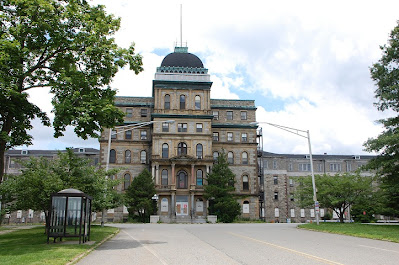
Greystone administration building, razed not long
after this picture in 2015 (Margo D. Beller)

Let's start with the symbol of Greystone, the Kirkbride administration building. There was a battle over the abandoned building, which was ultimately torn down because that was cheaper than preserving it. Plans included turning it into apartments, which would've greatly changed this area with increased traffic. Now it is a wide-open field over which I've seen swallows and other birds hunting insects.

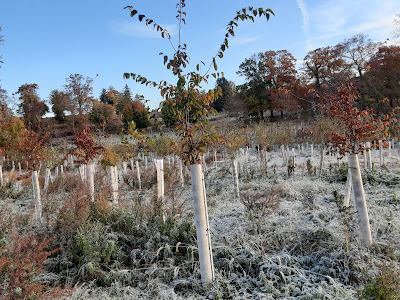
Conversely, there is an area at the outer edge of the property that was once a working farm. The structures were removed decades ago and the field became overgrown. When this area was turned into a county park a number of trees were cut down and the land cleared. Paths were cut through, intended for cross-country competitions but also used for walkers and joggers. Now the area has been replanted with different types of saplings in protective wrappings. In a decade, maybe less, this open space will become a forest.

As I walk this path in December it is cold and gray and the trees are bare, so I am thinking of what I have seen here in other seasons. Over here, a noise prompted me to look across the sapling field to find a herd of deer, including two bucks butting heads. Near the brook that runs through this field, a song sparrow was singing atop a downed tree. In yet another area, past a different field filled with blooming goldenrod and ragweed, a flock of migrating palm warblers. Here, in a tree over a field of milkweed, is a vesper sparrow, an autumn visitor, distinctive for its white eye ring.

The same area after the debris was removed, 2018.
(Margo D. Beller)

But today it is quiet and windy. I look at the tree where just a month ago I watched flocks of robins, cedar waxwings, starlings and bluebirds gorge on seeds, insects and the fruiting vines as white-throated sparrows called to each other from the field below. The tree is now bare, the birds laying low and quiet except for a couple of song sparrows alarmed by the guy running along the path with his dog. The dog wants to check me out but his owner calls to him and they continue on. Other walkers, some wearing headphones, ignore me so I am basically alone in this vast place.

I enjoy these winter walks and the solitude. Without the leaves the trees show their striking, sometimes grotesque, forms. I can see where past storms have sheared off limbs. It is easy to find the large nests of squirrels. 

Winter tree (Margo D. Beller)

But along with the starkness this time of year brings me a feeling of loss, of time passing, of death. The days are shorter, the nights longer and the year is ending. I think of friends and family no longer living. The darkness keeps me inside more than I'd like. These feelings come every year but they still hit me, sometimes in unexpected ways.

When I was here in November I noticed that many of the saplings had grown tall enough to be identifiable. This time, the leaves are down and I noticed several red cedars had also been planted. These conifers should grow much faster than the saplings, as well as provide little berries for the birds in winter. But at some point they will be overshadowed by the trees. I look at this field and try to imagine what it is going to look like. I know the landscape is going to look very different.

Saplings, November 2021 (Margo D. Beller)

For instance, the many types of sparrows I've seen in this open field are not found in deep woods and so will be moving elsewhere. This former mental hospital was altered to become a park to benefit county residents like me. But what about the birds and other creatures that were living here after the mental hospital closed but before the park was built? The wooded areas where I once found an assortment of birds are gone, cut down for soccer fields. Vultures that once roosted in trees along the main road have gone elsewhere because the area became too busy for them. 

There is good and bad to making massive changes

Both this area and I are changing, not necessarily for the better, and will continue to change as time goes on. Time can't be stopped. The year 2021 is ending. It has been filled with challenges, some pain but a lot of happiness. This year, in the midst of Covid-19, a lovely wedding. Next year offers the promise of a new grand-niece. Sometimes I dwell too much on the past and the future, so to stay sane I take these walks and try to stick to the present.

Monday, December 20, 2021

...And Through the Woods

When I met my husband (MH), his family was living in a town in Morris County, New Jersey. Over the years, the family has slowly migrated to central New Hampshire. 

First was MH's immediately younger brother, who had met a New Hampshire girl and eventually settled up there with her after college. Then MH's youngest brother migrated up there with his then-wife to look for a job. He also stayed and remarried after the first marriage ended. Once the grandchildren started coming, my in-laws moved to New Hampshire, too, leaving MH and me the only members of the family still in New Jersey, from which we had migrated from the city to a town not far from where his parents had lived..

Thus we've gone to New Hampshire for Thanksgiving for years as the children have grown and had children of their own. Coming from a suburb of New York City to a rural area gives me a chance to get away from work and observe a different area. I've seen the changes in this part of the state over several decades as other people have migrated up there to live either part time or full time. And, of course, I've watched the birds for ones I can't find at home.

A black-capped chickadee (Margo D. Beller)

MH's brother knows I am a serious birder and, considering he works at teaching people to look at, enjoy and protect nature, he always likes to test my knowledge.

So this year he asked me to guess which birds were currently coming to his yard, including his one seed and two suet feeders. One of them, the red-breasted nuthatch, is a rare visitor to my yard because I don't have the pine trees this bird prefers. I also don't get bluebirds (he has nest boxes for them). Aside from that, his visitors are what I typically get in suburban New Jersey: cardinal, chickadees, titmice, white-breasted nuthatch, song sparrows, juncos, downy and hairy woodpeckers, mourning dove, jays, robins.

But more recently he has also been visited by a Carolina wren, and after we left he told us a redbellied woodpecker came to the suet and he saw a redtailed hawk looking down from one of the trees on his property.

These were not visitors to this part of the state even 10 years ago, I believe, but, like the year-round human population here, that has been slowly changing.

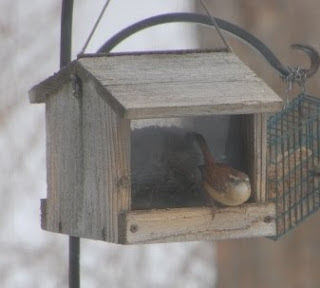
Carolina wren, common to my feeder
but now appearing to the
north. (Margo D. Beller)

I recently read an interesting book, by the biologist Thor Hanson, about the effects of climate change and how plants and animals react to it. The sections of the book cover the four possibilities: adjust, evolve, move or die. When it comes to the birds, as the planet warms many species have expanded their territories northward into previously inhospitable areas. (The increase in the number of people putting out feeders when winter comes doesn't hurt either.) The birds already in those areas are faced with increasing competition for limited resources. Those birds, in turn, have to move or change the way they live in order to survive.

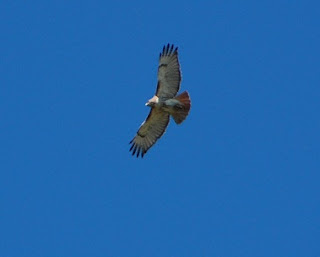
The appearance of a redtail near his property interests me in particular. In all our visits I've never seen a redtail in his part of the state. The more urbanized part of New Hampshire to the south, yes, particularly near the interstates where the hawks sit in a tree or on a lamp post and wait for a meal to appear below so they can swoop down and grab it. In my brother-in-law's area the more usual are redshouldered and broadwinged hawks.These birds usually fly south for the winter. What happens when they return to find redtails in their midst? Or what if this area warms enough that these birds fly south later than usual, or not at all?

Redtailed hawk (Margo D. Beller)

There are now more people on my brother-in-law's road who have either built new houses or converted their summer houses to year-end living. These people tend to be older, with children or visiting grandchildren, and are driving more luxury vehicles and trucks. As they come to the area, the forest disappears. The climate changes in subtle ways. If they put out feeders, the birds come during the winter. So do the hawks that feed on them.

Many of the common birds I see in my yard were once exclusively from south of my area: cardinal, mockingbird, Carolina wren, redbellied woodpecker. Now they are common in New Jersey. We don't think anything of it. But, as Hanson points out, climate change has slowly been prompting the flowers to bloom earlier than usual and bring out the insects, affecting what the migrating birds find when they are passing through during their long journeys from winter to breeding territories. Meanwhile, the yard birds benefit so why should they leave?

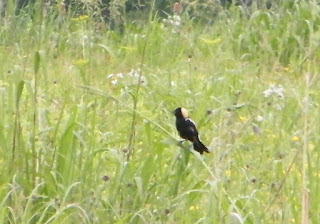
Male bobolink (RE Berg-Andersson)

The national Audubon Society believes there are nearly 400 bird species threatened by climate change and habitat devastation including 53 types of coastal birds, 69 types of Eastern forest birds and 39 types of grassland birds including the bobolink - a bird I once saw and heard in a field not far from the N.H. town where my in-laws moved. But that was many years ago. As people have migrated into areas once dominated by woods or grasslands, they have pushed out the birds that can't adapt or are forced to leave when humanity cuts down the forests, paves the dirt roads and generally warms the planet with car exhaust.

I don't know what we can do to hold back this tide, and that bothers me.

Sunday, December 19, 2021

Space Invaders

Another gray morning. On my enclosed porch, my chair in the corner faces east to catch the rays of the rising sun. But the day is starting cloudy once again, with a stiff, cold wind out of the north-northwest.

As I stare out, sipping my coffee, the sky turns black. Thousands of dark birds, all heading norttheast, fill the sky, a veritable river of birds, more and then more still. I think of Audubon's description of the now-extinct passenger pigeon blackening the sky: "The air was literally filled with Pigeons; the light of noon-day was obscured as by an eclipse..."

These birds, however, were common grackles.

You see them in small flocks for most of the year, but in winter these shiny, long-tailed birds mass in flocks of thousands.

Grackle flock, February 2020 (Margo D. Beller)

Why certain types of birds do this is not known. Safety in numbers? A need to keep warm? Easier to find food? All of the above?

In my area of the country, the common grackle predominates. The much larger, aptly named great-tailed grackle is a bird of the southwest. I have never seen one, but I have seen the shore-loving boat-tailed grackles when I've been on one of the New Jersey or Delaware beaches. An easy way to tell the boat-tails from the common grackles is by looking for the smaller females. If she is brown, she's a boat-tail. If she's black, she's a common.

What they all have in common, besides their genus, is they can be pests, especially when they arrive in a cornfield, at a yard or mass along a boardwalk in large numbers. 

Female boat-tailed grackle (RE Berg-Andersson)

I've written before about the sudden arrival of literally a thousand common grackles on my lawn back in 2020, a year where we did not get much snow to keep these birds away. (As opposed to 2021, when we got too much snow.) I am fascinated by these extravagantly large flocks that appear out of nowhere, stay for a while and then leave for the next food source.

Grackles breed in northern New England, a healthy swath of Canada and into the U.S. midwest, according to the Cornell Ornithology Lab's range map. But they are found year-round throughout the eastern U.S., and that's where my New Jersey yard fits in.

These invasions in my yard generally take place in late autumn or early spring, before and after snow  covers the lawn. Grackles mass in fields and eat certain crops like corn, but in my area they can mass in parks and will eat just about anything including garbage or, in my case, bird seed. When I look through my open office shade and see one of these flocks showing up in my vicinity, the first thing I do is rush out to pull in my feeders. 

Once the feeders and I are safely back on the enclosed porch, I watch. The birds stalk the ground poking for worms, or fly into the corners (or my compost pile) where they can turn over leaves and search for insect larvae or other food. There is a loud chatter of "chuk chuk chuk" as dozens, hundreds or even thousands of birds call to family members. Then they fly to the next yard or, if I come outside, rise into the trees, continuing their chorus of "chuk" before flying off in small groups until suddenly the rest of the flock leaves.

Robin (Margo D. Beller)

Sometimes, I see fellow travelers. Robins also poke at the ground and turn over leaves for food and so join the grackle flocks, and then hang around after the bigger birds have left to find what is left over. I have seen grackle flocks include cowbirds, starlings or, rare for my yard, rusty blackbirds (named for a call that sounds like a swinging metal gate needing lubrication).

Starlings are interesting. At this time of year they also mass and you will see them flying and moving like a giant organism in the sky, almost like watching synchronized swimmers in the way they undulate as one. (Do a search for "starlings massing" and watch some of the videos to see what I mean.)  How do these individuals know to do that? I don't know.

What I do know is these invasions are another sign of approaching winter, and just as inevitable.