Cape May

Cape May
(RE BERG-ANDERSSON)
Showing posts with label redtailed hawks. Show all posts

Sunday, February 16, 2025

Snow More

So far this year 2025 has been filled with cold, snow and ice. And yet, according to my home state of New Jersey, January was one of the driest in history.

Says NJ.com about January, "Many areas of the Garden State have picked up less than an inch of total precipitation so far this month. That includes rain and all the liquid from melted snow and sleet, according to data from the National Weather Service." 

Scene from a recent snowstorm
(Margo D. Beller)

It was also very cold for a number of days. According to NOAA, "For those living in the southern, central, or eastern parts of the nation—who might have forgotten what winter could be like following last winter’s record-warmth—Mother Nature provided a hard-hitting reminder during January. Temperatures averaged below normal from coast-to-coast during the month, but periodic intrusions of Arctic air were most prevalent into the central and eastern U.S." 

Now, it's February. As I write the temperature is above freezing and it is raining. Our last snowstorm the other week dropped three inches of snow and one of ice, making it harder to shovel the front and back paths. Since then temperatures have risen above freezing during the day and then dropped at night, freezing the snow and making it more hazardous to get to the bird feeders. It is miserable out and, unless everything is washed away, it will continue to be icy for days.

According to NOAA again: The temperature outlook favors well above average temperatures across the southern and eastern parts of the nation, as well as in northern and western Alaska. Below-average temperatures are favored across parts of the northern and western U.S., as well as in southeastern Alaska. The precipitation outlook favors well above average precipitation in the Pacific Northwest, Northern Rockies, around the Great Lakes, in the Ohio and Tennessee Valleys, in the Northeast, and in western and northern Alaska, with below-average precipitation favored only in parts of the Southwest and Florida. (emphasis added) 

One of the redtail hawks I've seen near my house.
(Margo D. Beller)

The birds do not seem to mind all this strange weather. Several times I have seen a pair of redtail hawks flying around and landing in trees near my house. At this time of year they would be pairing, mating, creating a nest and having a brood. I have not found the nest yet, but I haven't had much opportunity to go out looking for it. (I haven't found a nest since 2012.)

In weather like this, when it is either raining heavily or extremely windy, the feeders are inside and the smaller birds have to fend for themselves. I don't like this but I can't fly over the ice to get to the poles, and the rain rots the seed.

Unfortunately, there is another reason for keeping them inside - one of the local squirrels has figured out how to jump on the baffle on one of the feeder poles and grab hold of the long feeder I put out after big snowstorms. (It holds more seed and I don't have to worry about leaving it out overnight because the bears are hibernating, but that will end in March.) The last time there was so much snow and ice the squirrels couldn't get to their stashes and the birds didn't drop enough for them to eat was in February 2014. That was a bad winter. The squirrels used the ice atop the snow piles as a step. This year the snow is a bit less but the one squirrel (who might be a female eating for six) is just as desperate.

This was from 2014. The feeder is the same, the
squirrel far different. (Margo D. Beller)

I used to like snow, until I became a homeowner who had to shovel it or pay someone to plow it from the driveway. Snow looks pretty until it starts to melt or, as is currently the case, gets rained upon. We have had more snow this month than we've had the last two winters. That's a good thing considering last September's drought but even with all the rain and snow we've had, my region of New Jersey is considered severely dry. Other areas are worse.

Thanks to climate change my area of the country has had milder winters with little in the way of snow, which contributed to the drought. What we're getting now is more "normal," though historically we are still getting far less snow than when I was a child. 

So, much as I hate to say it, I can only hope for more snow, ice and rain to ease the drought, and enough dryness in between to feed the birds.

Monday, December 20, 2021

...And Through the Woods

When I met my husband (MH), his family was living in a town in Morris County, New Jersey. Over the years, the family has slowly migrated to central New Hampshire. 

First was MH's immediately younger brother, who had met a New Hampshire girl and eventually settled up there with her after college. Then MH's youngest brother migrated up there with his then-wife to look for a job. He also stayed and remarried after the first marriage ended. Once the grandchildren started coming, my in-laws moved to New Hampshire, too, leaving MH and me the only members of the family still in New Jersey, from which we had migrated from the city to a town not far from where his parents had lived..

Thus we've gone to New Hampshire for Thanksgiving for years as the children have grown and had children of their own. Coming from a suburb of New York City to a rural area gives me a chance to get away from work and observe a different area. I've seen the changes in this part of the state over several decades as other people have migrated up there to live either part time or full time. And, of course, I've watched the birds for ones I can't find at home.

A black-capped chickadee (Margo D. Beller)

MH's brother knows I am a serious birder and, considering he works at teaching people to look at, enjoy and protect nature, he always likes to test my knowledge.

So this year he asked me to guess which birds were currently coming to his yard, including his one seed and two suet feeders. One of them, the red-breasted nuthatch, is a rare visitor to my yard because I don't have the pine trees this bird prefers. I also don't get bluebirds (he has nest boxes for them). Aside from that, his visitors are what I typically get in suburban New Jersey: cardinal, chickadees, titmice, white-breasted nuthatch, song sparrows, juncos, downy and hairy woodpeckers, mourning dove, jays, robins.

But more recently he has also been visited by a Carolina wren, and after we left he told us a redbellied woodpecker came to the suet and he saw a redtailed hawk looking down from one of the trees on his property.

These were not visitors to this part of the state even 10 years ago, I believe, but, like the year-round human population here, that has been slowly changing.

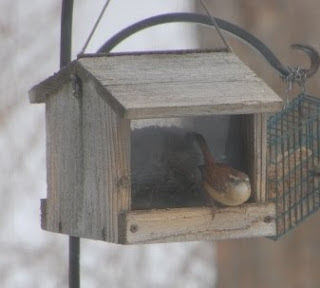
Carolina wren, common to my feeder
but now appearing to the
north. (Margo D. Beller)

I recently read an interesting book, by the biologist Thor Hanson, about the effects of climate change and how plants and animals react to it. The sections of the book cover the four possibilities: adjust, evolve, move or die. When it comes to the birds, as the planet warms many species have expanded their territories northward into previously inhospitable areas. (The increase in the number of people putting out feeders when winter comes doesn't hurt either.) The birds already in those areas are faced with increasing competition for limited resources. Those birds, in turn, have to move or change the way they live in order to survive.

The appearance of a redtail near his property interests me in particular. In all our visits I've never seen a redtail in his part of the state. The more urbanized part of New Hampshire to the south, yes, particularly near the interstates where the hawks sit in a tree or on a lamp post and wait for a meal to appear below so they can swoop down and grab it. In my brother-in-law's area the more usual are redshouldered and broadwinged hawks.These birds usually fly south for the winter. What happens when they return to find redtails in their midst? Or what if this area warms enough that these birds fly south later than usual, or not at all?

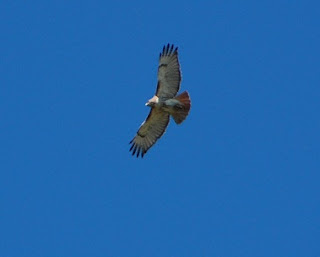
Redtailed hawk (Margo D. Beller)

There are now more people on my brother-in-law's road who have either built new houses or converted their summer houses to year-end living. These people tend to be older, with children or visiting grandchildren, and are driving more luxury vehicles and trucks. As they come to the area, the forest disappears. The climate changes in subtle ways. If they put out feeders, the birds come during the winter. So do the hawks that feed on them.

Many of the common birds I see in my yard were once exclusively from south of my area: cardinal, mockingbird, Carolina wren, redbellied woodpecker. Now they are common in New Jersey. We don't think anything of it. But, as Hanson points out, climate change has slowly been prompting the flowers to bloom earlier than usual and bring out the insects, affecting what the migrating birds find when they are passing through during their long journeys from winter to breeding territories. Meanwhile, the yard birds benefit so why should they leave?

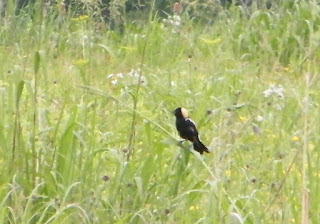
Male bobolink (RE Berg-Andersson)

The national Audubon Society believes there are nearly 400 bird species threatened by climate change and habitat devastation including 53 types of coastal birds, 69 types of Eastern forest birds and 39 types of grassland birds including the bobolink - a bird I once saw and heard in a field not far from the N.H. town where my in-laws moved. But that was many years ago. As people have migrated into areas once dominated by woods or grasslands, they have pushed out the birds that can't adapt or are forced to leave when humanity cuts down the forests, paves the dirt roads and generally warms the planet with car exhaust.

I don't know what we can do to hold back this tide, and that bothers me.