Cape May

Cape May
(RE BERG-ANDERSSON)
Showing posts with label forests. Show all posts

Monday, December 20, 2021

...And Through the Woods

When I met my husband (MH), his family was living in a town in Morris County, New Jersey. Over the years, the family has slowly migrated to central New Hampshire. 

First was MH's immediately younger brother, who had met a New Hampshire girl and eventually settled up there with her after college. Then MH's youngest brother migrated up there with his then-wife to look for a job. He also stayed and remarried after the first marriage ended. Once the grandchildren started coming, my in-laws moved to New Hampshire, too, leaving MH and me the only members of the family still in New Jersey, from which we had migrated from the city to a town not far from where his parents had lived..

Thus we've gone to New Hampshire for Thanksgiving for years as the children have grown and had children of their own. Coming from a suburb of New York City to a rural area gives me a chance to get away from work and observe a different area. I've seen the changes in this part of the state over several decades as other people have migrated up there to live either part time or full time. And, of course, I've watched the birds for ones I can't find at home.

A black-capped chickadee (Margo D. Beller)

MH's brother knows I am a serious birder and, considering he works at teaching people to look at, enjoy and protect nature, he always likes to test my knowledge.

So this year he asked me to guess which birds were currently coming to his yard, including his one seed and two suet feeders. One of them, the red-breasted nuthatch, is a rare visitor to my yard because I don't have the pine trees this bird prefers. I also don't get bluebirds (he has nest boxes for them). Aside from that, his visitors are what I typically get in suburban New Jersey: cardinal, chickadees, titmice, white-breasted nuthatch, song sparrows, juncos, downy and hairy woodpeckers, mourning dove, jays, robins.

But more recently he has also been visited by a Carolina wren, and after we left he told us a redbellied woodpecker came to the suet and he saw a redtailed hawk looking down from one of the trees on his property.

These were not visitors to this part of the state even 10 years ago, I believe, but, like the year-round human population here, that has been slowly changing.
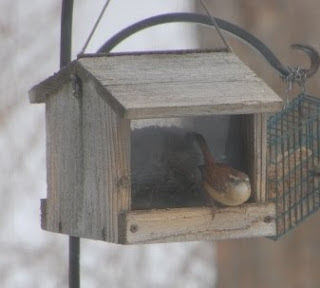
Carolina wren, common to my feeder
but now appearing to the
north. (Margo D. Beller)

I recently read an interesting book, by the biologist Thor Hanson, about the effects of climate change and how plants and animals react to it. The sections of the book cover the four possibilities: adjust, evolve, move or die. When it comes to the birds, as the planet warms many species have expanded their territories northward into previously inhospitable areas. (The increase in the number of people putting out feeders when winter comes doesn't hurt either.) The birds already in those areas are faced with increasing competition for limited resources. Those birds, in turn, have to move or change the way they live in order to survive.

The appearance of a redtail near his property interests me in particular. In all our visits I've never seen a redtail in his part of the state. The more urbanized part of New Hampshire to the south, yes, particularly near the interstates where the hawks sit in a tree or on a lamp post and wait for a meal to appear below so they can swoop down and grab it. In my brother-in-law's area the more usual are redshouldered and broadwinged hawks.These birds usually fly south for the winter. What happens when they return to find redtails in their midst? Or what if this area warms enough that these birds fly south later than usual, or not at all?
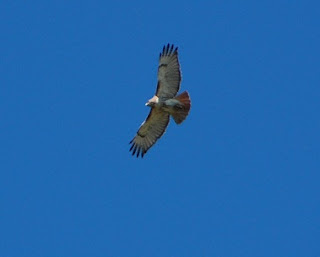
Redtailed hawk (Margo D. Beller)

There are now more people on my brother-in-law's road who have either built new houses or converted their summer houses to year-end living. These people tend to be older, with children or visiting grandchildren, and are driving more luxury vehicles and trucks. As they come to the area, the forest disappears. The climate changes in subtle ways. If they put out feeders, the birds come during the winter. So do the hawks that feed on them.

Many of the common birds I see in my yard were once exclusively from south of my area: cardinal, mockingbird, Carolina wren, redbellied woodpecker. Now they are common in New Jersey. We don't think anything of it. But, as Hanson points out, climate change has slowly been prompting the flowers to bloom earlier than usual and bring out the insects, affecting what the migrating birds find when they are passing through during their long journeys from winter to breeding territories. Meanwhile, the yard birds benefit so why should they leave?
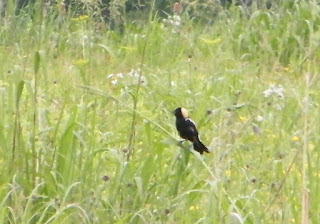
Male bobolink (RE Berg-Andersson)

The national Audubon Society believes there are nearly 400 bird species threatened by climate change and habitat devastation including 53 types of coastal birds, 69 types of Eastern forest birds and 39 types of grassland birds including the bobolink - a bird I once saw and heard in a field not far from the N.H. town where my in-laws moved. But that was many years ago. As people have migrated into areas once dominated by woods or grasslands, they have pushed out the birds that can't adapt or are forced to leave when humanity cuts down the forests, paves the dirt roads and generally warms the planet with car exhaust.

I don't know what we can do to hold back this tide, and that bothers me.

Monday, December 31, 2018

When the Cure Is Worse Than the Disease


Same overflow pond a year apart. In the top picture, from 2018, the pond is
not frozen but some of the trees near it were cut down. (Margo D. Beller)


I am lucky that not far from my home there are a number of parks of varying size. One of them is a linear park that was once a short-line railroad that failed. At one point there were plans to extend a major road through these woods but that failed, too. The resulting park is called Patriots Path because it was first formed in Morris County (the path has since been greatly expanded into several counties), once known as the "Birthplace of the Revolution" because of its proximity to Jockey Hollow, where Washington's troops encamped for two winters years before the better-known encampment at Valley Forge in Pennsylvania.

The path is under the jurisdiction of the county, so it is county workers who do the maintenance. Thus, I am going to blame the county for the seemingly haphazard destruction of trees along parts of this path because of a small menace called the emerald ash borer.

The borer is an insect that, like the Asian long-horned beetle, is invasive and likely came over in wood pallets or other wood products shipped here from abroad. The borer's destruction of ash trees has been well known for months but it was only in the last few weeks signs have gone up along the trail warning of work to be done in the coming days to keep any damage from spreading through the entire forest.


Warning signs (Margo D. Beller)
When that work was finally done and the men, saws and heavy machinery I'd seen were gone, I brought MH to one part of the path for a short walk along the flat, paved trail. What I saw was horrific.

2017 - overflow-created pond, frozen tight.
(Margo D. Beller)
Trees were cut down and the stumps left in the ground. The cut trees were tossed aside or dragged away from the path and left in piles. Why would the county cut down trees it feared would be invested with borers and then leave them there? Did someone think the winter cold would finish off the insects? Maybe it will, but the ugliness of leaving them on the ground to become months of eating pleasure for a plethora of bacteria and insects makes me very angry.

I can understand taking down trees to save a forest. What I can't understand is leaving the area ugly so it is devalued and thus more easily ignored by people who don't care or want to understand why forests are as important to have as ballfields, dog parks or a shopping mall.

A year before, when the wind chill was in the single digits, MH and I had walked this same part of the path and we marveled at how the overflow from earlier rains and the nearby Whippany River had created huge frozen ponds. This year has been particularly rainy so the ponds that formed were deep but definitely not frozen.

Either way, it seems no one cares about these woods, all they care about is killing trees that maybe - maybe - were invested with borers. These county people are no better than my neighbors who take down a 50-year-old, inconvenient tree because they fear it maybe - maybe - will fall on their house.


Two different views of the destruction, Dec. 31, 2018
(Margo D. Beller)
There is such a thing as forest management. I've seen it at work. You take down trees to open up the understory to other types of trees. Thoreau wrote about it when he noticed that in a forest of white pines, any open ground was soon filled with oak seedlings.

Patriots Path, like many other parks, is a bit of woods in a suburban environment. When not chopped down for a housing development it is affected by the pollution from cars, lawn chemicals and even fireplace wood smoke. Too many times I have seen woods along state roads covered with choking vines, usually poison ivy but also mile-a-minute and Virginia creeper. At some point the vines will shut out all light to the trees and they will die. The state sends out mowers to cut the roadside grass but no one notices, much less cares for, the trees. The system seems to be based on benign neglect.

To those areas that proclaim, "See? We have woods here that are protected!" I say, well, I guess that's better than wiping them out and putting in a road or ballfields. But if you don't take care of the land and remove the sick or fallen trees or the vines and other invasives, people are going to ignore the woods as just so much wallpaper. Too many times I have seen people using these natural resources as backdrops to walk the dog, make a phone call or talk to their friends. Maybe it relaxes them but to me they are not walking in the woods to get away from the pressures of modern life or even to look for birds and wildlife. It's just a prettier background than walking Fido on your neighbor's lawn.

Dec. 31, 2018 (Margo D. Beller)
Winter is an ugly enough season in New Jersey when the leaves are down and everything is gray. Today with MH, walking on Patriots Path the only birds I heard were the woodpeckers high in the remaining trees. Many of the shrubs that lined the path were either ripped up by the county tree cutters or flattened by their machinery, so the white-throated sparrows that hid in these shrubs are gone.

I am hoping for a heavy snow to cover this mess, and that someone does something to remove the dead trees in spring and make this park meaningful to those who walk the path when the tree leaves sprout and the wildflowers are in bloom.

Friday, April 14, 2017

Scorched Earth, Rebirth

Scherman Hoffman, 4/12/2017 (RE Berg-Andersson)
I write during the Easter period. Easter is the time of spiritual renewal and rebirth. It coincides, most years, with the full arrival of spring.

April finally feels like April here in NJ after a February that felt like May and a March that felt like January. The early-blooming daffodils are finally at peak beauty after starting to grow too early and then stopping when it turned cold.

The furnace is off and I keep the window open a bit at night, so in the morning I hear the white-throated sparrows calling for "old Sam Peabody, Peabody, Peabody;" the titmice calling for "Peter, Peter;" and the chickadees greeting me with "hey, Sweetie." The downy woodpeckers are drumming against a nearby tree, proclaiming this is their breeding territory now. The male goldfinches are in their more-familiar bright yellow breeding color. The male juncos that winter in NJ have taken off north to claim their breeding patches, waiting for their potential mates to join them. 
(RE Berg-Andersson)

Birds are at the feeders, getting the fuel they need to sing, defend territories and live to sing another day.

These are the expected signs of spring. But there is another, less familiar sign - the controlled, or prescribed, burn.

Earlier this month I attended a nature program with, among others, Mike Anderson, the director of NJ Audubon's Scherman Hoffman sanctuary in Bernardsville. Someone asked him about his "burn" and he replied that he had the permit but it gives only a short time to do the burning and time was running out. If it couldn't be done soon, before his planned Easter week vacation, it would have to be put off another year.

As the pictures here, taken at Scherman Hoffman this week, show, he got his burn. Conditions have to be right. It can't be too windy and hot, the ground can't be too wet or dry. That was why the burn had to be delayed until nearly the last minute.

Scherman Hoffman is not alone. The managed area of the federal Great Swamp National Wildlife Refuge was burned on April 13 but, according to one volunteer, the burn turned out to be less extensive than planned.

It may seem like a contradiction to use a scorched earth policy - we have to torch this forest to save it - to promote growth in a sanctuary or refuge area, but fire is a natural part of the eco-system. Some seeds, such as those of the pitch pine, won't open unless burned. Burning dead wood allows sun to break in and new trees to sprout and grow. In the case of Scherman Hoffman, Mike Anderson said the idea is to burn the ground and when the inevitable invasive plants - the barberry, the knotweed and the like - take advantage to grow ahead of the native plants, go in and pull them out so the natives can thrive. 
(R.E. Berg-Andersson)

In the case of the Great Swamp, the idea was to get rid of the overgrowth around the various impoundments and make it attractive to migrating waterfowl. According to the press release put out by Morris County, where this part of the federally run Swamp is located:

The U.S. Fish and Wildlife Service regularly conducts prescribed burns on refuge lands to maintain and restore habitat for wildlife. The goal of these prescribed burns is to increase the amount of open water available to waterfowl by reducing the amount of standing dead vegetation and invading woody vegetation in three of the impoundments.

Once restored, these impoundments will provide better feeding, nesting, brood rearing, and resting habitat for all waterbird species that use the refuge. In addition to improved habitat, visitors to the refuge also benefit from prescribed burns because fire promotes native species and habitats, thus increasing wildlife observation opportunities.''

Other parks use controlled burns to improve the overall health of the forest. As the Daniel Boone National Forest in Kentucky explains:
Due to our successful prevention and suppression efforts, fire patterns were markedly altered during the past century. In the absence of fire, massive insect and disease epidemics and various other forest health problems have proliferated.
(RE Berg-Andersson)
That's why:
The historic suppression of fire has resulted in a lack of periodic, natural fire in our forest. The absence of these low intensity fires has increased the risk of large fire events and has negatively impacted the health of our forests.
Why were burns suppressed? Because if done improperly, when the conditions are too dry and/or too windy, they can go horribly wrong. And in NJ, one of the most population-dense states in the US, if not THE most population dense because of its small size and proximity to New York City and Philadelphia - a barrel tapped at both ends, as Benjamin Franklin once said - more and more housing developments are very close to parks and woods. 

And when you have continued heat and dry weather, you have a greater danger of fire. Many burns take place specifically to take out dead wood and invasives to try to forestall the risk of a more destructive forest fire.

In the case of the NJ Pinelands, where combustible pitch pines and sandy soil predominate, there have always been small towns within. Fires were expected. However, now there are these big, nearby housing developments - many of them nursing homes and "active adult" communities - which are threatened whenever there is a fire, even a planned one.

Consider what can go wrong. In 2015 the Colorado  State Forest Service set fire to an overgrown forest near the Lower North Fork of the Platte River, about 40 miles outside Denver.  But, according to OutsideOnline.com, apparently no one looked at the weather patterns and so warm temperatures and high winds fanned a fire that burned 1,400 acres, destroyed 23 homes and killed three people.
(RE Berg-Andersson)

Also, when you burn something, you have to make sure the fire is out completely. As MH and I walked around Scherman Hoffman, a breeze blew charged, black, paper-thin particles around us. These particles were cold but sometimes embers start new fires if they are not completely extinguished.

“The only reason that anybody gives for doing [burns] is that it’s ‘natural,’” a homeowner who lost his home to that 2015 Colorado fire told OutsideOnline. com. “But it isn’t natural anymore. It’s where humans live.”  

And that, of course, is the problem. Too many people living in areas where they could get burned, literally, as part of nature's cycle of renewal and rebirth.

Fire, like death, is a fact of life.


Updated 5pm, Friday, April 14.