Cape May

Cape May
(RE BERG-ANDERSSON)
Showing posts with label global warming. Show all posts

Monday, January 19, 2026

Winter Wonderland (2026)

It's winter. It's cold, very cold. And we have snow, a lot of snow.

It's winter. I get it. It's supposed to be very cold and produce a lot of snow.

We have not had a real heavy snowfall in over 10 years, in 2014, when the squirrels learned to jump over baffles and tried to pry apart feeders to get at the seed because thick snow and ice blocked them from getting to the nuts they hid in the lawn.

We have had extreme cold since then, when the "polar vortex" breached its usual boundaries and moved south. (As usual I blame climate change.) But getting two storms of three inches each within three days (with more predicted in the coming weeks) is a throwback to an earlier time when heavy snow in my part of the country was more common.

So I went out to photograph this event today.

The first thing I saw from the back door was the snow, not just on the ground but sticking to the apple and other trees and the shrubs. The snow storm did not end until after dark yesterday and what fell stuck, creating this coating.


Thanks to the snow, the yew hedge was weighed down. I usually knock some snow off the hedge so the branches won't be in the way of the driveway plow but this time I didn't get to it before they came. There are birds that roost in this hedge, different ones depending on the season, which is why I have refused to cut it down. I know the deer will come and eat as much as they can reach until the snow melts and the hedge stands tall again.

I plan to buy or borrow a chainsaw to cut some branches at some point this year. For now, the birds have their shelter and my brush pile, to the right of this picture behind the branches, is inaccessible for pickup this month. I hope to put several months' worth of fallen limbs out at the end of February.


As you can see, my compost pile is also inaccessible. It is also frozen. So that means I will be filling old coffee containers with my compost, putting them on my enclosed porch until the pile defrosts.

These roof icicles are over the back plot. When they start melting in earnest the water will provide moisture for various plants. 


No matter how deep the snow, the birds must be fed. I drag the shovel behind me to smooth out something of a path, then carry out the feeders. I did not have feeders out while it was snowing and so far I've seen few birds coming for food. But I've no doubt they'll be back.


After seeing the snow on the trees and shrubs the next thing I saw were the tracks. These tracks are deer. (I've also seen squirrel, fox, weasel, birds and perhaps raccoon. Here in the expanding suburbs, the wild world isn't that far away.)

Once the snow stopped the deer started looking for food. With the grass covered that meant checking for dropped seeds from the feeders and probing the deer netting for weaknesses that will let them get at the plants. This is why I have burlap covering the fencing on my back plot and have double-netted my two front plots. It is also why I take in the feeders at night. I have seen deer come to the house feeder and tip it to spill out the seed. They also climb on the baffles to get to the feeders on the other feeder pole. (A hoof punched a hole in the old battle, now replaced by something far stronger.)


Spruce Bringsgreen always looks so dignified in his white winter coat. But after a few days of sun on him the snow will slide off his down-slopping branches and his natural blueish-green coloring will show.


The dogwood also looks dignified in her snow coat. I have noticed buds forming on her branches, which means flowers in the spring and then fruits later on for the birds. This is the tree on which I hang the house wren nest box. The tree is surviving having about half of it go dead and then be cut off.

One of the things I enjoy about the early mornings, besides the relative (for the suburbs) silence of the area, is watching the morning sun spread light on the trees as it rises. Eventually, it will be up high enough to warm me in my corner chair on the porch. On winter days like this, when it is cold and snowy and taking a bird walk is more difficult, I need the sunlight in my face to raise my mood and help me get through this crazy world of today.

Wednesday, August 20, 2025

Down the Shore on a Stakeout

When a bird is in an area where you don't expect it, it is considered an "accidental." If it hangs around an area long enough for birders to come from far and wide to see it, it is an "event."

But if it hangs around and only comes out into the open for very short periods during the day, and there are lots of people who still want to see it, that becomes a "stakeout."

Here is the difference between an event and a stakeout. Years ago I learned several northern lapwings, a bird usually found in Europe and Asia, showed up at a farm in New Egypt, New Jersey. These birds caused quite a stir. In their usual territory they like mudflats, open country and, notably, farm land. Based on what I read on the eBird lists, quite a lot of people came to the south Jersey farm to see these birds and had to be reminded to stay in the road and not to block the farm equipment.

Cormorant watching over the oyster reefs in Barnegat Bay
 (the lighthouse can be seen on the far right.)
(Margo D. Beller)

Also in New Egypt is a used bookstore my husband (MH) likes to visit, so it was not very hard to get him to agree to drive down there a few weeks after these birds had been reported. Amazingly, the three birds were still around and there were no people other than another couple and us. We saw, we noted, we left.

That was an event.

Meanwhile, in 2019 I was underemployed. I had a lot of time to go chasing after rarities, especially if they were close to home. So it was that a black-headed grosbeak, a western relative of the more common (to me) rose-breasted grosbeak, was coming to a feeder in the backyard of a house not far from Jockey Hollow in Morristown. The homeowners were nice enough to allow people to come to their driveway and watch for the bird at their feeder.

Sign explaining the Forked River Beach project (RE Berg-Andersson)

In hindsight, I should've brought a chair because this bird was nowhere to be seen, at first. A man who drove with his wife to NJ from Ohio, as I recall, was nice enough to let me sit in his chair. They'd been there for hours by the time I arrived. We were soon joined by others in chairs or standing behind tripods holding their long-lensed cameras, ready to "shoot" this rarity.

I was lucky. Besides the man letting me sit it was only 30 minutes in that I saw the bird, pointed it out and the cameras started clicking. The bird allowed me to see its handsome black head and orange breast (it was a male) and then I gave the man his chair, thanked him and left.

That was a stakeout.

This is a longwinded introduction to the second stakeout I've ever attended, this one with MH the other week down the New Jersey shore.

Green heron (RE Berg-Andersson)

I don't know if it was the weather pattern or global warming but recently there have been many roseate spoonbills found far from their usual breeding territory in the Florida Everglades and along the Gulf of Mexico. The bird, as the name implies, is pink and has a spoon-like bill to scoop up its meal. MH and I have seen one twice - a mature captive bird at Pittsburgh's National Aviary and a juvenile that in 2018 was found by the side of a rain-created pond at a quarry in northwestern New Jersey. More recently these birds have been found in Maine, Connecticut and Minnesota.

Three juveniles were found in Forked River Beach, NJ, earlier this month and that prompted a stakeout. Incredibly, MH was into the idea of traveling to a shore area in summer (on a weekday) to see these birds.

Semipalmated plover (RE Berg-Andersson)

It is a long drive from our town to Forked River Beach, especially taking the back roads MH prefers to drive rather than superhighways (me, too) and making pit stops. Once we got to the area we parked near a playground by Barnegat Bay. We could see the lighthouse across the water. In front of us were poles atop which were double-crested cormorants standing guard over oyster reefs.

If the insatiable desire for eating oysters at fashionable New York restaurants, as detailed by Mark Kurlansky in his book "The Big Oyster", didn't kill off the area's oysters, water pollution did. According to the New Jersey Department of Environmental Protection, oysters are a "keystone" species "meaning they are an integral part of a healthy marine ecosystem. Oyster reefs provide vital habitat for many of the commercial and recreational species that fishermen, boaters, and naturalists enjoy in New Jersey’s waters. Oyster reefs are home to a host of species including striped bass, blue crab, and summer flounder, among many others. Additionally, a single adult oyster can filter and clear significant volumes of water each day, helping to improve water quality by cycling excess nutrients."

At the same time the oysters were being depleted, coastlines were being eroded by the constant wave action intensified whenever a major storm or hurricane occurred. And we've had some major hurricanes affecting the shoreline in recent years. Beaches are big business in New Jersey. The Forked River Beach beds were an effort to help the shoreline in this area.

Great egret, as seen from behind the stakeout. The
roseate spoonbills would later be seen in this
area. (RE Berg-Andersson)

There was a paved path to walk past beach houses large and small with lovely gardens. There were benches, monarch butterflies at the flowers and even some birds but no spoonbills and, tellingly, no people looking for them. We were in the wrong place.

Luckily, someone had put a map on Facebook and by comparing that map to our map we found our way to another part of Forked River Beach. This time we found the stakeout. This time we had our chairs and sat a while. MH took pictures as I scanned the mudflats with my binoculars.

There were green herons. There were semipalmated sandpipers and semipalmated plovers. There were Forster's terns and a great egret. There were laughing gulls and herring gulls and very nice people who pointed out birds as they found them.

Sometimes it is a good thing to have a spotting scope, but I don't have one.
As best as I can tell the birds in this picture include semipalmated sandpiper (the 
small one), Forster's tern (the smaller blackheaded one), laughing gull (the larger
blackheaded one) and immature herring gull (the dark one in the back). I
can't identify the others. I've always been weak on shorebird IDs.
(RE Berg-Andersson)

What there weren't were roseate spoonbills.

That these birds were here at all was an amazing thing. This wetland along the bay was across the street from a massive development of expensive houses, many of which faced or were within walking distance of the water. (Hurricane Sandy's devastation of the Jersey shore in 2012 has not stopped housing development. If anything, it has gotten worse.) The main streets were named for Florida areas. Cross streets were named for birds. (As it happened, the closest cross street to the stakeout was Spoonbill Court.) Thankfully, this wetland had been left alone. 

We did not stay more than a half-hour. Seeing these birds would've been nice but they weren't my main reason for us to come here. It was very pleasant to get out of the house, sit by water on a sunny summer day, get a breeze in my face and look for birds. We left to explore areas nearby and eventually started the long trip back. As I later learned, the spoonbills briefly showed themselves about 30 minutes afterwards. The air must've been loud with camera clicks.

As of Aug. 15, they are still around, according to a Facebook post from the area.

Global warming has pushed many birds north. There was a time someone from New Jersey would be lucky to find a Carolina wren, a redbellied woodpecker or a northern cardinal. Now they are common. White ibis, another Everglades bird, has been coming to Ocean City, NJ, for years to breed and now white ibis are being seen in other northeastern areas. Mississippi kites have bred in New Hampshire for years.

There was a time you'd never see a Carolina wren in the north, especially
in winter. But that has changed. (Margo D. Beller)

I expect the ibises and the spoonbills to head south when winter comes. But what if winters remain so warm there is no cold and no snow to prompt them to leave? I would say there would be no migration but there would be a lot of competition for limited resources between birds that should've migrated south and those that remain all year or are only found in winter.

For the moment, the New Jersey spoonbills are an accidental that created an event that became a stakeout. But they could be a harbinger of things to come. 

Saturday, July 26, 2025

Midsummer Flowering Weeds

On a recent less-humid morning I took a long walk around what I call Greystone and the maps now call the Central Park of Morris County. I was walking on the cross-country running track created in the back fields of what was once a psychiatric hospital. I was looking and listening for birds, as usual, and managed to find a few.

But after a while I started looking at the plants. In the area where saplings had been planted a few years ago there are now small trees - tulip poplar, sweetgum, sumac, among others - as well as fields of weeds I once thought were ragweed but I now know have the lovely name of common mugwort, which sounds like something out of Harry Potter. I like the mugwort because last year a drainage ditch filled with the stuff offered protection to at least four types of migrating sparrows, goldfinches and at least two types of warblers.

Back in September of 2019 I wrote about walking among the autumn weeds. It is now July of 2025 and the same weeds are already out thanks to a combination of warmer than usual temperatures and more than usual amounts of rain. Maybe they were always out in July, or maybe it's another sign of global warming.

So while I hate the weeds in my backyard with a passion, I enjoy the park weeds' flowers, fruits and seeds because they help pollenators and birds, migrating and those that hang around all year.

Here are some of my photos.

This is a wild grape vine. The fruits are now white but they will turn blue. They are enjoyed by sparrows, robins and other fruit-eating birds. The vine will engulf anything nearby. 

There is goldenrod that blooms in the middle of summer, and goldenrod that blooms near the end of summer. I grow the midsummer type. I presume this is the same type. 

This is called teasel. It is about four feet tall and has spiky, blue flowers that are favored by bees. Every time I see these I consider taking off a seed head or two for my garden. Maybe I will do it this year.

This poison ivy was growing along the walls of what used to be the hospital dance hall. Unless cut down the ivy will completely cover the building. Obviously the Parks Dept. doesn't want to touch it.

Trees can be weeds, too. This is tree of heaven, growing along the same building as the poison ivy. Unless you get it when small it will put its long taproot into the ground and be very difficult to remove, as I learned when I tried to dig out one from my in-laws' front yard years ago. 

A field of mugwort provides hiding spaces for birds, deer and rabbits, as I saw during my walk.

I once had one of these inkweed plants growing in my yard but I quickly dug it up before the taproot went too deep. In this picture the berries are not ripe yet. When they are they'll be deep purple. Catbirds love these berries, as do robins and cardinals, among others. 

In front are the white wild carrot (Queen Anne's lace) and the blue chicory, whose roots can be made into a type of coffee. They are surrounded by mugwort and other weeds. Some of the growing saplings are behind them.

Milkweed is very important to the survival of monarch butterflies. The caterpillars feed on the plant and bees pollenate the pink flowers. As I have learned in my yard, they spread by an underground root system. In a field they look lovely. In my backyard they have popped up in the wrong place and do not flower. Except for one that popped up in the ornamental grass garden, the rest are mowed down. But then more pop up.

Ah, bee balm! This is another plant that will get everywhere because of its spreading roots. I grew it once but years of digging and weeding in that particular area eventually killed all of it. Now I look at large fields of bee balm and wish I still grew some in a bigger, preferably fenced, backyard.

This weed with its yellow and orange flowers is known as the common toadflax, but I prefer its colloquial name of butter-and-eggs. It looks like a wild snapdragon.

More than a few times I have carefully picked the wild raspberries along the path while I've hiked. As you can see here, other people as well as birds also help themselves. The stem is full of large, very sharp thorns. I have found seedlings all over my backyard. If they are behind the floodwall I leave them but if they are in the garden plots or the lawn, they have to go.

Unfortunately, the jewelweed was not flowering at the time. Hummingbirds really like this late summer weed's orange or yellow trumpet flowers, especially when the birds need fuel to help them migrate south.

As I discovered last year, the county Parks Department mows down the fields of mugwort and the other weeds, including the ones I photographed, in October. But like all seeding, fruiting and spreading weeds, they'll be back next year. Of that I've no doubt.

Wednesday, July 2, 2025

Saving the Apple Tree

I hope she forgives me.

The apple tree and I go way back to when we moved into this house. I've been here over 30 years and I estimate that, based on the size of the tree, it was planted about decade before. So it is an old tree.

The apple tree now. You can see where
the cut was made on the right. (Margo D. Beller)

A few days ago the boss of the lawn service I use came over with his chainsaw and cut off the rotting branch of the apple tree. He also, on his own, took off two smaller dead branches, saving me climbing up my ladder with my handsaw.

The result does not look so bad ... from afar. Once I paid the man and he left, I went out to look at the cut. I was horrified to see a large hole, and carpenter ants coming to investigate - or scurrying around after being disturbed. If carpenter ants were in the tree it wouldn't have much of a chance. If the ants didn't dig it out from within a hungry pileated woodpecker would start excavating from the outside to get at the ants. Either way, the tree would soon die.

I immediately drove to the local big-box store and bought limb sealant to cover the wound. 

Once I cleared the sawdust I sprayed the cut and into the hole.
(Margo D. Beller)

When half the dogwood died a few years ago, I had it cut back. The cut was clean, there was no rot in the center of the wood. But I wrapped the bottom of the trunk where pieces were starting to fall off. I must've done the right thing because the tree has survived, leafed out and even blossomed. I have gotten used to the way it looks when I am sitting on the porch. It is only when you go out and look at what was cut that you can get an idea of how much more there used to be.

The apple tree situation is different in several ways. For one, there was that big hole. So I sprayed into that hole to protect what I could reach. 

Another difference - I had the dogwood planted in 2007 at the same time as Spruce Bringsgreen, the blue spruce. So both trees are teenagers compared with the apple tree. 

The apple has survived my cutting down three overgrown, deer-attracting apple trees on the property, and one small apple tree that was killed by too many young bucks rubbing the velvet off their antlers. This remaining apple tree has survived sapsucker drill holes, a gall at the bottom and a hole in the trunk big enough for a chipmunk to hide in. It has produced apples every year, especially after it has been pruned. It has abided the squirrels and the house wren nest box that hung there for 10 years until it was moved to the dogwood. It has forgiven me for walking around with my long pole to whack the branches and bring down enough apples to use.

But I'm not sure it will forgive me this time.

The apple tree in 2023. 
(Margo D. Beller)

Last year, thanks to climate change, we had a severe drought starting in the summer and lasting into spring of this year, at which point we were inundated with an overabundance of rain. The apple blossoms appeared as usual, and then suddenly one-third of the tree went black. The squirrels and I had apples but they tended to be smaller. The apples were done by June 30 and the rotting branch was cut off that day. I should not have been surprised by that hole in the tree, but I was.

"I felt her pain, even though I do not have the problems an apple tree can have," Spruce told me after it was done. "But it was hard to watch."

The apple tree has been stoic. Her leaves are still green and, even with one-third of her gone, she doesn't look misshapen. But she isn't talking to me at the moment.

I hope she lives.

Sunday, June 29, 2025

Many Directions At Once

 ...[S]tarting a sentence in the middle, and then going to the beginning and the end of it at the same time... both directions at once.

--Liner note from the John Coltrane "lost" album "Both Directions At Once," recorded in 1963 but not released until 2018.

It is a warmish but quiet morning on the enclosed back porch, and I am catching up with the world after last week's heatwave kept me inside with the air conditioning for nearly a week, except for brief forays in the oppressive air to pick up apples dropped by the thirsty squirrels. I would hear birds but had no inclination to go looking for them until the day the heatwave ended, when it was wonderfully cool in the early morning and I could take a long walk.

Wren nest in what is now the diseased area
of the apple tree, back in 2020.
(Margo D. Beller)

This morning, however, I am sitting. In one direction I can see the house wren nest box. During the heatwave the male had been singing almost continually, and I wondered what had happened to its mate. I could not sit on the porch in the heat to watch for activity. 

Unlike the first wren brood, when it was unusually wet and cool during incubation, it must've been extremely hot in that little wooden box for this female. If there were eggs in there they wouldn't need her all the time to keep them warm. But when it turned cooler I did see her leaving the box to get food, then fly back inside for long periods of time.

As I watched today she flew out and soon returned holding a bright green insect, maybe a katydid. She took it inside. So I'm sure the eggs have hatched and she is now feeding small young that will grow bigger. 

What the hummingbird saw, which may be why it didn't stay.
(Margo D. Beller)

That's one direction I can look. If I turn around in my chair I can see the hummingbird feeder. When it turned cool I had put fresh sugar water in and hoped something would be interested.

A couple of days ago, as I was at the back door before going out to collect dropped apples, a hummingbird did suddenly appear. It briefly investigated the pink coral bell flowers, flew up to look at the red lid of the feeder but did not fly over the netting. Instead, it headed for the apple tree but a squirrel in a lower branch must've spooked it because it disappeared. I hope it returns.

Hummingbirds used to be a common occurrence in my yard, usually during July. Last year I saw no hummingbirds at the feeder but one could've come by. Same with the one I saw this week. Did it come by when I had taken the feeder inside? Did it come by when the liquid had spoiled? Was it put off by the netting that protects the plants in the shade? No clue.

Years ago a yellow-bellied sapsucker drilled these holes in
the apple tree. I didn't think they had anything to do with
the current rot. Now I'm not sure. (Margo D. Beller)

So now I'm watching for hummingbirds when I'm on the porch. That is good, because the apple tree is done putting out fruit and I will soon have to do something about its diseased limb.

There was a time, early in our occupancy of this house, when apple season was during July. Little by little apple season has been earlier and earlier. This year the tree started dropping small apples at the end of May, not long after flowering. Then one-third of the tree suddenly went black. As apples got bigger in the rest of the tree the squirrels started coming. I took my long pole out to knock down what apples I could reach. Despite one-third of the tree being dead I managed to get enough fruit for two pints of sauce and two apple cakes. 

The fruit I could not reach I left for the squirrels. Yesterday, June 28, I picked up the last little apples from the ground. Today, June 29, there were no squirrels in the tree and a chipmunk was rummaging around looking for what apple bits it could find. 

Chipmunk hunting apple pieces. (Margo D. Beller)

Apple season is over for this year and it isn't even July. If cutting off the diseased limb doesn't save the tree it could be the last apple season. We've lived in this house for over 30 years and the tree was there when we moved in. It was planted by a previous owner maybe a decade before that.

According to one website I found, the average lifespan of an apple tree is 25 to 50 years, depending on the type. Years ago I showed one of the apples to the manager of the farmstand I buy from and he thought it was a MacIntosh type, even though the tree blooms in the spring rather than fall. MacIntosh trees live 30-45 years.

Factors affecting its life include exposure to sunlight (check), competition with other trees (it stands alone) and moisture. Too little is bad and so is too much. Last year we were in a severe drought, which lasted until this spring, when we had too much rain. This is an old tree. As with the dogwood a few years ago, my hope is cutting away the dead stuff will allow the apple tree to live. But it may not.

Besides apples ripening sooner than before thanks to increasing global warming the insect population is surging earlier, too.

That's why another distraction from my chair is watching for fungal gnats on the porch. Last year the gnats started bothering me in August, at which point I brought my house plants inside and put the infested bird seed bag outside. This year they started in the spring, when it was cold and wet. Maybe they were seeking shelter and warmth because during the heatwave there were very few of them on the porch. (And I don't have house plants on the porch this year.) What I found inside during the heatwave I am sure I brought in after dealing with the apples. 

Instead of spraying the porch, as I did last year, I tried old-fashioned flypaper. 

Hanging from the ceiling. (Margo D. Beller)

I hung it on a wall near the screen door, because that is where I'd see a gnat early in the morning. But all I caught was a spider. I don't want to catch spiders. Spiders are useful insects with their webs. So I changed the location and have the sticky paper hanging from the ceiling. But unlike flies, attracted by the color yellow, gnats could care less. They seem to prefer the white walls of the porch, which is where I've continued to kill them. The one fly that got onto the porch got caught in a spider web. 

The flypaper is something else to look at when I'm not watching the wrens.  


Monday, June 16, 2025

Another Tree Problem

“Trees are poems that the earth writes upon the sky.”
 Khalil Gibran, "Sand and Foam"

At this time of year things have settled somewhat in the yard. Catbirds fly around looking for food to feed their young. I am serenaded by one singing from my hedge, where I'm sure there is a nest. Less than 24 hours after the wren young left the box, a male wren, possibly a different bird, started singing its territorial song. It was not the only one. On my street alone I've heard three others, one of them two yards over. The male hasn't drawn a mate yet but he is fierce in protecting the nest box.

The dead part of the tree against the living rest
of the apple tree. (Margo D. Beller)

The fledged wren young were noisily following their parents in and around shrubs at the periphery of my yard for a couple of days but lately I have not heard them.

The gnats continue in ones and twos rather than a bagful, and I am still not sure how they are getting inside the enclosed porch. Every day I play whack-a-gnat. There is no longer anything on the porch that would allow them to eat or breed. If they are coming in through small spaces around the windows, I may have to turn to chemical warfare again.

Currently, however, my main attention is on the apple tree.

We had a lot of rain this spring, and the tree was full of blossoms, which meant it would be full of apples. Then, suddenly, one third of the tree died. This is an old tree. It has a hole in its trunk big enough for a chipmunk to hide in. It has a ring of little holes from a yellow-bellied sapsucker that visited a few years ago. And yet, the tree continued to bloom and produce apples.

Dogwood blossoms in 2016. (Margo D. Beller)

When half the dogwood tree died in 2023, I asked the yard man I was using at the time to bring his chainsaw. He cut the dead parts into stackable pieces. I waited to see what would happen. The next spring the dogwood not only lived, it put out flowers.

Last year, the problem was the tree-like house plant that was getting too unwieldy to transport in and out of the house. I agonized over whether to kill the plant, but when it began growing from the bottom my decision was made and I chopped down the top. The two parts growing from the bottom are healthy (see below) and, I hope, won't grow too much.

These are a little bigger now. (Margo D. Beller)

Now it is the apple tree's turn. 

There are no lack of sites on the internet explaining what can happen to an apple tree. Here's what Tree Fluent has to say: "Environmental changes can significantly impact apple trees. Temperature fluctuations, excessive rainfall, or drought conditions can lead to stress."

Well, that sums up life in my area in a nutshell. This week alone we started 20 degrees colder than average and expect to jump to 20 degrees hotter than average by the weekend. A major fire in the New Jersey Pine Barrens in April was finally put out with help from a series of heavy rain storms. But last summer was so dry we had drought emergencies that didn't end until last month.

What else could've affected the apple tree?

Couch to Homestead lists a variety of causes including over- or under-watering, the wrong growing environment, a lack of nutrients, pests and diseases. The diseases have such charming names as apple scab and fire blight. There are also various parts of the tree that can be prone to rot, starting with the roots.

Apples growing on the living two-thirds of the tree.
(Margo D. Beller)

I did not plant this tree. It is the last of five apple trees standing, four of which I've taken down and one taken down by stags rubbing velvet from their antlers too many times. I left this one tree because its apples taste good as apple sauce. (Unfortunately, the squirrels and the deer also like them.) These apples usually have more bad than good parts, requiring a lot of cutting to use. In summer the apple leaves seem to be the first to yellow and fall. I thought this was a natural thing. Now I am not so sure.

My remedy for this problem is to rent a chainsaw, cut down the dead wood and hope that allows the tree to recover and grow next spring. It worked for the dogwood. It worked for the big plant.

I haven't gotten around to doing it yet because it has been too wet, yet again. If this remedy doesn't work the tree, like the diseased ash tree we had to cut down years ago, is history. 

Saturday, July 13, 2024

Heat, Humidity and House Wrens

When it is so hot and humid outside I must stay indoors with the air conditioner on for most of the day, I try to imagine what it is like for the house wrens in my yard.

This past week the western half of the United States has been baking under brutal heat, with wildfires sparked. Meanwhile, in my half of the United States, we just got through more than five days where the temperatures were in the 90s and the humidity made the air feel like 105 degrees F.

House wren (Public domain photo)

Weather like that is dangerous. Weather like that keeps people like me inside and extremely uncomfortable unless I have the air conditioner on.

In weather like that I can't even keep a water dish outside because when the sun hits it late in the day the water becomes undrinkable. I can only go out to walk in the very early morning when the air, while still humid, is 20 degrees cooler than what it is forecast to hit for the high. If it is raining in the early morning, as it has for a couple of mornings, I am stuck inside and start to feel caged and anxious, not the best company for my husband.

In weather like that I feel sorry for the First Responders and others who must be outside to do their jobs. I used to travel to work but I would leave in the early morning, sit on a (usually) air conditioned train and then walk into an air conditioned office. The heat would not become an issue until my walk home from the train. But I was younger then and didn't think twice about being in an inferno. Now, I do.

This most recent heat wave wasn't the first this summer. There was a heat wave in June. And there will be a new one starting July 14. And August is weeks away. You can blame El Nino, La Nina, climate change, global warming - whatever you want to call it, it's hot. The Earth won't cool anytime soon without drastic actions.

So I look at the house wrens with amazement and admiration.

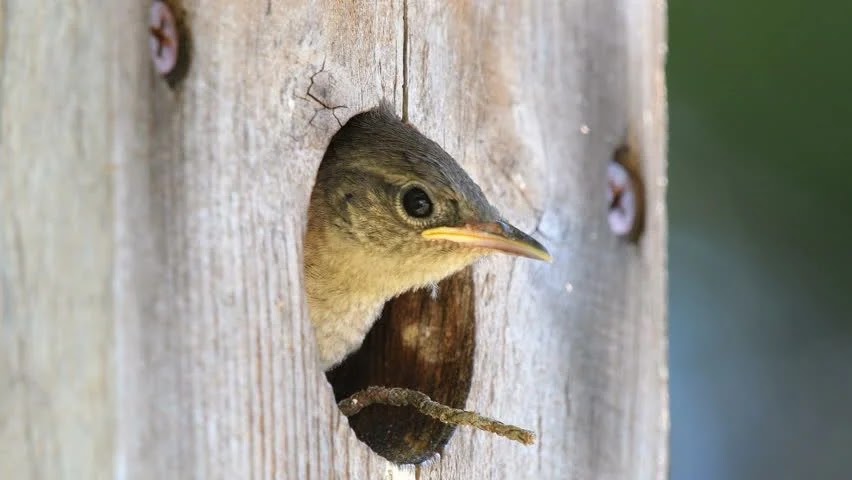
I could tell when Mother Wren was sitting on eggs because she would zip into the box and disappear for long periods of time. If it was especially hot, she would sit at the edge of the box and stick her head out of the opening. Then, she'd fly out to get herself a meal while her mate called from nearby, watching the nest.

She sat inside the box because that is what she has to do to protect her young. She keeps cool by panting, sitting by the box opening but also by flying into the shade to hunt for her food. Unlike people, she doesn't have any choice in the matter of how she spends her days. 

Two days ago I could tell the eggs had hatched because she started making more trips into and out of the box. Even Father Wren came to the opening and leaned in, feeding young. More recently he has gone in and out of the box, tho' not as quickly and surely as his mate. They are regurgitating food into the young birds' mouths and taking poop out to keep the nest clean.

Just as I saw with this year's first brood, soon the young will get big enough to move around the inside of the nest and will start jostling each other to get the food when the adults bring it.

Meanwhile, on the other side of my enclosed porch, I've seen only one hummingbird, a male, back in June. It came to the pink coral bell flowers, ignored the feeder I had out and flew off. I've seen none since. Usually I see females in July, when they are also seeking food for their young. Unlike the house wrens, male hummers don't hang around once mating is accomplished.

Where are the hummingbirds?

Toad, 2024 (Margo D. Beller)

So far this month I've seen nothing, and the pink flowers that had been blooming have faded and are mostly done thanks to an unusually hot summer that prompted many of my flowers to bloom at the same time instead of one after the other. The apple tree that provided me with enough fruit to make eight cups of sauce had its last apple plucked by a squirrel on July 5, about a week earlier than usual. Over the years the last apple day has been getting earlier and earlier as the weather has gotten hotter and hotter.

Luckily, the hot weather has also brought out another important source of food for young birds - insects, as well as insect eaters such as dragonflies. And toads.

Last week, a day after several weeks' worth of grass growth was finally cut, I went on the patio and pushed at the cover on my charcoal grill to tuck it in. Something jumped. It was an American toad, common in the east. It was dark and blended into the black cover's folds in the shade where I had put the grill. When I moved the grill it jumped out to the paving stones. 

I am guessing the combination of losing the long grass and the high heat and humidity forced it to find shelter where it could. It hung around for long enough to determine I wasn't going to bother it (I was watching from inside) and then it was gone.

This is not the first time we've had a toad visit our patio in July. 

(RE Berg-Anderson)

In fact, this American toad showed up on the fourth of July 10 years ago, tho not in the folds of the grill cover. It had somehow gotten into the bottom section of the composter I keep on the patio. When I moved the composter to sweep out leaves that had gotten behind it, out jumped the toad.

I can't imagine how this 2014 toad, bigger than the one I discovered last week, managed to get inside the composter. But out in the wild, I guess any port in a storm will do. I expect Mr. Slither to show up any day now, basking in the heat of the paving stones.

Sunday, June 11, 2023

Catching Up in the Garden

Last week, New York City had the dubious distinction of having the dirtiest air in the world because of the smoke blown on winds out of the north from wildfires that continue to rage throughout Canada. At its worst, the smoke made the sun look deep orange, kept the temperature to the mid-60s (F) and turned the sky brownish-yellow. The smell of burning wood was thick.

Stargazer lilies, supported by a tomato
cage, protected by deer fencing.
(Margo D. Beller)

Living as I do 35 miles or so due west of the Big Apple, I could not avoid this manifestation of the continuing harm of what is now called "climate change," but I still refer to as global warming. (I know there are differences between the two terms but the overall destructive effect is the same.) There has been very little rain anywhere in my area, and apparently the same is true of Canada.

This is not the first time smoke has filled the skies over my part of New Jersey. Usually the smoke comes from wildfires in the southern part of the state, such as in the Pine Barrens, during extremely dry periods during the summer. The smoke is blown north on hot winds from the south. This year will likely be no exception because with the lack of rain those fires continue, unfortunately.

But this thick yellow smoke from Canada was unprecedented. A persistent low off the eastern coast kept pulling the smoke into my region until the air was toxic to breathe for those of us in "vulnerable" groups, who were urged to stay inside with the windows closed. I was under house arrest, for the most part. If I absolutely had to go outside, I kept it short and wore a mask. 

Blooming viburnum (Margo D. Beller)

The world continued on without me, of course. People were urged to limit their pets' time outside but the wild animals - including birds - were still out there foraging for food, both for themselves and for their young. Somehow they managed, but I have to wonder about the effect of that poisonous air.

When the smoke finally cleared, literally, it was with relief I could go back outside. I walked around the yard and found some flowers had faded - the rhododendron, irises and the peony - while others were blooming (viburnum, salvia and stargazer lilies) or growing to the point where they would soon bloom (butterfly weed).

Meanwhile, what I thought were peppers growing from the seeds I'd planted a few months ago are not peppers. I'm not sure what they are. I've moved those pots to make more room for the pots of marigolds and zinnias that are definitely growing from seed. 

I don't know what this is but it isn't
a pepper. (Margo D. Beller)

The apple tree is filled with growing fruit that has been getting knocked to the ground, still too raw to be usable. I'm not sure if the squirrels are searching for ripe apples to slack their thirst of if the tree is dropping apples to save energy because of this drought. Maybe both. 

I also took note of the birds. One of my few trips outdoors was to make sure the water dish was full. It drew a pair of goldfinches, a song sparrow and a jay. (I'm sure there were others, including squirrels, but I didn't see them.) Every so often I would see the resident cardinals and catbirds hunting around the yard. Overhead I heard cedar waxwings and chimney swifts, hunting for seeds or insects. 

Apples in tree (Margo D. Beller)

And, of course, I was able to see what was happening with the house wrens. Based on their activity the eggs had hatched but the young were still small enough for either parent to go inside to feed them. When the young get bigger they will jostle for position and the parent will only be able to feed the one or ones that can push to the nest box opening. Right now the parents go in with food and come out, sometimes with chick poop, which must be removed to keep bacteria out of the nest. I estimate two or three young are in the nest.

As I watch the wrens following their instincts to feed their young so they will one day (soon?) fledge, feed themselves and continue the cycle, I have to wonder why it is that humans, the top of the food chain and the only creatures capable of creating weapons - and now weather conditions - to destroy themselves, are considered to be so damned superior.

This cropped picture was taken through my porch screen. if you look
carefully you will see the parent wren over the box. Less
obvious is the wren looking out from inside.
(Margo D. Beller)