Cape May

Cape May
(RE BERG-ANDERSSON)
Showing posts with label catbird. Show all posts

Sunday, March 1, 2026

Spruce Loses His Winter Coat

I was in the backyard the other morning, checking to make sure the woodpeckers had not finished all the suet in the feeder, when Spruce Bringsgreen called to me.

"Look, Margo, my winter coat is gone!"

Sure enough, Spruce, whose boughs were heavily laden with snow for what seemed like forever, now showed their usual blue-greenness. 

After our late January foot of snow, followed a period of intense cold, the slowly warming temperatures started working to melt the white stuff until I could not only see a good swath of the front and back lawns, I could carefully walk in the two inches or so of remaining snow to get to my compost pile and find just enough thawed area to dump several weeks of coffee grounds and other worm food.

Then, a month later, we had another foot of snow. This time, however, there was no deep freeze to follow but very warm (for February) temperatures.

Spruce in the winter coat he has finally shed.
(Margo D. Beller)

As Bernd Heinrich points out in his book "The Trees in My Forest," conifers including firs and spruces have boughs that point downward. When covered with snow the boughs are pushed against the trunk and the snow slides off ... eventually.

"I am so glad to be rid of that coat," Spruce said. "Yes," I replied, "I am getting tired of all the snow, too. It gets depressing after a while to always have to put on my boots to take out or take in feeders. The sun never gets to the area behind the enclosed back porch that I have to walk, and with all the recent melting by day and freezing by night it can get rather slippery."

"Didn't I see you putting down some gray stuff before?"

"Yes, that was some old cat litter. It helped after the first storm when there was ice, but when the melting started it became mud and left quite a mess on my boots. This time I am leaving that area alone and walking very carefully so I don't fall again."

"I will be glad to get rid of those juncos," he said. "They've been hiding out in my branches but they seem to be anxious to leave, and there are so many they are annoying some of the other birds I've hosted such as the red-breasted nuthatches and chickadees."

Over the past week there has been an increase in the number of birds singing territorial songs or drumming on trees to warn potential rivals away from a preferred nest site. A Carolina wren showed up in the yard for the first time in weeks. Canada geese have been getting restless to move now that lakes and rivers are nearly free of ice. Daffodils have started growing. So have the weeds.

"Don't worry," I said, "the juncos will be gone soon and they'll be replaced by catbirds like the one that screamed at me when I got too close last summer. There must've been a nest nearby, perhaps in you."

"Not me," he said, "tho' I don't mind catbirds or even the robins that build nests in my upper branches they don't always use. What I do mind is when a hawk that goes after your feeder birds hides in my branches."

He meant the accipiters, specifically the small sharp-shinned hawk. Accipiters are accomplished fliers. If they aren't strafing the ground looking to pick off a bird or squirrel they are diving into bushes or trees to catch a meal. The larger accipiter called the Cooper's hawk is another hazard to the feeder birds.

"Well, Spruce, considering the number of birds that are in decline because of climate change, pollution, the destruction of forests for more residential houses and agriculture, I can put up with the occasional hawk in the yard. I'll just make sure one doesn't set up housekeeping in your branches."

"That would be fine," he said. "Is the snow done for the year?"

"Gosh, I hope so," I said. "Maybe the occasional snow shower. But the forecasts I see are mainly for higher temperatures. Anything from the sky would be rain."

"That means when the snow is all gone you'll soon be cleaning up the winter mess in your garden, right?"

Alas, yes.

Monday, June 16, 2025

Another Tree Problem

“Trees are poems that the earth writes upon the sky.”
 Khalil Gibran, "Sand and Foam"

At this time of year things have settled somewhat in the yard. Catbirds fly around looking for food to feed their young. I am serenaded by one singing from my hedge, where I'm sure there is a nest. Less than 24 hours after the wren young left the box, a male wren, possibly a different bird, started singing its territorial song. It was not the only one. On my street alone I've heard three others, one of them two yards over. The male hasn't drawn a mate yet but he is fierce in protecting the nest box.

The dead part of the tree against the living rest
of the apple tree. (Margo D. Beller)

The fledged wren young were noisily following their parents in and around shrubs at the periphery of my yard for a couple of days but lately I have not heard them.

The gnats continue in ones and twos rather than a bagful, and I am still not sure how they are getting inside the enclosed porch. Every day I play whack-a-gnat. There is no longer anything on the porch that would allow them to eat or breed. If they are coming in through small spaces around the windows, I may have to turn to chemical warfare again.

Currently, however, my main attention is on the apple tree.

We had a lot of rain this spring, and the tree was full of blossoms, which meant it would be full of apples. Then, suddenly, one third of the tree died. This is an old tree. It has a hole in its trunk big enough for a chipmunk to hide in. It has a ring of little holes from a yellow-bellied sapsucker that visited a few years ago. And yet, the tree continued to bloom and produce apples.

Dogwood blossoms in 2016. (Margo D. Beller)

When half the dogwood tree died in 2023, I asked the yard man I was using at the time to bring his chainsaw. He cut the dead parts into stackable pieces. I waited to see what would happen. The next spring the dogwood not only lived, it put out flowers.

Last year, the problem was the tree-like house plant that was getting too unwieldy to transport in and out of the house. I agonized over whether to kill the plant, but when it began growing from the bottom my decision was made and I chopped down the top. The two parts growing from the bottom are healthy (see below) and, I hope, won't grow too much.

These are a little bigger now. (Margo D. Beller)

Now it is the apple tree's turn. 

There are no lack of sites on the internet explaining what can happen to an apple tree. Here's what Tree Fluent has to say: "Environmental changes can significantly impact apple trees. Temperature fluctuations, excessive rainfall, or drought conditions can lead to stress."

Well, that sums up life in my area in a nutshell. This week alone we started 20 degrees colder than average and expect to jump to 20 degrees hotter than average by the weekend. A major fire in the New Jersey Pine Barrens in April was finally put out with help from a series of heavy rain storms. But last summer was so dry we had drought emergencies that didn't end until last month.

What else could've affected the apple tree?

Couch to Homestead lists a variety of causes including over- or under-watering, the wrong growing environment, a lack of nutrients, pests and diseases. The diseases have such charming names as apple scab and fire blight. There are also various parts of the tree that can be prone to rot, starting with the roots.

Apples growing on the living two-thirds of the tree.
(Margo D. Beller)

I did not plant this tree. It is the last of five apple trees standing, four of which I've taken down and one taken down by stags rubbing velvet from their antlers too many times. I left this one tree because its apples taste good as apple sauce. (Unfortunately, the squirrels and the deer also like them.) These apples usually have more bad than good parts, requiring a lot of cutting to use. In summer the apple leaves seem to be the first to yellow and fall. I thought this was a natural thing. Now I am not so sure.

My remedy for this problem is to rent a chainsaw, cut down the dead wood and hope that allows the tree to recover and grow next spring. It worked for the dogwood. It worked for the big plant.

I haven't gotten around to doing it yet because it has been too wet, yet again. If this remedy doesn't work the tree, like the diseased ash tree we had to cut down years ago, is history. 

Sunday, December 22, 2019

Frozen but Surviving

December 2019 (Margo D. Beller)
I have never seen either "Frozen" movie but this week I got an inkling of what it is like to live in a frozen world.

In the past week we've had freezing rain that coated tree limbs, power lines, blades of grass and shrubs; followed two days later by an intense snow squall that threw about an inch of white on everything, including the roads; then came the intense cold. Only now, on this first full day of winter, is there any expectation of above-freezing warmth to melt the ice and allow my bowed-down yew hedge to rise and me to add matter to my compost pile.

In the meantime, as I watch the thermometer, the sun is shining prettily on the iced limbs of the trees and shrubs I can see from my porch.

Bowed boughs (Margo D. Beller)
It has been a hard week, particularly because I have started a new job and, for the first time in years, I must commute into New York. The sun rises later but I must rise earlier, and I must dress in layers to be ready for the harsh cold in my town and the (somewhat) warmer temperature when I arrive in the concrete jungle. Today, on the porch, I can see the sun is lower and its arc much shorter from when I could last spend time out here.

Feeders are out, but aside from some titmice and a cardinal in one of the bushes, there's been very little activity.  But I know that will change because when the feeders have come in at night this week they have been nearly empty.

In midtown Manhattan, it's another story. If I have the time to walk through some of the smaller parks near my office, it is easy to find what I call the "usual three" types of birds - house sparrows, pigeons and starlings. These birds will eat anything, including bread tossed by people. To survive they have adapted to life and people in the city.

Frozen feeder baffle (Margo D. Beller)
So, too, have white-throated sparrows, which I'm now finding so often in my city travels I may have to start referring to the "usual four." While these sparrows don't go for tossed bread, they manage to survive by scratching the soil for insects or gleaning what they can find (insects or fruit) from foliage. At night, they roost where they can - the other day I heard something as I walked along Madison Ave., and found a white-throat atop an office tower display of Christmas trees surrounded by concrete!

White-throats are winter visitors - they are common in my yard at this time of year - but catbirds are not. On the coldest day of this past week, when the wind chill in New York City was in the single digits, I found one catbird sitting at the base of a shrub in the sun. Catbirds have been gone from my yard for months (usually the white-throats replace the catbirds) and yet the previous week, before the frozen rain and cold, I had found a total of five catbirds in two Manhattan parks.

Sun on ice (Margo D. Beller)
I was astounded. They were not perturbed by my closeness at all. One, in fact, sat on a railing and looked at me. Then the cold came. Obviously, these birds either fly to another, more hospitable habitat, work harder to find food in this park or die. On this day at least one catbird has managed to survive. But it is a tough world out there and a small bird faces large odds, so who knows what happened to the catbirds and other birds I've seen over the last two weeks that should've been elsewhere (including a brown thrasher, swamp sparrow and ovenbird).

No doubt the annual Christmas Bird Count, where people comb the streets and parks all over the U.S., if not the world, to see what birds are around at this time of year, will find all sorts of birds in the urban parks. I know there is an annual count in New York's Central Park, that oasis of green that attracts dozens of types of birds during the spring and fall migration periods and likely many staying for the winter. But for me, finding a bird in a small patch of green in an area surrounded by traffic, noise and people is more than just a bit of wonder, it is a small miracle. Like that catbird basking in the cold sun.

I've been thinking of it a lot as I make my way along in this frozen, hard world.

Frozen world (Margo D. Beller)


Thursday, February 22, 2018

The Robin

“The robin flew from his swinging spray of ivy on to the top of the wall and he opened his beak and sang a loud, lovely trill, merely to show off. Nothing in the world is quite as adorably lovely as a robin when he shows off - and they are nearly always doing it.”
Frances Hodgson Burnett, The Secret Garden 

One afternoon last week, when the temperature was unusually mild for mid-February and allowed me to wear a light coat instead of a parka, I was walking down my street and heard the "chuckle" of a robin overhead. I looked up. First a couple flew over, heading southeast. Then another few, then more. I started counting. I stopped at 25. Altogether it must've been 100 or so flying in small groups from the edge of the Central Park of Morris County.

November 2017 (Margo D. Beller)
Robins are considered a harbinger of spring, even though there are robins that will remain in the snowy, colder north as long as there are fruiting shrubs or the ground has thawed enough for them to pick at worms and insects.

The American robin is a thrush, like the hermit thrush, wood thrush and bluebird. Its cousins are the catbird and the mockingbird. Despite having the same name it is different from the European robin, which is more of a songbird. (The English colonists likely saw one and were reminded of the robins back home.)
  
I continued my walk and turned eastward. As I approached a large white pine girdled with English ivy (not poison ivy) several robins flew in and started thrashing around in what I guess was a feeding frenzy. What could they be finding, I wondered. I took a right and started southward toward my home and more robins, likely from the same flock that had passed over me earlier, were now heading back north, stopping at every holly or cedar they could find. Unlike the pines and spruces, ivy, holly and cedar have softer leaves. So these robins were going after - what? Likely seeds, fruits or insects that came out in the milder weather. 

Why the large flock? Safety in numbers. Grackles form large flocks in winter before pairing off to mate in the spring. Sometimes the large flocks include starlings, redwinged blackbirds and cowbirds. I never know when the flocks will invade my yard but when they come down it is to look under the leaf litter for insects or probe the soft ground or mob the bird feeders. Sometimes there are robins following along. Like the grackles, the robin's bill is more suited to pecking into soft ground than cracking a sunflower seed. Unlike the grackles they stay out of the feeders, which is why I don't mind seeing large flocks of this particular bird.

Robin in fruiting red cedar tree (Margo D. Beller)
Lately I've been seeing robins on my front lawn and those of my neighbors, with some grackles and starlings. On the day before our most recent snowstorm I drove down the driveway and found at least a dozen pecking into the grass.

In his book, "What the Robin Knows," author Jon Young says the robin is a "sentry" that can tell us about the health of our environment -- if we choose to slow down, listen and observe. When a human is respectful, the robin doesn't fly away (even if it does watch warily). So when I see several dozen robins feeding while walking down a street named for our first U.S. president, I stay away a respectful distance and watch and then, when I must move, I move slowly and make no threatening movements.

You can learn a lot watching a robin. Watching these robins I learned which fruiting shrubs I should consider for my yard to draw robins and other birds. I learned that owners of even the most manicured suburban lawn can't kill off all the bugs or poison the grass since otherwise the robins wouldn't be feeding. I've also learned that when you see a large flock of robins eating like there's no tomorrow, they might know more than you do about changing weather. Luckily for the robins there are shrubs where the fruits aren't palatable until after a few frosts.

The most important thing I've learned from the robin is that no matter how bad winter can be, spring is always around the corner.

Long Island, NY, November 2017 (Margo D. Beller)


Friday, May 5, 2017

5 Ways of Looking at a Catbird

The river is moving. The blackbird must be flying.   

Every spring day brings a new surprise. One day the perennial salvia looks dead from too much cold and rain, the next it's showing this year's leaves. Soon it will grow and have big spikes of purple flowers the bees love.

Birds have a way of surprising, too. Suddenly, there is a lot of birdsong in the mornings. There is still one white-throated sparrow from the winter in my yard, the nest box I thought would have a pair of house wrens as usual has been taken by a pair of chickadees (I can tell because the nest materials I see poking out at the seams are soft arborvitae leaves and animal fir, not the twigs used by house wrens) and such migrants as rose-breasted grosbeaks and black and white warblers have passed through the yard where I can see them.

But to me, it isn't spring until the catbird shows up.  One day you are wondering why you haven't seen or heard any yet this year, the next they are everywhere in the yard, in your neighbor's yard, in the local park. Come one, come all.

Catbird-2012 (Margo D. Beller)

Here are five ways of looking at a catbird, with apologies to Wallace Stevens.

    1. What is that black bird?

Actually, it is gray and its full name is the Gray Catbird. It has, as you can see above, a black eye, black atop its head and at the end of its tail. What you can't see is the distinctive red under the tail. This bird, Dumetella carolinensis, is a cousin to the robin but is not a thrush. Cornell's ornithology lab calls the catbird "secretive but energetic" and every morning I can depend on it to be singing in the dawn chorus with the house wren, chipping sparrow, cardinal and occasionally that remaining white-throated sparrow.

2. Why that name?

Catbirds have a mewing call that can sound like a cat. Its warbling song is actually an amalgam of other bird songs, similar to the mimicry of the mockingbird - another cousin - although the songs used are rarely that clear, at least to me. To me the catbird sounds like it is chattering with no set pattern, unlike the mockingbird.

3. Why would someone be in the catbird's seat?

The "catbird seat," according to Merriam-Webster, is a position of great prominence or advantage. It is a southern expression, one famously used by the sports announcer Red Barber while he was calling games for, among others, the Brooklyn Dodgers baseball team. In James Thurber's 1942 story "The Catbird Seat" he notes one of the characters uses that phrase a lot, probably from listening to Red Barber.

In my experience you are just as likely to find a catbird calling from within a bush or poking for food on the ground as you are to see one in a tree, rarely as high up as the mockingbird that doesn't care a bit if you hear its complicated mimicry and can see where it is.

However, it is true that many are the times I've been weeding the back garden or digging a hole to put in a plant or moving things around in the compost pile and found a catbird sitting over my head, waiting for me to walk away so it can swoop down and see what worms or other food I've inadvertently provided it.

4. Cold-blooded killer

Birds gotta eat, be they hawks swooping down to snatch a mourning dove picking at dropped seed under my feeder or a robin tugging at a worm struggling to stay in the ground after MH has cut the lawn.

When I think of catbirds I remember the time when a sphinx moth graced my property. I did not realize it was a moth at first because it was large, dark and hovered like a hummingbird as it fed from flowers with a long, thin, hummer-like bill.

It was flying among my flowering plants one day when out jumped a catbird to snatch a meal. I was amazed and upset. Who knew catbirds (or any bird for that matter) ate hummingbirds? 

However, I had wondered about that "hummer's" coloring. The only hummingbird we usually get in my area is the rubythroat, and this didn't have the right coloring, being more brownish than greenish. That was when I looked in MH's various insect books and learned about the sphinx moth. Still, I was sad to see it go and have held it against the catbird ever since.

5. Now you see it, now you don't.

One year I was watering shrubs at the side of the house and suddenly a catbird flew out to a nearby tree. Something made me look behind and there was a nest with two or three eggs in it. I left it alone. The next time I watered I shut off the hose and looked first and there she was, on her eggs. Not long after, all were gone.

Same with the end of the summer. One moment the catbirds have descended en masse in your yard, the next they have disappeared. It seems that when the summer is over, nearly all are out of here, heading to their wintering grounds in the U.S. south, Cuba and central America.

But I know they'll be back next spring. 

Thursday, June 19, 2014

Summer Visitors

Summer is a time of heat, humidity and, if you have the time and money for it, travel. Unless you are a bird. If you are a migrating bird, you don't plan -- you just go north from April to early June to your specific breeding area to create the next generation. It is an automatic response keyed to the seasons.

Many birds breed in New Jersey. Along Old Mine Rd., the last exit off Route 80 west before you cross the Delaware River into Pennsylvania, you will find a vast tract of state and federal forest providing breeding space for many birds, including the cerulean warbler
House wren box (Margo D. Beller)
According to the Conserve Wildlife Federation of New Jersey, this sky-blue bird's status is of "special concernbecause "of some evidence of decline, inherent vulnerability to environmental deterioration, or habitat modification that would result in their becoming a Threatened species." This bird breeds in forests with tall deciduous trees and wet bottomlands and dry slopes.

Just the kind of land "developers" like to build McMansions and other homes.

But today I am not writing about warblers and the other birds that visit my backyard briefly and move on. I am writing about three birds in particular that visit for the summer before heading south in Autumn.

House wren (Margo D. Beller)
Unlike other years, I've kept my house feeder going this summer with only a minimum amount of seed. It has drawn cardinals, white-breasted nuthatches and titmice as well as birds I'm not crazy about but tolerate.

I also put up a bird house every year designed for a house wren, and every year a male house wren investigates it, brings by a female and, if she approves, they set up housekeeping and brood young.

This year was a little different. After a winter of seemingly endless snow and torrential rains, migration was delayed. It seemed to take forever for the birds to show up, and then many that would've come over weeks came all at once -- which made for some exciting birdwatching.

I put up the box in mid-April, as usual, but this time it did not draw house wrens, it drew one of the few birds small enough to get through the opening - a blackcapped chickadee. 'Dees are among my favorite birds so I wasn't that upset about this development.

However, although a pair had been busy in and out of the box, at one point I came home and saw a long plume of nesting material coming out of the nest. House wrens, I know from cleaning out the box every winter, tend to favor twigs for their nests, while 'dees use softer material such as animal hair, and this was what I was seeing. I left it alone. The next day it was gone.

Did the 'dee nest fail?  Was there a brood? I do not know. When I get summer visitors I leave them alone. What I do know is it wasn't long before I heard the familiar singing of a house wren, and now there is a pair using the box. I've yet to hear cheeping young when one of them flies to the nest, but I hope I do.

Catbird (R.E. Berg-Andersson)
Another reliable summer visitor is the catbird. This year these gray cousins of the robin were also delayed. Usually they show up after our winter visitor, the white-throated sparrow, departs. But we had white-throats for a much longer time than usual this year, no doubt delayed heading north by this spring's storms.

But the catbirds came. They are so named because of the cat-like mewing of their call. They don't have a song per se but warble bits of other birds' songs. They are all gray except for a black cap and some red under the tail. When I put out a water dish, these birds will drink and bathe. They will fly to a branch as I work in the garden and watch what I do, so they can swoop in when I leave and find any bugs or worms I've exposed.

When dawn light breaks around 5 am, I can be sure that, along with the robins and cardinals, one of the first songs I'll hear will be warbling of the catbird, followed by the house wren -- all guarding their breeding territories.

One last summer visitor, however, will not be singing, and is a less reliable visitor than the others -- the rubythroated hummingbird.

I have a friend in Bernardsville, up in the hills of Somerset County, who gets hummers every year almost from the moment she puts out her red-topped feeder. These birds are drawn to red, and will use their long bills and longer tongues to draw liquid from trumpet-like flowers. Feeders contain 1 part sugar to 4 parts water. 
Hummingbird at backyard feeder (Margo D. Beller)

I am not as lucky as she is, but for the past few years I've been seeing visitors at my hummer feeder in July. Usually these are females. In the hummingbird world, the males mate and then they head south as early as July, leaving the females to build a nest, lay the eggs and then feed herself and the young. That's when I start seeing visitors. (It doesn't hurt that I have coral bells blooming at that time.)

But once again, things are different this year. When the deluge of migrating birds passed through, I spooked a hummingbird visiting my azaleas in May, prompting me to get the feeder out immediately. A hummer came to it the next day. There have since been sporadic visits but because I don't keep the feeder in an area where I can easily see it (I must come out on my enclosed porch) I don't know how successful the feeder has been.

My pink flowers have all bloomed at once, and my next-door neighbor has two hummer feeders out, so any visitors won't go hungry. I change the liquid every week and hope for the best.

A bird has a hard, short life. They were not put here for our amusement, although I've certainly been amused and entertained by birds for over a decade. But their lives are made harder by man-made factors that could've been avoided.

Like the cerulean warbler and other birds, their lives are put at risk by suburban sprawl -- too many farms sold for housing developments and golf courses, too many mountains denuded for housing or, in the case of New Jersey, huge power lines put up to take the every-increasing load people put on the electric grid with their computers, phones and appliances.

Snowpile, winter of 2013-2014 (Margo D. Beller)
There is also global warming. When the heads of the Environmental Protection Agency under Republican presidents say there is global warming, it shows there is a major problem. Global warming was responsible for New Jersey's above-normal snowfall last winter, just as it was responsible for its below-normal snowfall in previous years. We have had fewer but more intense rainstorms that, when there's wind, looks like a hurricane.

And there was Hurricane Sandy. We have had former hurricanes pass through our area, dumping rain and causing much damage. But Sandy was the first hurricane that passed through my part of northern New Jersey at hurricane strength, toppling trees and leaving people without power for over a week. Sandy was the first full hurricane I have lived through and it was a terrifying experience that, I fear, will likely repeat at some point.

One doesn't want to think about such things when on the back porch on a calm summer day, watching the flitting house wren, listening to the catbird or watching the feeder for a hummingbird.  

But how much longer will we have the birds and the calm?            

Sunday, June 5, 2011

The Wren Days of Summer

There comes a time when you have to acknowledge spring migration is over.

No more blackpoll warbler, whose squeaky-brake call was heard for two weeks in the backyard. No more large flocks of goldfinches jockeying for position at the thistle feeder.

Far fewer birds are singing at dawn. The other day as I was hiking in the neighborhood I heard a strange song, then spotted a goldfinch. He wasn't singing but the male indigo bunting at the top of the spruce was.

But that's the exception. At this time of year birders leave the woods and head to the shore to look at the peeps and waders. The birds sit in the open and, if you can put up with the biting flies and mosquitoes, you don't have to work as hard at seeing something.

This is the season of the breeders. In my brother-in-law's New Hampshire woods, the black-throated green and blackburnian warblers still call to protect their nesting territory, the wood thrush and veery sing all day and the yellow-bellied sapsucker drums loudly on branches.

In my area, we have cardinals, catbirds, chipping and song sparrows and loads of robins. The chickadees, titmice and nuthatches sing every so often but they are more concerned with feeding young behind the thick tree canopy. If I didn't have suet out I might not be seeing downy, hairy or redbelly woodpecker.

Thankfully, there are wrens.

The carolina wren, such as this one from last winter, has a very loud song for such a little bird. If fed during the worst of winter, it will hang around all year. In the last week I have heard a carolina wren singing from the next street. One of the reasons why I love carolina wren is it sings all the time - in winter's cold, in summer, in breeding season. So this one is singing and is likely proclaiming his territory.

The other breeding wren is the house wren, which comes up in spring after wintering far to the south. (This year's current singer is at the top.) Years ago a friend gave me a small decorative bird house and for the hell of it I hung it in one of my apple trees. To my delight a house wren and mate raised a family in it. It was not meant to be a real birdhouse so it was not a surprise that it broke apart after a few years.

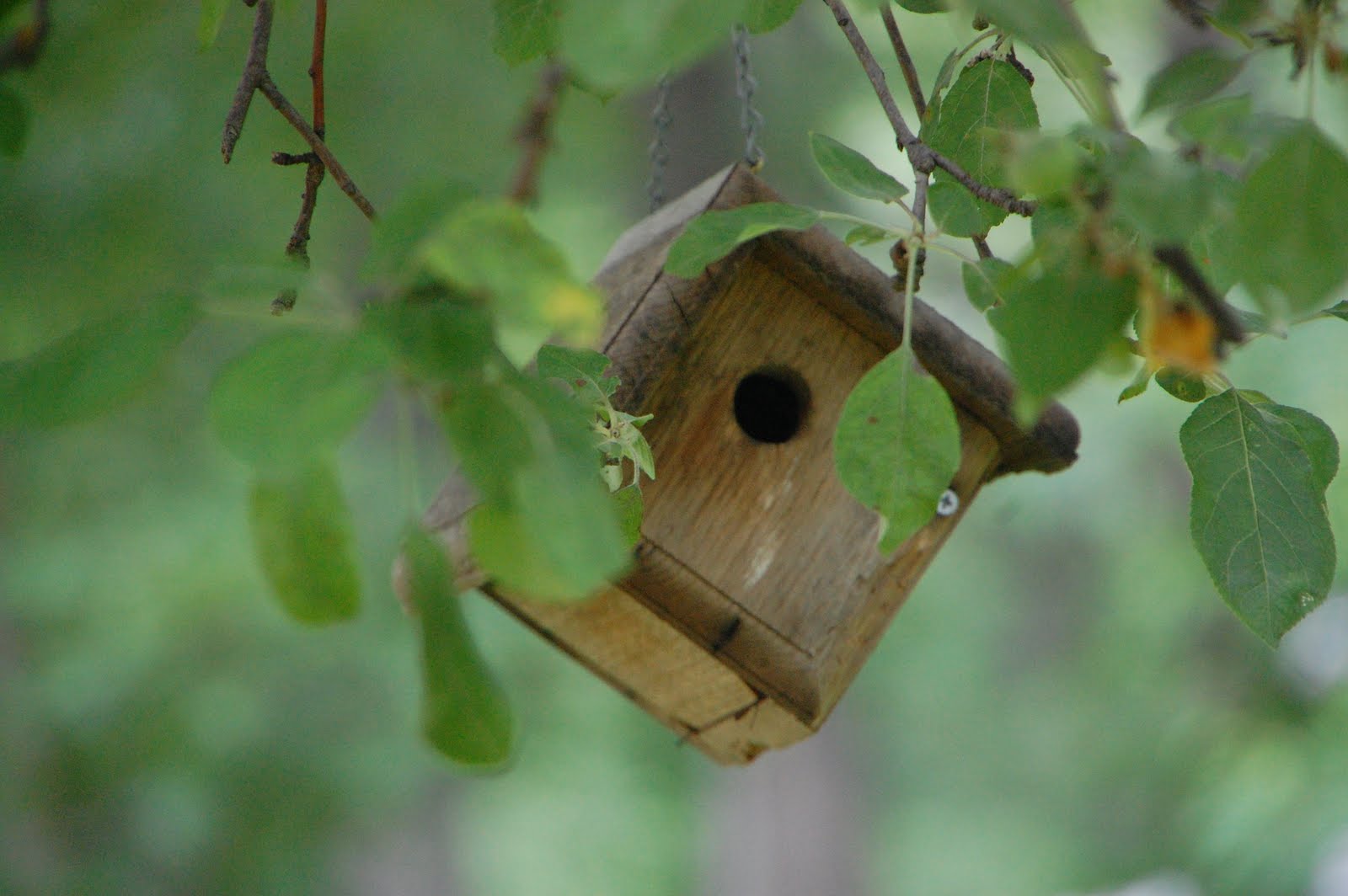
At that point I went to the local Audubon office and bought this wren house.

I wait for "house wren" to show up on area birding lists and then put the house up. Usually within a few days there is activity and later a brood or two. (The opening is too small for the carolina wren.)

This year, as with everything else during a cold and wet spring, things were different. It seemed to take a long time for a house wren to discover the box and then after a few days it was silent. A week would go by and then there would be early morning wren song.

If you look at the house above you'll see a bit of stuff coming out the bottom - nesting material. I see a pair of wrens going in and out of the box but I don't hear any cheeping. At this point I am just glad to have them at all. It is nice to be awakened by a house wren's bubbly song rather than the alarm clock. It is nicer to hear the house wren nearby and the carolina wren a block or so away.

As I get ready to take the feeders in for the season the wrens will be my summer solace.

Saturday, May 7, 2011

In the dark

For about five years I would have to get up at 3:45 a.m. to catch a 5:20 a.m. train and be at the office in Jersey City by 7 a.m. I always woke in the dark and most of the time I walked in the dark, too. The short period of a month before and after Memorial Day would allow me to walk at dawn and listen to the singing of warblers, finches and the Big 4 of robin, cardinal, song sparrow and catbird. (The most I have heard at one time those dawn mornings over the years was 23 different types of bird.)

Since changing to more normal hours I've come to appreciate what I had while walking in the dark. I learned the constellations and traveled with a moon shadow. Most house lights were off and except for adults delivering newspapers from their cars (no more the boy or girl on the bicycle), I was usually alone in my travels. Unlike life in New York City, the only thing I feared most during these trips was spooking a skunk. I was never sprayed, thankfully, even when I practically kicked a young one sitting at the edge of a dark road.

Seeing deer was a given, although the 15 that ran out of a yard in a freight train-like line stopped me in my tracks. I've also seen racoon, possum and red fox, including one that sat literally in the intersection of two roads until I walked close to it.

If you go out at night when the sky is clear and the moon is full during migration season you can see the birds cross the moon and - listen carefully - hear the flight calls. I'm not experienced enough to be able to tell you what I am hearing, but just hearing them is a thrill.

But what I miss most, however, is the calling owls.

I heard what you would expect - the hoo-hoo-hoo of the great horned owl, the whinny of the screech owl.

But I have heard the screech owl actually screech (it isn't pretty) and once I heard the "who cooks for you, who cooks for you all" of the barred owl.

And then there was the time I heard the most unearthly screaming, sounds that were not of this world. I have since learned they came from a barn owl that must have been passing through and decided to sit in a tree over our town's brook.

Nowadays I come home in daylight and once in the house I stay put. When it gets dark I am usually getting ready for bed. But there are times I get up in the night and stand by an open window, hoping to hear one of the owls.

I was lucky once - a brood of noisy great horned owls yowling in my backyard. I threw on a robe and ran out and listened. Momma Owl saw me, of course, and I could hear the yowling move off when I tried to see them. I never did.

Maybe it's the degree of difficulty that makes night owls so special. MH and I once saw a snowy owl on a pier in Piermont, NY, where it had been for some weeks drawing a crowd. It looked bored when we saw it. Snowys hunt by day so seeing this was easy. So was the short-earred owl we saw at a grasslands in upstate New York.

More difficult, and thus more satisfying, was seeing long-earred owl. I wrote last time about the ones at Great Swamp but the first one I saw was in Central Park, and I had come in just to see it. Marie Winn was kind enough to let me know where in the Pinetum it was but it was still hard to see.

But there was a woman on a bench with her small dog and she painstakingly guided my eyes to the dark shape in the pine. I thanked her profusely. She said she and several other park regulars were being very protective of the owl, and I can understand why.

It might be time to start taking night walks again...