Cape May

Cape May
(RE BERG-ANDERSSON)
Showing posts with label survival. Show all posts

Sunday, January 24, 2021

The Smallest Survivor

If we had no winter, the spring would not be so pleasant: if we did not sometimes taste of adversity, prosperity would not be so welcome. 

--Anne Bradstreet

I'm thinking about a gold-crowned kinglet this winter morning. 

It is at 8 a.m. the rising sun now comes out from behind my neighbor's house and hits me as I sit on my enclosed porch. Little by little the sun's arc has been lengthening as it rises higher in the sky. At this point I can only sit outside on the weekend for the 35 minutes or so I am in full sun at this point of the year because I need time to have breakfast and then ready for work. (In the pre-coronavirus days I would be on a train during this time.) 

The thermometer shows me it is 20 degrees F on the enclosed but unheated porch and my phone showed me it is 19 degrees outside, windchill of 9. That's why I'm thinking about the kinglet.

I am wearing a number of layers from head to toe, including a long down coat with hood. A gold-crowned kinglet, a tiny bird (about the weight of a couple of pennies) with bold markings on its face and wings and a yellow patch on its head (the male has an orange stripe on that yellow patch), does not have that luxury. The one I saw while taking a recent hike in the woods, trying to stay out of a fierce, cold wind, was flitting around quickly in a low shrub, looking for food. 

Gold-crowned kinglet, Pennsylvania, December 2013
(Margo D. Beller)
Usually I see this tiny bird high in a conifer, its preferred habitat, once I'm alerted to its presence by its buzzy tse-tse-tse call. They breed in conifer forests but when I see them it is during migration periods, mainly in autumn. But this bird seems to hang around in areas like mine in winter, as long as it can find food.

According to the people at the Cornell Ornithology Lab, a gold-crowned kinglet can survive in temperatures of -40 degrees F at night. That's 40 degrees below zero. How do they survive?

The scientist Bernd Heinrich wanted to know that, too. The gold-crowned kinglet (as opposed to its cousin, the ruby-crowned kinglet, which does not hang around here in winter) is among the creatures he studied in his book "Winter World" about survival in the harshest conditions. Heinrich, who is professor emeritus at the University of Vermont, owns a lot of property in Maine, which he has traveled for the observations in his many books. He found these kinglets, which normally eat insects, will eat what they can find in winter including spiders, insect eggs and moth caterpillars. They need to maintain an internal temperature of 110 degrees F, Heinrich found.

The gold-crowned will use old squirrel or bird nests and huddle together to stay warm, he found after following several to their roost one December twilight. Like me in my coat, sleeping kinglets fluff up their feathers to make an inch-thick, downy blanket. These feathers make up 10% of a kinglet's body weight

Heinrich also found that without this down layer, a naked kinglet would cool rapidly, which would be fatal. He caught one bird and weighed the wing and tail feathers, which are primarily used for flying, and compared them to the weight of the body feathers, which are primarily used for insulation. Kinglets have four times more feather mass committed to insulation than to flying, he learned.

Still, as I sit in the sun's warmth, warmly dressed in my down layer and holding a hot cup of coffee, I can't help but think of that little bird having to stay in perpetual motion on such a wicked cold day so it eat and thus survive. It is a cold, cruel world out there. I hope it survives.


Sunday, January 5, 2020

High-Flying Vultures

It is a cold morning made colder by a strong wind. Where I am walking - an old railroad embankment now a paved, linear park - the river barely ripples because the trees on either side are blocking the wind from it and me. Only a pair of mallard ducks are on the river, more disturbed by me standing still and looking at them than the people running along the path, with and without dogs.
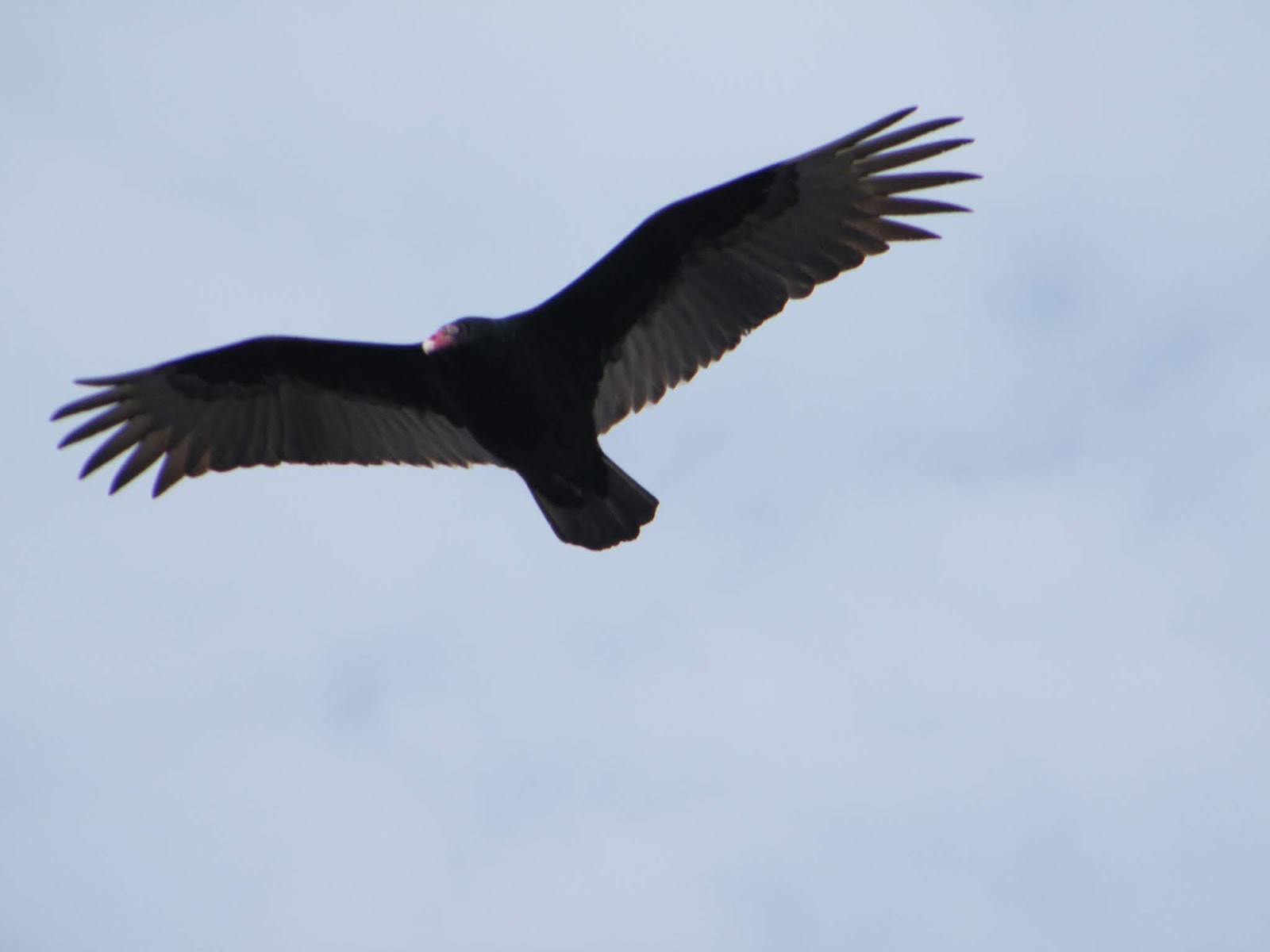
Turkey vulture, Sandy Hook, NJ, 2018 (RE Berg-Andersson)
There is not much else going on in the wind aside from a brief call by a jay. Then I look up and there is my third turkey vulture of the morning.

I have written about turkey vultures in the past. I've always been impressed by how an ungainly, ugly bird that lives on dead animals looks so graceful and majestic when it flies. Its wide wings are held back, making it look like a giant V in the sky. I heard Pete Dunne describe turkey vultures once as a man walking a tightrope, his arms held up to keep his balance. It is an accurate description.

In a strong wind a turkey vulture wobbles as it fights to stay aloft and in the direction it wants to go. On days like this, turkey vultures are the only birds I expect to see flying. Others, even redtailed hawks, are more likely to stay in the bushes or perched in the low branches of a tree to stay out of the wind.

Why do turkey vultures fly in gusty winds? To eat, naturally. But hawks need to eat, too, and I don't usually see them in gales. I went looking through the internet and found this explanation, which you can believe or not:

One way of looking at the flight behavior of Turkey Vultures, is that they are the one species which flies “with” the wind, while other raptors fly “through” the wind. 

That's one way to look at it, although I've seen plenty of hawks flying "with" rather than "through" the wind. The experts at Cornell's Ornithology Lab note these vultures fly low and slow to smell out carrion, so perhaps the high winds are bringing the smells of breakfast to wherever the big birds roosted for the night, prompting them to take off.

Vultures aloft, Sandy Hook, NJ, December 2019
(RE Berg-Andersson)
Turkey vultures like wide-open spaces, so unless you have a particularly big yard with something dead in it, you are not likely to find them there. (I have never hosted turkey vultures in my yard except one spring, after the snow had melted, when they found a dead, frozen rabbit the day after I did. I made sure they took their snack elsewhere.)

Finding them sunning themselves on your roof on a cold winter morning or roosting in large numbers in your large trees is another matter.  I've seen many such vulture roosts, some in my neighborhood. As you would expect, most people don't want these reminders of death hanging around their roofs or trees because, as with all creatures, what goes in one orifice eventually comes out another, and 70 pooping vultures can make quite a mess.

Better to watch them aloft in the wind, doing what they must to survive.

Sunday, December 22, 2019

Frozen but Surviving

December 2019 (Margo D. Beller)
I have never seen either "Frozen" movie but this week I got an inkling of what it is like to live in a frozen world.

In the past week we've had freezing rain that coated tree limbs, power lines, blades of grass and shrubs; followed two days later by an intense snow squall that threw about an inch of white on everything, including the roads; then came the intense cold. Only now, on this first full day of winter, is there any expectation of above-freezing warmth to melt the ice and allow my bowed-down yew hedge to rise and me to add matter to my compost pile.

In the meantime, as I watch the thermometer, the sun is shining prettily on the iced limbs of the trees and shrubs I can see from my porch.

Bowed boughs (Margo D. Beller)
It has been a hard week, particularly because I have started a new job and, for the first time in years, I must commute into New York. The sun rises later but I must rise earlier, and I must dress in layers to be ready for the harsh cold in my town and the (somewhat) warmer temperature when I arrive in the concrete jungle. Today, on the porch, I can see the sun is lower and its arc much shorter from when I could last spend time out here.

Feeders are out, but aside from some titmice and a cardinal in one of the bushes, there's been very little activity.  But I know that will change because when the feeders have come in at night this week they have been nearly empty.

In midtown Manhattan, it's another story. If I have the time to walk through some of the smaller parks near my office, it is easy to find what I call the "usual three" types of birds - house sparrows, pigeons and starlings. These birds will eat anything, including bread tossed by people. To survive they have adapted to life and people in the city.

Frozen feeder baffle (Margo D. Beller)
So, too, have white-throated sparrows, which I'm now finding so often in my city travels I may have to start referring to the "usual four." While these sparrows don't go for tossed bread, they manage to survive by scratching the soil for insects or gleaning what they can find (insects or fruit) from foliage. At night, they roost where they can - the other day I heard something as I walked along Madison Ave., and found a white-throat atop an office tower display of Christmas trees surrounded by concrete!

White-throats are winter visitors - they are common in my yard at this time of year - but catbirds are not. On the coldest day of this past week, when the wind chill in New York City was in the single digits, I found one catbird sitting at the base of a shrub in the sun. Catbirds have been gone from my yard for months (usually the white-throats replace the catbirds) and yet the previous week, before the frozen rain and cold, I had found a total of five catbirds in two Manhattan parks.

Sun on ice (Margo D. Beller)
I was astounded. They were not perturbed by my closeness at all. One, in fact, sat on a railing and looked at me. Then the cold came. Obviously, these birds either fly to another, more hospitable habitat, work harder to find food in this park or die. On this day at least one catbird has managed to survive. But it is a tough world out there and a small bird faces large odds, so who knows what happened to the catbirds and other birds I've seen over the last two weeks that should've been elsewhere (including a brown thrasher, swamp sparrow and ovenbird).

No doubt the annual Christmas Bird Count, where people comb the streets and parks all over the U.S., if not the world, to see what birds are around at this time of year, will find all sorts of birds in the urban parks. I know there is an annual count in New York's Central Park, that oasis of green that attracts dozens of types of birds during the spring and fall migration periods and likely many staying for the winter. But for me, finding a bird in a small patch of green in an area surrounded by traffic, noise and people is more than just a bit of wonder, it is a small miracle. Like that catbird basking in the cold sun.

I've been thinking of it a lot as I make my way along in this frozen, hard world.

Frozen world (Margo D. Beller)


Sunday, July 14, 2019

Family Time, Again

She is nearly invisible in the messy cup nest she built at the top of my pear tree, her yellow bill showing as she raises her head to look at me. But I am behind glass on my enclosed porch and no threat to her. After taking about a week to put the nest together, she is sitting on three to five blue eggs and will rarely move off them for the next two weeks or so unless she must.

Like the neighborhood children freed from school to run around their yards and play, my yard is filled with the sound of noisy young, in this case birds.

Robin in my pear tree, July 13, 2019 (Margo D. Beller)
The American robin female in her nest is not the only robin in my yard. There are others flying around, many of them juveniles whose breasts are mottled rather than orange to help camouflage them. Their nest was in my large yew hedge. An adult male robin is feeding them. There could be two robin pairs or these juveniles may be an earlier brood of the same female robin in the pear tree. (Robins can have up to three broods, if conditions are right.)

This is the time of year when, if you are looking for them, you'll likely see birds either holding food for young or nesting materials. Those with food will lead you to squawking young, which, when they get a little bigger, will flock after their parents and make themselves very visible.

In my yard, besides the robins, the types of birds followed by young so far have included cardinal, flicker, chipping sparrow, starling, titmouse and grackle, with large flocks of cedar waxwings flying overhead. The other morning I watched a young grackle pull a worm from the grass beneath the apple tree. The bird is completely dull brown while an adult grackle is iridescent, with a bright yellow bill and eyes. When you are a young bird, you need all the help you can get to survive into adulthood.

This old nest was within a wild rose bush I was cutting
back. It was well hid and protected by thorns. (Margo D. Beller)
Bigger birds - jays, gulls, great blue herons, crows - will eat baby birds, which is why you will often see these birds chased off by smaller birds - red-winged blackbirds, mockingbirds, Eastern kingbirds, for instance - protecting their young. Danger can come at any time from soaring raptors and neighbors' prowling cats.

Take the robin in my pear tree. According to the Cornell Ornithology Lab, on average "only 40 percent of nests successfully produce young. Only 25 percent of those fledged young survive to November. From that point on, about half of the robins alive in any year will make it to the next."  And robins are relatively big songbirds, about eight to 11 inches long. 

All these bird families passing through my yard are fascinating to watch. Small chipping sparrows land in the longish grass and seem to disappear except for the young's buzzy contact calls. Larger starlings stick with their parents as they hunt in the grass and in the winter will join with other family groups to create the huge flocks that seem to undulate in the air like a single organism. When the berries on my viburnums, dogwood and other shrubs are ready, the robins and other fruit-eating birds will feast (as will the squirrels). Then, when it turns cooler and the leaves start to fall and the insects die off, many of these birds will fly south to their winter grounds to eat there in preparation for next spring's migration and breeding.


Mother Robin coming back from a food break. When I took this picture the
male flew off to the flood wall. I am guessing he was watching things
while his mate was away. (Margo D. Beller)
Unlike in past years, I am not watching a house wren brood. The nest box I cleared a few weeks ago was visited by a singing male. I was hopeful. However, it didn't attract a mate and didn't build a nest. It used the box as a temporary roost for a few days and hasn't been seen since. But that's the nice thing about the natural world. While there are no house wrens this year, I have a front-row porch seat for when Mother Robin's eggs hatch.  

Sunday, February 4, 2018

A Tree Grows

Several winters ago I was taking a walk in the cold early morning along a road near the local dog park and happened to see this little tree rising above the packed snow. Why had I never noticed this before?

Spruce, Feb. 1, 2018 (Margo D. Beller)
I looked at it as closely as I could because it was up a little hill and I didn't trust my footing on the snow. It is most definitely a conifer, a spruce from the way it is holding out its branches. It was getting lots of light thanks to the taller oaks having lost their leaves. Somehow the deer had not browsed it to nubs. Deer, as a rule, don't browse spruce trees because their leaves - the needles - are hard and prickly compared with the softer leaves of a yew or an arborvitae, something I know from painful experience.

But when a tree is small, a deer will taste the leaves and see if it is to its liking. That is why when we bought and planted Spruce Bringsgreen 10 years ago, I put in fence posts and strung deer netting around the little tree for the winter. I did it only the one time because Spruce, like all blue spruces, has proven to be a quick grower. It is now over 15 feet tall and its leaves are hard and sharp. The deer have left it alone.

This little tree is not a blue spruce, I think, but it is very much alive and growing thanks to taking advantage of its location on the top of a small hill.

Later that year, weeds surrounded the small spruce, obscuring it. I would not have seen it had I not known it was there. Thick stands of the invasive Japanese knotweed grew along the road in front of that hill, making it hard for a deer to get up there even if it was so inclined. Besides, with all the barking dogs at the dog park most deer, I've found, keep to the other end of the road where there are more open fields and, in summer, tall grass for browsing or bedding down on.

Down the road are much taller spruces, several of which were destroyed by Hurricane Sandy in 2012. Somehow a seed got blown or carried up the road by a squirrel or chipmunk, was planted and then left alone, allowing a tree to come up and replace at least one of those that fell.

There are so many seeds floating around us during the warmer months. This is how plants perpetuate themselves. Sometimes they put out fruits eaten by birds or rodents who either plant them as droppings or put them in the ground to store for the coming winter. Some seeds, like those of ragweed, make us sneeze. Some seeds blow into places where they manage to grow where least expected. Early on in our ownership of our house, we had many more apple trees and many more apples eaten by squirrels and deer. Several times I had to dig up apple tree seedlings from another part of the yard. Now that we only have the one tree whose apples I use, we have not had any seedlings in years. But I'm still vigilant.

In the woods, seeds fall and, if they are in an area where light comes in because of a gap in the taller trees, they may grow, presuming they are left alone and get enough moisture.

Every tree puts out hundreds of seeds every year because not very many will be lucky enough to  germinate.

This little tree, however, managed to be planted, left alone and given the right conditions to grow. It is a survivor, which is why I celebrate it. I hope to see it grow as tall as its parent.

Sunday, July 3, 2016

The Adventures of Alpha and Beta

When John J. Audubon referred to the ruby-throated hummingbird as "the glittering fragment of the rainbow," he was referring to the male. The male's back and head are bright green, his throat a deep red that can look black in some lights and the breast and belly are white.

Audubon was not referring to the duller females. As with most other birds, the females are not as bright or colorful as the males so as to be inconspicuous on her nest, or getting food for her young.

Attempt at a hummingbird picture (Margo D. Beller)
In late May my New Hampshire brother-in-law hung two feeders and, as usual, two males battled over one of the feeders, leaving the other alone. Hummingbirds will do that - they don't play well with others.

However, one of the males already had a mate and every so often the shier female would come feed, also at the same feeder. She, too, is green but a duller shade and there is no ruby throat.

My brother-in-law, as well as a friend of mine who lives in a hillier part of New Jersey, draw hummingbirds almost from the moment they put a feeder out. I always know the first batch of liquid I make will likely be wasted as I watch for the bird - more insect than bird, wings moving over 50 times a second, able to back up (which no other bird can do) and take off at great speed.

Admittedly, I make it hard on myself. I have the feeder hanging in a shady part of the garden (so as to keep the liquid from going bad quickly in the sun) that I can't see unless I step out on the enclosed porch. I have flowers hummingbirds like in different parts of the garden - azaleas and rhodedendron in the front, for instance, and geraniums and columbine in the back - so the birds are not always where I can see them, unlike the winter where the seed feeders can be seen from the kitchen.

This year I saw a male on June 3, the earliest ever for my yard, and then another one 15 days later. Then nothing.

Until June 30 when the first female showed up.

For some reason, what draws the birds to the feeder are the sprays of tiny pink trumpets thrown up by the coral bells. As I sat on my porch having breakfast, I was aware of movements at the bells and saw the green back. Eventually it flew up and saw the red-topped feeder. It flew over and took a sip. It was very tentative. Its head was so dark I was sure it was a male, but getting my binoculars I saw the white breast and throat.

She came several times that day and has continued coming. This is the typical pattern. At this time of year - June into July - the male hummers have done their genetic duty and go off on their own, sometimes heading south as early as late July into August. That leaves the female with the task of creating a nest, laying eggs, brooding them and then feeding the young, all the while needing food to give her the energy for all that fast flying.

So once she found a reliable food source, she wasn't going to let it alone.

Hummingbird, Higbee Beach, Cape May, NJ (Margo D. Beller)
This is typical. What wasn't typical was when the second hummingbird showed up a couple of days later.

I didn't realize it at first. When the first one - I'll call her Alpha - would stop by, she would feed, then back up and take off to the north, toward a high hedge I keep as privacy from the neighbors. Then I noticed she would fly up to the nearby apple tree, or head east, past my yard and to the next street.

The other morning I took my folding chair outside to drink my coffee and watch the feeder. In came the hummer - and then in came a second one to chase her off. The chaser was Alpha, with the dark head. The one chased off came back about five minutes later. I noticed her head was much lighter green and when she flew off, it was to the apple tree. This one is Beta.

Several times now I have seen Alpha at the feeder and Beta feeding from the coral bells, or Beta at the feeder and Alpha chasing her off, then coming back to feed.

All of this is fun to watch but there are some serious issues under all the feeding and chasing.

These females are making the constant trip to the feeder so they have the energy to sit on their nest or catch food for their young. In my part of suburbia, homeowners leave it to the landscapers to put in their plants and they are usually dull shrubs that do not flower and are cheap to replace. If they have flowers, it is a hanging basket and the flowers are generally not the orange or red trumpets hummingbirds prefer. They don't even have scent, most of the time.

I do have flowers hummingbirds like - bee balm, butterfly bush, salvia, coral bells, columbine - but the deer eat most of them too, and these plants are behind netting as a result. That is the reason for the dull shrubs - easy to replace when eaten by deer and not so lovely as to be missed and thus easily replaced.

My feeder is hanging on that pole in the shade behind netting, too.

When overdevelopment tears up fields of wildflowers and suburban sprawl doesn't replace the lost plants, you don't give a hummingbird a lot of choices. It doesn't have unlimited time and energy to look around.

Hummer drawn by my friend's zinnias (Margo D. Beller)
A feeder, however, is another matter. You buy one at any store. It is usually red either in whole or in part. You boil one-quarter cup of sugar for every cup of water until the sugar is dissolved, wait for it to cool and put it in the feeder. Hang it outside.

There! You've just helped out a hummingbird.

I see many yards with hummingbird feeders, even those with dull shrubs. People like watching hummingbirds. They are fascinating creatures. One second there's a feeder and the next there is a tiny bird sitting and taking long drinks with her very long, thin tongue. Then she rises up and is gone.

They fly backwards. Their wings beat so fast you can hear the blur. Several times I have come face to face with a hummingbird. When it doesn't feel threatened, it wants to check you out. We look at each other, it gives me a small "chip" and takes off. Working in the garden, I've heard an angry squeak and knew I was working in an area where the hummingbird, easily annoyed, was going to check out the nearby plants.

Ruby-throated hummingbirds are not considered to be endangered. More people are putting out feeders and, if global warming continues, hummers might be hanging around beyond late summer when they generally head south to Central America.

I enjoy watching the antics of Alpha and Beta, and if global warming keeps them around longer it might even be worth it. I have lots of sugar.

Sunday, February 15, 2015

Backyard Feeder Drama

This weekend has not only been Presidents Day weekend and Valentine's Day weekend but the weekend of the Great Backyard Bird Count run by, among others, the Audubon Society and Cornell. These counts are useful as a way of getting the average person as well as the avid birdwatcher involved in reporting what they see and how many, which helps the scientists get an idea of what species are increasing and which are on the decline.

Adult sharp-shinned hawk with prey in hole (Margo D. Beller)
This particular day, Sunday, Feb. 15, the wind has been howling and I've had to go out twice to re-set a feeder in danger of being blown off the pole. I came downstairs at 7:30 a.m. and the birds were already all over the 4 feeders I left out despite the risk of wind. It is wicked cold out, wind chills in the minus numbers and even the enclosed porch's thermometer is showing me 10 degrees.

In short, it's cold and the birds gotta eat to survive.

The early risers are there - cardinals, chickadees, titmice - and a few surprises including a pair of American goldfinches and a Carolina wren that nestled inside the house feeder as the wind rocked it like a cradle. When things calmed it flew to the suet feeder and took advantage of the pounding a larger hairy woodpecker had given the near-frozen fat to take a few nibbles before flying off. I like Carolina wrens and if I had been outside I am sure I'd have heard it singing from somewhere nearby.

But I did not go outside. And at 8am, just as a cloud of house sparrows and house finches descended to push off the birds I do like, there was a gust of wind and a sudden large bird in the yard I just knew to be an accipiter and all the birds scattered. The bird flew to a low branch, giving me a perfect view of it. I saw it was an adult (gray feathers, red breast), male (smaller than the female) sharp-shinned hawk with its rounded head and square tail.

Juvenile Cooper's hawk (Margo D. Beller)
Accipiters are the most feared birds in this area. The sharpy and its larger cousin, the Cooper's hawk, are lightning fast and agile enough to fly between trees in a forest, going after birds, squirrels and other smaller animals. I have seen sharpys fly out of a bush. They seem to come from nowhere (unlike the larger red-tailed hawk, a buteo, which either hovers in the air or sits atop a pole or tree before dropping down to grab prey in an open area like a highway).

The sharpy sat for 10 minutes before catching another gust of wind out of my backyard. It took another 20 minutes for any birds to return to the feeders, and I was not surprised they were the intrepid chickadees and their cousins the titmice.

When I told MH about the sharpy he reminded me what it says in one of my reference guides, "Birds at Your Feeder," when it comes to sharp-shins and Cooper's - they like birds at your feeder.

We have hawks fly through at all times of the year, going after birds, squirrels and chipmunks. We've had a small flock of turkey vultures that somehow found a frozen rabbit carcass in a corner of my yard. We've had broadwing hawks, red-tails and even a juvenile northern goshawk, the largest of the accipiters, that somehow found its way to a low branch in my backyard for a day.

I find the accipiters most interesting. When they are young they are brown, streaky and not very good at catching prey. We've seen several near-misses over the years including the time an American tree sparrow flew out of our caged feeder just as a juvenile Cooper's hit it from the other side. It sat atop the feeder stunned, and I took a picture. I've seen juvenile Coopers on a branch on one side of a tree trunk trying to grab at a squirrel on the other side. It would be funny to watch if it wasn't a life and death struggle. The hawk wants to eat, the squirrel wants to live.
Juvenile Cooper's hawk (R.E. Berg-Andersson)

But accipiters have to learn fast if they want to survive and by the time the streaked breast goes red and the brown feathers turn gray they know how to hunt very well - unfortunately for the junco and the chickadee and the mourning doves I've seen picked off in the yard over the years.

The only thing that kept today's sharp-shinned hawk from catching any of the many birds at my feeders was that sharp wind blowing it off course. Today, the little birds got away. Tomorrow?

I've no doubt that sharpy found something in another yard to fill its crop and allow it to live to hunt another day.