Cape May

Cape May
(RE BERG-ANDERSSON)
Showing posts with label ruby-throated hummingbird. Show all posts

Monday, July 21, 2025

At Midsummer

If you consider summer to start on June 1 rather than May's Memorial Day weekend, we are currently in midsummer. Today, a rare not-so-humid day, I took a walk around my yard to see how things are doing.

The early spring flowers are a distant memory. The azaleas, irises and rhododendron have bloomed and busted, the lily flowers gone while the stems remain.

I put seeds from three different types of plants into a pot, and only the zinnias are growing. I had collected the seeds from a friend's plant last fall, and will do it again this fall with these flowers once they are done.

Hummingbird-attracting canna flower (Margo D. Beller)

The purple coneflowers have finally started to open. The midseason goldenrod is in flower. Rose of sharon shrubs are blooming purple in neighbor yards but the pale pink flowering type I have are just starting to bud, as are the succulent sedums protected by the deer fencing. Some of the potted cannas have put up long spikes of red flowers that, witnessed at least once by my husband, attracted a female ruby-throated hummingbird. (I hope she gets to the backyard where the feeder hangs waiting for her.)

The house wren young are now so noisy when a parent comes to feed them that I can hear their begging through the closed windows of the porch, even with the fan on. They are so big the parents feed them from outside the box, except when they squeeze in to remove poop. I expect that, like the brood earlier this summer, there are three birds in the box and they will soon be enticed to leave and follow their parents, learning to feed themselves. If they survive they'll head south and the box will come down for the year.

The humidity has affected me more than usual this year, starting with the heavy spring rains. I used to wonder how those living in New Orleans could survive the humidity. Now I know - you close the windows, put on the air conditioner, close the curtains against the sun and stay inside as the air dries along with my skin, just as it does in the winter when the furnace is continually running. And don't look at the electric bill until absolutely necessary.

But at least the gnats are gone from my porch. Unlike last year when I didn't start noticing them until August and found they had infested the open bag of bird seed, they have nothing to breed on. The seed is in a locked container. Old plastic pots are gone. Soil is off the porch. What ceramic pots I've kept are covered with plastic. If a gnat was desperate enough it would visit the yellow sticky strip, where there are already a number of corpses. My hope is the wrens and other baby birds are eating the overflow.

This month the cicadas started calling during the day, the fireflies have been out in the evenings and soon there will be night choruses of katydids and crickets.

In the cooler early morning I have been hearing a number of different types of birds, besides the resident house wrens. I hear families of titmice and chickadees. Mockingbirds harried a pair of fish crows that seemed interested in nesting in my trees. (They left.) A catbird sang for the longest time atop my yew hedge in the mornings, but now its young are gone and the bird has moved on. It is not yet August but already some birds are heading south for the winter feeding grounds, such as the shorebirds that stop off at some of New Jersey's shore empoundments (along with the nasty, biting, greenhead flies). 

From 2020, a house wren feeding young from outside the box.
(Margo D. Beller)

Warblers are starting to move south. They won't be as colorful as in spring and won't be singing their territorial songs. They will be harder to find.

Leaves are already falling from some of the trees, but not the apple tree. Cutting off that rotted limb seems to have done it some good. The dogwood I saved two years ago is showing green fruits that will eventually redden and, I hope, draw robins and cedar waxwings before the squirrels can get at them.

Back-to-school ads on TV tell me it will soon be time for the kids currently on vacation to hit the books (and their after-school activities) again. It is already darker in the early morning. Soon enough it will be dark in the early evening, too.

I'll put the garden to bed and the seed feeders out for the cardinals and other birds hanging around my yard during the winter. Then another year will end, as it inevitably does.


Sunday, June 9, 2019

Watching for Hummingbirds

This post is based on one that originally ran on May 29, 2013, on the blog of New Jersey Audubon's Scherman Hoffman sanctuary. The NJA blog was significantly overhauled since then and the archives were deleted. However, I was able to keep a copy so this can again see the light of day.

I hear like you see — like that hummingbird outside that window, for instance.
– Ray Charles


This morning (Sunday) a Ruby-throated Hummingbird hovered over the feeder briefly, then flew into the nearby apple tree. It did not return while I sat on my porch with my binoculars.

Another year's backyard hummer. (Margo D. Beller)
For my yard, this is typical. Every year the hummingbirds visit infrequently in late spring, then more regularly in late June into July when the female, which does all the work feeding the young, stops for a sip of sugar water so she has the energy to find insects to feed her chicks. 

When I hang the seed feeders, I know a host of different birds will come to eat all year long. But the sugar water feeder is meant for only one type of bird that visits over the summer, and the food can go bad quickly in the heat. I have a pole in a shady area but I can't see the feeder from the kitchen, unlike the seed feeder poles. 

My brother-in-law, noted below, has no trouble drawing these tiny colorful birds to his feeders. But even he has been known to complain about the "waste" of having to dump nearly full feeders when the sugar water has gone bad:


It is dusk in New Hampshire. It is raining and unusually cold for late May and I am sitting on my brother-in-law’s wide, covered porch.

As it darkens, a Ruby-throated Hummingbird comes to one of the two feeders hung from a support for the grape vines. It perches and takes a long drink of the sugar water that will help keep it alive over the expected cold night.

A second, slightly larger hummer arrives. Despite two feeders being out, this one chases the other away because this is what hummingbirds do, they battle each other for food and territory. These little birds are tough. The first one leaves and the second takes a long drink, then perches for a while until it gets almost too dark to see. Then it flies off to roost in a nearby sheltering willow.

(Margo D. Beller)
I am always taken aback when a Ruby-throated Hummingbird, looking more like a bug than bird, flits by me. They are fascinating to watch, the only bird that can fly backwards, bright green back, long bill and, if a mature male, a deep, red throat. John J. Audubon referred to the Ruby-throat as the “glittering fragment of the rainbow.”

Hummingbirds are so small - they weigh the same as a penny - and so colorful. In the U.S. they have interesting names including Broad-billed, Broad-tailed, Anna’s, Allen’s, Calliope and Magnificent. But in New Jersey, the hummingbird you’ll see 99% of the time is the Ruby-throated. Go walk in the woods wearing a red hat or bandana and you might draw one to you, checking out what kind of flower you are.

People love to watch hummingbirds. They put out red feeders with sugar water (1 part sugar to 4 parts water) to feed them. They plant flowers for them – preferably those that are red and/or trumpet-shaped (yellow jewelweed is a favorite, if you happen to have a stream or river along your property). They make documentaries about them. There’s even websites to track the Ruby-throat’s northbound migration.

One year I was in New Jersey’s Great Swamp, crossing a bridge over a brook, when I was buzzed by a hummer that flew to a tiny nest made of lichen and spider webs at the tip of a thin branch hanging over the water, a good defense against predators. This was a female: Once the male has done his part, he’s gone, frequently heading south as early as July, leaving the female to build the nest and raise the brood alone.

New Jersey Audubon’s Scherman Hoffman sanctuary has a feeder attached to the bookstore window so those inside get a close view of the feeding bird. It is nice to be inside, perhaps talking to sanctuary director Mike Anderson or one of the volunteers, and suddenly have a brilliantly colored male hummer appear out of nowhere. Very little deters a hungry hummingbird, as the ones I saw in New Hampshire reminded me.

When I see a hummer at a feeder, its whirring wings beating thousands of times a second, I appreciate the great lengths it has gone - and the dangers it has faced - to make it here from central and South America.

In his book “The Big Year,” Mark Obmascik gives a harrowing account of northbound migration over the Gulf of Mexico, from the point of view of a female Ruby-throat. Like all birds the hummer eats and eats and eats, then takes off and flies nonstop over the water, burning fat supplies as she goes until she can get to land to eat and rest. Many don’t make it. The one in the book does. Read it and I guarantee the next time you look at a hummingbird you will be awed.

If you want to attract hummingbirds you can create a garden with the right type of flowers. Trumpet Vine is a hummer favorite, and so are other native plants including Beard Tongue, Wild Bergamont and Bleeding Heart. If you have a wet garden, there’s Fire Pink and Cardinal Flower and its blue cousin Lobelia.

The nice thing about these flowers is that besides hummers you will also draw butterflies – another long-distance migrant that is tougher than it appears. These plants evolved along with native birds, insects and wildlife. Putting these in your garden is like buying heirloom tomatoes with their strange colors and textures and juicy taste instead of the bland orange tomatoes used for fast-food sandwiches. Natives are just more interesting, and so are the birds and insects they attract.

Hummer at a friend's feeder (Margo D. Beller)
Here is Audubon on hummingbirds and native flowers:

No sooner has the returning sun again introduced the vernal season, and caused millions of plants to expand their leaves and blossoms to his genial beams, than the little Humming-bird is seen advancing on fairy wings, carefully visiting every opening flower-cup, and, like a curious florist, removing from each the injurious insects that otherwise would ere long cause their beauteous petals to droop and decay... Its long delicate bill enters the cup of the flower, and the protruded double-tubed tongue, delicately sensible, and imbued with a glutinous saliva, touches each insect in succession, and draws it from its lurking place, to be instantly swallowed. All this is done in a moment, and the bird, as it leaves the flower, sips so small a portion of its liquid honey, that the theft, we may suppose, is looked upon with a grateful feeling by the flower, which is thus kindly relieved from the attacks of her destroyers.

Makes you want to go native and plant a few Fire Pinks, doesn’t it?

I get a grateful feeling about hummingbirds, too.

Sunday, August 19, 2018

Sunday on the Porch, With Junior

It is quiet on the porch this Sunday morning. Despite the rain I have windows open and it is cool enough to not need the fan to air things out. It is quiet except for the sound of the rain, the occasional call of a jay or cardinal or a car driving on the next street.

I am sitting with my coffee and trying to wake up after a long Saturday visiting with friends in the City. I turn my head and there is the immature ruby-throated hummingbird that has been visiting the feeder for the last couple of days. It is grayish green on the back with white on the front. Since this could be either a male or a female (and even be more than one bird) I have been calling this visitor Junior.

Juvenile ruby-throated hummingbird
(photo courtesy Birds of North America Online) 
This has been the wettest summer I can remember. Some of my plants have thrived - the tropical cannas, the peppers in their pots, the basil, the coleuses - while others have struggled. The joe-pye weed I grow near the hummingbird feeder has not produced many flowers or grown very tall, likely because of the nearly continual deluge of rain off the garage roof above it. The pink flowers of the coral bells and the perennial geranium are long gone. In a sea of green shrubs, the red feeder and the red ant moat above it stand out like a beacon.

And yet hummingbirds have been few in the backyard. Junior has only been coming the past few days. During the usual peak (for my yard) period of July I saw one. That might've been because of the heat. I can't sit long on the porch, even with the fan, when it feels like close to 100 degrees. Also, while the feeder is in the shade, the sugar water can still go bad if not changed after a week, and there were times I did not do that. (When a hummingbird hovered and then flew off, I knew it was time to clean the feeder.)

In July, the males, having mated and created the next generation, are gone or ready to leave. By August, the females have raised the young and shown them how to fend for themselves. Then the female adults leave. So by this time of the month the juveniles are what come to feed before instinct tells them it's time to head south for the winter. (When I say I have "peak" visitors in July it is females who need to fuel up as they seek protein food - insects - for their young.)

Canna flowers (Margo D. Beller)
What I need is a better garden of flowers attractive to hummingbirds and not attractive to deer. Right now the small yellow-orange flowers of jewelweed are blooming near streams, offering hummers a meal. Gardens with varieties of red - joe-pye, phlox, purple coneflowers, cardinal flower and zinnias -  I have visited in the last month have drawn anywhere from one to four hummingbirds at a time, fighting each other over the same flower despite all the food around them.

I do have more flowers that attract hummingbirds in the front yard. I just bought a purple coneflower, the light pink flowers of the Rose of Sharon are finally opening, the sedum are not yet ready to bloom but are close, there are the purple flowers of the butterfly bush and the bee balm and there are the red flowers of the cannas. Cannas are usually grown for their foliage but I like the flowers. One year I opened the front door and there, through the storm door, I could see a hummer at one of the flowers. It saw me, flew to the storm door, looked at me and then flew off. But I'm not always looking and most hummers are skittish and fly off at the slightest movement.

Soon summer will finally be over. I've already taken in my wooden wren house so it doesn't rot in the rain, and the house wren brood at the birdhouse next door are gone. (What I have seen is a lot of squirrel activity in the trees, gathering nuts. When one squirrel knocked the birdhouse, I knew the wrens must be gone because the parents would never have allowed a squirrel to get that close.) School resumes in a little over two weeks, and the daylight is noticeably shorter.

The leaves will fall, the flowers will be done and the hummers will be gone until next spring, when I hope for better weather conditions and more a more favorable environment to bring them to my feeder.

Wednesday, July 5, 2017

Family Time

It is a pleasant day for early July, and I am on my patio with my binoculars. Behind me, I hear my neighbor walking around her yard with her two little girls. She will soon give birth to her third child.

Unlike humans, who can conceive and give birth any time of the year, the birds are limited to a short period after they have migrated north to their breeding grounds in the spring but before they must leave for their southern feeding areas in the fall.

Jay (Margo D. Beller)
So now, in early July, even though the house wren box is empty, the yard is full of calling birds again. This time, it is noisy families of titmice, house sparrows, fish crows and blue jays.

With all the feeding activity, whether it is an adult going back and forth to a nest or being followed by hungry, raucous young, there are plenty of opportunities for birders to get out there and find something again.

Even the wrens are not completely gone - coming back up the driveway after putting the garbage can at the curb the other day, I saw several little birds poking between the paving blocks by the front door. One flew past me to a nearby bush. It was a house wren. Its parents have already taught it to stop begging loudly because it is no longer protected in the box but out in the open.

Today the apple tree has been visited several times by squirrels, and I have had to clean up after them. It is a temptation to knock down more apples but I still have too many that must be used soon. So I sit in my folding chair and watch as a noisy flock of jays goes into the trees to peck the apples for a cool drink or pick bugs off the apples and leaves. These big birds don't have to worry about danger as much as the small wrens and, like their cousins the crows, they call loudly to each other and stay in a flock. For the most part, they feed themselves. But when one parent gives a juvenile some food, they all rush to the tree branch and beg before the parent flies off and they go back to the apple tree and then to the next yard.

In the past I have seen grackles and both kinds of crows - fish and American - hitting the tree for the same reason as the jays. The squirrels are a little leery of these bigger birds but, despite some hesitation, they go up and the apples come down, some so ripe they fall uneaten for me to collect. Were the wrens still in the box I'd be more concerned because big birds will eat baby birds.

(courtesy of Mike Anderson, director, Scherman Hoffman)
Catbirds are flying around, a cardinal is calling and a speckled young robin, its breast in the process of turning red, is poking the ground around the lilac. Downy woodpeckers, the young male's red head spot not completely filled in, are calling to each other as they explore the bark of the various trees. I watch one in a hemlock and see that, unfortunately, the wooly adelgid is doing its destructive work again for the first time in years. In hot, dry summers this fungus is kept down but after all the rains this season, it is back and will literally suck the life out of the hemlocks unless I spray them with oil, a messy and time-consuming process.

Hummingbirds are also coming to the yard. At the moment there are two females, one rather dusky and fidgety, the other with a shiny green back and clear white breast. Until I looked at her with my binoculars today, the lighting of her head made her look like a male with a dark, ruby-red chin. This hummer comes to the feeder and sits to eat. You don't realize how long a hummingbird's tongue is until you watch her with binoculars and see the light rippling of the liquid below from her tongue lapping at it.

Both she and the dusky one - who hovers over the feeder, her wings going a mile a minute as she feeds - have nests somewhere but not in the apple tree, although I've occasionally seen one fly there to rest and preen when the squirrels are taking a break from their raids.

I've seen a hummer nest only once, and that was only because I was standing on a bridge over a brook at the Great Swamp and the hummer led me to it. The nest of moss and lichen was at the end of a thin branch hanging over the brook, to keep it safe from predators. She flew in and sat on her eggs. It was a remarkable construction, strong enough to support them now and two or three growing hummers later.

Goldfinch pair (Margo D. Beller)
Finally, I hear a calling male goldfinch. Goldfinches do their nesting later than other birds because they feed their young exclusively with seeds, and it is in the midsummer that thistle and other seeds are ready. If I put out a feeder at all during the summer, it is a thistle sock for the goldfinches. At the moment I have no plans to buy seed but that could change. In the meantime, I'll just sit and listen.

Sunday, September 4, 2016

Acting My Age

There is the bucket list, and there is the anti-bucket list.

The bucket list is what you want, need or have to do before you die. Usually it refers to places to go and things to see.

There are places I would like to visit, sooner rather than later, such as the interior mountain west, the Point Reyes Seashore, the forests of Oregon. There are places I have visited and want to see again - Seattle, New Orleans, San Francisco.

And there are places I have visited I have no desire to see again. That is the anti-bucket list, for lack of anything else to call it.

At the top of the anti-bucket list is the North Lookout at Hawk Mountain. Hawk Mountain is one of the finest places to go in the Autumn if you want to see migrating raptors. It was once where sportsmen and farmers would climb and shoot eagles, osprey, redtails, kestrels and other raptors out of the sky, just for the hell of it.
On the North Lookout at Hawk Mountain (RE Berg-Andersson)

That ended thanks to the courageous actions of a number of people and one rich woman who bought the mountain to create the Hawk Mountain Sanctuary.

There are number of areas where you can walk or climb and sit on the rocks to watch the hawks fly in, presuming the wind is out of the north and the air is warm enough to promote thermals, the air currents on which the birds coast, saving their energy for less-windy areas.

The top place, literally, is the North Lookout. To get there you climb over rocks large and small, up an incline. Over the years, there have been a lot of people walking up and down to the lookout and between the first time MH and I visited and the last time, it seems to me there was some significant erosion or rock shifting. Or maybe it was being older. Or all those people of different ages jostling us. Whatever, it was extremely difficult climbing up and more treacherous climbing down.

When we got back to the bottom I turned to MH and said, "This is the last time we go to the North Lookout."

There are other lookouts not so far up or treacherous to visit, and the South Lookout is accessible to those in wheelchairs or can't walk.
Higbee Beach, Cape May, NJ (Margo D. Beller)
Here is another example: I love Cape May. If you are a birder, this is mecca. Always something to see, but especially during the spring and fall migrations.

In Autumn, many southbound migrants travel at night (to avoid diurnal raptors) and as the sun rises find themselves over Delaware Bay. At that point they turn around and fly north.

One of Cape May's best areas is Higbee Beach Wildlife Management Area. There are trails through fields, there is a path down to the beach and there is a dune - a very high dune.

There are some birders - all men - who go up there every year to count and note the birds passing through. One September, we visited Cape May and got up at dawn to visit Higbee. I attempted to climb to the viewing area. I got about halfway up and realized the trail was going straight up! I could not go up and going down was going to be extremely hazardous. I used the phragmites as a kind of bannister and resolved not to do that again. (There are more than enough other fine birding experiences in Cape May.)

Finally, in Dutchess County, N.Y., there is a preserve owned by the Nature Conservancy. It encompasses Thompson Pond and Stissing Mountain. I read about it from my old edition of the "New York Walk Book."

There are three trails and the first time we went there we took the longest of the three, the Yellow, which is nearly three miles long around the pond. It did not get as close to the pond as I would've liked and on the eastern side of pond it was wet, muddy, overgrown, uncomfortably close to the neighboring farm property where someone was using his ATV and his cattle crowded close to the fence to watch us as we made our sodden way along, slowly.

That was last year. This year, looking for something to do, I suggested we go back to Stissing Mountain and the pond, but use the other trails. The Blue trail is 0.2 miles and came much closer to the pond than the Yellow trail. We saw and heard a number of fine birds - three great blue herons, a singing yellow-throated vireo, a foraging black-throated green warbler, among them. The Blue trail brought us to the Yellow trail. We walked it until we met up with the third trail, the White, 0.8 miles. It took us into the woods, uphill, over rocks, around downed trees. Few birds.

By this time, several years on from our Hawk Mountain finale, MH's knees have gotten worse and my back isn't great. By the time we came down the Stissing Mountain ridge line we were extremely tired. It was obvious no one had bothered checking on this trail to clear the downed trees. MH and I agreed that unless we were in the area anyway there was no longer any reason to come to this spot.

The Baby Boomer generation does things. We rush out and run around and take pills to ignore the pain and pretend we are never going to age or get infirm or die. We do things our parents would not do, for whatever reason, and we refuse to think anything can stop us.

Until it does. Steep climbs, deep mud and water, downed trees to get around, lose rocks that can turn an ankle. And don't get me started about coming face to face with a bear or mountain lion or someone with bad intent. I've been lucky to avoid all three and I don't want to test my luck.

Sorry, my g-g-generation. I don't want to die before I get old.

Male downy woodpecker, Sept. 4, 2016 (Margo D. Beller)
An Update

What you see here is a male downy woodpecker. As I mentioned last time, the hummingbird feeder not only has drawn rubythroated hummers but downys, which are small enough to sit on the feeder and has a small enough bill and long enough tongue to enjoy the sugar water within.

The reason I am noting this is because after my last post I came out to find one male and one female downy sitting on the feeder.

Today I came out to find one downy on the feeder itself, one at the top of the feeder pole and one hovering around, trying to decide whether it wanted to fight the first male for access.

Three sugar-addicted downy woodpeckers?

Soon enough, the hummers will be gone and so will this feeder. Next year I may have to do something else to feed the hummers.

The downys, and the others, will have to make do with the seed and suet feeders.

Sunday, August 28, 2016

The Green, the Woods and the Woodpeckers

A New Leaf

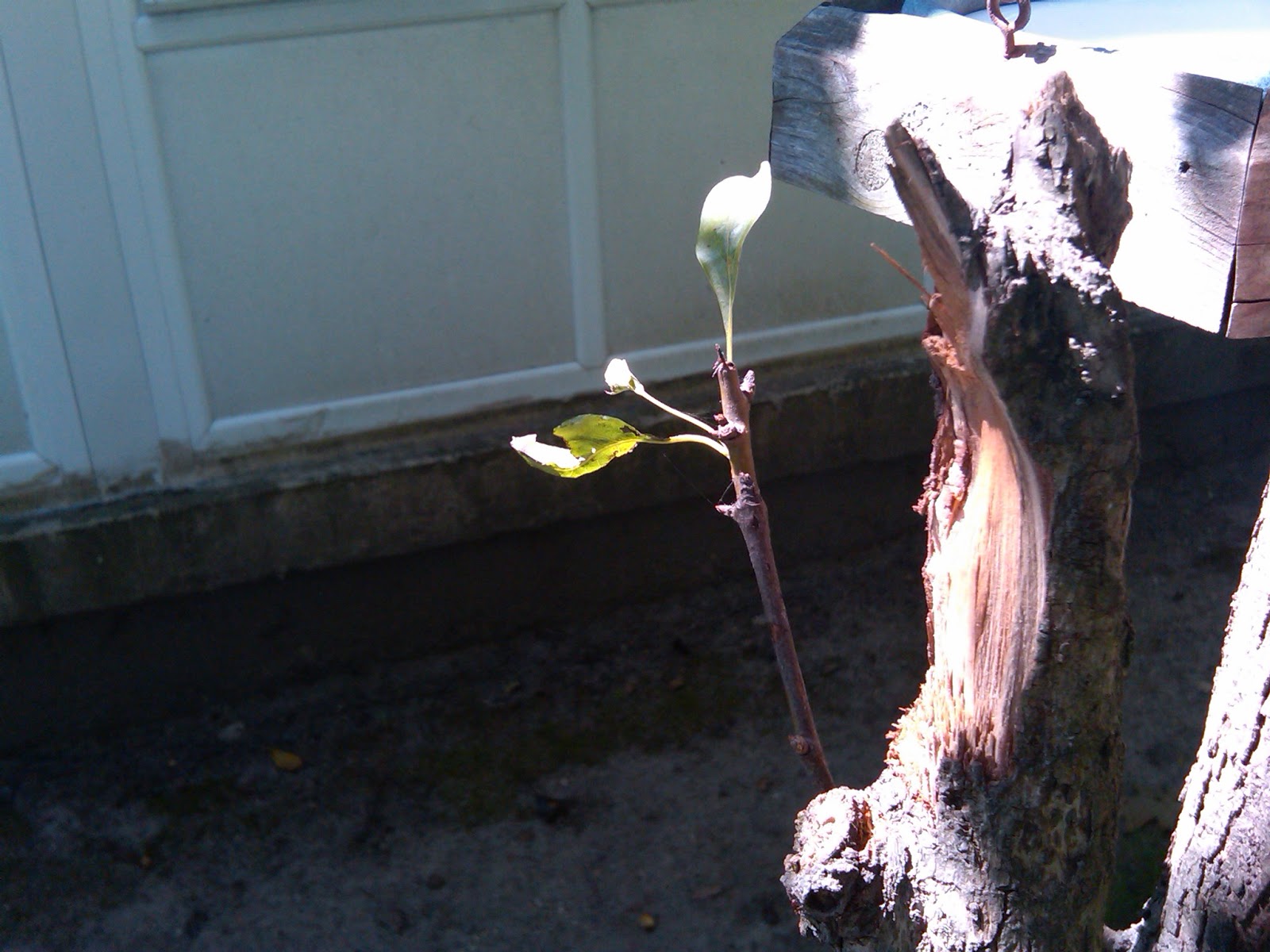
A few weeks ago I wrote about my shock at opening the kitchen shade and looking out the window to see two big hunks of pear tree broken. I said at the time it was likely another bear visit, this time going after the one pear in the tree rather than a seed feeder. I still think it was a bear.

I worried about the pear tree, especially after I did some "pruning" that took off far more than I anticipated. I began to think about what kind of tree I'd get to replace the pear.

Today I went outside to refresh the water cooler and dish. I discovered that once again, Nature provides.

Below shows the growth coming from the snapped ends (once I sawed the broken part off).


New growth from broken pear branches (Margo D. Beller)


A Walk in the Woods

MH and I like to find new places to hike. If we find birds, so much the better. If there's no admission, better still.

So the other day we looked at a map of New York and found the Neversink River Unique Area. It's the word "unique" that interested me. All places are unique to me. However, the "uniqueness" comes from the deep gorge leading from the trail down to the river.

We did not hike that far in. We started uphill along the path from the parking lot among hemlock and pine in an easy grade (maybe not for MH's old knees) until we got to a level part of the path with a clearing. Oaks and maples with the pines. I heard the tittering of black-capped chickadees and titmice but when I saw movement and looked up, I saw something quite different - a male hooded warbler. Moments later, a Philadelphia vireo. A pileated woodpecker called loudly. Black and White warblers chased each other. All told we found five warblers (mourning warbler and ovenbird rounds out the list) in one small area.

This is why I go birding, the element of surprise, of one moment hearing nothing and then suddenly be surrounded by birds. This has happened to me a few times when seeing one bird led to seeing all sorts of "good" birds in a small area. It helps when it's migration, either spring or fall. I suspect the warblers and vireo were using the local knowledge of the local birds to find food.

The only problem was the shooting. Two guys were near the trailhead as we returned, one showing the other how to use a gun. Neither were young. One had the gun, the other a spotting scope, perhaps to make sure the other guy didn't kill anything. The guy with the gun was shooting low into the trees. The sound was loud and scary to me. I made sure they knew we were there as we hiked back to the car and they acknowledged. Eventually they left after other hikers showed up and as we were getting ready to drive off. Maybe we spooked them the way they spooked off the birds.

Hunting and trapping are part of the history of the Unique area, too. 

Woodpeckers With a Sweet Tooth

The law of unintended consequences bit me today.

We have had a lot of rain this summer but in the last week it has not rained much and gotten very hot again. I went outside to check the hummingbird feeder and found it filled with ants that drowned trying to get a drink. I dumped it and took out the cup that, filled with water, acts like a moat to keep them out.
Hummer feeder after downy flew off and before hummingbird arrived. (Margo D. Beller)
I came out today and found a male downy woodpecker on the feeder. I chased him off a couple of times. And then a female downy came to the feeder. I've had to chase her off a few times.

I realized that woodpeckers and hummingbirds have something in common - a long tongue.

So the downys - the smallest of our local woodpeckers - either sat on or perched on the feeder, dipped in their beaks, stuck out their tongues and drank, just like the hummers. It explains why the sugar water levels seemed to suddenly drop very low. I attributed it to the heat.
This would be a better picture if not for the screen but the dark object at the top center is a hummingbird. (Margo D. Beller)

Now I know the downys have a sweet tooth.

We are soon into bird-feeder time and the hummers should be heading south. This feeder will come inside for another year but the seed and suet will sustain the downys and other woodpeckers. I'll worry about a new breed of sugar-sucking woodpeckers next year.

Saturday, August 13, 2016

Three Types of Summer's Winged Wonders

Butterflies

This is the time of summer when I go out to the woods and if I see any movement in the trees it is usually a butterfly. The butterflies I see most commonly are tiger swallowtails, dark swallowtails and the occasional monarch butterfly.
Tiger swallowtail (Margo D. Beller)

August into September must be when the caterpillars break out of their cocoons as butterflies. Adult butterflies lay their eggs, the eggs hatch caterpillars, the caterpillars (after eating a lot of leaves, I think) crawl up trees or shrubs to become cocooned pupas and then they hatch as butterflies, which then head south for the winter.

The nice thing about butterflies, besides their many different colors and the way they seem to float in out of nowhere, is they aren't that picky about where they feed. Yes, they have special needs in terms of where they lay eggs, such as the monarch butterfly needing milkweed, but when they need food they will go to any flower, shrub or roadside weed. They will even come to puddles to drink.

I once walked along a road in a strong wind. There was a tiger swallowtail on a Rose of Sharon flower, hanging on for dear life. You would think something so small and delicate would have a problem in wind but this is one strong little creature. 

Butterflies have a lot of fans, which is why you can do a simple search and find all sorts of butterfly clubs to learn more.

Hummingbirds 

When I last wrote about rubythroated hummingbirds, I mentioned the two that were coming regularly to my feeder. I named them Alpha and Beta. Alpha was the more dominant of the two, hence the name. Beta was rather dusky and very skittish at the feeder, hovering over the portal to drink rather than perch as Alpha did.

Much has happened since then.

First, I realized Alpha might have been a male. We had visited our niece in Connecticut and a male hummer had come to her feeder. The male had a dark head, just like Alpha. The next time Alpha visited I had binoculars with me and did not see a lot of red at the throat, although there was a pink tinge. That was the last time I saw Alpha.
A friend's juvenile hummer (Margo D. Beller)
Beta continued to visit much longer and was soon joined by a smaller, greener individual that was definitely a juvenile male. I named that one Delta. Beta would feed in her skitterish fashion and take off in one direction, Delta would feed and head in another direction.

With the heat and humidity I have not spent time on the enclosed porch, the only way I can see the hummingbird feeder, but it seems to me Beta has moved on and what I call Delta may be Epsilon, Gamma or any of a number of hummingbird visitors. Young are fledging and they have to eat. By now the adult males should've been heading south, and soon the adult females and the young birds will be doing the same.

All I know is, at least once a day a hummingbird comes to feed. I still have plenty of food for as long as they come.

Dragonflies 

One of the things that makes walking with MH so enjoyable is we usually look at different things. I will be looking up in the trees for any bird activity while he will be looking down for snakes, toads and other nonwinged creatures.

But one thing that interests him very much, and is now interesting me, are all the dragonflies.
Green dragonfly blending well into leaf. (RE Berg-Andersson)
You can be in a marsh, in a park, in your backyard and you will have a number of these insects buzzing around, picking off mosquitoes and gnats. If you have clean water, you have dragonflies and the smaller damselflies.

They come in a variety of colors. In the Great Marsh of Concord, Mass., we found a dragonfly that looked like it was red, white and blue. In the Franklin Parker Preserve in southern NJ, in the heart of the Pine Barrens, we found a very large dragonfly that was bright red. We're still trying to identify it.

Usually we find such exotically named creatures as 12-spotted skimmers, white-tailed skimmers, green darners and ebony jewel-wings. There is a state dragonfly association and several Internet sites devoted to field guides and identification. This one even tells you how many different types can be found in each county of New Jersey. In my home county of Morris there are 125!

Like the dragonfly I'm just skimming the surface here. But I am becoming as interested in their colors and diversity as I have been on birds for over a decade. Like the butterflies, these seasonal winged wonders can be easily overlooked, and that is unfortunate.

Sunday, July 3, 2016

The Adventures of Alpha and Beta

When John J. Audubon referred to the ruby-throated hummingbird as "the glittering fragment of the rainbow," he was referring to the male. The male's back and head are bright green, his throat a deep red that can look black in some lights and the breast and belly are white.

Audubon was not referring to the duller females. As with most other birds, the females are not as bright or colorful as the males so as to be inconspicuous on her nest, or getting food for her young.

Attempt at a hummingbird picture (Margo D. Beller)
In late May my New Hampshire brother-in-law hung two feeders and, as usual, two males battled over one of the feeders, leaving the other alone. Hummingbirds will do that - they don't play well with others.

However, one of the males already had a mate and every so often the shier female would come feed, also at the same feeder. She, too, is green but a duller shade and there is no ruby throat.

My brother-in-law, as well as a friend of mine who lives in a hillier part of New Jersey, draw hummingbirds almost from the moment they put a feeder out. I always know the first batch of liquid I make will likely be wasted as I watch for the bird - more insect than bird, wings moving over 50 times a second, able to back up (which no other bird can do) and take off at great speed.

Admittedly, I make it hard on myself. I have the feeder hanging in a shady part of the garden (so as to keep the liquid from going bad quickly in the sun) that I can't see unless I step out on the enclosed porch. I have flowers hummingbirds like in different parts of the garden - azaleas and rhodedendron in the front, for instance, and geraniums and columbine in the back - so the birds are not always where I can see them, unlike the winter where the seed feeders can be seen from the kitchen.

This year I saw a male on June 3, the earliest ever for my yard, and then another one 15 days later. Then nothing.

Until June 30 when the first female showed up.

For some reason, what draws the birds to the feeder are the sprays of tiny pink trumpets thrown up by the coral bells. As I sat on my porch having breakfast, I was aware of movements at the bells and saw the green back. Eventually it flew up and saw the red-topped feeder. It flew over and took a sip. It was very tentative. Its head was so dark I was sure it was a male, but getting my binoculars I saw the white breast and throat.

She came several times that day and has continued coming. This is the typical pattern. At this time of year - June into July - the male hummers have done their genetic duty and go off on their own, sometimes heading south as early as late July into August. That leaves the female with the task of creating a nest, laying eggs, brooding them and then feeding the young, all the while needing food to give her the energy for all that fast flying.

So once she found a reliable food source, she wasn't going to let it alone.

Hummingbird, Higbee Beach, Cape May, NJ (Margo D. Beller)
This is typical. What wasn't typical was when the second hummingbird showed up a couple of days later.

I didn't realize it at first. When the first one - I'll call her Alpha - would stop by, she would feed, then back up and take off to the north, toward a high hedge I keep as privacy from the neighbors. Then I noticed she would fly up to the nearby apple tree, or head east, past my yard and to the next street.

The other morning I took my folding chair outside to drink my coffee and watch the feeder. In came the hummer - and then in came a second one to chase her off. The chaser was Alpha, with the dark head. The one chased off came back about five minutes later. I noticed her head was much lighter green and when she flew off, it was to the apple tree. This one is Beta.

Several times now I have seen Alpha at the feeder and Beta feeding from the coral bells, or Beta at the feeder and Alpha chasing her off, then coming back to feed.

All of this is fun to watch but there are some serious issues under all the feeding and chasing.

These females are making the constant trip to the feeder so they have the energy to sit on their nest or catch food for their young. In my part of suburbia, homeowners leave it to the landscapers to put in their plants and they are usually dull shrubs that do not flower and are cheap to replace. If they have flowers, it is a hanging basket and the flowers are generally not the orange or red trumpets hummingbirds prefer. They don't even have scent, most of the time.

I do have flowers hummingbirds like - bee balm, butterfly bush, salvia, coral bells, columbine - but the deer eat most of them too, and these plants are behind netting as a result. That is the reason for the dull shrubs - easy to replace when eaten by deer and not so lovely as to be missed and thus easily replaced.

My feeder is hanging on that pole in the shade behind netting, too.

When overdevelopment tears up fields of wildflowers and suburban sprawl doesn't replace the lost plants, you don't give a hummingbird a lot of choices. It doesn't have unlimited time and energy to look around.

Hummer drawn by my friend's zinnias (Margo D. Beller)
A feeder, however, is another matter. You buy one at any store. It is usually red either in whole or in part. You boil one-quarter cup of sugar for every cup of water until the sugar is dissolved, wait for it to cool and put it in the feeder. Hang it outside.

There! You've just helped out a hummingbird.

I see many yards with hummingbird feeders, even those with dull shrubs. People like watching hummingbirds. They are fascinating creatures. One second there's a feeder and the next there is a tiny bird sitting and taking long drinks with her very long, thin tongue. Then she rises up and is gone.

They fly backwards. Their wings beat so fast you can hear the blur. Several times I have come face to face with a hummingbird. When it doesn't feel threatened, it wants to check you out. We look at each other, it gives me a small "chip" and takes off. Working in the garden, I've heard an angry squeak and knew I was working in an area where the hummingbird, easily annoyed, was going to check out the nearby plants.

Ruby-throated hummingbirds are not considered to be endangered. More people are putting out feeders and, if global warming continues, hummers might be hanging around beyond late summer when they generally head south to Central America.

I enjoy watching the antics of Alpha and Beta, and if global warming keeps them around longer it might even be worth it. I have lots of sugar.