Cape May

Cape May
(RE BERG-ANDERSSON)
Showing posts with label apples. Show all posts

Wednesday, June 26, 2024

Chipmunks and Squirrels and Deer (Oh, No!)

I want to talk about some of my neighbors, Not the two-legged ones I'd rather ignore. No, I mean the four-legged ones that make gardening even more of a challenge than it needs to be.

But first, a house wren update. Since my last post, no sooner had the one house wren chick fledged but the adult male - at least I think it is the same male - started singing up a storm all over the yard. It was once again setting his territory for his next brood - house wrens have two each year, tho' I haven't always seen two broods in my yard. He is also "fighting" in song another house wren male that has been singing from a yard across the street recently. I have seen the wren in my yard chase off other birds getting too close to the nest box including house sparrows, jays, catbirds, Carolina wrens and that neighboring house wren.

The male wren on the dogwood branch, between
couplings. (Margo D. Beller)

In the midst of his singing he found a mate - the same as before? - and the female has set about making the box her own, clearing out some stuff and replacing it with some twigs and grasses to line the nest for her eggs when they come. There has been frequent coupling in the dogwood tree so there are no eggs at the moment. 

Now back to the neighbors.

My main problem with chipmunks is they dig, and they are small enough to get under or around my deer fencing. So I find deep holes dug around my plants, usually just after I plant them in the ground or in a pot. If I catch the damage in time I can put the plant back in and save it but that doesn't always happen. I discovered one chipmunk continuously dug up a canna I kept putting back in - when I figured out it wanted a spot for a tunnel hidden by the peony I moved the canna. Another time I came out the front door and a chipmunk jumped OUT of the cage I had put around my pepper and basil plants and a couple of annuals to protect them from the digging. So much for that brilliant idea.

The cage and all but one potted plant (a zinnia) are now stowed inside, either on the enclosed porch or in my sunny front room. (The pepper plant has a nice-sized fruit growing on it and I don't want it seized by the rodent.) Now I am thinking that next year I won't have many pots of plants outside.

Why do chipmunks dig? Maybe to create tunnels for transportation for themselves and their young or to look for acorns they may have planted in these or similar pots last year or to put new acorns in for the winter. Whatever the reason, they create havoc in my garden.

Squirrel in apple tree, caught in the act.
(Margo D. Beller)

Squirrels are too big to follow the chipmunks behind the netting and don't want to get caught in an area they can't escape. But they do climb. They climb into the dogwood to look at the nest box (and are chased away by the male wren). Thanks to the fur coat squirrels always wear they get very hot and very thirsty. Over the past few years squirrels have managed to break or damage water containers I hang in the pear tree by acrobatically grabbing the container with front paws while hanging onto the tree with rear paws. That's when they pull the container down.

One of the water containers squirrels have
damaged over the years.
(Margo D. Beller)

They also really, really like apples.

The old apple tree has been showing signs of stress in recent years, ever since I last had it pruned. This year it produced a lot of blossoms, to my surprise, and that means a lot of apples. The tree dropped many apples on its own early on, and the recent strong winds have blown down more. However, usually it is the squirrels that let me know when the apples are ripe. The climbing begins and I must once again try to get as many apples as I can for myself before the squirrels, which are very sloppy eaters. In this current hot and humid weather they have been particularly active, tho' not as bad as the time I came outside and six squirrels jumped out of the tree. Yet.

If I don't pick up what the squirrels drop the deer get them and leave a mess of their own. I throw chewed apples into the corner of the yard near my compost pile.

From 2018. The apple is now showing signs of stress but
it still produces fruit for me ... and the squirrels.
(Margo D. Beller)

I am sure those apples are feeding that fawn that found its way behind my deer fencing. The other week fawn and doe were passing through my backyard and when I came out the fawn took off, running in circles until its mother led it across the street. Did I give it PTSD? Good. It is because of the deer I must struggle under and over and even around the deer fencing around my garden plots.  

These are the most common critters, although this yard has seen the occasional coyote, bear and, too often, cats that must be some neighbors' pets because they look too neat to be feral. I can almost forgive the trouble animals cause me because they are doing what they do in order to survive. The two-legged ones are another matter.

Sunday, July 10, 2022

Apples and Wrens, Yet Again

In my yard, the apple tree and the house wren nest box are forever linked, and not just because until two years ago the box was in that tree. From late June into July, both are busy with young. In the tree's case, that means a lot of ripe, edible apples drawing squirrels, insects and birds. For the birds, it means the parent wrens taking turns flying to the box to feed their chicks.

House wren feeding young, 2022 (Margo D. Beller)

For the past two weeks, the young - two? three? Can't be much more in that small box - have grown. I know this because now when a wren comes to the box, the sounds of begging are loud enough for me to hear without opening a porch window. The parent can't get inside. It flies to the opening and whichever chick has muscled its way to the front gets the insect meal. 

As for the old tree, last year there was so much rain we had an abundance of apples, so many I had to sort what I picked (or picked up when the squirrels dropped them so the deer didn't get any) and put the ones I knew I wouldn't use in a corner of the yard for the critters. Even then I made several quarts of apple sauce. This year, either because there has been less rain or the squirrels took advantage of my being away for five days on vacation, there have been fewer apples in a good condition to use, enough for one pail rather than my larger apple basket. I intend to use what I have and leave none for the critters. If I'm lucky, by the time I cut off the bad parts and cook the good ones, I'll get one quart out of all of them.

Two of the last apples of 2022. A squirrel later got one of them.
(Margo D. Beller)

Some years, things get out of whack between the nesting and the fruiting. There have been years when the squirrels started going into the tree earlier, in mid-June, for the juicy apples because we were in an unusually hot stretch. In those years I would be concerned the squirrels would disturb the wren sitting on eggs and the tree would survive the drought. There have been other years when the young wrens have fledged before apples were ready to be picked. Some years the tree would not have many flowers in the spring, and that would be a year when I would not be making much apple sauce, if at all. 

It was during a plentiful year that I had to use an extension pole to knock down apples if I wanted to use any, thus disturbing the wrens as much as the squirrels. That was when I decided to move the nest box to the dogwood on the other side of the yard, which also allowed me to watch the wren activity more easily.

(Margo D. Beller)

Any day now I expect to bring my morning coffee to the porch and see no feeding and hear no begging. Every so often I've been hearing one of the parents calling from a shrub, trying to draw out its young. At the moment they are, like a lot of young nowadays, happy to stay at home. Why go out when Mom or Dad brings me what I need?

However, unlike their human counterparts, the wrens' brains are hardwired to continue the species. At some point instinct will kick in and they will leave box, learn how to fly and feed themselves, and then leave in late fall for their winter grounds. If they survive the trip, they'll fly north next spring to pair up, find a suitable nesting spot, mate and make more young. 

As usual, I hope at least two of them will be in my yard.


Saturday, June 11, 2022

Watching and Waiting

Thanks to technology, it is possible to put the smallest of cameras into a nest box to record what is going on inside. Do a search of "nest box cameras" and you'll find all the latest models. Do another search of "watching nest webcams" and you'll find links to cameras put into or near nests by Audubon, the American Eagle Foundation and others. Thanks to webcams you can see into the nests of barn owls, bluebirds and American kestrels. It's an easy way to learn about birds and get engrossed in their life cycles. It's as easy as watching TV.

One of this year's wrens, on the branch
below the box. (Margo D. Beller)

I, however, don't have such a camera. To know what is going on in the house wren nest I have hanging I must depend on my many years of watching and being very, very patient.

After I relearned my lesson about intruding it took several days before the house wren pair resumed their activity in and around the nest box I had put up in the dogwood tree. It was very silent in the yard. Just when I'd think the wrens were gone the male would sing, briefly. This happened for several days. Then, on the fourth day, the house wren male started singing early and often, and I saw the female going into the box and not coming out again for long periods of time.

There must be eggs, I thought then. Now, I think there must be young.

According to the experts at Cornell, egg incubation takes nine to 16 days. Once the eggs hatch, the nesting period is another two weeks or so. Today when the female came back to the tree she had an insect in her bill. So there are young, I thought, likely three or four (house wrens can lay up to 10 eggs per clutch, but not in this little box). Right now the chicks must be very small because I hear no calling when either parent is in the vicinity of the nest. That will change when the young get bigger, noisily clamoring to be fed.

There have been other signs of life in the yard.

Blooming viburnum, already fading.
(Margo D. Beller)

Every so often I have to remind myself to go outside and look at the flowering plants before it is too late. Often, it is too late. The showy red peony flowers are already spent, as are those of the azaleas and the rhododendron. I've already deadheaded the columbine and the iris but the daisies, coneflower, goldenrod and sedums are growing quickly. The Stargazer lilies have opened. The coral bells continue to bloom. The viburnum is covered with white flowers that are already starting to fade. 

There are flowers on the privet bushes that will become little black berries, and the wild cherry tree is covered with green fruit that will ripen for the robins that will soon acrobatically pick them off. There are small wild strawberries all over the yard and a couple of wild raspberry bushes that sprang up in areas where they are not in the way, so I have left them. What I don't pick the birds will get.

The pear tree, way too tall, has fruit growing on branches resting on the roof, perfect for a hungry squirrel ambitious enough to climb up.

One of this year's catbirds. (Margo D. Beller)

And there will be apples, plenty of apples. I'll soon be busy collecting them before the squirrels (and the deer) can do much damage. Those apples are the reason I moved the wren box from this tree.

Yes, it would be easier to see what goes on inside the nest box. I could sit at my computer and watch, like some sort of Peeping Tom. There would be no wondering, no reason to even go outside.

No, thank you.


Thursday, June 13, 2019

A Delicate Dance Around the Apple Tree

I was so hoping the cool, wet spring would keep the squirrels hydrated so they would not need to climb into my apple tree and start eating. But no. The first spate of sunny, warm days and they were in there, even though to me the fruit was not large or ripe enough. But to squirrels, apples of any type are a temptation at this time of year.

The first of this year's apples (Margo D. Beller)
And so over the last few days I have been outside either picking up usable dropped apples or picking what I can reach. Most of these apples are not ripe but when I cook them with enough sugar they will taste just fine as apple sauce.

Most apples can be picked in the fall. This tree has always bloomed in the late spring. When I first realized these apples were sweet and thus edible, they would ripen red. I took one to the manager of a farm market near me and he said it was a type of Macintosh. All I knew was of the five apple trees planted by the previous owner of my home, this one had usable apples. (The other four trees have since been removed.)

The problem is the house wren box, which prompts me to do a delicate dance when it comes to gathering the apples. I hang it in the apple tree. When I get too close to the box, one of the wrens starts to fuss, either from high in the tree or from a nearby bush. On occasion both adults scold because I am too close. I had hoped that by standing under the tree when the apples were first appearing the birds would get used to my presence. Perhaps it has worked, as long as I stay away from the box.

Apple tree with this year's crop and house wren box (Margo D. Beller)
In past years, the squirrels didn't start hitting the tree in droves (the record is six at once) until late June or even early July. Some years the tree provides a meager harvest while others there is too much. This year, based on the number of blossoms that bloomed for over a week this spring, looks like it is in-between.

Under the late June-early July scenario, the house wrens were usually done with their brood and they, and young, would have left for larger quarters (such as a nearby hedge) before separating and flying south. But this year with all the drama over whether there would even be a wren family, the nesting started later than usual.

So thanks in part to the increasing global warming affecting even my part of the U.S., my yard has a bad combination of late nesting and early apple picking.

There are two other figures in this dance: deer and birds. Squirrels are sloppy eaters, I've found. If they take an apple and run off to a safe location, I'm ok with that. But when they eat in the tree there is a likelihood part of that apple will end up on the ground. That is particularly true when I go out to shoo them away. Unless I pick up those apple parts and either throw them in a corner of the yard or put them in the garbage, the deer will stop by and eat this free food. I know this because they leave lots of calling cards.

As for the birds, some, like American crows, like to eat fruit but in my experience most of the time a bird will peck into the apple to draw insects to it or to get at any insects already inside. I don't spray the tree, so when I do use the apples I have to cut off a goodly amount of them to make sure that, at minimum, I'm not mixing a worm into my apple sauce.

Feeding the young in 2018 (Margo D. Beller)
So once again I will be stiffly going outside early in the morning and then perhaps again at dusk to retrieve any fallen apples. Many are the times I've picked up a pail's worth of apples and maybe one-third of them have not been partially eaten or pecked. When the wren young have left the nest I will take out my long stick and start whacking the tree for the apples in the mid level while the squirrels go after the ones in the highest branches I can't reach. They can have those.

The good news is, this madness should be over in about 10 days and the cooking will begin sooner than that. In the meantime, I'll be trying to disturb the house wren family-in-the-making as little as possible.

Saturday, June 23, 2018

Because It Is Hard

We choose to go to the moon in this decade and do the other things, not because they are easy, but because they are hard...

John F. Kennedy, Sept. 12, 1962

I doubt President Kennedy was thinking of his garden when he announced the space race in his speech at Rice University. But a variant of those words, "because it is hard," kept sounding in my brain earlier this week as I was yanking miles of ground ivy out of areas of my garden I thought I had protected from encroachment with a trench.


Feeding time, June 2018 (Margo D. Beller)
I thought of those words again as I was standing beneath my apple tree this morning and a record-high six squirrels jumped out of it. The house wrens have been shuttling back and forth with food for their young, which must be growing fast. The adults must feed the young by clinging to the outside of the box. From inside, what had been little cheeps are now the same type of dry, rattling "scold" the adults call every time MH or a deer or I get too close to the nest box.

In fact, the wrens seem less perturbed by all the squirrels running around the tree than they are by me after I angrily pull off all the low-hanging ripe apples I can reach, just to have some instead of the squirrels.

Because it is hard.

Another thing I think of at this time of year is the myth of Sisyphus, the guy condemned to an eternity of pushing a large stone to the top of a hill, only to have it roll down to the bottom, forcing him to roll the stone up yet again. Sisyphus' story is used as an allegory for all sorts of things, in my case the uselessness of trying to control weeds when I know they are going to come back, or keep the squirrels from dropping partially eaten apples that will attract deer and other creatures, which will leave a big mess around the base of the apple tree. 


Ground ivy (Margo D. Beller)
And yet, there I was earlier this week outside with my shovel, trying to reinforce the trenches I put in last fall, which were subsequently eroded by recent very heavy rain. There I was struggling with the netting I put in so securely to keep out digging chipmunks that now I can't get in either without going to a great deal of planning and difficulty. 

There I was pulling out clump after clump of ground ivy that was growing over the trench and into the areas where I thought I had eradicated it. This ivy spreads through underground roots that regenerate even if you yank up the above-ground part that breaks very easily. (My weed reference says that if your lawn has ground ivy, dig up the lawn and start over.) There I was trying to push aside the foliage of the daffodils now that the flowers are long gone to allow me to see the other plants now growing. 

Why do I do all this? Because it's hard. You put in a garden, you take care of it. You have deer that will destroy plants you now know you should never have planted, you put up fences and netting. If you don't take care of the garden it will look like crap. If I don't get the apples I won't be able to make apple sauce or cobbler. It's just that simple. 

Last year's apples (Margo D. Beller)
But it is hard. Many times I think, why bother? Why push myself? What's the point? Lots of phrases come to mind: Tired of living and scared of dying. Dying is easy, comedy is hard. In the long run we are all dead. Someday someone else will be living in this house and might chop down the tree. Maybe even pull down the house and replace it with something grander. Pull out the garden I've tended for several decades. 

For now, I listen to the singing Carolina wren and do my work. This and other birds fly thousands of miles to breed in one favored area because the cycle of life must go on. Besides the house wrens there are chipping sparrows feeding in the yard with their parents. I see the yard catbird followed by a begging youngster. Birds don't sit and agonize. Even birds that find themselves feeding a cowbird chick instead of one of their own keep feeding it. They get on with it.  And so do I, even when it's hard.

Perhaps it is true that in the long run the pessimist may be proven right, but the optimist has a better time on the trip. I'd like to believe that.

Sunday, June 3, 2018

Of Apples and Wren, Again

Early June. It is cloudy, cool and breezy on the porch this morning, a relief after the heat and humidity of yesterday when I was walking in a fog all day and had trouble breathing. Today, though damp, the coolness gives me more energy.

Not MH, however. It is the season of the long grass and it has been too wet for him to use the mower. He is waiting for the grass dry out a bit but in doing so we have the beginnings of a deer meadow. I am watching for deer dropping any newborn fawns in the grass, or eating the foliage of the shrubs that have enjoyed all the rain and humidity. The trees have leafed out and everything in the backyard looks very lush.

The porch window is open and the apple tree says, "Come see me. I am fertile and magnificent."

Apples in the making, 2018 (Margo D. Beller)
And she is! All the flowers of a few weeks ago have disappeared and in their place are tiny, growing apples, hard to see among all the leaves until you get close enough. The squirrels are already going into the tree, as they do every year, looking for an apple to provide moisture on a hot day, even a hard, small one. They go into the tree and, in the process of moving around, knock small apples to the ground for the deer to find. I don't feel like searching in the long grass. It will be enough of a struggle to pick up larger, partially eaten fruit and toss them into the corner for the deer while picking what apples I can for this year's sauce and pies.

This year's house wren sees me near the nest box that hangs from this tree and starts singing insistently from a nearby oak. The song is his territorial song and must also be a warning because soon his mate flies nearby. The singer is a plain little bird, brown except for the tan of his breast and belly. He looks strangely green in this cloudy morning light when surrounded by all the leaves. He sees me looking at him and flies to a higher branch of another tree. I wonder if there are eggs in the box and, if so, when they will hatch.

I take another step closer to the tree and the wren flies nearby to scold. "Go inside. You're disrupting things," the tree tells me. I step away and sit inside. I watch the wren fly to several places around the yard to sing or find food.

Apple tree with wren box at the bottom, summer 2018 (Margo D. Beller) 
Aside from the cardinal pair that still comes to the empty feeder pole looking for seed, the call of a distant chipping sparrow and the chattering catbird flying from its nest in one bush to another bush across the yard and back, the house wrens are once again the extent of my summer birding unless I see something in passing during my travels. At this time of year, I must take advantage of these cooler days to keep the ground ivy and other weeds in check and have no time or, on hot days, energy for birds. On hot, muggy days, I stay where it is cool. The birds can't do that. They must hatch and feed their young and teach them how to fend for themselves and maybe even have a second brood with another mate before the days shorten and instinct tells them it's time to fly south.

Meanwhile, also as usual, the apples will get bigger on the tree. This tree is rather odd, putting out a Mcintosh-like apple in June and July rather than in the fall, as other apple trees do. But the fruit is sweet, and that is why I will be racing the squirrels (and perhaps bear?) to pick as many as I can for approximately three weeks once the apples start to ripen.

I am hoping the house wrens will have had their brood and flown off before the squirrels and I disturb the tree too much with our picking. It works out that way each year and, barring a catastrophe I can't foresee, should happen yet again.

Sunday, May 27, 2018

See You in September

It is always with mixed feelings of sadness and relief that I take the seed feeders inside for the summer.

Carolina wren at feeder, from another year.
(Margo D. Beller)
The signs were there. Few of the birds I like - chickadees, titmice, white-breasted nuthatch - were visiting but there were plenty of birds I don't like:  A grackle hogging the house feeder. A jay swooping in again and again, swatting away any bird, including a big cardinal, that dared come to the feeder between swoops. A family of house finches - a brood already? - swarming the caged tube feeder, eating more than half the seeds in a day.

With the feeders inside for the next few months the downys and redbellied woodpeckers will have to work a bit harder prying bugs from tree bark as they walk along the side of a tree trunk. The cardinal pair that would be sitting on the feeder pole waiting for me to bring out the feeders in the morning will have to spend more time searching the trees and the grass for insects to feed themselves and their young.

They will do alright without me.

Hanging baskets 2018 (Margo D. Beller)
To give myself something to look at from my corner porch chair, I've hung two plants that usually spend the summer sitting on the sunny window ledge in my front room. This is an experiment to see if these plants can do well outside where they'll be rained on, baked in the sun and visited by insects. Who knows, the pink geranium might even draw a curious hummingbird.

There is one feeder still outside. The hummingbird feeder is out, hanging above the pink flowers of the perennial geranium and the coral bells, and I am hoping a hummer or two come by this year. The only other bird that concerns me now is this year's house wren, which has been singing continually to protect his territory. When the bird first claimed the box there was a second one, presumably a female that accepted the offered lodging. But lately I've only seen the one wren, singing from a tree, the feeder pole, on top of the nest box.

Apples in the making, 2018 (Margo D. Beller)
If there is a brood this year I should be able to hear it soon enough and I hope all will have fledged before the apples need to be knocked off the tree for me to use before the squirrels can ruin them. Based on all the flowers this year we'll be having another bumper crop.

So with apples and summer's heat and humidity on the horizon, it is a relief to not have to worry about taking the feeders in each night to avoid any bear, or put them out early each morning when my back is stiff. I do have water out for the birds and that is really all they need from me as long as there are insects to provide the protein. They won't need the fat from my sunflower seeds until it starts to get cooler and the days grow shorter after Labor Day.

And that is when the feeders will go back out. I'll miss the cardinals but I've no doubt they'll be back again.

Monday, July 17, 2017

The Fruits of My Labor

I am in no way, shape or fashion a particularly sophisticated cook. MH rarely complains about what I put in front of him, even if there are too many leafy greens for his liking, but I am not in the same league as various friends and family who really know their way around a kitchen.
Blueberry cobbler (Margo D. Beller)

However, while I wouldn't know what to do with an eggplant without instruction, I do enjoy making desserts. At this time of year I have all the ingredients I need.

First, were the apples. After weeks of cleaning up after the squirrels the apple harvest for 2017 is finally drawing to a close, to my relief and, no doubt, the tree's. After making six pints of apple sauce and swearing that was the end,  I had another two dozen apples that were either close enough for me to reach or the squirrels dropped while they clambered over the tree's branches. (This morning I noticed it took a lot longer, and the squirrel had to go a lot higher, to get an apple. These are at the very top of the tree, too high even for my extension pole.)

So I made another quart of sauce. This was a week after my last marathon cutting, cooking and Cuisinarting of sauce (not to mention a mess of pesto and an apple cake that was more apple than cake). However, MH, who had put up with the fresh zucchini I'd fed him for one meal, asked me to make a zucchini bread, which he remembered fondly from the last time I made it.

Thus, I went to my favorite farmstand and bought a couple of zucchini.

This is a wonderful time of year if you like heat and humidity, as various plants do. Zucchinis are coming in, tomatoes and corn are not far away and I have already picked one pepper that's now reddening on the counter. Next time in the market I'll be stocking up on more NJ blueberries to freeze for later on in the year. Why NJ blueberries? They are literally closer to home and taste better to me than fruit shipped from elsewhere in the U.S. or around the globe.

Out in the garden the daisies and the butterfly bush are blooming and at least one hummingbird continues to visit the feeder. When it is not raining I have a thistle sock out for the goldfinches, although I've yet to see a visitor.

Half of one zucchini bread heading for
the freezer (Margo D. Beller)
Meanwhile, back in the kitchen I have the vegetable drawers filled with chard and zucchinis.

Ever since the terrorist attacks on Sept. 11, 2001, there has been an inclination toward sticking close to home, locally sourcing the food you buy, and cooking things yourself. Maybe it is a yearning for a simpler time, a time before the 24/7 bombardment of the Internet, cellphones and movies on demand anywhere. For those who would like to cook like Mom or Grandma once did but haven't a clue you can enroll in one of the many cooking schools, or use a company that will ship you ingredients and directions for what to do with them. Presto! Home-cooked meal.

I'm not that bad. I can follow a recipe if I want to. The key is wanting to. When I have a lot of fresh fruits and vegetables in my refrigerator and a picky eater, I sometimes have to be creative in what I make for supper.

In the case of the zucchini bread, I didn't have that problem since I was making it at MH's request. First, I had to find my old zucchini bread recipe. But in the course of looking for that recipe I found one for a ridiculously simple blueberry cobbler I'd clipped from the New York Times in 2008 and never made.

Since I happened to have a big container of blueberries I was getting ready to freeze, I decided to use the Cuisinart and make it. As I said, ridiculously simple, and MH loves it despite not being overly fond of blueberries on his cereal.

More apples than pancake (Margo D. Beller)
As for the zucchini breads (my recipe makes two loaves), that came after the cobbler and the apple sauce in another marathon cooking session. I recently bought a hand blender, a souped-up version of one I had years ago that collapsed, and this has not only made mixing things so much easier but has made me more inclined to bake things. (This may be good for the taste buds but not the waistline.)

For now my freezer is filled with, among many other things, one zucchini bread and half of another, pints of apple sauce, containers of vegetable stock and one of pesto.

And I just found an easy recipe for eggplant.


Wednesday, July 5, 2017

Family Time

It is a pleasant day for early July, and I am on my patio with my binoculars. Behind me, I hear my neighbor walking around her yard with her two little girls. She will soon give birth to her third child.

Unlike humans, who can conceive and give birth any time of the year, the birds are limited to a short period after they have migrated north to their breeding grounds in the spring but before they must leave for their southern feeding areas in the fall.

Jay (Margo D. Beller)
So now, in early July, even though the house wren box is empty, the yard is full of calling birds again. This time, it is noisy families of titmice, house sparrows, fish crows and blue jays.

With all the feeding activity, whether it is an adult going back and forth to a nest or being followed by hungry, raucous young, there are plenty of opportunities for birders to get out there and find something again.

Even the wrens are not completely gone - coming back up the driveway after putting the garbage can at the curb the other day, I saw several little birds poking between the paving blocks by the front door. One flew past me to a nearby bush. It was a house wren. Its parents have already taught it to stop begging loudly because it is no longer protected in the box but out in the open.

Today the apple tree has been visited several times by squirrels, and I have had to clean up after them. It is a temptation to knock down more apples but I still have too many that must be used soon. So I sit in my folding chair and watch as a noisy flock of jays goes into the trees to peck the apples for a cool drink or pick bugs off the apples and leaves. These big birds don't have to worry about danger as much as the small wrens and, like their cousins the crows, they call loudly to each other and stay in a flock. For the most part, they feed themselves. But when one parent gives a juvenile some food, they all rush to the tree branch and beg before the parent flies off and they go back to the apple tree and then to the next yard.

In the past I have seen grackles and both kinds of crows - fish and American - hitting the tree for the same reason as the jays. The squirrels are a little leery of these bigger birds but, despite some hesitation, they go up and the apples come down, some so ripe they fall uneaten for me to collect. Were the wrens still in the box I'd be more concerned because big birds will eat baby birds.

(courtesy of Mike Anderson, director, Scherman Hoffman)
Catbirds are flying around, a cardinal is calling and a speckled young robin, its breast in the process of turning red, is poking the ground around the lilac. Downy woodpeckers, the young male's red head spot not completely filled in, are calling to each other as they explore the bark of the various trees. I watch one in a hemlock and see that, unfortunately, the wooly adelgid is doing its destructive work again for the first time in years. In hot, dry summers this fungus is kept down but after all the rains this season, it is back and will literally suck the life out of the hemlocks unless I spray them with oil, a messy and time-consuming process.

Hummingbirds are also coming to the yard. At the moment there are two females, one rather dusky and fidgety, the other with a shiny green back and clear white breast. Until I looked at her with my binoculars today, the lighting of her head made her look like a male with a dark, ruby-red chin. This hummer comes to the feeder and sits to eat. You don't realize how long a hummingbird's tongue is until you watch her with binoculars and see the light rippling of the liquid below from her tongue lapping at it.

Both she and the dusky one - who hovers over the feeder, her wings going a mile a minute as she feeds - have nests somewhere but not in the apple tree, although I've occasionally seen one fly there to rest and preen when the squirrels are taking a break from their raids.

I've seen a hummer nest only once, and that was only because I was standing on a bridge over a brook at the Great Swamp and the hummer led me to it. The nest of moss and lichen was at the end of a thin branch hanging over the brook, to keep it safe from predators. She flew in and sat on her eggs. It was a remarkable construction, strong enough to support them now and two or three growing hummers later.

Goldfinch pair (Margo D. Beller)
Finally, I hear a calling male goldfinch. Goldfinches do their nesting later than other birds because they feed their young exclusively with seeds, and it is in the midsummer that thistle and other seeds are ready. If I put out a feeder at all during the summer, it is a thistle sock for the goldfinches. At the moment I have no plans to buy seed but that could change. In the meantime, I'll just sit and listen.

Sunday, July 2, 2017

Wrens and Apples

The backyard is now lushly green. The flowers are gone from the shrubs and trees, and the grass is not too short or too long at the moment. There is very little other color except for the pink flowers of the coral bells and fringed bleeding hearts, the red hummingbird feeder and my bright blue bucket for collecting apples for the house.

Apple tree, July 1, 2017. Wren box is to right of the trunk.  (Margo D. Beller)
On the morning of July 1, I walked outside with my bucket and realized something was different. The constant chatter and begging of the house wren young was not coming from the nest box, as it had been the day before. No, one bird was calling from higher in the apple tree and two others were on the ground in the one area where not much sun shines during the day, behind me just off the porch.

I went over and found, barely, two very dark brown young wrens in the dirt calling for food while one of their parents scolded me from a nearby bush.

I went back to picking apples. Later in the morning, when the sun had dissolved the summer haze, I went out to find no wrens in the tree or on the ground, but they were calling from the thick hedges at the edge of the back yard. Later still I went out to pick up partially eaten apples dropped by the squirrels and heard absolutely nothing. I kicked myself for not having my camera on me the day before when I saw two of the young jostle for the best position at the box opening.

These birds had flown.

Empty nest (Margo D. Beller)
According to last year's calendar, the wrens in the box fledged on June 23. These wrens were about 10 days late, which makes sense considering the adults didn't take over the box until a week after the chickadee pair that had gotten there first suddenly abandoned it. So while the wren parents were shuttling back and forth to feed their young at the box at my neighbor's, the ones in my yard were not quite as frenzied, and the young made the occasional peep.

In years past, such as in July 2011 when I wrote my post "This brood has flown" (which I'll have to republish someday after messing up the link), I have come out one day to hear wrens and the next day come out to hear nothing. This is the first time I have witnessed an intermediate step. I don't know if they have left my property entirely but today I still heard nothing.

What drove them out?

It could've been the high humidity and heat. That box, with three growing young in a confined space including a twig nest, must've gotten very crowded and hot. It could've been instinct. It could've been my taking my long stick to drop more apples, carefully doing my hitting of tree branches away from the area where the box hangs. It could've been the four or so squirrels going back and forth into the tree after sweet liquid from the apples on a hot day.

Whatever caused it, the wrens are gone. I will leave up the box in case a wren wants to start a second brood in it before it is time for it to migrate south in autumn.

Meanwhile, I am done collecting apples. If the wrens had been "on time," they would've been gone before the apples ripened enough for me to use that stick on the tree. Well, having collected over 200 apples (a rough estimate) in a bushel basket I had in the cellar, the squirrels can have the rest. All I do now is pick up the mess and dump it in the non-lawn corner, where evidence shows me the deer have been devouring them along with squirrels or chipmunks.

What do I do with all those apples, you might ask.

2017's bumper crop (Margo D. Beller)
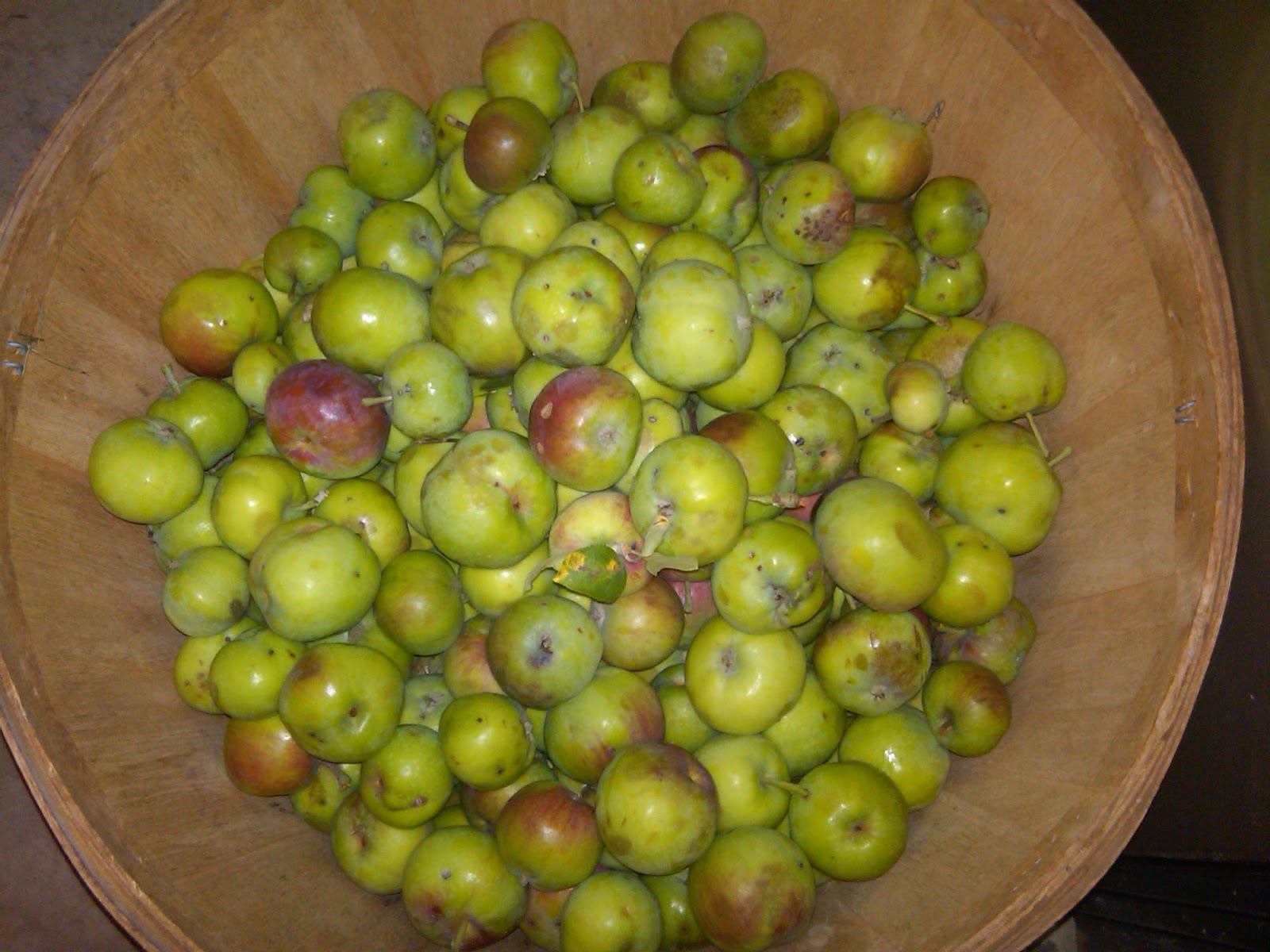
Well, I have amassed many recipes. So far this year I have made 5 pints of apple sauce and one apple bundt cake. The apples I have not used are in another blue bucket in the basement, which I can carry more easily than the bushel basket.

The hardest part is the chopping. I used to peel apples but nicked myself too many times. So now I wash and cut. Long experience has taught me whether there will be a lot of usable apple or whether to just toss it after the first chop. I admit, after cutting up about 100 apples in two shifts (applesauce, then an apple cake, then more applesauce) with more I can use, I can afford to get picky.

These apples from my tree are smaller than the ones you get in the store, in part because I have to work fast before the squirrels get all of them. A farmer told me the apples look like a form of macintosh. In the picture above you see there is not a lot of red in them. I went for size - easier to cut a larger apple - over redness, and cutting into one bears this out. The redder ones are riper, and usually has evidence of rot or insects in them. The not-quite-ripe ones were firmer and I could use more of them, once I cut out the core and stem (as seen below).

My grandmother used to make apple sauce. I never learned her recipe but the sauce was delicious. She bought her yellow apples from the store. I can't say my sauce is any better but if I have any reason for making it - aside from having too many apples - she is it.

Making apple sauce, 2017 (Margo D. Beller)
But preparing the apples is not a task I enjoy, even though the finished product tastes fine to me and MH and to those lucky enough to receive a pint. So far most of the pints are in the freezer. Each year I have a good number of apples (last year was an exception - the apples were done the same day as the wren nest and I had so few I just cut them up and used them in pancakes), I collect a lot of them and then pick a day to do all the hard work. It requires a lot of time as well as standing and careful chopping, making sure I don't take off a finger or two.

The bundt cake was a first for me, and a really messy process because I don't do a lot of baking. I am more impressed by my baking friends than before, especially those with the right tools. I had to use my grandmother's very manual egg beater on the thick batter and was glad I had done some exercising recently because it gave my arms a workout. Did she use it to make her sauce? I don't know. As a small child at the time I had no interest in how the sauce was made, just that I wanted some. Nowadays people have more of an interest in what they eat and in making food themselves. This is a good thing.

As for the rest of those apples, I have bought an electric hand mixer, so I expect I'll be making another cake and yet more sauce.

Friday, June 23, 2017

Chatting With the Apple Tree

Apple tree (Margo D. Beller)
We have passed the point on the calendar marked "First day of summer" although from a meteorological standpoint, summer began on June 1. There are two hummingbirds at the feeder. I know this because frequently they show up at the same time and one chases the other off. Because they look alike, I can't tell which is the Alpha and which is the Beta. However, one does tend to squeek when it flies off or is disturbed. I heard it from the tree this morning as I was picking apples.

Most apples grow in late summer into autumn. I have one tree that blooms in late April or early May and puts out fruit a few weeks later. Some years, such as last year, drought conditions prompted few flowers and thus fewer apples for me to pick. This year, with all the rain, there was an overabundance of flowers and now you can see the apples growing.

Last year I brought one to a farmer I know and he identified the apple as a sort of Mcintosh, although these are usually ready to be picked in the fall, too. But my apples are usually ready in late June into July. I know this when I see squirrels climbing up, grabbing one and running off with it.

Thus begins an annual routine. I go out with a bucket, pick up whatever the squirrel has dropped and then pick whatever apples look big enough to cook - ideally I'd like them redder but I am in a race against time here - before the deer can come and eat them. The other morning I had just done that when a big doe arrived and started browsing. I chased her off but she did not go willingly.

House wren in apple tree. (Margo D. Beller)
This is suburban life now. At one time deer were afraid of people. No longer.

I do this picking (or picking up) twice a day, in the early morning and at dusk. But judging by all the deer excrement under the tree, I can't get everything.

When we bought the house over 20 years ago, it had been standing at that point 30 years or so. The previous owner must've fancied himself a gardener because he put in five apple trees, a pear and a cherry. He also built up a small, terraced garden with railroad ties. However, he stopped taking care of it, then moved out ahead of a divorce and the ties rotted. Chipmunks nested beneath it. When we had work done on the house and surrounding property, the ties were removed.

However, the trees stayed. The cherry eventually rotted and I had three of the five apples taken down because the fruit was not usable to me but made a big mess in the yard thanks to the squirrels and deer. The fourth, a small tree and the same type as the one that remains, was killed by too much rubbing of antlers against it by young bucks.

Where one tree was removed is now a garden of ornamental grasses and other plants deer tend to leave alone. Where two others were are now planted a dogwood tree and my friend Spruce Bringsgreen. But I kept the last tree because the apples make good sauce or pies. It holds up the house wren box, where the adults are now shuttling back and forth to feed peeping young. It provides some shade. It is a place for birds to perch such as the hummingbird. During the flowering season, I discovered 14 cedar waxwings going after the bugs, or perhaps eating the petals.

But those apples do draw the squirrels and the deer.

Recently I sat outside on my patio, admiring this tree with its growing fruits. I had it trimmed a few years ago but now it is bushier than ever.

I am an old tree, she told me. I have to do much to protect myself and to protect my young. When I have too many, as this year, I must abort many of them while they are still small and hard. It can't be helped. I have to be able to bear more fruit next year and beyond. As you can see I have a gall on my trunk and an opening big enough for a chipmunk to sit in, but I keep going.

I had noticed all those little apples underfoot, I said. I guess a lot of trees do that. I notice the elm over there has dropped a lot of green seeds. I hope the squirrels and chipmunks will get to them later, when they have to be stored for winter.

I do not mind the birds in my upper branches, she continued. I do not mind the nest box you hang on my lower branch so you can watch the birds. I did not mind the yellow-bellied sapsucker that drilled little holes in a ring around my trunk for the sap last spring, the one you kept chasing off. It was trying to survive, too. I have withstood all that. 

I survived a hurricane, the one called Sandy. I have stood in deep snow and in fog and in heavy rain and in such heat that my leaves have turned brown and fallen before their time. I do what I must to survive.

I can understand that, I said. So do I.

What I do not like is you whacking me with a big stick every year, breaking off my branches and making the apples rain down before their time, she said.

I am sorry, I told her, but I am now past the age where I can climb trees or even stand on the upper part of a ladder to gently pick the ripe fruit. The squirrels are not so choosy, especially in those years where we have had high heat for days on end. The squirrels want a sweet drink and will ignore my water dishes for your apples.

I will remove the core and rot before using (Margo D. Beller)
And when they drop partially eaten apples, the chipmunks grab them, which is fine, but then the deer come, which is not. One deer is bad enough but the time I came out to find five of them was a horror. I once used an umbrella to hook your branches and pull them closer. Now, I admit, ever since I got the extension pole for another project, it has come in handy to bring down as many apples as possible at once.

But it is not as if your fruit goes to waste. I put the partially eaten ones into the corner of the yard, where I prefer the deer to poop than in the lawn under you. I throw out the really small or bad ones. I put the rest in the cellar and then, when I have the time, energy and inclination, I make pints and quarts of sauce I can freeze and use for months. I would love to compost the parts I don't use but I don't want a forest of apple trees to grow there.

You took down my child, she said.

Your child was small and destroyed by deer, I said. I would've loved to have had two of you for the apples and the shade, but what else could I do? I am trying to balance having something natural and pretty in my backyard with the new realities of suburban life, where wildlife I never would've imagined are showing up in the yard.

You know a bear was once in the neighboring tree, the one you took down, she said.

Yes, I do. That was the first time a bear visited, to my knowledge, many years before the visit that destroyed my bird feeder pole. I came out and found a large indentation in the ground, a lot of scat and broken branches. It is one of the reasons I later had that tree removed and put in my ornamental grass garden. You saw what a bear did to the pear tree over there.
Damaged pear tree (Margo D. Beller)

Yes, she said, I did, and I appreciated all the work you did to save it. It looks very healthy now. I hope a bear does not decide to climb me for my fruit. A 200-pound bear does a lot of damage to apple tree branches. But if it does, there is nothing much I can do about it. I am a tree. If I am struck down, I can only hope one of my seeds grows to keep my line going.

Do not worry, old tree, I said. As long as I can still get up in the morning and bend down to pick up dropped fruit and pull off apples before anything else can get to them, no bear will destroy you.

But we both know that in this life there are no guarantees, to anything.

No, she replied. There aren't.