Cape May

Cape May
(RE BERG-ANDERSSON)
Showing posts with label technology. Show all posts

Sunday, May 24, 2026

'Dumb' Bird Watching

This very rainy morning I sat on my enclosed porch and watched the wren box. Even though the rain had weighed the dogwood branches down to obscure most of the box, I knew what was happening because I had seen the same activity yesterday when it was merely cloudy.

The female appears to be sitting on eggs.

The male house wren would start singing from a nearby bush and the female would pop out of the box to go get some food. The male would continue singing, now from the dogwood, until the female returned and went back in the box.

'Dumb' wren nest box (Margo D. Beller)

The dogwood doesn't have the thick canopy that was once in the apple tree, where the box once hung, but the wet does not stop the house wrens from going about their business in order to survive and bring up young. The male goes up in the tree to a branch where I can see it, sings until his mate returns, then flies to the shelter of the nearest bush.

I base my presumption that she is on eggs on many years of watching house wrens using this box I hung in the dogwood, where I can see it from my chair on the porch. But even then I can't be sure what is going on. 

When we returned from a recent family visit it looked like there was no female. The "tell-tale" sticks were no longer hanging beneath the box. Did the female that had been busily building the nest depart? I have no idea, but now there is a female - possibly the same one - and she is spending more time in the box because, I presume, there are eggs in the nest.

Had I one of those tiny cameras in the nest I'd be able to see inside. But I am not a fan of "smart" technology in general, and for birding in particular.

My Facebook feed, besides items from "Friends," will sometimes send up something based on some algorithm that says I enjoy seeing things about birds. I do, but I also get ads. A recent ad appeared for a "smart" bird feeder that would allow me to "watch birds live from your phone" and download photos and videos of every bird visit, among other talents.

'Dumb' bird feeder, with titmouse and white-breasted nuthatch
(Margo D. Beller)

If there is one thing these old eyes don't need it is another reason to look at the small screen of my phone.

It is ironic that while I've been running around most mornings in these waning days of spring migration I've likely been missing "good" stuff in my own backyard. But when I am home I prefer to use my eyes and ears - albeit with some help from the Merlin app because I can't hear many calls anymore unless the bird is very loud or over my head. 

The idea of putting out a "smart" feeder that has some sort of camera in it allowing someone to see what's at the feeder every time a house sparrow or other bird shows up, even while that person is elsewhere, does not appeal to me. Too much information. Too much like one of those camera doorbells.

The birding world has come a long way from those intrepid people who would go out to distant places, see or hear something and then report back to Audubon. Merlin is helpful, yes. So is Cornell's eBird. But the social media channels - Instagram, Discord, etc. - where report of a rarity can draw hundreds of people in a pop-up flash - scare me. The coronavirus forced people outdoors, and while there they discovered birds. But binoculars and good pairs of eyes and ears are apparently not enough anymore.

Using 'dumb' technology
(RE Berg-Andersson)

I'm sure there are people out on this rainy morning looking for what migrants might still be around. But you won't find me going far from my porch.

Extreme Birding

My Facebook feed also brought me an article from NPR on three teenage boys who, with their fathers assisting them, competed in the World Series of Birding earlier this month.

My reaction to what I read was mixed. I was glad to see younger people getting involved with birding. There was a time, decades ago, when I was one of the younger ones in a group seeking out a bird. Now I'm right in there with the demographic. Birding needs younger blood.

However, I was sad to see there were no girls on the all-white team - not even a mother helping out - and I was horrified to read these kids were just as gung-ho competitive as the adults who were also running around the state trying to tick off as many birds on their list as they could in a day.

You're not seeing the birds when you are competing to see how much you can find in a day, you're seeing something - shape, sound - that allows you to claim you "saw" it and add it to your checklist.

I was amused the teenagers named their team the Pete Dunnelins, a play on the dunlin shorebird and Pete Dunne, who created the World Series of Birding as a charitable endeavor that would also contribute Citizen Science data on how well, or badly, bird species were doing in New Jersey.

The kids found 206 species of birds, but they came in second to a team that found 209.

The WSB is still an important way of recording what birds are where in a world where bird populations are in decline due to "development" and global warming, among other factors. 

But the WSB has gone way beyond its original intent. Now it is a competitive sport. The people at Cornell's Ornithology Lab - the ones behind Merlin and eBird - broadened the WSB to the world, calling it the Global Big Day. You have teams all over the world competing to find as many birds as possible. I imagine hundreds of people running into each other as they stomp on a marsh at 3 a.m. to hear grunting rails and soras, or whatever the global equivalents are.

I expect to see the WSB become part of the next X Games on television soon enough. 

No thank you.


Saturday, February 14, 2026

I Don't Count (Don't Ask Me)

Lately, I have found I can no longer do on my computer the things I was doing just fine before. This is not so much because of any infirmity on my part but because these websites have tech people and I am convinced these tech people must change things in order to keep their jobs.

So now instead of signing into one of my emails with a password I have to click more buttons in order to do so. The way I used to print was changed after the last alleged upgrade. When I downloaded a document as a pdf recently I got a pdf.aspx I couldn't open without a "third-party program." I had to look up how to change it back to a pdf so I could print it.

None of this has saved me any time or made my use of the computer any easier. I didn't ask for these changes, they were foisted upon me.

Not using eBird. (RE Berg-Andersson)

In the name of security, several sites I've signed into for years recently asked me to create a new password. I get it, people can hack into your computer if they get your password, although some disagree how often these passwords have to be changed. I disagree, too, considering the several data breaches that affected me within the last year that did not involve these websites forcing the new password.

So I am more than a little disappointed the good people behind the Great Backyard Bird Count, held every year during the Presidents' Day weekend, have made filing my bird lists more high-tech and less user-friendly. The organizations involved include the Cornell Ornithology Lab (creator of the Merlin app I use), Birds Canada and the national Audubon Society.

In the past I could go to a dedicated site, sign in and then attempt to go through the steps to post the number of birds I saw, where, under what conditions, what day and what time. 

That has changed. 

There is still a dedicated site, www.birdcount.org. But now to report you must use either the Merlin app, the eBird Mobile app or send the information to the eBird website. For this I would have to create an account.

I have no interest in creating an eBird account because I don't care to use eBird to list my sightings. Sure, I look at the eBird lists to see what others have found in particular areas, including my home county. But when you file to eBird it is expected you will keep a COUNT of how many birds you've seen every time you go out birding.

Still not using eBird. (RE Berg-Andersson)

When I am out in the field, with binoculars around my neck, a stick in one hand and the Merlin recording app in the other, it is hard enough just finding a bird by eye or ear without taking the extra step and counting.

Say I see a couple of titmice as I walk in one direction and I then see a couple of titmice on the way back - have I seen the same two or four?

Say I am by a frozen pond where the one bit of open water contains what looks like hundreds of Canada geese (plus others - as I saw several winters ago). These geese aren't sitting still waiting to be counted. Most people reporting huge numbers are estimating, and while they are counting and estimating they are missing other birds flying or swimming around.

I support what Cornell and the others are doing. The Great Backyard Bird Count helps scientists understand bird populations and their health by collecting data on bird sightings from participants around the world. This information is very important for monitoring changes in bird species and their habitats, especially as the environmental changes - the climate change the Trump administration considers a hoax. (More on that in a separate blog post.)

And I can understand why you have to post with Merlin and eBird. Cornell runs Merlin and eBird. It built the infrastructure. Why create a separate site when you have already spent a lot of time and money on a technology platform that can entice more birders into creating more accounts to post their findings?

A cardinal, one of the many nice birds I've seen in the last few days 
without reporting to eBird. (Margo D. Beller)

Why? Because some of us would rather concentrate on birding than keeping count and filing electronic paperwork. 

Obviously, I'm no "citizen scientist." I'm just a backyard birder.

So, for what it is worth, here is what I saw or heard in the area of my backyard between Feb. 12 and today, Feb. 14, 2026, with help from Merlin:

Fish crow, American crows, mourning doves, a ton of juncos, downy woodpeckers, hairy woodpecker, a red-bellied woodpecker, jay, too many house finches, two female and one male purple finch, male red-breasted nuthatch, titmice, starlings, grackle, robins, mockingbird, two white-breasted nuthatches, a pair of cardinals. 

Not bad, for winter.

Wednesday, May 21, 2025

The Breakup

The definition of insanity is doing the same thing over and over again and expecting a different result.

(attributed to Albert Einstein, but maybe not)

Merlin and I are no longer together.

As in any relationship, when it worked things were wonderful. I opened the birding app on my phone, Merlin started, it listened, it identified what we were hearing. It was still good when I would have to restart the birding app six or seven times to get it recording.

Birding without Merlin (RE Berg-Andersson)

Thanks to Merlin I knew to look for the Canada warbler hanging around my property, a first for my backyard. Another day Merlin told me there was a magnolia warbler somewhere, and then I found the bird. 

But Merlin could also be frustrating. It would hear things I didn't, or couldn't. It would also hear things that weren't there. If a police siren sounded Merlin reported a screech owl, thinking it was hearing its whinnying call. If a mockingbird was singing, Merlin would report the various calls the bird was making as actual birds - Carolina wren, cardinal, killdeer, even an osprey. (Sometimes, in the case of the wren, the actual bird would answer.)

Then, for some reason, things came apart. Once I could turn on the app and it would work just fine. Then it started crashing several times before it would work. Did the techs at the Cornell University Birding Lab change something to make it incompatible with my old phone? Whatever the cause I would go out, hear things in the field and Merlin wasn't helping me until I could get it to work. Then everything would be fine.

I knew there was a problem but I didn't want to face it.

The parting became inevitable, however, when the app stopped working completely at Great Swamp the other day. The swamp is a very large piece of property, most of it administered by the federal government. There is a "managed" area and a "wilderness" area. I had gone to the wilderness area, not to hike in the mud but to listen from the parking area. Lots of singing birds including several types of warblers. I knew what they were but put on Merlin to hear if there was anything else. It crashed. I tried several times and it continued crashing. I thought I was in a dead zone so I shut off the app. 

Then I drove to the managed area, where Merlin had worked before. I heard a bird I didn't recognize from the lot. Merlin let me down again, and again, and again. It was taking up a lot of my time, energy and bandwidth to try to get it working so I finally gave up. 

I heard close to 50 birds in my travels, but without Merlin it wasn't the same. Not knowing that one bird ate at me for the rest of my time in the field. (All the people who showed up on a nice weekday didn't help either.)

Goodbye, Merlin (RE Berg-Andersson)

When I got home I uninstalled the program, waited, then reinstalled it. I went into the backyard. Merlin crashed again. So I uninstalled it for good. 

My husband (MH) shrugged at this news. He had given up on Merlin some time ago, depending on me to identify what he was hearing. That made Merlin's failure all the more aggravating for me. "We need new phones," MH said, thinking maybe Merlin needed more than I could provide. Well, we need a lot of things but a phone is not high on the priority list at the moment.

To identify the unfamiliar bird I went back to what I would do pre-Merlin. I noted how the song sounded, then eliminated all the kinds of birds it likely wasn't. I noted the surroundings where I heard it - wet swamp. My best guess: prothonotary warbler, a bird of wet swamps I last heard in Florida in 2010. But was that what it was? It would've been nice for Merlin to confirm this for me but I'm tired of putting up with failure.

If we do get new phones, maybe I'll try Merlin again. Maybe.

UPDATE: My guess was wrong. I did not hear a prothonotary warbler. In a very different habitat recently I heard the same call and saw the bird making the call - an American redstart.  

Sunday, April 20, 2025

Depending on Myself

It is an unfortunate fact, one I hate acknowledging, that I will no longer see 20 again. Or 30. Or even 50. 

What led me to this reluctant acknowledgement is feeling the pains in my neck and legs after taking long, slow walks outside to find the birds in my area on their way to northern breeding grounds.

Today's Merlin home screen
(RE Berg-Andersson)

Yes, it is spring migration season and every day there are different birds now coming to my feeders that weren't around over the winter - purple finches, chipping sparrows, even white-throated sparrows that may have been intimidated during the winter by all the juncos. Meanwhile, the number of juncos is down as they head north to breed.

My husband (MH) is slowing down and there are many days I can't get him to come birding with me. He is a late riser and his knees are balky. When he does consent to accompany me, he tends to lag behind and depend on me to point birds out rather than using his eyes and ears to help me find them.  

So now that I have the time to do this, most mornings I go birding alone. Until recently, though, I had some help.

I wrote last year about using the free Merlin app created by the birding people at Cornell. Along with my eyes and legs, my hearing has been declining after decades of blaring music through headphones to dull out the noise from commuter trains. The app hears things I don't always hear right away. It gives me something to look for. Yes, it gets things wrong, such as identifying the calling Canada geese overhead as the smaller, darker brant geese. It makes "suggestions" after all.

This is as much technology as I care to use when I go birding. I found Merlin to be a helpful backup -- until it stopped working.

A sighting of that rare bird, MH. (Margo D. Beller)

A couple of weeks ago MH and I went birding, I heard something, I put on Merlin. It shut off. I tried again. It shut off again. MH opened the app on his phone. It crashed. I tried opening it on my phone once we got home. It crashed again.

MH and I uninstalled the app from our respective phones. I looked on some online forums and found others were having the same problem. Had Cornell made some change so it wouldn't work with my phone? I wrote Cornell and never got an answer.

Some people suggested clearing the cache on my phone. Didn't work. I loaded Merlin on my tablet, even adding packages of bird data from way outside my area. It worked on the tablet. I uninstalled Merlin from my phone again and reinstalled it. Same problem.

MH, meanwhile, decided it wasn't worth his trying because he always birds with me and I am the more active searcher. So Merlin is off his phone.

For a couple of weeks I was back to birding the way I once did - depending on my eyes and ears, with maybe some help from MH if he deigned to go out with me. I was still finding things but the searching up and down did a number on my neck, a phenomenon birders call "warbler neck" because these little birds are always moving around high in trees starting to leaf out. 

(RE Berg-Andersson)

Without Merlin I was no longer taking off my gloves so I could carefully pull my phone out of my jacket pocket so as not to lose the list of what Merlin had picked up. I was no longer walking with a phone in my hand, looking at it every few minutes. I began to think I would only use Merlin on the tablet in places where I would really need help, such as during our annual trip to Old Mine Road where the cacophony of calls makes it hard to identify the individual breeding birds. 

Periodically I would try Merlin on my phone. Sometimes it would have trouble finding my location and then crash. Sometimes it wouldn't even get that far. 

I was resigned to depending on myself - bad eyes, ears and legs - to find birds, bothered by thoughts of what I could be missing because the calls were too faint or high in pitch for me to hear. 

This story has a quasi-happy ending. Merlin still does not work consistently. In fact, it has been about as easy to get Merlin to accompany me as MH. I've gotten Merlin to work on my phone after multiple crashes by turning the app on, leaving it alone long enough to load all the things it needs to work and then hitting the record button as a bird sings overhead. But this does not always work. I now have to be patient to use this app, and patience is not one of my usual traits.

So when it comes to technology I've been reminded it is better for me to trust the computer in my brain, enjoy what birds I can find on my own and not fuss about what I can't. 

Saturday, June 11, 2022

Watching and Waiting

Thanks to technology, it is possible to put the smallest of cameras into a nest box to record what is going on inside. Do a search of "nest box cameras" and you'll find all the latest models. Do another search of "watching nest webcams" and you'll find links to cameras put into or near nests by Audubon, the American Eagle Foundation and others. Thanks to webcams you can see into the nests of barn owls, bluebirds and American kestrels. It's an easy way to learn about birds and get engrossed in their life cycles. It's as easy as watching TV.

One of this year's wrens, on the branch
below the box. (Margo D. Beller)

I, however, don't have such a camera. To know what is going on in the house wren nest I have hanging I must depend on my many years of watching and being very, very patient.

After I relearned my lesson about intruding it took several days before the house wren pair resumed their activity in and around the nest box I had put up in the dogwood tree. It was very silent in the yard. Just when I'd think the wrens were gone the male would sing, briefly. This happened for several days. Then, on the fourth day, the house wren male started singing early and often, and I saw the female going into the box and not coming out again for long periods of time.

There must be eggs, I thought then. Now, I think there must be young.

According to the experts at Cornell, egg incubation takes nine to 16 days. Once the eggs hatch, the nesting period is another two weeks or so. Today when the female came back to the tree she had an insect in her bill. So there are young, I thought, likely three or four (house wrens can lay up to 10 eggs per clutch, but not in this little box). Right now the chicks must be very small because I hear no calling when either parent is in the vicinity of the nest. That will change when the young get bigger, noisily clamoring to be fed.

There have been other signs of life in the yard.

Blooming viburnum, already fading.
(Margo D. Beller)

Every so often I have to remind myself to go outside and look at the flowering plants before it is too late. Often, it is too late. The showy red peony flowers are already spent, as are those of the azaleas and the rhododendron. I've already deadheaded the columbine and the iris but the daisies, coneflower, goldenrod and sedums are growing quickly. The Stargazer lilies have opened. The coral bells continue to bloom. The viburnum is covered with white flowers that are already starting to fade. 

There are flowers on the privet bushes that will become little black berries, and the wild cherry tree is covered with green fruit that will ripen for the robins that will soon acrobatically pick them off. There are small wild strawberries all over the yard and a couple of wild raspberry bushes that sprang up in areas where they are not in the way, so I have left them. What I don't pick the birds will get.

The pear tree, way too tall, has fruit growing on branches resting on the roof, perfect for a hungry squirrel ambitious enough to climb up.

One of this year's catbirds. (Margo D. Beller)

And there will be apples, plenty of apples. I'll soon be busy collecting them before the squirrels (and the deer) can do much damage. Those apples are the reason I moved the wren box from this tree.

Yes, it would be easier to see what goes on inside the nest box. I could sit at my computer and watch, like some sort of Peeping Tom. There would be no wondering, no reason to even go outside.

No, thank you.


Sunday, January 26, 2020

Limits to Technology


I don't go out of my way to be continually plugged in. My old car has a radio I can tune and a player for one CD at a time. There is no dock for continuous music from an iPod, nor do we use satellite radio. I keep using my 10-year-old phone, a BlackBerry, because it has a real keyboard for sending short messages rather than a touch screen. It has a decent camera and I can read emails. I can't "interface" with some sites anymore because BlackBerry has become a dinosaur, sort of like me, but those are sites I don't miss. 

BlackBerry, photographed using my tablet (Margo D. Beller)
Unlike the people I see on my various trains to work now, or on the busy streets of New York City, I can't monitor social media on my phone - no Facebook, no Twitter, no cat videos, nothing. I can listen to music I've loaded on it but most of the time I use the phone for what I consider its primary use - as a way to make a call (although now I also use it to text).

That said, I am no Luddite. I've had to learn how to use technology in order to stay gainfully employed. I recently bought a small tablet I can use when I travel or if I don't care to go upstairs to my laptop, itself an improvement from the "old days" of two decades ago when I had a full computer rig with drive, monitor and keyboard. My laptop is lighter and has more power than the old rig, but even here I prefer using an outside keyboard and a mouse, both of which have wires I plug into ports. (Yes, I've learned what a port is.)

Technology has also invaded the birding world beyond taking a decent pair of binoculars out into the field. 

Bird-centric technology is everywhere, starting with the apps. There are apps you can put on your souped-up phone to send your bird sightings directly to e-bird, the service run by Cornell University's Ornithology Lab and the National Audubon Society that lets you record your lists, check what's happening at "hotspots" around the world or in your backyard, and read bird-related news. You can load field guides into your phones rather than lug around your copy of the 1947 Peterson guide. You can download thousands of bird songs to check what you are hearing at that moment rather than trying to figure it out later. You can use the Global Positioning Satellite, or GPS, on your smart phone to go into the woods and presumably not get lost because you'll be able to check where you are and the type of terrain you might be stepping onto. 

Tablet, photographed using my BlackBerry (Margo D. Beller)
Even binoculars have changed. You can buy them with night vision to find that great horned owl hooting at you at midnight. There are digital binoculars that act like digital cameras so, in the words of one site, "you will not just be able to view objects but also you will be able to record them." 

I admit, some of this stuff could be helpful, especially as I get older. So why don't I use it? The cost is one reason. And the more bells and whistles, the more things that can go wrong and/or break, just like with some of the high-tech cars.

Another reason: I like to use my brain. 

It seems too much like work to go charging into the woods headlong after some reported rarity and depend on an app you might not be able to access if you don't have a signal. Too many people go into places where they are not supposed to go because they think they can get out as long as they have the app. It is like the drivers who pay no attention to road conditions, expecting the car to think for them. 

If I need to know where I am, I study a map - a paper one. Or I travel with MH, aka Mr. Map, who will either know from studying a paper map where we're going or will check his phone, which is a bit smarter than mine. I prefer to "listen" to my sore knees, my lack of breath, my fatigue and know when to turn around and go back before it's too late.

My Nikon 10x50, non-tech binoculars (Margo D. Beller)
If I am looking for a bird I'm hearing, I use my non-tech binoculars. They can't help me see at night, they can't automatically send my data anywhere, but they help me see what I am looking for, at least most of the time (especially since upgrading to 10x50s).

Again, I've learned to live with technology. But I've also learned technology has its limits. So do I.


Saturday, April 27, 2019

A Very High-Tech Treasure Hunt

This post is based on one that originally ran on March 22, 2015, on the blog of New Jersey Audubon's Scherman Hoffman sanctuary. The NJA blog was significantly overhauled since then and the archives were deleted. However, I was able to keep a copy so this can again see the light of day.

The other week, MH and I went to a relatively close-by park that was once the estate of the billionaire Doris Duke. Since her passing her mansion has been torn down and other buildings have been made more ecologically friendly. In fact, the whole park is a model for eco-friendliness. For instance, we went looking for a newer trail map and discovered these are not printed anymore, to save on paper. (Luckily, we had brought our old paper map.) A tram that would take people to some of the more notable landmarks on the property had been discontinued to save on fuel and pollution (and the cost of maintenance, no doubt).

Duke mansion (Margo D. Beller)
I mention all this because one brochure that was available related to geocaching. What is that, you might ask? It is a form of treasure hunt except you use your mobile phone's GPS to locate the prizes at specific locations. According to one site I found, there are 4,422 geocaches in my area alone.

No thanks.

However, others love this stuff, not just in my area but all over the world. Since this is an activity that you do by getting off your couch, leaving your home and getting outside, preferably into nature (albeit with a phone in your face), there are some nature organizations that want to take advantage of the foot traffic and don't mind hosting some of these geocaches if it promotes their parks. Duke Farms, I now know, is one of them. At least in 2015, so was the Scherman Hoffman sanctuary of New Jersey Audubon.

Here is what I wrote about geocaching for the Scherman Hoffman blog. I took all the pictures:

The treasure hunt has gone high-tech.

The Northern New Jersey Cachers (NNJC) held a “meet and greet” at Scherman Hoffman on May 31, a unique partnership between a group dedicated to expanding interest in using satellite technology to find caches and a sanctuary that, as its website says, is “focused on nature.”

If you see an inherent contradiction here, you’re right.

For this treasure hunt, called geocaching, you need global positioning satellite, or GPS. Ever since the Clinton administration stopped scrambling government satellite data, the use of GPS has exploded.

According to NNJC President John Neale, once GPS took off it was just about inevitable some techie wonk would make a game with it. That happened in 2000, in Oregon, when a couple of hikers found an old bucket in the woods. Instead of passing it by and forgetting about it, they put the coordinates -- good old longitude and latitude -- on a website for others to find.

From those humble beginnings the movement has grown to 220 countries, 2.5 million active caches and over 6 million geocachers worldwide, according to geocaching.com. Neale told me that in New Jersey alone there are 16,000 caches. His group has over 500 members and there are separate organizations that cover central and south Jersey.

The cache can be anything, of any size. Some are big enough to fit into ammunition boxes. Some are “nano-caches” that can be easily concealed in big cities. Griggstown Grasslands has caches concealed in the false bottoms of a few bird boxes. Typically, it’s a plastic lock box that contains a pencil and pad of paper for signing your name. The cache can be anything from a toy Jeep (many are sponsored by Chrysler dealerships - it’s good publicity) to a manhole cover. If you take the cache you must leave something of equal or greater value.


Then you log your finding in your logbook and log the experience at the geocaching.com website.

So on a lovely Saturday morning more than a dozen people chatted, ate cookies baked by one of the long-time cachers and waited for the coordinates of the 10 Scherman Hoffman caches to “go live” so the hunters could check their phones and then their GPS and start hunting. 

The event was intended to bring newbies and more experienced geocachers together. Neale said that besides being a fun activity for people of all ages there is a competitive aspect. Case in point: One older man he pointed out is ranked ninth in the world in finding geogaches. Like a lot of cachers, this man goes by an alias, IMSpider. Neale - whose own alias is Old Navy - told me IMSpider took up caching with a vengeance after his wife died years ago. Now he doesn’t even bother using the pencil when he finds the caches, he stamps his name.

Any birder who has been involved in the annual World Series of Birding or has read The Big Year or To See Every Bird on Earth knows that competitive aspect too well.

Bird watching has also become more high-tech. There are bird calls that can be stored on mobile phones for checking in the field as well as GPS, high-tech cameras and sites such as New Jersey Audubon’s eBird, which allows you to check what has been found and where, including coordinates.

We’ve come a long way from a walk in the woods.

Ironically, that’s how Neale got into geocaching. Neale loves to hike and gained a love of nature traveling with his mother when she worked at Watchung Reservation. She worked with Dorothy Smullen, now a teaching naturalist at Scherman Hoffman and the point person on the meet and greet.

Smullen said the route of the caches runs along the Dogwood (Red) trail, crosses the driveway heading toward the vernal ponds near the NJ Audubon headquarters building at 9 Hardscrabble and then along the River (Yellow) trail (see below). Each cache has letter(s) inside the box tops. When unscrambled, the letters complete a phrase that cachers can use for a discount on some merchandise in the Scherman Hoffman store. Cachers could also buy a collectible "path tag" with the NJ Audubon logo to keep as a souvenir or drop at their next cache.

The Passaic River running through the Scherman Hoffman sanctuary.
Smullen told me the hope is the cachers discover the sanctuary, see the beauty of the place and then come back. Many of the cachers I spoke with had never been to Scherman Hoffman before, much less Bernardsville, NJ, where it’s located.

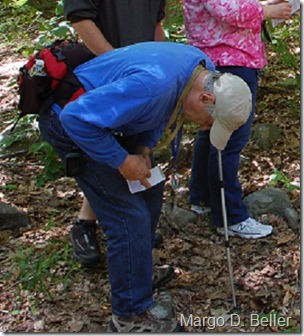
Once the cache coordinates were published, I followed one small group (2 men, 1 woman and 2 boys) to the first location. “Third boulder from the trail,” one of the men read from his phone. (Warning: In the woods, you’re likely to lose your cellphone signal.)

The boys started counting and then turning over rocks somewhat off the path. By the time they had found the cache we were joined by a larger group, who now - one by one - signed their names in the cache notebook. IMSpider used his stamp and then strode off to the next cache, up the steep hill, other cachers scrambling to keep up.

Among them were Carmine and Maria, of Jersey City and Mountainside, who have been geocaching for a year. “That guy is hardcore,” Carmine said of IMSpider with some awe as he puffed up the hill. Maria told me she’s a teacher. Trying to find some way of engaging her tech-literate students, she read about geocaching in a magazine and got them involved. That’s how she and Carmine got into it.

I think I told Carmine and Maria as much about Scherman Hoffman as they told me about their geocaching.


By this time we’d gotten to the top of the hill. But instead of veering left along the Red trail, the group continued on Patriots Path (the White trail) into the Cross Estate, which is not part of the private Scherman Hoffman but is part of the federal National Park Service's Morristown National Historical Park (Jockey Hollow).

This brings up one of the problems I find with geocaching. The official route might’ve been along the Red trail but if the GPS says the quickest way is cutting through a federal park, you follow it. Neale told me people placing caches are supposed to get permission from landowners and at least warn states and the federal government there will be caches and people looking for them. But that does not stop people from using shortcuts.

One geocacher told me he does not believe in bushwhacking and puts all his caches within five feet of a trail. He also gives clear clues on the geocaching website so people don’t harm the environment looking for the cache.

I gather he is unusual.

Just as you will see birders putting themselves and the environment in danger by bushwhacking after a bird, you will see people put caches in inappropriate places and searchers do quite a bit of harm -- despite the organization’s rules to the contrary.

It’s part of the “game’s” competitive spirit, I guess.

Scherman Hoffman Director Mike Anderson told me geocachers inundated New Jersey’s Kittatinny Valley State Park with caches. Before the state knew it, hundreds of people were overrunning the park.

That’s the main reason NJ Audubon got involved with the NNJC -- to have some sort of control and minimize that kind of damage, Anderson said. NNJC maintains the caches. NJ Audubon trail maps, program schedules and other flyers were there for the taking, to encourage NNJC members to come back again.

I’m not sure that will happen.

Leader with box turtle
The cachers running up the hill were too busy following the leader -- IMSpider -- to stop and listen to the birds around them or even notice the beauty of the woods.

Not everyone is like this, of course. I later found a geocacher alone on the river trail - unlike others, he came from the area - who said he doesn’t like finding caches in packs because it takes the fun out of it when others find them first. However, he showed less interest in the nearby veery I pointed out than in his ringing cellphone.

As with everything else, it is too easy to forget technology is merely a tool. Too often I see people use an iPod - even in the car - to block out the world, or stare at a game on their phone to avoid eye contact on the street. And don’t get me started on drivers blindly following GPS instructions to the exclusion of sense.

I do not use GPS (MH is my GPS) and I was glad when the cachers left me alone in the woods with the birds.

Earlier that morning I had been on the weekly bird walk with naturalist Stephanie Punnett. Our group stopped for long periods of time listening to and looking at all sorts of birds. At one point one of the younger group members looked down instead of up and found a wood turtle.

Wood turtles are threatened in NJ, and Punnett said this female was new to her because it hadn’t been marked for tracking. She put it in her bag so it could be marked and then returned to the same spot to get on with its life.

Now this was a cache worth finding.

Saturday, June 27, 2015

Searching for Our Rural Past

Back in late March, a hungry bear just out of its winter den came rambling through my yard and bent my aluminum feeder pole to the ground, then tried to get into the feeder, which happens to be within a cage. The bear went to the other, iron pole, almost bent it to the ground, grabbed that feeder and ate all the sunflower seeds. Then it ambled off.

I did not see the bear because this happened at night. I did, however, see the damage it left behind.

The old feeder pole, with squirrels. (Margo D. Beller)
After that the feeders were taken in at night until I stopped putting them out, in mid-May. So I wasn't in a rush to get a second feeder pole. However, I knew I would need one eventually and started looking around.

I had found the old aluminum one on the floor in the back of a small garden center. I can't remember what I paid for it. I do know it lasted a long time although it was never very stable. Now that I was looking for a new, sturdier feeder pole, I found the price ranged all over the place. Lots of poles to attach to decks, which I don't have, and lots of poles I can put together in expensive pieces.

Wal-Mart didn't help. Nor did Home Depot or Wild Birds Unlimited or my local New Jersey Audubon store. I was starting to get desperate until MH and I were on a drive and passing a Tractor Supply Company store and I suggested we look there.

Tractor Supply Company, as the name implies, tends to sell in the more rural areas. (We've also seen people in there I'm guessing want to make their home seem more rural. Certainly the stores are smaller and the employees friendlier than the local Home Depot.) There aren't many of them in my part of northern New Jersey, itself one of the most urbanized and congested states in the U.S. But here one was, in Flanders, Mt. Olive Township, about 11 miles away from my home.

And within the store was a two-crook feeder pole, topped by a medallion showing a cow, a pig and a chicken. Not a bird, as I'd seen on other poles, but farm animals.

"I've never seen a feeder pole topped with farm animals," I told the helpful employee who took it apart for me so it would fit in the station wagon.

"Yes, isn't it pretty?" he gushed.

New feeder pole, with farm animals. (Margo D. Beller)
It is, after a fashion. When the morning sun shines on it there is an almost stained-glass look about it. It is a 7-footer and it cost less than $30 - a bargain compared with what I'd been seeing. I made sure to put my old baffle in a suitable place on it so it isn't in the way of our longest bird feeder. It stands just to the right of where the old feeder pole - still in pieces in the garage - stood.

Looking at the farm animals made me think that New Jersey once was rural. My house stands on a former meadow. Mt. Olive was covered with farms. There are some still - we stopped at one on the way home, Ashley's, which has been in business since the mid 1940s. But Mt. Olive is not rural anymore. The International Trade Center brought people and people brought "development" - more homes and more shopping strips and malls and more taxes to pay for more children in schools and more services. Northern New Jersey is not very rural and neither is a good hunk of the rest of the state.

The same scenario is seen in other states. Where once were farms now stand housing developments. Sprawl. Of those farms left, many are run by corporations. Family farms struggle.

Many of these family farms have been sold to become housing developments of some sort - "luxury rental" townhomes, estates of varying acreage, "active adult" communities with age restrictions or even senior residences to house my increasingly elderly generation.

Many of the farms we go to have turned themselves into a sort of amusement park. In fact, there is a name for those of us who go to farms - agritourism. I used to work with several people living in built-up areas of New Jersey who would go to a particular Morris County farm to pick berries and see the farm animals with their kids in spring, and then come to pick apples, walk the corn mazes and buy corn threshes, mums and hay bales to decorate their houses come harvest time.

(RE Berg-Andersson)
I go to farms to buy fruits and vegetables that are grown there because they taste better for being local. So do many others. Community-sponsored agriculture (CSA) is big business now, a way for farms to stay alive because they are very popular in places where people can afford to buy food fresh off the farm and want to move beyond the local Whole Foods.

Why is it people feel a need to find some sort of agricultural past? Is it because we want to find something to help us overcome being overcrowded with technology, information blaring at us all the time, 140-character bursts of noise? I think so.

For every person whose face is glued to a phone or is binge-watching "Game of Thrones" is another person paying someone to teach them how to cook with heirloom vegetables, make cheese and grow and can vegetables the way their grandparents did. (If they are lucky, they have parents or grandparents to teach them. More likely they have to learn elsewhere. There are many places, including farms, earning good money teaching them. Of course, there's always the Internet.)

Why? I think it is because doing something that uses your brain and your hands and not your ability to write in 140 characters or post on Facebook is a way to actively DO something instead of passively receive what others think you want to know. It is a way of feeling self-sufficient at a time when many, if not most, people feel powerless and/or apathetic.

It is a way of feeling human.

So I will look at my cow, pig and chicken on my feeder pole and think, yes, I guess it is pretty. Later in the year, when the feeders draw the goldfinches, titmice, chickadees and cardinals, it will get even prettier.

Sunday, June 1, 2014

Nature vs. Technology

On Saturday, May 31, I was at a "meet and greet" of the North New Jersey Geocachers, part of a world-wide movement of people who use GPS, or global positioning satellite, to follow coordinates to a "cache" in a particular place that could be anything from a toy truck to a manhole cover.

It was very strange for me to be at this because it was taking place at New Jersey Audubon's Scherman Hoffman sanctuary, which advertises itself on its website as being "focused on nature."

Until I received the Scherman press release, I'd never heard of geocaching. But it makes sense - even the most Luddite of my friends now have cellphones and the Internet is a facet of everyday life. Geocaching was started in 2000 by two techie guys in Oregon who found a bucket in a park and published the coordinates (longitude and latitute) on a website for others to find it, the head of NNJC told me.

In short, it's a high-tech treasure hunt.

One of the Scherman Hoffman caches. (photo by Margo D. Beller)
These folks at the meet and greet were a fine bunch of people. They were friendly and not upset at all to have a reporter - even an unpaid one for the Scherman Hoffman blog - follow along as they walked the trail, stopped at the proper spot and started searching for the prize. One geocacher at the sign-in table, who had baked cookies, and told me he spent a lot of money each week filling his many bird feeders at home.

He also told me he makes it a point to put his caches not far off a park's trail and makes his online clues so clear you don't destroy the area looking for the cache.

I got the sense he is rather unusual in this.

When the first cache was found - "3 boulders from the trail" - people lined up and signed the pad of paper with the pencil found in the plastic lockbox. In this case the caches contain words you put together and bring to the Scherman Hoffman store for a discount on some merchandise.

This reminded me of the old Gene Shepherd routine, dramatized in "A Christmas Story," where the clues on the decoder ring spelled out "Be Sure To Drink Your Ovaltine."

Signing the cache log book. (Photo by Margo D. Beller)

I don't blame Scherman Hoffman for getting involved with geocaching thanks to the head of the NNJC knowing teaching naturalist Dorothy Smullen through his mother. It is a huge movement, I learned from geocaching.com. Scherman Director Mike Anderson told me Kittanny Valley State Park was overrun by caches and people looking for them before New Jersey had any idea what was happening.

In this case, by getting involved at the start Scherman Hoffman gains some sort of control over the process on its land by working with NNJC, which maintains the caches.

My problem is with the technology.

Following a GPS to find a cache does not mean you are going to stop and look around you in the woods and be interested in that red bird over there. (It's called a veery.) When I attempted to follow the group I found myself falling behind as they raced up the steep incline and then continued, not along the official trail route on Scherman land but on another trail into part of the National Park System, the Cross Estate.

There are rules on where to put caches and notifying landowners but apparently no rules on following a shortcut your GPS finds for you.

I've seen it on the highway and so have you -- drivers who do not plan ahead, blindly follow their GPS and then, at the last second, veer across several lanes of traffic to exit, ignoring the hazards they create for other drivers.

Same with geocaching. You focus on the GPS and/or the cellphone (be aware, many woods don't have cell towers in them) to the exclusion of everything else. I would like to think, as the officials at Scherman Hoffman do, that once people discover the sanctuary they will come back and become more interested in nature, maybe even become NJ Audubon members.

Sorry, but I doubt it.

I was very glad when I lost the pack in the woods, reset my internal GPS and proceeded along familiar trails to find birds, my preferred sort of treasure.