Cape May

Cape May
(RE BERG-ANDERSSON)
Showing posts with label new jersey. Show all posts

Sunday, May 4, 2025

Birding as a Competition

On Saturday, May 10, hundreds if not thousands of New Jersey residents will rise and seek out as many birds as they can find. But this will not be the usual weekend during peak northbound migration when the warblers, vireos, tanagers, flycatchers and many, many others are passing through on their way to breeding territories.

(Margo D. Beller)

This day will be the World Series of Birding, started in Cape May, N.J., in 1984 by Pete Dunne and others as a charitable competition with the aim of finding as many birds as possible in a day and collecting money based on how much is pledged per bird. The winnings go towards bird habitat conservation.

There will be teams starting off at midnight and traveling from High Point at New Jersey's northwestern tip to Cape May in the south. There will be people sitting in one place and tallying what they see and hear. There will be yet others who travel to bird specific areas, such as my home county where Great Swamp, Troy Meadows and Jockey Hollow are located. They'll compete, raise money, then report their findings on eBird in the name of "citizen science."

No thanks.

Charitable as I try to be, I tend to avoid official competitions like this. Too many people zooming around, ticking off birds on a list and trying to find more birds than anyone else. It reminds me very much of the narrative of "The Big Year," a nonfiction book (later made into a movie) describing how three guys competed to get into the record books for seeing the most North American birds in a year. 

This is not birding, this is listing.

I admit to some competitive spirit. If I look at the eBird reports for my county and see things listed in places near me, I'll go out and try to find them - strictly for my satisfaction and not to report to eBird because I don't like counting how many birds I'm seeing. Like ticking off a list without looking at the birds for more than a second and a half, counting how many robins or whatever I'm finding detracts from my enjoyment of being outside with my binoculars.

I also admit to using the Merlin app, when I can get it working, to help me hear and/or identify some of the sounds I hear if they are not familiar to me. I have to take Merlin with more than a grain of salt because it is not always correct in its "suggestions."

World Series of Birding "Big Stay" team at Scherman
Hoffman, 2012 (Margo D. Beller)

I am a Luddite compared to others. Ever since Covid got people outside and noticing the singing birds, birding has become more popular. I am seeing more people when I go out. I am reading more posts on eBird. I wonder how they are finding the birds.

They have help.

We are far beyond the time when all you needed were binoculars and a pair of eyes (and maybe a spotting scope). Besides apps like Merlin there are social media feeds where someone finding a rarity can send out an alert and 100s of people will be at the spot in a matter of minutes. Gadget technology is big, too. Hang a bird feeder with a camera on it that connects to your phone and you can get information on what you are seeing with the push of a button. Field guides? That's so last century!

Every birding organization from magazines such as Birds and Blooms to the National Audubon Society will be more than happy to show you the latest gear including camera attachments, gloves that will allow you to use your phone's touchscreen without removing them and the most effective mosquito repellent.

To me this is a bit much. As I've written before, there are limits to technology.

In years past, when I've seen Pete Dunne in the field, he has his binoculars and his decades of experience to guide him. Too many newbies think they have to become instant experts. When I see them in the field, more often than not they are holding cameras with long lenses rather than binoculars. They are going off the path, bushwhacking, destroying habitat and risking tick bites

Pete Dunne at Scherman Hoffman, 2019
(Margo D. Beller)

I can be obsessed about birding at this time of year now that I have the time to rise most weekday mornings and travel to where I (and Merlin) can hear the birds that will soon either be gone or sitting quietly on nests. Seeing what Merlin heard and I didn't can be humbling. It makes me want to listen to the calls more often so I can learn them. In that, I am competing with myself.

So have fun with the World Series of Birding, fellow birders. Raise untold thousands of dollars. Find rarities that may be passing through the state on May 10.

I wish you all luck. But this birder will be back in the field on May 11.

Friday, November 22, 2024

A Change in the Weather

 Climate is what you expect. Weather is what you get. -- Robert A. Heinlein

I am fascinated by weather, how one day can be picture perfect and the next cloudy and gray; 20 degrees higher than "average" one day and 20 degrees below the next.

When the local news is on I always pay particular attention to the weather segment.

Shearwater blown close to shore. (Margo D. Beller)

When I first contemplated this post, we had not gotten any significant rain since August. The ground was dry, brown and rock-hard, an amazing change from earlier in the year when we got a lot of rain. There was no forecast of rain for the following weeks, including the week my husband (MH) and I were to be away. Fires were raging throughout my home state of New Jersey and I feared some neighbor's stupidity in running a lawn mower or lighting a backyard fire pit despite a state burn ban would set the neighborhood ablaze, leaving us homeless.

So before traveling I gathered important papers, my laptop, prescription drugs and small artifacts I wanted to keep and packed them to bring with us. We left and I hoped for the best.

We drove to Cape Cod, which is the only area of Massachusetts that was not in significant or extreme drought - it is only down about 2 inches, as opposed to more than double that elsewhere in the state. Its geographical location - sticking out into the ocean - helps. The warmer ocean currents that may be a factor in New Jersey's strange weather kept Cape Cod warm and moist enough for flowers - mums and snapdragons among others at the motel - to be blooming long after my flowers became a memory.

Sheltered savannah sparrows (Margo D. Beller)

But being out in the ocean is not good when the winds start blowing hard from the north, as they did when we were on vacation. It became wintry in a hurry, although the winds that nearly knocked me down several times also blew ocean birds closer to shore where I could see them. It also forced the land birds I was seeking to gather in numbers in more sheltered areas.

When we returned home most of the backyard trees were bare, their leaves blown in clumps around the lawn. I had cut back and stored the cannas before we left but the coleus in the one pot I'd left outside was dead. The earlier darkness and the later morning light depressed me. 

Hard, dry ground at Greystone (Margo D. Beller)

This is when I contemplated this post, to try and make sense of this annual change that I find doesn't get any easier to live through. But then, a week after returning, something good happened - it rained. And when the temperature started falling it snowed, lightly.

It has been raining or snowing for two days now. After the initial runoff because the ground was so hard the soil has softened and is drinking in the moisture. The snow showers have prompted the birds to flock to the feeders in droves. When I contemplate Thanksgiving I do not fear my house will burn if we go away. The forecast is for two or three more soakings, including more snow, in the coming week. 

New Jersey is still in a drought, however, even with the current and forecast precipitation. Much of the northeast is also in a drought. We would need two weeks of rain like today's to make up the deficit. With climate change it is no longer predictable if we'll get enough rain, too much rain or no rain.

And during the time the northeast was drying up, the southeast was flooding, the west was burning and parts of the southwest had heavy snow

As I sat writing this post I wondered, why this wacky New Jersey weather?  Climate change, of course.

From the New York Times:

New Jersey is heating up faster than any other state in the Northeast, pacing a region with rapidly rising temperatures, according to data gathered by a nonprofit research organization

The cause of New Jersey’s dubious distinction is most likely a combination of factors, including the warming of the ocean bordering the coastal state and overdevelopment in some areas, experts say.

But what is certain, they added, is that the state — and the Northeast in general — will continue to see more heat waves like the one last month, as well as worsening storms and floods.

“New Jersey is ground zero for some of the worst impacts of climate change, including extreme heat and considerable increases in flood risk,” said Shawn M. LaTourette, the commissioner of New Jersey’s Department of Environmental Protection.


While average annual temperatures across the country have increased by about 2.5 degrees since 1970, annual temperatures in New Jersey have increased by roughly 3.5 degrees, said Lauren Casey, a meteorologist with Climate Central, the nonprofit organization that gathered the temperature data.

According to the group’s findings, New Jersey is the third fastest warming state in the country.

When we had less than half an inch of rain in early
November I took this picture of my back patio.
(Margo D. Beller)
What does this mean? More heat, more rain (when there is rain), more humidity in summer and less snow in winter. According to my state's climatologist, 80% of New Jersey’s warmest months have occurred since 1990. And there has not been a top-five coldest month in New Jersey since 1989.

In years past, during the worst summer heat, there would usually be one day when the humidity was low, the sun was out and the breeze was cool and pleasant. I would say to MH, I wish all the summer days could be like this.

Be careful what you wish for. After this year's long string of "perfect" days sucking us dry, I don't think this anymore.

Sunday, May 5, 2024

Catching Up (Again)

It has been over two months since my last blog post because it is only now, with the rain coming down as I write, that I can sit still and try to make sense of the annual madness known as birding during spring migration. 

In late April the unusual warmth prompted
the cherry blossoms at Greystone to open.
(Margo D. Beller)

Phoebes, redwinged blackbirds and chipping sparrows were among the early birds I found in such places as Greystone. The crowd of juncos that mobbed my feeders over the winter and roosted in Spruce, to his annoyance, disappeared as soon as winter's north winds were replaced by unusually (for April) warm winds from the south. White-throated sparrows that had been very scarce in my yard during the winter started showing up, the males flashing the bright white of their breeding colors. These will soon be gone, too.

In early March a deer got into my euonymous bushes by pulling down the netting. I reinforced the netting and hoped for the best. Thanks to the April rains and warmth many other plants started growing around the neighborhood, giving the deer much easier access to a meal than my yard. The leaves not eaten by the deer are now fully grown and there are new buds where there had been browsing. As usual, these shrubs will be fine.

There are times I wish my yard was a Quality
Deer Management Area. 
(Margo D. Beller)

When we had a long period of warmth in early April I and many, many other retirees or landscapers went to the local Agway and bought our plants. Mine were a pepper and what turned out to be four (not two) basil plants. But days later, when I was going to plant them and the cannas I had divided, it turned way too cold to put them outside. Frost and freeze warnings in April? Yes indeed.

So I waited and fussed until there was finally a good day to do the plantings. Once that was finally done I could concentrate on the birds.

For decades I would go to work, watch for what birds I could find during my commute or lunch hour, and then fuss that I could not be out there looking for more. I did not have that problem this year in my "retirement." When the winds shifted around to come from the south the floodgates opened and the birds passed through. 

Be careful what you wish for.

In late April we went to the Ocean City (NJ) Welcome Center built over a treed island that provides all types of shorebirds a place to breed. Hundreds of great and snowy egrets, black-crowned night-herons, yellow-crowned night-herons, glossy ibis, little blue heron and, not found in New Jersey until recently, white ibis everywhere. I took over 100 photos with my camera. Some of these birds were extremely close to the walkway where we humans stood gawking and photographing. We come here only once a year because Ocean City is quite some distance from our home.

Glossy ibises (Margo D. Beller)

Being retired means I can travel to places early on a weekday morning, mindful that there are plenty of people driving to work. Most of the time I bird alone, walking in areas that will later draw walkers (with or without dogs) and bike riders. I can walk at my own pace, faster than my husband's, and go into areas where he would balk. 

I was in one such place when I went down a steep, rocky incline and then had to lean hard on my walking stick to get me back up to my car. Unusual for me, it was Saturday afternoon and at that moment a man and his son drove up, got out their mountain bikes and plunged down the trail I had just left. A close call and a lesson learned about inclines and Saturday trips. 

An unusual picture. White Ibis has been extending its
breeding range northward, and this bird just sat here and
posed for me. Having a camera handy is unusual for me, too.
(Margo D. Beller)

I referred to this as madness, and it is. It is too easy to move into the realm of obsession. I look at the bird lists and I see people who drive to three or four places in a morning (to my one or two) or who go into restricted areas like a Superfund site or who bushwhack their own trails, all in the pursuit of recording birds on a list they'll file with eBird for others (like me) to see and be envious over. They use apps such as Merlin to identify (and perhaps draw out) birds they want to list and/or photograph. These people are out in all weather, at all times of the day. (I wonder how many of them are retired, too.) Or, they go on one of the many field trips held at this time of year, with a guide to find them as many birds as possible to justify the cost.

I was like this on a far lesser scale back when I worked five days in the city and could only bird as much as I wanted on weekends. Sadly, now that I am at home and my time is my own I find I tire more easily and feel the effects. But when I am not out there I feel something akin to withdrawal, and then I must go out as soon as I can.

I am very aware that spring migration will soon be over for the year. By the end of May there will be birds on nests and the forests will be quiet as the young are protected. It will get very hot, very humid and very buggy, even in the early morning. Walking won't be as interesting.

One of the quiet places where I like to walk - Patriots
Path. The spring rains created lots of standing water 
on both sides of the path. There will be lots
of mosquitoes soon enough.
(Margo D. Beller)

Birders, like many who live in NJ, will head to the shore and fight the heat and bugs to look at the water birds. The forest birds I'm trying to find now - not in their bright breeding colors and not fighting for territory using song - will be passing through on their way south in the fall. Another year will soon be over.

Monday, January 1, 2024

Once Around the White Oak

Back in November I wrote a post about my dismay at finding another trail at the Great Swamp, the 7800-square-foot national wildlife refuge, was being boardwalked so that more people can walk through a variety of habitats without the danger of slipping on icy or muddy ground.

That was then. (RE Berg-Andersson)

This "managed" part of the Swamp has been slowly but surely planking paths to get more people walking, and perhaps limit where they walk. Too many people have a habit of walking wherever they feel like, with or without dogs and children, thus disturbing wildlife and eroding sensitive areas.

My husband (MH) and I need our exercise and I wanted to get us out of the house. So on the last Saturday of 2023 we decided to check out the finished pathway and compare it to when we last walked the 1-mile White Oak Trail, as it is called, in January 2016. At that time it was cold and the path was icy. We wore boots and carried our walking sticks. 

The path is a loop. You walk a bit and then can either go to the left into the woods, or to the right toward the many old white oaks. At that time there were more things growing in the area of the path, including trees, which is why we were surprised when we suddenly came upon the large trees.

THE White Oak, the one for which the trail is named, is a massive tree reckoned to be several centuries old. The tree was around when the road we drove up had a neighborhood along it. The tree was around when the federal government planned an airport on the property, and it was around when Helen Fenske and other activists got that plan blocked. The trail begins across the road from the education center named for her.  

This is now. THE White Oak is
to the left. (Berg-Andersson)

I have stood at the base of the redwoods in California's Muir Woods north of San Francisco and been impressed by the sheer size and majesty of the trees. I was similarly impressed by the White Oak, though it is not nearly as tall. 

I walked over to the tree and MH took my picture. I look puny, but I like the picture because it reminds me of my - and humankind's - place in the general sphere of things. Stand next to a mighty tree and you will gain some perspective. (At least I hope so.)

We continued on the trail, entered woods, walked through and around and eventually came back to the road and our car.

Fast forward eight years.

View from the boardwalk back towards the
Fenske center. (RE Berg-Andersson)

The boardwalking certainly kept our feet safe from the cold mud of the old trail, which we could see as we walked. I wore sneakers. MH used his cane for his balky knees. It was chilly from a breeze but in the 40s, normal for the time. However, for the previous two weeks temperatures had been above normal and it was very wet for December, so it felt colder by comparison. (Of course, had the temperature been normal all month we would've been walking in several inches of snow.)

We forked right, heading to the oak. Unlike last time we could see it quite clearly because where we were walking had had a controlled burn a few years ago to make a habitat conducive to woodcock. (This was before the boardwalk went in, of course.) The wide openness unnerved me, for some reason.

Another difference: When you stay on the boardwalk you can't get close to the White Oak. Perhaps that was by design. Weeds and other plants have grown in the area where I stood next to the tree. I suppose this was just as well because the old tree was showing signs of damage, either from age or from this autumn's major wind and rain storms. (I have a sizable brush pile at home thanks to those storms.) 

As MH took pictures I wondered how much longer the tree would last. 

We pushed on into the woods, where I felt more comfortable. By now the boardwalk gave over to cinders. Here were the birds, starting with a calling redshouldered hawk. The trees blocked much of the wind and we could see water everywhere from the last major storm less than a week before. This is what a swamp does - it collects water. However, on paved areas water runs off, flooding streets and backing up sewers, damaging the many residential areas now built on former barrier islands or meadowlands. (Ironically, the paved road in the Swamp where there were once houses was closed this day to car traffic because of flooding.)

Vernal pool (RE Berg-Andersson)

We then entered another cleared area I didn't remember being so clear, but this one was smaller and led back to woods that were again boardwalked and featured some benches. One bench was near a vernal pool. Vernal pools fill with spring rains and are essential to the lives of salamanders and wood frogs. What should've been empty was filled to overflowing from all the rain. I wondered if this would have an effect next spring but I leave the explanations to the experts

A woman at the Fenske center said that while many areas had been cleared for the boardwalk, the route of the trail had not been changed and it was still a mile long. It had seemed much longer.

We were lucky there had not been many people walking this trail when we were, either because of the cold or because they were doing other things in other places in the week between Christmas and New Year's, when schools are closed. I do not like noise when I am trying to look at a bird. Nor do I like having to get out of the way of a large group of people approaching. But MH, who has become very careful about where he hikes, said he'd be willing to walk this trail again in the spring when the migrating birds pass through. I hope my luck will hold at that time.

So maybe I was too hard on the boardwalking of this trail. However, I still believe my concern to be valid that too many natural areas "opened up" to all are being overrun by people who learned during the Covid pandemic that being outside can be therapeutic for them, if not for the land they walk upon.

Sunday, January 20, 2019

Free Day

Thanks to computers and the Internet, we know about storms days before they strike. This isn't always a good thing. It meant that MH, former Boy Scout, was anxious to get in food supplies days in advance. It meant I cooked enough food so I could have things that only needed to be warmed on the stove top in case we lost power. It meant taking money out to pay the plow guy. In my case it also meant being angry about the inadequacies of this house and of me.

After a relatively snow-free winter, we learned of a snowstorm that would hit last night. We were expecting the worst - six inches of snow followed by an inch of ice and then a drop of 30+ degrees to freeze it all.

I am older now and not enamored of being in the road show of "Frozen." There's a reason why Florida is known as God's waiting room - no shoveling although you do have those pesky hurricanes every summer.

Jan. 20, 2019, pre-plow guy (Margo D. Beller)
But here I am in New Jersey. I woke and looked out the front window and saw it was not as bad as predicted and the town plow had already been through. What was 3 inches of snow last night - the totals had been lessened as we got closer and closer to the actual event - was now 2 inches or so of slush. I went downstairs and opened the back door to push some of it with my shovel. Heavy, as expected. I thought of our 38-foot driveway, mandated by town code, and I thought of MH and me pushing this heavy stuff with our assorted ailments.

I called our plow guy. He seemed surprised to hear from me. But he knew, as I do, that the forecast is for the temperature to fall from a relatively balmy 40 degrees F to about 6 overnight. It will be enough for MH to push stuff off our walkways and for me to check on the feeders I left outside overnight. (I am now certain any self-respecting bear is safely resting in a cave. In effect, that will be what I do for the better part of today and tomorrow.)

Before the storm, MH and I had done as much as we could while we still had power. So today is a free day, free in a sense that my usual Sunday chores are done and, once the shoveling part is done, I can use the day for myself. Were I a younger, more foolish person, I'd be out in the field with my binoculars. I know there are many who are outside now, whether with binoculars or skis. Instead, I will be writing and reading or watching the feeder birds.

They have been coming at a rapid clip. I will smooth a path through the slush to the feeders, clear the slush off them and then withdraw. At least in my yard, they will be fed during the freeze. I remind myself that even if we lose power for a day or so because of frozen tree limbs falling on the power lines, we will survive. The birds, meanwhile, aren't free to relax and must hunt for what food they can find.


Sunday, October 14, 2018

The Meadow and the Swamp

In 1966, when Cornell University's Laboratory of Ornithology published "Enjoying Birds Around New York City," it included only two pages (out of 171) on New Jersey. At the top of the list is Troy Meadows, located in Parsippany-Troy Hills Township, which happens to be just north of my town. 

Boardwalk, Great Swamp management area
(Margo D. Beller)
The short listing calls it "a justly famous freshwater marsh" and that "though gradually losing to development, it is still our most extensive freshwater marsh." However, by the time of the 2004 revised edition of  "A Guide to Bird Finding in New Jersey," William J. Boyle Jr.'s describes the state of Troy Meadows this way, in part:

Because of the proximity of I-80 and I-280, which significantly reduced the size of Troy Meadows, it is now difficult to hear the early-morning calls of distant marsh birds due to the traffic from the highways. Nearby development and consequent siltration have reduced the value of the area to wildlife. Although it is seldom visited by birders anymore, it remains an interesting and worthwhile area to bird, and can still produce many of the expected marsh birds.  

The Great Swamp National Wildlife Refuge is not mentioned in 1966 because at the time there was not much of it. MH remembers one designated trail at the end of a busy road - a road that is now incorporated into the refuge. There are several such incorporated roads. As time goes by the people whose homes were allowed to stand sold them to the federal govenment and went elsewhere. The homes were taken down and the land left open. By 2004, Boyle was referring to it as a "haven for wildlife in the midst of southern Morris County's ever-expanding suburbia."

Great Swamp in winter (Margo D. Beller)
Why did Troy Meadows contract while Great Swamp expand from one trail to 8,000 acres that include a managed area and a wilderness area?  

Both are threatened by over-development. Part of one area of the Swamp owned by Morris County as a park comes right up against backyards and runs along power lines. The federally owned part of the Swamp - the greater part of those 8,000 acres - provides plenty of room to wander without seeing human habitation. (This can be both good and bad, and it is always a good thing to hike with a companion.)

From my own birding experience, I am comfortable hiking throughout the Swamp, including the area where volunteers come maybe once a year to cut back fallen trees and clear the trails. The managed area has a tour road, boardwalked trails and is very popular with suburbanites who want their kids to experience "nature" in small doses. The wilderness area, as the name implies, tends to be muddier and more of a challenge, tho' I find the birding as good if not better than in the managed area.

I am not comfortable at Troy Meadows, even though at 3,000 acres it is considerably smaller than the Swamp. (That's one reason you won't see any photographs from there. We leave our cameras at home.) There are many access points onto the Meadows property. Some are off well-traveled roads but some are at deadends that are rather secluded and frequently used by people not there to go birdwatching. At least that's been my experience. (One time MH and I were walking an unpaved trail when several cars of area college-age kids drove by to what was once an old rifle range to hang out.) Another entrance, in the middle of a housing development, takes you into wild marsh. You might find roughlegged hawks flying over the power lines in winter or sparrows and warblers in the brush. But you'll also find the walking is difficult, there is no path per se and the grass will need a good mowing in late summer. 

Great Swamp vista, management area (Margo D. Beller)
Both areas were created by a receding glacier to form what was once Lake Passaic. But now the Great Swamp is in a part of Morris County where the people tend to have more money. In the late 1950s there was a plan to put a fourth New York City-area airport in the area. A citizens group led by housewife Helen Fenske rattled enough chains and bent enough ears to get the plan stopped. When a new visitor center was built, it was named for Helen Fenske.

The Meadows' Helen Fenske is Robert L. Perkins, Jr., who died just last year. Keeping "development" at bay in  Parsippany-Troy Hills is a much more difficult matter. (The township is an amalgamation of several smaller towns, the largest two of which became the new name.)

When I was growing up in NY there was the snooty Upper East Side and the wannabes on the Upper West Side. So to me those in Parsippany are those who wanted to show they'd "made it." Being one of the largest townships in the area, development is rampant and the McMansions have sprouted like weeds.

Perkins started agitating around the same time as Helen Fenske. However, as you can see from the timeline of Wildlife Preserves, the group he led, results have been mixed.

Late 1930s— The U.S. Fish and Wildlife Service proposed Troy Meadows as a national wildlife refuge to serve the greater New York metropolitan region, but the designation was never granted. Since the early 1950s, Troy Meadows has been reduced to half its original size. Troy Meadows continues to be endangered by development all around it.
1952— Wildlife Preserves was founded and incorporated by a group of philanthropic conservationists, including the organization's long-time President and Executive Director- ("Bob") Robert L. Perkins, Jr. of Tenafly, NJ. The fledgling corporation began fundraising from within and outside of New Jersey and started buying farm lots and meadowlands in the Passaic River Basin, including land in Troy Meadows, Hatfield Swamp, and along the Whippany, Rockaway, and Passaic Rivers in East Hanover, Hanover, and Parsippany-Troy Hills.  

Redheaded woodpecker, Colonial Park, NJ
(RE Berg-Andersson)
So Troy Meadows is owned by Wildlife Preserves, a private group, with some property owned by the State of New Jersey. Although considered an important area by the federal government, the feds have no ownership. The Swamp is mainly federally owned and patrolled, with large gates that block roads to vehicle traffic after hours, a large ranger station and lots of patrols in 4-wheel-drive vehicles. Troy Meadows is maintained by individuals who have to repair and replace things on their own through fundraising. As I said, there are no gates to keep area kids out. 

Here's another difference: Nowadays the Swamp is better known. However, those who see reports out of Troy Meadows, such as those compiled by veteran Meadows hiker and naturalist Jonathan Klizas through his mocosocobirds.com website, flock there. There are now breeding redheaded woodpeckers in the meadows (in the Swamp the reports are not as consistent). Recently, a Connecticut warbler - a notoriously difficult bird to find when it passes through New Jersey on its way south, was sighted there, as were Lincoln's sparrows. On the same mid-October day, 43 species of birds were found at the Swamp; 42 were found at Troy Meadows.

You can believe that Troy Meadows was a well-known marsh bird spot visited by famous ornithologists back in the day, including Roger Tory Peterson and Ludlow Griscolm. That's why, as Klizas told me, work continues to be done by Len Fariello, the manager of Wildlife Preserves, to keep the Meadows a meadow. That means putting up deer "exclosures" around the interior of the property to protect it from overbrowsing, planting trees and keeping the runaway phragmites under control.

So while you may have to work harder to shut out the surrounding noise and people watching you from their back decks, birding the Meadows won't waste your time. MH and I will have to try it again soon. 

Tuesday, March 6, 2018

Don't Take Your Guns to the Swamp (from April 16, 2011)

(This is another old column that got obliterated and I am now republishing. I've since learned how to put in more pictures as well as links.)

It has only been in the last couple of years that I have begun bringing a camera with me when I go birding. Until then I was content to have only my 10x50 Nikon binoculars and use the camera in my brain to record notable images.

With digital cameras suddenly everyone became a nature photographer. That's fine if you are trying to prove you saw something unusual such as this pinkfooted goose my husband, MH, photographed early in March in a private park in Washington Township (Bergen County), NJ.
But a lot of photographers are doing it for profit, either by selling those photographs as stock images to be used in calendars and the like or to put on their personal photography pages and garner the ensuing glowing comments.

If you want to do that, fine. But what I CAN NOT STAND is when someone takes his or her gun-like lens and aims it practically in the face of a bird, creating unnecessary stress and ruining it for other birders when the bird takes off.

There have been many instances of this selfish and cruel behavior on the part of people who want a picture that badly. For instance, a few years ago the birding lists were full of angry birders screaming about a rare boreal owl in Central Park that had been there for a few weeks but finally left after a man set up a camera and used a bright flash (by day, yet) to take a picture practically in the face of the roosting owl.

I have witnessed several such instances, two of them at the Great Swamp in New Jersey.
An aside: Fifty years ago, the plan was to make this 7,500-acre gem straddling Morris and Somerset counties into an airport. Environmentalist Helen Fenske created a grassroots movement to stop that plan. Every time a plane flies over the swamp I shudder. The new visitor center is named for Helen Fenske.

Another birder and I were at the Heronry Overlook parking lot watching a mature bald eagle sitting in a tree close by. Suddenly, we saw a man with a rifle-like camera lens walking in an off-limits area closer and closer to the tree, snapping away, until the eagle flew off.

We started yelling at him and he was completely amazed and confused at our reaction. What was the big deal? He only wanted a picture of an eagle. (The eagle eventually returned after the idiot left, but to a tree much farther away and only identifiable thanks to its white head.)

The second example involved a couple of long-earred owls that decided one winter to roost in a cedar tree very close to Pleasant Plains Road, practically at eye level, not far from the Fenske office.
The swamp is not far from my home so my husband and I drove over and found the owls easily thanks to a couple of birders there. Most birders know to give owls some space during the day since they are resting for the night's hunting. Not the guy there with another gun-like lens, standing real close to the alarmed owls as he took his pictures.

This begs the question, why stand that close if you are using a telephoto lens?

I asked him that question, and told him to get the hell back across the road. MH and the man's wife were afraid we were going to get into a fight, and it was very close. But he moved back. MH and I took our own pictures from across the road. I thought I had gotten through to Mr. Photographer until I looked in the rear-view mirror as we drove off and there he was, up in the owls' faces again. I wasn't surprised to learn not long after that at least one of the two had flown off. I can only hope the second owl, when it left, hadn't been scared off by other inconsiderate birders lusting for that special photograph.

There hasn't been an extended stay by a long-earred owl along that part of Great Swamp since, as far as I know. Owls have long memories, too.

Sunday, February 25, 2018

Our Day on the Beach

Barnegat Light (Margo D. Beller)
One of the advantages of being semi-retired is being able to travel someplace on a nice weekday when most others are at work. So last Wednesday MH and I traveled to Barnegat Lighthouse, at the northern end of New Jersey's Long Beach Island.

Rock jetty toward harbor light with the cormorant. (Margo D. Beller)
It is a very long drive for us, which is why we come down here only once a year in the winter offseason to find sea ducks and, with luck, some of the land birds that like the dunes such as horned larks, Ipswich sparrows and snow buntings. While we've seen all three in the past we did not see them this time.

Nor did we see the lovely harlequin ducks, to my mind one of the prettiest ducks in this part of the country, although others told us they were in the channel in good numbers. But to see them we'd have had to climb atop the rock jetty, which is uneven and dangerous, as I found out years ago. MH and I have gotten unsteady as we've gotten older.

Instead, we saw what we could from the paved seawall and then walked down to the beach and out as far as we could in the wind. Back home it was nearly 80 degrees this February day but here it felt much cooler and I was glad to be wearing gloves.

Purple Sandpipers (Margo D. Beller)

While I did not see the harlequins, there was compensation. This picture above is of purple sandpipers that decided, for some reason, to fly from where they were on the rock jetty into the air where I could see them from the beach and quickly take their picture. There was the great cormorant, a winter visitor, showing its distinctive white side patch as it perched on a harbor light.

Harbor seal (Margo D. Beller)

There was the harbor seal that bobbed up for a moment before diving. There were those birds I expected: long-tailed ducks, red-breasted mergansers, black scoters, myrtle warblers in the trees next to the parking lot.

Finally, as we were leaving for our car, there were boat-tailed grackles serenading us as the sun dipped to the western horizon. It was a good day and since then we've had nothing but cold rain, making us glad we could go when we did.

Male boat-tails are dark, females are brown (Margo D. Beller)


Thursday, December 7, 2017

Birding for the Soul

The natural world is a gateway to the timeless and the infinite. We can never understand it completely, and so for us it serves as a bridge to the infinite.
 -- Thomas Moore, "Ageless Soul"

"These are the times that try men's souls," MH tells me as we slowly walk down a gentle incline, kicking through beech, red oak, white oak and tulip poplar leaves, trying to avoid the rocks and roots. He is not talking about what's going on in the world now. He is quoting Thomas Paine regarding George Washington and the War of Independence.

Looking back up from the hollow. (Margo D. Beller)
We are on a narrow trail through woods at the Morristown (NJ) National Historic Park known as Jockey Hollow. Washington and his army camped at Jockey Hollow twice, the first time for a few months in the winter of 1777 and then for a longer period starting in the winter of 1779 - much more time than the better-known winter encampment at Valley Forge, Pa.

I do not like winter, and since my last post on the subject, MH's father died. As we walk in the woods, past tall, century-old trees that sprang up after Washington's army left after clearing the original trees to build huts and cook their food, it is cold and quiet, only us except for the occasional dog walker.

There are a lot of hills and valleys in this park. This particular trail, named for the New York State Brigade, is leading to what may be THE hollow for which this park is named.

Our hike here was not planned. I stopped here because I like driving the paved tour road through Jockey Hollow when we are headed elsewhere, and then I had to make a stop to adjust something. MH suggested we hike the path near us. Our motivations were different. I was looking for a place for us to walk and maybe hear a few birds. He was thinking of our recent hike at Washington Crossing State Park, the area where, on Christmas 1776, Washington brought his army across the Delaware River into New Jersey to surprise the British at the Battle of Trenton. We hiked near the river after looking at the artifacts at the park's museum. I was not expecting to find any unusual birds but I was pleasantly surprised to find a yellow-bellied sapsucker - a woodpecker I rarely see in our backyard - and a brown creeper.

Brown creeper, front yard (Margo D. Beller)
So here we were at Jockey Hollow. We walked a long while before we heard the contact calls of black-capped chickadees, tufted titmice and juncos, but MH heard something else - the scream of a red-tailed hawk. I did not hear it the first time but I did the second time, and so did the birds, which went quiet. I set about trying to find it with my binoculars. We slowly continued along the path.

Then, it flew from one tree to another.

I watched it watching me. It called several times. It must've been a juvenile - a male, judging by its size (female red-tails are larger) - because an adult would know that screaming would not get it any supper, winged or otherwise. Finally, it got tired of watching me and flew off. A minute or so later, the small birds started chattering again and MH said he wanted to start the hike back up the hill to our car.

I did not want to leave. A few winters ago I had to have surgery, and in the long recovery afterwards I only started to feel like myself again - well - when I went to the local park and started walking along the familiar trail and tried to find the birds I heard calling, something I enjoy doing.

Another red-tail in another tree
(Margo D. Beller)
In his new book, "Ageless Soul," Thomas Moore makes the point that there is a difference between aging well and getting old. As with the other book I recently read about global warming, this book has made me see another view of what I consider a negative experience. You can't change time. You can't make yourself younger, no matter how many pills you take or how much plastic surgery you have.

What you can do is enjoy the world around you, expand your horizons and make a difference.

"Work without play is a burden," he writes. "Play helps relieve some of the weight of labor."

For me, play is going outside for a walk and trying to find and identify birds, even if they are familiar ones I can see at the feeder from my kitchen. Birding is good for the soul and has been a way to help me heal through several winters of personal and professional changes.

The starkness of winter, Jockey Hollow (Margo D. Beller)
I think of all those Saturday mornings I felt compelled to get up and out of the house and go birding after a particularly hellish week when I was working in the city, away from home for 12 hours a day including work hours and the commute. Since working from home I sometimes feel a waning in my birding interest. "I've seen all these birds before. Why bother going outside?" I thought. That, I now know, is the wrong attitude.

As Moore writes, "[I]f you work without play, that soul work is neglected, and your work doesn't age you well. You get older as the years pass, but you don't get better as a person."

Like Scrooge on Christmas morning, I now know I can change my ways before it is too late.


Saturday, August 26, 2017

Hawking

Here in New Jersey we have been given a gift this late August - cool, dry, breezy weather, more like September than late summer.

The cool air has inspired me to go outside and deadhead the spent flowers on the perennials in hopes there may be new bloom before winter. My peppers have started growing, at last. Leaves are falling off the apple and pear trees, and the dogwood has a hint of red in the leaves, even as its fruits are starting to form. The female locust tree in the front yard will have a bumper crop of seed pods this year, unfortunately, and when they fall they will have to be raked to the curb with the inevitable leaf piles.

Male Harlequin-you can hunt it in season.
(Margo D. Beller)
For now, however, I am thinking about migration.

There is still the occasional hummingbird visitor to the feeder. The adult males are long gone, the adult females are leaving and the juveniles are now big enough to feed and travel on their own. The rubythroated hummingbird I've been seeing of late seems to have a tinge of red on its "chin," making it a juvenile male. He perches and takes long drinks. With the accumulated fat he's building he'll soon be heading to the lush tropics for the winter. I hope he survives the trip.

Overhead, the clouds are moving from north to south. In the bird reports I see warblers and other migrating birds showing up in greater numbers on their way to their winter grounds. The north wind is a tail wind, and when September comes that means it will be time for me to look in the skies for southbound raptors.

Buteos such as redtail hawks, accipiters, falcons, harriers, vultures, eagles: When they fly south they use the warm air rising off mountains to help them stay aloft. So unlike the warm spring winds from the south, which don't seem to limit the hawks' flight patterns, in autumn the best place to see these birds is along mountain ridges. I enjoy the hawk watch from Scott's Mountain and have seen hawks from elsewhere in New Jersey, including New Jersey Audubon's Scherman Hoffman sanctuary and from the front lawn of an office building in Englewood Cliffs, across the road from the Palisades and the Hudson River, which the hawks follow south.
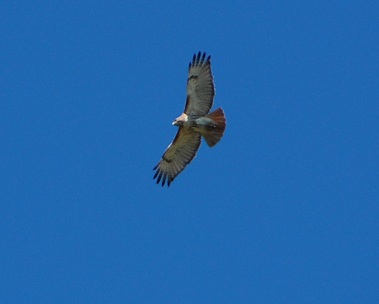
Redtail hawk (Margo D. Beller)

The view of raptors from the top of Pennsylvania's Hawk Mountain, an extremely rugged hike each way, is awesome. No platform here, just jagged rocks. This was one of the many places where sportsmen would see how many hawks they could shoot out of the sky.

That doesn't happen anymore, at least officially. The outcry over such slaughter as well as the killing of birds such as great egrets for their feathers led to the passage of the 1918 Migratory Bird Act. No more raptor target practice. Birds such as grouse, woodcock, ducks and geese can be hunted, but only during limited times of the year and with a strict limit on how many you can kill, just as with the deer and bear.

According to the U.S. Fish & Wildlife Service: For over a century, wildlife conservation laws and regulations have been enacted to keep our bird populations healthy. As part of our mandate to conserve birds and their habitats, we administer the Migratory Bird Treaty ActMigratory Bird Hunting and Conservation Stamp Act and the Bald and Golden Eagle Protection Act. These acts are at the foundation of the Migratory Bird Program.


Hawk feathers (Margo D. Beller)
Among the artifacts in my museum of collected oddities are three feathers. I see, but don't usually collect, feathers all over my yard and from all kinds of birds. But these three feathers (at left) were found while I was hiking and for some reason I took them. From the pattern, it looks like they came from a Cooper's or a sharp-shinned hawk, presuming these are tail feathers, but I can't be sure. They are fascinating to study.

But was my taking them illegal? Under the law what happens when you kill, say, a Canada goose during hunting season? Can you collect its feathers for sale?

According to this site, created by a person who sells feather art, some situations are legal, some are not. One of my friends, who is handy with crafts, recently found feathers from a great blue heron that was preening in one of her trees. She is angry at what she sees as hypocrisy -- that she can shoot a bird for supper but can't use its feathers for art and commerce.

So she won't be hawking her wares anytime soon. I, meanwhile, will be waiting for autumn to come for real and the north winds bringing the great raptor push southward. Feathers will be flying.