Cape May

Cape May
(RE BERG-ANDERSSON)
Showing posts with label vacation. Show all posts

Friday, November 22, 2024

A Change in the Weather

 Climate is what you expect. Weather is what you get. -- Robert A. Heinlein

I am fascinated by weather, how one day can be picture perfect and the next cloudy and gray; 20 degrees higher than "average" one day and 20 degrees below the next.

When the local news is on I always pay particular attention to the weather segment.

Shearwater blown close to shore. (Margo D. Beller)

When I first contemplated this post, we had not gotten any significant rain since August. The ground was dry, brown and rock-hard, an amazing change from earlier in the year when we got a lot of rain. There was no forecast of rain for the following weeks, including the week my husband (MH) and I were to be away. Fires were raging throughout my home state of New Jersey and I feared some neighbor's stupidity in running a lawn mower or lighting a backyard fire pit despite a state burn ban would set the neighborhood ablaze, leaving us homeless.

So before traveling I gathered important papers, my laptop, prescription drugs and small artifacts I wanted to keep and packed them to bring with us. We left and I hoped for the best.

We drove to Cape Cod, which is the only area of Massachusetts that was not in significant or extreme drought - it is only down about 2 inches, as opposed to more than double that elsewhere in the state. Its geographical location - sticking out into the ocean - helps. The warmer ocean currents that may be a factor in New Jersey's strange weather kept Cape Cod warm and moist enough for flowers - mums and snapdragons among others at the motel - to be blooming long after my flowers became a memory.

Sheltered savannah sparrows (Margo D. Beller)

But being out in the ocean is not good when the winds start blowing hard from the north, as they did when we were on vacation. It became wintry in a hurry, although the winds that nearly knocked me down several times also blew ocean birds closer to shore where I could see them. It also forced the land birds I was seeking to gather in numbers in more sheltered areas.

When we returned home most of the backyard trees were bare, their leaves blown in clumps around the lawn. I had cut back and stored the cannas before we left but the coleus in the one pot I'd left outside was dead. The earlier darkness and the later morning light depressed me. 

Hard, dry ground at Greystone (Margo D. Beller)

This is when I contemplated this post, to try and make sense of this annual change that I find doesn't get any easier to live through. But then, a week after returning, something good happened - it rained. And when the temperature started falling it snowed, lightly.

It has been raining or snowing for two days now. After the initial runoff because the ground was so hard the soil has softened and is drinking in the moisture. The snow showers have prompted the birds to flock to the feeders in droves. When I contemplate Thanksgiving I do not fear my house will burn if we go away. The forecast is for two or three more soakings, including more snow, in the coming week. 

New Jersey is still in a drought, however, even with the current and forecast precipitation. Much of the northeast is also in a drought. We would need two weeks of rain like today's to make up the deficit. With climate change it is no longer predictable if we'll get enough rain, too much rain or no rain.

And during the time the northeast was drying up, the southeast was flooding, the west was burning and parts of the southwest had heavy snow

As I sat writing this post I wondered, why this wacky New Jersey weather?  Climate change, of course.

From the New York Times:

New Jersey is heating up faster than any other state in the Northeast, pacing a region with rapidly rising temperatures, according to data gathered by a nonprofit research organization

The cause of New Jersey’s dubious distinction is most likely a combination of factors, including the warming of the ocean bordering the coastal state and overdevelopment in some areas, experts say.

But what is certain, they added, is that the state — and the Northeast in general — will continue to see more heat waves like the one last month, as well as worsening storms and floods.

“New Jersey is ground zero for some of the worst impacts of climate change, including extreme heat and considerable increases in flood risk,” said Shawn M. LaTourette, the commissioner of New Jersey’s Department of Environmental Protection.


While average annual temperatures across the country have increased by about 2.5 degrees since 1970, annual temperatures in New Jersey have increased by roughly 3.5 degrees, said Lauren Casey, a meteorologist with Climate Central, the nonprofit organization that gathered the temperature data.

According to the group’s findings, New Jersey is the third fastest warming state in the country.

When we had less than half an inch of rain in early
November I took this picture of my back patio.
(Margo D. Beller)
What does this mean? More heat, more rain (when there is rain), more humidity in summer and less snow in winter. According to my state's climatologist, 80% of New Jersey’s warmest months have occurred since 1990. And there has not been a top-five coldest month in New Jersey since 1989.

In years past, during the worst summer heat, there would usually be one day when the humidity was low, the sun was out and the breeze was cool and pleasant. I would say to MH, I wish all the summer days could be like this.

Be careful what you wish for. After this year's long string of "perfect" days sucking us dry, I don't think this anymore.

Sunday, May 19, 2019

What We Found After a Week Away

Time isn't the main thing, it's the only thing.
   -- Miles Davis

In the greater scheme of things, a week is a very small period of time. It comes and goes before you know it. But after a recent week away we returned to find major changes had taken place in the small bit of ecology I call my backyard and in the behavior of the birds that live in it.

Before we went away the first full week of May to chase the northbound migrants closer to their breeding grounds, I could go out early in the morning and hear or see a host of birds feeding on the strands of seeds hanging from the oak trees. The locust trees appeared bare. The forsythia, lilacs and quince were flowering. The grass was just starting to green and grow.

Blackpoll photo by jerryoldenettel is licensed under CC BY-NC-SA 2.0 

Where we traveled it was unusually cool and rainy most of the time. The one day of full sun and spring-like warmth, the weathercasters warned, "Don't get used to it." They were right - the cold returned. But while we were away our part of NJ got a lot of rain and a lot of heat.

So when we returned last Sunday we found our lawn had turned into a long, bushy meadow, complete with matted-down areas where the deer had rested unmolested. The forsythia, quince and lilac flowers were done. The apple tree lost its blossoms and was in full leaf. Same with the dogwood. I found the irises, azaleas and rhododendron flowering and the cannas had sprouted. And the weeds were, as usual, everywhere.

The front-yard locust tree leaves came out and the backyard oak and maple trees are now casting lush green shade. Several of the bushes, including the viburnum I planted three years ago, jumped in size. The wrongly named "dead area" was filled with overgrown wild onion, wild rose, garlic mustard, ragweed and plants I can't name. In another corner of the yard, the space was filled with wild strawberries.

All this happened in a week.

As for the birds, the white-throated sparrows left when the feeders were taken in. Others came back once I put the feeders back out but they have other concerns now. I hear young begging for food when a parent returns to the hidden nest. One nest must be cardinals, based on the activity of the adult pair. While the young will only be fed protein-rich insects, the parents are coming to the feeder for the quick energy they can get from the sunflower seeds.

Robin's nest, found on the stairs
leading to the observation platform,
Montezuma (NY) NWR (Margo D. Beller)
The male house wren that could be heard daily before dawn before we left is silent. When I go outside to look at the nest box a wren will scold me from a hedge nearby and then, when I back off, fly into the box but it does not immediately come out. This means the wren is an adult who must sit on a nest full of eggs. Is this bird a female or male? Wrens of both sexes look the same. A single parent will have to work that much harder to get food for the brood (and itself) plus protect the nest.

As for the migrants, in the last couple of days I have been hearing the squeaky-brake call of the blackpoll warbler, a call I associate with the end of migration. This little bird, which has a superficial resemblance to the black-capped chickadee, has a very long migratory route and is one of the last to pass through my area on its way north. So migration is basically over, as far as my yard is concerned.

This past week it was time to catch up on bills, groceries and the yards. MH and I mowed the long, seeding grass and I spent several cool, wet early mornings pulling weeds (far from all of them) and untangling some of the plants growing into the deer netting before they could open flowers that would get stuck. I potted the vegetable and herb seedlings bought before we left and put them behind fencing in a sunny part of the yard. You'd hardly know we'd been away, presuming anyone had noticed.

For the moment we can relax and enjoy our bit of property before summer's heat and humidity comes back with a vengeance and the yard will need attending to again.

Saturday, October 29, 2016

November in My Soul

Whenever I find myself growing grim about the mouth; whenever it is a damp, drizzly November in my soul...then, I account it high time to get to sea as soon as I can.

Herman Melville, "Moby-Dick"

It is sad to think that when it comes to vacations, most Americans either don't take one or make it as short as possible. When they travel, they take their computers, check their phones several times a day for email, Facebook or maps to tell them where to go next.

As I get ready to change the calendar page, I am thinking about my coming vacation. I plan to leave the computer at home and keep the phone off as much as I can.

I did not take one week by choice. If I could afford it - for if I don't work I don't get paid in this freelance life - I'd take several weeks and drive down to check out Florida's birds and the migrants. This would be in April, when the birds are in their breeding plumage and heading north.
Male common merganser duck (RE Berg-Andersson)
But since this is November I am talking about, we are following the ducks and other birds south. Seashore areas in November are very quiet - almost too quiet because many restaurants are closed for the season. However, if you go far enough afield and are willing to eat where the locals do, you won't go hungry, especially south of the Mason-Dixon line.

The ocean roars and the air is chilly on the Outer Banks. People walk on the beach, sometimes with their dogs, but I plan to take along our chairs so MH and I can sit and relax. We have both worked very hard this election year. There will also be some days driving around, looking at the birds of Pea Island and on the Delmarva Peninsula on the way home. 

I can't wait. For now, however, MH and I have been raking.

Weather has zigzagged from very hot to very cold and the trees have dropped their leaves. One day you see brilliant color. The next, it is "past peak" and falling. If my house was in the forest, I'd leave the leaves alone because they make good mulch, providing cover for insects, salamanders and other creatures. 

But I am in suburbia, and for the past few weeks there has been a near-constant droning of leaf blowers. During the week, it is the lawn services. On the weekend, it is the homeowner who is a do-it-yourselfer. MH and I are the latter. We spent several hours in the backyard, where the green grass was buried under oak, elm, apple, maple and pear leaves. We attacked with rakes, tarp and, yes, blower. Big piles are now at the curb. Some other time we will do the front yard, where the locust trees are already bare but the grass can still be seen. And then we'll likely repeat the process again.

Chipping sparrow in non-breeding colors (Margo D. Beller)
Hungry birds have been coming to the feeders. For the past week we've entertained winter visitors - purple finches, male and female, the state bird of New Hampshire. These birds of the north would only be in my backyard if their home regions don't have enough food for them. Will this be a year we also host red-breasted nuthatches and pine siskins? If so they will have to fight the resident house sparrows, cardinals, house finches, chickadees, titmice and white-breasted nuthatches. 

So far the purple finches - a threatened species - have been holding their own.

In the shrubs I hear the white-throated sparrows, which show up in the late summer into fall around the time the catbirds leave. I've also seen their cousins the juncos, which arrive around the time the chipping sparrows leave. When it snows and food becomes harder to find, they will be less skittish and go under the feeders to pick up what the other birds have dropped. The suet is eagerly eaten by woodpeckers - downy, redbelly and the occasional hairy.

My garden is done. What is spent has been cut back and I've done some neatening. All that remains is putting burlap over the deer netting to keep the evergreen shrubs from the deer.

I have three pots of peppers - two grown from seed this year and the one from last year - in the house, no white flies (thank goodness) and covered with flowers and/or growing peppers. I could not leave them outside to die.

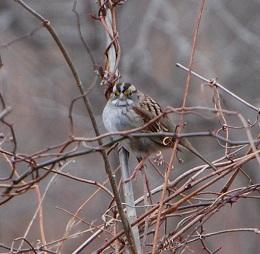
White-throated sparrow (Margo D. Beller)
The cannas and other big plants in pots, including a gift dahlia, are on the enclosed porch, going dormant. Soon they'll be in a more sheltered place for the winter. The begonias I potted in the spring are in the house, somehow fit among the house plants I brought in from the back porch earlier. 

The farm market ended its season. After the hard freeze earlier this week, I was amazed to find some coneflowers and snapdragons I could cut to make a decent bouquet, my last of the season. Turnips, tomatoes, lettuce, chard, collards, green peppers and garlic will last for several weeks because they are locally grown minutes from my house, not shipped in from halfway around the world.

With November comes shorter days and longer nights. I can understand why Melville's Ishmael would get restless and go to sea. November is a hard month. When we turn back the clock it is dark at 5 pm. It take more of an effort to get up in the morning when it is dark and cold. I feel old and sad at this time of year, made worse because of recent health and work issues.

And so I await that week of vacation. I need to be restored, at least for a short while.

A sad postscript: the redtail hawk that was the subject of my last post did not survive, despite the best efforts of the people at The Raptor Trust.  

Tuesday, August 11, 2015

The Not-So-Lonely Ocean

One of the nice things about environmental preservation is that after being hunted nearly to extinction in American waters, whales are coming back in numbers and are an important source of tourist income in such former fishing locales as Gloucester, Boston and Cape Cod in Massachusetts and various coastal towns throughout New England and elsewhere.

Wilson's storm petrel (Margo D. Beller)
When my husband (MH) and I went on vacation to Massachusetts and New Hampshire this year, a whale watch was not uppermost in my mind for the itinerary. I did want to go to Gloucester again because since the last time many years ago I had read Mark Kurlansky's book about the town and another book about Clarence Birdseye, who lived in Gloucester for a time.

I had been looking at the Massachusetts bird report to see if anything would be at Great Meadows refuge near Concord, Mass., when I mentioned all the birds seen off Cape Cod and reported to the list. It was MH who then suggested the whale watch.

When we had last gone on a whale watch, out of Provincetown at the very end of Cape Cod, we never got out of the bay because there were so many whales - mainly humpbacks - hanging around, going after the fish they have to eat in bulk to survive. I, who had wanted to go far offshore to see the pelagic birds one doesn't see even off the coast, enjoyed the whales but was disappointed nonetheless. (Didn't help the so-called naturalist wouldn't confirm the kittiwakes I know I saw.)

Humpback whale and storm petrel (RE Berg-Andersson)
This time, however, we got 25 miles away from the coast to an area that was once a prime habitat for cod - the subject of another Kurlansky book I've read - called Stellwagen Bank. When overfishing threatened, the fishermen were over-regulated as to what to take, how much and how often. The fish population has been slowly coming back and, in the process, so have the bigger underwater predators such as whales.

2 sooty shearwaters with greater shearwaters (Margo D. Beller)

On a hot day in Gloucester we were soon refreshed by cold, damp breezes in the hour it took us to get out to the area where whales had been seen. I was not surprised to see double-crested cormorants off shore but I was surprised to see greater black-backed gulls much farther out into the open waters of the Gulf of Maine. About halfway out to Stellwagen, a minke whale - looking like a larger, black dolphin - came up and then swam back down. The captain said we don't follow these because they are easily spooked. Our time was limited.

As we continued on I scanned the waters and soon saw what looked like a black swallow with a white tail band. When I got a closer look it was what the naturalist later said was the most prolific bird in the world, the Wilson's storm petrel. This was a new bird for me. One of the crew had told the captain about my interest in birds and he was nice enough to confirm it, and also call out the assorted shearwaters - very large birds that look like duller-colored gulls but with larger, hooked bills - we saw: greaters, Cory's and, in lesser numbers, sootys.
Greater shearwater (RE Berg-Anderson)
These birds feed and rest on the open waters, rarely coming to land except for a very short period of mating, nesting and brooding young. Then it's back to the distant waters.

There are many other types of pelagic birds out there, but aside from a northern gannett and a pomarine jaeger called out by the captain (another new bird for me), the shearwaters and storm petrels dominated.

Until we got to the whales.

We found two humpbacked whales, the second largest in the world (after the blue), just lying there, a process known as "logging" (as in, lying there like a bump on a log). Humpbacks are naturally buoyant so when they want to dive, they pick up their heads, give themselves a push down and up come the tails - to the oohs and ahs of those watching.

Whale sighting boats (RE Berg-Andersson)
At this point there was a boat from another Gloucester company in radio contact with our captain, and they were also looking at humpbacks. After a long visit with our two - recognized by the naturalist by the distinctive markings on the underside of the tail - we switched places with the other crew and watched two more. (Eventually a boat from Gloucester's third company arrived.) All told we saw 7 humpbacks and 3 minkes, which is pretty good considering people I talked with later were lucky to have only seen one whale.

There's a lot of water out there and whales are still a protected species. In many areas outside the U.S., they are still hunted despite electricity taking the place of whale oil. In the U.S., whaling has been relegated to coastal museums catering to the tourists and the most famous account of whaling, "Moby-Dick."

We learned a lot about whales on this trip (this was a much better naturalist than the Cape Cod one) and even tho' I saw birds I've never seen before and will likely never see again, the whales were the stars of this show.

Rightfully so.
(Margo D. Beller)

Sunday, November 17, 2013

Home

I said last time I would write here first about my recent vacation in the "wilds" of Pennsylvania, and here it is.

MH in the snowy woods. (Photo by Margo D. Beller)
First, what is "wild" is the forest but most of what we went through were huge farm fields in small rural communities. Hunting and fishing are the reasons most "foreigners" come here, and since we do neither we spent our time hiking or driving long distances.

We picked the northeastern part of this region for its Grand Canyon. I have never been to the one out west but this one was pretty nice, too, despite the extreme cold (expected high that day was 31 degrees F) and the little bit of snow that fell overnight. We hiked one day around the rim on the west side of the Pine Creek gorge and then, two days later when the ice had melted, hiked around the eastern part. Each side is a state park.

The west one, Leonard Harrison, is obviously more set up for tourists - bathrooms, a ledge for observing. The east one, Colton Point, is at the end of a narrow, twisty road through Tioga State Forest. What few bathrooms were open were hard to find and the rim trail wasn't very well marked. Luckily, this was the day the temperature started to rise again to the low 40s so the ice had melted off the road.

Raven chasing the much larger bald eagle. (Margo D. Beller)
This was not a birding trip, per se. I had hoped we'd be far enough north to find something like a boreal chickadee or black-backed woodpecker, something you'd find in the North Country of New Hampshire. What we did find were bald eagle flying over the canyon being harried by ravens, and the smaller American crows harrying a redtail hawk. Of the smaller birds the chickadees and titmice were joined by gold-crowned kinglets, downy woodpeckers and juncos.

In fact, the most unusual birding was along a back road behind our hotel, where I walked our second cold morning (19 degrees F) before we made our way north to the Finger Lakes area so MH could finally see one. Along that road were goldfinches, large flocks of robins and, to my shock, a Lincoln sparrow that just sat there in the sun, allowing me to make sure it had the yellow on the front and the thin streaking.

Gold-crowned kinglet. (Margo D. Beller)
We also found ducks on various lakes - hooded mergansers, black ducks, common mergansers and mallards. Again, nothing we can't also see on Lake Parsippany now that the summer season is over and the boats are out of the water.

The biggest thing was we were away from home, raking leaves, losing eight hours to work. I, for one, needed the break and it was nice to have the radio on in the evenings, classical music playing as I read on the bed while MH did his own reading in the lounge chair.

Isn't that why one goes on vacation, to break the routine, to refresh the mind and body?

Using that definition, we had a very enjoyable vacation.


Thursday, November 22, 2012

Thankful

Today is Thanksgiving. For the first time in six years my husband and I are not traveling to New Hampshire to visit his family. We will be visiting our friend in Bernardsville, NJ, instead.

There are many things for which we are thankful.

We are thankful our friend got power and heat back after Hurricane Sandy, albeit after nine days. We got ours back after two days but she refused to come to us or other friends and leave her animals behind. The day she thought she'd have to give in and go elsewhere the power came back.

We are thankful all our friends in the New York/New Jersey area who lost power for so long and had their lives disrupted are fine, and our hearts go out to those who still have no homes and/or no power nearly a month later.

MH's picure from North Carolina, November 2012. We are thankful we could get here.

We are thankful for today's sunshine, the lack of wind, the relatively warm temperature. We've had far colder Thanksgivings. We are thankful for the music of Teddy Wilson played over WKCR today. We are thankful to have a job, even if it is far from perfect, to pay the bills at a time when so many do not.

On a purely personal level, I am thankful to have MH, who among other things is a wonderful traveling companion. After a long marriage we know when to talk and when to stay silent, most of the time anyway. We make a good team in the field - he prefers his camera to the binoculars and I am the opposite, so I sight birds, call them out and he snaps pictures. Between the two of us we have lots of memories.

We are thankful we got to see many "good" birds on a week-long vacation in North Carolina we thought we'd have to cancel if the lack of power and the north Jersey gas lines continued for much longer. We are thankful we got away because in our darkest moment, literally, we weren't so sure.

On this trip MH finally saw a redheaded woodpecker, we both saw the rare red-cocaded woodpecker (I'll write more on this another time) and, most important, we had time together away from New Jersey and the trauma of the hurricane. We needed the break.

I have had a good life with a lot of good luck in it and I thank God for that. I hope it can continue for a long time.

I am also thankful I can put words together in a way that people enjoy reading, so thank you Readers.

Happy Thanksgiving.