Cape May

Cape May
(RE BERG-ANDERSSON)
Showing posts with label blackpoll warbler. Show all posts

Saturday, May 23, 2020

Goings-on in My Garden

It was pouring in my part of New Jersey on this Saturday of the Memorial Day weekend. My office allowed us Friday off for a long weekend, and I used the sunny, warm day to go to a few garden centers to look at things I am considering for my property.

Hepatica (white flower) and vinca (purple flower) in front netted garden plot
(Margo D. Beller)
Turns out hundreds of other people had the same idea.

In this time of coronavirus, scared people have been stuck at home for over two months. But now that it is finally feeling less like winter, there is a pent-up urge to get out. But to where? Many are ready to hit the beaches (at approved social distances) or the mountains but the rest of us are still staying close to home. So I should not have been surprised the three places I visited were filled with a lot of people buying vegetables, flowers, mulch and other garden supplies. I would say the ratio of buyers to store employees (everyone masked) was 3:1, all trying to make up for lost time. In the end, I bought nothing,

Even so, I have been doing work in the garden because it allows me to be outside, away from people and work, and do something that creates loveliness.

Azaleas (and growing daisy plants) protected from deer
(Margo D. Beller)
I have been lucky. I have perennials that come back year after year, although sometimes there is winter damage. For instance, the peony buds froze during the unexpected cold snap early in May. But the rest of the flowers and shrubs have done very well with the cooler temperatures and abundant rain. The red azaleas are the best I've seen in years, columbine that have sprouted from seeds thrown in various beds over the year are flowering and the daffodils were glorious while they lasted. I even had a flower bloom I haven't seen in years - hepatica, a woodland flower that got into one bed and I've left alone, waiting for it to flower. I've only seen it bloom one other time before now.

After my first attempt at growing peppers from seed for this year failed, I threw more into a small pot. When warm sunshine started hitting the window sill more frequently, nine seedlings appeared, crowded together. They are now spread (socially distanced?) between two bigger pots on the sunny window sill. They will be staying there until they get big enough to put into bigger pots that will be protected in a chicken-wire cage from chipmunks, which have already dug up rosemary I had in a pot and almost ruined the dahlias I planted.

Pepper seedlings, 2020 (Margo D. Beller)
Unfortunately, when you look at pictures of my flowers you see the deer netting. I've learned to make it disappear in my mind's eye but I can't do that in reality because of the deer, many of which have been passing through the yard in recent days now that there are bushes and other plants to eat.

Chipmunks, however, can easily get behind the netting and in some ways are more deadly to the plants with their digging, looking for nuts they buried last autumn. I surround vulnerable smaller plantings and those like the dahlia not big enough yet to fill their pots with old metal gutter fencing to keep the diggers out. It works, for the most part.

Houseplants on the porch with seed containers (Margo D. Beller)
Only recently has it been warm enough for me to move most of the houseplants to my north-facing enclosed porch. The humidity will do them more good than being inside a house where the air conditioner will be on soon enough.

As for the birds, the other day I heard a male blackpoll warbler singing in one of the backyard trees. This bird, whose spring mating colors makes it look similar to a black-capped chickadee, has a distinctive song that sounds like a braking truck and has one of the longest migration routes of the birds passing through here. It is usually one of the last migrating warblers, so hearing it prompts mixed feelings - it's a warbler but it's also the end.

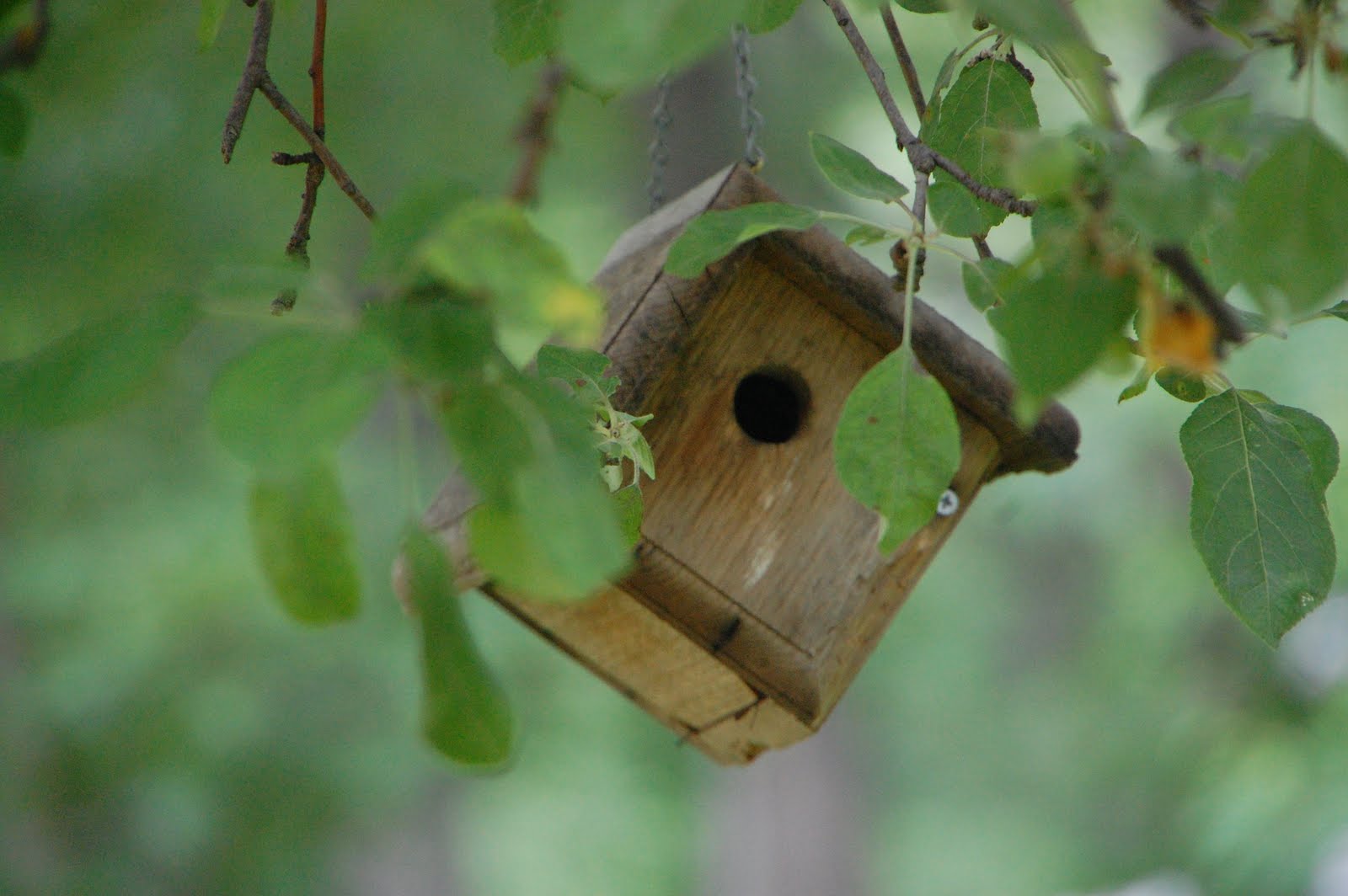
Empty wren box (Margo D. Beller)
I know there are plenty of other birds still heading north, but my yard has gone quiet as the birds staying here have begun their nests and don't want to draw attention to them. No house wren claimed the nest box this year, although once in a while I've heard a wren singing nearby. My two seed feeders seem to be drawing a lot more jays, house finches and grackles, so when they are empty that will be it for feeders until autumn, save for the hummingbird feeder that usually draws one or two in June into July.

By then it will truly be summer and the flowering plants of this spring will have faded except in my memories.

Sunday, May 19, 2019

What We Found After a Week Away

Time isn't the main thing, it's the only thing.
   -- Miles Davis

In the greater scheme of things, a week is a very small period of time. It comes and goes before you know it. But after a recent week away we returned to find major changes had taken place in the small bit of ecology I call my backyard and in the behavior of the birds that live in it.

Before we went away the first full week of May to chase the northbound migrants closer to their breeding grounds, I could go out early in the morning and hear or see a host of birds feeding on the strands of seeds hanging from the oak trees. The locust trees appeared bare. The forsythia, lilacs and quince were flowering. The grass was just starting to green and grow.

Blackpoll photo by jerryoldenettel is licensed under CC BY-NC-SA 2.0 

Where we traveled it was unusually cool and rainy most of the time. The one day of full sun and spring-like warmth, the weathercasters warned, "Don't get used to it." They were right - the cold returned. But while we were away our part of NJ got a lot of rain and a lot of heat.

So when we returned last Sunday we found our lawn had turned into a long, bushy meadow, complete with matted-down areas where the deer had rested unmolested. The forsythia, quince and lilac flowers were done. The apple tree lost its blossoms and was in full leaf. Same with the dogwood. I found the irises, azaleas and rhododendron flowering and the cannas had sprouted. And the weeds were, as usual, everywhere.

The front-yard locust tree leaves came out and the backyard oak and maple trees are now casting lush green shade. Several of the bushes, including the viburnum I planted three years ago, jumped in size. The wrongly named "dead area" was filled with overgrown wild onion, wild rose, garlic mustard, ragweed and plants I can't name. In another corner of the yard, the space was filled with wild strawberries.

All this happened in a week.

As for the birds, the white-throated sparrows left when the feeders were taken in. Others came back once I put the feeders back out but they have other concerns now. I hear young begging for food when a parent returns to the hidden nest. One nest must be cardinals, based on the activity of the adult pair. While the young will only be fed protein-rich insects, the parents are coming to the feeder for the quick energy they can get from the sunflower seeds.

Robin's nest, found on the stairs
leading to the observation platform,
Montezuma (NY) NWR (Margo D. Beller)
The male house wren that could be heard daily before dawn before we left is silent. When I go outside to look at the nest box a wren will scold me from a hedge nearby and then, when I back off, fly into the box but it does not immediately come out. This means the wren is an adult who must sit on a nest full of eggs. Is this bird a female or male? Wrens of both sexes look the same. A single parent will have to work that much harder to get food for the brood (and itself) plus protect the nest.

As for the migrants, in the last couple of days I have been hearing the squeaky-brake call of the blackpoll warbler, a call I associate with the end of migration. This little bird, which has a superficial resemblance to the black-capped chickadee, has a very long migratory route and is one of the last to pass through my area on its way north. So migration is basically over, as far as my yard is concerned.

This past week it was time to catch up on bills, groceries and the yards. MH and I mowed the long, seeding grass and I spent several cool, wet early mornings pulling weeds (far from all of them) and untangling some of the plants growing into the deer netting before they could open flowers that would get stuck. I potted the vegetable and herb seedlings bought before we left and put them behind fencing in a sunny part of the yard. You'd hardly know we'd been away, presuming anyone had noticed.

For the moment we can relax and enjoy our bit of property before summer's heat and humidity comes back with a vengeance and the yard will need attending to again.

Sunday, June 5, 2011

The Wren Days of Summer

There comes a time when you have to acknowledge spring migration is over.

No more blackpoll warbler, whose squeaky-brake call was heard for two weeks in the backyard. No more large flocks of goldfinches jockeying for position at the thistle feeder.

Far fewer birds are singing at dawn. The other day as I was hiking in the neighborhood I heard a strange song, then spotted a goldfinch. He wasn't singing but the male indigo bunting at the top of the spruce was.

But that's the exception. At this time of year birders leave the woods and head to the shore to look at the peeps and waders. The birds sit in the open and, if you can put up with the biting flies and mosquitoes, you don't have to work as hard at seeing something.

This is the season of the breeders. In my brother-in-law's New Hampshire woods, the black-throated green and blackburnian warblers still call to protect their nesting territory, the wood thrush and veery sing all day and the yellow-bellied sapsucker drums loudly on branches.

In my area, we have cardinals, catbirds, chipping and song sparrows and loads of robins. The chickadees, titmice and nuthatches sing every so often but they are more concerned with feeding young behind the thick tree canopy. If I didn't have suet out I might not be seeing downy, hairy or redbelly woodpecker.

Thankfully, there are wrens.

The carolina wren, such as this one from last winter, has a very loud song for such a little bird. If fed during the worst of winter, it will hang around all year. In the last week I have heard a carolina wren singing from the next street. One of the reasons why I love carolina wren is it sings all the time - in winter's cold, in summer, in breeding season. So this one is singing and is likely proclaiming his territory.

The other breeding wren is the house wren, which comes up in spring after wintering far to the south. (This year's current singer is at the top.) Years ago a friend gave me a small decorative bird house and for the hell of it I hung it in one of my apple trees. To my delight a house wren and mate raised a family in it. It was not meant to be a real birdhouse so it was not a surprise that it broke apart after a few years.

At that point I went to the local Audubon office and bought this wren house.

I wait for "house wren" to show up on area birding lists and then put the house up. Usually within a few days there is activity and later a brood or two. (The opening is too small for the carolina wren.)

This year, as with everything else during a cold and wet spring, things were different. It seemed to take a long time for a house wren to discover the box and then after a few days it was silent. A week would go by and then there would be early morning wren song.

If you look at the house above you'll see a bit of stuff coming out the bottom - nesting material. I see a pair of wrens going in and out of the box but I don't hear any cheeping. At this point I am just glad to have them at all. It is nice to be awakened by a house wren's bubbly song rather than the alarm clock. It is nicer to hear the house wren nearby and the carolina wren a block or so away.

As I get ready to take the feeders in for the season the wrens will be my summer solace.

Saturday, May 14, 2011

Slowing down

Today, as I was working in my garden, I heard the "squeaky brake" call of the blackpoll warbler. I've been hearing Old Blackpoll alot this week, singing high in the trees near my office and around the yard.

If you can find it you would see a bird that looks a lot like a chickadee but does not flit about as the 'dee does. This is the male blackpoll and he is a slow and steady gleaner of bugs in the upper tree canopy. So is the female but she is alot plainer, as most female birds are so they can blend in while on the nest.

Blackpolls have always impressed me because they have one of the longest migration routes of any bird, including other warblers.

But here is the significance of the blackpoll for me: It is one of the last of the warblers to pass through my area northbound. That means from now on, migration is slowing down.

Oh, there will still be birds passing through for a few more weeks. Also, places like the Great Swamp and Delaware Water Gap will host numbers of breeding birds through the summer.

But for me it isn't the same as spring, when you hear your first black-throated green of the season.

This year has been different.

This year, I haven't heard a black-throated green. When I read the bird reports I learn northern New England and southern Canada are seeing influxes of birds weeks earlier than usual. Were they pushed up by the wacky weather we had this spring, strong winds from the west and south or the unexpected warm days making them think they'd better get a move on?

This year seems different for me, too.

Maybe I'M the one slowing down. I am getting older. My neck hurts more and longer when I look up at treetops for too long, my legs tire from what seems like endless stops and starts and it gets harder to wake at dawn on a Saturday after a busy, busy work week.

Are you working harder than ever to keep your family fed and bills paid nowadays? Me, too. The pressures never end.

Intense work-week pressures used to send me into the woods on weekends. But I am at another job now and, while busy, things are not as intense.

Or perhaps I am even getting a bit bored with the eastern birds I find each year. I surprised myself to realize that with the exception of the Wilson's warbler in spring and the Connecticut warbler that tends to pass through my area in fall I've seen and/or heard every Eastern warbler, including the Swainson's that I saw a year ago on a Florida barrier island.

That trip might've been the highlight of my birding life thus far. Lovely sunrises, as you can see above. Great food on the Panhandle. You could stand still and within 30 minutes see 30 birds, some at eye level. It was my first time seeing (rather than hearing) a worm-eating warbler, for instance.

After that, trying to see a flitting shape high in the leafed-out trees on a cold spring morning through binoculars you can't get focused fast enough seems very old indeed.

MH told me he is relieved I am slowing down, that I am less obsessed by birding and can "take it or leave it" and do more resting on the weekends.

My husband sees that as a good thing, but as I listened to the blackpoll today for some reason the thought left me rather sad.