Cape May

Cape May
(RE BERG-ANDERSSON)
Showing posts with label song sparrow. Show all posts

Sunday, June 5, 2011

The Wren Days of Summer

There comes a time when you have to acknowledge spring migration is over.

No more blackpoll warbler, whose squeaky-brake call was heard for two weeks in the backyard. No more large flocks of goldfinches jockeying for position at the thistle feeder.

Far fewer birds are singing at dawn. The other day as I was hiking in the neighborhood I heard a strange song, then spotted a goldfinch. He wasn't singing but the male indigo bunting at the top of the spruce was.

But that's the exception. At this time of year birders leave the woods and head to the shore to look at the peeps and waders. The birds sit in the open and, if you can put up with the biting flies and mosquitoes, you don't have to work as hard at seeing something.

This is the season of the breeders. In my brother-in-law's New Hampshire woods, the black-throated green and blackburnian warblers still call to protect their nesting territory, the wood thrush and veery sing all day and the yellow-bellied sapsucker drums loudly on branches.

In my area, we have cardinals, catbirds, chipping and song sparrows and loads of robins. The chickadees, titmice and nuthatches sing every so often but they are more concerned with feeding young behind the thick tree canopy. If I didn't have suet out I might not be seeing downy, hairy or redbelly woodpecker.

Thankfully, there are wrens.

The carolina wren, such as this one from last winter, has a very loud song for such a little bird. If fed during the worst of winter, it will hang around all year. In the last week I have heard a carolina wren singing from the next street. One of the reasons why I love carolina wren is it sings all the time - in winter's cold, in summer, in breeding season. So this one is singing and is likely proclaiming his territory.

The other breeding wren is the house wren, which comes up in spring after wintering far to the south. (This year's current singer is at the top.) Years ago a friend gave me a small decorative bird house and for the hell of it I hung it in one of my apple trees. To my delight a house wren and mate raised a family in it. It was not meant to be a real birdhouse so it was not a surprise that it broke apart after a few years.

At that point I went to the local Audubon office and bought this wren house.
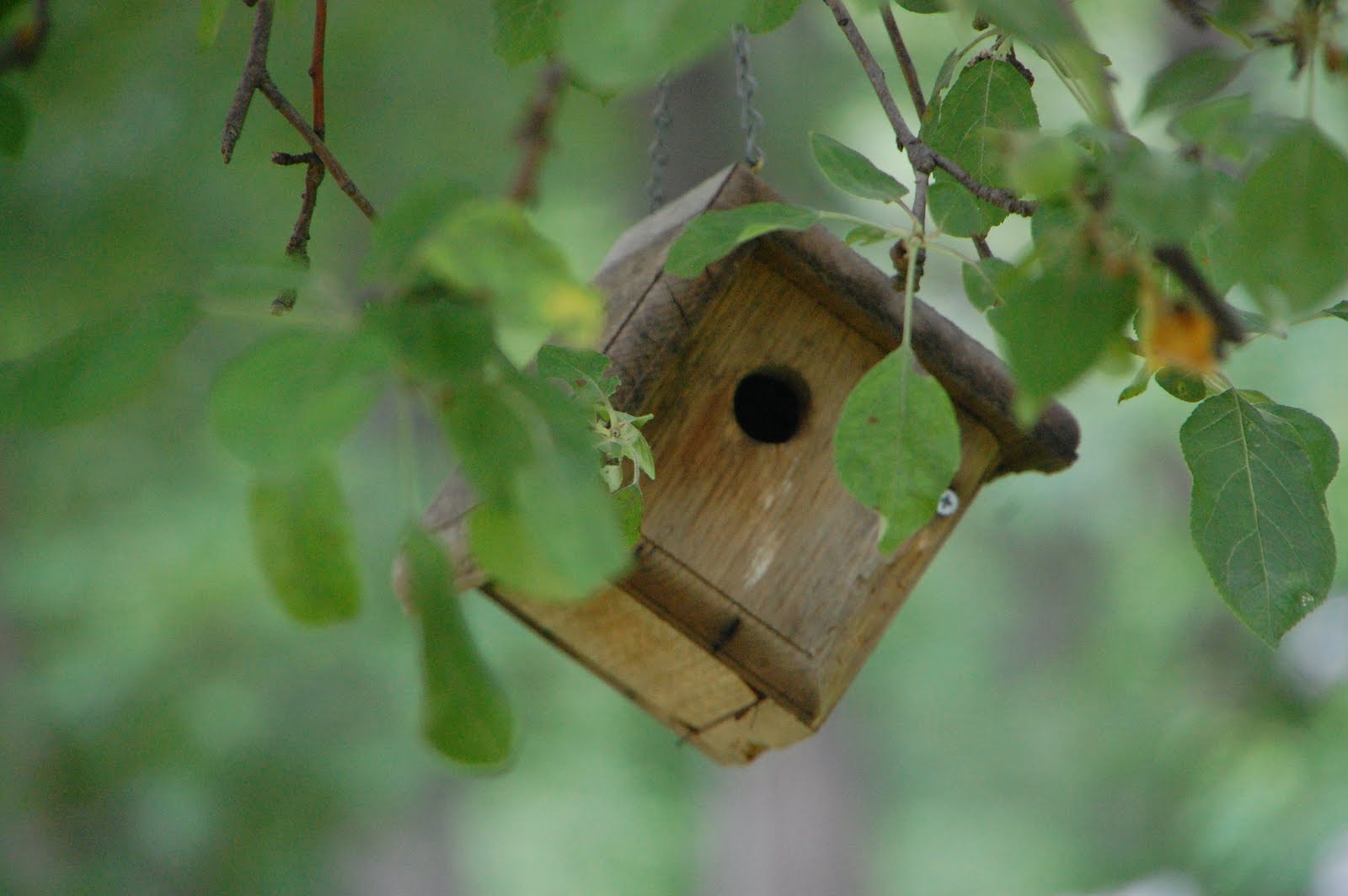
I wait for "house wren" to show up on area birding lists and then put the house up. Usually within a few days there is activity and later a brood or two. (The opening is too small for the carolina wren.)

This year, as with everything else during a cold and wet spring, things were different. It seemed to take a long time for a house wren to discover the box and then after a few days it was silent. A week would go by and then there would be early morning wren song.

If you look at the house above you'll see a bit of stuff coming out the bottom - nesting material. I see a pair of wrens going in and out of the box but I don't hear any cheeping. At this point I am just glad to have them at all. It is nice to be awakened by a house wren's bubbly song rather than the alarm clock. It is nicer to hear the house wren nearby and the carolina wren a block or so away.

As I get ready to take the feeders in for the season the wrens will be my summer solace.

Saturday, May 7, 2011

In the dark

For about five years I would have to get up at 3:45 a.m. to catch a 5:20 a.m. train and be at the office in Jersey City by 7 a.m. I always woke in the dark and most of the time I walked in the dark, too. The short period of a month before and after Memorial Day would allow me to walk at dawn and listen to the singing of warblers, finches and the Big 4 of robin, cardinal, song sparrow and catbird. (The most I have heard at one time those dawn mornings over the years was 23 different types of bird.)

Since changing to more normal hours I've come to appreciate what I had while walking in the dark. I learned the constellations and traveled with a moon shadow. Most house lights were off and except for adults delivering newspapers from their cars (no more the boy or girl on the bicycle), I was usually alone in my travels. Unlike life in New York City, the only thing I feared most during these trips was spooking a skunk. I was never sprayed, thankfully, even when I practically kicked a young one sitting at the edge of a dark road.

Seeing deer was a given, although the 15 that ran out of a yard in a freight train-like line stopped me in my tracks. I've also seen racoon, possum and red fox, including one that sat literally in the intersection of two roads until I walked close to it.

If you go out at night when the sky is clear and the moon is full during migration season you can see the birds cross the moon and - listen carefully - hear the flight calls. I'm not experienced enough to be able to tell you what I am hearing, but just hearing them is a thrill.

But what I miss most, however, is the calling owls.

I heard what you would expect - the hoo-hoo-hoo of the great horned owl, the whinny of the screech owl.

But I have heard the screech owl actually screech (it isn't pretty) and once I heard the "who cooks for you, who cooks for you all" of the barred owl.

And then there was the time I heard the most unearthly screaming, sounds that were not of this world. I have since learned they came from a barn owl that must have been passing through and decided to sit in a tree over our town's brook.

Nowadays I come home in daylight and once in the house I stay put. When it gets dark I am usually getting ready for bed. But there are times I get up in the night and stand by an open window, hoping to hear one of the owls.

I was lucky once - a brood of noisy great horned owls yowling in my backyard. I threw on a robe and ran out and listened. Momma Owl saw me, of course, and I could hear the yowling move off when I tried to see them. I never did.

Maybe it's the degree of difficulty that makes night owls so special. MH and I once saw a snowy owl on a pier in Piermont, NY, where it had been for some weeks drawing a crowd. It looked bored when we saw it. Snowys hunt by day so seeing this was easy. So was the short-earred owl we saw at a grasslands in upstate New York.

More difficult, and thus more satisfying, was seeing long-earred owl. I wrote last time about the ones at Great Swamp but the first one I saw was in Central Park, and I had come in just to see it. Marie Winn was kind enough to let me know where in the Pinetum it was but it was still hard to see.

But there was a woman on a bench with her small dog and she painstakingly guided my eyes to the dark shape in the pine. I thanked her profusely. She said she and several other park regulars were being very protective of the owl, and I can understand why.

It might be time to start taking night walks again...