Cape May

Cape May
(RE BERG-ANDERSSON)
Showing posts with label chipping sparrow. Show all posts

Monday, April 16, 2018

Dawn Chorus, With Junco

It is a cold dawn with slight fog as I stand on my back patio, listening. There are many robins singing, the occasional high peal of a cardinal. They are greeting the day in their own ways, proclaiming "I am here, this is my territory, stay away unless you are a potential mate."

Singing cardinal (Margo D. Beller)
Robins are the early birds that catch the worms, but there are others in this dawn chorus that join in as more daylight comes. More cardinals, the "here, here" of a titmouse, the "oh Sam Peabody, Peabody, Peabody" of a white-throated sparrow now in breeding colors (his throat and "eyebrows" are a very bright white and you can see the yellow close to the eyes, an area known as the lores).

In the old days, when I walked early in the morning to the train to take me to work, I would listen to the birdsong. Some birds I could easily recognize, others I would come to learn over the course of a decade. The chatter of goldfinches, the "tea kettle, tea kettle" of a Carolina wren and the cascading warble of its smaller relative, the house wren. The "hey sweetie" of a black-capped chickadee or the raucaus "thief!" of the blue jay. It took years of searching trees and walking through the woods to learn which calls were made by which bird.

White-throated sparrow in nonbreeding coloring
(Margo D. Beller)
Now, standing still in the growing light, I hear Canada geese, the high-pitched squeal of a red-bellied woodpecker, the three-note "tzee-tzee-tzee" of a golden-crowned kinglet, the drumming against four different trees by woodpeckers proclaiming their territories. Here are the mourning dove, the fish crow, the larger American crow and the rattle of cowbirds. The slight differences in call between a downy woodpecker and the larger, nearly identical hairy woodpecker.

Once in a while there is something unusual -- a sharp-shinned hawk flap-flap-soaring overhead, a raven's guttural croak, the high-pitched "hank" of a white-breasted nuthatch. The longer I stand outside, the longer I hear another soloist come to the foreground of this chorus. For me it ends as I am going inside to warm up and get some coffee and a flicker does its long laughing call.

Spring is my favorite time of the year. The birds are noisier as they start looking for a suitable nest site and a mate. The migrants are passing through my area, heading north from their wintering grounds. Ruby-throated hummingbirds have been reported as far north as New Jersey, despite our unusually cold March and April weather. When the instinct says go, you go.

Depending on where you are located, you will hear different birds calling in the dawn or at dusk. My patch is a suburban town in New Jersey. In a few weeks, if I'm lucky, I might hear the softer songs, clicks and buzzes of the warblers and other migrant birds foraging in the treetops as the first rays of the rising sun hit that area. There are many songs I still can't identify, even after all these years.

House finch in feeder, junco at top right, female
cardinal at top left (Margo D. Beller)
One of the interesting "problems" I have is telling the difference between four different birds whose songs are very similar. What I heard the other morning as part of the dawn chorus was a small black and white sparrow with a pink bill called a junco or, to give it its formal name, a dark-eyed junco. This is a winter visitor, and in my part of the country it is only the male birds hanging around. The browner females stay farther to the south. The idea, I think, is the males can get north and find the best territories faster if they stay farther north. So they and the white-throats come to the feeders in winter and are soon replaced by summer visitors including the catbird and the chipping sparrow.

The junco's call is soft, high in pitch and musical. The chipping sparrow will call more loudly, longer and the call is not as musical. Some refer to it as "dry." To me, and this dates me, it sounds like a person using two fingers to tap tap tap on a manual typewriter keyboard, kind of mechanical. As noted, the chippy arrives around the time the junco is making ready to leave and you'll often hear their calls during that time.

Chipping sparrow in nonbreeding coloring (Margo D. Beller)
There are two other summer visitors with similar musical calls, so I have to work my memory a little harder to remember them. I don't have many pines growing around my area and I don't live near a swamp, so I have to travel elsewhere to hear pine warblers or swamp sparrows. Pine warbler song is high in pitch and very sweetly musical. The ornithologists at Cornell describe the swamp sparrow call as "a slow trill consisting of two or more pitches repeatedly sung essentially at the same time." To me it sounds like a chippy or a junco.

As problems go, trying to remember the different songs of four birds is a minor but enjoyable challenge.

Friday, April 25, 2014

A Reunion I Can Enjoy

This Saturday my old high school will hold its annual reunion. I will not be attending.

I have nothing against the old school. Being a private school I send a contribution every year. I learned a lot of good things there, including that there was life beyond my little enclave of southern Brooklyn. I learned how to make my way across the borough via subway, and how to get around the Brooklyn Heights neighborhood when I didn't have a class to attend.

That was 40 years ago.
I look forward to seeing this year's Baltimore orioles.
(Margo D. Beller)
Looking at the school website I saw that only 5 members of my class would be attending, and these are people I didn't particularly like, for the most part. Did I want them to see me, graying hair, even grayer husband, and then, in answer to the inevitable "What are you doing now?" and "Do you have children?" say "nothing of importance" and "no," respectively?

No.

I have gone to some of the reunions a few times, the last time to see all the physical changes to the place both inside and out. But do I want to be reminded I am 40 years older than the time I graduated from there and went on to a different city for college life and where I met MH? Not really.

So I gave my regrets, which were not sincere.
I'm ready to start hiking now. (Margo D. Beller)

Instead, I will be having a different kind of reunion.

MH and I will be going to a park in another state and look for returning migrants. We've had wacky weather this year, and the cold and wind that returned after unusual warmth this April are gone now - for good, I hope. Birds that have been trying to get to their northern breeding grounds, including New Jersey where I live, have been delayed. But I think they are now on the way, if the reports I read are right.

The phoebe returned to the bridge over the brook, as usual. J.J. Audubon tied a string around the leg of a phoebe he found as a young bird and the next year the bird returned, one of the first instances of banding to track the migratory path.

And the chipping sparrow has returned, not long after its cousin the junco departed. For a little bird it has a big song and it will sit and sing it for hours. So will the house wren, another spring visitor. I am looking forward to hearing one in my yard again. Same with the Baltimore oriole and wood thrush. Goldfinches have been coming to the seed feeder.

The warblers are returning. These little bits of sunshine don't really warble much in their song and they are a challenge to find and identify since they tend to arrive just as the trees start leafing out. But that's the fun of them. We've already had a reunion with three of the earliest returnees - the pine, the palm and the myrtle (or yellow-rump, as some call it). We've even made the acquaintance of a usually southern warbler, the yellow-throated warbler.

Soon will come more -- the northern parulas, black-throated greens and the American redstart, and perhaps a yellow warbler or a common yellow-throat will grace our backyard again.

In my element. (RE Berg-Andersson)
We've already been greeted by the ruby-crowned and the gold-crowned kinglets, the field sparrows and the green heron in our travels. The other week we sat on Scott's Mountain with Henry Kielblock and his group and watched ospreys and broadwinged hawks head north.

These are the reunions I enjoy.

I'm not against family reunions. I've had some wonderful times with my maternal relatives, not with my father's side, unfortunately. MH and I have plenty of reunions with his family and our far-flung friends, either at their houses or at ours, as well.

But in this case, given the choice between sitting with people I haven't seen for 40 years and wandering the fields and parks with MH to once again see winged wonders, I'll take the wandering every time.


Sunday, June 5, 2011

The Wren Days of Summer

There comes a time when you have to acknowledge spring migration is over.

No more blackpoll warbler, whose squeaky-brake call was heard for two weeks in the backyard. No more large flocks of goldfinches jockeying for position at the thistle feeder.

Far fewer birds are singing at dawn. The other day as I was hiking in the neighborhood I heard a strange song, then spotted a goldfinch. He wasn't singing but the male indigo bunting at the top of the spruce was.

But that's the exception. At this time of year birders leave the woods and head to the shore to look at the peeps and waders. The birds sit in the open and, if you can put up with the biting flies and mosquitoes, you don't have to work as hard at seeing something.

This is the season of the breeders. In my brother-in-law's New Hampshire woods, the black-throated green and blackburnian warblers still call to protect their nesting territory, the wood thrush and veery sing all day and the yellow-bellied sapsucker drums loudly on branches.

In my area, we have cardinals, catbirds, chipping and song sparrows and loads of robins. The chickadees, titmice and nuthatches sing every so often but they are more concerned with feeding young behind the thick tree canopy. If I didn't have suet out I might not be seeing downy, hairy or redbelly woodpecker.

Thankfully, there are wrens.

The carolina wren, such as this one from last winter, has a very loud song for such a little bird. If fed during the worst of winter, it will hang around all year. In the last week I have heard a carolina wren singing from the next street. One of the reasons why I love carolina wren is it sings all the time - in winter's cold, in summer, in breeding season. So this one is singing and is likely proclaiming his territory.

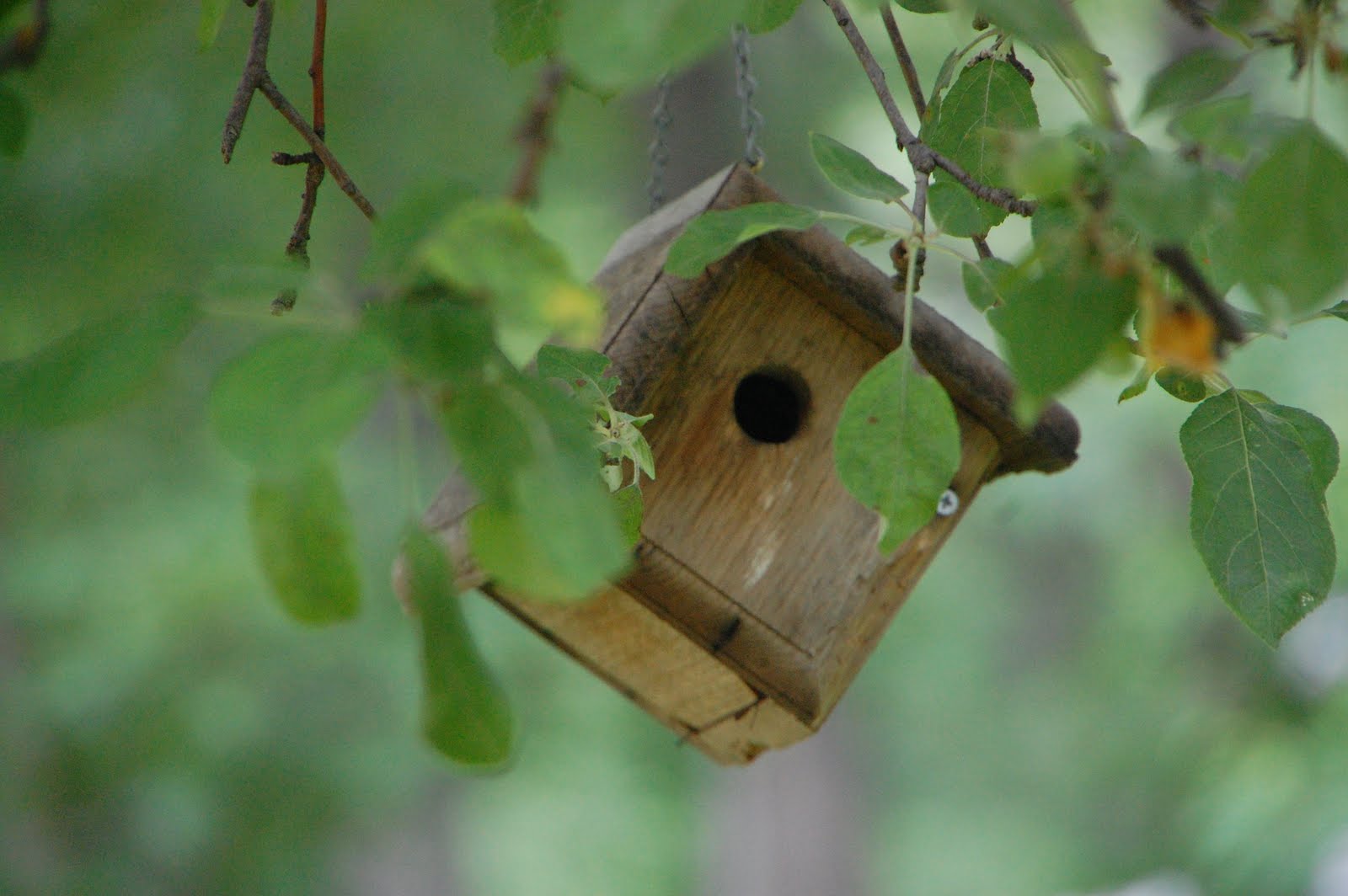
The other breeding wren is the house wren, which comes up in spring after wintering far to the south. (This year's current singer is at the top.) Years ago a friend gave me a small decorative bird house and for the hell of it I hung it in one of my apple trees. To my delight a house wren and mate raised a family in it. It was not meant to be a real birdhouse so it was not a surprise that it broke apart after a few years.

At that point I went to the local Audubon office and bought this wren house.

I wait for "house wren" to show up on area birding lists and then put the house up. Usually within a few days there is activity and later a brood or two. (The opening is too small for the carolina wren.)

This year, as with everything else during a cold and wet spring, things were different. It seemed to take a long time for a house wren to discover the box and then after a few days it was silent. A week would go by and then there would be early morning wren song.

If you look at the house above you'll see a bit of stuff coming out the bottom - nesting material. I see a pair of wrens going in and out of the box but I don't hear any cheeping. At this point I am just glad to have them at all. It is nice to be awakened by a house wren's bubbly song rather than the alarm clock. It is nicer to hear the house wren nearby and the carolina wren a block or so away.

As I get ready to take the feeders in for the season the wrens will be my summer solace.