Cape May

Cape May
(RE BERG-ANDERSSON)
Showing posts with label backyard birding...and beyond. Show all posts

Saturday, June 11, 2022

Watching and Waiting

Thanks to technology, it is possible to put the smallest of cameras into a nest box to record what is going on inside. Do a search of "nest box cameras" and you'll find all the latest models. Do another search of "watching nest webcams" and you'll find links to cameras put into or near nests by Audubon, the American Eagle Foundation and others. Thanks to webcams you can see into the nests of barn owls, bluebirds and American kestrels. It's an easy way to learn about birds and get engrossed in their life cycles. It's as easy as watching TV.

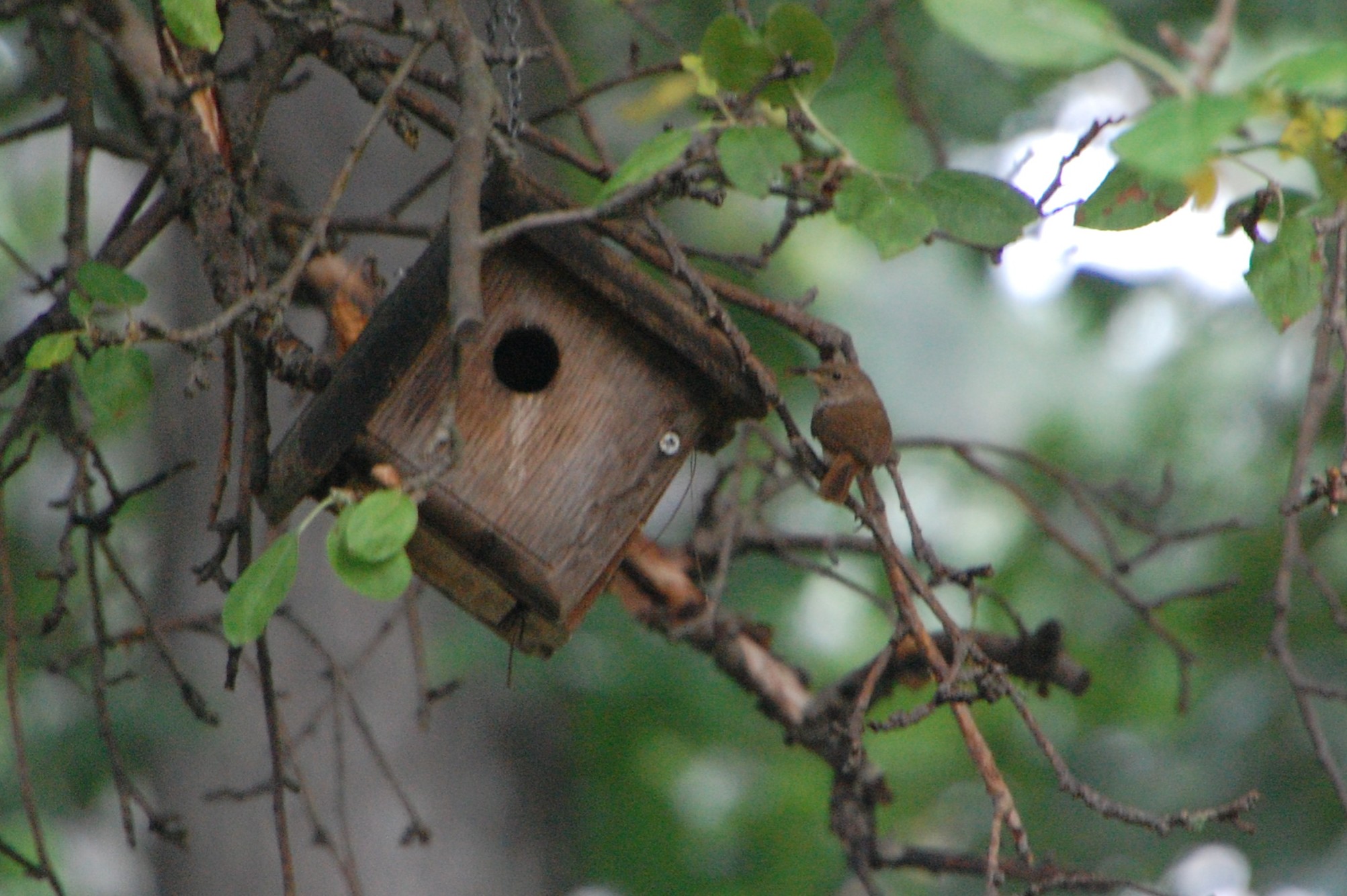
One of this year's wrens, on the branch
below the box. (Margo D. Beller)

I, however, don't have such a camera. To know what is going on in the house wren nest I have hanging I must depend on my many years of watching and being very, very patient.

After I relearned my lesson about intruding it took several days before the house wren pair resumed their activity in and around the nest box I had put up in the dogwood tree. It was very silent in the yard. Just when I'd think the wrens were gone the male would sing, briefly. This happened for several days. Then, on the fourth day, the house wren male started singing early and often, and I saw the female going into the box and not coming out again for long periods of time.

There must be eggs, I thought then. Now, I think there must be young.

According to the experts at Cornell, egg incubation takes nine to 16 days. Once the eggs hatch, the nesting period is another two weeks or so. Today when the female came back to the tree she had an insect in her bill. So there are young, I thought, likely three or four (house wrens can lay up to 10 eggs per clutch, but not in this little box). Right now the chicks must be very small because I hear no calling when either parent is in the vicinity of the nest. That will change when the young get bigger, noisily clamoring to be fed.

There have been other signs of life in the yard.

Blooming viburnum, already fading.
(Margo D. Beller)

Every so often I have to remind myself to go outside and look at the flowering plants before it is too late. Often, it is too late. The showy red peony flowers are already spent, as are those of the azaleas and the rhododendron. I've already deadheaded the columbine and the iris but the daisies, coneflower, goldenrod and sedums are growing quickly. The Stargazer lilies have opened. The coral bells continue to bloom. The viburnum is covered with white flowers that are already starting to fade. 

There are flowers on the privet bushes that will become little black berries, and the wild cherry tree is covered with green fruit that will ripen for the robins that will soon acrobatically pick them off. There are small wild strawberries all over the yard and a couple of wild raspberry bushes that sprang up in areas where they are not in the way, so I have left them. What I don't pick the birds will get.

The pear tree, way too tall, has fruit growing on branches resting on the roof, perfect for a hungry squirrel ambitious enough to climb up.

One of this year's catbirds. (Margo D. Beller)

And there will be apples, plenty of apples. I'll soon be busy collecting them before the squirrels (and the deer) can do much damage. Those apples are the reason I moved the wren box from this tree.

Yes, it would be easier to see what goes on inside the nest box. I could sit at my computer and watch, like some sort of Peeping Tom. There would be no wondering, no reason to even go outside.

No, thank you.


Sunday, June 5, 2022

A Lesson Relearned

On June 1, the morning after my last post, I came out on my porch with my second mug of coffee, put on the fan to move the warm air and sat down to relax and let my mind wander before I had to go to work. After a few minutes I heard something through the whirring of the fan. I opened the porch door and put my head out. I heard a house wren.

Nest box, pre-wrens, 2022. Note the string to
the right. (Margo D. Beller)

I came in to sit and watch the nest box I'd hung in the dogwood tree weeks before, a day after I'd seen another house wren at the water dish. There had been silence after that wren flew off but now there was the bubbly song of another and it did not stop, except when the bird examined the wooden box. Then it flew off but soon returned, still singing. 

The next step was to see if there would be a second wren. The female is the one who must approve the site and then start gathering materials for her nest. A day later, I saw her.

Over this past week the male started singing at dawn and the female actively worked at the nest.

Then, today, came a reminder that even when I try to help birds their lives are still precarious.

Sitting on my porch this morning, I was horrified to see a squirrel climbing up the dogwood and then climbing ON the nest box. A squirrel weighs a lot more than a wren and I didn't want the box to fall, in part because I didn't know if there were eggs inside. The female wren flew out of the box and the male flew from the nearby hedge, both to attack the much larger danger.

By then ("NO!") I had rushed from my chair to the other side of the porch to bang on the window. The squirrel took off.

But so did the wrens.

Until last year, I hung this nest box in the apple tree. It was placed halfway out on a strong, horizontal branch to prevent the squirrels from bothering it. I decided to move the box to the dogwood on the other side of the yard because the profusion of apples drew a lot of squirrels (and me) and I didn't want the birds disturbed. However, the dogwood is more open, and the way the branches grow it was hard to find one strong and straight but not too high to make it dangerous for me to attach from the ladder.

House wren in 2020, when the box was in
the apple tree. (Margo D. Beller)
And, of course, I wanted to see the birds. In the dogwood I only had to sit in my chair and look out. In the apple tree I would have to turn around or look from a different, less comfortable chair.

When I took down the box last year I tied a string to the branch to remind me where to place the box this year. When the wrens came, the male kept pecking at it. I realized it might have thought the string was a snake so I went out to cut it. I agitated the birds but I was quickly gone and I hadn't touched the box, unlike the squirrel.

I can't be outside all the time, much as I'd like to be, so I don't know if any squirrels attacked the box last year. The wrens had their brood and, as usual, suddenly disappeared with the young once they had fledged.

This year, after 15 long minutes of silence, one of the wrens came back and went into the box. Then it flew down to a lower branch for a moment before moving off to the area behind the flood wall. A few minutes later it - she - came back with nesting material, flew into the box and then back behind the flood wall. I was relieved at first, but then started to get agitated. Except for one brief call by the male just after I scared off the squirrel there has been silence. I decided I didn't want to keep punishing myself so I came inside. I'll come back out tomorrow to see if they are staying.

A badly placed robin's nest,
(Margo D. Beller)
When I put out feeders in winter, it is to help the birds stay alive in harsh conditions. Many people now feed birds all year round and that is why there are more birds (and more birders). At this time of year I bring in the feeders because there are plenty of insects for the birds and their young. They do not need sunflower seed, they need bug protein.

Still, even with plentiful food there is continual danger in the life of a bird. Just before the squirrel came to the box a flock of noisy fish crows flew overhead, silencing the male house wren. There is no way a fish crow could attack young in a wooden box nest but in the wild predators could get at a badly placed or unprotected nest, and so the wrens go quiet by instinct.

At this time of year there are already baby birds in nests. Just after the squirrel incident another fish crow came too close to the hedge where I know there is a robin nest. Both parents put up a frightful racket as they chased off the intruder. They even got some help from a mockingbird, not the most social of birds but likely also protecting its own nest nearby. 

The Cooper's nest that failed.
(Margo D. Beller)
It is a common site to see big birds being chased off by one or more smaller, protective birds: starlings chasing off grackles, grackles chasing off crows, crows chasing off hawks. But sometimes nests fail, either because they are in the wrong place or are abandoned by immature birds before eggs are laid. The latter was the case with the young Cooper's hawks that built their nest in 2020, only to be spooked off by a flock of fish crows that came too close. The hawks left and squirrels later claimed the empty nest.

And there are the sad situations where the parent (usually the female alone cares for the nest) is killed by a predator (including cars), a cowbird egg hatches in the nest and destroys the other eggs or the parent is forced to abandon the nest and the young starve to death.

I get protective about this nest box and the house wrens that use it every year, but once again I should've let nature take its course. I'm sure the two wrens would've forced off the squirrel - there was no food to interest it - but by my getting involved I possibly made things worse.

One of my friends likes to refer to "my birds" when they come to her feeders. I remind her these are not house pets, they are wild birds. I know she is feeding them so she can see and enjoy them in their various shapes and colors. So do many other people. I tell myself that I don't do that but I now realize, yet again, that I am no better than anyone else.

Will the wrens pick up where they left off? I don't know, but it would serve me right if they didn't. Lesson relearned.


Monday, May 30, 2022

Resurgence

Life is what happens to you while you're making other plans.

  -- John Lennon

The blue iris that suddenly appeared. (Margo D. Beller)

Hello! It has been a while. Time has a way of running away when you're not paying attention. In my case a combination of Covid prevention, cancer treatments and work stress had kept me occupied and not in the best state of mind. But today, Memorial Day, I have gotten my weekend chores out of the way and I'm not working - perfect for gathering my thoughts and catching up.

Azaleas 2022
(Margo D. Beller)
Since I last wrote we had a less snowy but very cold winter followed by a bit of spring when the trees started to bud and the grass started to go green. Then, in late April into early May, it was damp and chilly, which was good for the outdoor plants but not for me, who was itching to put out my pepper pots before the little flies killed them. The same with my canna pots, covered in the garage. The cannas went out first - a month late - while it was still in the 40s overnight. Finally, around the time we went to visit family for Mother's Day, I put out the peppers, two types of basil I had bought at the local Agway and the pot of coleus I kept over the winter. All are enclosed in a wire cage, of course, because we still have plenty of deer. 

What we didn't have were migrating birds. By the time I took the feeders in for the summer, the migration radar I look at showed the strong winds out of the north and northeast that brought the cold and rain had detoured the birds coming up on the southerly  winds into the midwest. Then, many of them hung a right and flew over the mid-Atlantic region where I live and, eventually, into New England and beyond. 

Columbine, behind the deer netting. 
(Margo D. Beller)
Once we returned from New Hampshire (where we didn't have much in the way of warblers except for the pine, one of the earliest migrants) the heat came at us - midsummer heat in May with strong thunderstorms. The weeds started to grow in the front walkway and in the garden beds. If I wanted to walk it had to be early. One such weekday morning I went to Greystone as the sun was hitting a tree near the back path where I walk. It was filled with calling birds. I had a few such mornings, when I could force myself out of bed at first light so I would have time before work. 

The day after I should have put up the wren box, a house wren appeared at the water dish when we happened to be sitting on the porch, and then it flew off. The box went up (my husband spotting me as I went up the ladder at the dogwood tree) but no bird has come. Same with the hummingbirds - nothing, despite my feeder and the pink flowers of the geranium and coral bells in back, the red azeleas in front and the purple columbine everywhere. (Usually I start seeing hummers in June but I start putting sugar water out in May because, as they say, you never know.)   

By the time we took our annual trip to Old Mine Road to listen for the territorial calls of breeding birds (in the ridges near the Delaware Water Gap) I knew migration was just about over. This was the point when I started doing garden chores, including using my edger around the ornamental grass garden and lugging soil and mulch to the area behind the porch where the heavy rains had eroded the dirt and left it muddy when I'd go out with the feeders. Now, no more mud (but no more feeders either, until maybe Labor Day).

Lenten rose 2022 (Margo D. Beller)

There have been birds around my yard, singing as I have worked or sat on my porch - red-eyed vireo, titmouse, chickadee, cedar waxwings, various woodpeckers and what I call the Big Four of robin, catbird, cardinal and song sparrow. (The juncos and white-throated sparrows are long gone.) There has also been a mockingbird that does a very good imitation of a Carolina wren, so good that when a real wren was singing I had to listen hard to make sure of it. We even had some warblers passing through including an orange-crowned that spent the day calling from a neighbor's bush, a Nashville (my 100th yard bird) whose large eye ring makes identification simple and a few blackpolls, whose call I associate with the end of migration (this bird has one of the longest migration routes).

Peonies, again behind deer netting.
(Margo D. Beller)
The snowdrops, crocus and glory of the snow started the growing season. Then the daffodils, which did very well this year, as did the azaleas, the irises and the hyacinth. The columbines in front and back decided to flower, the peony finally opened its big, red flowers and the rhododendron is tall and healthy with pink flowers that bloomed as the azaleas were fading. As usual, I was relieved when the sedums, the coneflower, the rose of Sharon and the liriope started growing again and now the peppers (including one I bought to hedge my bets) are showing signs of life.

There were also some surprises. For the first time in many years, a blue iris appeared in one of my garden plots, in the same spot as last time. I still don't know where it came from but I welcome it. I also discovered a jack in the pulpit under my hedge among the usual weeds - this is one plant I am not touching as I yank out the others. One sunny day I found a garter snake in one plot, and I am hoping it sticks around to keep down the chipmunks. The Lenten rose, which at one point I thought had been killed by the cold, bloomed profusely and only now those flowers have faded and been covered by large, green leaves. 

Another surprise: Last year there were three milkweed plants that suddenly appeared near the lilacs. This year there are eight. I am hoping that this year they bloom and help the endangered monarch butterfly population.

The area behind the porch where 
I put down heavy buckets
of soil and mulch.
(Margo D. Beller)

There have also been weeds, of course. One early morning I took out the lopper to get at the ones I could not reach because of the deer netting. The bigger ones I could reach over and pull out. I could easily identify ragweed and garlic mustard but another one looked like it could be a wild sunflower. However, when it is in the wrong bed it is still a weed. I found more of them in other areas and pulled them out, except for one in a place where it doesn't threaten anything so I can leave it and see what it becomes. 

The weeds made me despair, as usual, but this year I've decided to put down sheets of black garden fabric (weed block) to kill those near the compost pile (which finally got turned and the rich soil removed), in an area erroneously known as the "dead area" but is anything but. We now have someone to cut and edge our lawn regularly, and that not only makes the grass look better while keeping down the ubiquitous ground ivy but it makes me determined to do something with those areas not mowed.

Also sprouting: fences. Neighbors on either side of me decided to put in solid, white, vinyl privacy fences. To do that, one neighbor cut down the bush that worked very well as a privacy fence and also fed the local deer. (I can only wish I had a fence to block the goings-on of the neighbor along the long side of my yard, who hacked down the forsythia and other plants that had obscured our yards a few years ago.)

The fence replacing the bush: vinyl on 3 sides, wood in back.
The wood has since been painted white.
(Margo D. Beller)

This need for privacy comes out of the violent times we live in, and perhaps the lingering coronavirus. The younger people now living on my street want to keep their families contained and thus "safe" from the outside world. They do not seek me out; nor do I seek them out. I keep to myself. I try to be friendly but I frankly do not understand a lot of what is considered "modern" nowadays, and perhaps that showed. When my cancer treatment was at its worse during the summer I stayed indoors and the weeds ran rampant, including along our front walkway. This year, I am well enough to regularly spray my walkways with a cocktail of vinegar and salt - easy to make and not lethal to birds while it kills the weeds. 

There is much more that needs to be done - gutter cleaning, power washing, cutting back some overgrown trees - but not today. For today, at least, I can enjoy the early coolness (before the expected July-like heat) and the quiet (before the inevitable suburban cookout gatherings) that come with a work holiday. 


Saturday, December 18, 2021

The Season of Quiet

During the summer I sit on the enclosed porch, look around the colorful and leafy yard and try to imagine the winter scene of bareness and gray. Now it's the opposite. I sit on my porch wearing a down coat and warm hat, my legs covered by a blanket, and try to imagine the leaves are still on the trees.

I am finally at the point in the year where the lawn services are done for the season, the town is no longer collecting leaves (which doesn't stop some neighbors from putting to the curb whatever last leaves may have fallen) and the majority of the trees and shrubs are bare. I am happy to have the quiet, but the continuing cold and grayness of many days plus the darkness at 5 p.m. make me restless, tired and, sometimes, down because my gardening is done and migration is long over. I feel shut in, and it does not help that we are close to the end of another year and there is a more contagious form of COVID-19 that affects even fully vaccinated people like me. That means another winter of avoiding people in the streets and not visiting friends or family. 

But at least there is no snow, at least not yet.

New Hampshire, November 2021 (Margo D. Beller)

To some it is soothing to have a blanket of snow on the ground, the white providing a nice contrast with the gray skies. Those who depend on snow for revenue from winter activities are very happy to have the snow. Those with the strength and energy to snowshoe, ski or snowmobile are also very glad to see the white stuff.

Not me.

It is when the snow falls that I feel my age and am at my most vulnerable. I think of last year when we had two feet of snow on our property. Will that next shovelful of snow from the back path make me breathless or have some sort of attack? How long will it take my husband (MH) to find me if I keeled over? My neighbors look after their own properties and are not inclined to help the people next door they don't know so well. We have no children or grandchildren so we hire someone to plow our long driveway. We do the rest, carefully, on the off-chance someone would want to visit. That has yet to happen.

Cardinal in winter (Margo D. Beller)

It has not been the best year for me. I look back on my health issues and am thankful I survived them and the subsequent treatments, and that MH has been here to watch over me and chauffeur me to medical appointments. I have been regaining my strength, trying to make up for lost time. But I can never be 100% again. I can't go back in time, much as I'd like to do.

So I sit bundled on the porch, refusing to confine myself to the house, watching the feeder birds, enjoying the quiet and looking ahead to the return of spring.


Sunday, October 31, 2021

Sunday Silence

Once again I'm going old-school, attacking the autumn leaves with broom for my compost pile and the locust pods with rake for the town to take away.

Locust pods, a constant part of the autumn landscape.
(Margo D. Beller)

"Every man looks at his wood-pile with a kind of affection," according to Henry David Thoreau. Thoreau knew that wood ensured surviving a cold winter. However, eventually the woodpile would have to be replenished. It is an annual ritual, as expected as the seasons themselves.

I do not look at the locust pods I must rake every year with anything resembling affection.

It is that time again. I am outside in the early morning cool on a Sunday, enjoying some rare quiet, where the only things I hear are the scraping of my rake, the screams of the jay and the tapping of leaves and pods falling to the street in the breeze. It is rare because at this time of year the air is usually filled with the roar of leaf blowers and the stench of the gasoline that fuels them. But not at this hour on a Sunday. At least, not yet.

As sure as the sun rises in the east, during the weekdays the lawn services have been blowing every last leaf off my neighbors' properties. Those who don't use a service do the same on evenings and weekends. Also like clockwork, the articles have come out either directly blasting the use of blowers or making fun of them. But that makes no difference to those in suburbia who equate success with a neatly cropped, leafless lawn.

White-throated sparrows have come south to New Jersey.
(Margo D. Beller)
(Two anti-blower articles, as it happens, were sent to me by my brother-in-law, the teaching naturalist. He lets the wind takes care of what leaves fall on his rural NH property. His son, by contrast, uses a gas-powered, backpack-enabled blower on his property. He must wear ear coverings.)

I have a blower, an old, electric-powered model. I find that unless I am blowing leaves into a rough pile for my husband (MH) and me to rake into tarps, it is useless on the heavier pods. So I have been using a broom on the leaves matting the patio and a rake on the pods littering the driveway and the lawn. MH plans to do one last mowing soon to cut the grass he recently fed and mulch the leaves, and I want the pods out of the grass.

As in past years, I silently curse the person who, 40-plus years ago, thought locust trees would be a fine street tree. The locust leaves are very small but their stems fall and clump when raked. The dark brown pod contains the seeds the birds and squirrels and possibly deer eat and then spread through their poop or their digging. 

I recently finished reading a very interesting book on seeds and the lengths plants go to protect the seeds until they are ready to be expelled into the world and create more plants. During the summer the female locust put out greenish pods, some of which dried out and fell to the ground. But the pods didn't start falling in large numbers until they had developed the familiar tough brown casing to protect the seeds. Now, opening one of the pods, my hand was filled with small brown seeds. If I threw them on the lawn I might have a forest before too long.

Part of the fairy ring. (Margo D. Beller)
As I work I see all the ground ivy taking up space, happily fed along with MH's grass. In one area, a strange circle of mushrooms has sprung up, a "fairy ring." I'm not bothering to pick them because they are likely poisonous. The mower will do the work for me. 

There is always some good in doing this raking. It is another thing I do to prepare for the winter when I won't be working in the garden (except for possibly shoveling snow). When I stopped to straighten my back I could enjoy the increasing color of the leaves in my trees - red maple, brownish-yellow oak, yellow elm. The dogwood tree's red leaves haven't fallen but the fruit is long gone, and with it the catbirds. Now I hear the "old Sam Peabody, Peabody, Peabody" of the white-throated sparrow, which finds my part of New Jersey just fine for winter roosting. I am hearing woodpeckers, including a pileated flying over the trees beyond my neighbor's house across the street. The air is cool, the exercise healthy. I've needed exercise after a summer spent mainly indoors due to heat, humidity and illness.

Now I am making up for lost time.  

Black vulture, a southern bird becoming more common
in the north. (RE Berg-Andersson)
At one point something casts a shadow and I look up to see nine or so black vultures circling, Black vulture is a southern species but, like the red-headed woodpecker, it is slowly extending its range northward as the U.S. continues to warm. These birds might be heading south, but maybe not. I also hear Canada geese honking from the nearby community garden. Canada geese migrate but some found suburban yards, parks and office lawns so pleasant they have stayed, bred and become as much of a pest as the deer.

I hear other birds, including a mockingbird making its rasping "this is mine!" call, no doubt guarding a fruiting tree or bush. Smaller birds are flying between the trees looking for insects to pry out of the bark, including the gold-crowned kinglet, another winter bird that typically doesn't hang around my yard. (It prefers pine forests.)

For now, I'm done. Have I removed every pod? No, but most of them. Did I get every leaf off the patio? Not by a long shot. There are plenty more in the trees to come down. They always come down, as sure as day follows night and autumn follows summer.

And, as expected, now I hear a distant leaf blower. By the time I get to the top of my driveway to put the rake in the garage, a second, louder, blower is going nearby. 

So much for Sunday silence.


Sunday, October 17, 2021

Christmas in October

Red and green are the traditional colors of Christmas. There are differing reasons why. According to one site I looked at, use of these colors dates back to the 1300s. As the site puts it, many believe the green represents the eternal life of Jesus while red symbolizes his shed blood. 

Viburnum and berries, 2021 (Margo D. Beller)

However, a different site ties the red to advertising, specifically the suit Santa wore in Coca-Cola's first Christmas-themed print ad, which was extremely successful. The green is thought to be related to holly and other evergreens as part of the holiday's pagan past.

Right now, in October, you could say Christmas has come early for the birds.

The leaves of the viburnum in my backyard are a bright green, contrasting with the clusters of red berries that formed once the spring flowers faded. The same was true for the dogwood.

These fruits are important in the lives of the birds migrating south for the winter. When birds finish their overnight flights, they are very hungry and need food for the energy to continue their journeys. When it gets cold, insects are hard to come by unless they are pried out from under tree bark, as woodpeckers can do with their long, hard bills.

But for other birds, particularly fruit eaters such as robins, catbirds and cedar waxwings, my fruit-laden dogwood was like a big neon sign at a rest stop.

Dogwood berries and reddening leaves.
(Margo D. Beller)

The overabundance of rain we've had for most of this year has been very good to the trees and shrubs. This year a black cherry tree at the edge of my property was laden with fruit. At a certain point in the late summer, robins would fly out from the nearby yew hedge and pick off the cherries, sometimes being very acrobatic in the process.

These cherries are long gone. Several weeks ago I noticed the dogwood was covered with red berries. I also noticed red was coming into the green leaves. Nothing much happened except for the leaves getting redder each day. 

And then, boom: A catbird appeared from a nearby shrub and flew into the tree and moved throughout, eating. So did cardinals and house finches that didn't feel like eating my sunflower seeds. One weekday morning, as I was finishing my coffee on the porch, I saw movement in the tree and saw a small bird flitting around that turned out to be a very special guest, a Tennessee warbler - a first for my yard! It was a one-day wonder. Soon flocks of robins started hitting the tree and now just about all the berries are gone.

How did the birds know when the dogwood berries were ripe enough to eat? I don't know but I do know when the leaves had turned completely red, that is when the most birds showed up. So there may be a connection.

Black cherries before the robins got to them.
(Margo D. Beller)

Many plants fruit at this time of year. The yew hedge was filled with soft red berries eaten by birds and squirrels. The squirrels also seem partial to the small black berries that form in the privet shrubs. Crab apples are particularly prized by mockingbirds, robins and cedar waxwings.These are just a small sampling of plants whose fruits help birds during migration.  

And, of course, they also feed those birds that stick around for the winter, or those that stop their southbound flight in my area. So when the red berries of the viburnum ripen, perhaps after a few frosts, there will be food for the chickadees, titmice and other yard birds.

So these berry-producing plants (like the food from seed heads of spent flowers and weeds) are the gift that keeps on giving, both for the birds and me watching them.


Sunday, June 13, 2021

Broken Homes

I've been watching the wren box from my perch on the back porch and I think something has gone wrong.

Robin on nest, 2019 (Margo D. Beller)

By now there should've been signs of a mother house wren feeding young. I had put the box in the dogwood rather than the apple tree as I have in the past in order to keep the squirrels (and me) from bothering the birds when we went to pick the fruit.

I thought the move had worked. The male wren has been singing up a storm from around the property, including the locust trees in front and the apple tree in back. One time I happened to see it singing from the dogwood and going into and out of the box as if feeding a mate.

Admittedly, I do not spend as much time sitting on the enclosed porch as I'd like every day - things like work intervene - so I may be missing something. It would not be the first time. 

It started me thinking about why nests fail.

I'm no scientist, and there are plenty of scientific papers on the subject, but from my observations I have a few theories.

Cooper's hawk nest after it was abandoned, 2020
(Margo D. Beller)
One of the parent birds might've been killed, either because of a predator (cat, snake, another bird, hit by a car) or disease. Maybe all the heavy rain we've had in the last few weeks created an unhealthy condition in the wooden box that made the bird sick or caused it to leave. 

Maybe the nest was in the wrong location. Was the nest more exposed to the sun because the more open canopy of the dogwood did not shade the box enough during the July-like heatwave we had in late May into early June? Or was the female wren intimidated by the larger and potentially dangerous catbirds and jays flying into the dogwood to survey the ground for food?

I think of the robin nest I discovered in my pear tree in 2019. I watched the female build it high enough off the ground that it was partially blocked by the porch roof, and I'd have missed it entirely had I not seen the pair going back and forth to the tree. Once built, the female settled down, presumably on eggs. The male would come by every so often to relieve her so she could get food. Then, the pair was gone. Squirrels would climb the tree and look in and around the nest. Eventually, it fell apart and out of the tree. 

Eggs in the wrong place, Montezuma
National Wildlife Refuge, NY, 2019
(Margo D. Beller)
Were there ever eggs? Did squirrels get at them? More recently I found a robin in her nest on a window ledge in a bird blind built high off the ground. The windows had screens on them so I could look out at her but not disturb her. This nest would be safe. (The one I and, no doubt, others found on a staircase leading to a platform at a nature center in upstate New York might not have been so fortunate.)

Another reason for nest failure? One or both birds were immature. Instinct told them to mate and build a nest but they might not have known what to do next.

An immature male Cooper's hawk may have been the reason last year's nest failed. I watched - with some trepidation - as the male called and swooped as he helped the larger female bring sticks to the top of a very tall maple tree where branches had created a V that would hold a nest. They mated - noisily - and built. The female started spending time on the nest. Then fish crows discovered it. The female chased them off, with some help from the male. Eventually, both took off and the nest was taken by squirrels.

Nest box in the apple tree, 2020
(Margo D. Beller)
Recently an immature redshouldered hawk has been flying and calling around the area and at one point I saw it flying with nesting materials. I have a rough idea where the nest is but I'm not going to search for it. If the nest is successful there will be enough stress without my hanging around.

As for the wrens, I know for sure another cause of nest failure - parasitism, such as when a cowbird puts one of its eggs in the nest and kicks out the resident eggs - is not involved because the box entrance is too small for a female cowbird to get inside, much less lay an egg. Some birds, such as the yellow warbler, build a new nest on top of the old one when it sees a foreign egg, even tho' there may be its own eggs, too.

Nature can be cruel.

House wrens are not considered an endangered species, and there is always the possibility the singing male will find another mate and the various conditions needed for a successful brood may come together. Or they may not.

I'll have to keep watching.


Sunday, April 11, 2021

Looking Inward

When I sit on my enclosed back porch, I am usually in my favorite old chair in the corner. I can look to my left and see the feeders but my back is to two of the surrounding houses and I try not to look too much at the third house. When I sit on my porch it is to get away from people and not think about the things I must do such as work. Generally, I am sitting there to listen to the birds in the morning, get some sun on my face as I have my first cup of coffee and let my mind wander.

Porch plants in summer (Margo D. Beller)
Today is a gray, foggy, rainy day, making it easy to look inward and ponder life and death. I am facing surgery this week and trying to keep a positive attitude.

Thanks to the coronavirus, I have a lot of time to look within, maybe too much. I have been spending most of my time at home. On days when I should be walking I sit on the porch and listen. I can find in my backyard many of the same birds I'd find elsewhere. Sometimes something unusual will fly overhead, such as a great blue heron or a raven. I can see or hear these through a porch window or if I stand just outside on the patio.

I have always kept to myself, now even more so. I wave at neighbors, they wave back but we don't socialize. People walking in the street make sure they are on the other side of the road if I am walking along. When I go around the block, I am usually more nervous on the one side of the oval that is on a sidewalked street because there anyone approaching prompts a quandary: Do I walk into the street as we pass or will that person? It is easier to walk on my U-shaped street where there are no sidewalks and I can see my house as I approach.

Looking toward the back of the house from my 
corner chair (Margo D. Beller)
From my corner chair I look at the back of my house. But when the weather is consistently warm I will have plants on the porch to keep me company. These plants don't need a lot of direct light and will appreciate the humidity after a dry winter in my front room. It is not that time yet. 

I also look at a row of empty pots in another corner of the porch. They remind me I have cannas to divide and dahlias to plant, plus a small pepper plant and a tomato to put into bigger pots and move outside. 

From my chair I can see the house feeder. Usually
in May rosebreasted grosbeaks pass through. 
These two are males. I hope to
see more this year. (Margo D. Beller)
Spring is a busy time for me. Besides the plants there are the northbound migrants I would like to see and hear, perhaps birds I have not found for quite some time. It is harder for my husband (MH) and me to hike rocky or hilly trails nowadays. Paths should be reasonably flat and, preferably, paved to save balky knees. This can be limiting but I enjoy MH's company and he is helpful in finding snakes and things on the ground while I am scanning the treetops.

I am looking ahead to that time when we can go out more and not worry about who is near us and whether we have on masks. I'm even looking at the compost pile, which hasn't been turned in too long, with some degree of expectation. But mostly I'm looking within, wondering if I have everything arranged in case the worst happens. As I said, I'm trying to stay positive, but it is not easy. 

Saturday, April 10, 2021

Putting Things in Order

When February's snows finally receded in March, I could no longer ignore the devastation of last winter. Branches of shrubs were bent low. Fence posts were askew. Some of the deer netting had been pulled down under the snow's weight or pushed up by hungry deer looking for any food they could find.

March 2021 (Margo D. Beller)

When the snow was gone and the weather became unusually warm for March it was time to put things in order.

All of the plants are perennials and can take care of themselves. Once the snow was gone, the snowdrops and crocuses popped up, albeit a month late. When the temperature jumped into the upper 60s and low 70s, these faded but the daffodils and irises, which had been poking their noses up from the soil, jumped out and, in the case of the daffs, are blooming. Several types of weeds have also come up with no help from me, and a few dandelions are blooming between the cracks in the paving stones on the front walk.

The apple and pear trees plus the shrubs are now either leafing or blooming. To some the bright pink of the quince may look garish next to the yellow of the forsythia in the backyard but I don't mind it at all.

There is more birdsong: cardinals, robins, song sparrows. I am now hearing chipping sparrows and chipmunks, the former welcomed for its dry trill, the latter not so much because of the digging they do even behind the deer netting.

Hellebore. Since I took this
picture it is now flowering.
(Margo D. Beller)
But there are things that need human attention. The butterfly bush and liriope needed to be cut back in early March and are now growing again. Same with the dried ornamental grasses I hacked down and now showing green growth. At some point I have dahlias to pot and cannas to divide. 

Finally, there was the fencing. After the deer found a weakness in the netting and were able to nearly destroy the euonymous bushes in front yet again, I cut everything back, reinforced and tied the netting and fastened it down with garden "staples." Had I known what to expect when I put in these yellow and green evergreen shrubs, I'd have put in something less appetizing to deer.

The area most in need of repair, however, was in back where I cover the netting with burlap to protect the yew shrubs behind. Out of sight, out of trouble is my motto. With these shrubs are other plants that don't need a lot of sun including two pots of hostas I took in for a friend and a hellebore that has bloomed despite the soil being more acidic than it would like. The joe-pyes grow here, as do a pot of perennial geranium, coral bells that attract hummingbirds and a few fringed bleeding hearts.

Repurposing the garden hose
(Margo D. Beller)
It was a job that took many hours because I had to cut back the yews and remove debris from the potted plants. Then the burlap had to be removed, the garden staples pulled up and the deer netting untied or cut off. New netting was put on (doubled above and below) the posts that I thought weren't too bent or shredded from use. I took new, thick garden ties to secure it above and many more garden staples to do the same below. It is both aggravating and calming work that allows me to be outside and listening to the birds.

Finally, I took the old garden hose and put it in to block an opening. Many years ago, a deer got behind the netting and then tried to leave. I woke up to find half the netting was in the yard. Luckily, that was the day I had planned to put in new posts anyway. More recently, a doe put her newborn fawn in back. I had to pull up the posts to let it out. Around that time we got a new hose and so the old one became a deer barrier. (The other end is close to a leader pipe so I can tie the netting to it.)

It is a good feeling to put things in order. When it becomes really hot and things start to overgrow the neatness will disappear. Soon my husband (MH) and I will have to bring out the canna and dahlia pots and get them behind the netting somehow. Weeds will fill the spaces between the plants and create a green carpet I don't need along the walkways. For now I enjoy this feeling of accomplishment when I look at my handiwork.

Backyard daffodils, 2020 (Margo D. Beller)

Nowadays I am putting other things in order, in my life. I will be having cancer surgery in the coming week, a repeat of surgery I had five years ago. I am five years older now, survived a visit to the emergency room because of blood clots and am living in a time when the coronavirus pandemic shows no signs of ending, even with more people (including me) getting vaccinated. I can be hopeful I come through but there is always that possibility something will go wrong. So I am making lists for MH and talking, virtually and via social media, to good friends and family ahead of time. I am writing here. 

Daffodils are blooming, birds are singing. There is so much more to be done. I am looking ahead, but not too far.

Sunday, April 4, 2021

Corvid Conversations

The other morning I went out to hang the bird feeders and heard a soft, repetitive call that turned out to be a male goldfinch, molting into his bright yellow and black breeding plumage, high atop a tree in my yard singing to a female high in a tree at the front curb. She, too, was changing into breeding plumage - from winter brown to yellow and green to better blend into the foliage while on her nest. I was eavesdropping on pair bonding.

This morning, I eavesdropped on something very different. This was not pair bonding but a loud conversation, such as what I hear when people are running or bicycling together, to the point of being aggravating. I was on my back porch and was hearing fish crows - eight of them, as it turned out - atop another yard tree. This was not the angry or alarmed cawing of crows when a hawk is in the vicinity. This was just crow talk - a short, nasal caw that sounds like "uh-uh." After a while they flew off to another tree and them eventually left the area. 

Fish crow, Cape May, NJ, 2011 (RE Berg-Anderson)

Crows, of the corvid family, are social creatures. Where you see one, you'll usually see (and hear) more, sometimes in very large flocks. In that way they are similar to their cousins the blue jays, which also travel in noisy family groups.

In my part of the world there are two kinds of crows. There is the American crow and the smaller fish crow. The American is what we think of when we see a "crow" - large, raucous, chasing predators or other, unwanted creatures away, ripping apart garbage bags for what's inside.

As the name implies, the fish crow can be found near water. That is where I saw my first one many years ago. These all-black birds are otherwise hard to differentiate from the American crow unless you hear them or see the two types together - the American is always larger. (Their cousin the raven is larger still.)

That I am seeing and hearing fish crows at all in my neighborhood is a relatively recent, semi-disturbing phenomenon.

All crows are omnivores, meaning they'll eat anything from berries to garbage to dead chipmunks. They are active in the morning when they are hungriest. That is when you will hear them the loudest as they scope out easy to access food sources.

It may not look like it, but jays are related to the corvid
family. (Margo D. Beller)

When I was a kid growing up in coastal Brooklyn, I knew that if I saw gulls whirling in the skies above my house there must be a storm approaching, forcing the birds inland. Now that I live much farther inland, I see gulls all the time. These gulls have learned it is much easier to dive into the open dumpster behind a fast-food place than to fly over the open ocean looking for fish.

The fish crows have learned this, too.

In my area there are several distinct groups of fish crows clustered in the vicinity of food places with lots of garbage going into the dumpsters. The group closest to my house, which centers itself on the local Quik-Chek, sometimes flies along a brook that flows behind the neighbors' houses across the street. These are the ones I hear in the morning, particularly on garbage pickup day. There is another, larger group that hangs out in an area on the edge of town where they can fight the gulls to pick from the dumpsters behind a supermarket on one corner, a fast-food place on another corner and a shopping mall including several food places on a third. (A restaurant is going up on the fourth corner.)

So the crows, like the gulls, are following the garbage because members of the corvid family are very smart and they know where the pickings are easiest and most fruitful. Suburbia provides lots of favorable habitat conditions, including abundant food.

Take the fish crow pictured above. My husband (MH) and I were in Cape May, NJ, one September and I heard a fish crow calling outside our motel room. I looked out the window and there it was, perched on the railing. I opened the door. It did not fly off. In fact, it looked at me with what I would say was a very human look of expectation. MH took its picture. It still didn't fly off. We realized it was sitting on the railing of our balcony room waiting for us to provide its breakfast, the way many other occupants of this room (and perhaps others) had been doing possibly for generations. 

Even though this crow was literally within sight of the Atlantic Ocean, it was waiting for us to serve it. We went back inside and eventually it flew to another railing where maybe the occupant would be more generous. 

Fish crow on the beach with laughing gulls, which also
like to pick garbage out of dumpsters. September 2013
(RE Berg-Andersson)

(There are many reasons I don't feed birds, aside from what I put into feeders in the backyard. You could say I'm selective in what birds I care to feed or that I don't feel the need to show my human mastery over dumb critters, as I see many do. But mainly it is because I know birds like crows will find their own food just fine.) 

Corvids like the fish crow are extremely intelligent. They have large brains capable of memorizing human faces, using tools and solving problems. Young crows will play, swinging from branches or floating in the wind, according to the Cornell Ornithology Lab. They are a species far from threatened by hunting or disease. In fact, their numbers are increasing to the point of them becoming a real pest. Luckily for these crows, they are protected by the Migratory Bird Act even though like the Canada geese - another bird that found suburbia to its taste - they don't exactly migrate in the same way as other types of birds such as warblers.

So what exactly were the fish crows talking about so loudly this morning? They could've been discussing the next place where they could get a meal. They could've been telling another crow I couldn't see to get out of the area. (There was one American crow calling in the distance.) Maybe they were discussing the weather or whether they should go down the shore for a change of pace. Or maybe they were just idly chattering. 

After they left, I started to hear loud human chattering, and that is when I left, too.