Cape May

Cape May
(RE BERG-ANDERSSON)
Showing posts with label nesting birds. Show all posts

Sunday, July 17, 2022

Backyard Nursery

The day after my last post, the house wrens fledged. I was working in my office and through the open window I heard one of the wren parents doing its scolding call from the tall arborvitae by the front door. I went downstairs, out the back door and around the house. I could see the bird moving around as it called. When I headed to the back door I could hear the young calling from the box or the shrubs across the way. 

Now-empty nest (Margo D. Beller)

I'm no expert but I am thinking the parent was telling the young if they wanted to get fed they'd better fly out and follow him or her. And they did. Later that day I went out the front door and heard the wrens in the border hedge between my neighbor and me. One day after that, silence. They had left.

As usual, I was saddened by the silence. However, the adult house wrens had done what they were supposed to do: find a mate, find a nest site, build the nest, mate, lay eggs, sit on eggs and then feed the young when they hatch. When the young get big enough, encourage them to start flying and hunting on their own. Then, when the time is right, leave for the winter grounds until next spring.

My yard is not completely silent, however, There have been noisy bird families flying around for weeks now.

Robins, Suffolk County, NY (Margo D. Beller)

The young robins are as big as their parents, their red breasts speckled for camouflage. They are hunting insects in the lawns, every so often running over to Mom or Dad for a quick worm. Families of grackles and starlings dig into the lawn, too. Raucous titmice young are calling as they follow their parents in the treetops. Families of blue jays are scouring the apple tree for insects, a little harder for them with the apples gone. A family of cardinals, the young looking like their mother for now but with black bills, hunt in the trees, as does a family of flickers.

In the hot July air, male goldfinches are doing their swooping flight to impress the females. Goldfinches nest later than other birds because they depend on seeds to feed their young, and it takes a while for plants to go to seed.

Fawn on the lawn, from several years ago.
(Margo D. Beller)

And there are other young. I did not have a repeat of what happened in 2013 but the other day a doe ran through my yard followed by her two speckled fawns prancing like colts. They are lovely to watch, as long as they are leaving my property so they can't nibble on my plants. (A doe with young is a lot more skittish and ready to run if I confront them than when a doe is alone.)

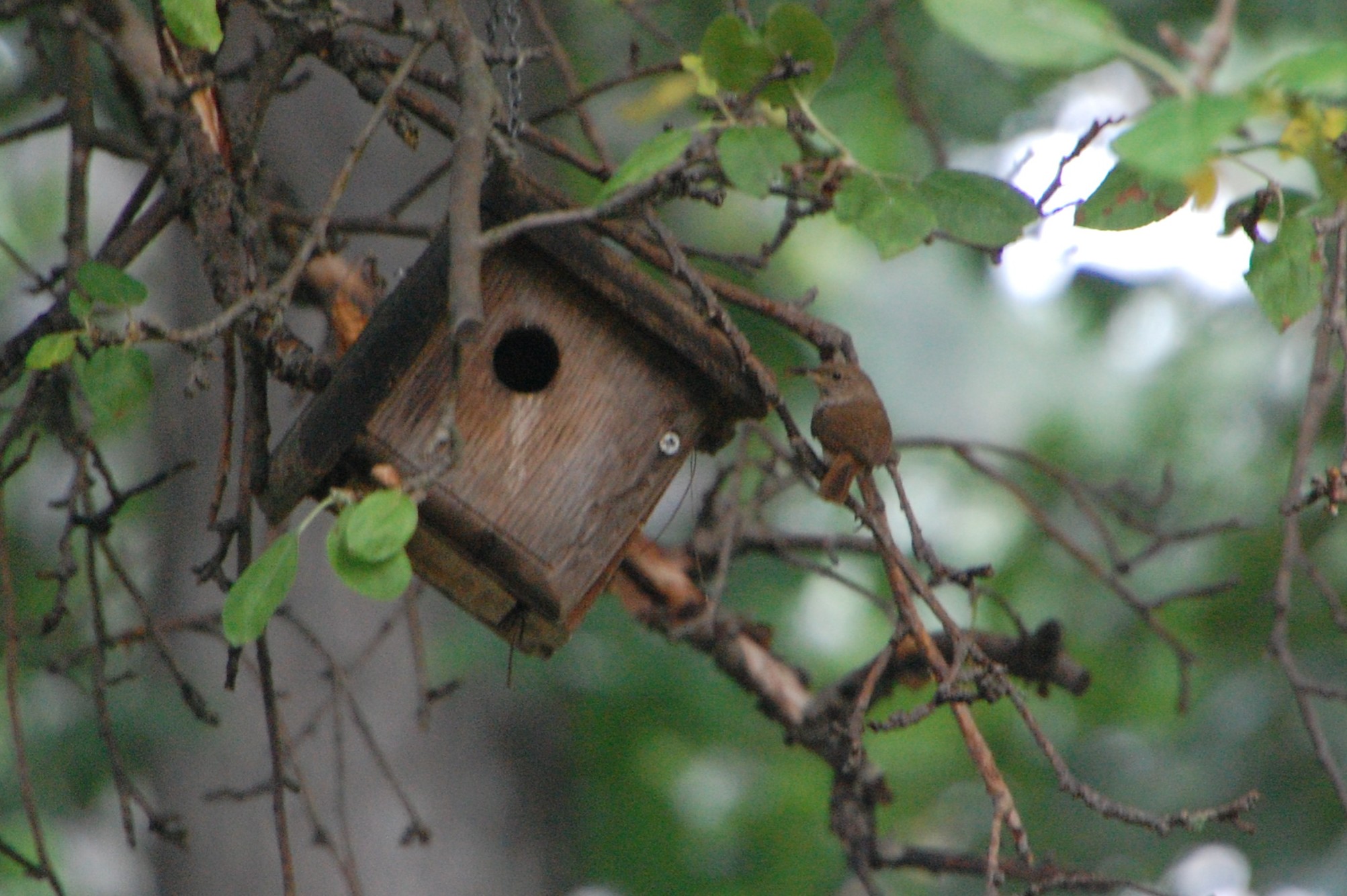
And to bring the story full circle, a few days ago I was on the porch when a house wren appeared at the water dish, dipped its bill and then flew to the dogwood tree. As I watched it checked out the nest box inside and out. Then it flew to a shrub.

You'll recall it was a house wren that came to the water dish back in June that spurred me to put up the nest box, and then I waited for what seemed like years for a pair to come and use it, the pair whose young just fledged.

Was this recent bird one of those wrens coming back to the old homestead? One of the young? Or was it a completely different wren looking for a suitable place to start a second brood? I don't know. It has not returned but the box will remain out for the rest of the summer, just in case.  


Sunday, June 5, 2022

A Lesson Relearned

On June 1, the morning after my last post, I came out on my porch with my second mug of coffee, put on the fan to move the warm air and sat down to relax and let my mind wander before I had to go to work. After a few minutes I heard something through the whirring of the fan. I opened the porch door and put my head out. I heard a house wren.

Nest box, pre-wrens, 2022. Note the string to
the right. (Margo D. Beller)

I came in to sit and watch the nest box I'd hung in the dogwood tree weeks before, a day after I'd seen another house wren at the water dish. There had been silence after that wren flew off but now there was the bubbly song of another and it did not stop, except when the bird examined the wooden box. Then it flew off but soon returned, still singing. 

The next step was to see if there would be a second wren. The female is the one who must approve the site and then start gathering materials for her nest. A day later, I saw her.

Over this past week the male started singing at dawn and the female actively worked at the nest.

Then, today, came a reminder that even when I try to help birds their lives are still precarious.

Sitting on my porch this morning, I was horrified to see a squirrel climbing up the dogwood and then climbing ON the nest box. A squirrel weighs a lot more than a wren and I didn't want the box to fall, in part because I didn't know if there were eggs inside. The female wren flew out of the box and the male flew from the nearby hedge, both to attack the much larger danger.

By then ("NO!") I had rushed from my chair to the other side of the porch to bang on the window. The squirrel took off.

But so did the wrens.

Until last year, I hung this nest box in the apple tree. It was placed halfway out on a strong, horizontal branch to prevent the squirrels from bothering it. I decided to move the box to the dogwood on the other side of the yard because the profusion of apples drew a lot of squirrels (and me) and I didn't want the birds disturbed. However, the dogwood is more open, and the way the branches grow it was hard to find one strong and straight but not too high to make it dangerous for me to attach from the ladder.

House wren in 2020, when the box was in
the apple tree. (Margo D. Beller)
And, of course, I wanted to see the birds. In the dogwood I only had to sit in my chair and look out. In the apple tree I would have to turn around or look from a different, less comfortable chair.

When I took down the box last year I tied a string to the branch to remind me where to place the box this year. When the wrens came, the male kept pecking at it. I realized it might have thought the string was a snake so I went out to cut it. I agitated the birds but I was quickly gone and I hadn't touched the box, unlike the squirrel.

I can't be outside all the time, much as I'd like to be, so I don't know if any squirrels attacked the box last year. The wrens had their brood and, as usual, suddenly disappeared with the young once they had fledged.

This year, after 15 long minutes of silence, one of the wrens came back and went into the box. Then it flew down to a lower branch for a moment before moving off to the area behind the flood wall. A few minutes later it - she - came back with nesting material, flew into the box and then back behind the flood wall. I was relieved at first, but then started to get agitated. Except for one brief call by the male just after I scared off the squirrel there has been silence. I decided I didn't want to keep punishing myself so I came inside. I'll come back out tomorrow to see if they are staying.

A badly placed robin's nest,
(Margo D. Beller)
When I put out feeders in winter, it is to help the birds stay alive in harsh conditions. Many people now feed birds all year round and that is why there are more birds (and more birders). At this time of year I bring in the feeders because there are plenty of insects for the birds and their young. They do not need sunflower seed, they need bug protein.

Still, even with plentiful food there is continual danger in the life of a bird. Just before the squirrel came to the box a flock of noisy fish crows flew overhead, silencing the male house wren. There is no way a fish crow could attack young in a wooden box nest but in the wild predators could get at a badly placed or unprotected nest, and so the wrens go quiet by instinct.

At this time of year there are already baby birds in nests. Just after the squirrel incident another fish crow came too close to the hedge where I know there is a robin nest. Both parents put up a frightful racket as they chased off the intruder. They even got some help from a mockingbird, not the most social of birds but likely also protecting its own nest nearby. 

The Cooper's nest that failed.
(Margo D. Beller)
It is a common site to see big birds being chased off by one or more smaller, protective birds: starlings chasing off grackles, grackles chasing off crows, crows chasing off hawks. But sometimes nests fail, either because they are in the wrong place or are abandoned by immature birds before eggs are laid. The latter was the case with the young Cooper's hawks that built their nest in 2020, only to be spooked off by a flock of fish crows that came too close. The hawks left and squirrels later claimed the empty nest.

And there are the sad situations where the parent (usually the female alone cares for the nest) is killed by a predator (including cars), a cowbird egg hatches in the nest and destroys the other eggs or the parent is forced to abandon the nest and the young starve to death.

I get protective about this nest box and the house wrens that use it every year, but once again I should've let nature take its course. I'm sure the two wrens would've forced off the squirrel - there was no food to interest it - but by my getting involved I possibly made things worse.

One of my friends likes to refer to "my birds" when they come to her feeders. I remind her these are not house pets, they are wild birds. I know she is feeding them so she can see and enjoy them in their various shapes and colors. So do many other people. I tell myself that I don't do that but I now realize, yet again, that I am no better than anyone else.

Will the wrens pick up where they left off? I don't know, but it would serve me right if they didn't. Lesson relearned.


Sunday, July 18, 2021

The Season of Abundance

Yesterday I went to two farm markets. The first, where I go for lettuce and chard, among other vegetables, was also offering kale, beets, zucchini, fennel, green beans, radishes and salad turnips, all grown on a large plot of land behind a school. It was not offering tomatoes yet but when I asked about buying a couple of green ones to ripen on my window sill (or fry green) I was directed to a greenhouse filled with rows of green tomatoes of different sizes, all of which will eventually become red and luscious. In another greenhouse were peppers, now green but soon to ripen into various colors. 

Apple sauce, 2021 (Margo D. Beller)

The second farm market is where I go to buy peaches and corn, both offered as "our own." I like knowing where the stuff I buy is grown. 

This is July and here in New Jersey the fruits and vegetables are growing fast and furious. My four pepper plants are filled with growing fruits that are still green. The basil is growing like a weed - I've already harvested enough for two batches of pesto and some basil-cheddar biscuits. I have plenty of daisies, coneflowers and others to pick for the table.

There has been an abundance of many things this year.

There has been an abundance of rain following a winter when over two feet of snow buried my yard. There has been an abundance of heat waves, the first in early June and then at least two more into mid-July. The humidity has been abundant, too, making even "cooler" days in the mid-80s feel oppressive. It seems to me this heat and humidity started earlier this year and when the rain falls the scene looks disturbingly tropical for an area considered a temperate zone.

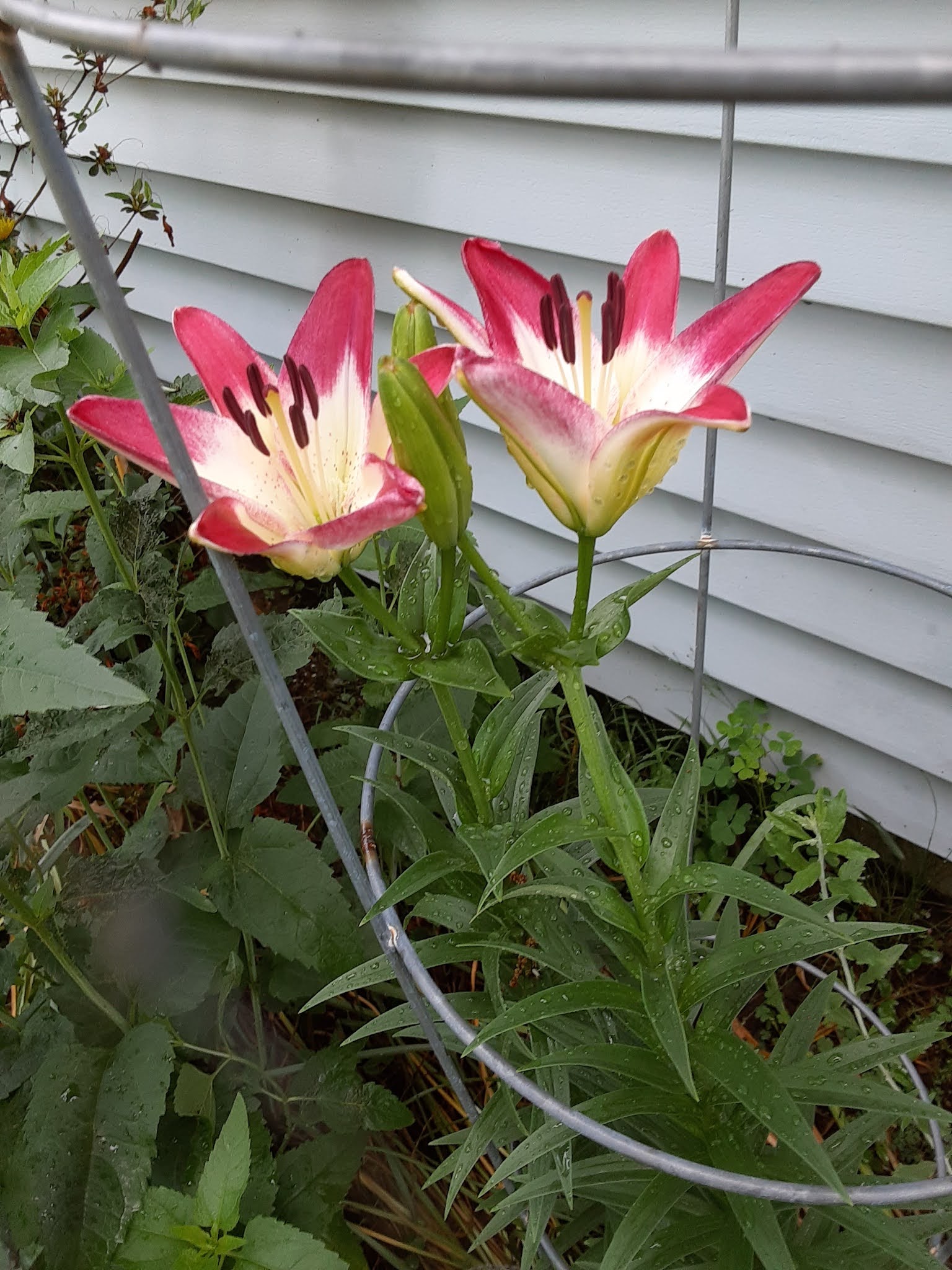
The Stargazer lilies did extremely
well thanks to the rain. (Margo D. Beller)
All that moisture that started in the spring and now the heat have not only led to a bumper crop of my peppers and flowers but also apples. I picked many and then cut off the parts I could use. I had enough apple pieces to fill a large freezer bag. I finally cooked them yesterday after returning from the farm markets. I had four nicely packed pints of apple sauce and there might be more coming because the tree is still not finished (and there seem to be fewer squirrels in the tree, too).

The moisture has brought an abundance of weeds, especially my old nemesis the ground ivy. A couple of Sundays ago I awoke to a cool, dry morning - a rarity this season - and finally tackled some of the mess in the various garden plots including removing spent daffodil foliage, cutting back assorted branches and pulling out the many, many weeds including what seemed like miles of ground ivy. After many hours of labor I'd say I made a dent, but only a dent.

The ground ivy, as usual, was everywhere I didn't want it.
(Margo D. Beller)
There has been abundance in the bird world, too. After a quiet period when many birds were sitting on or guarding nests, there is now birdsong again - robins, cardinals, chipping sparrows, Carolina wren. The catbirds and jays are more actively flying around, using apple and dogwood branches to look for a meal crawling in the grass below. Raucous families of titmice and grackles fly through the trees or search in the grass for a meal.

And there are now two singing house wrens I can hear from my yard - the one using the nest box I put out and one I can hear from a few yards away. 

When the house wren in my yard hears the other one he flies around agitated and sings all the louder. But lately his song has been a little softer, a little shorter in duration. I've been watching the nest box from my perch on the back porch when I can and I've seen a second wren going in and not coming out while the male sings from a nearby branch. A female sitting on eggs. 

This year's house wren doesn't look that different 
from this one from 2016. (Margo D. Beller)

Until today. Today I've seen a lot more activity, birds going into the box and then coming out, so the eggs must've hatched and now there are tiny baby wrens. Feeding, protecting and cleaning up after them are now the parental pair's priorities. In a week or so, the babies should get big enough that the parents will have to feed them from outside the box. In another few weeks, they'll all be gone. This brood is later than in past years and I'm relieved there was one at all after seeing little activity as recently as a month ago.

When it comes to rain, heat and snow, too much of a good thing is too much. But for vegetables, fruit and birdsong, I wish they would continue beyond the summer.


Sunday, July 14, 2019

Family Time, Again

She is nearly invisible in the messy cup nest she built at the top of my pear tree, her yellow bill showing as she raises her head to look at me. But I am behind glass on my enclosed porch and no threat to her. After taking about a week to put the nest together, she is sitting on three to five blue eggs and will rarely move off them for the next two weeks or so unless she must.

Like the neighborhood children freed from school to run around their yards and play, my yard is filled with the sound of noisy young, in this case birds.

Robin in my pear tree, July 13, 2019 (Margo D. Beller)
The American robin female in her nest is not the only robin in my yard. There are others flying around, many of them juveniles whose breasts are mottled rather than orange to help camouflage them. Their nest was in my large yew hedge. An adult male robin is feeding them. There could be two robin pairs or these juveniles may be an earlier brood of the same female robin in the pear tree. (Robins can have up to three broods, if conditions are right.)

This is the time of year when, if you are looking for them, you'll likely see birds either holding food for young or nesting materials. Those with food will lead you to squawking young, which, when they get a little bigger, will flock after their parents and make themselves very visible.

In my yard, besides the robins, the types of birds followed by young so far have included cardinal, flicker, chipping sparrow, starling, titmouse and grackle, with large flocks of cedar waxwings flying overhead. The other morning I watched a young grackle pull a worm from the grass beneath the apple tree. The bird is completely dull brown while an adult grackle is iridescent, with a bright yellow bill and eyes. When you are a young bird, you need all the help you can get to survive into adulthood.

This old nest was within a wild rose bush I was cutting
back. It was well hid and protected by thorns. (Margo D. Beller)
Bigger birds - jays, gulls, great blue herons, crows - will eat baby birds, which is why you will often see these birds chased off by smaller birds - red-winged blackbirds, mockingbirds, Eastern kingbirds, for instance - protecting their young. Danger can come at any time from soaring raptors and neighbors' prowling cats.

Take the robin in my pear tree. According to the Cornell Ornithology Lab, on average "only 40 percent of nests successfully produce young. Only 25 percent of those fledged young survive to November. From that point on, about half of the robins alive in any year will make it to the next."  And robins are relatively big songbirds, about eight to 11 inches long. 

All these bird families passing through my yard are fascinating to watch. Small chipping sparrows land in the longish grass and seem to disappear except for the young's buzzy contact calls. Larger starlings stick with their parents as they hunt in the grass and in the winter will join with other family groups to create the huge flocks that seem to undulate in the air like a single organism. When the berries on my viburnums, dogwood and other shrubs are ready, the robins and other fruit-eating birds will feast (as will the squirrels). Then, when it turns cooler and the leaves start to fall and the insects die off, many of these birds will fly south to their winter grounds to eat there in preparation for next spring's migration and breeding.


Mother Robin coming back from a food break. When I took this picture the
male flew off to the flood wall. I am guessing he was watching things
while his mate was away. (Margo D. Beller)
Unlike in past years, I am not watching a house wren brood. The nest box I cleared a few weeks ago was visited by a singing male. I was hopeful. However, it didn't attract a mate and didn't build a nest. It used the box as a temporary roost for a few days and hasn't been seen since. But that's the nice thing about the natural world. While there are no house wrens this year, I have a front-row porch seat for when Mother Robin's eggs hatch.