Cape May

Cape May
(RE BERG-ANDERSSON)
Showing posts with label vegetables. Show all posts

Sunday, July 18, 2021

The Season of Abundance

Yesterday I went to two farm markets. The first, where I go for lettuce and chard, among other vegetables, was also offering kale, beets, zucchini, fennel, green beans, radishes and salad turnips, all grown on a large plot of land behind a school. It was not offering tomatoes yet but when I asked about buying a couple of green ones to ripen on my window sill (or fry green) I was directed to a greenhouse filled with rows of green tomatoes of different sizes, all of which will eventually become red and luscious. In another greenhouse were peppers, now green but soon to ripen into various colors. 

Apple sauce, 2021 (Margo D. Beller)

The second farm market is where I go to buy peaches and corn, both offered as "our own." I like knowing where the stuff I buy is grown. 

This is July and here in New Jersey the fruits and vegetables are growing fast and furious. My four pepper plants are filled with growing fruits that are still green. The basil is growing like a weed - I've already harvested enough for two batches of pesto and some basil-cheddar biscuits. I have plenty of daisies, coneflowers and others to pick for the table.

There has been an abundance of many things this year.

There has been an abundance of rain following a winter when over two feet of snow buried my yard. There has been an abundance of heat waves, the first in early June and then at least two more into mid-July. The humidity has been abundant, too, making even "cooler" days in the mid-80s feel oppressive. It seems to me this heat and humidity started earlier this year and when the rain falls the scene looks disturbingly tropical for an area considered a temperate zone.
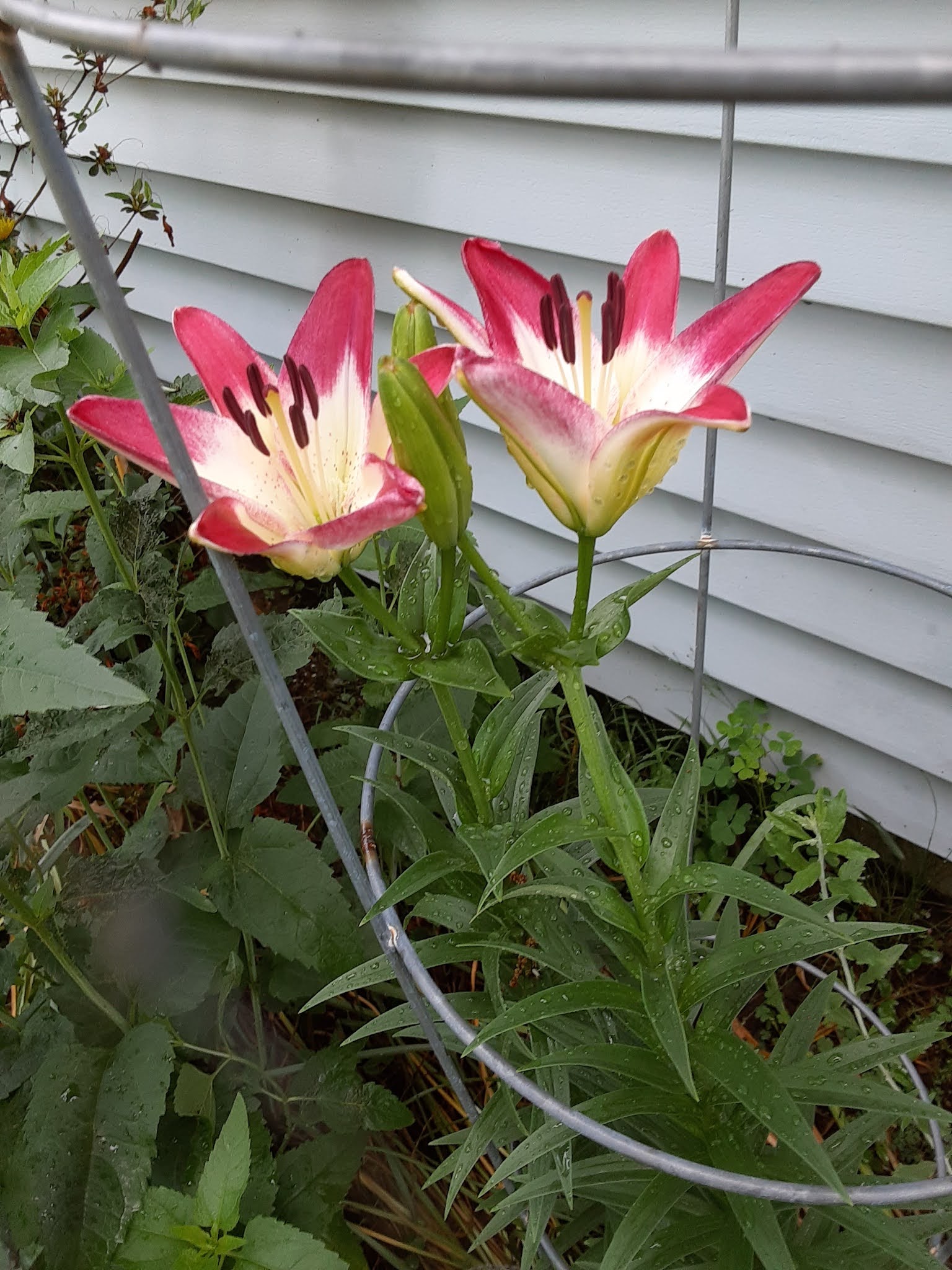
The Stargazer lilies did extremely
well thanks to the rain. (Margo D. Beller)
All that moisture that started in the spring and now the heat have not only led to a bumper crop of my peppers and flowers but also apples. I picked many and then cut off the parts I could use. I had enough apple pieces to fill a large freezer bag. I finally cooked them yesterday after returning from the farm markets. I had four nicely packed pints of apple sauce and there might be more coming because the tree is still not finished (and there seem to be fewer squirrels in the tree, too).

The moisture has brought an abundance of weeds, especially my old nemesis the ground ivy. A couple of Sundays ago I awoke to a cool, dry morning - a rarity this season - and finally tackled some of the mess in the various garden plots including removing spent daffodil foliage, cutting back assorted branches and pulling out the many, many weeds including what seemed like miles of ground ivy. After many hours of labor I'd say I made a dent, but only a dent.

The ground ivy, as usual, was everywhere I didn't want it.
(Margo D. Beller)
There has been abundance in the bird world, too. After a quiet period when many birds were sitting on or guarding nests, there is now birdsong again - robins, cardinals, chipping sparrows, Carolina wren. The catbirds and jays are more actively flying around, using apple and dogwood branches to look for a meal crawling in the grass below. Raucous families of titmice and grackles fly through the trees or search in the grass for a meal.

And there are now two singing house wrens I can hear from my yard - the one using the nest box I put out and one I can hear from a few yards away. 

When the house wren in my yard hears the other one he flies around agitated and sings all the louder. But lately his song has been a little softer, a little shorter in duration. I've been watching the nest box from my perch on the back porch when I can and I've seen a second wren going in and not coming out while the male sings from a nearby branch. A female sitting on eggs. 

This year's house wren doesn't look that different 
from this one from 2016. (Margo D. Beller)

Until today. Today I've seen a lot more activity, birds going into the box and then coming out, so the eggs must've hatched and now there are tiny baby wrens. Feeding, protecting and cleaning up after them are now the parental pair's priorities. In a week or so, the babies should get big enough that the parents will have to feed them from outside the box. In another few weeks, they'll all be gone. This brood is later than in past years and I'm relieved there was one at all after seeing little activity as recently as a month ago.

When it comes to rain, heat and snow, too much of a good thing is too much. But for vegetables, fruit and birdsong, I wish they would continue beyond the summer.


Saturday, August 8, 2020

Sad at Midsummer, Again

Flowers from my garden, 2020 (Margo D. Beller)
Every year, in late July going into August, I start feeling sad. Perhaps it is the continued heat and humidity forcing me inside with the air conditioning while the weeds proliferate. Perhaps it goes back to the days when I was a student and I knew that, come September (or August when I was in college), it would be time to go back to school and I'd lose my freedom. Or perhaps it is seeing the darkness in the early morning when it was once light, or seeing the sun's arc getting smaller as the days get shorter.

So it is this midsummer, except it is worse because this is not a normal year. It is the year of the coronavirus and things may never be the same again.

My life is one example. Doing simple things such as going to the supermarket or getting my hair cut has become more complicated. I have been working from home since March and will continue working from home through the end of the year, and likely beyond. I am OK with that. I find I am less and less comfortable walking outside where I can come into contact with people except for when I can get myself out early to walk on a trail and listen for any birds. But getting up and out is getting harder to do and I am feeling disconnected from nature. I try to go out on the weekends for a walk with MH or to run errands such as to my favorite farm market, particularly now that it is tomato season.

Tomato, basil and peppers, 2020
(Margo D. Beller)
Here, too, things have become complicated. I must be masked, stand six feet from a guy behind the vegetable bins, pointing to what I want, asking it not "be so wilted." Where once zinnias and other flowers grew for picking, every inch of land is filled with a variety of vegetables. That's a good thing because this farm feeds not only casual shoppers like me but members of its CSA community plus it donates produce to local organizations feeding those who would otherwise go hungry. (But for the grace of God that could've been me, too.)

To keep myself from feeling too sad, I think of what COVID-19 hasn't changed.

My flowers - yellow coreopsis, white daisies, purple coneflowers, goldenrod and the deep red flowers of the cannas - are in bloom. If I can't pick the farm's flowers, I can selectively pick my own.

My vegetables are growing, finally. I am waiting for a dozen little green cherry tomatoes and two large, still-green Italian frying peppers to ripen, and there will be more to come. The basil continues to produce big, green leaves I pick for sandwiches and to make pesto.

Fritillary butterfly (RE Berg-Anderson)
Hummingbirds have been visiting the canna flowers in the front yard and the feeder in the back. At this time of year the females need energy to find insects to feed their young. Soon the young will need energy to hunt and may follow their mothers (the fathers will have left long before) to the feeder. The birds started coming later in July than usual but now they are more frequent visitors.

The house wrens are long gone. They and other birds will be heading south soon, if they haven't already started. Those passing through won't be as gaily colored and they won't be singing territorial songs but knowing they're out there might be just enough for me to leave the house and reconnect with the outside world, in spite of this pandemic. The birds need to head south to reach their wintering areas and what we're going through will not affect nor deter them. Those not flying as far south will be stopping (or staying) in my yard when I put the seed feeders back out after Labor Day, less than a month from now.

Monarch butterfly (RE Berg-Anderson)
Butterflies will be heading south, too. I have noticed more tiger swallowtails on the purple flowers of the butterfly bush and some of the smaller butterflies such as the fritillarys. I am waiting for the first monarch butterfly to come.

The days will get even shorter, and there will come a time all too soon when it will be dark before 5 p.m. The inevitability of that depresses me. August is my late mother's birth month and the month her mother as well as one of my good friends died. It adds to the sadness of the period, much as I try to enjoy the flowers, birds and butterflies.

I expect I'll get out of this funk eventually, as I do every year. This year it might take a little longer.

Sunday, October 13, 2019

Disposing of the Fruits of My Labor

Dahlia, Autumn 2019 (Margo D. Beller)
As I sit on my enclosed porch, the weather is most definitely autumnal. I am in my warmest robe. The windows are closed. A feeder has drawn cardinals. The sun's arc is shorter and it doesn't rise as high in the sky. Days are most decidedly shorter.

And in the corner are four pots of vegetables continuing to grow.

Every year around this time I begin the slow task of closing the garden and getting the house ready for winter. I wait for as long as possible before bringing indoors the houseplants I've put on the porch for the summer because they are going to get more humidity outside than in, especially once I start using the furnace. This year I made it until the beginning of October when the projected overnight low one night would be 37 degrees F. My porch would've kept the plants a degree or two warmer but since many of them are tropicals they had to be brought in.

The pots of cannas and dahlias in front behind the deer netting are staying put for now. The dahlias are autumn flowers, just starting to bloom. The cannas' leaves still look fresh although what flowers they had are long since done. Once frost hits and the foliage goes brown I can cut it off and put the pots in the garage, while I pull up the dahlias and store the bulbs, wrapped in newspaper, in a box nearby.

Tomato plant, still bearing fruit (Margo D. Beller)
That leaves the vegetables. Most people, if they grow vegetables, seem to harvest what they can and leave the rest to rot. I've seen this in my town's community garden. I've walked there after a frost and found many tomatoes still on the vine until the plot holder makes it there to rip out the plants. (One of those holders allowed me access once and now I know what a frozen tomato looks and feels like.)

I, however, grow vegetables in pots. Usually I have anywhere from two to five pots of peppers and one of basil. The basil is used up first, long before the first frost. But if the peppers are covered with flowers (connoting the fruit to come), I bring them indoors for the winter.

Things are different this year.

Two autumns ago, I found a tomato seedling near my compost pile. I potted it and it grew into a tree that was difficult to keep upright. Just as it was about to put out fruit, it became infested with white flies that also affected the nearby peppers and my houseplants. Out went the tomato and the peppers, the former into the front yard where, despite the sun, it died in the cold, the latter into the one corner of the enclosed porch where the sun shines the longest. (Each houseplant was examined and cleaned outside before coming back in.)

Peppers  and base of tomato plant; note the pepper flowers
(Margo D. Beller)
This year, I had two of the four peppers I had kept inside for the winter (two died and the other two were continually moved to rid them of white flies) plus a basil, a third type of pepper and a cherry tomato plant that also grew to be like a tree. All were in a protective cage but the deer soon discovered they could reach up and eat the upper parts of the tomato. Thus I covered the tomato and the cage in netting. The plants continued to give me vegetables and, as usual, seemed to get a second life late in the summer.

So once the houseplants were brought into the house, I transported the four pots to the porch where I continue to pick tomatoes even as more grow. Of the peppers, one has been a disappointment (the one decent pepper it produced wasn't particularly good), one is nearly done but the last is covered with flowers and growing fruit.

Tomato flowers and small, unripe fruit (Margo D. Beller
What is different this year is my attitude - none of these pots are going to be taken into the house. I am done with battling white flies. I am done with moving heavy pots. In the autumn of my life, there are more important things I must consider, such as my declining physical strength.

Next year I plan on following Thoreau's dictum of "simplify, simplify" and have one pot of peppers and one of basil. I'll leave the majority of vegetable growing to the farm markets.

When the really cold weather comes, which it inevitably will, I will pick what tomatoes and peppers I can use and leave the plants on the porch and let nature take its course. Then the plants will be pulled out and composted to feed the worms.

Monday, August 28, 2017

Too Much of a Good Thing

Where do the natives of Tahiti go on vacation?

Our dry, cool, sunny un-August weather in New Jersey is like paradise after our recent, normal heat and humidity, but it may be too much of a good thing and it has me concerned.


Gift tomatoes (Margo D. Beller)
At some point during the expected 10 days without rain, I will have to go out with the hose and the sprinkler so the plants and the lawn don't die. There are two water dishes out for the birds (and the squirrels), and they've been visited frequently.

The peppers prefer heat, not evenings that fall into the 50s, as we've been having out here, so I am not sure if the fruits will ever get big or change from green to their expected ripe colors. 

The people who like the beach had a fine weekend (until the traffic home) and those who stayed home and have a grill and/or an outdoor fireplace enjoyed stinking up the neighborthood using them, too.

We aren't beach people but we did visit friends near the Brooklyn waterfront the other day and the wife's small garden put me to shame. Various tomatoes, cucumbers, ginger root, melons, coneflowers, sunflowers, herbs, all in a space about the size of a postage stamp. 

Like other gardening friends when the harvest is coming in, I got gifts to take home because they had too much of a good thing. That happens this time of year. I've had garden plants foisted on me because they'd otherwise be thrown out. One friend claims he will put a zucchini in every unlocked car he finds in his neighborhood, and I've been given zucchinis that look like green logs. A relative complains she doesn't know what she is going to do with all the fruit and vegetables she's picking. (She is a good cook and canner so I am not worried.)

My produce, in pots rather than in the ground, have it a little tougher because the roots are limited in how far they can grow. Some friends are using the new type of mesh pot that supposedly allows for greater air circulation for the roots and creates happier, fruit-bearing plants.


Gift cucumber, nearly 14 inches long
(Margo D. Beller)
Will my peppers ever grow to the right size? One friend in Delaware complains that all the rain she got this summer created a terrible harvest for her cucumbers and tomatoes. The farmers I've talked to in New Jersey have said the same. Too much rain is as bad as to little.

And yet the farm markets are full of peaches, corn, tomatoes, cucumbers, peppers and other produce. Some people are obviously doing a lot of things better than I am.

Meanwhile, our good thing in the northeast is balanced by too much of a bad thing in the rest of the country.

In California. there are major forest fires. In Texas, Hurricane Harvey strengthened into a Category 4 hurricane thanks to the abnormal warmth of the Gulf of Mexico before slamming into the barrier islands, which should've limited the damage but there are people living on them, and so there is damage. The continued rain has devastated Houston. The rain in Texas is being measured in feet, not inches.

Too much dry, sunny weather in NJ, a mega-hurricane flooding Texas. Global warming? You tell me.

Wednesday, August 3, 2016

Mid-summer Morning Walk

Rocky's "office" (Margo D. Beller)
For a number of reasons, I have stopped taking daily walks in the early morning before work. Part of it is the heat. You have to get up early to walk when at midday it is 10 degrees hotter than it should be in suburban New Jersey, and there are some mornings it is all I can do to get to the bathroom in time, and then wrap a robe around me so I can put the thistle feeder out for the goldfinches.

But I have been trying to walk more, even though the birds I hear I can find as easily in my backyard - fish crows, Carolina wrens, cardinals, grackles, song sparrows.

As I walk, staying out of the way of the people running on the sidewalks or the people with dogs or the ones with the baby carriages, I think about other walks in other years.

That made me think of Rocky.

Tomatoes (Margo D. Beller)
Before MH and I moved to New Jersey, we lived in Queens, NY. Our landlady, who lived upstairs, had a big backyard where she grew tomatoes, bell peppers, eggplant, zucchini and had a huge fig tree. When she would visit her daughter's family in California, she would allow me to pick the vegetables, leaving most of them on her kitchen table and taking the rest. I have never been able to eat a fig or a tomato since then without thinking of Mary's garden. All the tomatoes I've bought, even from farm markets, just don't taste the same.

Then we moved to NJ. A few streets over, every summer, a handmade sign would be hammered into the grass at the corner. "Tomatoes" it would read, with an arrow pointing up the street.

It took me a few years to finally get the interest or the courage to investigate. I found a house on the corner where a huge hunk of property had been converted to growing tomatoes. I walked to the garage and looked in. A neighbor across the street called over that "he" might be in the house and to come back. It took weeks but I did.

I talked to Rocky, the man selling the tomatoes, who was in a wheelchair and hooked up to air because of emphysema. It did not stop him smoking or watching TV, usually westerns, with a small fan going.

Zucchini plants (Margo D. Beller)
He told me how he would put in a winter crop, plow it under, put down manure and then put in the various types of tomatoes. When he couldn't do it, neighbors would come over and do it. I picked a number of tomatoes and he threw in some basil he was growing. The tomatoes were delicious, the closest to Mary's I'd found.

For several years I would visit him every week, stocking up on tomatoes.

Then, two years ago, the sign did not go up. I later heard Rocky had died. His family has kept the garden going but now only half of it is tomatoes and they are not for sale. In the other half of the garden grow zucchinis and peppers. That house must have a lot of stewed tomatoes and sauce in the cellar.

I miss Rocky and I miss those tomatoes. I don't miss the walking, however. I'll have to make do with farm market tomatoes.