Cape May

Cape May
(RE BERG-ANDERSSON)
Showing posts with label house wrens. Show all posts

Monday, July 20, 2026

Again At Midsummer

Nearly a year ago I wrote a post about what was going on in my yard. In many ways things are the same and things are different this year.

Cherries in various stages of ripeness (Margo D. Beller)

After the house wren family dispersed, I waited to see if another wren would use the nest box. It took five days - not one like last year - for a male to investigate and start singing around my yard. But nothing much happened. No female showed up. Several times the wren would fly to the box but then would leave.

Finally, I investigated. I found the opening to the box was plugged with nesting material for a house sparrow. Neither the nest nor the sparrow would be able to fit through the small opening so the bird gave up. I knew it was a house sparrow because of the nest material. House wrens use twigs. According to the bird experts at Cornell, house sparrows use "coarse dried vegetation, often stuffed into the hole until it’s nearly filled. The birds then use finer material, including feathers, string, and paper, for the lining." They also steal other birds' nests for their own.

I pulled the mess out of the opening but by then it was too late. It takes many weeks for a wren to find a mate, for her to sit on the eggs and raise the young. Southbound migration is only a month or so away. I've heard no  house wren song in my yard, tho' I've heard them elsewhere. I'll take the nest box down soon.

One of many robins in the cherry tree (Margo D. Beller)

Last year the apple tree did not lose its leaves for some time. This year its yellowed leaves are scattered below. The last apple was taken by a squirrel near the middle of June, nearly a month earlier than in the past. The tree survived its surgery but has been hit, as has the rest of my garden, with high winds, searing heat, thick humidity, the occasional flooding downpour and, now, wildfire smoke. Unlike me, it was not affected by the nearly three days we were without power over the July 4 weekend because of hurricane-force winds and hours of rain. Global warming? You be the judge.

The heat and humidity has kept me from doing much in the way of gardening, and the weeds have been taking advantage. But also taking advantage is a cherry tree at the edge of my yard.

I didn't plant this tree. I don't know if a previous owner did or if it sprang up from a dropped seed. This tree's growth was blocked for years by a nearby apple tree and the giant ash tree, both of which I cut down for different reasons. Once those trees were gone the cherry tree got plenty of light and so jumped in height and spread out. This year it was covered in flowers and now is covered in cherries. These are small and sour (yes, I tried a few) and the families of grackles, robins, catbirds and other fruit-eating birds love them.

The cherry tree trunk is the smaller one to the left.
(Margo D. Beller)

The nearby viburnum's berries are currently green but will, I hope, soon turn red. So will the dogwood's fruit. The privet shrubs will soon have their own berries. All of these will feed the birds as they get ready to head south for the winter.

It is hard to believe some birds are already migrating, such as male hummingbirds - which is why the trumpet vines and jewelweeds are flowering for them. At my house I've twice caught sight of a hummingbird investigating flowers but no birds have been inclined to use the feeder I have out, as far as I know.

There are plenty of birds that breed in my area, meaning their spring migration north stopped in my yard or in local parks that provided them with food, water and a protected place to breed. Hearing them singing or flying around gives me something to enjoy when I go out early in the morning nowadays. And there are plenty of fruiting and seeding plants out there - including weeds - that will feed those birds and the others later in the summer when it's time for them to leave.

Friday, June 19, 2026

So Many Babies

The catbird sat on the branch just below the wren nest box. It surveyed the ground below, looking for movement of a worm or insect. Then it flew down to nab its meal.

While it sat there, no house wren came out to chase it from the nest. For the first time in weeks the box was empty. 

Wren nest box, June 2026 (Margo D. Beller)

For the second straight year, after years of just missing, I saw the house wren chicks leave the nest and take their first wobbly flight to where a parent was no doubt calling for it. I was on my porch so I could not hear the parent, but I could see the three chicks as, one by one, they flew to the bare part of a dogwood branch. Each fluttered to keep its balance. One by one each moved to the leaves at the end of the branch and flew in the direction of the blue spruce's boughs.

This was a change. In past years, the wrens would fly in the other direction, to the shrubbery behind the flood wall. But this year a new neighbor had moved in and put up a wall so his dog could run in the yard. While he had put the fence well in from the property line to leave the trees and shrubs standing, the wall might've made the area too confining to the parents. So they led their young to Spruce, who had told me when the male first investigated the box in mid-April.

"They were here, Margo," he told me now, "but soon they all flew down to the ferns you have growing near me. I couldn't see them in the foliage. They might've flown behind your fencing."

This was on Tuesday, June 16, a week after my last post. In the interval the young had grown so big they could only be fed from outside the box. It was only a matter of time before they flew, I thought. And so, again, I was right.

I have not heard any of the wrens in the yard since then but there have been plenty of baby birds calling after their parents to be fed: cardinal, chipping sparrow, catbird, robin, starling, grackle, titmouse. But the yard is different without the sound of a singing house wren.

This fawn from several Junes ago was in the backyard,
under the apple tree and away from the street.
(Margo D. Beller)

Last year the box was empty only a day before another, or possibly the same, male claimed it and started singing. This year there have been no new takers as yet.

Meanwhile, in late May a doe appeared in the backyard nearly every morning, mainly eating weeds in that sheltered area behind the flood wall. I told my husband and MH's immediate comment was, "Is she pregnant?"

Memorial Day to early June seems to be the time when pregnant does give birth to one, two, sometimes three fawns. The fawns are hidden at first, spending their time sleeping like any newborn, surviving on mother's milk. We have found sleeping newborns in the yard in past years. So I understood his question. No, I said.

But I figured there was a fawn somewhere nearby. After a few weeks it would start following Mom around and supplement its milk diet with grass and plants. (A dangerous time for any unprotected plants as the young figures out what tastes good and what doesn't.)

The viburnum stands in front of the flood wall, with the fence
beyond. (Margo D. Beller)

So I was not surprised the other week when I found the fawn hunkered down in the area behind the flood wall. I couldn't see it from where I was sitting outside on the patio. But when first a chipmunk and then a squirrel climbed a tree and started their alarm calls, I went to see if a cat was hiding back there. Instead, there was the fawn. We stared at each other. When deer are small like this they look cute. It is when they grow and destroy my plants that I want to shoot them. (Same with baby Canada geese.)

Well, I said to it, at least your mother didn't leave you behind the deer netting where you'd make a mess trying to get out. (I now use an old garden hose to block the way in behind that fence.)

I moved and then the fawn bounded away in that herky-jerky way colts run, heading for Mom.

I figured Mom would not leave it there alone again and I was right. When I saw it behind the flood wall today, Mom was nearby, behind a privet bush. Both took off, going around the house next door, perhaps to the area where they'd have gone directly had the fence not been there. 

But they'll be back at some point. Whether house wrens are is another story.

Tuesday, June 9, 2026

House Wrens and a Sea of Green

With the exception of the viburnum, whose flower heads went from greenish yellow to bright white and have now faded before they will eventually produce red berries, all the trees and shrubs in my garden have lost their flowers. No more pink flowers on the dogwood or white blossoms on the apple and pear trees or yellow on the forsythia. The rhododendron and azalea flowers have shriveled and fallen. The irises have finished their bloom and so has the peony.

Viburnum flowers (Margo D. Beller)

Other perennials are now growing and will soon flower. The weeds are way ahead of them and I've already made several long, painful attempts to contain the spread by pulling what I can reach over, under and behind the deer fencing. 

For the most part my yard is a sea of green except where the clover is showing its white flowers in the grass. In the midst of this green sits the house wren nest box.

At this time of year what birds I find in my usual places have ended their migrations to nest and breed. Many of them now have young that need feeding. I hear the young birds calling for food and I see their parents zipping around, gleaning insects from tree leaves. The tree foliage is so thick now I can't see the birds well up there, I can only hear them unless they happen to come lower to hunt on the ground.

The house wrens living in my yard also have young. I estimate they have at least two, maybe three. I'm not sure when exactly the eggs hatched but Mom was in the box a lot at first and now both parents are flying back and forth from the box to remove waste and bring food. Last week the young were small enough for both parents to go inside the box at the same time but usually it is just Mom who goes in. If Dad brings food while she is in the box he gives it to her to give the young.

(I am not humanizing these birds, but it is easier to call them Mom and Dad than to keep saying "the female house wren," etc.)

This year's male house wren. (Margo D. Beller)
After Dad has delivered the food to the nest he sometimes goes to a higher branch in the dogwood and flutters. Then he sings. I don't know what the fluttering means. The singing is the only way I can tell male from female.

Soon the young will get so big both parents will feed them from outside the box, except when Mom squeezes inside to get the waste matter. Eventually, the chicks will be induced to leave the nest and try flying to their parents. With luck they'll make it to the safety of the thick shrubbery across from the box and eventually learn to feed themselves. Then the family will disperse.

Always, there are dangers.

So far this year I have shooed away house sparrows trying to reach into the box to destroy the eggs and take the nest for themselves. They are bigger than wrens so I knew they couldn't get past the small opening on the box to destroy any eggs. Still, I ran them off. I have also run off squirrels several times in the last week because I don't know if they are climbing the dogwood to find insects in the leaves or any fruits being formed or to grab a wren chick.

Until yesterday what I thought was the most horrifying attack I've seen on the nest box - and who knows how many I have missed - was the male red-bellied woodpecker that flew to the box and then stuck its long bill, and longer tongue, inside. At that point there were only eggs. I chased the bird off and later learned from an article that many types of woodpeckers, including the red-belly, eat baby bird brains. I can no longer hear a red-belly in my yard without apprehension.

But worse than that attack was the Cooper's hawk.

Another immature Cooper's hawk atop another feeder pole.
(Margo D. Beller)

Sitting on my enclosed porch with my coffee early in the morning, trying to wake up, I was horrified to see a hawk fly at the nest box as the parents were shuttling back and forth to feed their young. Based on the size I thought, "Cooper's hawk." After hitting the box it flew back to the nearby privet shrub. I ran out clapping my hands to scare it off. When it flew I realized the bird's wings were brown - an immature bird. (Adults have gray wings.)

As I stood near the dogwood after the hawk flew off I heard the cheeping of the wren young.

I went back to the porch and waited for at least one parent to return. After what seemed an eternity, Mom returned and zipped into the box, then left to get more grub. I did not hear the male. It will be much more difficult to feed all those young with only one parent, I thought. That happened several years ago when the male disappeared, the female did all the feeding and then a new male appeared to help her.

(Margo D. Beller)

I went out for a while to do some birding, not wanting to know if the juvenile Cooper's had succeeded in grabbing a meal. (Adult birds are usually much more successful than juveniles that are still learning to hunt.)

When I returned from my time away I went back to the porch, this time with my breakfast. And then I heard Dad. Then I saw Dad and Mom shuttling to the nest box to feed their young. 

The Cooper's had missed. It was as though the attack had never happened. 

This is what life is like for a bird - you migrate, you pick a territory, you find a mate and raise young. If you are lucky they will live to feed themselves, migrate, then come back next year - perhaps to the box I hang in the dogwood - and do it all over again. If a chick trying to fly falls to the ground a jay may grab it for a meal, as I've seen happen. The parents continue feeding what young remain. Do they mourn the loss? Mourning is a human concept. 

Life and death are everyday occurrences in nature. There is very little I can do, but I try to keep the cycle going in my yard.

For now I'm watching the nest box like a hawk.

Wednesday, April 29, 2026

And Then There Were Two

Since my last post I haven't spent much time in the yard because it is migration time. I've risen early and gone places at various distances from my home, usually without eating. The early birder gets the birds as they look for food. Then I come home around 9 a.m. for my own breakfast. In good weather I take my food out to my enclosed porch and sit so I can watch the house wren nest box.

In a previous post I mentioned hearing the first house wren on April 19, 2025.  Exactly one year later, a male house wren started singing in the yard, two days after I put up the box. But things never seem to go as planned with these birds. After a day of seeing it around the box, the wren seemingly left.

Then, according to my notes, on Thursday, April 23, as I pulled the car out of the garage to go off one early morning, I heard a house wren singing very close, which meant it was on the opposite side of the yard from where the nest box hung. Was this the same wren or a different one?

The tell-tale stick telling other wrens this box is taken.
April 28, 2026 (Margo D. Beller)

I got my answer the next day when the house wren male continually sang from different parts of the yard as I ate my breakfast. Then it came to fuss over the box, bringing in a few sticks to give a prospective mate the idea that this would make a good spot for her nest. But I saw no second house wren that day and he soon left. 

On Saturday, April 25, it rained buckets for about 12 hours. The next day I could see the box had gotten plenty wet. I hoped it was dry inside. I saw no activity that day but I heard the male house wren singing almost continually, advertising his availability to any female.

Finally, on April 27, I saw a second wren come to the box. To me all house wrens look alike - they have no difference in size or color. The only way I could tell which was which was the male sat on a branch above the box and sang a bit while the female silently examined the box inside and outside. Then the two flew off together.

"So he has a mate," I thought. 

When I was next on the porch I saw the tell-tale stick coming out from the bottom of the box. That stick means that "this nest is taken."

This is far from new activity. I've been writing about house wrens since at least 2011. When I provide a box they have come every year, no matter which tree I securely hang it in. Every year they do the same thing - look at the box, decide to take the box, create a nest, defend it, raise young, leave with them once they can fly. To me this never gets old. 

Today, resting after hours of birding, I sat on the porch and watched the female furiously adding more sticks to the box. The male sang nearby as she worked on her nest. It is interesting to watch her bring a stick and then try to figure out how to get it into the box. Sometimes the stick is dropped. Sometimes it is broken. Eventually she figured out she can turn her head and put the stick in that way. 

I don't see the male as she does this but I can certainly hear him. He is still singing his loud territorial call. He'll continue to do that until eggs are laid. Then he will sing more softly so as not to call attention to the nest. To me it sounds like the call is intended to assure his mate he is around to defend the nest or tell her he'll watch things while she gets some food for herself.

This 2018 picture of the wren nest I cleared from the box
gives you an indication of what's in there, mainly done by the female.
(Margo D. Beller)

When she took a break from her nest-making labors she stood for a while on top of the nest box. She then flew down to nearby bushes where she can find what she needs, be it sticks or food. 

Every year when the nest is done and the wrens - which pair only for breeding and then separate - have gone south in the fall, I empty the box to clean it. Every year I am amazed at how tightly packed the stick nest is inside. The wrens usually have a brood of three chicks. That's a lot of birds jammed into what looks like a small box. But house wrens are small birds, particularly when just hatched.

Aside from those few sticks the male put in to "stage" the box, the female does all the work building the nest. He won't enter the box again except when the chicks are born and he helps her feed them and remove the poop.

She could be sitting on eggs as early as this weekend. And then things will really get interesting.

Monday, July 21, 2025

At Midsummer

If you consider summer to start on June 1 rather than May's Memorial Day weekend, we are currently in midsummer. Today, a rare not-so-humid day, I took a walk around my yard to see how things are doing.

The early spring flowers are a distant memory. The azaleas, irises and rhododendron have bloomed and busted, the lily flowers gone while the stems remain.

I put seeds from three different types of plants into a pot, and only the zinnias are growing. I had collected the seeds from a friend's plant last fall, and will do it again this fall with these flowers once they are done.

Hummingbird-attracting canna flower (Margo D. Beller)

The purple coneflowers have finally started to open. The midseason goldenrod is in flower. Rose of sharon shrubs are blooming purple in neighbor yards but the pale pink flowering type I have are just starting to bud, as are the succulent sedums protected by the deer fencing. Some of the potted cannas have put up long spikes of red flowers that, witnessed at least once by my husband, attracted a female ruby-throated hummingbird. (I hope she gets to the backyard where the feeder hangs waiting for her.)

The house wren young are now so noisy when a parent comes to feed them that I can hear their begging through the closed windows of the porch, even with the fan on. They are so big the parents feed them from outside the box, except when they squeeze in to remove poop. I expect that, like the brood earlier this summer, there are three birds in the box and they will soon be enticed to leave and follow their parents, learning to feed themselves. If they survive they'll head south and the box will come down for the year.

The humidity has affected me more than usual this year, starting with the heavy spring rains. I used to wonder how those living in New Orleans could survive the humidity. Now I know - you close the windows, put on the air conditioner, close the curtains against the sun and stay inside as the air dries along with my skin, just as it does in the winter when the furnace is continually running. And don't look at the electric bill until absolutely necessary.

But at least the gnats are gone from my porch. Unlike last year when I didn't start noticing them until August and found they had infested the open bag of bird seed, they have nothing to breed on. The seed is in a locked container. Old plastic pots are gone. Soil is off the porch. What ceramic pots I've kept are covered with plastic. If a gnat was desperate enough it would visit the yellow sticky strip, where there are already a number of corpses. My hope is the wrens and other baby birds are eating the overflow.

This month the cicadas started calling during the day, the fireflies have been out in the evenings and soon there will be night choruses of katydids and crickets.

In the cooler early morning I have been hearing a number of different types of birds, besides the resident house wrens. I hear families of titmice and chickadees. Mockingbirds harried a pair of fish crows that seemed interested in nesting in my trees. (They left.) A catbird sang for the longest time atop my yew hedge in the mornings, but now its young are gone and the bird has moved on. It is not yet August but already some birds are heading south for the winter feeding grounds, such as the shorebirds that stop off at some of New Jersey's shore empoundments (along with the nasty, biting, greenhead flies). 

From 2020, a house wren feeding young from outside the box.
(Margo D. Beller)

Warblers are starting to move south. They won't be as colorful as in spring and won't be singing their territorial songs. They will be harder to find.

Leaves are already falling from some of the trees, but not the apple tree. Cutting off that rotted limb seems to have done it some good. The dogwood I saved two years ago is showing green fruits that will eventually redden and, I hope, draw robins and cedar waxwings before the squirrels can get at them.

Back-to-school ads on TV tell me it will soon be time for the kids currently on vacation to hit the books (and their after-school activities) again. It is already darker in the early morning. Soon enough it will be dark in the early evening, too.

I'll put the garden to bed and the seed feeders out for the cardinals and other birds hanging around my yard during the winter. Then another year will end, as it inevitably does.


Sunday, June 29, 2025

Many Directions At Once

 ...[S]tarting a sentence in the middle, and then going to the beginning and the end of it at the same time... both directions at once.

--Liner note from the John Coltrane "lost" album "Both Directions At Once," recorded in 1963 but not released until 2018.

It is a warmish but quiet morning on the enclosed back porch, and I am catching up with the world after last week's heatwave kept me inside with the air conditioning for nearly a week, except for brief forays in the oppressive air to pick up apples dropped by the thirsty squirrels. I would hear birds but had no inclination to go looking for them until the day the heatwave ended, when it was wonderfully cool in the early morning and I could take a long walk.

Wren nest in what is now the diseased area
of the apple tree, back in 2020.
(Margo D. Beller)

This morning, however, I am sitting. In one direction I can see the house wren nest box. During the heatwave the male had been singing almost continually, and I wondered what had happened to its mate. I could not sit on the porch in the heat to watch for activity. 

Unlike the first wren brood, when it was unusually wet and cool during incubation, it must've been extremely hot in that little wooden box for this female. If there were eggs in there they wouldn't need her all the time to keep them warm. But when it turned cooler I did see her leaving the box to get food, then fly back inside for long periods of time.

As I watched today she flew out and soon returned holding a bright green insect, maybe a katydid. She took it inside. So I'm sure the eggs have hatched and she is now feeding small young that will grow bigger. 

What the hummingbird saw, which may be why it didn't stay.
(Margo D. Beller)

That's one direction I can look. If I turn around in my chair I can see the hummingbird feeder. When it turned cool I had put fresh sugar water in and hoped something would be interested.

A couple of days ago, as I was at the back door before going out to collect dropped apples, a hummingbird did suddenly appear. It briefly investigated the pink coral bell flowers, flew up to look at the red lid of the feeder but did not fly over the netting. Instead, it headed for the apple tree but a squirrel in a lower branch must've spooked it because it disappeared. I hope it returns.

Hummingbirds used to be a common occurrence in my yard, usually during July. Last year I saw no hummingbirds at the feeder but one could've come by. Same with the one I saw this week. Did it come by when I had taken the feeder inside? Did it come by when the liquid had spoiled? Was it put off by the netting that protects the plants in the shade? No clue.

Years ago a yellow-bellied sapsucker drilled these holes in
the apple tree. I didn't think they had anything to do with
the current rot. Now I'm not sure. (Margo D. Beller)

So now I'm watching for hummingbirds when I'm on the porch. That is good, because the apple tree is done putting out fruit and I will soon have to do something about its diseased limb.

There was a time, early in our occupancy of this house, when apple season was during July. Little by little apple season has been earlier and earlier. This year the tree started dropping small apples at the end of May, not long after flowering. Then one-third of the tree suddenly went black. As apples got bigger in the rest of the tree the squirrels started coming. I took my long pole out to knock down what apples I could reach. Despite one-third of the tree being dead I managed to get enough fruit for two pints of sauce and two apple cakes. 

The fruit I could not reach I left for the squirrels. Yesterday, June 28, I picked up the last little apples from the ground. Today, June 29, there were no squirrels in the tree and a chipmunk was rummaging around looking for what apple bits it could find. 

Chipmunk hunting apple pieces. (Margo D. Beller)

Apple season is over for this year and it isn't even July. If cutting off the diseased limb doesn't save the tree it could be the last apple season. We've lived in this house for over 30 years and the tree was there when we moved in. It was planted by a previous owner maybe a decade before that.

According to one website I found, the average lifespan of an apple tree is 25 to 50 years, depending on the type. Years ago I showed one of the apples to the manager of the farmstand I buy from and he thought it was a MacIntosh type, even though the tree blooms in the spring rather than fall. MacIntosh trees live 30-45 years.

Factors affecting its life include exposure to sunlight (check), competition with other trees (it stands alone) and moisture. Too little is bad and so is too much. Last year we were in a severe drought, which lasted until this spring, when we had too much rain. This is an old tree. As with the dogwood a few years ago, my hope is cutting away the dead stuff will allow the apple tree to live. But it may not.

Besides apples ripening sooner than before thanks to increasing global warming the insect population is surging earlier, too.

That's why another distraction from my chair is watching for fungal gnats on the porch. Last year the gnats started bothering me in August, at which point I brought my house plants inside and put the infested bird seed bag outside. This year they started in the spring, when it was cold and wet. Maybe they were seeking shelter and warmth because during the heatwave there were very few of them on the porch. (And I don't have house plants on the porch this year.) What I found inside during the heatwave I am sure I brought in after dealing with the apples. 

Instead of spraying the porch, as I did last year, I tried old-fashioned flypaper. 

Hanging from the ceiling. (Margo D. Beller)

I hung it on a wall near the screen door, because that is where I'd see a gnat early in the morning. But all I caught was a spider. I don't want to catch spiders. Spiders are useful insects with their webs. So I changed the location and have the sticky paper hanging from the ceiling. But unlike flies, attracted by the color yellow, gnats could care less. They seem to prefer the white walls of the porch, which is where I've continued to kill them. The one fly that got onto the porch got caught in a spider web. 

The flypaper is something else to look at when I'm not watching the wrens.  


Saturday, June 7, 2025

The Dangers of Youth

"The energy of youth is infectious, but its inexperience is dangerous."

-- Charles de Gaulle

As every parent knows, there are many dangers out there. You give birth, you feed your young, you keep them clean and you try to protect them from predators as best you can. But in the end there is only so much you can do to prepare them for leaving the nest. The young will have to learn to fend for themselves and, with luck, survive to create a new generation.

This is true for all creatures, including birds.

Parent feeding young (This and other pictures from 2020.)
(Margo D. Beller)

The other day, from my porch, I saw two male house sparrows attacking the house wren nest box hanging in my dogwood tree. Had the opening been large enough, one or the other would've gone in, dragged out the wrenlets, killed them and taken over the box. Why there were two males instead of a male and a female, as I saw a few weeks ago, I don't know.

But there they were, so here I went outside to clap my hands to chase them off. When they were gone I heard an angry chittering from the box and then one of the parent house wrens flew out - it had blocked the opening to protect its young. "You're welcome," I said as I walked away. Soon the parents went back to shuttling food to their young.

I did not immediately go back on the porch. I walked to the driveway because I heard the high-pitched screaming of a robin and I sensed something was wrong. Two birds were going at it across the street, or so I thought. I've seen robins fighting each other before in territorial disputes but this turned out to be different.

One of the birds, a young robin (the breast spotted rather than red), flew across the street to the bottom of my yew hedge and hid under one of the small, bare branches near the ground that stick out and prevent me from weeding in that area. The other bird flew at it and I knew by the fanned, striped tail it was no robin but a similarly sized male sharp-shinned hawk. It must've seen me standing there because after the one attempt it took off. Then the chickadees and titmice in the neighbor's walnut tree started their alarm calls. I walked around the hedge and there was the hawk. It was a brown juvenile. Had it been a gray adult that young robin would've been supper. I clapped my hands, the hawk flew off and the little birds went quiet.

(Margo D. Beller)

Hawks have to eat, too, I know, but not in my yard.

Which brings me back to the house wrens.

For the first time since I started writing about the house wren nest box (in 2011; unfortunately, the link no longer works), I happened to be on the porch and saw the young fledge.

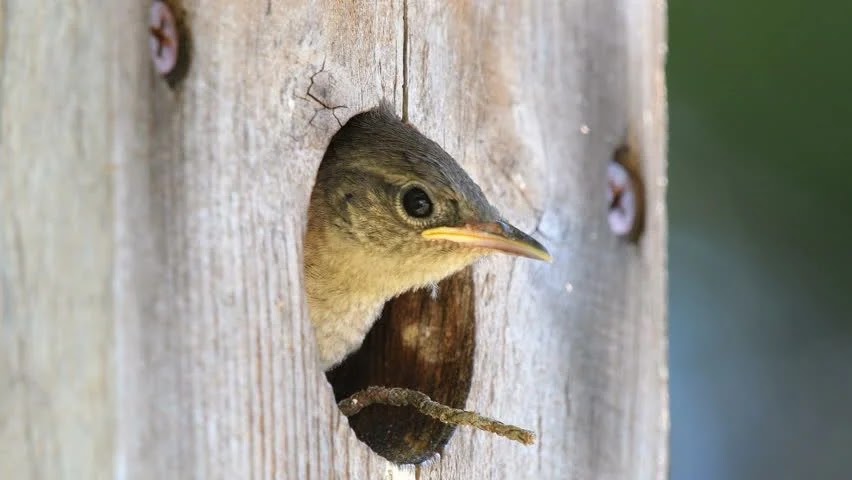
I knew that time was coming soon. The young birds had gotten so big they were being fed by the parents from outside the box. It must've been very crowded and uncomfortable in that box, especially when the temperature soared into the upper 80 degrees F to 90 degrees this week. A parent would occasionally push the young aside to go inside the box to remove poop. When an adult was near I could hear the young begging for food. Lately, the head of a curious wrenlet had been coming partway through the box opening.

I watched this last part with trepidation. Years ago, when the nest box was in the apple tree, a wrenlet fell out of the box and was snatched up by a jay before I could get outside to rescue it. Jays, like their cousins the corvids (including crows and ravens) are among those that will eat young birds. So will squirrels, one of which I saw being harried all over the yard by an angry house wren parent.

So when I saw the little head looking so far out of the box I was concerned, especially when a male sparrow flew to the dogwood. 

I walked to the window and rapped on it. The house sparrow left. That was when I saw that along with the house wren looking out was another small house wren on top of the nest box.

Close to leaving.
(Margo D. Beller)

I had no camera with me. The best I could do was take a picture with my phone from the porch. (It was easier photographing the nest box from outside when it was in the apple tree, and the pictures for this post are from 2020, before I moved the box.) I wouldn't have dared missing anything for a camera anyway.

The first wrenlet flew to a higher branch of the dogwood. The second got closer and closer to leaving the box. A parent came to feed it, then the adult flew to base of the bushes on the other side of the flood wall. I could hear the male parent calling to the young. Finally, the second wrenlet left the box and jumped to a side branch, where it did a little climbing and pecked at leaves. It stumbled a bit but did not fall.

Then, a third head poked out of the box. 

One by one its siblings flew from the dogwood down behind the flood wall, where I'm sure at least one of the parents was waiting. The third one didn't bother jumping to a branch, it flew directly to where the others had gone. No doubt it was hungry and the male's calls told the three they had to fly out if they wanted to be fed.

Now the box is quiet, unless there is a second brood later in the summer. 

The wrens aren't the only young in the yard, of course. I've seen a male cardinal fly to the feeder pole with one of its young, which was the same size and brown like a female but without the red crest and beak. The scared chickadees and titmice were the first indication there were families in the vicinity of my yard since I stopped putting out bird food. 

Not the greatest picture but if you look close
you'll see one wren in the opening and
another atop the box. 2025
(Margo D. Beller)

And, of course, there are young deer. Earlier this week a doe was in the next yard with a tiny fawn drinking her milk. When the doe saw me standing in my yard and looking at them she led the tiny fawn away. For now my yard is safe from curious young nibbling at my plants, learning what tastes good.

Like the fawn, the young birds will be fed by their parents for a time and then will have to fend for themselves. Some, like the juvenile hawk, will need a lot of practice grabbing supper. Others, like the wrens, will be helping my yard by catching a ton of insects. But the young birds will also learn they must avoid predators to survive, and that includes other birds, cats, dogs and humans. 

They will travel with their parents for a time but eventually they will be on their own.

Sunday, July 28, 2024

Gone Again

Once again a house wren brood has fledged and once again I managed to miss it.

As was the case with the first brood back in June, the young started getting antsy. One chick again stayed close to the nest box opening to intercept a parent bearing food. This chick at one point leaned so far out of the box the parent pushed it back inside. But the chick kept looking out, watching for food but also, to me, curious about the world outside the box.

Yesterday, I had my binoculars on the box when a parent came with food, shoved the one chick out of the way and allowed me to see the open mouth of its sibling. The parent fed that chick, checked for poop and left.

Empty nest, July 27, 2024
(Margo D. Beller)

I told myself I should get my camera, sensing things were about to change. As usual, I just sat there.

Later in the day, back from various Saturday errands, I took advantage of the less-humid weather to do some very necessary weeding, including clearing out crabgrass from between paving stones and pulling out ragweed before it could develop pollen that would make me sneeze more than I already do.

One of those areas was at the other end of the yard where ornamental grasses and other plants deer generally avoid are in an unnetted plot. Behind me I heard house wrens. They later flew to a shrubby area just beyond my compost pile, the same area where the first brood hid after fledging. Later, I rested on my porch and saw no activity at the nest box.

Unlike in past years, however, I do not feel sad at seeing the empty nest. I did what I intended, which was to help maintain the house wren population, even though house wrens are far from endangered. This year a pair had one chick and then a second (or the same?) pair had two chicks. With any luck the chicks will grow, fly south to the wintering grounds in Central and South America and then fly north to breed. Big ifs. Life is perilous for all birds, but especially for young birds that somehow know how to migrate without parental help.

I can only hope for the best. The box will be taken down and cleaned out in October, then stowed away for next year.

Monday, July 22, 2024

A Wren by Any Other Name

As we approach August, families have been passing through my yard - small flocks of robins, flickers, grackles, chipping sparrows, all pecking at the ground for food. Birds are also flocking to the cherry tree, where the berries have become ripe enough to consume. The robins, catbirds and jays have been joined by raucous families of titmice as well as the occasional house finch.

Over at the house wren box, the young - I'm guessing there are at least two in this brood - are now big enough that the parents feed them from outside, except when one (usually the female) goes in to remove poop. I can hear the cheeping of hungry young through the open window while I sit on my enclosed porch.

Northern House Wren, aka one of my backyard birds.
(Margo D. Beller)

Many types of birds, including the house wrens and the robins - have multiple broods in a season. Many more are one and done. At this point of the summer, some species of birds are already heading south to their winter feeding grounds. More will be on the move in August into September, including warblers, shorebirds and raptors.

At that point it will be time for people like me to prepare our gardens for winter and put out feeders for the birds passing through and those that will be spending the cold months in and around my yard.

It is at this point of the summer that the American Ornithological Society's (AOS) Committee on Classification and Nomenclature of North and Middle American Birds publishes its "check-list supplement." This benign-sounding document in reality contains what could be radical realignments of the way birds are categorized. Many types of birds previously considered separate species can be "lumped" into one - decreasing the number of birds to record on a Life List. Other birds have been found to be separate species and so are "split," thus increasing the number of birds to be sought by birders.

Here are a couple of examples.

The small common redpoll, which I've seen only during some winters in New Hampshire when they come farther south because of the lack of food in their usual territories are now considered the same species as a paler redpoll I've never seen and is considered a rare visitor to northern U.S. states, the hoary redpoll.

Meanwhile, the Audubon's shearwater, a bird that looks like a large gull and lives its life over the open ocean, is now five species of shearwater, only one of which (the Sargasso shearwater) is found in North American waters. The cattle egret, which is found in farm fields rather than at the edges of water, is now the Western and the Eastern cattle egret. AOS says they are different in plumage. The Western is what is found in the Americas, the Eastern in Asia and Australia.

Normally these changes in taxonomy don't interest me because they involve birds I don't see often or are not likely to see unless I travel to a completely different part of the world.

But the change to the house wren did interest me.

Where there was once one "house wren" there are now six: the northern house wren, the southern house wren, the Cozumel wren, the Kalinago wren, St. Lucia wren, St. Vincent wren and the Grenada wren.

According to the press release announcing the changes:

This split was a long time coming. Some of the island species, in particular, look and sound very different. Some sound so different that people who are intimately familiar with House Wrens from the mainland don’t even recognize their songs as being from a wren! Indeed, that was my experience on my first visit to Cozumel. Speaking of the island species, it was very nice to see this sentence in the acknowledgements of the supplement: “We thank Kalinago Chief Lorenzo Sanford and the Kalinago Council for permission to use ‘Kalinago’ in the English name for the newly recognized species Troglodytes martinicensis.”

Note that “Brown-throated” Wren of Mexico and the far sw. United States is included in Northern House Wren, so there is no additional species for the ABA Area. Northern and Southern house wrens switch over in Veracruz and Oaxaca, where they look different (warm “Brown-thoated” Northerns vs. grayish Southerns) and use different habitats (highland vs. lowland). Kalinago Wren was originally found on Dominica, Martinique, and Guadeloupe but persists on only the first island. The other species are found on their namesake islands.

So the birds in my yard are Northern House Wrens. 

Of course, the birds don't know what we humans call them. If they could understand the human need to classify they likely wouldn't care either. Neither do I. I'll continue to call the birds in my yard "house wrens" even after they fly south for the winter.

Saturday, July 13, 2024

Heat, Humidity and House Wrens

When it is so hot and humid outside I must stay indoors with the air conditioner on for most of the day, I try to imagine what it is like for the house wrens in my yard.

This past week the western half of the United States has been baking under brutal heat, with wildfires sparked. Meanwhile, in my half of the United States, we just got through more than five days where the temperatures were in the 90s and the humidity made the air feel like 105 degrees F.

House wren (Public domain photo)

Weather like that is dangerous. Weather like that keeps people like me inside and extremely uncomfortable unless I have the air conditioner on.

In weather like that I can't even keep a water dish outside because when the sun hits it late in the day the water becomes undrinkable. I can only go out to walk in the very early morning when the air, while still humid, is 20 degrees cooler than what it is forecast to hit for the high. If it is raining in the early morning, as it has for a couple of mornings, I am stuck inside and start to feel caged and anxious, not the best company for my husband.

In weather like that I feel sorry for the First Responders and others who must be outside to do their jobs. I used to travel to work but I would leave in the early morning, sit on a (usually) air conditioned train and then walk into an air conditioned office. The heat would not become an issue until my walk home from the train. But I was younger then and didn't think twice about being in an inferno. Now, I do.

This most recent heat wave wasn't the first this summer. There was a heat wave in June. And there will be a new one starting July 14. And August is weeks away. You can blame El Nino, La Nina, climate change, global warming - whatever you want to call it, it's hot. The Earth won't cool anytime soon without drastic actions.

So I look at the house wrens with amazement and admiration.

I could tell when Mother Wren was sitting on eggs because she would zip into the box and disappear for long periods of time. If it was especially hot, she would sit at the edge of the box and stick her head out of the opening. Then, she'd fly out to get herself a meal while her mate called from nearby, watching the nest.

She sat inside the box because that is what she has to do to protect her young. She keeps cool by panting, sitting by the box opening but also by flying into the shade to hunt for her food. Unlike people, she doesn't have any choice in the matter of how she spends her days. 

Two days ago I could tell the eggs had hatched because she started making more trips into and out of the box. Even Father Wren came to the opening and leaned in, feeding young. More recently he has gone in and out of the box, tho' not as quickly and surely as his mate. They are regurgitating food into the young birds' mouths and taking poop out to keep the nest clean.

Just as I saw with this year's first brood, soon the young will get big enough to move around the inside of the nest and will start jostling each other to get the food when the adults bring it.

Meanwhile, on the other side of my enclosed porch, I've seen only one hummingbird, a male, back in June. It came to the pink coral bell flowers, ignored the feeder I had out and flew off. I've seen none since. Usually I see females in July, when they are also seeking food for their young. Unlike the house wrens, male hummers don't hang around once mating is accomplished.

Where are the hummingbirds?

Toad, 2024 (Margo D. Beller)

So far this month I've seen nothing, and the pink flowers that had been blooming have faded and are mostly done thanks to an unusually hot summer that prompted many of my flowers to bloom at the same time instead of one after the other. The apple tree that provided me with enough fruit to make eight cups of sauce had its last apple plucked by a squirrel on July 5, about a week earlier than usual. Over the years the last apple day has been getting earlier and earlier as the weather has gotten hotter and hotter.

Luckily, the hot weather has also brought out another important source of food for young birds - insects, as well as insect eaters such as dragonflies. And toads.

Last week, a day after several weeks' worth of grass growth was finally cut, I went on the patio and pushed at the cover on my charcoal grill to tuck it in. Something jumped. It was an American toad, common in the east. It was dark and blended into the black cover's folds in the shade where I had put the grill. When I moved the grill it jumped out to the paving stones. 

I am guessing the combination of losing the long grass and the high heat and humidity forced it to find shelter where it could. It hung around for long enough to determine I wasn't going to bother it (I was watching from inside) and then it was gone.

This is not the first time we've had a toad visit our patio in July. 

(RE Berg-Anderson)

In fact, this American toad showed up on the fourth of July 10 years ago, tho not in the folds of the grill cover. It had somehow gotten into the bottom section of the composter I keep on the patio. When I moved the composter to sweep out leaves that had gotten behind it, out jumped the toad.

I can't imagine how this 2014 toad, bigger than the one I discovered last week, managed to get inside the composter. But out in the wild, I guess any port in a storm will do. I expect Mr. Slither to show up any day now, basking in the heat of the paving stones.

Wednesday, June 26, 2024

Chipmunks and Squirrels and Deer (Oh, No!)

I want to talk about some of my neighbors, Not the two-legged ones I'd rather ignore. No, I mean the four-legged ones that make gardening even more of a challenge than it needs to be.

But first, a house wren update. Since my last post, no sooner had the one house wren chick fledged but the adult male - at least I think it is the same male - started singing up a storm all over the yard. It was once again setting his territory for his next brood - house wrens have two each year, tho' I haven't always seen two broods in my yard. He is also "fighting" in song another house wren male that has been singing from a yard across the street recently. I have seen the wren in my yard chase off other birds getting too close to the nest box including house sparrows, jays, catbirds, Carolina wrens and that neighboring house wren.

The male wren on the dogwood branch, between
couplings. (Margo D. Beller)

In the midst of his singing he found a mate - the same as before? - and the female has set about making the box her own, clearing out some stuff and replacing it with some twigs and grasses to line the nest for her eggs when they come. There has been frequent coupling in the dogwood tree so there are no eggs at the moment. 

Now back to the neighbors.

My main problem with chipmunks is they dig, and they are small enough to get under or around my deer fencing. So I find deep holes dug around my plants, usually just after I plant them in the ground or in a pot. If I catch the damage in time I can put the plant back in and save it but that doesn't always happen. I discovered one chipmunk continuously dug up a canna I kept putting back in - when I figured out it wanted a spot for a tunnel hidden by the peony I moved the canna. Another time I came out the front door and a chipmunk jumped OUT of the cage I had put around my pepper and basil plants and a couple of annuals to protect them from the digging. So much for that brilliant idea.

The cage and all but one potted plant (a zinnia) are now stowed inside, either on the enclosed porch or in my sunny front room. (The pepper plant has a nice-sized fruit growing on it and I don't want it seized by the rodent.) Now I am thinking that next year I won't have many pots of plants outside.

Why do chipmunks dig? Maybe to create tunnels for transportation for themselves and their young or to look for acorns they may have planted in these or similar pots last year or to put new acorns in for the winter. Whatever the reason, they create havoc in my garden.

Squirrel in apple tree, caught in the act.
(Margo D. Beller)

Squirrels are too big to follow the chipmunks behind the netting and don't want to get caught in an area they can't escape. But they do climb. They climb into the dogwood to look at the nest box (and are chased away by the male wren). Thanks to the fur coat squirrels always wear they get very hot and very thirsty. Over the past few years squirrels have managed to break or damage water containers I hang in the pear tree by acrobatically grabbing the container with front paws while hanging onto the tree with rear paws. That's when they pull the container down.

One of the water containers squirrels have
damaged over the years.
(Margo D. Beller)

They also really, really like apples.

The old apple tree has been showing signs of stress in recent years, ever since I last had it pruned. This year it produced a lot of blossoms, to my surprise, and that means a lot of apples. The tree dropped many apples on its own early on, and the recent strong winds have blown down more. However, usually it is the squirrels that let me know when the apples are ripe. The climbing begins and I must once again try to get as many apples as I can for myself before the squirrels, which are very sloppy eaters. In this current hot and humid weather they have been particularly active, tho' not as bad as the time I came outside and six squirrels jumped out of the tree. Yet.

If I don't pick up what the squirrels drop the deer get them and leave a mess of their own. I throw chewed apples into the corner of the yard near my compost pile.

From 2018. The apple is now showing signs of stress but
it still produces fruit for me ... and the squirrels.
(Margo D. Beller)

I am sure those apples are feeding that fawn that found its way behind my deer fencing. The other week fawn and doe were passing through my backyard and when I came out the fawn took off, running in circles until its mother led it across the street. Did I give it PTSD? Good. It is because of the deer I must struggle under and over and even around the deer fencing around my garden plots.  

These are the most common critters, although this yard has seen the occasional coyote, bear and, too often, cats that must be some neighbors' pets because they look too neat to be feral. I can almost forgive the trouble animals cause me because they are doing what they do in order to survive. The two-legged ones are another matter.