Cape May

Cape May
(RE BERG-ANDERSSON)
Showing posts with label time passing. Show all posts

Monday, July 21, 2025

At Midsummer

If you consider summer to start on June 1 rather than May's Memorial Day weekend, we are currently in midsummer. Today, a rare not-so-humid day, I took a walk around my yard to see how things are doing.

The early spring flowers are a distant memory. The azaleas, irises and rhododendron have bloomed and busted, the lily flowers gone while the stems remain.

I put seeds from three different types of plants into a pot, and only the zinnias are growing. I had collected the seeds from a friend's plant last fall, and will do it again this fall with these flowers once they are done.

Hummingbird-attracting canna flower (Margo D. Beller)

The purple coneflowers have finally started to open. The midseason goldenrod is in flower. Rose of sharon shrubs are blooming purple in neighbor yards but the pale pink flowering type I have are just starting to bud, as are the succulent sedums protected by the deer fencing. Some of the potted cannas have put up long spikes of red flowers that, witnessed at least once by my husband, attracted a female ruby-throated hummingbird. (I hope she gets to the backyard where the feeder hangs waiting for her.)

The house wren young are now so noisy when a parent comes to feed them that I can hear their begging through the closed windows of the porch, even with the fan on. They are so big the parents feed them from outside the box, except when they squeeze in to remove poop. I expect that, like the brood earlier this summer, there are three birds in the box and they will soon be enticed to leave and follow their parents, learning to feed themselves. If they survive they'll head south and the box will come down for the year.

The humidity has affected me more than usual this year, starting with the heavy spring rains. I used to wonder how those living in New Orleans could survive the humidity. Now I know - you close the windows, put on the air conditioner, close the curtains against the sun and stay inside as the air dries along with my skin, just as it does in the winter when the furnace is continually running. And don't look at the electric bill until absolutely necessary.

But at least the gnats are gone from my porch. Unlike last year when I didn't start noticing them until August and found they had infested the open bag of bird seed, they have nothing to breed on. The seed is in a locked container. Old plastic pots are gone. Soil is off the porch. What ceramic pots I've kept are covered with plastic. If a gnat was desperate enough it would visit the yellow sticky strip, where there are already a number of corpses. My hope is the wrens and other baby birds are eating the overflow.

This month the cicadas started calling during the day, the fireflies have been out in the evenings and soon there will be night choruses of katydids and crickets.

In the cooler early morning I have been hearing a number of different types of birds, besides the resident house wrens. I hear families of titmice and chickadees. Mockingbirds harried a pair of fish crows that seemed interested in nesting in my trees. (They left.) A catbird sang for the longest time atop my yew hedge in the mornings, but now its young are gone and the bird has moved on. It is not yet August but already some birds are heading south for the winter feeding grounds, such as the shorebirds that stop off at some of New Jersey's shore empoundments (along with the nasty, biting, greenhead flies). 

From 2020, a house wren feeding young from outside the box.
(Margo D. Beller)

Warblers are starting to move south. They won't be as colorful as in spring and won't be singing their territorial songs. They will be harder to find.

Leaves are already falling from some of the trees, but not the apple tree. Cutting off that rotted limb seems to have done it some good. The dogwood I saved two years ago is showing green fruits that will eventually redden and, I hope, draw robins and cedar waxwings before the squirrels can get at them.

Back-to-school ads on TV tell me it will soon be time for the kids currently on vacation to hit the books (and their after-school activities) again. It is already darker in the early morning. Soon enough it will be dark in the early evening, too.

I'll put the garden to bed and the seed feeders out for the cardinals and other birds hanging around my yard during the winter. Then another year will end, as it inevitably does.


Sunday, May 25, 2025

Sliding Into Summer With the Wrens

The year has been going quickly. On the cusp of Memorial Day the daffodils and very early blooming flowers in my garden are long done. When I pushed down the daffodil foliage I exposed the other plants that are now growing thanks to all the rain we've had lately - butterfly weed, liriope, purple coneflower, sedum. The azaleas bloomed nicely, as did the hellebore. The flowers on both are fading but the foliage is growing. 

(Margo D. Beller)

The rhododendron (above) is now flowering the best I've ever seen it and all of the potted cannas are growing lush foliage behind the protective enclosures used to thwart the deer.

The migrant birds I had heard in my yard are mainly gone now, taking advantage of the north wind lessening to go elsewhere. I can still hear plenty of birds during the day but they are no longer setting territory, they are quietly building their nests and creating the next generation of birds.

One of those birds is what is now known as the northern house wren.

(Margo D. Beller)

Sometime in mid-April - unfortunately I did not note the day - after reading reports house wrens had returned to my area from their wintering grounds to the south, I hung the wren box (above) in the dogwood tree. I was hoping to draw a breeding pair for another year.

On Monday, April 21 - which I noted - a house wren was singing from the locust tree in the front yard closest to the driveway. I had taken out the garbage pail so the bird was over my head. I knew to start watching for action.

Nothing happened for three days. Then, on April 24, I saw a pair of house wrens investigating the nest box. They looked inside and outside it like any couple investigating a prospective residence. Then they left. It did not take long before they started bringing nesting material - twigs - to the box. 

The activity brought a pair of house sparrows to the dogwood. Sparrows will nest in anything - any opening in a street light, for instance - and they will also try to take a nest away from another bird, in this case a house wren.

The wooden nest box was made with a small opening to let in a house wren and keep out a bigger bird like a house sparrow. After a few attempts, plus my going outside to chase them off, they stopped bothering the box. That is when the nest building began in earnest.

After my husband and I returned from a family visit the second weekend in May I sat on my porch and watched the nest box. I noticed the male would sing from a nearby shrub. The female would come out of the box. Was she sitting on eggs? Very likely. To me the wren call was the same as the "this is my territory" call but apparently the female heard something different. He would call, she would fly out to get food and then return to the box. 

A few days later I noticed she was making more trips out of the box and then flying back with food. If the Cornell bird people are right about the timing, the eggs likely hatched. Mom would fly in with food, then maybe brood her young if it was cold out. Sometimes the male flew to the box and gave the female food, presumably to feed a chick. He would fly to another branch in the dogwood or a nearby shrub and sing, presumably letting his mate know he was watching for predators.

One of the parent wrens, as photographed from
my porch chair through a screen.
(Margo D. Beller)

House wrens are tough little birds when it comes to protecting their territory. When another house wren was in the yard it was quickly chased off. When a gray squirrel climbed the dogwood looking for something to eat, the male wren flew at it, pricking the much bigger animal with its sharp bill. The squirrel left in a hurry. The wren chased off any downy woodpecker using the tree as a staging area before flying to the suet feeder. (I've since put all the feeders away.)

Some birds it left alone because they have no interest in baby birds - the yard robins and catbirds, which flew to the dogwood to scan the lawn for something to eat or bring back to nearby nests. The wren would fly to a nearby branch and watch until the larger bird left. Then the wren flew off.

Today I noticed from the porch that both parents were bringing food and going into the box to feed a chick. When they left they would take a small amount of poop to keep the nest free of bacteria. At this point the young - two or three chicks, I'm guessing - are still small. In the next two weeks the baby birds will get so big their parents won't be able to get into the box. These birds will be hungry and loudly begging when a parent arrives. The chicks will jostle each other to get to the front and grab the meal. If a chick can't fend for itself it will die.

The nesting period is 15-17 days, according to Cornell. That means at some point in the next 10 days or so, likely when I'm not on the porch watching, the male will call to the young and draw them out. One day the young are squawking in the box as usual, the next I can tell by the silence the birds have flown. Maybe for a few days I will hear the young begging for food as they follow one or the other parent around the fringes of the yard. Then they will be gone, maybe to start their own broods. The parents will go their separate ways, unless they decide to have a second brood in the nest box. At the end of the summer the birds will face the perils of flying south again.

When hot, humid summer comes I try not to do much in the garden aside from the necessary weeding. The perennial flowers and shrubs I planted will take care of themselves with little assistance from me until it is time to cut them back for the winter. 

At this point I will acknowledge that, once again, another year is ending and take the nest box out of the dogwood.

Friday, December 31, 2021

Time Passing


What good is the warmth of summer, without the cold of winter to give it sweetness.

-- John Steinbeck

When I am walking in a familiar place in one season, I can't help remembering the birds I saw in the same place in another season, usually in another year.

So when I took a winter walk the other weekend in the Central Park of Morris County (but what I still call Greystone for the mental hospital that once stood there), I saw what is and what was.

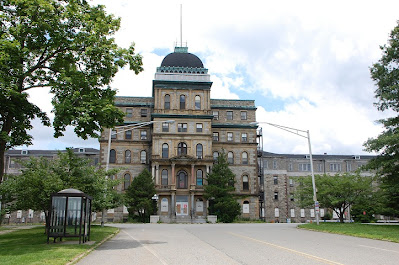
Greystone administration building, razed not long
after this picture in 2015 (Margo D. Beller)

Let's start with the symbol of Greystone, the Kirkbride administration building. There was a battle over the abandoned building, which was ultimately torn down because that was cheaper than preserving it. Plans included turning it into apartments, which would've greatly changed this area with increased traffic. Now it is a wide-open field over which I've seen swallows and other birds hunting insects.

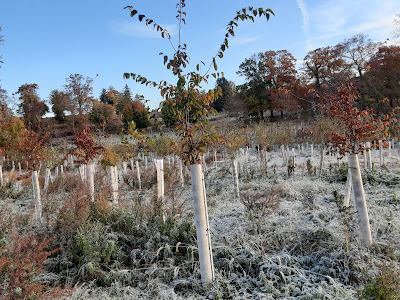
Conversely, there is an area at the outer edge of the property that was once a working farm. The structures were removed decades ago and the field became overgrown. When this area was turned into a county park a number of trees were cut down and the land cleared. Paths were cut through, intended for cross-country competitions but also used for walkers and joggers. Now the area has been replanted with different types of saplings in protective wrappings. In a decade, maybe less, this open space will become a forest.

As I walk this path in December it is cold and gray and the trees are bare, so I am thinking of what I have seen here in other seasons. Over here, a noise prompted me to look across the sapling field to find a herd of deer, including two bucks butting heads. Near the brook that runs through this field, a song sparrow was singing atop a downed tree. In yet another area, past a different field filled with blooming goldenrod and ragweed, a flock of migrating palm warblers. Here, in a tree over a field of milkweed, is a vesper sparrow, an autumn visitor, distinctive for its white eye ring.

The same area after the debris was removed, 2018.
(Margo D. Beller)

But today it is quiet and windy. I look at the tree where just a month ago I watched flocks of robins, cedar waxwings, starlings and bluebirds gorge on seeds, insects and the fruiting vines as white-throated sparrows called to each other from the field below. The tree is now bare, the birds laying low and quiet except for a couple of song sparrows alarmed by the guy running along the path with his dog. The dog wants to check me out but his owner calls to him and they continue on. Other walkers, some wearing headphones, ignore me so I am basically alone in this vast place.

I enjoy these winter walks and the solitude. Without the leaves the trees show their striking, sometimes grotesque, forms. I can see where past storms have sheared off limbs. It is easy to find the large nests of squirrels. 

Winter tree (Margo D. Beller)

But along with the starkness this time of year brings me a feeling of loss, of time passing, of death. The days are shorter, the nights longer and the year is ending. I think of friends and family no longer living. The darkness keeps me inside more than I'd like. These feelings come every year but they still hit me, sometimes in unexpected ways.

When I was here in November I noticed that many of the saplings had grown tall enough to be identifiable. This time, the leaves are down and I noticed several red cedars had also been planted. These conifers should grow much faster than the saplings, as well as provide little berries for the birds in winter. But at some point they will be overshadowed by the trees. I look at this field and try to imagine what it is going to look like. I know the landscape is going to look very different.

Saplings, November 2021 (Margo D. Beller)

For instance, the many types of sparrows I've seen in this open field are not found in deep woods and so will be moving elsewhere. This former mental hospital was altered to become a park to benefit county residents like me. But what about the birds and other creatures that were living here after the mental hospital closed but before the park was built? The wooded areas where I once found an assortment of birds are gone, cut down for soccer fields. Vultures that once roosted in trees along the main road have gone elsewhere because the area became too busy for them. 

There is good and bad to making massive changes. 

Both this area and I are changing, not necessarily for the better, and will continue to change as time goes on. Time can't be stopped. The year 2021 is ending. It has been filled with challenges, some pain but a lot of happiness. This year, in the midst of Covid-19, a lovely wedding. Next year offers the promise of a new grand-niece. Sometimes I dwell too much on the past and the future, so to stay sane I take these walks and try to stick to the present.