
What good is the warmth of summer, without the cold of winter to give it sweetness.
-- John Steinbeck
When I am walking in a familiar place in one season, I can't help remembering the birds I saw in the same place in another season, usually in another year.
So when I took a winter walk the other weekend in the Central Park of Morris County (but what I still call Greystone for the mental hospital that once stood there), I saw what is and what was.
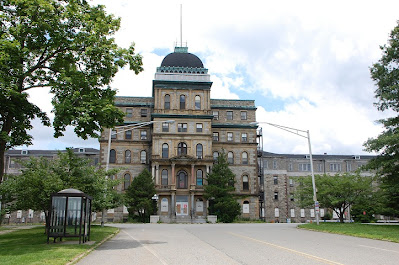 |
| Greystone administration building, razed not long after this picture in 2015 (Margo D. Beller) |
Let's start with the symbol of Greystone, the Kirkbride administration building. There was a battle over the abandoned building, which was ultimately torn down because that was cheaper than preserving it. Plans included turning it into apartments, which would've greatly changed this area with increased traffic. Now it is a wide-open field over which I've seen swallows and other birds hunting insects.
Conversely, there is an area at the outer edge of the property that was once a working farm. The structures were removed decades ago and the field became overgrown. When this area was turned into a county park a number of trees were cut down and the land cleared. Paths were cut through, intended for cross-country competitions but also used for walkers and joggers. Now the area has been replanted with different types of saplings in protective wrappings. In a decade, maybe less, this open space will become a forest.
As I walk this path in December it is cold and gray and the trees are bare, so I am thinking of what I have seen here in other seasons. Over here, a noise prompted me to look across the sapling field to find a herd of deer, including two bucks butting heads. Near the brook that runs through this field, a song sparrow was singing atop a downed tree. In yet another area, past a different field filled with blooming goldenrod and ragweed, a flock of migrating palm warblers. Here, in a tree over a field of milkweed, is a vesper sparrow, an autumn visitor, distinctive for its white eye ring.
 |
| The same area after the debris was removed, 2018. (Margo D. Beller) |
But today it is quiet and windy. I look at the tree where just a month ago I watched flocks of robins, cedar waxwings, starlings and bluebirds gorge on seeds, insects and the fruiting vines as white-throated sparrows called to each other from the field below. The tree is now bare, the birds laying low and quiet except for a couple of song sparrows alarmed by the guy running along the path with his dog. The dog wants to check me out but his owner calls to him and they continue on. Other walkers, some wearing headphones, ignore me so I am basically alone in this vast place.
I enjoy these winter walks and the solitude. Without the leaves the trees show their striking, sometimes grotesque, forms. I can see where past storms have sheared off limbs. It is easy to find the large nests of squirrels.
 |
| Winter tree (Margo D. Beller) |
But along with the starkness this time of year brings me a feeling of loss, of time passing, of death. The days are shorter, the nights longer and the year is ending. I think of friends and family no longer living. The darkness keeps me inside more than I'd like. These feelings come every year but they still hit me, sometimes in unexpected ways.
When I was here in November I noticed that many of the saplings had grown tall enough to be identifiable. This time, the leaves are down and I noticed several red cedars had also been planted. These conifers should grow much faster than the saplings, as well as provide little berries for the birds in winter. But at some point they will be overshadowed by the trees. I look at this field and try to imagine what it is going to look like. I know the landscape is going to look very different.
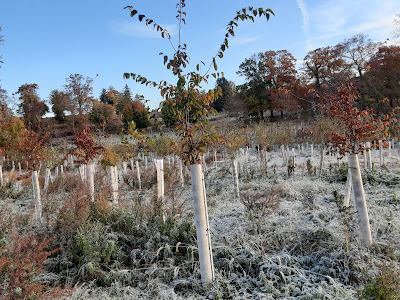 |
| Saplings, November 2021 (Margo D. Beller) |
For instance, the many types of sparrows I've seen in this open field are not found in deep woods and so will be moving elsewhere. This former mental hospital was altered to become a park to benefit county residents like me. But what about the birds and other creatures that were living here after the mental hospital closed but before the park was built? The wooded areas where I once found an assortment of birds are gone, cut down for soccer fields. Vultures that once roosted in trees along the main road have gone elsewhere because the area became too busy for them.
There is good and bad to making massive changes.


