Cape May

Cape May
(RE BERG-ANDERSSON)
Showing posts with label central park of morris county. Show all posts

Sunday, January 4, 2026

The Wild West Suburbs

It was an eerie sound. My husband heard it through our closed den window. "That's not a dog," he said. I went to the door and opened it in time to hear a small bit. It was a coyote, howling at that night's full moon. 

A coyote? In a western suburb of New York City? We figured it was singing in the vicinity of our town's community garden and woods beyond the backyards of the homes across our street.

"Coyote (Canis latrans)" by Joshua Tree National Park is marked with Public Domain Mark 1.0.

(Well, maybe it's not so unusual considering coyotes have frequently been seen in the heart of New York City's Central Park and a pair have lived there for years.)

I have seen and heard some interesting things in my suburban town over the years, especially during the years when I'd be walking the streets at 5 a.m. to make a very early train. I've seen and heard owls - screech, great horned, barred, perhaps even a barn owl. I've seen foxes sitting in the middle of an intersection as I approached or trotting down the street.

I've seen raccoons the size of small dogs crossing what would otherwise be a busy street, heading from one backyard to another. I've also seen raccoons popping out of the sewer at the end of my property.

I've sidestepped skunks, including two baby skunks I barely saw. I've had to stop as a herd of 12 deer galloped across the road ahead of me.

And there was the bear I saw after it damaged the house feeder - and ripped off the pole arm - on a sunny late afternoon in October when there were plenty of people outside their homes. And there was the bear that damaged another feeder and the one that damaged my pear tree.

But a coyote howling at the moon? This was a first.

Like a lot of animals, coyotes, members of the dog family like your pet Bowser, have always been around in New Jersey and other eastern states, where some called them "brush wolves." Unlike wolves, coyotes don't hunt in packs. According to the International Fund for Animal Welfare, a coyote's diet "consists primarily of mammals, such as deer and rabbits, but may also include frogs, fish, and other prey, as well as fruits, grass, insects, and carrion."

"fox" by digitalprimate is licensed under CC BY 2.0.

"Mammals" such as pet cats and dogs are also eaten, which is why some towns go berserk when a coyote is spotted. Usually they won't attack - the one time I saw one it quickly skittered away. But some will. 

As for "carrion," I suspect overflowing garbage cans would attract a coyote the way they do skunks, raccoons, bears and crows, among others.

According to a group called Project Coyote, the United States Department of Agriculture’s Wildlife Services accounts for over 64,000 of the hundreds of thousands of coyotes killed each year through hunting bounties, poisoning and hunting, among other ways of death. Despite that, coyotes are not an endangered species. They’re classified as least concern with increasing populations.

If you provide coyotes with an increase in suburban garbage and deer, you'll see more coyotes. It's a wonder I've never heard one here in the neighborhood before.

I've seen a lot of changes in my suburb. When we moved in over 30 years ago you could often see rabbits and red squirrels. I once inadvertently uncovered, then quickly re-covered, a nest of baby bunnies under one of my shrubs. Rabbits used to eat my plants and occasionally would get behind the deer netting. Now I see rabbits only in wide-open areas, such as the Central Park of Morris County. I see more foxes there, too, as well as on my street and sometimes crossing my yard.

The red squirrels I would see were on one street where there was a large white pine. Between the larger and more numerous gray squirrels and the homeowner cutting down the pine the red squirrels disappeared. But they can easily be found in dense pine forests.

Another animal seen more often in the NJ suburbs,
including my backyard. (RE Berg-Andersson)

My point is the area has changed. More houses, less open land and trees. No hunting except at specified times and locations. The growth of suburbia has promoted the increase in deer and other animals as well as in the predators that eat them. The growth of suburban man-made garbage promotes an increase in animals, like bear, that have found rifling through a garbage can is an easy meal. So there are more human encounters with wild animals.

As encounters go I'd rather hear a coyote singing to the moon.

Saturday, July 26, 2025

Midsummer Flowering Weeds

On a recent less-humid morning I took a long walk around what I call Greystone and the maps now call the Central Park of Morris County. I was walking on the cross-country running track created in the back fields of what was once a psychiatric hospital. I was looking and listening for birds, as usual, and managed to find a few.

But after a while I started looking at the plants. In the area where saplings had been planted a few years ago there are now small trees - tulip poplar, sweetgum, sumac, among others - as well as fields of weeds I once thought were ragweed but I now know have the lovely name of common mugwort, which sounds like something out of Harry Potter. I like the mugwort because last year a drainage ditch filled with the stuff offered protection to at least four types of migrating sparrows, goldfinches and at least two types of warblers.

Back in September of 2019 I wrote about walking among the autumn weeds. It is now July of 2025 and the same weeds are already out thanks to a combination of warmer than usual temperatures and more than usual amounts of rain. Maybe they were always out in July, or maybe it's another sign of global warming.

So while I hate the weeds in my backyard with a passion, I enjoy the park weeds' flowers, fruits and seeds because they help pollenators and birds, migrating and those that hang around all year.

Here are some of my photos.

This is a wild grape vine. The fruits are now white but they will turn blue. They are enjoyed by sparrows, robins and other fruit-eating birds. The vine will engulf anything nearby. 

There is goldenrod that blooms in the middle of summer, and goldenrod that blooms near the end of summer. I grow the midsummer type. I presume this is the same type. 

This is called teasel. It is about four feet tall and has spiky, blue flowers that are favored by bees. Every time I see these I consider taking off a seed head or two for my garden. Maybe I will do it this year.

This poison ivy was growing along the walls of what used to be the hospital dance hall. Unless cut down the ivy will completely cover the building. Obviously the Parks Dept. doesn't want to touch it.

Trees can be weeds, too. This is tree of heaven, growing along the same building as the poison ivy. Unless you get it when small it will put its long taproot into the ground and be very difficult to remove, as I learned when I tried to dig out one from my in-laws' front yard years ago. 

A field of mugwort provides hiding spaces for birds, deer and rabbits, as I saw during my walk.

I once had one of these inkweed plants growing in my yard but I quickly dug it up before the taproot went too deep. In this picture the berries are not ripe yet. When they are they'll be deep purple. Catbirds love these berries, as do robins and cardinals, among others. 

In front are the white wild carrot (Queen Anne's lace) and the blue chicory, whose roots can be made into a type of coffee. They are surrounded by mugwort and other weeds. Some of the growing saplings are behind them.

Milkweed is very important to the survival of monarch butterflies. The caterpillars feed on the plant and bees pollenate the pink flowers. As I have learned in my yard, they spread by an underground root system. In a field they look lovely. In my backyard they have popped up in the wrong place and do not flower. Except for one that popped up in the ornamental grass garden, the rest are mowed down. But then more pop up.

Ah, bee balm! This is another plant that will get everywhere because of its spreading roots. I grew it once but years of digging and weeding in that particular area eventually killed all of it. Now I look at large fields of bee balm and wish I still grew some in a bigger, preferably fenced, backyard.

This weed with its yellow and orange flowers is known as the common toadflax, but I prefer its colloquial name of butter-and-eggs. It looks like a wild snapdragon.

More than a few times I have carefully picked the wild raspberries along the path while I've hiked. As you can see here, other people as well as birds also help themselves. The stem is full of large, very sharp thorns. I have found seedlings all over my backyard. If they are behind the floodwall I leave them but if they are in the garden plots or the lawn, they have to go.

Unfortunately, the jewelweed was not flowering at the time. Hummingbirds really like this late summer weed's orange or yellow trumpet flowers, especially when the birds need fuel to help them migrate south.

As I discovered last year, the county Parks Department mows down the fields of mugwort and the other weeds, including the ones I photographed, in October. But like all seeding, fruiting and spreading weeds, they'll be back next year. Of that I've no doubt.

Wednesday, October 30, 2024

When You Know Migration Is Truly Over

As I write, October is nearly over. We have had nearly a month without rain in New Jersey, where I live, and the shriveled leaves rain down with every puff of wind. We had lovely color for a while but then the temperature, which had dropped, started rising again. Now, Halloween might be 80 degrees F, a new record.

The "Sparrow Bowl," Sept. 29, 2024
(Margo D. Beller)

Every day I check the lists to see what other birders have found and also the interactive "Bird Migration Forecast" map that uses the information picked up by the nation's radar system to track bird movement. Lately, movement has been light.

So in my head I know this year's southbound migration is just about over. But it was still a jolt to visit an area I only recently discovered to be a good place for a variety of sparrows, warblers and other birds needing a place to rest and where they can feed on the weed seeds and the fruits on assorted vines. 

This weedy area is in the Central Park of Morris County, which I still refer to as Greystone for the former mental hospital that moved up the road. The site is 5 minutes from my house, making it very convenient to visit daily. It is a very large piece of property and one can find birds, deer, even foxes if you hike early in the morning before the dog walkers and runners show up.

This particular area I'm mentioning consists of two drainage ditches located behind the playgrounds. These ditches became overgrown with weeds, as open areas like this will do. One of the ditches also has small trees in it, and that made a difference to what I now relate.

The same area, Oct. 30, 2024. (Margo D. Beller)

I came to the area today for the first time in a week. As I walked over from where I parked I saw half of what I called the "sparrow bowl," was gone - completely mowed down. The other half, where the trees are growing, was left basically alone except for the mowing down of ragweed at the edge. With my binoculars I looked up the path at nearby areas where I discovered more birds would hide in the ragweed. All gone.

Logically, I can understand why this county park would want to mow down ragweed. I don't like it in my yard either. This area of the park gets a lot of foot traffic between the dog walkers and the cross-country runners, with a birder like me showing up here and there.

Emotionally, I was ready to throw up.

There are still plenty of weeds near where I was standing in the park and in the fields beyond, but the only birds I heard or saw today were the ones I'd expect to hang around during the winter including juncos, various woodpeckers, jays.

[UPDATE: Between the time of this post and today, Nov. 3, the weeds in the second drainage area were cut down. The trees were left standing. I found late migrants in a field down the hill where they can hide among the dried goldenrod.]

The other part of the "bowl" (to the right) where only the weed
border was mowed down thanks to the trees.
(Margo D. Beller)

I was reminded of when I worked in Jersey City, on the waterfront. There were plenty of open, empty lots filled with weeds. During migration I'd find plenty of birds, including the types others reported from more typical migrant hotspots such as Central Park in New York City. But soon "development" did away with those open lots, and with them the birds.

Many weedy areas in parks and vacant lots are important stopovers for birds on the move, but most people don't look at weeds that way. What was a nearby bird paradise for me (and the birds) was just so much wasted land to the Jersey City "developers" and, I realize, those who want Greystone used by everyone, birders and nonbirders alike. So once again something has changed, and not for the better.

In this particular area, at least, migration is over. I'll have to look elsewhere farther afield and hope to find this paradise restored next year.

Sunday, September 29, 2024

The Stranger

It is a cloudy weekday morning with a chance of rain. The young woman pushing the baby carriage down the grassy park path sees a figure ahead. The figure is in black - pants, wool cap, raincoat. The woman has a moment of panic and hesitates, but as she comes closer she sees the figure is another woman who is wearing binoculars on a harness. This woman is leaning on a large walking stick and looking intently into a weedy area. She looks up, notes where the woman with the carriage is walking, and goes back to looking into the weeds. The woman with the carriage passes by. They don't speak.

(Margo D. Beller)

A short time later an older couple, each walking a large dog on a leash, also sees the woman in black. They come down the small hill from the parking area where the woman has also parked. They see her and the binoculars. The woman sees them and the dogs. She walks to the other side of the path from where the dog walkers go, her back to them, looking up into the trees. When they leave she goes back over to the weeds and continues to watch.

After a time she shifts her position as the birds' calls draw her attention. Over here, a flock of goldfinches. Over there, palm warblers, a little duller in color but looking not much different from their spring plumage, batting their tails every time they alight on a tree branch or tall weed. 

The woman looks over and sees the couple coming back. Once again she shifts her position away from them. Once again they look at her. No one speaks. The couple goes down a hill and are gone to another part of the park. The woman goes back to finding the calling sparrows her Merlin app says are in the area. She will ultimately find six types of sparrows that come out of the weeds and sit in the open just long enough for the woman to see and identify them.

I have been doing this a long time and knew what I was seeing. 

The weedy area ahead of me is in a depression that, ringed by ragweed and filled with that, some milkweed, goldenrod and other weeds, provides a deep, relatively secure hiding and foraging place for the sparrows, warblers and other birds I found there. I had discovered this birdy area, located behind a playground and picnic area at the Central Park of Morris County (formerly the Greystone Psychiatric Hospital), after birding in a different area of the park the day before. I came on this weekday morning to explore it further without the crowd of noisy people the park draws for after-school soccer practice or weekend sporting events.

The weedy field. (Margo D. Beller)

I try to imagine what others see when we encounter each other. I usually wear a hat to protect my scalp from sun and bug bites. I keep my hair down and my shirt and jacket collars up to protect my ears and neck. I wear gloves tho' if I use Merlin or write something in my notebook I have to expose a hand.

I figure the binoculars is what allows people to relax, realizing I'm just some old bird watcher and not a sex offender or thief ready to ambush them. Still, I must look strange all covered up as others are walking or running the same paths in shorts and T-shirts.

Greystone, as I still call it, is a more-open piece of property than some of the places I go to bird. Where the playground sits once stood stone dormitories for the patients. I don't know if the weedy depression where I stand was there before and, if so, its use. But Greystone is filled with weedy areas, and at this time of year they provide food and shelter for migrating birds and those that will be hanging around for the winter.

Ragweed, in another part of Greystone. (Margo D. Beller)

When I am in areas where the paths are more narrow people passing me will sometimes say hello or good morning or even ask me what I am seeing or have seen. Runners don't usually speak to me unless it is to say "on your left" as they pass. Most people on bikes say nothing, don't even ring a bell. I have to hope to hear them coming so I don't step in their way. If I hear them and step out of the way maybe one in three thanks me.

Most of the time I am not out there to be sociable or exercise, I am out there looking for birds, particularly during the migration periods in spring - when birds are colorful and singing - and autumn - when they are dull and, if I'm lucky, making soft contact calls.  

One of the narrow paths I usually walk.
(Margo D. Beller)

People with dogs can be troublesome, particularly if their dogs are not on a leash. I used to make comments but after a few times I stopped because the reactions ranged from ignoring me to downright hostility. Concerned birders know unleashed dogs can kill birds. Dog owners know these concerned birders can be troublesome, too. We pass each other and I hope they don't come back this way.

Most times the people I see with dogs are pleasant, leash their pets and clean up after them. If the dogs are friendly I pet them. Since Covid there seems to be more people spending time outside in the parks, often with the dogs they bought during the pandemic. When someone is heading my way with a dog I stand aside and let them pass.

If they look at me as strange, I don't care. They are strange to me, too.

Monday, November 13, 2023

When Too Much of a Good Thing Can Be Bad

Nobody goes there anymore, it's too crowded.

-- Yogi Berra

As more trees are cut down and more buildings are put up in urban and suburban areas, I've noticed it is rare to have a static piece of open space. It has to feature more things for people to do rather than boring stuff like walking, listening to the birds or sitting quietly on a bench.

These pieces of open land have to include soccer fields, playgrounds, areas for "special needs" people, cross-country running tracks and the occasional field hockey rink. This is known as "mixed use."

Boardwalk under construction at Great Swamp
(Margo D. Beller)

I can understand the need for such facilities. As there is less open land and more people living in new developments, those creating a park know residents need a place to run the dogs or get the kids outside to play in a supervised environment. It adds to the "quality of life," and is an attractive incentive to move to that development.

What I don't like is the effect of such thinking at federal "refuge" areas. 

There is a school of thought that if land is opened to more people, they will want to protect it. Or people who approve the construction of a park want to justify the cost because you can't collect property taxes on land where no one lives or works. In a state like New Jersey, where property taxes are the highest in the U.S. because they are used to pay for so many services, the latter is no small thing.

So, for instance, you have the Central Park of Morris County, created out of the old Greystone Hospital that was closed because of horrendous conditions. Empty stone buildings were taken down, including the historic Kirkbride Building, and the fields opened for soccer, cross-country running, even disc golf. The state had sold the land to the county for $1 at a time when people were yelling for affordable housing to be put on this huge piece of property. The park people won out, thankfully for me and my small town abutting the land, and the park is usually filled with people. If I go there birding, it is early in the morning and never on a weekend during school months.

Here's another example of how the law of unintended consequences could come into play.

In the central part of northern New Jersey lies a 12-square-mile piece of open land that is known as the Great Swamp. Most of it is overseen by the U.S. government through the National Park Service, with sections that became county parks run by adjacent Morris and Somerset counties. Private groups, such as the Great Swamp Watershed Association, also have a hand in making sure people are enjoying themselves responsibly, although park rangers do the enforcing.

Great Swamp entrance, not far from a network of boardwalked
trails (Margo D. Beller)

Half of the property is maintained as "wilderness" where the land is left alone for the most part - mud, overgrowth and all. There are no cinders on the trail, no boardwalks, very few signs. There are birds - wonderful birds - in season as well as deer, fox, possum and sometimes bear, among others.

The other half of the swamp is "managed." Fields are periodically burned to get rid of invasive plants or to open an area to a field bird like the woodcock.The main road through this part was once a real residential street. Little by little the federal government bought up the land. As people moved out the houses were knocked down. That empty road has become a tour road, allowing cars to drive through the sanctuary. Half the road's stretch is paved, the rest unpaved. In another part of the managed area trails are boardwalked to allow people to get to blinds or, in one case I'll get to, an "observation" area.  One particular trail in this part of the Swamp tends to get a lot more people who "find nature" while wearing sneakers or other footwear not suited for mud. On weekends and holidays they bring their kids, who usually rush ahead of them shouting.

Overlook, replacing a blind
(Margo D. Beller)

I avoid this particular trail.

The Swamp, located in the midst of suburbia, serves the same function as New York City's Central Park - a large area in the middle of a concrete jungle where migrating birds can rest before pushing on or arrive to spend the winter. Back in the 1960s, no doubt in the name of "progress," there was a serious move to make the Swamp the New York metro area's fourth airport. Protesters, led by Helen Fenske, fought over many years to get that plan blocked. 

When the Friends of Great Swamp decided to leave its old center at one end of the tour road to refurbish a larger property at the other end, the new visitor center was named for Fenske.

It is what is now taking place across the road from the center that sparked this musing on unintended consequences.

The old center was small. It had a bookstore, a bathroom and a kitchen where visitors could get a cookie, coffee or a glass of water. It had a very homey air about it. Outside were bird feeders, which attracted many birds as well as some of their predators, including a redtailed hawk and a kestrel. 

However, as a place where it could draw large numbers of people for lectures and showcase everything the Swamp has to offer, it was considered insufficient. After the Fenske center opened the old house was taken down. 

The larger center does not offer coffee and cookies. It has a larger bookstore, more bathrooms and more meeting areas, but is not particularly homey. There are still feeders, positioned so those inside can look through a plate-glass window without disturbing the feeding birds.

Winter, Great Swamp (Margo D. Beller)

When the Fenske Center opened several small trails were put in. However, another, much longer trail was soon blazed on the other side of the road. It was dubbed the "White Oak Trail" because, as my husband and I discovered when we walked it one winter, it leads to some huge oak trees several hundred years old. That winter the trail was icy, and I'm sure it became muddy in spring.

Now, it is being boardwalked.

The managed part of the Swamp, as I said, has long had boardwalked trails. And, unfortunately, there was precedent for taking a trail and making it more accessible with boardwalks. One trail I walked all the time was boardwalked until you came to the woods. Then you continued on to a blind. This trail is now fully boardwalked. No more trying to get around ankle-deep water after heavy rain. No more tripping over tree roots. 

No more old blind either - it was removed for a large "observation platform" named for a local environmentalist. It has plenty of seating. More people troop over there, climb the steps, look over the tall reeds at the distant waterfowl. When I am up there, which isn't as often anymore, most of those who come up do not stay long because they are not birding, they are only walking to the end of a boardwalked trail.

On the White Oak trail, before it was paved.
(RE Berg-Andersson)

As for the White Oak trail, even tho it is not completely boardwalked people are already on it. Perhaps one day MH, with his balky knees, and I will do it, too, if only to see what birds are still hanging around the area and check in on the old oaks (like the one in the photo above).

But I think something is lost when you open up an area like this in the name of making it "accessible" and getting people "back to nature." More people mean more erosion, more noise, less opportunity to stand in a truly quiet area.

I guess I am being selfish in wanting governments to leave parks alone. During Covid, this part of the Swamp was one of the few areas not closed down by a misguided federal government and thus available to people who needed to get out during a time of great fear. We came, too, and found the tour road crowded with cars, people walking (many with dogs on a leash) and riding bicycles. People fought over parking places. Cars crawled along the road, just like during rush hour.

It is nowhere near that bad now. But it could become that way again, and that is what I dread. 

Saturday, June 17, 2023

Growing Concern

I like trees. I've written about my despair when they are cut down, including by me. But after a recent walk I had to wonder about the unintended consequences of planting some trees in a particular area.

Saplings, May 2023
(Margo D. Beller)

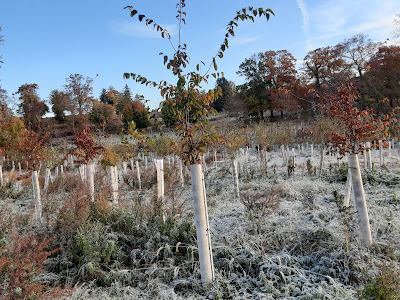
In the Central Park of Morris County not far from me a field was planted with tree saplings a number of years ago. All you could see were rows of protective tubing. In autumn 2021 I went for a walk in that area after a long absence and noticed the saplings had grown tall enough to be seen above the tubing.

The other week I went back and the saplings were even taller. I could now identify many of the trees including tulip poplars, maples, even at least one sweetgum. What happens when they all grow up, I wondered. Tulip poplars alone can grow 70 to 90 feet tall and have a 35- to 50-foot spread. It is also a fast-growing hardwood tree, which might explain why it was planted here.

Saplings, November 2021
(Margo D. Beller)

I can't remember exactly when Morris County put in the saplings. It could've been after hurricane Sandy blew through in 2012 and toppled trees in this field, once part of a working farm associated with the old Greystone hospital. The saplings could've been planted as part of the work the county did when it took over the land to turn it into a multi-use park.

The field in the aftermath of Hurricane Sandy in 2012,
which might be the reason more trees
were planted. (Margo D. Beller)

During that time, the old hospital buildings including the wards, the farm and the Kirkbride administration building came down. Old or damaged trees came down with them. (Many other trees that came down in a different area were neither sick nor damaged. They were in the way of a very large planned soccer field.) 

This old farm field usually draws a lot of birds depending on the season. In past years I've found different types of sparrows, warblers, vireos and thrushes. But now I have to wonder what will happen when the trees grow to their full height. The area is already changing. The grasses around the saplings have not been cut and have become very long and weedy. This is good for some birds but not for others. 

Once the trees have grown and darken the area it will change even more. Will there be more forest dwellers? Bird that look for insects or build nests in treetops? I fear the sparrows and other grassland birds that prefer wood edges to deep woods will go elsewhere. 

I'll just have to see what happens when those trees throw shade.

Friday, December 31, 2021

Time Passing


What good is the warmth of summer, without the cold of winter to give it sweetness.

-- John Steinbeck

When I am walking in a familiar place in one season, I can't help remembering the birds I saw in the same place in another season, usually in another year.

So when I took a winter walk the other weekend in the Central Park of Morris County (but what I still call Greystone for the mental hospital that once stood there), I saw what is and what was.

Greystone administration building, razed not long
after this picture in 2015 (Margo D. Beller)

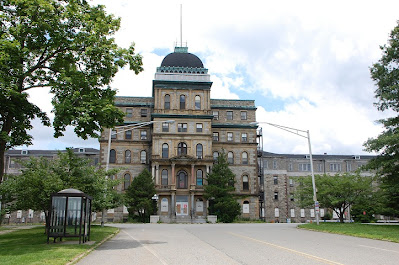
Let's start with the symbol of Greystone, the Kirkbride administration building. There was a battle over the abandoned building, which was ultimately torn down because that was cheaper than preserving it. Plans included turning it into apartments, which would've greatly changed this area with increased traffic. Now it is a wide-open field over which I've seen swallows and other birds hunting insects.

Conversely, there is an area at the outer edge of the property that was once a working farm. The structures were removed decades ago and the field became overgrown. When this area was turned into a county park a number of trees were cut down and the land cleared. Paths were cut through, intended for cross-country competitions but also used for walkers and joggers. Now the area has been replanted with different types of saplings in protective wrappings. In a decade, maybe less, this open space will become a forest.

As I walk this path in December it is cold and gray and the trees are bare, so I am thinking of what I have seen here in other seasons. Over here, a noise prompted me to look across the sapling field to find a herd of deer, including two bucks butting heads. Near the brook that runs through this field, a song sparrow was singing atop a downed tree. In yet another area, past a different field filled with blooming goldenrod and ragweed, a flock of migrating palm warblers. Here, in a tree over a field of milkweed, is a vesper sparrow, an autumn visitor, distinctive for its white eye ring.

The same area after the debris was removed, 2018.
(Margo D. Beller)

But today it is quiet and windy. I look at the tree where just a month ago I watched flocks of robins, cedar waxwings, starlings and bluebirds gorge on seeds, insects and the fruiting vines as white-throated sparrows called to each other from the field below. The tree is now bare, the birds laying low and quiet except for a couple of song sparrows alarmed by the guy running along the path with his dog. The dog wants to check me out but his owner calls to him and they continue on. Other walkers, some wearing headphones, ignore me so I am basically alone in this vast place.

I enjoy these winter walks and the solitude. Without the leaves the trees show their striking, sometimes grotesque, forms. I can see where past storms have sheared off limbs. It is easy to find the large nests of squirrels. 

Winter tree (Margo D. Beller)

But along with the starkness this time of year brings me a feeling of loss, of time passing, of death. The days are shorter, the nights longer and the year is ending. I think of friends and family no longer living. The darkness keeps me inside more than I'd like. These feelings come every year but they still hit me, sometimes in unexpected ways.

When I was here in November I noticed that many of the saplings had grown tall enough to be identifiable. This time, the leaves are down and I noticed several red cedars had also been planted. These conifers should grow much faster than the saplings, as well as provide little berries for the birds in winter. But at some point they will be overshadowed by the trees. I look at this field and try to imagine what it is going to look like. I know the landscape is going to look very different.

Saplings, November 2021 (Margo D. Beller)

For instance, the many types of sparrows I've seen in this open field are not found in deep woods and so will be moving elsewhere. This former mental hospital was altered to become a park to benefit county residents like me. But what about the birds and other creatures that were living here after the mental hospital closed but before the park was built? The wooded areas where I once found an assortment of birds are gone, cut down for soccer fields. Vultures that once roosted in trees along the main road have gone elsewhere because the area became too busy for them. 

There is good and bad to making massive changes

Both this area and I are changing, not necessarily for the better, and will continue to change as time goes on. Time can't be stopped. The year 2021 is ending. It has been filled with challenges, some pain but a lot of happiness. This year, in the midst of Covid-19, a lovely wedding. Next year offers the promise of a new grand-niece. Sometimes I dwell too much on the past and the future, so to stay sane I take these walks and try to stick to the present.

Sunday, May 10, 2020

Watching the Neighbors: Mother's Day

This has been a topsy-turvy, Bizarro World type of week. On May 9 there was snow falling in upstate New York and much of northern New England. In my part of New Jersey the temperature fell to around the freezing level, making some of my sun-loving perennials less than happy.

Meanwhile, the strong wind made the high of 45 degrees feel like 30 degrees.

Map of conditions around 11 p.m. ET by Cornell University Ornithology Lab,
 screenshot by Margo D. Beller

That's why the migration forecast radar map put out by Cornell, seen above, shows a big, blank area over my part of the country while all the migrants are hitting the midwest, as the yellow and pink shows.

Did I mention it's May?

This week would be when, in years past, MH and I would've taken some time off to travel and look for northbound migrant birds. The coronavirus put an end to any planning. Like everyone else, I've had to make do and stick closer to home. That includes birding. But with work taking a lot of time my birding is mainly on the weekend.

MH and I have found some interesting birds - worm-eating warbler, a Blackburnian warbler, an American bittern posing for the camera I didn't have on me - but so far we have not seen some birds I've seen more regularly such as the northern parula and the indigo bunting. There has been a house wren in my yard but it is not using the nest box I hung in the apple tree. For a time some other small bird that could fit inside, perhaps a chipping sparrow, was using it but now it seems to be empty.

The weather had not helped either. When we had a rare warm and sunny day the crowds (most of them nonbirders and minus face masks) hit the state parks just as the birds did. (We stuck to a smaller, local park.) But most of the time it has been rainy, cold, windy. In those conditions you can't plant many types of vegetables and during a recent dawn walk through my town's community garden before work I saw most of the plots filled with weeds or cold weather crops such as lettuce.

That's where the law of unintended consequences comes in.

With less human traffic in the community garden (and, until recently, at the nearby Central Park of Morris County) creatures have become emboldened, and they sometimes wander out of that area and into my neighborhood.

"Fox pup" by gm_pentaxfan is licensed under CC BY-NC-ND 2.0

Deer are a given, and usually in May I watch anxiously for pregnant does that might want to drop a fawn or two (or three) in my yard, as has happened in years past.

This time it's a different type of mammal.

For the last two mornings, around 6:30 a.m., I have gone outside with the feeders. A small fox, likely a female (vixen), has popped up from behind the flood wall in the corner of my property and then trotted quickly away. We've had fox pass through before, which might be the reason we haven't seen a rabbit in the yard in many years.

This morning, however, was quite unusual.

I was in my porch chair, relaxing in the sun with my coffee, when I heard a house wren sing, loud. I slowly got up, turned and saw the bird on the patio. Then it flew to the top of my garage. The next time it sang it was somewhere in the front yard. Since I had my binoculars with me - I had hoped for migrants in the seeding oaks - I walked to the end of the back path and scanned the trees across the way from the top of the driveway.

There was the vixen, across the street, quickly trotting in a neighbor's yard not far from the community garden. She stopped to give me a long look and I quickly saw why.

A couple of playful pups in a nearby backyard. Then another. Then another. Four baby foxes.

Mom took off, spooking some nearby squirrels. The pups continued playing until a neighbor's dog barked. They stopped playing and huddled together. You must know they were in the yard of the neighbor who had put the hole in the sky and would not think twice about calling Animal Control. But never underestimate the power of a mother. To my relief, when I turned to go back to the house Mom must've called her pups to her because when I turned back for a last look they were gone.

At the time I took this picture, the sticks poking out from the bottom
showed an occupant. But lately the nest looks abandoned.
(Margo D. Beller)
And to think, I was worried about deer dropping fawns.

It is obvious to me now the vixen behind the flood wall was hunting to feed her babies, just as the nesting birds are doing once the eggs hatch, presuming the recent cold didn't kill them. It is also obvious to me the den is somewhere in the woods that are on the other side of the community garden from the side that abuts the neighbors across the street.

Why should I care about foxes? Besides the fact they are really cool animals there's the down side. According to the field guide to mammals co-authored by Kenn Kaufman, foxes eat rabbits, squirrels, chipmunks, lizards and birds.

Birds. Oh boy.

Did I mention I saw Mom and babies on Mother's Day?

I thought I'd dodged a bullet when the Cooper's hawks abandoned their nearby nest. I guess not. If it ever stays consistently warm and more people are in the community garden growing their tomatoes, peppers and zucchinis, the foxes will stay hidden. They are smart enough to know to stay away from people.

At some point my plants will go out on the porch or in the yard and the feeders will come into the house for the summer. The birds will go farther afield for food since they'll have no reason to drop by at, say, 6:30 a.m. when there's a fox in the yard.

Perhaps I'll even be able to go farther afield, too.

Wednesday, January 1, 2020

New Year, Old Birds

I'd like to state for the record that my first bird on the first day of the first month of 2020 was a male cardinal at the house feeder. As usual he came, took a seed and then ate it from the top of the feeder pole. When finished, he took another and went back to the top of the pole. I don't know why he doesn't just sit in the feeder unless it is to watch for other cardinals or predators.

Female bufflehead duck, Sandy Hook, NJ (RE Berg-Andersson)
There is a tradition among birders that on the first day of the new year they go out and record the birds they see. For many, they are getting ready to embark on a Big Year where they set a goal of seeing as many birds as possible in a year, be it in one place or around the world. Others, however, just like making lists of what birds they see and when. This isn't necessarily part of their Life List because their "first" birds are usually common ones seen around the house. They may do it just to keep track.

Usually, I am not one of them. Weather is one reason. Two New Years ago, the weather was frigid and I was content to be home. Last year, rain soaked the area on New Year's Eve and I had no inclination to trudge through mud.

But this year, with my time limited by working away from home, I felt restless so, after seeing the cardinal, I ventured into the cold wind of January and met one of my friends who was at nearby Speedwell Lake in Morristown with his photo club.

We walked the path to the wider part of the lake. Few birds on the water, even fewer in the trees. But there was a pair of bufflehead ducks and, in an inlet, a few Canada geese.

I decided to go to another place near me to see how many "first" birds I could find. The answer: not many.

Cold, desolate and not the best place to find birds on a windy day. Jan. 1, 2020.
(Margo D. Beller)
That's how it goes some days, but I was in a truly bad place to try to find birds on a cold, windy day. I was in a county park that was once the Greystone psychiatric hospital. It is a wide-open piece of property with little to block a strong wind. Worse, the county has been cutting down ash trees to limit the damage caused by the emerald ash borer. Just like a year ago, the fallen trees have been left on the ground, pulled away from what is normally a cross-country running track. But cross-country is over for the season and the big machinery that pushed the cut trees aside churned up the path to make it nearly unwalkable for the rest of us. (That did not stop the many people there walking their dogs, however.)

A few birds could be found, mainly sparrows and woodpeckers, but the more unusual birds I've seen here before when the sheltering grasses and weeds were taller and there were many more trees were long gone. I was glad to get back to my warm car and get to my warmer home.

For the record, these are my "first" birds of 2020:

Cardinal

Bufflehead ducks

Canada geese

Song sparrow

American crow

Redbellied woodpecker

White-throated sparrow

Downy woodpecker

Turkey vultures

Rock doves (pigeons)

It can only go up from here.