Cape May

Cape May
(RE BERG-ANDERSSON)
Showing posts with label nest box. Show all posts

Tuesday, June 9, 2026

House Wrens and a Sea of Green

With the exception of the viburnum, whose flower heads went from greenish yellow to bright white and have now faded before they will eventually produce red berries, all the trees and shrubs in my garden have lost their flowers. No more pink flowers on the dogwood or white blossoms on the apple and pear trees or yellow on the forsythia. The rhododendron and azalea flowers have shriveled and fallen. The irises have finished their bloom and so has the peony.

Viburnum flowers (Margo D. Beller)

Other perennials are now growing and will soon flower. The weeds are way ahead of them and I've already made several long, painful attempts to contain the spread by pulling what I can reach over, under and behind the deer fencing. 

For the most part my yard is a sea of green except where the clover is showing its white flowers in the grass. In the midst of this green sits the house wren nest box.

At this time of year what birds I find in my usual places have ended their migrations to nest and breed. Many of them now have young that need feeding. I hear the young birds calling for food and I see their parents zipping around, gleaning insects from tree leaves. The tree foliage is so thick now I can't see the birds well up there, I can only hear them unless they happen to come lower to hunt on the ground.

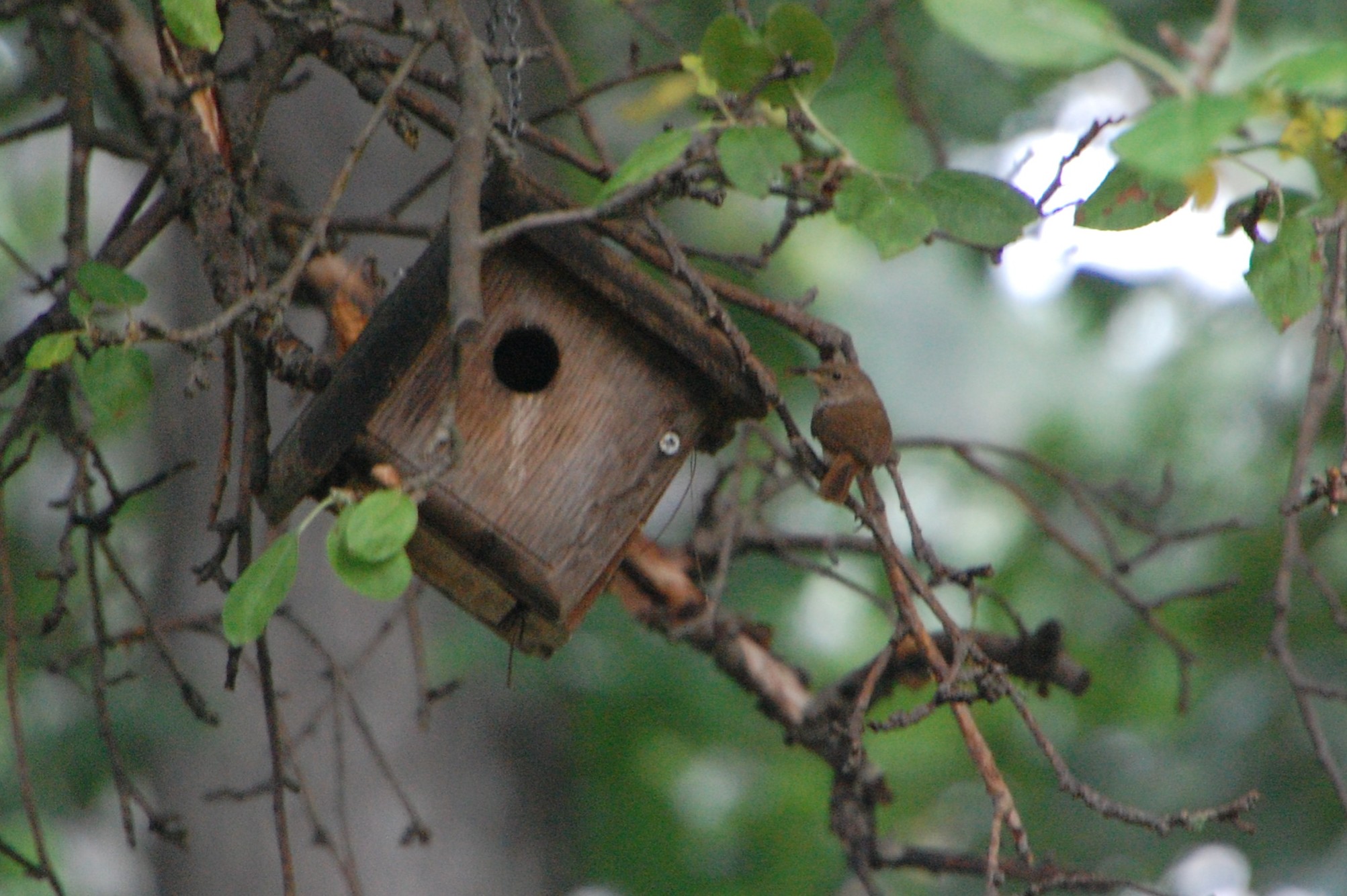
The house wrens living in my yard also have young. I estimate they have at least two, maybe three. I'm not sure when exactly the eggs hatched but Mom was in the box a lot at first and now both parents are flying back and forth from the box to remove waste and bring food. Last week the young were small enough for both parents to go inside the box at the same time but usually it is just Mom who goes in. If Dad brings food while she is in the box he gives it to her to give the young.

(I am not humanizing these birds, but it is easier to call them Mom and Dad than to keep saying "the female house wren," etc.)

This year's male house wren. (Margo D. Beller)
After Dad has delivered the food to the nest he sometimes goes to a higher branch in the dogwood and flutters. Then he sings. I don't know what the fluttering means. The singing is the only way I can tell male from female.

Soon the young will get so big both parents will feed them from outside the box, except when Mom squeezes inside to get the waste matter. Eventually, the chicks will be induced to leave the nest and try flying to their parents. With luck they'll make it to the safety of the thick shrubbery across from the box and eventually learn to feed themselves. Then the family will disperse.

Always, there are dangers.

So far this year I have shooed away house sparrows trying to reach into the box to destroy the eggs and take the nest for themselves. They are bigger than wrens so I knew they couldn't get past the small opening on the box to destroy any eggs. Still, I ran them off. I have also run off squirrels several times in the last week because I don't know if they are climbing the dogwood to find insects in the leaves or any fruits being formed or to grab a wren chick.

Until yesterday what I thought was the most horrifying attack I've seen on the nest box - and who knows how many I have missed - was the male red-bellied woodpecker that flew to the box and then stuck its long bill, and longer tongue, inside. At that point there were only eggs. I chased the bird off and later learned from an article that many types of woodpeckers, including the red-belly, eat baby bird brains. I can no longer hear a red-belly in my yard without apprehension.

But worse than that attack was the Cooper's hawk.

Another immature Cooper's hawk atop another feeder pole.
(Margo D. Beller)

Sitting on my enclosed porch with my coffee early in the morning, trying to wake up, I was horrified to see a hawk fly at the nest box as the parents were shuttling back and forth to feed their young. Based on the size I thought, "Cooper's hawk." After hitting the box it flew back to the nearby privet shrub. I ran out clapping my hands to scare it off. When it flew I realized the bird's wings were brown - an immature bird. (Adults have gray wings.)

As I stood near the dogwood after the hawk flew off I heard the cheeping of the wren young.

I went back to the porch and waited for at least one parent to return. After what seemed an eternity, Mom returned and zipped into the box, then left to get more grub. I did not hear the male. It will be much more difficult to feed all those young with only one parent, I thought. That happened several years ago when the male disappeared, the female did all the feeding and then a new male appeared to help her.

(Margo D. Beller)

I went out for a while to do some birding, not wanting to know if the juvenile Cooper's had succeeded in grabbing a meal. (Adult birds are usually much more successful than juveniles that are still learning to hunt.)

When I returned from my time away I went back to the porch, this time with my breakfast. And then I heard Dad. Then I saw Dad and Mom shuttling to the nest box to feed their young. 

The Cooper's had missed. It was as though the attack had never happened. 

This is what life is like for a bird - you migrate, you pick a territory, you find a mate and raise young. If you are lucky they will live to feed themselves, migrate, then come back next year - perhaps to the box I hang in the dogwood - and do it all over again. If a chick trying to fly falls to the ground a jay may grab it for a meal, as I've seen happen. The parents continue feeding what young remain. Do they mourn the loss? Mourning is a human concept. 

Life and death are everyday occurrences in nature. There is very little I can do, but I try to keep the cycle going in my yard.

For now I'm watching the nest box like a hawk.

Sunday, May 24, 2026

'Dumb' Bird Watching

This very rainy morning I sat on my enclosed porch and watched the wren box. Even though the rain had weighed the dogwood branches down to obscure most of the box, I knew what was happening because I had seen the same activity yesterday when it was merely cloudy.

The female appears to be sitting on eggs.

The male house wren would start singing from a nearby bush and the female would pop out of the box to go get some food. The male would continue singing, now from the dogwood, until the female returned and went back in the box.

'Dumb' wren nest box (Margo D. Beller)

The dogwood doesn't have the thick canopy that was once in the apple tree, where the box once hung, but the wet does not stop the house wrens from going about their business in order to survive and bring up young. The male goes up in the tree to a branch where I can see it, sings until his mate returns, then flies to the shelter of the nearest bush.

I base my presumption that she is on eggs on many years of watching house wrens using this box I hung in the dogwood, where I can see it from my chair on the porch. But even then I can't be sure what is going on. 

When we returned from a recent family visit it looked like there was no female. The "tell-tale" sticks were no longer hanging beneath the box. Did the female that had been busily building the nest depart? I have no idea, but now there is a female - possibly the same one - and she is spending more time in the box because, I presume, there are eggs in the nest.

Had I one of those tiny cameras in the nest I'd be able to see inside. But I am not a fan of "smart" technology in general, and for birding in particular.

My Facebook feed, besides items from "Friends," will sometimes send up something based on some algorithm that says I enjoy seeing things about birds. I do, but I also get ads. A recent ad appeared for a "smart" bird feeder that would allow me to "watch birds live from your phone" and download photos and videos of every bird visit, among other talents.

'Dumb' bird feeder, with titmouse and white-breasted nuthatch
(Margo D. Beller)

If there is one thing these old eyes don't need it is another reason to look at the small screen of my phone.

It is ironic that while I've been running around most mornings in these waning days of spring migration I've likely been missing "good" stuff in my own backyard. But when I am home I prefer to use my eyes and ears - albeit with some help from the Merlin app because I can't hear many calls anymore unless the bird is very loud or over my head. 

The idea of putting out a "smart" feeder that has some sort of camera in it allowing someone to see what's at the feeder every time a house sparrow or other bird shows up, even while that person is elsewhere, does not appeal to me. Too much information. Too much like one of those camera doorbells.

The birding world has come a long way from those intrepid people who would go out to distant places, see or hear something and then report back to Audubon. Merlin is helpful, yes. So is Cornell's eBird. But the social media channels - Instagram, Discord, etc. - where report of a rarity can draw hundreds of people in a pop-up flash - scare me. The coronavirus forced people outdoors, and while there they discovered birds. But binoculars and good pairs of eyes and ears are apparently not enough anymore.

Using 'dumb' technology
(RE Berg-Andersson)

I'm sure there are people out on this rainy morning looking for what migrants might still be around. But you won't find me going far from my porch.

Extreme Birding

My Facebook feed also brought me an article from NPR on three teenage boys who, with their fathers assisting them, competed in the World Series of Birding earlier this month.

My reaction to what I read was mixed. I was glad to see younger people getting involved with birding. There was a time, decades ago, when I was one of the younger ones in a group seeking out a bird. Now I'm right in there with the demographic. Birding needs younger blood.

However, I was sad to see there were no girls on the all-white team - not even a mother helping out - and I was horrified to read these kids were just as gung-ho competitive as the adults who were also running around the state trying to tick off as many birds on their list as they could in a day.

You're not seeing the birds when you are competing to see how much you can find in a day, you're seeing something - shape, sound - that allows you to claim you "saw" it and add it to your checklist.

I was amused the teenagers named their team the Pete Dunnelins, a play on the dunlin shorebird and Pete Dunne, who created the World Series of Birding as a charitable endeavor that would also contribute Citizen Science data on how well, or badly, bird species were doing in New Jersey.

The kids found 206 species of birds, but they came in second to a team that found 209.

The WSB is still an important way of recording what birds are where in a world where bird populations are in decline due to "development" and global warming, among other factors. 

But the WSB has gone way beyond its original intent. Now it is a competitive sport. The people at Cornell's Ornithology Lab - the ones behind Merlin and eBird - broadened the WSB to the world, calling it the Global Big Day. You have teams all over the world competing to find as many birds as possible. I imagine hundreds of people running into each other as they stomp on a marsh at 3 a.m. to hear grunting rails and soras, or whatever the global equivalents are.

I expect to see the WSB become part of the next X Games on television soon enough. 

No thank you.


Wednesday, April 29, 2026

And Then There Were Two

Since my last post I haven't spent much time in the yard because it is migration time. I've risen early and gone places at various distances from my home, usually without eating. The early birder gets the birds as they look for food. Then I come home around 9 a.m. for my own breakfast. In good weather I take my food out to my enclosed porch and sit so I can watch the house wren nest box.

In a previous post I mentioned hearing the first house wren on April 19, 2025.  Exactly one year later, a male house wren started singing in the yard, two days after I put up the box. But things never seem to go as planned with these birds. After a day of seeing it around the box, the wren seemingly left.

Then, according to my notes, on Thursday, April 23, as I pulled the car out of the garage to go off one early morning, I heard a house wren singing very close, which meant it was on the opposite side of the yard from where the nest box hung. Was this the same wren or a different one?

The tell-tale stick telling other wrens this box is taken.
April 28, 2026 (Margo D. Beller)

I got my answer the next day when the house wren male continually sang from different parts of the yard as I ate my breakfast. Then it came to fuss over the box, bringing in a few sticks to give a prospective mate the idea that this would make a good spot for her nest. But I saw no second house wren that day and he soon left. 

On Saturday, April 25, it rained buckets for about 12 hours. The next day I could see the box had gotten plenty wet. I hoped it was dry inside. I saw no activity that day but I heard the male house wren singing almost continually, advertising his availability to any female.

Finally, on April 27, I saw a second wren come to the box. To me all house wrens look alike - they have no difference in size or color. The only way I could tell which was which was the male sat on a branch above the box and sang a bit while the female silently examined the box inside and outside. Then the two flew off together.

"So he has a mate," I thought. 

When I was next on the porch I saw the tell-tale stick coming out from the bottom of the box. That stick means that "this nest is taken."

This is far from new activity. I've been writing about house wrens since at least 2011. When I provide a box they have come every year, no matter which tree I securely hang it in. Every year they do the same thing - look at the box, decide to take the box, create a nest, defend it, raise young, leave with them once they can fly. To me this never gets old. 

Today, resting after hours of birding, I sat on the porch and watched the female furiously adding more sticks to the box. The male sang nearby as she worked on her nest. It is interesting to watch her bring a stick and then try to figure out how to get it into the box. Sometimes the stick is dropped. Sometimes it is broken. Eventually she figured out she can turn her head and put the stick in that way. 

I don't see the male as she does this but I can certainly hear him. He is still singing his loud territorial call. He'll continue to do that until eggs are laid. Then he will sing more softly so as not to call attention to the nest. To me it sounds like the call is intended to assure his mate he is around to defend the nest or tell her he'll watch things while she gets some food for herself.

This 2018 picture of the wren nest I cleared from the box
gives you an indication of what's in there, mainly done by the female.
(Margo D. Beller)

When she took a break from her nest-making labors she stood for a while on top of the nest box. She then flew down to nearby bushes where she can find what she needs, be it sticks or food. 

Every year when the nest is done and the wrens - which pair only for breeding and then separate - have gone south in the fall, I empty the box to clean it. Every year I am amazed at how tightly packed the stick nest is inside. The wrens usually have a brood of three chicks. That's a lot of birds jammed into what looks like a small box. But house wrens are small birds, particularly when just hatched.

Aside from those few sticks the male put in to "stage" the box, the female does all the work building the nest. He won't enter the box again except when the chicks are born and he helps her feed them and remove the poop.

She could be sitting on eggs as early as this weekend. And then things will really get interesting.

Sunday, May 25, 2025

Sliding Into Summer With the Wrens

The year has been going quickly. On the cusp of Memorial Day the daffodils and very early blooming flowers in my garden are long done. When I pushed down the daffodil foliage I exposed the other plants that are now growing thanks to all the rain we've had lately - butterfly weed, liriope, purple coneflower, sedum. The azaleas bloomed nicely, as did the hellebore. The flowers on both are fading but the foliage is growing. 

(Margo D. Beller)

The rhododendron (above) is now flowering the best I've ever seen it and all of the potted cannas are growing lush foliage behind the protective enclosures used to thwart the deer.

The migrant birds I had heard in my yard are mainly gone now, taking advantage of the north wind lessening to go elsewhere. I can still hear plenty of birds during the day but they are no longer setting territory, they are quietly building their nests and creating the next generation of birds.

One of those birds is what is now known as the northern house wren.

(Margo D. Beller)

Sometime in mid-April - unfortunately I did not note the day - after reading reports house wrens had returned to my area from their wintering grounds to the south, I hung the wren box (above) in the dogwood tree. I was hoping to draw a breeding pair for another year.

On Monday, April 21 - which I noted - a house wren was singing from the locust tree in the front yard closest to the driveway. I had taken out the garbage pail so the bird was over my head. I knew to start watching for action.

Nothing happened for three days. Then, on April 24, I saw a pair of house wrens investigating the nest box. They looked inside and outside it like any couple investigating a prospective residence. Then they left. It did not take long before they started bringing nesting material - twigs - to the box. 

The activity brought a pair of house sparrows to the dogwood. Sparrows will nest in anything - any opening in a street light, for instance - and they will also try to take a nest away from another bird, in this case a house wren.

The wooden nest box was made with a small opening to let in a house wren and keep out a bigger bird like a house sparrow. After a few attempts, plus my going outside to chase them off, they stopped bothering the box. That is when the nest building began in earnest.

After my husband and I returned from a family visit the second weekend in May I sat on my porch and watched the nest box. I noticed the male would sing from a nearby shrub. The female would come out of the box. Was she sitting on eggs? Very likely. To me the wren call was the same as the "this is my territory" call but apparently the female heard something different. He would call, she would fly out to get food and then return to the box. 

A few days later I noticed she was making more trips out of the box and then flying back with food. If the Cornell bird people are right about the timing, the eggs likely hatched. Mom would fly in with food, then maybe brood her young if it was cold out. Sometimes the male flew to the box and gave the female food, presumably to feed a chick. He would fly to another branch in the dogwood or a nearby shrub and sing, presumably letting his mate know he was watching for predators.

One of the parent wrens, as photographed from
my porch chair through a screen.
(Margo D. Beller)

House wrens are tough little birds when it comes to protecting their territory. When another house wren was in the yard it was quickly chased off. When a gray squirrel climbed the dogwood looking for something to eat, the male wren flew at it, pricking the much bigger animal with its sharp bill. The squirrel left in a hurry. The wren chased off any downy woodpecker using the tree as a staging area before flying to the suet feeder. (I've since put all the feeders away.)

Some birds it left alone because they have no interest in baby birds - the yard robins and catbirds, which flew to the dogwood to scan the lawn for something to eat or bring back to nearby nests. The wren would fly to a nearby branch and watch until the larger bird left. Then the wren flew off.

Today I noticed from the porch that both parents were bringing food and going into the box to feed a chick. When they left they would take a small amount of poop to keep the nest free of bacteria. At this point the young - two or three chicks, I'm guessing - are still small. In the next two weeks the baby birds will get so big their parents won't be able to get into the box. These birds will be hungry and loudly begging when a parent arrives. The chicks will jostle each other to get to the front and grab the meal. If a chick can't fend for itself it will die.

The nesting period is 15-17 days, according to Cornell. That means at some point in the next 10 days or so, likely when I'm not on the porch watching, the male will call to the young and draw them out. One day the young are squawking in the box as usual, the next I can tell by the silence the birds have flown. Maybe for a few days I will hear the young begging for food as they follow one or the other parent around the fringes of the yard. Then they will be gone, maybe to start their own broods. The parents will go their separate ways, unless they decide to have a second brood in the nest box. At the end of the summer the birds will face the perils of flying south again.

When hot, humid summer comes I try not to do much in the garden aside from the necessary weeding. The perennial flowers and shrubs I planted will take care of themselves with little assistance from me until it is time to cut them back for the winter. 

At this point I will acknowledge that, once again, another year is ending and take the nest box out of the dogwood.

Wednesday, May 8, 2024

A Day In the Life of H. Wren

About 10 days from the end of April, I read several reports of house wrens returning to areas of New Jersey close, as the wren flies, to where I live. I had been avidly awaiting this news for weeks. Two days later, with my husband steadying the ladder, I hung the nest box in the dogwood tree, which had beat the odds and come back to flowering life after I had the dead wood removed.

The nest box in the dogwood
(Margo D. Beller)

Hanging a nest is an annual ritual. It started when a friend gave me a small, decorative bird house that I hung in one of the apple trees. It soon drew a house wren, perhaps the only bird that could have fit through the small opening. I hung that bird house out every year until it fell apart. I've used a sturdier (and slightly larger) nest box ever since, first hung in the one apple tree I didn't take down and then in the dogwood so I could see it more easily from my seat on the enclosed porch.

I hung the box and waited. And waited.

Seemingly the day after hanging it the weather turned winter-like. Northbound migration was altered as birds avoided the north winds of the northeast and traveled up through the midwest. Seedllings were left on window sills because it was too cold to plant them. The down quilt stayed on the bed.

Finally, at the very end of April the winds turned around, the temperatures warmed dramatically and the migration floodgates were opened in my region. One early walk I heard house wrens calling. On May 1 I heard the same call from my yard. A bird checked out the nest box, my feeders, the immediate area. Would he find a mate and would she want to nest in my box?

Yes and yes, a day later. Hooray.

Thanks to having more time to spend on the porch, I could see details I'd missed in previous years.

House wren from a previous year. I haven't tried to take
a picture of this year's pair yet. (Margo D. Beller)

On May 3 the pair took turns bringing large sticks to the box to create the nest where they will likely raise two to three chicks. (The Cornell Ornithology Lab people say it could be as many as 10, but that would be too many for this box.) Each bird came back with sticks too large to fit in the doorway as held in its beak. Each bird had to re-learn that if he or she turned his or her head, the sticks could be put inside. Or, if the stick was thin enough, the bird could just ram it through the hole. Both birds had to do this many times. It became comical to watch.

But they kept at it. The next day, May 4, it was only the female working on the nest, bringing in smaller sticks to put on the finishing touches. As far as I could see the male did not go into the box. I could tell which bird was which because he sang from another branch. She did not.

On May 5 it rained. There was some movement in and out of the box by the female and singing at dawn by the male. However, I was inside for most of the day and so do not know when or where any mating took place. Because that is the next step - the female has to lay eggs and she has to sit on them on the nest they made. 

Once again I regretted not buying one of those minuscule cameras I could have put inside the box and get an entirely different view. If they do what I've seen other wrens do over the years, the female will be in the box much of the time and the male will be singing nearby. If a larger bird it considers a threat - such as a house sparrow interested in taking the box for itself (it can't fit through the opening but that doesn't mean it won't try and destroy the eggs) - the wren will drive it off, if I don't first. When the female needs to get a meal he will stay close to the box until she returns.

Feeding the young from the outside. (Margo D. Beller -
From 2020 when I hung the box in the apple tree.)

Once the chicks hatch their mother won't leave them unless she has to eat. At that point the male will sit close by. Then she'll return to feed them and keep them warm. When they get bigger both parents will only go into the nest to feed them. As the young get even bigger they will get noisier and will be fed by both parents from outside the box. 

The whole incubation/nesting process will only last a few weeks. At some point I've yet to catch the parents will stop feeding them but will call the young from nearby - you have to leave the nest to get a meal, kids. The young will fly out and the nest stay empty. The family will hang out around the yard for a time, maybe a week or so, and then disperse.

If I am lucky, another wren - or maybe the same male - will find the box, bring a female that approves of it and they'll use the sticks I'll leave in there for their nest. At the end of the year the house wrens will head south and the box will be taken down, emptied, cleaned and stowed away until next spring.

It is an annual ritual that brings me closer to the life of a tiny, plain, brown bird that graces my yard for a few weeks. 

Saturday, June 11, 2022

Watching and Waiting

Thanks to technology, it is possible to put the smallest of cameras into a nest box to record what is going on inside. Do a search of "nest box cameras" and you'll find all the latest models. Do another search of "watching nest webcams" and you'll find links to cameras put into or near nests by Audubon, the American Eagle Foundation and others. Thanks to webcams you can see into the nests of barn owls, bluebirds and American kestrels. It's an easy way to learn about birds and get engrossed in their life cycles. It's as easy as watching TV.

One of this year's wrens, on the branch
below the box. (Margo D. Beller)

I, however, don't have such a camera. To know what is going on in the house wren nest I have hanging I must depend on my many years of watching and being very, very patient.

After I relearned my lesson about intruding it took several days before the house wren pair resumed their activity in and around the nest box I had put up in the dogwood tree. It was very silent in the yard. Just when I'd think the wrens were gone the male would sing, briefly. This happened for several days. Then, on the fourth day, the house wren male started singing early and often, and I saw the female going into the box and not coming out again for long periods of time.

There must be eggs, I thought then. Now, I think there must be young.

According to the experts at Cornell, egg incubation takes nine to 16 days. Once the eggs hatch, the nesting period is another two weeks or so. Today when the female came back to the tree she had an insect in her bill. So there are young, I thought, likely three or four (house wrens can lay up to 10 eggs per clutch, but not in this little box). Right now the chicks must be very small because I hear no calling when either parent is in the vicinity of the nest. That will change when the young get bigger, noisily clamoring to be fed.

There have been other signs of life in the yard.

Blooming viburnum, already fading.
(Margo D. Beller)

Every so often I have to remind myself to go outside and look at the flowering plants before it is too late. Often, it is too late. The showy red peony flowers are already spent, as are those of the azaleas and the rhododendron. I've already deadheaded the columbine and the iris but the daisies, coneflower, goldenrod and sedums are growing quickly. The Stargazer lilies have opened. The coral bells continue to bloom. The viburnum is covered with white flowers that are already starting to fade. 

There are flowers on the privet bushes that will become little black berries, and the wild cherry tree is covered with green fruit that will ripen for the robins that will soon acrobatically pick them off. There are small wild strawberries all over the yard and a couple of wild raspberry bushes that sprang up in areas where they are not in the way, so I have left them. What I don't pick the birds will get.

The pear tree, way too tall, has fruit growing on branches resting on the roof, perfect for a hungry squirrel ambitious enough to climb up.

One of this year's catbirds. (Margo D. Beller)

And there will be apples, plenty of apples. I'll soon be busy collecting them before the squirrels (and the deer) can do much damage. Those apples are the reason I moved the wren box from this tree.

Yes, it would be easier to see what goes on inside the nest box. I could sit at my computer and watch, like some sort of Peeping Tom. There would be no wondering, no reason to even go outside.

No, thank you.


Sunday, June 5, 2022

A Lesson Relearned

On June 1, the morning after my last post, I came out on my porch with my second mug of coffee, put on the fan to move the warm air and sat down to relax and let my mind wander before I had to go to work. After a few minutes I heard something through the whirring of the fan. I opened the porch door and put my head out. I heard a house wren.

Nest box, pre-wrens, 2022. Note the string to
the right. (Margo D. Beller)

I came in to sit and watch the nest box I'd hung in the dogwood tree weeks before, a day after I'd seen another house wren at the water dish. There had been silence after that wren flew off but now there was the bubbly song of another and it did not stop, except when the bird examined the wooden box. Then it flew off but soon returned, still singing. 

The next step was to see if there would be a second wren. The female is the one who must approve the site and then start gathering materials for her nest. A day later, I saw her.

Over this past week the male started singing at dawn and the female actively worked at the nest.

Then, today, came a reminder that even when I try to help birds their lives are still precarious.

Sitting on my porch this morning, I was horrified to see a squirrel climbing up the dogwood and then climbing ON the nest box. A squirrel weighs a lot more than a wren and I didn't want the box to fall, in part because I didn't know if there were eggs inside. The female wren flew out of the box and the male flew from the nearby hedge, both to attack the much larger danger.

By then ("NO!") I had rushed from my chair to the other side of the porch to bang on the window. The squirrel took off.

But so did the wrens.

Until last year, I hung this nest box in the apple tree. It was placed halfway out on a strong, horizontal branch to prevent the squirrels from bothering it. I decided to move the box to the dogwood on the other side of the yard because the profusion of apples drew a lot of squirrels (and me) and I didn't want the birds disturbed. However, the dogwood is more open, and the way the branches grow it was hard to find one strong and straight but not too high to make it dangerous for me to attach from the ladder.

House wren in 2020, when the box was in
the apple tree. (Margo D. Beller)
And, of course, I wanted to see the birds. In the dogwood I only had to sit in my chair and look out. In the apple tree I would have to turn around or look from a different, less comfortable chair.

When I took down the box last year I tied a string to the branch to remind me where to place the box this year. When the wrens came, the male kept pecking at it. I realized it might have thought the string was a snake so I went out to cut it. I agitated the birds but I was quickly gone and I hadn't touched the box, unlike the squirrel.

I can't be outside all the time, much as I'd like to be, so I don't know if any squirrels attacked the box last year. The wrens had their brood and, as usual, suddenly disappeared with the young once they had fledged.

This year, after 15 long minutes of silence, one of the wrens came back and went into the box. Then it flew down to a lower branch for a moment before moving off to the area behind the flood wall. A few minutes later it - she - came back with nesting material, flew into the box and then back behind the flood wall. I was relieved at first, but then started to get agitated. Except for one brief call by the male just after I scared off the squirrel there has been silence. I decided I didn't want to keep punishing myself so I came inside. I'll come back out tomorrow to see if they are staying.

A badly placed robin's nest,
(Margo D. Beller)
When I put out feeders in winter, it is to help the birds stay alive in harsh conditions. Many people now feed birds all year round and that is why there are more birds (and more birders). At this time of year I bring in the feeders because there are plenty of insects for the birds and their young. They do not need sunflower seed, they need bug protein.

Still, even with plentiful food there is continual danger in the life of a bird. Just before the squirrel came to the box a flock of noisy fish crows flew overhead, silencing the male house wren. There is no way a fish crow could attack young in a wooden box nest but in the wild predators could get at a badly placed or unprotected nest, and so the wrens go quiet by instinct.

At this time of year there are already baby birds in nests. Just after the squirrel incident another fish crow came too close to the hedge where I know there is a robin nest. Both parents put up a frightful racket as they chased off the intruder. They even got some help from a mockingbird, not the most social of birds but likely also protecting its own nest nearby. 

The Cooper's nest that failed.
(Margo D. Beller)
It is a common site to see big birds being chased off by one or more smaller, protective birds: starlings chasing off grackles, grackles chasing off crows, crows chasing off hawks. But sometimes nests fail, either because they are in the wrong place or are abandoned by immature birds before eggs are laid. The latter was the case with the young Cooper's hawks that built their nest in 2020, only to be spooked off by a flock of fish crows that came too close. The hawks left and squirrels later claimed the empty nest.

And there are the sad situations where the parent (usually the female alone cares for the nest) is killed by a predator (including cars), a cowbird egg hatches in the nest and destroys the other eggs or the parent is forced to abandon the nest and the young starve to death.

I get protective about this nest box and the house wrens that use it every year, but once again I should've let nature take its course. I'm sure the two wrens would've forced off the squirrel - there was no food to interest it - but by my getting involved I possibly made things worse.

One of my friends likes to refer to "my birds" when they come to her feeders. I remind her these are not house pets, they are wild birds. I know she is feeding them so she can see and enjoy them in their various shapes and colors. So do many other people. I tell myself that I don't do that but I now realize, yet again, that I am no better than anyone else.

Will the wrens pick up where they left off? I don't know, but it would serve me right if they didn't. Lesson relearned.


Saturday, May 29, 2021

Location, Location, Location

In the dawn's gray light, the house wren begins his bubbly, incessant territorial song. He is better than an alarm clock. I listen through the open window, thinking of how I had hoped to sleep in later. Then I remember, I am lucky to be hearing a wren singing at all.

Wren nest box in its new location.
(Margo D. Beller)

Once again the changes in my yard came fast when winter was finally over. Where once the sun would hit me as I sat on my enclosed porch, now the light is filtered through oak and maple leaves. The sun's arc is now wide enough that my chair gets hit by the early and late sun. 

Besides the tree leaves, the shrubs, lawn and perennials came back with a vengeance. The back garden bed I had re-netted after taking off the protective burlap and cutting back the yew shrubs and the other plants quickly filled with fresh leaves and bright pink and purple flowers on the geraniums, coral bells and columbine. In the front yard, the azeleas, lillies and rhododendron were the best I've seen in years thanks to all the rain we had in the spring. Even Spruce Bringsgreen was covered in fresh blue-green foliage.

On May 7 I was still wrapping the pots of peppers I had put out front in plastic sheeting to protect them from the overnight cold. On May 9 we had a heavy rain. On May 10 the yard was filled with warblers, vireos and even a Swainson's thrush. All of them couldn't continue north to their breeding areas because of the bad weather. The birds were in my yard to take advantage of the oak seeds and insects. They fed and sang for only a day or so before continuing on their way.

But not all the migrants left. Some like to stay in my yard. Earlier this month there were still white-throated sparrows calling and singing their "Sam Peabody" song in my yard, where they had spent the winter. Then the catbirds started arriving. Now those sparrows are gone (but will be back next winter) and the catbirds fill the void with their activity and singing.

Back plot filled with blooming
geraniums, coral bells and 
columbine, with feeder.
(Margo D. Beller)
And then there is the migrant bird I watch for every year, the house wren. Every year I hang a wooden nest box in a tree, hoping a pair will use it to have a brood. Sometimes a wren pair will take over the nest box immediately. Some years it takes a little longer. 

Until this year the box was always hung in my apple tree. Last year I had planned on putting it in another location because when the tree is full of apples it is also full of squirrels, other birds and me trying to knock down as many apples as I can for my own use. The wrens would be disturbed. Two years ago there had been plenty of apples. 

But in 2020 I had forgotten my plan and hung the box in the apple tree as usual. However, in the year of the coronavirus the apple did not put out as many flowers to form fruit, so the picking was done by the time the wrens were feeding their young.

This year I did not forget, and I learned there are some differences using a dogwood instead of an apple tree.

Once I read the first reports of house wrens in my area I hung the box on what I thought was a sturdy branch. But the next strong wind had the box swinging wildly, something that didn't happen in the more densely branched apple tree. Luckily, the dogwood had another set of branches that made a natural V where the box could be hung more securely. 

Then I waited. 

Rhododendron (Margo D. Beller)
On May 4, I heard a house wren singing in the backyard. As I watched from the porch he investigated the box. Then he left. Later that day I was on the porch, looked at the box and was horrified to realize the hinged side that allows me to get in there to clear the nest after the birds have flown south for the winter was hanging open! I quickly got my ladder to climb up and shut the box tight so a bird would want to use it.

That's how things stood until May 9 when another house wren came singing into the yard. This one was more promising. He checked out all the feeders, flew into the dogwood and into the box. He stayed around the yard for a few days and at one point I heard the scolding call of his mate answering him. But on May 13 I realized there was no singing, no birds.

On May 15 I went to the box, intending to take it down and put it in the apple tree, even tho' this is shaping up to be another good year for apples. Then I saw the tell-tale twig sticking out from the box, signifying "this is taken." Was it from the pair? Would they be back? I left the box alone. But there was only silence for nearly a week.

Spruce Bringsgreen in his spring coat.
(Margo D. Beller)

On May 21, another male house wren was in the dogwood singing. He went into and out of the box and stayed in the yard all day. The next day he was back singing and his mate was making trips into the box with nesting material. Was this the pair from the other week? I don't know, but this time it looks like they are staying.

The dogwood leaves shade the box from the sun for most of the day (tho' the foliage is not as thick as it is in the apple tree) and the only things to possibly disturb the wrens are catbirds and others that happen to fly to a dogwood branch for some reason. Squirrels wouldn't be interested now, tho' they might be later in the season if there are dogwood fruits, which are small and red and won't be ripe enough to eat until after the wrens have finished their breeding and left the yard. Right now the squirrels are distracted by the apples that are growing and will soon be all over the yard, attracting deer.

As it was in the apple tree, the box is high enough in the dogwood to be free from danger while not so high that I have difficulty putting it up or taking it down. The box is sturdy despite years of dings. It is a good home in a very good location. 

That's why, as of today, Mr. Wren is still singing that bubbly, incessant song in the gray light of dawn. 


Sunday, June 28, 2020

Apple Tree Watching

You can observe a lot by just watching.
              -- Yogi Berra

The squirrel walks through the long grass stealthily, gets close to the apple tree, then leaps to the main trunk. It is a small squirrel, so let us presume it is a female. She climbs up the trunk into thicker canopy until she appears on one of the smaller branches as she climbs to the top of the tree. She raises her head and sniffs as she seeks an apple.

(Margo D. Beller)
Nearby, a house wren sings, warning his mate of the potential danger. She is in the nest box hanging in this tree. On this cool, early morning she is sitting on eggs, fed occasionally by her mate. She's not going anywhere unless the squirrel shakes the branches and jostles the nest box while looking for apples. A flicker explores the nooks and crannies of the wooden flood wall at the edge of the yard, and a family of noisy titmice are in the oak trees, following a parent around and begging for food.

The squirrel, meanwhile, has gone up one branch, found nothing and then backtracked to climb another branch. Finally, again near the top, she snares a small apple and climbs down to eat it sitting in the crotch made by two thicker branches. 

2020 crop (Margo D. Beller)
She is hidden from most people (and predators) but I know where she is because I have been sitting in my chair in a corner of my patio and watching her progress. I know what will happen and I am not proved wrong. She finishes her breakfast and drops the core with just enough apple on it to draw the interest of a chipmunk, perhaps a bird, more likely a deer that passes through the yard later. 

That's why I go pick it up and toss it into a corner of the yard to keep deer out of this area so near to my plants.

Now, a second squirrel approaches and climbs. When it is up a ways I walk to the tree and look up. The squirrel freezes. We look at each other, then I step back and the second squirrel jumps down and rushes away. The first one, meanwhile, is so high up I have to walk back somewhat to see it. She seems to know I am not the type to climb trees. She will be looking in this tree a while because there are not many apples in it this year.

Unusual for an apple tree, mine produces fruit in late June going into July. If all things were "normal" the apples would get bigger, redder, sweeter and I'd have three weeks to go out at dawn and dusk to gather them before the squirrels and deer.

Plenty of blossoms earlier this year. (Margo D. Beller)
Last year, we had a bumper crop both of apples and squirrels, sometimes as many as six at a time in the tree, all dropping partially eaten apples.

But in this year of coronavirus, which has changed everything about life as we know it, the apple tree blossomed beautifully in spring but did not put out a lot of fruit. The coronavirus has nothing to do with it, but it seems apt that this year would turn out to be a bust year. 

Many trees go through booms and busts. In my yard that also includes oaks, elms and locusts. Last year was very good for oak acorns. They fell to the lawn continuously as the squirrels climbed along the branches. Some would sound like gunshots when they hit the metal porch roof. I left them alone for a while until I started putting out feeders again in the autumn and it was hard walking on the acorns (or their caps, once the nut was removed). I raked up as many as I could and put them into a corner of the yard behind the compost pile. They are still there.

What the squirrels are dropping nowadays.
(Margo D. Beller)
According to John C. Kricher and Gordon Morrison, authors of the "Peterson Field Guide to Eastern Forests," many types of trees in the temperate zone, which includes New Jersey, have "mast" years when seed production is higher than usual.

Why? "Masting is probably an adaptation to aid the trees in escaping the potential ravages of seed predators. By alternating between occasional bumper crops and more usual poor crops, trees conserve energy, enabling them in a given year to produce more seeds than all seed predators combined could ever hope to eat," they write.

So the apple tree might be taking a breather this year to protect itself.

Unfortunately, it is too easy to underestimate the importance of trees, their ability to clean the air and provide shade and food. About 36 million trees a year are cut down, according to one report. I know I see enough of that destruction in suburbia when a tree that took several decades to grow is taken down, hunk by hunk, in a day. (Was the tree sick, planted in the wrong place or just in the way? Who knows?)

Meanwhile, those that need acorns (or apples) to survive, breed and feed young (squirrels, jays and other birds) are going to have a harder time of it this year, as will the raptors that feed on those animals. When snowy owls or rough-legged hawks can't find their favorite small mammals in their northern breeding territories because the population has "crashed," they fly farther south to find food. That is known as an irruption year. Smaller birds that depend on cone and other seed crops can have irruption years, too, including both types of crossbills, pine grosbeaks and redpolls, to the delight of the bird-watching community. 

Gone for now, but it - or a descendant - will be back next year. (Margo D. Beller_
But that's winter. Right now, in June, I was only able to pick 10 apples this year, but I am happy to be relieved of the annual routine of chasing off deer, picking up chewed apples, trying to find apples I could use and then the long process of cutting off the bad stuff and making apple sauce with the rest. As for the squirrels, they have turned their attention to getting other things to eat, including gathering oak acorns. What is falling so far this year are shrunken and not nearly big enough to feed them, much less a family.  

Most happily, this year I won't be going around the tree smacking ripe apples with an extension pole and agitating the house wrens in the nest box. Once the squirrels get the last few apples from the very top of the tree (where I couldn't get at them anyway), that's it until next year. And next year the nest box is going into another tree.