Cape May

Cape May
(RE BERG-ANDERSSON)
Showing posts with label cooper's hawks. Show all posts

Sunday, June 5, 2022

A Lesson Relearned

On June 1, the morning after my last post, I came out on my porch with my second mug of coffee, put on the fan to move the warm air and sat down to relax and let my mind wander before I had to go to work. After a few minutes I heard something through the whirring of the fan. I opened the porch door and put my head out. I heard a house wren.

Nest box, pre-wrens, 2022. Note the string to
the right. (Margo D. Beller)

I came in to sit and watch the nest box I'd hung in the dogwood tree weeks before, a day after I'd seen another house wren at the water dish. There had been silence after that wren flew off but now there was the bubbly song of another and it did not stop, except when the bird examined the wooden box. Then it flew off but soon returned, still singing. 

The next step was to see if there would be a second wren. The female is the one who must approve the site and then start gathering materials for her nest. A day later, I saw her.

Over this past week the male started singing at dawn and the female actively worked at the nest.

Then, today, came a reminder that even when I try to help birds their lives are still precarious.

Sitting on my porch this morning, I was horrified to see a squirrel climbing up the dogwood and then climbing ON the nest box. A squirrel weighs a lot more than a wren and I didn't want the box to fall, in part because I didn't know if there were eggs inside. The female wren flew out of the box and the male flew from the nearby hedge, both to attack the much larger danger.

By then ("NO!") I had rushed from my chair to the other side of the porch to bang on the window. The squirrel took off.

But so did the wrens.

Until last year, I hung this nest box in the apple tree. It was placed halfway out on a strong, horizontal branch to prevent the squirrels from bothering it. I decided to move the box to the dogwood on the other side of the yard because the profusion of apples drew a lot of squirrels (and me) and I didn't want the birds disturbed. However, the dogwood is more open, and the way the branches grow it was hard to find one strong and straight but not too high to make it dangerous for me to attach from the ladder.
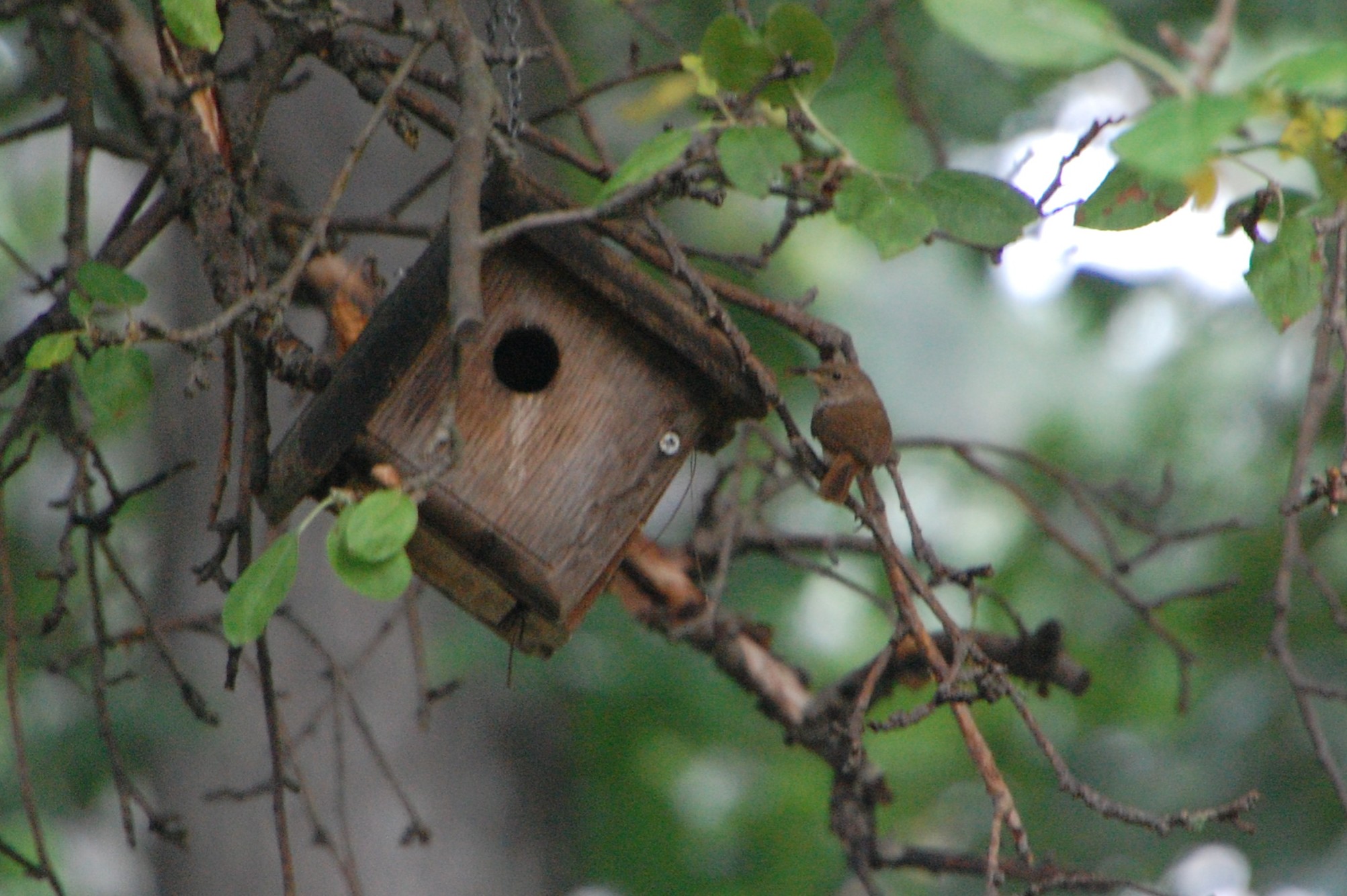
House wren in 2020, when the box was in
the apple tree. (Margo D. Beller)
And, of course, I wanted to see the birds. In the dogwood I only had to sit in my chair and look out. In the apple tree I would have to turn around or look from a different, less comfortable chair.

When I took down the box last year I tied a string to the branch to remind me where to place the box this year. When the wrens came, the male kept pecking at it. I realized it might have thought the string was a snake so I went out to cut it. I agitated the birds but I was quickly gone and I hadn't touched the box, unlike the squirrel.

I can't be outside all the time, much as I'd like to be, so I don't know if any squirrels attacked the box last year. The wrens had their brood and, as usual, suddenly disappeared with the young once they had fledged.

This year, after 15 long minutes of silence, one of the wrens came back and went into the box. Then it flew down to a lower branch for a moment before moving off to the area behind the flood wall. A few minutes later it - she - came back with nesting material, flew into the box and then back behind the flood wall. I was relieved at first, but then started to get agitated. Except for one brief call by the male just after I scared off the squirrel there has been silence. I decided I didn't want to keep punishing myself so I came inside. I'll come back out tomorrow to see if they are staying.

A badly placed robin's nest,
(Margo D. Beller)
When I put out feeders in winter, it is to help the birds stay alive in harsh conditions. Many people now feed birds all year round and that is why there are more birds (and more birders). At this time of year I bring in the feeders because there are plenty of insects for the birds and their young. They do not need sunflower seed, they need bug protein.

Still, even with plentiful food there is continual danger in the life of a bird. Just before the squirrel came to the box a flock of noisy fish crows flew overhead, silencing the male house wren. There is no way a fish crow could attack young in a wooden box nest but in the wild predators could get at a badly placed or unprotected nest, and so the wrens go quiet by instinct.

At this time of year there are already baby birds in nests. Just after the squirrel incident another fish crow came too close to the hedge where I know there is a robin nest. Both parents put up a frightful racket as they chased off the intruder. They even got some help from a mockingbird, not the most social of birds but likely also protecting its own nest nearby. 

The Cooper's nest that failed.
(Margo D. Beller)
It is a common site to see big birds being chased off by one or more smaller, protective birds: starlings chasing off grackles, grackles chasing off crows, crows chasing off hawks. But sometimes nests fail, either because they are in the wrong place or are abandoned by immature birds before eggs are laid. The latter was the case with the young Cooper's hawks that built their nest in 2020, only to be spooked off by a flock of fish crows that came too close. The hawks left and squirrels later claimed the empty nest.

And there are the sad situations where the parent (usually the female alone cares for the nest) is killed by a predator (including cars), a cowbird egg hatches in the nest and destroys the other eggs or the parent is forced to abandon the nest and the young starve to death.

I get protective about this nest box and the house wrens that use it every year, but once again I should've let nature take its course. I'm sure the two wrens would've forced off the squirrel - there was no food to interest it - but by my getting involved I possibly made things worse.

One of my friends likes to refer to "my birds" when they come to her feeders. I remind her these are not house pets, they are wild birds. I know she is feeding them so she can see and enjoy them in their various shapes and colors. So do many other people. I tell myself that I don't do that but I now realize, yet again, that I am no better than anyone else.

Will the wrens pick up where they left off? I don't know, but it would serve me right if they didn't. Lesson relearned.


Sunday, June 13, 2021

Broken Homes

I've been watching the wren box from my perch on the back porch and I think something has gone wrong.

Robin on nest, 2019 (Margo D. Beller)

By now there should've been signs of a mother house wren feeding young. I had put the box in the dogwood rather than the apple tree as I have in the past in order to keep the squirrels (and me) from bothering the birds when we went to pick the fruit.

I thought the move had worked. The male wren has been singing up a storm from around the property, including the locust trees in front and the apple tree in back. One time I happened to see it singing from the dogwood and going into and out of the box as if feeding a mate.

Admittedly, I do not spend as much time sitting on the enclosed porch as I'd like every day - things like work intervene - so I may be missing something. It would not be the first time. 

It started me thinking about why nests fail.

I'm no scientist, and there are plenty of scientific papers on the subject, but from my observations I have a few theories.

Cooper's hawk nest after it was abandoned, 2020
(Margo D. Beller)
One of the parent birds might've been killed, either because of a predator (cat, snake, another bird, hit by a car) or disease. Maybe all the heavy rain we've had in the last few weeks created an unhealthy condition in the wooden box that made the bird sick or caused it to leave. 

Maybe the nest was in the wrong location. Was the nest more exposed to the sun because the more open canopy of the dogwood did not shade the box enough during the July-like heatwave we had in late May into early June? Or was the female wren intimidated by the larger and potentially dangerous catbirds and jays flying into the dogwood to survey the ground for food?

I think of the robin nest I discovered in my pear tree in 2019. I watched the female build it high enough off the ground that it was partially blocked by the porch roof, and I'd have missed it entirely had I not seen the pair going back and forth to the tree. Once built, the female settled down, presumably on eggs. The male would come by every so often to relieve her so she could get food. Then, the pair was gone. Squirrels would climb the tree and look in and around the nest. Eventually, it fell apart and out of the tree. 

Eggs in the wrong place, Montezuma
National Wildlife Refuge, NY, 2019
(Margo D. Beller)
Were there ever eggs? Did squirrels get at them? More recently I found a robin in her nest on a window ledge in a bird blind built high off the ground. The windows had screens on them so I could look out at her but not disturb her. This nest would be safe. (The one I and, no doubt, others found on a staircase leading to a platform at a nature center in upstate New York might not have been so fortunate.)

Another reason for nest failure? One or both birds were immature. Instinct told them to mate and build a nest but they might not have known what to do next.

An immature male Cooper's hawk may have been the reason last year's nest failed. I watched - with some trepidation - as the male called and swooped as he helped the larger female bring sticks to the top of a very tall maple tree where branches had created a V that would hold a nest. They mated - noisily - and built. The female started spending time on the nest. Then fish crows discovered it. The female chased them off, with some help from the male. Eventually, both took off and the nest was taken by squirrels.

Nest box in the apple tree, 2020
(Margo D. Beller)
Recently an immature redshouldered hawk has been flying and calling around the area and at one point I saw it flying with nesting materials. I have a rough idea where the nest is but I'm not going to search for it. If the nest is successful there will be enough stress without my hanging around.

As for the wrens, I know for sure another cause of nest failure - parasitism, such as when a cowbird puts one of its eggs in the nest and kicks out the resident eggs - is not involved because the box entrance is too small for a female cowbird to get inside, much less lay an egg. Some birds, such as the yellow warbler, build a new nest on top of the old one when it sees a foreign egg, even tho' there may be its own eggs, too.

Nature can be cruel.

House wrens are not considered an endangered species, and there is always the possibility the singing male will find another mate and the various conditions needed for a successful brood may come together. Or they may not.

I'll have to keep watching.


Sunday, April 19, 2020

Watching the Neighbors: The End(?)

Squirrel on nest April 19,2020 (Margo D. Beller)
This Sunday morning, when I put out the bird feeder as I always do on nonrainy days, things were the same and yet very different.

The Cooper's hawks were gone.

Up until Wednesday, the hawks were acting as usual. The male flew to the nest with twigs at first light, the female sat on a nearby branch facing where the sun would be if it wasn't cloudy. Every so often they noisily mated. At some point the male must've flown off because of what happened next. Two fish crows flew to branches close to the nest. The female Cooper's, comparable in size to the crows if not a bit larger, flew at them. They left and she sat in the nest for a long time, so long I thought there might be eggs in there. But after 15 minutes or so she, too, left.

That's been it.

Squirrel at work
(Margo D. Beller)
I have done nothing to prompt this. The yard birds and I had been adapting to the presence of predators. I had out only one feeder. When the male cardinal came after singing from a nearby tree, he would not stay long. His skittish mate came by even less frequently. Squirrels stayed up in the trees until the hawks, as usual, flew off for the day. For the past two weeks or so, the hawks had returned to repeat the process at dusk before going off to roost.

It took three days to realize there was a lot more activity in my yard. Squirrels were digging in the lawn for buried acorns. An assortment of bigger birds that would make more of a meal for a Cooper's - redbellied woodpecker, jays, mourning doves - returned to the feeder. Each morning I had looked at the nest and seen no activity. Then, yesterday afternoon, I watched as a squirrel climbed the tree to the nest with a bunch of leaves in its mouth.

Cardinals in apple tree, pre-mating (Margo D. Beller)
It had claimed the nest. While Cooper's use sticks and line the nest with bark, squirrels tend to use leaves and other softer materials. No squirrel would dare climb into an active hawk nest.

This morning, unusually cold for mid-April (frost on the roofs and some of the plants), I looked up at the nest and it was a different shape - piled high with leaves. The squirrel sat on the branch beneath it. Then it climbed down for another bunch of leaves.

When the male cardinal came to the feeder he was back to his usual habit of grabbing a seed and eating it atop the pole. At one point he flew to his mate and I thought he would give her a seed. Instead, they mated far more quickly and silently than the hawks.

Frost on quince leaves; most of the flowers are gone (Margo D. Beller)
What prompted the Cooper's to abandon the nest the male had spent over two weeks building? Was it the heavy rain we'd had for several days this week? The unusual cold? The lack of sun? Had the female felt threatened by the fish crows discovering the nest? Did one or both die in an accident or attack from something larger, either winged or human?

Or was it simply these were two immature birds that, after being prompted to mate and build a nest by that internal process triggered by longer, warmer days, couldn't continue the work of raising a family?

I have no answers. It could have been any one or more of those things. What I do know is I have more birds in the yard and may now be able to put out more feeders again. Unlike the cloud of coronavirus that continues to hang over the world for the foreseeable future, the uncertainty caused by the hawk nest appears to be gone.

The hawks may be elsewhere, of course, and there will always be other predators either passing through or nesting nearby. The yard birds and I will have to remain vigilant.

Saturday, April 11, 2020

Life Going On

Every spring I am surprised and relieved when I see signs of life in the garden, showing me the perennials survived the winter, even a relatively mild but wet winter like the one just past.

Red quince, yellow forsythia, green boxwood, blue sky - 2020
(Margo D. Beller)
This year, of course, things are very different in the world. With the coronavirus, many parks - including ones I visited just days ago - are closed to us. Supermarkets have restrictions on how many people can be admitted, forcing us to stand on line, six feet apart, faces covered.

In the yard, the Cooper's hawks are still flying around at first light, the male flying to and from the nest to work on it between noisily mating with the female on a nearby tree. So far, the female has no reason to sit in the nest. The cardinals, meanwhile, give me a reason to get up in the morning and put out the feeder. I hear the cardinals sing along with several types of woodpeckers, jay and even fish crows. Also, I am hearing the first migrants - in my travels I've found chipping sparrows, phoebes, ruby-crowned kinglet, bluebird, pine warbler, palm warbler and redwing blackbird.

Deer won't eat daffodils, making it easy to grow them anywhere.
(Margo D. Beller)
Like the birds, the plants are returning. The early bloomers were the crocus and snowdrop. Now long gone, they've been replaced by daffodils in various shades of yellow and white, the standard and grape hyacinths, the blue and white glory of the snow and the purple flowers of the ground ivy. The forsythia's yellow flowers are only now starting to give way to green leaves, as are the red flowers of the quince.

Maples have been in flower for weeks. They are now being joined by the oaks. The pear and apple trees are leafing, the apple showing the hint of the flowers that will later form this year's crop. Among the shrubs dogwood, boxwood, lilacs and viburnum are starting to leaf out, and the andromeda is showing its bell flowers. The irises are taller and the lilies, goldenrod, bleeding heart, hostas, coneflower, salvia and - so that's where I transplanted it - lobelia show me they survived. So did the garlic I found growing in the compost pile and potted.

Flowering andromeda (Margo D. Beller)
I don't have cherry trees but they, magnolias and the Bradford pears are flowering all over town, already dropping petals on windy days.

The ornamental grasses and butterfly bush I hacked back last month have put out fresh foliage. I've seen no signs of the milkweed seeds I planted or the joe-pye that looked so sickly last year or the lily of the valley but I am trusting they will come when it gets warmer than it is now.

Perhaps the most pleasing discoveries in my yard are the appearance of so many columbines in areas where I put seeds and where the plants themselves put seed. The lenten rose is finally sending up new leaves to push aside the tattered old ones. The peony, which has moved from box to pot to unnetted plot to, finally, one behind netting is also showing itself, and I hope it will flower. 

Deer damage (Margo D. Beller)
There are other, less pleasant signs. Pollen is starting to cover the street. The grass MH recently fed is now ready to be mowed - a little behind our neighbors, whose lawn services have been polluting the neighborhood with gas fumes and noise for weeks.

A deer discovered a weakness in my netting and browsed the closest euonymous bush. It will grow back. Almost all my flower plots are netted to protect them from deer, although netting does nothing to stop the digging chipmunks. I have learned to ignore the netting when looking at the flowers (unless I must pull it down to work in the garden) although it will, of course, show up in my pictures.

Weeds are back, too, including the ground ivy, the garlic mustard and one thin small weed with smaller while flower I can't identify. In one corner of my back plot where I once had a cactus there is something growing but I don't know what it is - for now I will leave it and see what develops. That's part of the fun of spring, you never know what will show up from elsewhere.
Mystery plant (Margo D. Beller)

One thing I do know will happen is I will be spending a lot of time at home for the foreseeable future. That means a lot more time in the backyard, tending plants, pulling up weeds, checking on the deer fencing and watching for spring birds passing through. They, thankfully, are still free to go where they wish.


Sunday, April 5, 2020

Watching the Neighbors, Round 2: Coming to Terms

Once again I fell into the trap of thinking I, homo sapiens, knew more than a wild bird that evolved long before I did, in this case accipiter cooperii.

Male Cooper's hawk, April 2020 (Margo D. Beller)
Not three days after I wrote my last post thinking I had intimidated the Cooper's hawk pair because I was taking their picture, they were back. For all I know they came back earlier but I was not outside to see it. This is why I should never presume. 

I don't know, I can only observe. 

Man may think he/she is at the top of the food chain but the reality is, all creatures must adapt to their circumstances. People used to shoot at Cooper's and other hawks. Now that is illegal. That has brought back the hawk populations, and with them the need for a good place to nest and rear young. 

That, for the Cooper's, increasingly means nesting in towns and suburbs rather than the forests, which are being ripped down for so-called development.

Here is how I described the return of my new neighbors in my bird log of March 31: "I don't know why I thought I could intimidate a hawk. Yesterday [March 30] circa 7 am, I was outside and heard a "kek." I looked up [and] there they were, working on twigs for the nest. I put out one feeder and stood by as the male cardinal, perhaps sensing why I was there, came to feed as usual, jumping to the top of the pole. His mate called to him from the dogwood. When he flew off I moved so she would not see me but I could be seen by the hawks. They weren't interested, and the female cardinal stayed put. Only after I went back on the porch did [the female and then the male again] both come to eat. After they left I got the feeder."

Since then any hope of "normal" has disappeared. As with the coronavirus, there is a "new normal" in my yard. The nest, like the virus, like the clouds that have rarely departed over the past week, hangs over my thoughts and has changed the feeder birds' behavior - and mine. After several days of no activity at the caged seed feeder or the suet feeder I emptied them until winter. Now, I only put out water and the house feeder, which can accommodate all the birds large and small. The cardinals have not deserted me, not just because I am feeding them (I would like to think) but because I think the pair has its own nest nearby.

Now, at dawn, I go outside and hear the usual birds - song sparrows, Carolina wren, more robins, the cardinals. I hang the one feeder and usually the male flies from his hiding place to a nearby shrub, waiting for me to move away. He eats, then jumps to a high perch to sing his territorial song. His song used to cheer me, now it fills me with dread because I am watching that damned stick nest. Other birds might come by but as soon as we hear that "kekkekkek" I know one or both predators are back and so do the birds and squirrels.

Another year, another juvenile Cooper's hawk in flight (RE Berg-Andersson)
Still, I leave the house feeder out all day because the hawks don't seem to be hanging around the nest all day - yet. I have watched them long enough by now to think - not know - they are most active at dawn and at dusk. Yesterday I sat on the porch and watched the hawks on a stout branch of the next tree over from the nest tree. The male worked on the nest, flying up every so often with twigs. 

But he did something else, too - he mounted the female. Ten seconds of noisy avian sex. He worked on the nest and than mounted her a second time. As far as I know I am the only person who witnessed it, but the male cardinal was smart enough to grab some food while the hawks were otherwise engaged. Eventually, the male Cooper's flew south and, a few minutes later, so did the female. Then the birds and squirrels started returning, tentatively.

On the one sunny day we had this week, I had my office shades open. I am frequently distracted by noise and movement on my street, which is greater than usual at this time of year because of New Jersey's stay-at-home order. But I wanted the shades open to let in the sun, and that is how I saw one of the hawks flying around the front yard. Finally, I raised my shade and saw the male sitting on a branch on the tree in front of me, working to break off a twig! I took his picture. Eventually he left.

So, as with the virus and being forced to wear a bandana over my nose and mouth, I have had to make an accommodation. The hawks are not going to give up the nest and I am not going to give up feeding at least some of the birds.

I look on the bright side. Since the hawks arrived I have seen only one blue jay at the feeder. I have seen only one house finch. The jays bombard the house feeder, making it swing so wildly I fear it will fall to the ground. The house finches arrive en masse and make a mess while blocking other birds from eating - unless it is a bigger bird like the cardinal. There are fewer squirrels running around the lawn. I have seen no chipmunks, at least in the backyard. 

I am allowing myself to look at these visitors with wonder. Last year I enjoyed watching the robins at their nest. This year it will be Cooper's hawks. 

The day I photographed the male was windy, and I was amazed how aerodynamic the birds are. They seem top-heavy with their squared-off heads and wings compared with their relatively slender, rounded tail. The pair are juveniles - both brown-backed and streaked on the breast rather than the mature hawk's gray back and dense red streaking on the breast. But these juveniles know what they are doing. From the branch, the hawk jumps off and spreads its wings, allowing the updraft to carry it higher. Unlike the smaller sharp-shinned hawk, with its flap-flap-soar wing motion, the Cooper's seems to glide.

The male cardinal continues to sing from a high perch whether a hawk
is around or not. (Margo D. Beller)
I've learned where it got its name: It was, says Wikipedia, "first described by French naturalist Charles Lucien Bonaparte in 1828. This bird was named after the naturalist William Cooper, one of the founders of the New York Lyceum of Natural History (later the New York Academy of Sciences) in New York."

Here is how John James Audubon describes the Cooper's in his Birds of America: "The flight of the Cooper's Hawk is rapid, protracted, and even. It is performed at a short height above the ground or through the forest. It passes along in a silent gliding manner, with a swiftness even superior to that of the Wild Pigeon...seldom deviating from a straight-forward course, unless to seize and secure its prey."

It is that flying "a short height above the ground" that keeps the squirrels high in the trees when the hawks are around and the mourning dove - a favorite snack - away from the area under the feeder where the seeds are dropped.

Audubon says the male is 20 inches long with a 36-inch wingspan while the female is 22 inches long with a 38-inch span. This is much bigger than what David Allen Sibley says in his guide, although he gives only one measurement despite knowing the female is bigger than the male: 16.5 inches long with a 31-inch wingspan. 


Cooper's passing through another year
(Margo D. Beler)
While the Cornell Ornithology Lab does not give the hawk's dimensions, it does provide this handy tip:

"While catching smaller birds is just doing what comes naturally for a Cooper’s Hawk, many of us would prefer not to share the responsibility for the deaths. If a Cooper’s Hawk takes up residence in your yard, you can take your feeders down for a few days and the hawk will move on."

But what if that residency involves an honest-to-Audubon nest? In that case, here is what I can look forward to: one brood a year, two to six eggs, 30-36 days of sitting on the eggs and then 27 to 34 days of young in the nest. The Audubon field guide says the young "may climb about in nest tree after about 4 weeks, can fly at about 4-5 weeks."

That puts the time when both parent hawks will be feverishly seeking food for the young at around mid-May, peak songbird migration time. If the young hawks successfully fledge, they should all be gone by mid-summer, which is when the hummingbird feeder I still plan to hang and the house wren box I still plan to hang should be pretty busy.

And maybe this coronavirus plague will have passed by then.

It's going to be a long season.


Saturday, March 28, 2020

Watching the Neighbors: Look Who's Here

Watching the neighbors is a long-time suburban occupation that has become even more important, at least to me, as people stuck working indoors or with small kids at home take to the streets in greater numbers during this time of coronavirus to keep from going stir-crazy. 


Cooper's hawk nest, 2020 (Margo D. Beller)
I keep the shades open on sunny days and so I am frequently distracted at my work by all the passersby, wondering if they are neighbors and, if not, who they could be. There are also the service trucks pulling into neighbors' driveways, landscapers doing the annual "spring cleanup" lawn service and the occasional herd of deer I have to go outside and chase off.

It was because my office shades were open one day this week that I saw a large shape fly over the house and wondered what it could be. That evening, when I went outside to take in the bird feeders, I learned what that shape was and I was less than excited.

I've had bird nests in my yard, including a robin's nest for a good hunk of last summer. The house wren box is a nest I provide. I've even had hawks of different types in my yard, but they are usually passing through, hunting for a meal.


But to discover a Cooper's hawk, with mate, building a nest high in my next-door neighbor's maple tree with a birds-eye view of the feeders, I knew this was trouble.


Cooper's hawks are accipiters and, like their smaller relative the sharp-shinned hawk, are very nimble hunters in parks, woods and backyards. Unlike the bigger and bulkier buteos such as the redtail hawk, accipiters can maneuver through tree branches and bushes after their prey, especially after the hawks have matured to become better hunters. I have seen mature accipiters catch and kill birds and I've also seen immature accipiters miss and then sit on the lawn or atop the bird feeder looking, to me, puzzled.


Watched like a Cooper's hawk, the larger female on the right.
(Margo D. Beller)
About the only "good" thing about having Cooper's hawks rather than sharp-shinned hawks around is the former prefers medium-sized birds rather than, say, a titmouse or chickadee. Cooper's prefer mourning doves and one of my least favorite birds, the European starling. But they will also go after other medium-sized birds including common pigeons, robins, jays and flickers, according to Cornell's Ornithology Lab. Cooper's have been known to eat chipmunks, mice and squirrels. (I can do with fewer chipmunks.) 

But a cardinal would be just the size for a Cooper's and I have a pair that use my house-shaped feeder daily, the male prone to taking a seed and then jumping on top of the feeder pole to eat while showing others this feeder is his. When he did that the day after I discovered the nest I watched nervously until he left. After that I noticed no other birds came to the feeder and the squirrels high stayed in the trees.


The hawk pair seemed to be more concerned with building their nest of sticks the day I found them. They flew to a nearby oak and laboriously broke off smaller twigs to add to what had already been built up in the V formed by two branches high in the tree. Again according to Cornell, "Nests are piles of sticks roughly 27 inches in diameter and 6-17 inches high with a cup-shaped depression in the middle, 8 inches across and 4 inches deep. The cup is lined with bark flakes and, sometimes, green twigs."


Robin's nest, 2019 - I don't mind nests like this in my yard. (Margo D. Beller)
Typically it takes two weeks for a nest to be formed, so this one couldn't have been started that long before (bird traffic at the feeders had not appeared to be down, tho' since I was working I couldn't be completely sure).

Once I realized what was going on I grabbed my binoculars to confirm my guess as to what kind of hawk these were. One look at the prominent "eyebrow" confirmed they were Cooper's. Then I got my camera and used the telephoto lens in hopes of getting a decent picture of the nest. (My picture above was taken the next day.)


The next morning, around 7 a.m., both hawks were back to their nest building. I heard robins, cardinals and Carolina wrens calling as usual, except nowhere near my yard. When a Cooper's is in the area, birds like low. So do squirrels, which were not their usual boisterous selves chasing each other around the yard. I got my camera and started taking pictures again, especially when at one point in their twigmaking both hawks were on the same branch.


They looked at me intently. Then the male left and I heard it call "kekkekkek" from another tree. The female looked at me a little longer before leaving. I checked the nest throughout the day but they never returned.


Typical male cardinal behavior, photographed through
the backdoor screen. (Margo D. Beller)
That afternoon the squirrels were back looking for dropped seed under the feeders and the house finches, woodpeckers and cardinals were back eating. The danger was gone.

It was likely the hawks realized I had discovered the nest, or perhaps they didn't like me taking pictures. Unlike the redtails "Harold" and "Maud" whose nest I discovered many years ago in another town, this nest was in plain sight and close by. Seeing me taking pictures these hawks were likely as unhappy to have an intrusive neighbor as I was to have a bird-eating menace. It was easier for them, and safer for their prospective young, to abandon the nest and start over someplace else. Cooper's hawks are not an endangered species and I am confident that eventually the female will lay anywhere from two to six eggs in her one brood of the year.


Had these birds picked a tall Norway spruce or some other type of evergreen where the nest (and they) would be hidden, I'd never have seen them and perhaps not realize the danger to the feeder birds until too late. But they had picked a maple tree that had not leafed out yet, and even as I was taking pictures fish crows were cawing and circling the tree. Crows don't like having hawks in the vicinity either.


So the Cooper's hawks are gone and the danger is past for the cardinals and other feeder birds, at least from this source. My human neighbors, however, remain as noisy as ever. 

Saturday, October 3, 2015

Bearing With More Trouble

On Sept. 27, six months to the day after the last incident, I was making supper. It was a Sunday early evening, people were enjoying their backyards with their children or taking a late afternoon walk in the sunshine.

I turned around to see if any cardinals were at the house feeder. I planned to take it in by 6:30 pm ET, 30 minutes from that moment, as I have been ever since a bear came into my yard overnight and destroyed one of my feeder poles trying to get to the sunflower seed.

Well, there was no feeder. I cursed, ran out into the backyard and on the next street, ambling northward, was a black bear, about as big as the one MH and I saw from our car on Old Mine Road in the ridges and forests of Sussex County, NJ.

Old Mine Road bear (RE Berg-Andersson)
This time, the bruin had ignored the sock and the cage-enclosed feeder that were filled with thistle put out for what had become a huge flock of goldfinches. It went for the old house feeder. In pulling it the bear had taken off the wrought-iron arm, too, and MH thinks when it fell it spooked the bear off. The house feeder, which hadn't had that much seed in it at the time, was on the ground but unscathed.

After the last attack, I had taken in the feeders for a while and then it was summer and I put a hanging basket on the remaining pole. Eventually, I had gotten a new feeder pole to replace the broken one. Around Labor Day I had started putting out seed. The dry weather conditions made it hard for birds to find food unless they found my feeder, which many of them did.

So did the bear.

Rosebreasted grosbeak on house feeder,
when the pole still had two arms (RE Berg-Andersson)
I have no idea if this was the same one because I didn't see the bear six months before. That attack was overnight. This one was during daylight, when there were lots of people outside, as I said. While I called 911 to alert the police, my neighbor was atop his grandchildren's playground setup, watching. He gave me a thumb's up. His son told me he had seen the bear rip off the feeder arm and then lope off through my backyard, my backyard neighbor's yard and then to the street. A squad SUV drove up that street after the bear but whether it was confronted or just followed into the next town, I do not know.

My brother-in-law the naturalist in rural NH told me he always waits until the snow falls and the bears go into their dens before he hangs feeders - even if that's in December. His feeders are always inside by April 1.

But he is in rural NH. The migrants have long left there. I was feeding a lot of cardinals, goldfinches and chickadees (along with more annoying house sparrows) because seeding plants were dying and there were no bugs because of the drought. Where I live, it might not snow until February. And my last attack had been before April 1.

What to do?

Predators have always been a problem. Accipiters -- Cooper's hawks and sharp-shinned hawks -- and redtailed hawks often haunt the yard. Lately, a cat has been loitering. (It is not feral because it is neat and has a flea collar, but it is not from my street and I have seen it run off through yards across the street and over to another side street, where its owner may live. It doesn't let me get close enough to see any ID tag. I do not understand the old adage about putting out the cat. You don't do that for dogs.)

Cooper's hawk atop feeder (Margo D. Beller)
But I can go outside and chase off a hawk or a cat. When I ran out and saw the bear I realized that had I turned around and run out sooner we'd have been face to face. What would I have done? Would I have been as stupid as the time I went out to chase off a buck in my yard and then quickly backed way when it put its head down intending to charge? In my anger, perhaps.

There are people who love bears so much they would like nothing better than for my neighbors and me to tear down our houses and let the bears roam free, unhunted. That isn't going to happen. Yes, there are houses in areas where they never should've been built, but people are in there now and bears are dangerous. I favor a bear hunt, as I do the annual deer hunt for the same reason - restoring something of a balance.

After a day or so inside, I put the house feeder on the remaining pole arm and put the thistle sock on the other pole. Not having seed outside plus a strong northerly wind seems to have decreased the number of sparrows and goldfinches dramatically to more manageable numbers, thus allowing more of the birds I like to get to the feeders. (We've also had a significant rainfall.)

Is putting out feeders foolishness or an act of faith? I want to feed birds. But I must now be extremely vigilant, at least until a hard winter cold comes. Fool me twice, shame on me. It may not be six months until the next bear encounter.