Cape May

Cape May
(RE BERG-ANDERSSON)
Showing posts with label squirrels. Show all posts

Tuesday, June 9, 2026

House Wrens and a Sea of Green

With the exception of the viburnum, whose flower heads went from greenish yellow to bright white and have now faded before they will eventually produce red berries, all the trees and shrubs in my garden have lost their flowers. No more pink flowers on the dogwood or white blossoms on the apple and pear trees or yellow on the forsythia. The rhododendron and azalea flowers have shriveled and fallen. The irises have finished their bloom and so has the peony.

Viburnum flowers (Margo D. Beller)

Other perennials are now growing and will soon flower. The weeds are way ahead of them and I've already made several long, painful attempts to contain the spread by pulling what I can reach over, under and behind the deer fencing

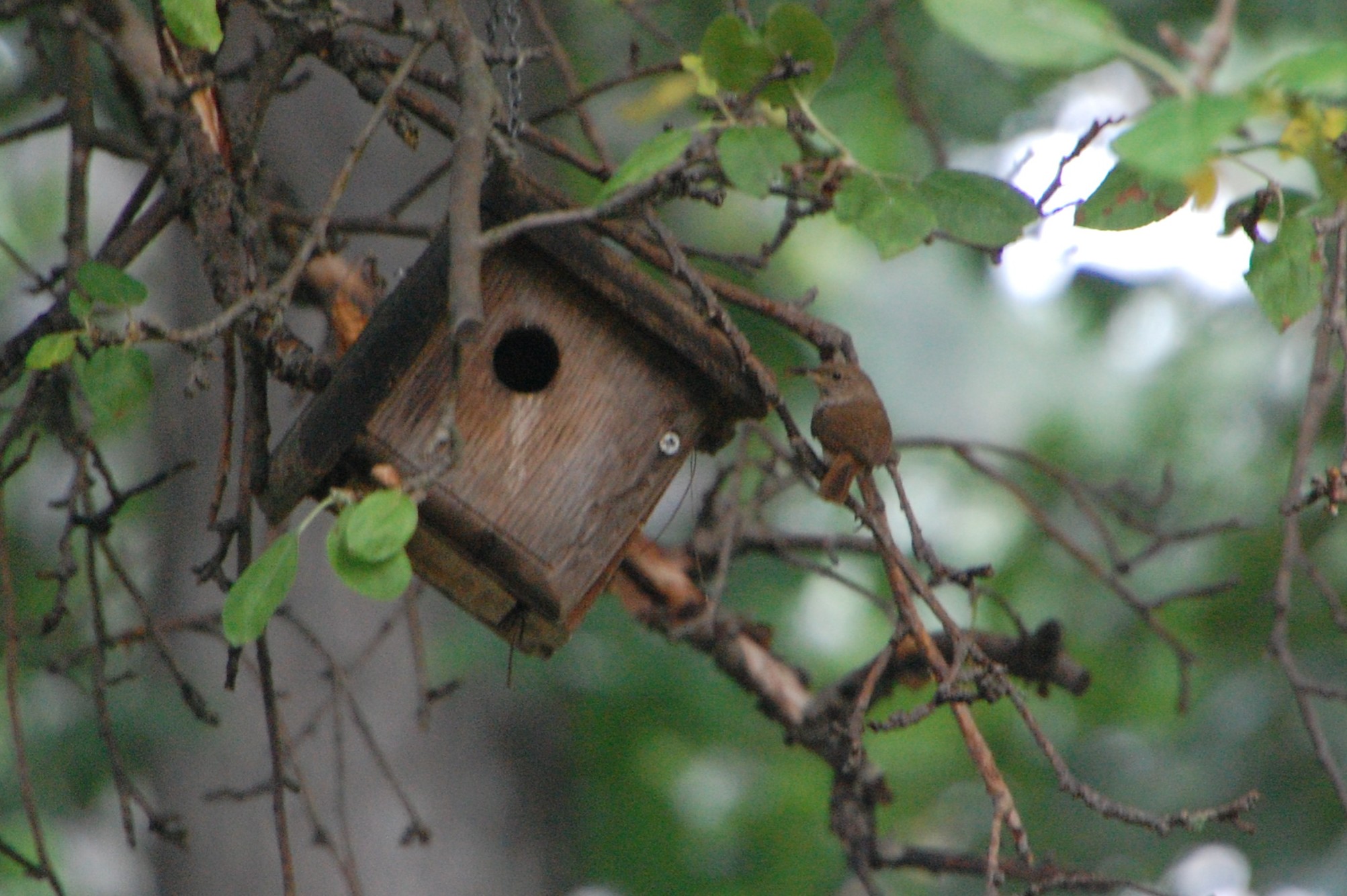
For the most part my yard is a sea of green except where the clover is showing its white flowers in the grass. In the midst of this green sits the house wren nest box.

At this time of year what birds I find in my usual places have ended their migrations to nest and breed. Many of them now have young that need feeding. I hear the young birds calling for food and I see their parents zipping around, gleaning insects from tree leaves. The tree foliage is so thick now I can't see the birds well up there, I can only hear them unless they happen to come lower to hunt on the ground.

The house wrens living in my yard also have young. I estimate they have at least two, maybe three. I'm not sure when exactly the eggs hatched but Mom was in the box a lot at first and now both parents are flying back and forth from the box to remove waste and bring food. Last week the young were small enough for both parents to go inside the box at the same time but usually it is just Mom who goes in. If Dad brings food while she is in the box he gives it to her to give the young.

(I am not humanizing these birds, but it is easier to call them Mom and Dad than to keep saying "the female house wren," etc.)

This year's male house wren. (Margo D. Beller)
After Dad has delivered the food to the nest he sometimes goes to a higher branch in the dogwood and flutters. Then he sings. I don't know what the fluttering means. The singing is the only way I can tell male from female.

Soon the young will get so big both parents will feed them from outside the box, except when Mom squeezes inside to get the waste matter. Eventually, the chicks will be induced to leave the nest and try flying to their parents. With luck they'll make it to the safety of the thick shrubbery across from the box and eventually learn to feed themselves. Then the family will disperse.

Always, there are dangers.

So far this year I have shooed away house sparrows trying to reach into the box to destroy the eggs and take the nest for themselves. They are bigger than wrens so I knew they couldn't get past the small opening on the box to destroy any eggs. Still, I ran them off. I have also run off squirrels several times in the last week because I don't know if they are climbing the dogwood to find insects in the leaves or any fruits being formed or to grab a wren chick.

Until yesterday what I thought was the most horrifying attack I've seen on the nest box - and who knows how many I have missed - was the male red-bellied woodpecker that flew to the box and then stuck its long bill, and longer tongue, inside. At that point there were only eggs. I chased the bird off and later learned from an article that many types of woodpeckers, including the red-belly, eat baby bird brains. I can no longer hear a red-belly in my yard without apprehension.

But worse than that attack was the Cooper's hawk.

Another immature Cooper's hawk atop another feeder pole.
(Margo D. Beller)

Sitting on my enclosed porch with my coffee early in the morning, trying to wake up, I was horrified to see a hawk fly at the nest box as the parents were shuttling back and forth to feed their young. Based on the size I thought, "Cooper's hawk." After hitting the box it flew back to the nearby privet shrub. I ran out clapping my hands to scare it off. When it flew I realized the bird's wings were brown - an immature bird. (Adults have gray wings.)

As I stood near the dogwood after the hawk flew off I heard the cheeping of the wren young.

I went back to the porch and waited for at least one parent to return. After what seemed an eternity, Mom returned and zipped into the box, then left to get more grub. I did not hear the male. It will be much more difficult to feed all those young with only one parent, I thought. That happened several years ago when the male disappeared, the female did all the feeding and then a new male appeared to help her.

(Margo D. Beller)

I went out for a while to do some birding, not wanting to know if the juvenile Cooper's had succeeded in grabbing a meal. (Adult birds are usually much more successful than juveniles that are still learning to hunt.)

When I returned from my time away I went back to the porch, this time with my breakfast. And then I heard Dad. Then I saw Dad and Mom shuttling to the nest box to feed their young. 

The Cooper's had missed. It was as though the attack had never happened. 

This is what life is like for a bird - you migrate, you pick a territory, you find a mate and raise young. If you are lucky they will live to feed themselves, migrate, then come back next year - perhaps to the box I hang in the dogwood - and do it all over again. If a chick trying to fly falls to the ground a jay may grab it for a meal, as I've seen happen. The parents continue feeding what young remain. Do they mourn the loss? Mourning is a human concept. 

Life and death are everyday occurrences in nature. There is very little I can do, but I try to keep the cycle going in my yard.

For now I'm watching the nest box like a hawk.

Monday, February 2, 2026

Feeding the Birds

A week after the last snowstorm, just as everything had about melted except for the snow mounded by the plow at the curb and the top of the driveway, we were hit with over a foot of snow. We avoided most of the ice

The people we pay managed to make the driveway usable for our all-wheel-drive Subaru when I had to go to a longstanding medical appointment the next day. They also cleared our front walk. That left the rear walk to my husband (MH) and me, after which we dug a trench to the feeder poles. (The feeders had been inside during the Sunday storm.)

The curved blade of this shovel is 12 inches long.
(Margo D. Beller)

Remembering how, during another foot+ snowstorm 12 years ago this month, the desperate squirrels had used the ice-covered snow as a platform to jump over the baffle to the feeders, we cleared space around the poles this time and hoped it would be enough.

It wasn't.

Our snowstorm has been followed by a period of intense cold where daytime temperatures have not gotten much above 20 degrees F and the overnight temperatures have been in the single digits, with windchill in negative numbers. In the immediate aftermath of the storm there was little in the way of bird movement. Nor were there deer or other animal tracks. (Except for those digging out their driveways after the town plow cleared the street, you didn't see much in the way of people either.)

The back path we shoveled. (Margo D. Beller)

There was too much snow in my usual areas for me to do any birding, though I noted what birds I heard or saw while running errands or putting the house feeder back outside each morning. (With the bears in their dens, two feeders that deer can't reach to tip out seeds are left outside for now.) 

Two days later I saw the first junco on the flood wall and the first squirrel climbing down a yard tree. Since then three types of woodpecker and, once, a red-breasted nuthatch have come to the suet. A female cardinal sat on one side of the house feeder while her mate sat on the other side. Jays swooped in, as did house finches. Things seemed to be getting back to "normal" again.

The prolonged intense cold has frozen rivers and lakes. Any bit of open water
will draw land and water birds. But the paths are too snowy to
look for these birds. (Margo D. Beller)

Then, four days after the storm, I happened to look out the kitchen window and saw a squirrel on the long, "squirrel-proof" seed feeder. I ran out on my enclosed porch to rap on the window and scare it off. 

This may seem cruel but I am fanatical when it comes to keeping pests like squirrels and deer out of my yard and away from the feeders. The seed is to keep the cardinals, titmice, chickadees and other yard birds alive. 

From 2014. The feeder on the left is the one that had
the squirrel on it this year. This pole was later destroyed by a bear.
The other feeder pictured is currently inside. (Margo D. Beller)

That's why within an hour I was out with my shovel, digging a wider area around the two feeder poles to make it harder for the squirrels to jump. Luckily for me the snow was still soft enough under a thin crust for me to move quickly and with a minimum of strain. Since then I have seen no squirrels on feeders but I have seen at least three UNDER feeders to get the seeds dropped by the sloppy juncos, house finches and occasional house sparrow. So don't worry about the squirrels.

Winter is a harsh season. In this area what birds don't head south for warmer weather have to find food where they can. At Great Swamp recently I was able to see large groups that included seven types of sparrows foraging at the side of the road on what ground had been churned up by the plow. Winter birds have to find seeds and other food in that ground to stay alive. They also fluff their feathers for insulation, shiver to generate heat, shelter in trees or shrubs and, most important, store food for later use.

This is the replacement feeder pole. It may be hard to see the wider
area dug around it, but it has kept the squirrels at bay.
(Margo D. Beller)

So in a small part of the universe - my yard - I am trying to help the birds. Yes, I have a motive - I want to be able to see them, especially when I can't leave the house. Winter is a harsh season for me, too.

However, I know that little by little the snow will eventually melt. I am looking forward to a few days this week when the temperature rises above freezing during the day. I want to go back to my usual birding places, secure in the knowledge I won't slip and fall in snow. At some point the whiteness and ice everywhere will be a distant memory when the trees leaf out, the flowers bloom again, the insects appear and all the birds - migrant and yard - get to eat.

Until then, I feed birds, not squirrels.

Sunday, June 29, 2025

Many Directions At Once

 ...[S]tarting a sentence in the middle, and then going to the beginning and the end of it at the same time... both directions at once.

--Liner note from the John Coltrane "lost" album "Both Directions At Once," recorded in 1963 but not released until 2018.

It is a warmish but quiet morning on the enclosed back porch, and I am catching up with the world after last week's heatwave kept me inside with the air conditioning for nearly a week, except for brief forays in the oppressive air to pick up apples dropped by the thirsty squirrels. I would hear birds but had no inclination to go looking for them until the day the heatwave ended, when it was wonderfully cool in the early morning and I could take a long walk.

Wren nest in what is now the diseased area
of the apple tree, back in 2020.
(Margo D. Beller)

This morning, however, I am sitting. In one direction I can see the house wren nest box. During the heatwave the male had been singing almost continually, and I wondered what had happened to its mate. I could not sit on the porch in the heat to watch for activity. 

Unlike the first wren brood, when it was unusually wet and cool during incubation, it must've been extremely hot in that little wooden box for this female. If there were eggs in there they wouldn't need her all the time to keep them warm. But when it turned cooler I did see her leaving the box to get food, then fly back inside for long periods of time.

As I watched today she flew out and soon returned holding a bright green insect, maybe a katydid. She took it inside. So I'm sure the eggs have hatched and she is now feeding small young that will grow bigger. 

What the hummingbird saw, which may be why it didn't stay.
(Margo D. Beller)

That's one direction I can look. If I turn around in my chair I can see the hummingbird feeder. When it turned cool I had put fresh sugar water in and hoped something would be interested.

A couple of days ago, as I was at the back door before going out to collect dropped apples, a hummingbird did suddenly appear. It briefly investigated the pink coral bell flowers, flew up to look at the red lid of the feeder but did not fly over the netting. Instead, it headed for the apple tree but a squirrel in a lower branch must've spooked it because it disappeared. I hope it returns.

Hummingbirds used to be a common occurrence in my yard, usually during July. Last year I saw no hummingbirds at the feeder but one could've come by. Same with the one I saw this week. Did it come by when I had taken the feeder inside? Did it come by when the liquid had spoiled? Was it put off by the netting that protects the plants in the shade? No clue.

Years ago a yellow-bellied sapsucker drilled these holes in
the apple tree. I didn't think they had anything to do with
the current rot. Now I'm not sure. (Margo D. Beller)

So now I'm watching for hummingbirds when I'm on the porch. That is good, because the apple tree is done putting out fruit and I will soon have to do something about its diseased limb.

There was a time, early in our occupancy of this house, when apple season was during July. Little by little apple season has been earlier and earlier. This year the tree started dropping small apples at the end of May, not long after flowering. Then one-third of the tree suddenly went black. As apples got bigger in the rest of the tree the squirrels started coming. I took my long pole out to knock down what apples I could reach. Despite one-third of the tree being dead I managed to get enough fruit for two pints of sauce and two apple cakes. 

The fruit I could not reach I left for the squirrels. Yesterday, June 28, I picked up the last little apples from the ground. Today, June 29, there were no squirrels in the tree and a chipmunk was rummaging around looking for what apple bits it could find. 

Chipmunk hunting apple pieces. (Margo D. Beller)

Apple season is over for this year and it isn't even July. If cutting off the diseased limb doesn't save the tree it could be the last apple season. We've lived in this house for over 30 years and the tree was there when we moved in. It was planted by a previous owner maybe a decade before that.

According to one website I found, the average lifespan of an apple tree is 25 to 50 years, depending on the type. Years ago I showed one of the apples to the manager of the farmstand I buy from and he thought it was a MacIntosh type, even though the tree blooms in the spring rather than fall. MacIntosh trees live 30-45 years.

Factors affecting its life include exposure to sunlight (check), competition with other trees (it stands alone) and moisture. Too little is bad and so is too much. Last year we were in a severe drought, which lasted until this spring, when we had too much rain. This is an old tree. As with the dogwood a few years ago, my hope is cutting away the dead stuff will allow the apple tree to live. But it may not.

Besides apples ripening sooner than before thanks to increasing global warming the insect population is surging earlier, too.

That's why another distraction from my chair is watching for fungal gnats on the porch. Last year the gnats started bothering me in August, at which point I brought my house plants inside and put the infested bird seed bag outside. This year they started in the spring, when it was cold and wet. Maybe they were seeking shelter and warmth because during the heatwave there were very few of them on the porch. (And I don't have house plants on the porch this year.) What I found inside during the heatwave I am sure I brought in after dealing with the apples. 

Instead of spraying the porch, as I did last year, I tried old-fashioned flypaper. 

Hanging from the ceiling. (Margo D. Beller)

I hung it on a wall near the screen door, because that is where I'd see a gnat early in the morning. But all I caught was a spider. I don't want to catch spiders. Spiders are useful insects with their webs. So I changed the location and have the sticky paper hanging from the ceiling. But unlike flies, attracted by the color yellow, gnats could care less. They seem to prefer the white walls of the porch, which is where I've continued to kill them. The one fly that got onto the porch got caught in a spider web. 

The flypaper is something else to look at when I'm not watching the wrens.  


Sunday, February 16, 2025

Snow More

So far this year 2025 has been filled with cold, snow and ice. And yet, according to my home state of New Jersey, January was one of the driest in history.

Says NJ.com about January, "Many areas of the Garden State have picked up less than an inch of total precipitation so far this month. That includes rain and all the liquid from melted snow and sleet, according to data from the National Weather Service." 

Scene from a recent snowstorm
(Margo D. Beller)

It was also very cold for a number of days. According to NOAA, "For those living in the southern, central, or eastern parts of the nation—who might have forgotten what winter could be like following last winter’s record-warmth—Mother Nature provided a hard-hitting reminder during January. Temperatures averaged below normal from coast-to-coast during the month, but periodic intrusions of Arctic air were most prevalent into the central and eastern U.S." 

Now, it's February. As I write the temperature is above freezing and it is raining. Our last snowstorm the other week dropped three inches of snow and one of ice, making it harder to shovel the front and back paths. Since then temperatures have risen above freezing during the day and then dropped at night, freezing the snow and making it more hazardous to get to the bird feeders. It is miserable out and, unless everything is washed away, it will continue to be icy for days.

According to NOAA again: The temperature outlook favors well above average temperatures across the southern and eastern parts of the nation, as well as in northern and western Alaska. Below-average temperatures are favored across parts of the northern and western U.S., as well as in southeastern Alaska. The precipitation outlook favors well above average precipitation in the Pacific Northwest, Northern Rockies, around the Great Lakes, in the Ohio and Tennessee Valleys, in the Northeast, and in western and northern Alaska, with below-average precipitation favored only in parts of the Southwest and Florida. (emphasis added) 

One of the redtail hawks I've seen near my house.
(Margo D. Beller)

The birds do not seem to mind all this strange weather. Several times I have seen a pair of redtail hawks flying around and landing in trees near my house. At this time of year they would be pairing, mating, creating a nest and having a brood. I have not found the nest yet, but I haven't had much opportunity to go out looking for it. (I haven't found a nest since 2012.)

In weather like this, when it is either raining heavily or extremely windy, the feeders are inside and the smaller birds have to fend for themselves. I don't like this but I can't fly over the ice to get to the poles, and the rain rots the seed.

Unfortunately, there is another reason for keeping them inside - one of the local squirrels has figured out how to jump on the baffle on one of the feeder poles and grab hold of the long feeder I put out after big snowstorms. (It holds more seed and I don't have to worry about leaving it out overnight because the bears are hibernating, but that will end in March.) The last time there was so much snow and ice the squirrels couldn't get to their stashes and the birds didn't drop enough for them to eat was in February 2014. That was a bad winter. The squirrels used the ice atop the snow piles as a step. This year the snow is a bit less but the one squirrel (who might be a female eating for six) is just as desperate.

This was from 2014. The feeder is the same, the
squirrel far different. (Margo D. Beller)

I used to like snow, until I became a homeowner who had to shovel it or pay someone to plow it from the driveway. Snow looks pretty until it starts to melt or, as is currently the case, gets rained upon. We have had more snow this month than we've had the last two winters. That's a good thing considering last September's drought but even with all the rain and snow we've had, my region of New Jersey is considered severely dry. Other areas are worse.

Thanks to climate change my area of the country has had milder winters with little in the way of snow, which contributed to the drought. What we're getting now is more "normal," though historically we are still getting far less snow than when I was a child. 

So, much as I hate to say it, I can only hope for more snow, ice and rain to ease the drought, and enough dryness in between to feed the birds.

Wednesday, June 26, 2024

Chipmunks and Squirrels and Deer (Oh, No!)

I want to talk about some of my neighbors, Not the two-legged ones I'd rather ignore. No, I mean the four-legged ones that make gardening even more of a challenge than it needs to be.

But first, a house wren update. Since my last post, no sooner had the one house wren chick fledged but the adult male - at least I think it is the same male - started singing up a storm all over the yard. It was once again setting his territory for his next brood - house wrens have two each year, tho' I haven't always seen two broods in my yard. He is also "fighting" in song another house wren male that has been singing from a yard across the street recently. I have seen the wren in my yard chase off other birds getting too close to the nest box including house sparrows, jays, catbirds, Carolina wrens and that neighboring house wren.

The male wren on the dogwood branch, between
couplings. (Margo D. Beller)

In the midst of his singing he found a mate - the same as before? - and the female has set about making the box her own, clearing out some stuff and replacing it with some twigs and grasses to line the nest for her eggs when they come. There has been frequent coupling in the dogwood tree so there are no eggs at the moment. 

Now back to the neighbors.

My main problem with chipmunks is they dig, and they are small enough to get under or around my deer fencing. So I find deep holes dug around my plants, usually just after I plant them in the ground or in a pot. If I catch the damage in time I can put the plant back in and save it but that doesn't always happen. I discovered one chipmunk continuously dug up a canna I kept putting back in - when I figured out it wanted a spot for a tunnel hidden by the peony I moved the canna. Another time I came out the front door and a chipmunk jumped OUT of the cage I had put around my pepper and basil plants and a couple of annuals to protect them from the digging. So much for that brilliant idea.

The cage and all but one potted plant (a zinnia) are now stowed inside, either on the enclosed porch or in my sunny front room. (The pepper plant has a nice-sized fruit growing on it and I don't want it seized by the rodent.) Now I am thinking that next year I won't have many pots of plants outside.

Why do chipmunks dig? Maybe to create tunnels for transportation for themselves and their young or to look for acorns they may have planted in these or similar pots last year or to put new acorns in for the winter. Whatever the reason, they create havoc in my garden.

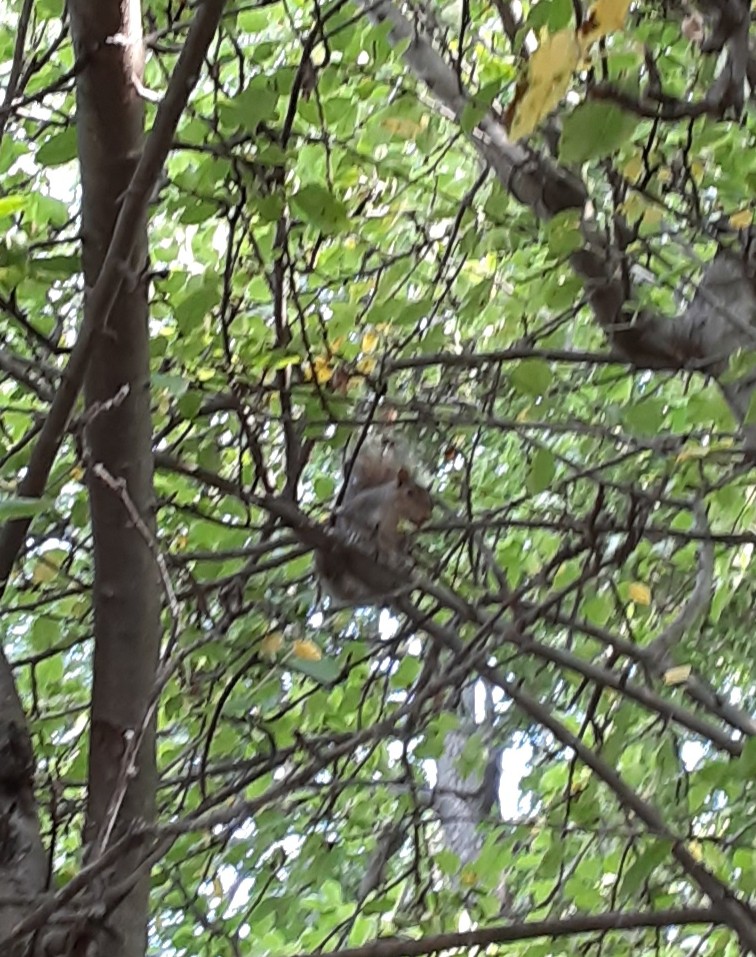
Squirrel in apple tree, caught in the act.
(Margo D. Beller)

Squirrels are too big to follow the chipmunks behind the netting and don't want to get caught in an area they can't escape. But they do climb. They climb into the dogwood to look at the nest box (and are chased away by the male wren). Thanks to the fur coat squirrels always wear they get very hot and very thirsty. Over the past few years squirrels have managed to break or damage water containers I hang in the pear tree by acrobatically grabbing the container with front paws while hanging onto the tree with rear paws. That's when they pull the container down.

One of the water containers squirrels have
damaged over the years.
(Margo D. Beller)

They also really, really like apples.

The old apple tree has been showing signs of stress in recent years, ever since I last had it pruned. This year it produced a lot of blossoms, to my surprise, and that means a lot of apples. The tree dropped many apples on its own early on, and the recent strong winds have blown down more. However, usually it is the squirrels that let me know when the apples are ripe. The climbing begins and I must once again try to get as many apples as I can for myself before the squirrels, which are very sloppy eaters. In this current hot and humid weather they have been particularly active, tho' not as bad as the time I came outside and six squirrels jumped out of the tree. Yet.

If I don't pick up what the squirrels drop the deer get them and leave a mess of their own. I throw chewed apples into the corner of the yard near my compost pile.

From 2018. The apple is now showing signs of stress but
it still produces fruit for me ... and the squirrels.
(Margo D. Beller)

I am sure those apples are feeding that fawn that found its way behind my deer fencing. The other week fawn and doe were passing through my backyard and when I came out the fawn took off, running in circles until its mother led it across the street. Did I give it PTSD? Good. It is because of the deer I must struggle under and over and even around the deer fencing around my garden plots.  

These are the most common critters, although this yard has seen the occasional coyote, bear and, too often, cats that must be some neighbors' pets because they look too neat to be feral. I can almost forgive the trouble animals cause me because they are doing what they do in order to survive. The two-legged ones are another matter.

Wednesday, June 28, 2023

Another Season of Wrens and Apples (and Squirrels)

Right now, on the cusp of July, birdsong is heard once again in my yard.

Apples (Margo D. Beller)

That's because the young that had been protected in their nests by their parents are now flying around after them, begging for food. The parents, in turn, send out contact calls to make sure everyone stays together. Now, about a month after the northbound migrants moved through and the nesting birds went silent, I am hearing songs or calls again: catbird, song sparrow, titmouse, house finch, white-breasted nuthatch, cardinal, assorted woodpeckers. Some of these birds may have second broods, but for now the emphasis is on teaching the first brood to take care of itself.

The house wrens in my yard have also been on the move. Once again I did not see the moment when the young, no doubt cramped in such a small space in hot, humid weather, took off after their parents. On Friday morning, June 23, the parents were busy feeding the young, hanging outside the box except for when one would go inside to clean out the poop. I could see the heads of the young as they came to the opening and looked out. They seemed very agitated.

On Saturday morning, June 24, we had a deluge for the first time in weeks. I stayed inside. When it was over I went outside to pull out stubborn weeds from my front walkway (stubborn because of long taproots, which gave easily in the soggy soil). When I walked to my compost pile to dump them I heard the scolding of a house wren, then the dry, rattle-like calls of young. Sure enough, as I sat to rest on my porch, I watched the nest box and saw no activity. Once again, these birds had flown. 

Empty nest (Margo D. Beller)

My guess is they flew Friday afternoon. Since then they have been moving between my yew hedge and the shrubby area near my compost pile. In fact, today, when I went to that shrubby area to pull out a tree branch to add to my brush pile, five wrens jumped out! A parent and four young? Two parents and three young? All young? I don't know. I quickly left the area and they settled down.

Here is a video I found that shows five wrens fledging. (The video lasts about five minutes. The site is not associated with mine.)  

Meanwhile, the apple tree has brought forth a prodigious amount of fruit, right on time. I am usually busy picking apples from late June into early July. People I know with their own apple trees think it odd that my apples are not ready for harvest in the fall. However, doing a bit of searching, I found that there are many types of early apple varieties. I'm not sure which of them is mine.

Starting last week, I was knocking apples down with an extension pole because thanks to the tree pruning in January the lower, more easily reached branches are gone. I've managed to fill a bucket with enough apples for me to make apple sauce, when I get around to it. For now, the fruit is stored in my cellar.

(Margo D. Beller)

The squirrels always seem to know when the apples are ripe and they have been eating the fruit regularly. I am also making regular visits, but to dispose of what they've eaten and dropped before the deer (or bear?) can get to it. Sometimes there is even fruit for me. I cut into one of the apples I picked up today and it doesn't taste particularly sweet - almost all the apples are on the green side - but for a hungry or thirsty squirrel they will do.

I have taken down what large fruit I can reach. I must now depend on squirrels, or one of the many intense thunderstorms we've been suffering through this week, to knock down any other apples. Then I must get them before the deer.

Treed squirrel (Margo D. Beller)

It is gratifying to me that, after all these years, the apple tree continues to produce despite heavy pruning (and whacking at the branches by me). I'm sure the squirrels are happy about it, too. We'll all enjoy it while it lasts.


Sunday, July 10, 2022

Apples and Wrens, Yet Again

In my yard, the apple tree and the house wren nest box are forever linked, and not just because until two years ago the box was in that tree. From late June into July, both are busy with young. In the tree's case, that means a lot of ripe, edible apples drawing squirrels, insects and birds. For the birds, it means the parent wrens taking turns flying to the box to feed their chicks.

House wren feeding young, 2022 (Margo D. Beller)

For the past two weeks, the young - two? three? Can't be much more in that small box - have grown. I know this because now when a wren comes to the box, the sounds of begging are loud enough for me to hear without opening a porch window. The parent can't get inside. It flies to the opening and whichever chick has muscled its way to the front gets the insect meal. 

As for the old tree, last year there was so much rain we had an abundance of apples, so many I had to sort what I picked (or picked up when the squirrels dropped them so the deer didn't get any) and put the ones I knew I wouldn't use in a corner of the yard for the critters. Even then I made several quarts of apple sauce. This year, either because there has been less rain or the squirrels took advantage of my being away for five days on vacation, there have been fewer apples in a good condition to use, enough for one pail rather than my larger apple basket. I intend to use what I have and leave none for the critters. If I'm lucky, by the time I cut off the bad parts and cook the good ones, I'll get one quart out of all of them.

Two of the last apples of 2022. A squirrel later got one of them.
(Margo D. Beller)

Some years, things get out of whack between the nesting and the fruiting. There have been years when the squirrels started going into the tree earlier, in mid-June, for the juicy apples because we were in an unusually hot stretch. In those years I would be concerned the squirrels would disturb the wren sitting on eggs and the tree would survive the drought. There have been other years when the young wrens have fledged before apples were ready to be picked. Some years the tree would not have many flowers in the spring, and that would be a year when I would not be making much apple sauce, if at all. 

It was during a plentiful year that I had to use an extension pole to knock down apples if I wanted to use any, thus disturbing the wrens as much as the squirrels. That was when I decided to move the nest box to the dogwood on the other side of the yard, which also allowed me to watch the wren activity more easily.

(Margo D. Beller)

Any day now I expect to bring my morning coffee to the porch and see no feeding and hear no begging. Every so often I've been hearing one of the parents calling from a shrub, trying to draw out its young. At the moment they are, like a lot of young nowadays, happy to stay at home. Why go out when Mom or Dad brings me what I need?

However, unlike their human counterparts, the wrens' brains are hardwired to continue the species. At some point instinct will kick in and they will leave box, learn how to fly and feed themselves, and then leave in late fall for their winter grounds. If they survive the trip, they'll fly north next spring to pair up, find a suitable nesting spot, mate and make more young. 

As usual, I hope at least two of them will be in my yard.


Sunday, June 5, 2022

A Lesson Relearned

On June 1, the morning after my last post, I came out on my porch with my second mug of coffee, put on the fan to move the warm air and sat down to relax and let my mind wander before I had to go to work. After a few minutes I heard something through the whirring of the fan. I opened the porch door and put my head out. I heard a house wren.

Nest box, pre-wrens, 2022. Note the string to
the right. (Margo D. Beller)

I came in to sit and watch the nest box I'd hung in the dogwood tree weeks before, a day after I'd seen another house wren at the water dish. There had been silence after that wren flew off but now there was the bubbly song of another and it did not stop, except when the bird examined the wooden box. Then it flew off but soon returned, still singing. 

The next step was to see if there would be a second wren. The female is the one who must approve the site and then start gathering materials for her nest. A day later, I saw her.

Over this past week the male started singing at dawn and the female actively worked at the nest.

Then, today, came a reminder that even when I try to help birds their lives are still precarious.

Sitting on my porch this morning, I was horrified to see a squirrel climbing up the dogwood and then climbing ON the nest box. A squirrel weighs a lot more than a wren and I didn't want the box to fall, in part because I didn't know if there were eggs inside. The female wren flew out of the box and the male flew from the nearby hedge, both to attack the much larger danger.

By then ("NO!") I had rushed from my chair to the other side of the porch to bang on the window. The squirrel took off.

But so did the wrens.

Until last year, I hung this nest box in the apple tree. It was placed halfway out on a strong, horizontal branch to prevent the squirrels from bothering it. I decided to move the box to the dogwood on the other side of the yard because the profusion of apples drew a lot of squirrels (and me) and I didn't want the birds disturbed. However, the dogwood is more open, and the way the branches grow it was hard to find one strong and straight but not too high to make it dangerous for me to attach from the ladder.

House wren in 2020, when the box was in
the apple tree. (Margo D. Beller)
And, of course, I wanted to see the birds. In the dogwood I only had to sit in my chair and look out. In the apple tree I would have to turn around or look from a different, less comfortable chair.

When I took down the box last year I tied a string to the branch to remind me where to place the box this year. When the wrens came, the male kept pecking at it. I realized it might have thought the string was a snake so I went out to cut it. I agitated the birds but I was quickly gone and I hadn't touched the box, unlike the squirrel.

I can't be outside all the time, much as I'd like to be, so I don't know if any squirrels attacked the box last year. The wrens had their brood and, as usual, suddenly disappeared with the young once they had fledged.

This year, after 15 long minutes of silence, one of the wrens came back and went into the box. Then it flew down to a lower branch for a moment before moving off to the area behind the flood wall. A few minutes later it - she - came back with nesting material, flew into the box and then back behind the flood wall. I was relieved at first, but then started to get agitated. Except for one brief call by the male just after I scared off the squirrel there has been silence. I decided I didn't want to keep punishing myself so I came inside. I'll come back out tomorrow to see if they are staying.

A badly placed robin's nest,
(Margo D. Beller)
When I put out feeders in winter, it is to help the birds stay alive in harsh conditions. Many people now feed birds all year round and that is why there are more birds (and more birders). At this time of year I bring in the feeders because there are plenty of insects for the birds and their young. They do not need sunflower seed, they need bug protein.

Still, even with plentiful food there is continual danger in the life of a bird. Just before the squirrel came to the box a flock of noisy fish crows flew overhead, silencing the male house wren. There is no way a fish crow could attack young in a wooden box nest but in the wild predators could get at a badly placed or unprotected nest, and so the wrens go quiet by instinct.

At this time of year there are already baby birds in nests. Just after the squirrel incident another fish crow came too close to the hedge where I know there is a robin nest. Both parents put up a frightful racket as they chased off the intruder. They even got some help from a mockingbird, not the most social of birds but likely also protecting its own nest nearby. 

The Cooper's nest that failed.
(Margo D. Beller)
It is a common site to see big birds being chased off by one or more smaller, protective birds: starlings chasing off grackles, grackles chasing off crows, crows chasing off hawks. But sometimes nests fail, either because they are in the wrong place or are abandoned by immature birds before eggs are laid. The latter was the case with the young Cooper's hawks that built their nest in 2020, only to be spooked off by a flock of fish crows that came too close. The hawks left and squirrels later claimed the empty nest.

And there are the sad situations where the parent (usually the female alone cares for the nest) is killed by a predator (including cars), a cowbird egg hatches in the nest and destroys the other eggs or the parent is forced to abandon the nest and the young starve to death.

I get protective about this nest box and the house wrens that use it every year, but once again I should've let nature take its course. I'm sure the two wrens would've forced off the squirrel - there was no food to interest it - but by my getting involved I possibly made things worse.

One of my friends likes to refer to "my birds" when they come to her feeders. I remind her these are not house pets, they are wild birds. I know she is feeding them so she can see and enjoy them in their various shapes and colors. So do many other people. I tell myself that I don't do that but I now realize, yet again, that I am no better than anyone else.

Will the wrens pick up where they left off? I don't know, but it would serve me right if they didn't. Lesson relearned.


Sunday, June 28, 2020

Apple Tree Watching

You can observe a lot by just watching.
              -- Yogi Berra

The squirrel walks through the long grass stealthily, gets close to the apple tree, then leaps to the main trunk. It is a small squirrel, so let us presume it is a female. She climbs up the trunk into thicker canopy until she appears on one of the smaller branches as she climbs to the top of the tree. She raises her head and sniffs as she seeks an apple.

(Margo D. Beller)
Nearby, a house wren sings, warning his mate of the potential danger. She is in the nest box hanging in this tree. On this cool, early morning she is sitting on eggs, fed occasionally by her mate. She's not going anywhere unless the squirrel shakes the branches and jostles the nest box while looking for apples. A flicker explores the nooks and crannies of the wooden flood wall at the edge of the yard, and a family of noisy titmice are in the oak trees, following a parent around and begging for food.

The squirrel, meanwhile, has gone up one branch, found nothing and then backtracked to climb another branch. Finally, again near the top, she snares a small apple and climbs down to eat it sitting in the crotch made by two thicker branches. 

2020 crop (Margo D. Beller)
She is hidden from most people (and predators) but I know where she is because I have been sitting in my chair in a corner of my patio and watching her progress. I know what will happen and I am not proved wrong. She finishes her breakfast and drops the core with just enough apple on it to draw the interest of a chipmunk, perhaps a bird, more likely a deer that passes through the yard later. 

That's why I go pick it up and toss it into a corner of the yard to keep deer out of this area so near to my plants.

Now, a second squirrel approaches and climbs. When it is up a ways I walk to the tree and look up. The squirrel freezes. We look at each other, then I step back and the second squirrel jumps down and rushes away. The first one, meanwhile, is so high up I have to walk back somewhat to see it. She seems to know I am not the type to climb trees. She will be looking in this tree a while because there are not many apples in it this year.

Unusual for an apple tree, mine produces fruit in late June going into July. If all things were "normal" the apples would get bigger, redder, sweeter and I'd have three weeks to go out at dawn and dusk to gather them before the squirrels and deer.

Plenty of blossoms earlier this year. (Margo D. Beller)
Last year, we had a bumper crop both of apples and squirrels, sometimes as many as six at a time in the tree, all dropping partially eaten apples.

But in this year of coronavirus, which has changed everything about life as we know it, the apple tree blossomed beautifully in spring but did not put out a lot of fruit. The coronavirus has nothing to do with it, but it seems apt that this year would turn out to be a bust year. 

Many trees go through booms and busts. In my yard that also includes oaks, elms and locusts. Last year was very good for oak acorns. They fell to the lawn continuously as the squirrels climbed along the branches. Some would sound like gunshots when they hit the metal porch roof. I left them alone for a while until I started putting out feeders again in the autumn and it was hard walking on the acorns (or their caps, once the nut was removed). I raked up as many as I could and put them into a corner of the yard behind the compost pile. They are still there.

What the squirrels are dropping nowadays.
(Margo D. Beller)
According to John C. Kricher and Gordon Morrison, authors of the "Peterson Field Guide to Eastern Forests," many types of trees in the temperate zone, which includes New Jersey, have "mast" years when seed production is higher than usual.

Why? "Masting is probably an adaptation to aid the trees in escaping the potential ravages of seed predators. By alternating between occasional bumper crops and more usual poor crops, trees conserve energy, enabling them in a given year to produce more seeds than all seed predators combined could ever hope to eat," they write.

So the apple tree might be taking a breather this year to protect itself.

Unfortunately, it is too easy to underestimate the importance of trees, their ability to clean the air and provide shade and food. About 36 million trees a year are cut down, according to one report. I know I see enough of that destruction in suburbia when a tree that took several decades to grow is taken down, hunk by hunk, in a day. (Was the tree sick, planted in the wrong place or just in the way? Who knows?)

Meanwhile, those that need acorns (or apples) to survive, breed and feed young (squirrels, jays and other birds) are going to have a harder time of it this year, as will the raptors that feed on those animals. When snowy owls or rough-legged hawks can't find their favorite small mammals in their northern breeding territories because the population has "crashed," they fly farther south to find food. That is known as an irruption year. Smaller birds that depend on cone and other seed crops can have irruption years, too, including both types of crossbills, pine grosbeaks and redpolls, to the delight of the bird-watching community. 

Gone for now, but it - or a descendant - will be back next year. (Margo D. Beller_
But that's winter. Right now, in June, I was only able to pick 10 apples this year, but I am happy to be relieved of the annual routine of chasing off deer, picking up chewed apples, trying to find apples I could use and then the long process of cutting off the bad stuff and making apple sauce with the rest. As for the squirrels, they have turned their attention to getting other things to eat, including gathering oak acorns. What is falling so far this year are shrunken and not nearly big enough to feed them, much less a family.  

Most happily, this year I won't be going around the tree smacking ripe apples with an extension pole and agitating the house wrens in the nest box. Once the squirrels get the last few apples from the very top of the tree (where I couldn't get at them anyway), that's it until next year. And next year the nest box is going into another tree.