Cape May

Cape May
(RE BERG-ANDERSSON)
Showing posts with label backyard birds. Show all posts

Saturday, December 6, 2025

Looking Out My Back Door

This morning I found it had snowed a bit overnight and the roads were shiny with ice. I had thought about going to one or more places to do some birding - not expecting much now that migration is long over, but maybe finding something that has flown south to my area and will now hang around for the winter.

Cardinal in a past winter. (Margo D. Beller)

But since my fall I try to be more careful about where I go to walk. Ice on the road means ice on the paved paths I usually walk.

So I put out the feeders, brewed some coffee, put a cup in a thermal mug and took Merlin outside to listen.

This blog is called Backyard Birding for a reason. It was in my backyard that I first realized the diversity of the winged world. The birds coming to the feeders. The birds calling from the trees and bushes. The birds flying overhead, some of them looking to make a meal of a bird or squirrel.

When weather won't allow me to go out, or even if I am just restless to do something, I either sit on the enclosed porch or I stand on the patio and wait. At this time of year, when I seem to be the only one offering birds something to eat, the yard gets very busy, very fast.

I must be careful where I walk on snowy days.
(RE Berg-Andersson)

Take today, for instance. In no particular order the yard had hairy woodpecker, downy woodpecker, red-bellied woodpecker, yellow-bellied sapsuckers (two, chasing each other around the dogwood tree), house finches (too many), mourning doves (at least eight, all picking up what the finches dropped), blue jays, cardinals, titmice, a black-capped chickadee, a goldfinch, white-breasted nuthatch, house sparrow and, unusually quiet in a nearby hedge, a mockingbird. (Once in a while a robin or a Carolina wren will pass through, but not today.)

Lately, I've hosted several visitors from the north: white-throated sparrows, juncos and, most unusual, red-breasted nuthatch. This nuthatch is smaller than the white-breasted nuthatch I see more often, and is more comfortable hanging upside-down on the suet feeder. One day we had two birds, a male and female. Both have a black and white face pattern, the male's breast a darker red than the female's. These birds are usually found in pine forests, so perhaps they were attracted to the sheltering branches of Spruce.

The more commonly seen white-breasted nuthatch (top) with
titmouse. (Margo D. Beller)

As for the "...and Beyond" part of my blog title, this afternoon the temperature rose and the wind died down, making it feel like spring, albeit a cold spring. My area was clear of snow. I drove out to the park I would've visited earlier in the day. The path was still covered with snow and the parking lot blocked. 

So I turned around and drove home, content to resume my backyard birding. 

Sunday, November 9, 2025

Still Life, With Woodpeckers

It is autumn once again. The ornamental grasses and other shrubbery are turning gold and brown and the trees in my yard have lost their leaves except for the red and white oaks. Other trees in the area have leaves but they are fluttering with each breeze to the ground like rain. Even though age has forced my husband and me to hire a lawn service to get the bulk of the leaves and locust tree pods to the curb, today I went out with my rake because I miss the calm I get from simple yard work outside.

Male redbelly at his preferred feeder. (Margo D. Beller)

But though my rake is far more quiet than a leaf blower, the calm was soon broken by the incessant and increasingly high-pitched barking of a neighbor's dog. After I finished, that noise was replaced by several homeowners using the inevitable leaf blower. Here in the suburbs, leaf blower season will last until it finally snows and people will stop caring about having a perfect green lawn.

It is dark at 5 p.m. Eastern Standard Time now, and southbound bird migration is just about done in my area. If the Merlin app on my phone is any guide, there are still a lot of different birds that will be stay through the winter in the general vicinity of my backyard early in the morning. (I usually hear about half of them.) But the catbird, warblers and other summer birds are now far south of here.

Once in a long while I do find something interesting in the yard - a Carolina wren, a gold-crowned kinglet, more recently a yellow-bellied sapsucker softly tapping on a branch of my old apple tree in the dim light of dawn. I like sapsuckers, and rarely see them, but this tree has had enough stress in its life and its trunk is already covered in tiny sapsucker holes of past years. So I walked toward the tree and the bird flew off.

Nearby tree. The leaves will soon be gone.
(Margo D. Beller)

Now, on my enclosed porch and running a fan to cut the leaf blower noise, I watch my feeders. It is not the coldest of days so there has been little activity. Suddenly, a red-bellied woodpecker - the red going up the back of its neck to its head showing this is a male bird - comes to the house feeder for a sunflower seed. It takes it, flies to a nearby tree and then pounds the seed against a limb to break open the shell and get to the meat.

The redbelly, a medium-sized bird, has drawn the attention of the much smaller downy woodpecker. There is no red spot on the back of the neck, so this is a female. She is on the dogwood tree, closer to the other feeder pole. When the redbelly flies off, she flies to the pole and slides down until she can jump up to the suet that hangs upside down in its feeder.

She picks at the suet, then quickly flies back to the dogwood as the redbelly returns to the house feeder for another seed. This is the law of nature. If you are a little bird and a larger bird, especially one of your type, flies at you, you quickly get out of the way. So each time the redbelly came to the house feeder - first one side, then the other - the downy would leave the suet for the safety of the dogwood.

Downy woodpecker at suet, back when I hung it near the house feeder.
(Margo D. Beller)

I don't know why this redbelly is not inclined to hang below the suet feeder as downys and the larger hairy woodpeckers do. This bird kept at the house feeder before deciding to try the caged seed feeder that hangs near the suet. The cage feeder is for the little birds but bigger birds like the redbelly will cling to the cage, put its head in and try to grab a seed from the central tube. It is not a comfortable position for the bird and eventually it goes to the house feeder.

The downy, meanwhile, climbed to the top of the dogwood. I thought she would fly off but instead she flew to the pear tree. I turned in my chair and saw her tapping at the trunk. She waited to see if the big bird would come back, then flew to the house feeder for her own seed. She took it back to where she had been on the pear tree to hammer off the shell and get at the seed. The redbelly, perhaps sated, flew off from another tree. The downy ate and later left.

I have seen downys come to the house feeder when titmice and chickadees make their runs back and forth to grab a seed. But should a large jay, redbelly or cardinal fly in, the smaller birds fly to the bushes and wait for the big birds to leave. 

This tableau has and will be repeated countless times, especially when the weather becomes colder. At this time of year I am not nearly as active as I would like. I feel aches and pains more often. I dread the coming of cold, snow and the dry heat from the furnace that affects my sinuses. 

When life becomes still, watching the feeders will be the best thing I do.

Saturday, March 25, 2023

Spruce Bringsgreen Speaks!

Hello again! Margo told me that some of you have been asking after me. It has been a long time [Editor's Note: Nearly five years, to be exact.] since the last time I've written in this blog, so it's high time I tell you what I've been up to lately.

So far, about 50 feet. [Colorado blue spruces can grow 75 feet tall in the wild but 30-60 feet in the yard, so I think Spruce might be exaggerating a little.)

Spruce Bringsgreen after the Feb. 28, 2023, snow.
(Modified photo by Margo D. Beller)

Yes, I've been growing. I put out my first cones so I am now a mature Colorado blue spruce. I'm the pride of Margo's yard and, unlike some of the other trees she had cut back recently, I've been left alone to get bigger and spread out. Maybe a bit of tickling of my bottom branches as that guy she now has mowing the lawn instead of her husband works around me. The deer leave me alone because they know I'm prickly and don't cotton to being nibbled on.

It has been very nice in this yard. We haven't had a lot of snow in a very long time except once, which gave me a thick, warm coat. [See photo.] But that didn't last long. The way I am built, the stuff just slides off once the sun comes out. Soon enough I am my old self again.

Spruce dressed up for Christmas, 2018
(Margo D. Beller)

However, I will say that it has been sad to see some of the old neighbors cut down. Up and down this block the tree cutters roll by in their trucks and the air is soon filled with the sound of sawing, mulching and stump pulling. I know Margo dislikes it very much because she tells me that. Some of the old guys were sick and had to come down, I guess, but some of them I don't know why they had to go. Maybe they were in the way. 

The cedar I can see by Margo's front door was cut in half by the people who came to do her tree work. That cedar got almost as tall as the roof, and it used to provide shelter for some of the small birds. It also has softer leaves than mine and the deer would get at it, as they get to most things. 

[Note: One of the biggest problems in suburbia is people planting trees too close to the house. This cedar, and one on the other side of the front door, I had planted in 1995, when I was a new homeowner and didn't know better, as I was to learn about most of the deer-attracting plants I put in before I put up netting to save them. The other cedar eventually died after an ice storm and I cut it back myself. I needed professional help on this second one because it was too tall. It would almost double over when covered with snow.] 

The cedar before it had to be cut back.
(Margo D. Beller)

Now the birds take shelter in my branches. Being so tall, they can be high off the ground and away from those four-legged predators that seem to come through this yard with increasing frequency, particularly at night. 

I don't mind sheltering these birds. The ones that go "dee, dee, dee" [black-capped chickadees] are fine. They stay quiet, fly out for food, eat it elsewhere and then come back to me to hide or get away from the wind or to rest. But those black and white ones [male juncos] are terrible. They fight each other, they fly in and out, they make a lot of noise as they get in each other's way. But they'll be gone once it gets warm.

Sometimes a redbreasted bird [a robin] will bring bits of material and make a nest high on my shoulder, but it rarely stays. I don't take it personally.

It's hard to believe I've been planted in this spot for as long as I have [since November 2007]. It feels good to be rooted. I know Margo comes out to admire me frequently. I've no fear she will be cutting me down. That's about all a tree can hope for nowadays.


Sunday, July 18, 2021

The Season of Abundance

Yesterday I went to two farm markets. The first, where I go for lettuce and chard, among other vegetables, was also offering kale, beets, zucchini, fennel, green beans, radishes and salad turnips, all grown on a large plot of land behind a school. It was not offering tomatoes yet but when I asked about buying a couple of green ones to ripen on my window sill (or fry green) I was directed to a greenhouse filled with rows of green tomatoes of different sizes, all of which will eventually become red and luscious. In another greenhouse were peppers, now green but soon to ripen into various colors. 

Apple sauce, 2021 (Margo D. Beller)

The second farm market is where I go to buy peaches and corn, both offered as "our own." I like knowing where the stuff I buy is grown. 

This is July and here in New Jersey the fruits and vegetables are growing fast and furious. My four pepper plants are filled with growing fruits that are still green. The basil is growing like a weed - I've already harvested enough for two batches of pesto and some basil-cheddar biscuits. I have plenty of daisies, coneflowers and others to pick for the table.

There has been an abundance of many things this year.

There has been an abundance of rain following a winter when over two feet of snow buried my yard. There has been an abundance of heat waves, the first in early June and then at least two more into mid-July. The humidity has been abundant, too, making even "cooler" days in the mid-80s feel oppressive. It seems to me this heat and humidity started earlier this year and when the rain falls the scene looks disturbingly tropical for an area considered a temperate zone.

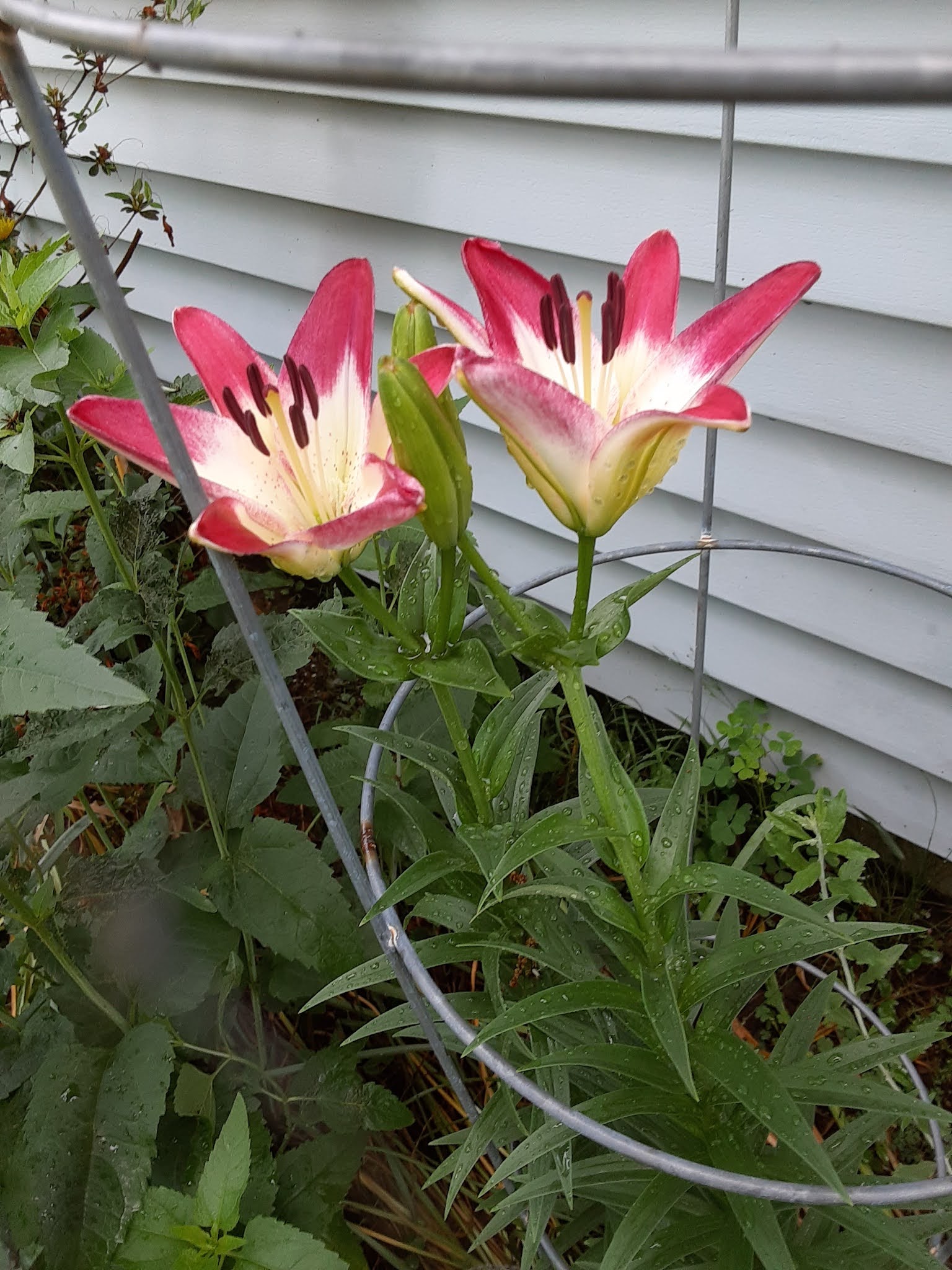
The Stargazer lilies did extremely
well thanks to the rain. (Margo D. Beller)
All that moisture that started in the spring and now the heat have not only led to a bumper crop of my peppers and flowers but also apples. I picked many and then cut off the parts I could use. I had enough apple pieces to fill a large freezer bag. I finally cooked them yesterday after returning from the farm markets. I had four nicely packed pints of apple sauce and there might be more coming because the tree is still not finished (and there seem to be fewer squirrels in the tree, too).

The moisture has brought an abundance of weeds, especially my old nemesis the ground ivy. A couple of Sundays ago I awoke to a cool, dry morning - a rarity this season - and finally tackled some of the mess in the various garden plots including removing spent daffodil foliage, cutting back assorted branches and pulling out the many, many weeds including what seemed like miles of ground ivy. After many hours of labor I'd say I made a dent, but only a dent.

The ground ivy, as usual, was everywhere I didn't want it.
(Margo D. Beller)
There has been abundance in the bird world, too. After a quiet period when many birds were sitting on or guarding nests, there is now birdsong again - robins, cardinals, chipping sparrows, Carolina wren. The catbirds and jays are more actively flying around, using apple and dogwood branches to look for a meal crawling in the grass below. Raucous families of titmice and grackles fly through the trees or search in the grass for a meal.

And there are now two singing house wrens I can hear from my yard - the one using the nest box I put out and one I can hear from a few yards away. 

When the house wren in my yard hears the other one he flies around agitated and sings all the louder. But lately his song has been a little softer, a little shorter in duration. I've been watching the nest box from my perch on the back porch when I can and I've seen a second wren going in and not coming out while the male sings from a nearby branch. A female sitting on eggs. 

This year's house wren doesn't look that different 
from this one from 2016. (Margo D. Beller)

Until today. Today I've seen a lot more activity, birds going into the box and then coming out, so the eggs must've hatched and now there are tiny baby wrens. Feeding, protecting and cleaning up after them are now the parental pair's priorities. In a week or so, the babies should get big enough that the parents will have to feed them from outside the box. In another few weeks, they'll all be gone. This brood is later than in past years and I'm relieved there was one at all after seeing little activity as recently as a month ago.

When it comes to rain, heat and snow, too much of a good thing is too much. But for vegetables, fruit and birdsong, I wish they would continue beyond the summer.