Cape May

Cape May
(RE BERG-ANDERSSON)
Showing posts with label woodpeckers. Show all posts

Sunday, November 9, 2025

Still Life, With Woodpeckers

It is autumn once again. The ornamental grasses and other shrubbery are turning gold and brown and the trees in my yard have lost their leaves except for the red and white oaks. Other trees in the area have leaves but they are fluttering with each breeze to the ground like rain. Even though age has forced my husband and me to hire a lawn service to get the bulk of the leaves and locust tree pods to the curb, today I went out with my rake because I miss the calm I get from simple yard work outside.

Male redbelly at his preferred feeder. (Margo D. Beller)

But though my rake is far more quiet than a leaf blower, the calm was soon broken by the incessant and increasingly high-pitched barking of a neighbor's dog. After I finished, that noise was replaced by several homeowners using the inevitable leaf blower. Here in the suburbs, leaf blower season will last until it finally snows and people will stop caring about having a perfect green lawn.

It is dark at 5 p.m. Eastern Standard Time now, and southbound bird migration is just about done in my area. If the Merlin app on my phone is any guide, there are still a lot of different birds that will be stay through the winter in the general vicinity of my backyard early in the morning. (I usually hear about half of them.) But the catbird, warblers and other summer birds are now far south of here.

Once in a long while I do find something interesting in the yard - a Carolina wren, a gold-crowned kinglet, more recently a yellow-bellied sapsucker softly tapping on a branch of my old apple tree in the dim light of dawn. I like sapsuckers, and rarely see them, but this tree has had enough stress in its life and its trunk is already covered in tiny sapsucker holes of past years. So I walked toward the tree and the bird flew off.

Nearby tree. The leaves will soon be gone.
(Margo D. Beller)

Now, on my enclosed porch and running a fan to cut the leaf blower noise, I watch my feeders. It is not the coldest of days so there has been little activity. Suddenly, a red-bellied woodpecker - the red going up the back of its neck to its head showing this is a male bird - comes to the house feeder for a sunflower seed. It takes it, flies to a nearby tree and then pounds the seed against a limb to break open the shell and get to the meat.

The redbelly, a medium-sized bird, has drawn the attention of the much smaller downy woodpecker. There is no red spot on the back of the neck, so this is a female. She is on the dogwood tree, closer to the other feeder pole. When the redbelly flies off, she flies to the pole and slides down until she can jump up to the suet that hangs upside down in its feeder.

She picks at the suet, then quickly flies back to the dogwood as the redbelly returns to the house feeder for another seed. This is the law of nature. If you are a little bird and a larger bird, especially one of your type, flies at you, you quickly get out of the way. So each time the redbelly came to the house feeder - first one side, then the other - the downy would leave the suet for the safety of the dogwood.

Downy woodpecker at suet, back when I hung it near the house feeder.
(Margo D. Beller)

I don't know why this redbelly is not inclined to hang below the suet feeder as downys and the larger hairy woodpeckers do. This bird kept at the house feeder before deciding to try the caged seed feeder that hangs near the suet. The cage feeder is for the little birds but bigger birds like the redbelly will cling to the cage, put its head in and try to grab a seed from the central tube. It is not a comfortable position for the bird and eventually it goes to the house feeder.

The downy, meanwhile, climbed to the top of the dogwood. I thought she would fly off but instead she flew to the pear tree. I turned in my chair and saw her tapping at the trunk. She waited to see if the big bird would come back, then flew to the house feeder for her own seed. She took it back to where she had been on the pear tree to hammer off the shell and get at the seed. The redbelly, perhaps sated, flew off from another tree. The downy ate and later left.

I have seen downys come to the house feeder when titmice and chickadees make their runs back and forth to grab a seed. But should a large jay, redbelly or cardinal fly in, the smaller birds fly to the bushes and wait for the big birds to leave. 

This tableau has and will be repeated countless times, especially when the weather becomes colder. At this time of year I am not nearly as active as I would like. I feel aches and pains more often. I dread the coming of cold, snow and the dry heat from the furnace that affects my sinuses. 

When life becomes still, watching the feeders will be the best thing I do.

Sunday, March 19, 2023

The Woodpecker Story Continues

The story never ends, it just enters another chapter.

It was over a month ago I heard the knocking of a pileated woodpecker excavating one of my neighbor's trees. At that time I wasn't sure if it was digging out a nest or just hunting for carpenter ants. If the latter that meant the tree might decay and die in a matter of years.

Pileated trying to hide from a sharp-shinned hawk. 
(Margo D. Beller)

When a squirrel climbed too close the woodpecker flew off. It was then I saw two holes so it was looking for a meal. I later learned February is not when these birds build nests and breed.

And now we get to today.

After spending some time outdoors in the cold and wind I returned home and made some hot tea. When I finished my drink I went into the kitchen to wash the mug. Through the open curtain, at eye level, I could see a male pileated whacking at a different tree in the same neighbor's yard.

Was it the same bird as a month ago? Could be. This one continued to whack at the tree until it could put its head into the hole and use its long tongue to pull out an ant to eat. Even then it kept using its long beak to chop further into the hole.

(According to the people at Cornell, while the pileated woodpecker’s primary food is carpenter ants, it also eats "other ants, woodboring beetle larvae, termites and other insects such as flies, spruce budworm, caterpillars, cockroaches and grasshoppers." I'm glad the bird was getting rid of one or more of these pests.)

The woodpecker kept at its work. It did not notice me taking pictures from my enclosed porch. Nor did it notice another neighbor's kids playing basketball, the birds flying to the feeders or the squirrel sunning itself on the flood wall.

Pileated rather far along in excavating.
(Margo D. Beller)

But what did stop it, suddenly, was the appearance of a male sharp-shinned hawk. From my porch I saw it fly low to the ground, heading toward the hedge where many small birds roost. The male is smaller than the female, and mature birds have red breasts rather than brown streaks on a white chest. This bird, I could see, was small and had red on the breast. These accipiters are fast, nimble flyers, able to maneuver through a hedge and fly out with a meal. (I can only hope it didn't pick off one of the cardinals or other birds I've seen in the hedge, tho' these birds have to eat, too.)

The pileated, meanwhile, had moved from the hole to another part of the tree and flattened itself against it. It did not move for a long time. Pileateds have black backs so perhaps the idea was to be unobtrusive. Whatever the reason, it stayed still. When it sensed the danger had passed it moved back to the hole and continued its excavation. 

Back at work after the danger is gone.
(Margo D. Beller)

As I write this it is still at the hole, tho' when I looked for it out an upstairs window I saw it was briefly spooked by a squirrel climbing the tree. Unlike the February visit, however, it did not leave. It spread its wings to make itself look bigger - pileateds are the size of a crow - and the squirrel left. 

I expect the bird will be there chopping at the tree when I go out this evening to get the feeders, at which point it will leave as it gets dark. 

It will be interesting to see if the bird returns to another tree in this yard, and which of its meal trees will fall first. (Not into my yard, I hope.)

Saturday, February 11, 2023

A Knocking at the Tree

A woodpecker's drilling/Echoes To/the mountain clouds.-- Haiku poet Dakotsu Iida


Around 4 o'clock in the afternoon during a particularly hellish workday, I went outside into my backyard to get some air and listen to the bird sounds around me as I tried to calm down. That was when I heard the hammering. 

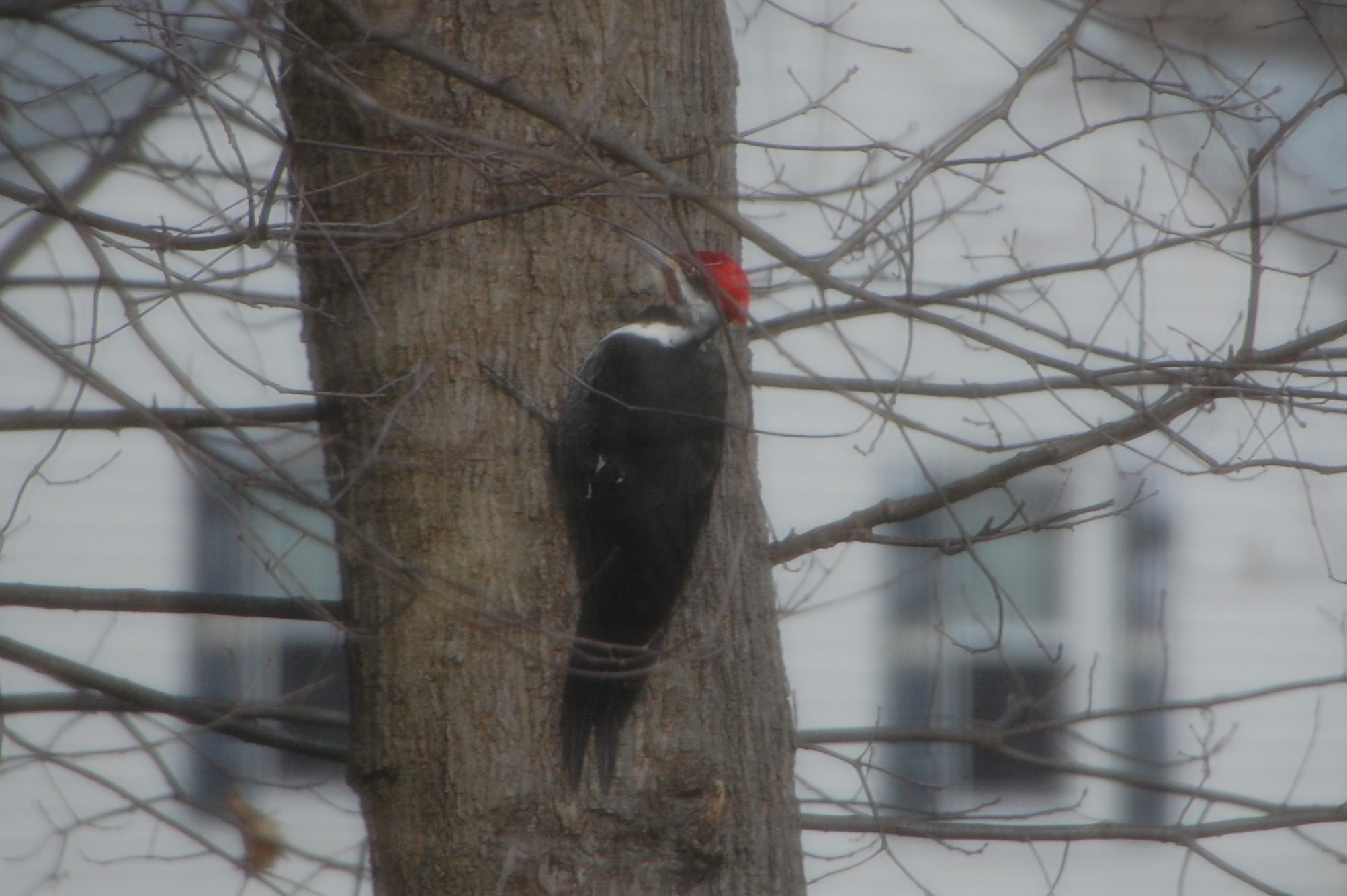
I looked around but there were no workmen at any of the neighboring houses, for once. So I followed the sound and looked at the nearby trees. That is when I saw the pileated woodpecker.

Backyard pileated woodpecker
(Margo D. Beller)

Back in early December I mentioned seeing this type of woodpecker - the largest of the woodpeckers in my part of the world - battering a dead tree in search of carpenter ants, its favorite food. I stood and watched until it flew off. Now, here was another one digging into what I took to be a live tree in the corner of my neighbor's yard, abutting a corner of mine.

My first thought was, uh oh, that tree will be gone in two years or less. If a pileated comes knocking it usually means the tree is infested with the ants and will soon die. The tree looked healthy, but then again so did the ash tree I had to cut down once all the little holes created by emerald ash borers were pointed out to me. This particular tree is not on my property so there is no reason for me to look closely at it. But the pileated obviously saw or smelled something that made it want to stop.

But it wasn't alone.

For as I was looking at the pileated with my binoculars and saw the red "moustache" that told me it was a male, I discovered that above it and picking at a smaller branch was a second, female pileated. Now I started to wonder, could the male be building a nest? I've had plenty of nests within sight of, or on, my property but not a woodpecker nest hole. 

The holes left behind
(Margo D. Beller)

According to Cornell's "All About Birds" information on the pileated: 

The male begins excavating the nest cavity and does most of the work, but the female contributes, particularly as the hole nears completion. The entrance hole is oblong rather than the circular shape of most woodpecker holes. For the finishing touches, the bird climbs all the way into the hole and chips away at it from the inside. Periodically the adult picks up several chips at a time in its bill and tosses them from the cavity entrance. Pileated Woodpeckers don’t line their nests with any material except for leftover wood chips. The nest construction usually takes 3-6 weeks, and nests are rarely reused in later years. Cavity depth can range from 10-24 inches.

So I had to wonder what was going on. Was the male building a nest or just hungry?

I went for my camera. By the time I returned the female had left but the male was still hammering away. I took some photos. Then I had to go back to work.

When I looked out an upstairs window about 90 minutes later, it was still hammering. But by the time I got downstairs and outside it was gone. My husband had been watching the bird but, he said, a squirrel had spooked it off. In fact, the squirrel was on the next branch. That's when I saw there were two holes, the original one and one above it, slightly smaller because the woodpecker didn't get as far into it before it was spooked off. 

The squirrel on the nearby branch
(Margo D. Beller)

So it was only looking for food, not making a nest. I checked the tree for the next few days before finally acknowledging it wasn't going to nest in my yard. The Cornell people confirmed that for me with a chart showing pileateds nest between mid-May and mid-July in most of its range, not mid-February. (Its range is almost like an upside-down U, mainly the eastern continental U.S. going up into southern Canada and down into the Pacific northwest.)

Now I can watch that tree and see how long before it comes down, and which way it will fall - away from my yard, I hope. In the meantime, maybe some of the smaller yard birds can use one or both holes as a winter roost.

Sunday, December 11, 2022

A View From the Bridge

I went for a walk yesterday, enjoying the sunshine and the cold air before today's expected snow. I have had a very bad cold for the past two weeks and this was one of the few times I wanted to walk and make sure my legs still worked. Still, I didn't want to go too far, so I went up my street and around to a brook the officials call the "north branch of the Whippany River," tho' that river is some distance away.

It is calming to look at this brook from this bridge. In early spring there is usually a pair of phoebes flying to and fro with nest materials. Later in the spring they do the same with insects to feed their young. The nest is always built under a structure, in this case the bridge.

Pileated woodpecker (RE Berg-Anderson)

I have seen other birds from this bridge, from the large great blue heron to a tiny winter wren, from a noisy great crested flycatcher to quiet wood ducks. But at this time of year most of these birds are not here.

However, a knocking above me caused me to look up. There was a pileated woodpicker.

No matter how often I see one of these crow-sized birds with their large, red crests I am impressed. This one was whacking into a dead tree, its usual habit as it searches for its favorite meal, carpenter ants. After a minute of this it flew across the road to another dead tree, the white patches on its black wings pleasingly visible. 

It proceeded to whack at this tree a good, long time. I am sure the people driving by me as I stood on the road shoulder were wondering what I was looking at for so long, presuming they even noticed me. Most of the time I feel invisible when I walk outside, rarely running into neighbors, rarely getting so much as a hello when I walk in my town's streets. It is the times, I guess. I prefer the solitude.

So I watched the woodpecker and every so often the sun would show the red "moustache." So this was a male (except for that sign, the male and female are identical). As I watched I wondered if it was excavating a nest. According to my Stokes Field Guide, pileateds put their nest in dead trees, way up high. The opening is about 3 inches across, which seems very small for what looks like a large bird. But the eggs rest as much as two feet into the tree. That means the woodpecker would have to be hammering for an awfully long time.

Male pileated (RE Berg-Andersson)

During the summer, when I had the invasion of carpenter ants, I thought how nice it would've been to have a pileated woodpecker hanging around the bathroom. Of course, that would've been ridiculous. For one thing it's a wild bird, not a pet. For another, it would've spent its time hammering large holes in the walls where the two colonies were nesting. 

As i watched, every so often the bird would pull its head back and it seemed to be having an ant snack. Finally, I turned to go. Then I looked back again. The bird was gone. This has happened to me before when I've watched a hawk in a tree. It seems to freeze and we watch each other as I stand below. Then, the second I turn away it silently flies off.

At some point I'll go back and see if the pileated was excavating a nest or having a three-course dinner. I won't be surprised if my watching spooked it off. But there are plenty of other pileateds and dead wood is hard to find in the suburbs.

Saturday, March 23, 2019

Pill-eated or Pie-liated Woodpecker? Who Cares?

This post is based on one that originally ran on March 9, 2014, on the blog of New Jersey Audubon's Scherman Hoffman sanctuary. The NJA blog was significantly overhauled since then and the archives were deleted. However, I was able to keep a copy so this can again see the light of day.

The other day, reading posts on the New Jersey Birders Facebook page, I saw a discussion over how to pronounce the word "pileated," as in the largest type of woodpecker you can see in New Jersey. This is one of those arcane discussions people will get into, like whether to say CARIB-be-an or Carib-BE-an. (The Gershwins wrote a whole song about such matters.)

Male pileated woodpecker (RE Berg-Andersson)
In the case of this woodpecker, there are those who say pie-liated and those who say pill-eated. I fall on the side of the Pillers, just because I find the word Pill easier. But it doesn't really matter either way because when you see one of these big birds - crow-sized, black and white with large red crest - the first thing out of your mouth tends to be "my God!" or "what IS that?"

This back and forth on how to say its name - the upshot was it can be said either way - got me thinking about a post I wrote for another blog back in 2014. March is when you start to hear a lot of woodpeckers, as well as other birds, calling or singing out, announcing their territories. In the case of the pileated, you will also hear it whacking into trees to pull out its favorite food, carpenter ants.

So here is some of what I wrote back in 2014:

Whether you are walking in a forest or park or sitting in your suburban backyard, there is nothing more distinctive than the sound of a pileated woodpecker whacking a hole in a tree, seeking the carpenter ants within.

Everything about the pileated is BIG. It is about the size of a crow, so when it flies over you in the woods it gets your attention. It has a large crest and a large bill that it uses to make large, rectangular holes in trees. If it is a male, he will have a little red "mustache" the female lacks. Sometimes the sound of one chopping into a tree reminds me of a woodsman with an ax. (Watch Jim O’Malley’s video of a pileated woodpecker here.)

Even its laugh is big. It carries far whether in the forest or the backyard. In fact, most times it is the laugh that alerts me to the bird because it’s otherwise rather shy. I am sure the creator of the old “Woody Woodpecker” cartoon character had the pileated’s crest and laugh in mind.

I was once walking in my town to the morning train to work when I discovered a pileated, at eye level, whacking away at a tree. I was able to walk within five feet, so close I could see it was a female. She ignored me. There must’ve been a lot of ants in that tree. “That’ll be down in a year,” I thought. In fact, it took two.

A tree full of holes is a goner. The very fact the woodpecker is on it shows the tree is infested with carpenter ants, and that weakened tree will die. But those holes also keep others, including smaller birds and even bats, alive because they create temporary shelters. So even a dead tree has its uses.

As for the name, whichever way you pronounce it the word “pileated” means having a crest covering the pileum, which is the top of the head of a bird from the bill to the nape.

The pileated is the largest woodpecker we have in the U.S., unless you believe the ivory-billed woodpecker is still around. Back in 2004 it was believed one was found in an Arkansas swamp decades after it was presumed extinct. The effort to locate this woodpecker was the subject of the 2005 "The Grail Bird: The Rediscovery of the Ivory-billed Woodpecker" and other books. Birders were excited about this. Many wanted to head down and find it. Even David Allen Sibley created an addendum on the ivory-billed you could download and add to his bird guidebook.

Female pileated. I confirmed this with my
binoculars after I took the picture. (Margo D. Beller)
According to “The Grail Bird,” which I read, the kayaker who got a glimpse was asked if he really saw a “Lord God” bird. Wasn’t it more likely to be the more common pileated? He claimed it was not a pileated. If you look at John J. Audubon’s portrait of the ivory-billed and compare it to the photograph above, you can see the difference between the two woodpeckers.

However, Audubon, writing about the pileated in his journal, said its flight is “powerful, and, on occasion, greatly protracted, resembling in all respects that of the Ivory-billed Woodpecker.”

Audubon has three ivory-billeds in his portrait. To get the birds he had to shoot them – with a gun. No digital cameras back then. We don’t know how many ivory-billeds were killed before he got the portrait he wanted but we do know from his journal that Audubon regretted killing any more birds than absolutely necessary.

Unfortunately, others didn’t think the same way and the ivory-billed is likely extinct. Not so the pileated, of which Audubon used four birds in his portrait. In his journal he wrote:

It would be difficult for me to say in what part of our extensive country I have not met with this hardy inhabitant of the forest. Even now, when several species of our birds are becoming rare, destroyed as they are, either to gratify the palate of the epicure, or to adorn the cabinet of the naturalist, the Pileated Woodpecker is every where to be found in the wild woods, although scarce and shy in the peopled districts.

Luckily for us in “the peopled districts” of New Jersey, these woodpeckers are still “every where to be found” today. It is up to all of us who love birds and open spaces to keep it that way.

Sunday, December 30, 2018

Feeding Time

Cardinal hogging the house feeder (Margo D. Beller)
Most mornings lately I have gone outside with the bird feeders around 7am when it is light but the sun hasn't risen high yet. Usually a male cardinal is sitting in the apple tree. When I prop open the screened door it starts to cheep to its mate, who cheeps back. It has figured out that when I open the door I will soon be out with the feeders - the suet on my right arm, the caged feeder in my right hand, the house feeder in my left. I go out and hang the house feeder on the first pole I pass, then walk to the other one and hang a feeder on each hook.

I go inside for the water cooler. By now the cardinal is on the house feeder but it flies off at my approach. I hang the water cooler on the pear tree and then walk back around the corner of the screened porch and close the door. Sometimes I stand outside and listen to the birds. Usually I hear white-breasted nuthatches and titmice nearby so I know they'll soon be at the feeder.

Titmouse at water cooler (Margo D. Beller)
Other times I go on the porch and sit in my corner and watch the feeders.

As usual, the first birds were able to somehow communicate that food was available. But once all those birds start coming, it is interesting to see what gets to feed first and what forces them away from the feeder.

One reason I have two seed feeders out is the more open house feeder will accommodate two larger birds, one on each side. The caged feeder allows smaller birds to come into the protective cage (the cage is to protect the feeder from squirrels but I have seen small birds protected from predators), perch and eat. Chicadees and titmice will come, take a seed and leave. House finches will perch and keep eating until something, or someone, prompts them to leave.

A cardinal will sit at the house feeder and, like the smaller finches, eat until it is sated or spooked off. When a house finch or sparrow attempts to sit next to it, the cardinal will force it away. But if a comparably large bird, say a jay or a redbelly woodpecker, flies at the feeder, the cardinal departs. Jays and woodpeckers will sit a while but not as long as the thicker-billed cardinal or finch. When the big birds leave, the smaller ones can grab a bite.

Hummingbird feeder with many portals (Margo D. Beller)
Within the group, there is a pecking order. A male house finch will come to the house feeder. It might allow its mate to sit next to him but if another male house finch approaches it will fight it off if it is not the alpha bird but it will leave if the approaching bird is the alpha bird. The top bird always gets to eat. The same is true for other birds. One particularly snowy winter we had four pairs of cardinals coming to the feeder. The alpha pair always ate. If another cardinal was in the vicinity, the male would fly at it to force it away. Later, one of the others would come eat only to have the alpha male chase it off.

The only other thing I've ever seen that forces a cardinal off the feeder is if it is besieged by a lot of smaller birds that will harass it until it leaves

I don't know if this fighting would be avoided if I had many more feeders of different types out. Unfortunately, I don't have many feeders and all but one are not designed to accommodate a large bird like a cardinal.

Hummingbirds have a pecking order, too. When I had two females coming to the feeder in 2016 the more dominant one would always chase off the other. When a male showed up the alpha female would battle it, too, sometimes winning but sometimes flying off. Mind you, the sugar water feeder has several portals so they all could've fed at the same time and even brought over friends. But that's now how the bird brain operates.

Redbelly dominating the house feeder (Margo D. Beller)
The suet feeder draws woodpeckers. If the small downy is on the feeder and sees the larger hairy or redbelliy woodpecker approaching, it leaves fast. If a female downy is on the feeder and a male downy approaches, she's out of there, even if it's her mate. If two male downys are interested in the feeder, the alpha will chase the beta off, feed and then fly off, allowing the beta to eat - presuming the alpha male doesn't chase it off just because it can.

How is it determined which male or pair is the alpha and which isn't? That's another mystery better left to others to figure out.

Monday, March 5, 2018

Watching the Woodpeckers


Downys will eat suet, seed or even sip from a hummingbird
feeder (both pictures Margo D. Beller)
Early the other morning I sat on the porch with my coffee, trying to wake up and hoping birds would be coming to my feeders, which I had just refilled. There was nothing for the longest time and then a male downy woodpecker suddenly appeared on the dogwood tree branch beyond the feeder pole where I keep the suet feeder and a long feeder full of sunflower seeds. Either food would appeal to it, but the bird just sat there.

Maybe was waiting for the breeze to die down so it could fly safely over without being blown off course. Maybe it saw a predator flying overhead. Maybe it saw the slight movement from me on my enclosed porch when I raised my coffee cup for a sip. Downys, the smallest of American woodpeckers, can be rather skittish.

Male red-bellied woodpecker (Margo D. Beller)
I enjoy sitting on my porch in the morning when the sun is here, especially in the aftermath of the recent powerful nor'easter that produced gale-force winds that prompted me to take all the feeders inside to protect them. I figured no intelligent bird would risk being blown into the side of the house, no matter how hungry it was.

It is too easy to ascribe human emotions to birds. So as I watched Mr. Downy - I could see the red spot on the back of its head, which the female does not have - I tried to understand the way his bird brain operates.

After sitting in the tree a long time, he flew to the suet feeder, took a few tentative pecks, then flew back to the tree. This suet feeder is made in a particular way to keep pests such as grackles and starlings off the block of fat - the bird must hang under the feeder. Woodpeckers do not mind that. This suet feeder has drawn downys, the larger but similar looking hairy woodpeckers and the larger-still red-bellied woodpeckers of both sexes to it.

I've seen eight types of woodpeckers, all but one of them in New Jersey. There are many more found in the American west, the desert southwest and in the higher elevations of New England. In my area, besides the three I have mentioned, the more common ones are the flicker, the pileated and the yellow-bellied sapsucker. In fact, one day in 2011 I saw all six.
Pileated woodpecker (Margo D. Beller)

There is also the redheaded woodpecker, of the same family as the red-bellied woodpecker and, like that bird, originally from the south but slowly finding suitable breeding grounds in New Jersey despite our tendency to cut down dead trees, which is where the redheaded builds its nests and feeds on bugs. It is too easy to call a red-bellied woodpecker a redheaded woodpecker because when you look at it you see the red on its head but not the bit of pink on its belly. However, when you see a redheaded woodpecker you can see why it got the name.

The pileated (pronounced PIE-leated, although I tend to say PILL-eated) woodpecker is a crowsized bird athat got its name thanks to its striking red crest (which is what pileated means, having a crest). It has black feathers and white down the face and neck. When one flies over me in the woods I never fail to be stunned by its size and beauty. When you see one whacking at a tree you can be sure that tree is filled with carpenter ants, its preferred food, and that means the tree will likely be dead within two years. (I base this on seeing a female pileated whacking at a yard tree for several mornings running on my way to the train; the tree fell over and had to be removed within two years.)

The other woodpecker I have seen was in North Carolina, a bird that makes its nest in living, mature, long-leaf pine trees, which is why its existence is more precarious than even the redheaded woodpecker. In fact, we went to the Croatan National Forest specifically to find this bird, where it is protected.

Red-cocaded woodpecker (Margo D. Beller)
Between MH and me, I think we've photographed all the woodpeckers mentioned except for the brownish flicker, which forages for ants with its long bill and longer tongue on the ground and is easily spooked, and the yellow-bellied sapsucker, which gets its name because it drills holes in trees and drinks the sap or eats insects attracted by the sap. My apple tree is girdled with little holes from a sapsucker. One year I spent several days shooing a sapsucker from the tree before all the holes could kill it.

Meanwhile, back at the dogwood, the downy continued to sit. I finished my coffee and went back inside the house. After hanging my winter coat I went to the kitchen window. As expected, there he was, on the suet feeder, eating heartily until he flew off to a different, taller tree, out of my sight. But he'll be back.

Six Woodpeckers (from Dec. 4, 2011)

(This is another in a sporadic attempt to republish old blog posts where I foolishly eliminated the link to the actual post. I did this a lot when I started this blog until I figured out you are supposed to leave the link in the headline to read the indivudl post. Live and Learn.)


You’ll have to forgive my being a little cocky today but in all my years of birding I’ve never had a day like Saturday.

A six-woodpecker day.


I have been known to find six warblers in a day, which is a big deal to me. I have also seen six types of sparrows in one day. But there are many more than six of these seen in this state at any given time.

The six woodpeckers commonly found in my area of New Jersey aren’t all that easy to find, particularly on the same day.

(A seventh - the redheaded woodpecker - is a southern bird that needs specific habitat to survive, in this case stands of dead trees. With the suburban penchant for cutting down any inconvenient tree dead or alive, you have to seek it in a Known Redheaded Woodpecker Location such as the Great Swamp. I usually seem them in winter.)

I was lucky enough to be in the right places at the right times, and it is this combination of luck and surprise with just enough knowledge to make identification possible that makes birding such a joy.

Three of the woodpeckers were gimmes. In the afternoon my feeders brought the six-inch downy, which was chased off by the nine-inch hairy, which was chased off by the comparably sized redbellied woodpecker, like the one here. For more on these go to http://www.allaboutbirds.org
Usually these three are all I see. But not yesterday.

I went walking early into the nearby Central Park of Morris County, once known as the Greystone property. (There is still a Greystone property but it is on the western edge and owned by the state. Where I was is now owned by the county.)

Besides the expected birds I heard the distinctive call of a flicker, a cackling “ahhhrrr.” Flickers are usually seen on the ground and are mostly brown to blend in. I couldn’t find it.

So that’s four woodpeckers.

As I headed home from this walk I stopped when I heard what sounded like the breathy “Wha-wha-wha” of the pileated woodpecker, the largest of the six. It is about the size of a crow and has a most distinctive red crest and black and white body.

These are great to see up close, like the female I saw on a neighbor’s tree, whacking away at it to scoop up the carpenter ants within.

No surprise, that tree rotted and fell over in a storm less than two years later.

If you are old enough to remember the Woody Woodpecker cartoon, his laugh and look were based on the pileated.

Anyway, I stopped and listened. It called, then it called again. I have found pileateds in Greystone before, one mere feet away. So I knew what it was.

That’s five woodpeckers.

Here is where luck morphed into transcendence.

Every winter my husband and I go through the marriage-testing experience of clearing the lower house gutters of fallen leaves. (We don’t do the higher gutters because we want to live to a comfortable old age, and any spillover comes into the lower gutters anyway.)

There I was, not long after the morning walk, holding the large, metal ladder on which MH, bad knees and all, was trying to pull out wet leaves.

Behind me I heard a whinny. Could it be? I heard it again. Yes it was! A yellow-bellied sapsucker!

“Pay attention to the ladder,” MH yelled, somehow sensing I wasn‘t giving 100 percent.

“But it’s a sapsucker!” I responded. “That’s my sixth woodpecker of the day.”

For some reason, perhaps being 15 feet above the ground, he wasn‘t as impressed. “No reckless birding! Concentrate,” he retorted.

At which point the calling bird flew from its tree next door and across the road, out of sight, allowing me to turn back and focus on not becoming a widow.

The sapsucker is a very different type of woodpecker. It has red on the top of its head, like some of the others, but distinctively on its “chin,” too. It drills small, shallow holes in trees, not to pull out insects but to draw the sap on which it feeds. This sap also draws a lot insects, which feeds all the birds. (The sap also feeds hummingbirds when they first arrive during spring migration.)

In spring these shy birds announce their territory as loudly as any other woodpecker, an activity known as drumming.

It’s a simple process: hammer on a branch (or a wood-shingled house) with your sturdy bill to loudy announce “I am here and if you are another woodpecker stay away.”

Find the right sounding board and your message will go far.

And that was the sixth. Does it make me a better birder? No, but it reminds me why I enjoy birding.

Sunday, December 4, 2011

Six Woodpeckers

You’ll have to forgive my being a little cocky today but in all my years of birding I’ve never had a day like Saturday.

A six-woodpecker day.


I have been known to find six warblers in a day, which is a big deal to me. I have also seen six types of sparrows in one day. But there are many more than six of these seen in this state at any given time.

The six woodpeckers commonly found in my area of New Jersey aren’t all that easy to find, particularly on the same day.

(A seventh - the redheaded woodpecker - is a southern bird that needs specific habitat to survive, in this case stands of dead trees. With the suburban penchant for cutting down any inconvenient tree dead or alive, you have to seek it in a Known Redheaded Woodpecker Location such as the Great Swamp. I usually seem them in winter.)

I was lucky enough to be in the right places at the right times, and it is this combination of luck and surprise with just enough knowledge to make identification possible that makes birding such a joy.

Three of the woodpeckers were gimmes. In the afternoon my feeders brought the six-inch downy, which was chased off by the nine-inch hairy, which was chased off by the comparably sized redbellied woodpecker, like the one here. For more on these go to http://www.allaboutbirds.org
Usually these three are all I see. But not yesterday.

I went walking early into the nearby Central Park of Morris County, once known as the Greystone property. (There is still a Greystone property but it is on the western edge and owned by the state. Where I was is now owned by the county.)

Besides the expected birds I heard the distinctive call of a flicker, a cackling “ahhhrrr.” Flickers are usually seen on the ground and are mostly brown to blend in. I couldn’t find it.

So that’s four woodpeckers.

As I headed home from this walk I stopped when I heard what sounded like the breathy “Wha-wha-wha” of the pileated woodpecker, the largest of the six. It is about the size of a crow and has a most distinctive red crest and black and white body.

These are great to see up close, like the female I saw on a neighbor’s tree, whacking away at it to scoop up the carpenter ants within.

No surprise, that tree rotted and fell over in a storm less than two years later.

If you are old enough to remember the Woody Woodpecker cartoon, his laugh and look were based on the pileated.

Anyway, I stopped and listened. It called, then it called again. I have found pileateds in Greystone before, one mere feet away. So I knew what it was.

That’s five woodpeckers.

Here is where luck morphed into transcendence.

Every winter my husband and I go through the marriage-testing experience of clearing the lower house gutters of fallen leaves. (We don’t do the higher gutters because we want to live to a comfortable old age, and any spillover comes into the lower gutters anyway.)

There I was, not long after the morning walk, holding the large, metal ladder on which MH, bad knees and all, was trying to pull out wet leaves.

Behind me I heard a whinny. Could it be? I heard it again. Yes it was! A yellow-bellied sapsucker!

“Pay attention to the ladder,” MH yelled, somehow sensing I wasn‘t giving 100 percent.

“But it’s a sapsucker!” I responded. “That’s my sixth woodpecker of the day.”

For some reason, perhaps being 15 feet above the ground, he wasn‘t as impressed. “No reckless birding! Concentrate,” he retorted.

At which point the calling bird flew from its tree next door and across the road, out of sight, allowing me to turn back and focus on not becoming a widow.

The sapsucker is a very different type of woodpecker. It has red on the top of its head, like some of the others, but distinctively on its “chin,” too. It drills small, shallow holes in trees, not to pull out insects but to draw the sap on which it feeds. This sap also draws a lot insects, which feeds all the birds. (The sap also feeds hummingbirds when they first arrive during spring migration.)

In spring these shy birds announce their territory as loudly as any other woodpecker, an activity known as drumming.

It’s a simple process: hammer on a branch (or a wood-shingled house) with your sturdy bill to loudy announce “I am here and if you are another woodpecker stay away.”

Find the right sounding board and your message will go far.

And that was the sixth. Does it make me a better birder? No, but it reminds me why I enjoy birding.