This is a story about an act of stupidity, an act of kindness and some harlequin ducks. To protect the identity of the stupid, we'll call the protagonist ME.
After a winter waiting for the snow that never arrived ME decided she had to go to Barnegat Light, the northernmost point of Long Beach Island, down the Jersey shore.
It is a long ride down from where ME lives, but the back roads she and her husband take goes through the Pinelands, and the bracing air and bright light off the ocean makes it an enjoyable trip.
 |
Harlequin ducks. Even the plainer
females are striking. |
ME and her husband had never been to Barnegat in March, usually breaking up winter's monotony in January or February. The aim is to see what winter ducks and shorebirds will be on the sides of the jetty or in the inlet between Long Beach Island and Island Beach state park. This trip was also the first where the tide was low, so low the barnacles on the rocks were exposed and thousands of gulls were attacking them or each other, in the water and in the air.
Beyond the paved promenade was the jetty of huge, flattened rocks and several people were already walking on it toward the end where, in the past, eiders have hung out along with mergansers, longtailed ducks, purple sandpipers, ruddy turnstones and the ducks that make Barnegat famous, the harlequin.
The harlequin is, to me, the most beautiful duck around, particularly the male. But even the duller female is striking. (The only ducks that come close, in my view, are the male and female wood duck.) They are the reason why ME and her husband came.
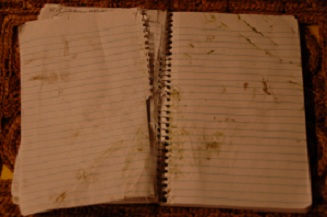
So ME started to climb through the fence blocking the paved walkway from the jetty and her notebook fell out of her pocket, between two rocks.
What made this so incredibly stupid was ME's pockets could be snapped shut but she hadn't done it.
ME was very lucky. First, it was low tide - at high tide the notebook would've been soaked and useless. There was two years worth of data on its pages, which would mean little to anyone other than ME.
 |
The jetty from the beach side. The ducks would be
on the other side. |
Second, she was unable to think anything other than "I WILL get that notebook." Failure was not an option.
And so I - er, ME - shimmied down between the two rocks and managed to get the notebook between her feet. The problem was being able to pull up the legs enough to get the notebook. This was not easy.
Meanwhile, ME had drawn a crowd. Her husband was horrified. He was afraid ME would get stuck.
He was justified in that fear. Several years ago a man wrote a post on the NJ bird list detailing how he had been on the jetty rocks, heading toward the end, when he slipped and fell headfirst between the rocks, unable to get to his phone and call for help. It had been a particularly bad weather day and it took a long time for someone to happen along who could call for assistance.
So there was ME, remembering that story, trying to pull up that notebook.
Here's where the kindness comes in: A man asked if "a skinny guy like me" could help ME. ME hauled herself out from between the rocks - again, not easy - and he was able to get low enough to reach forward and pluck the notebook from the deep!
 |
| Oystercatcher |
ME thanked him profusely, thanked his wife, thanked perfect strangers for their support.
Her husband handed ME her binoculars and camera - which she had smartly, for once, removed - and asked what they should do now. ME decided she'd had enough of the rocks, let's walk on the beach to the end and then try to get back up and find the harlequins.
ME secretly despaired of finding the pretty ducks with all the gulls attacking the side of the jetty. With each step on the sand her legs hurt, there was a stitch in her side, and the boots, camera and binoculars started to feel like 100 pounds each.
ME was thinking, the hell with it, let's go home.
There are many good things about birding including being outside, stimulating the mind to figure out what you're hearing or seeing and, if lucky, joining with others in mutual exploration.
But there are bad things about birding. One is that you quickly realize when you are out of shape, out of breath and aging rapidly. There is also a great feeling of inadequacy some of us feel when we are in the field and have no idea what we're seeing, or have seen nothing only to see from the bird lists that others have found 15 things, including something you've always wanted to see, at the same place that day.
 |
| Seal, pulled out with the tide. |
Land birds are more my thing, warblers and tanagers and hawks and nightjars. At the shore I can't tell a second-year herring gull from a first-year greater black-back gull. A semipalmated sandpiper and a least sandpiper would have to be standing still next to each other for me to tell them apart. I like ruddy turnstones, however, because their orange legs and breast coloring make them stand out, and I do like the ducks that come to Barnegat in winter and the two types of loons - common and redthroated - that visit as well.
So ME was walking with her husband down the beach, the enormity of what could've gone very wrong going after her notebook just hitting her, making her swear that was it, she was NEVER going birding again, when another woman with binoculars walked past them in the other direction. "See much?" ME asked. "Some harlequins, some turnstones," she said.
After thanking her ME caught up with her husband, who had kept going. "They're here, despite the gulls," ME said. So they carefully went back up on the rocks and almost immediately ME found an oystercatcher, its orange bill making it stand out amid the gulls. In the water were the loons, the longtailed ducks, some common mergansers and, on rocks that had no barnacles and so no gulls bothering them, the harlequins.
 |
| Soiled, but saved. |
And something else. Something big and gray came up on the water and ME looked through her binoculars and shouted "Seal!" while somehow getting the camera up and shooting two pictures before the seal went under.
"Good eye, lady," a man on the beach yelled at ME.
Well, yes. Thank you. It is sometimes better to be lucky than good.
And this day proved there was nobody luckier than ME.