Cape May

Cape May
(RE BERG-ANDERSSON)
Showing posts with label telephoto lens. Show all posts

Wednesday, March 7, 2018

Through a Lens, Darkly

Common merganser male in flight (RE Berg-Andersson)
One of my good friends is a noted writer and photographer. He has gotten better as he has taken more pictures and improved his equipment. (I bought one of his digital cameras that I later gave to MH when I bought a more professional model with a telephoto lens.) Recently, he sent along an article from a photography website detailing techniques for photographing birds in flight.

It was an interesting article, if you want to learn about "continuous focus mode" and "drive mode" or f-stops and things like that. I do not have that kind of bent. I am of the "point and shoot and hope I'm in focus" school of bird photography.

Northern harrier (Margo D. Beller)
When I was a callow student back in journalism school I took a photography course and one of my assignments was to take a picture of something in motion. So I had one of my roommates ride by me on her bicycle over and over as I trained my camera on her and took her picture in such a way to show her clearly while the background was in blurred motion. I also tried pointing my camera at a particular spot and when my roommate rode by snapped the picture, usually with mixed results.

Although I never became a professional photographer, some of what I learned has stayed with me. With digital photography you can take literally hundreds of shots a second and sometimes catch what I want. This has been a boon to MH, too, who graduated from my friend's digital camera to a later model that had a faster shutter speed.

So if I am walking along a beach and suddenly a flock of purple sandpipers rears up, I point, hope the automatic shutter focuses on one of the birds and then keep shooting away for at least one good picture. If a black vulture flies over my head and soars in the wind, it is usually easy to get that picture - provided the lens doesn't go into infinity and then I can see nothing.

Purple sandpipers (Margo D. Beller)
Photographing birds is, for me, one of the hardest things I do. In fact, most times I just take the binoculars, find the bird, point it out to MH and then hope he can take a good picture. If we are visiting a place we're not likely to see again for a long time, I will take my camera. The long lens has helped me take pictures of everything from roosting long-earred owls to a pine warbler to a group of cedar waxwings chattering high in a treetop.

When the birds sit, even if they fidget, there is a good chance I can get that picture. If they suddenly take off, I can get a great shot or I can get a blur or I can get a picture with no bird at all. If there is a harrier flying close to the ground looking for a meal, I focus on it and follow along and squeeze the shutter again and again.
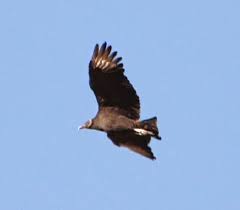
Black vulture (RE Berg-Andersson)
In the time before Roger Tory Peterson illustrated his field guides with pictures that plainly show a bird's identifying field marks, anyone who wanted to study or paint birds had to shoot them with a gun. J.J. Audubon writes of having to shoot several birds of one species in order to pin them in realistic poses and draw them before the bodies started decaying. He would often decry the waste when his crew would shoot hundreds of birds just for the sport.

It is for that reason why birds such as the passenger pigeon became extinct. It is why a rich woman had to buy what is now the Hawk Mountain sanctuary to stop local farmers and others from climbing to the top and shooting raptors out of the sky as they used the warm winds of autumn off the mountain ridges to migrate south.

Now you can identify a bird using your binoculars or telephoto lens, and everyone has a camera if they have a cellphone. You will see people out on the trails "shooting" everything including birds, flowers, themselves. The professional bird photographers are still out there with their big lenses and tripods wrapped in cammo as they patiently wait for just the right "shot."

There's money to be made from the right photograph: Calendars. Illustrating articles on how to take pictures of birds.
Pine warbler (Margo D. Beller)
I don't make money on my photos. They are strictly for me and this blog. I enjoy having a record of birds I have seen. I enjoy the challenge of even finding the bird and then trying to take its picture, if I care for one. It can be fun and it can be frustrating.

But no matter how good my pictures are, I know they will never be as good as the ones in my mind's camera lens.

Tuesday, March 6, 2018

Don't Take Your Guns to the Swamp (from April 16, 2011)

(This is another old column that got obliterated and I am now republishing. I've since learned how to put in more pictures as well as links.)

It has only been in the last couple of years that I have begun bringing a camera with me when I go birding. Until then I was content to have only my 10x50 Nikon binoculars and use the camera in my brain to record notable images.

With digital cameras suddenly everyone became a nature photographer. That's fine if you are trying to prove you saw something unusual such as this pinkfooted goose my husband, MH, photographed early in March in a private park in Washington Township (Bergen County), NJ.
But a lot of photographers are doing it for profit, either by selling those photographs as stock images to be used in calendars and the like or to put on their personal photography pages and garner the ensuing glowing comments.

If you want to do that, fine. But what I CAN NOT STAND is when someone takes his or her gun-like lens and aims it practically in the face of a bird, creating unnecessary stress and ruining it for other birders when the bird takes off.

There have been many instances of this selfish and cruel behavior on the part of people who want a picture that badly. For instance, a few years ago the birding lists were full of angry birders screaming about a rare boreal owl in Central Park that had been there for a few weeks but finally left after a man set up a camera and used a bright flash (by day, yet) to take a picture practically in the face of the roosting owl.

I have witnessed several such instances, two of them at the Great Swamp in New Jersey.
An aside: Fifty years ago, the plan was to make this 7,500-acre gem straddling Morris and Somerset counties into an airport. Environmentalist Helen Fenske created a grassroots movement to stop that plan. Every time a plane flies over the swamp I shudder. The new visitor center is named for Helen Fenske.

Another birder and I were at the Heronry Overlook parking lot watching a mature bald eagle sitting in a tree close by. Suddenly, we saw a man with a rifle-like camera lens walking in an off-limits area closer and closer to the tree, snapping away, until the eagle flew off.

We started yelling at him and he was completely amazed and confused at our reaction. What was the big deal? He only wanted a picture of an eagle. (The eagle eventually returned after the idiot left, but to a tree much farther away and only identifiable thanks to its white head.)

The second example involved a couple of long-earred owls that decided one winter to roost in a cedar tree very close to Pleasant Plains Road, practically at eye level, not far from the Fenske office.
The swamp is not far from my home so my husband and I drove over and found the owls easily thanks to a couple of birders there. Most birders know to give owls some space during the day since they are resting for the night's hunting. Not the guy there with another gun-like lens, standing real close to the alarmed owls as he took his pictures.

This begs the question, why stand that close if you are using a telephoto lens?

I asked him that question, and told him to get the hell back across the road. MH and the man's wife were afraid we were going to get into a fight, and it was very close. But he moved back. MH and I took our own pictures from across the road. I thought I had gotten through to Mr. Photographer until I looked in the rear-view mirror as we drove off and there he was, up in the owls' faces again. I wasn't surprised to learn not long after that at least one of the two had flown off. I can only hope the second owl, when it left, hadn't been scared off by other inconsiderate birders lusting for that special photograph.

There hasn't been an extended stay by a long-earred owl along that part of Great Swamp since, as far as I know. Owls have long memories, too.

Saturday, April 16, 2011

Don't take your guns to the swamp

It has only been in the last couple of years that I have begun bringing a camera with me when I go birding. Until then I was content to have only my 10x50 Nikon binoculars and use the camera in my brain to record notable images.

With digital cameras suddenly everyone became a nature photographer. That's fine if you are trying to prove you saw something unusual such as this pinkfooted goose my husband, MH, photographed early in March in a private park in Washington Township (Bergen County), NJ.

But a lot of photographers are doing it for profit, either by selling those photographs as stock images to be used in calendars and the like or to put on their personal photography pages and garner the ensuing glowing comments.

If you want to do that, fine. But what I CAN NOT STAND is when someone takes his or her gun-like lens and aims it practically in the face of a bird, creating unnecessary stress and ruining it for other birders when the bird takes off.

There have been many instances of this selfish and cruel behavior on the part of people who want a picture that badly. For instance, a few years ago the birding lists were full of angry birders screaming about a rare boreal owl in Central Park that had been there for a few weeks but finally left after a man set up a camera and used a bright flash (by day, yet) to take a picture practically in the face of the roosting owl.

I have witnessed several such instances, two of them at the Great Swamp in New Jersey.

An aside: Fifty years ago, the plan was to make this 7,500-acre gem straddling Morris and Somerset counties into an airport. Environmentalist Helen Fenske created a grassroots movement to stop that plan. Every time a plane flies over the swamp I shudder. The new visitor center is named for Helen Fenske.

Another birder and I were at the Heronry Overlook parking lot watching a mature bald eagle sitting in a tree close by. Suddenly, we saw a man with a rifle-like camera lens walking in an off-limits area closer and closer to the tree, snapping away, until the eagle flew off.

We started yelling at him and he was completely amazed and confused at our reaction. What was the big deal? He only wanted a picture of an eagle. (The eagle eventually returned after the idiot left, but to a tree much farther away and only identifiable thanks to its white head.)

The second example involved a couple of long-earred owls that decided one winter to roost in a cedar tree very close to Pleasant Plains Road, practically at eye level, not far from the Fenske office.

The swamp is not far from my home so my husband and I drove over and found the owls easily thanks to a couple of birders there. Most birders know to give owls some space during the day since they are resting for the night's hunting. Not the guy there with another gun-like lens, standing real close to the alarmed owls as he took his pictures.

This begs the question, why stand that close if you are using a telephoto lens?

I asked him that question, and told him to get the hell back across the road. MH and the man's wife were afraid we were going to get into a fight, and it was very close. But he moved back. MH and I took our own pictures from across the road. I thought I had gotten through to Mr. Photographer until I looked in the rear-view mirror as we drove off and there he was, up in the owls' faces again. I wasn't surprised to learn not long after that at least one of the two had flown off. I can only hope the second owl, when it left, hadn't been scared off by other inconsiderate birders lusting for that special photograph.

There hasn't been an extended stay by a long-earred owl along that part of Great Swamp since, as far as I know. Owls have long memories, too.

What's the worst birding transgression you've ever seen? Tell me at bellerbirder@gmail.com