|
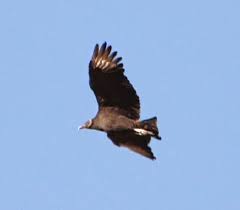
| Common merganser male in flight (RE Berg-Andersson) |
One of my good friends is a
noted writer and photographer. He has gotten better as he has taken more pictures and improved his equipment. (I bought one of his digital cameras that I later gave to MH when I bought a more professional model with a telephoto lens.) Recently, he sent along an article from a
photography website detailing techniques for photographing birds in flight.
It was an interesting article, if you want to learn about "continuous focus mode" and "drive mode" or f-stops and things like that. I do not have that kind of bent. I am of the "point and shoot and hope I'm in focus" school of bird photography.
 |
| Northern harrier (Margo D. Beller) |
When I was a callow student back in journalism school I took a photography course and one of my assignments was to take a picture of something in motion. So I had one of my roommates ride by me on her bicycle over and over as I trained my camera on her and took her picture in such a way to show her clearly while the background was in blurred motion. I also tried pointing my camera at a particular spot and when my roommate rode by snapped the picture, usually with mixed results.
Although I never became a professional photographer, some of what I learned has stayed with me. With digital photography you can take literally hundreds of shots a second and sometimes catch what I want. This has been a boon to MH, too, who graduated from my friend's digital camera to a later model that had a faster shutter speed.
So if I am walking along a beach and suddenly
a flock of purple sandpipers rears up, I point, hope the automatic shutter focuses on one of the birds and then keep shooting away for at least one good picture. If a black vulture flies over my head and soars in the wind, it is usually easy to get that picture - provided the lens doesn't go into infinity and then I can see nothing.
 |
| Purple sandpipers (Margo D. Beller) |
Photographing birds is, for me, one of the hardest things I do. In fact, most times I just take the binoculars, find the bird, point it out to MH and then hope he can take a good picture. If we are visiting a place we're not likely to see again for a long time, I will take my camera. The long lens has helped me take pictures of everything from roosting
long-earred owls to a
pine warbler to a group of cedar waxwings chattering high in a treetop.
When the birds sit, even if they fidget, there is a good chance I can get that picture. If they suddenly take off, I can get a great shot or I can get a blur or I can get a picture with no bird at all. If there is a harrier flying close to the ground looking for a meal, I focus on it and follow along and squeeze the shutter again and again.
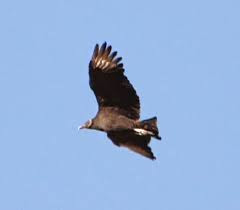 |
| Black vulture (RE Berg-Andersson) |
In the time before
Roger Tory Peterson illustrated his field guides with pictures that plainly show a bird's identifying field marks, anyone who wanted to study or paint birds had to shoot them with a gun.
J.J. Audubon writes of having to shoot several birds of one species in order to pin them in realistic poses and draw them before the bodies started decaying. He would often decry the waste when his crew would shoot hundreds of birds just for the sport.
It is for that reason why birds such as the
passenger pigeon became extinct. It is why a rich woman had to buy what is now the
Hawk Mountain sanctuary to stop local farmers and others from climbing to the top and shooting raptors out of the sky as they used the warm winds of autumn off the mountain ridges to migrate south.
Now you can identify a bird using your binoculars or telephoto lens, and everyone has a camera if they have a cellphone. You will see people out on the trails "shooting" everything including birds, flowers, themselves. The professional bird photographers are still out there with their big lenses and tripods wrapped in cammo as they patiently wait for just the right "shot."
There's money to be made from the right photograph: Calendars. Illustrating articles on how to take pictures of birds.
 |
| Pine warbler (Margo D. Beller) |
I don't make money on my photos. They are strictly for me and this blog. I enjoy having a record of birds I have seen. I enjoy the challenge of even finding the bird and then trying to take its picture, if I care for one. It can be fun and it can be frustrating.
But no matter how good my pictures are, I know they will never be as good as the ones in my mind's camera lens.