Cape May

Cape May
(RE BERG-ANDERSSON)
Showing posts with label owls. Show all posts

Saturday, April 20, 2019

Prowling for Owls

This post is based on one that originally ran on March 22, 2017, on the blog of New Jersey Audubon's Scherman Hoffman sanctuary. The NJA blog was significantly overhauled since then and the archives were deleted. However, I was able to keep a copy so this can again see the light of day.

In mid-March 2017, MH and I went on an "owl prowl" that took place at a Somerset County park. I have always been fascinated by owls because they are nocturnal and thus difficult to see or hear if you are a person who, like me, is more of sunshine lover.

But I have had my contact with owls. During the time I would have to rise long before sunrise to work an early shift I would hear great-horned owls, screech owls and the occasional barn and barred. Driving on a causeway in a marsh at dusk a short-earred owl flew over the car. A long-earred owl was reported at Central Park and I traveled a long way to find it, once a sympathetic birder told me which tree and another, sitting on a bench, pointed it out. 

Great Horned Owl (Photo by Joe Pescatore)
And then there was the snowy owl that came down to a NY pier one winter and just sat there, occasionally flying down to grab a ruddy duck (or so I was told; I didn't see it happen although we did travel to see the owl. We've seen other snowys during winter irruptions since then).

So I've seen almost all ones expected in NJ except for the smallest one, the saw-whet. But soon, I hope.

Here is some of what I wrote about the owl prowl:

Why are we so fascinated by owls?

Is it because some of them are very small and, with their round heads and big yellow eyes, look cute and cuddly?

Is it because we remember the Disney cartoon "The Sword in the Stone" where Merlin turns himself into a "wise, old owl" -- a Great Horned Owl -- to instruct the young, soon to be king Arthur?

Or perhaps we think of Hedwig, the Snowy Owl Harry Potter receives when he arrives at Hogwarts.

Or, maybe we are fascinated that these are birds of the darkness, which attracts and frightens us. After all, our human eyes lack the many additional rods owls have to see in the darkness and the asymmetrical hearing they use to hunt (depending on the species) mice, insects, rabbits, even other owls. (Great horned owls hunt skunks because the owls have no sense of smell.) There are many superstitions about owls, according to "Owls: A Wildlife Handbook" by Kim Long. For instance, the hooting of an owl is seen as a sign of impending death in some cultures.

Screech owl. As usual, someone had to point the bird out to us because
we'd never have found this ourselves. (RE Berg-Andersson)
There are 286 different types of owls around the world, from Iceland to the Falklands and across northern Europe and Russia down to Africa, but in the 950 acres that comprise the Somerset County (N.J.) Park Commission's Lord Sterling Park, which is adjacent to the federally run and much larger Great Swamp National Wildlife Refuge, the most commonly seen owls are great horned (GHO), barred and eastern screech owls.

And that was why 30 or so owl enthusiasts were standing in the dark, shivering on a subfreezing night, under a nearly full moon, listening to park naturalist Ben Barkley or Mike Anderson, director of the New Jersey Audubon Scherman Hoffman sanctuary (also located in Somerset County), try to fool a screech owl into calling to us by imitating it. We were a split squad and I was part of the 15 or so in Barkley's contingent.

"Why are we fascinated by owls? The darkness, and the cuteness factor," Anderson said before we headed out. An owl is cute, "unless you mess with it."

As he prepares us inside for the Owl Prowl outside, Barkley's enthusiasm is infectious. When he was a high school junior, in 2010, he and Mike Anderson identified raptors during the Scherman Hoffman hawk watch on the platform of its education center. Less than a year on this job now, he can watch and listen for birds as he walks to work. "I am very lucky," he told me. (Yes.)

Before leading us into the dark he tested our owl knowledge. Who knew the 25-inch GHO is only 6 pounds? He showed amazing video of a Serbian long-earred owl (LEO) roost where at dusk 140 birds flew out of one tree. He amused many in the crowd by showing how "cute" some owls -- such as the 11-inch burrowing owl and the 6-inch elf owl -- can be.

Don't be fooled, however. Just like the turkey vulture and the redtailed hawk that hunt by day, owls are raptors. They have sharp claws for killing and sharp bills. They will eat prey whole and then regurgitate the inedible parts in a hard pellet. Some owls hunt by day -- snowy, northern hawk and great grey owls are birds of the northern tundra where they can hunt in many hours of daylight in summer. In winter, if food supplies are scarce, they will frequently fly south in what is known as an irruption. Many "night owls" hunt at dawn and at dusk, such as the barn and short-earred owls.

But they are, in the main, creatures of the darkness, emitting eerie sounds ranging from the "Hoo-Hoo-Hoo" of the GHO to the weird barks and "Who cooks for you? Who cooks for you all?" call of the barred to the hissing of the ghostly white barn to the whinnying and one-note tremolo of the 8-inch-long eastern screech.
Snowy owl we almost missed at Island Beach State Park
during a winter 'irruption.' (RE Berg-Andersson)
It was the screech Ben was trying to fool into calling, a process known as "pishing." But no owl was responding. Either it could see we were a group of humans (very possible with all those rods in its eyes) or the cold wind kept it at bay.

The West Observation Blind loomed over us. A pair of canada geese voiced their displeasure at our presence from nearby Branta Pond. Trails I've walked many times now looked ominous. Owls are very good at hiding themselves when they roost by day. They are even better hiding in plain sight at night.


As it turned out, the only owl MH and I saw that night was at dusk when a GHO (or perhaps a barred) hunting, likely to feed its owlets, flew over the road ahead of us when we were almost at Lord Sterling. But for me it was enough.

Wednesday, March 7, 2018

Through a Lens, Darkly

Common merganser male in flight (RE Berg-Andersson)
One of my good friends is a noted writer and photographer. He has gotten better as he has taken more pictures and improved his equipment. (I bought one of his digital cameras that I later gave to MH when I bought a more professional model with a telephoto lens.) Recently, he sent along an article from a photography website detailing techniques for photographing birds in flight.

It was an interesting article, if you want to learn about "continuous focus mode" and "drive mode" or f-stops and things like that. I do not have that kind of bent. I am of the "point and shoot and hope I'm in focus" school of bird photography.

Northern harrier (Margo D. Beller)
When I was a callow student back in journalism school I took a photography course and one of my assignments was to take a picture of something in motion. So I had one of my roommates ride by me on her bicycle over and over as I trained my camera on her and took her picture in such a way to show her clearly while the background was in blurred motion. I also tried pointing my camera at a particular spot and when my roommate rode by snapped the picture, usually with mixed results.

Although I never became a professional photographer, some of what I learned has stayed with me. With digital photography you can take literally hundreds of shots a second and sometimes catch what I want. This has been a boon to MH, too, who graduated from my friend's digital camera to a later model that had a faster shutter speed.

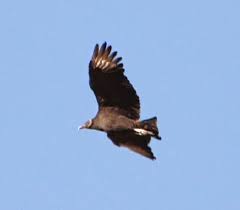
So if I am walking along a beach and suddenly a flock of purple sandpipers rears up, I point, hope the automatic shutter focuses on one of the birds and then keep shooting away for at least one good picture. If a black vulture flies over my head and soars in the wind, it is usually easy to get that picture - provided the lens doesn't go into infinity and then I can see nothing.

Purple sandpipers (Margo D. Beller)
Photographing birds is, for me, one of the hardest things I do. In fact, most times I just take the binoculars, find the bird, point it out to MH and then hope he can take a good picture. If we are visiting a place we're not likely to see again for a long time, I will take my camera. The long lens has helped me take pictures of everything from roosting long-earred owls to a pine warbler to a group of cedar waxwings chattering high in a treetop.

When the birds sit, even if they fidget, there is a good chance I can get that picture. If they suddenly take off, I can get a great shot or I can get a blur or I can get a picture with no bird at all. If there is a harrier flying close to the ground looking for a meal, I focus on it and follow along and squeeze the shutter again and again.

Black vulture (RE Berg-Andersson)
In the time before Roger Tory Peterson illustrated his field guides with pictures that plainly show a bird's identifying field marks, anyone who wanted to study or paint birds had to shoot them with a gun. J.J. Audubon writes of having to shoot several birds of one species in order to pin them in realistic poses and draw them before the bodies started decaying. He would often decry the waste when his crew would shoot hundreds of birds just for the sport.

It is for that reason why birds such as the passenger pigeon became extinct. It is why a rich woman had to buy what is now the Hawk Mountain sanctuary to stop local farmers and others from climbing to the top and shooting raptors out of the sky as they used the warm winds of autumn off the mountain ridges to migrate south.

Now you can identify a bird using your binoculars or telephoto lens, and everyone has a camera if they have a cellphone. You will see people out on the trails "shooting" everything including birds, flowers, themselves. The professional bird photographers are still out there with their big lenses and tripods wrapped in cammo as they patiently wait for just the right "shot."

There's money to be made from the right photograph: Calendars. Illustrating articles on how to take pictures of birds.
Pine warbler (Margo D. Beller)
I don't make money on my photos. They are strictly for me and this blog. I enjoy having a record of birds I have seen. I enjoy the challenge of even finding the bird and then trying to take its picture, if I care for one. It can be fun and it can be frustrating.

But no matter how good my pictures are, I know they will never be as good as the ones in my mind's camera lens.

Sunday, March 12, 2017

Owls I Have Known

One evening, I came outside to look at the night sky and an eastern screech owl was sitting on my fence post. We looked at each other. It was close enough to touch. Perhaps it realized that because it turned and flew off in that incredibly silent way owls have, thanks to the construction of its wing feathers.

That was serendipity. More typical was the other night when I was part of a group of people shivering in the dark, hoping our guide would be able to fool an eastern screech owl into calling for us as the temperature started on its long march below freezing.

As we stood in the snow waiting, I noticed the moon was nearly full and when wind blew aside the clouds I could see the constellations Gemini, Orion and Perseus. There is no Owl constellation and, ultimately, we heard no owls on this prowl.

That's the way it goes. As MH constantly reminds me, the birds aren't waiting for us -- especially when these nocturnal raptors can hide in plain sight in the dark as easily as they can when they roost in the daytime.

But it is not impossible. In fact, on the way to the Owl Prowl a great horned owl flew over the road ahead of us.

Another time, in the middle of an afternoon, walking on a boardwalked trail, a great horned owl flew over my head, landed in a tree long enough for me to identify it and then flew off. And there was the great horned owl duet I heard by chance one predawn morning in January, as the male - in one of my backyard trees - called to its mate some distance away as I was locking the front door to head off to work.

Driving in the Great Swamp one afternoon, I stopped to see what a woman was seeing through her binoculars. It was a barred owl, one of the few owls with dark rather than yellow eyes. It had a rather benign look on its face -- but that is just an illusion, just as it is an illusion to think of some of the smaller, round-headed owls are cute and cuddly.

They are not.

Take this screech owl (below) that MH photographed in Delaware in 2010. We missed it - another couple asked if we had seen it and were kind enough to lead us to it.

Eastern Screech Owl (RE Berg-Andersson)
This 8-inch owl, which looks like a great horned owl that shrunk in the wash, may look like a friendly little guy but like the bigger owls it has asymmetrical ears - those tufts sticking up are feathers, not its ears - the better to hear its next meal scurrying around, even under snow. It has sharp talons for killing and a sharp bill. Like all owls it will eat its meal whole, later regurgitating a hard pellet containing all the bones and other parts it can't digest.

Also like other owls the screech owl is not only good at not being seen at night, it is very good at hiding in plain sight in daylight. As you can see with this owl, it is in a cavity, poking its head out. Other owls hide themselves to roost by standing close to the trunk of a tall evergreen, or even a small, thickly foliaged shrub (if it is one of the smaller owls, such as the saw-whet owl). I was once in the Great Swamp, in an area where someone told me he'd seen a barred owl. I stood and looked but saw nothing...until it flew out. Its coloring and spotting had blended in with the mottled bark of a spruce.

It was likely right in front of me, having a good laugh...if owls could laugh. They do make other sounds -- whinnying (screech), hooting (great horned), barking (barred), hissing (barn owls) and tooting (saw-whet). In the middle of the night, those sounds can range from strange to downright scary, especially if you can't see the source.

Some owls hunt in daylight. The snowy owl, for instance, has the long summer days of the arctic tundra. But when the winter food supply crashes, this owl of the north will some south to find a meal. Several years ago there were many sightings of snowy owls, a phenomenon known as an irruption. This one below was seen at New Jersey's Island Beach State Park.

Snowy owl (RE Berg-Andersson)

People think snowy owls are cute and cuddly, too. They remember Hedwig, the snowy owl of Harry Potter's at Hogwarts. Gift shops run by New Jersey Audubon and the National Audubon Society will sell you a stuffed snowy. But don't let the round head and body and the big, yellow eyes fool you into doing something stupid. These are raptors, just like the redtail hawks and peregrine falcons. In fact, here is some video of a snowy fighting off a falcon.

Other owls hunt at dawn or at dusk. The first time I ever saw a short-eared owl it flew over our car as we were driving on a road through a marsh at dusk on the way to Cape May. (It was the odd silhouette that helped me identify this bird.)

When I think about it, I have seen and/or heard quite a number of different types of owls, both by day and by night. Sometimes it is better to be lucky than good.

Saturday, February 8, 2014

On Owls

The other day, on the New Jersey bird list, Susan Garretson Friedman mentioned finding a great horned owl when she was leaving her job running the bookstore at New Jersey Audubon's Scherman Hoffman sanctuary.

I write the blog for Scherman Hoffman, so when she mentioned seeing it from the "upper parking lot," I knew exactly where that was, and when she said she was joined by Mike Anderson, I knew she meant the sanctuary director.
GHO - Joe Pescatore, courtesy of Scherman Hoffman

"Our" great horned owl, she wrote - obviously a regular. The center closes around 5pm so it was twilight, allowing her to be able to see it and for Mike to follow the owl with his spotting scope. It turned out to be a male GHO, which flew to a female owl and they mated.

I was envious.

It got me thinking that at this time of year, when I used to leave my house at 5am to catch a train that would get me to work by 7am, I would hear owls calling - mainly GHOs and screech owls but occasionally barred owls ("who cooks for you? who cooks for you-all?") and barn owls.

GHOs are particularly active in January because they are mating. Susan's post was all the more interesting because I would've thought by now, in February, the owls would be on their nests (perhaps all our recent snow and ice delayed things).

I wrote about life "In the Dark" back on May 7, 2011.

Screech owl, Prime Hook, Del.  (R.E. Berg-Andersoon)
I remembered how one morning I stepped outside my front door at 4am to look at the stars before getting ready for work. I heard the distinct hooting of a GHO very close by. I walked to the driveway from my front door and there it was, a massive shape silhouetted in a nearby tree. Another GHO was calling from across the road, at the edge of the old Greystone property. Later, walking in town to the train station, another GHO called from a backyard tree.

I thought of that last night as I walked out the same front door, at 10pm this time, and listened for an owl. Nothing - no calls, no silhouette.

I came home from work once in the twilight to find a screech owl preening itself in one of my trees, and I watched it until it got too dark to see and it flew silently away.

My last owl encounter was very different. MH and I were at Island Beach State Park, and a snowy owl was sitting in the rays of the setting sun atop a dune. There have been a lot of snowy owls in New Jersey this winter, an "irruption" southward because these daytime-hunting owls couldn't find enough lemmings. For that same Scherman Hoffman blog I wrote about snowys, and how they have been seen as far south as Florida, according to one report.

I've also written about bad behavior toward owls, such as the photographer who, despite having a long lens on his camera, insisted on getting up close and personal with a pair of long-earred owls roosting at Great Swamp.
Snowy owl, Island Beach SP (RE Berg-Andersson)

My fascination with owls is no doubt fueled by the fact they are mainly nocturnal. I, like the birds I see more often, am diurnal. One forgets that life continues at night, too, even if I am not outside in it. When I encounter an owl, 99% of the time it is through my hearing, not sight. Owls can see in the dark and their hearing is 20 times better than mine, the better to hear the scurrying of rodents under 6 inches of packed snow and ice.

Hearing the owls in the deep dark of a cold January night was one of the few good things about getting up at that ungodly hour for six years and walking a mile to the train. As I write today, in my home office, the weak sun of a snow-covered and cold day barely warming me, I am wishing I was walking with the owls again.
Last night as I left the Center, I looked up and in the tree above the
upper parking lot, was our Great Horned Owl. I watched him for about 10
minutes, then he flew off, and I thought, caught another bird -- I heard
some squawk. Mike Anderson, who heard him too, was out in the upper
parking lot with the scope, and caught the actual situation, which was the
gentleman owl I was watching responding to the call of a female owl (which
I had heard) and doing what comes naturally. After that they flew off.
Pretty cool. - See more at: http://birding.aba.org/message.php?mesid=620327&MLID=NJ01&MLNM=New%20Jersey#sthash.a2UK6u6h.dpuf

Sunday, October 7, 2012

Flipping the Bird

When I’m out in the field birding, I run into a lot of nice people. They ask what I’m looking at. Sometimes they point out things I don’t see. We may talk shop, we may not.

If they have a spotting scope, they offer to let me look through it. One couple - at an industrial area in Salisbury, Md., that was drawing a lot of grassland birds one recent September - not only let us look through the scope but identified the birds we were seeing (I’m as bad identifying grassland birds as I am shorebirds).

When we are standing and looking at birds - whether at Sandy Hook’s Spermacetti Cove or Scherman Hoffman’s hawk platform - there are people who are friendly and who enhance the birdwatching experience.

But as in real life, there are also jerks.

These are the stupid people out there in the field who do a lot of stupid things.

*They will leave the trail, like the lady in this photo taken a few years ago in Massachusetts.

I was on the trail when I photographed her. She was walking alongside some deep water, likely the Concord River or a tributary. She was walking over a lot of downed tree limbs. We watched her to see how far she’d go, and whether she’d fall into the water. Luckily, she didn’t fall in and ran into enough brush that she was forced back to the trail.

Recently, at Sandy Hook’s Plum Island, my husband and I saw two guys with cameras - huge, gunlike lenses - walking ahead of us. One of them left the trail and was walking in the long marsh grass, in the mud, looking for something to photograph.

I don’t know what he was looking for when he was trampling the marsh but he spooked two black ducks out of hiding into the water. That didn’t interest them enough to use their cameras. Maybe they didn't even see them.

I’m sure the ducks were relieved the peregrine falcon that had been flying over the area most of the afternoon wasn‘t around at the time.

*They use recorded devices.

If you play a recording of a singing male bird, there is a great likelihood a real bird of the same species will fly in to defend his territory. It will get stressed. It may even attack you. That’s bad enough when it’s something small, like a Bicknell’s thrush.

But if it’s an owl, watch out. In bird etiquette, you do not stress out a roosting owl during the day. In my book, you don’t use tapes to draw owls even at night.

*They will do anything for a picture.

Some people use their big lenses to stay in the background and get the picture, blowing it up in the editing. Some, however, will trample the ground like elephants, rush the bird, push you out of the way for that picture.

I’ve written before about the people who put their lenses practically in the faces of the roosting long-earred owls found by others a few years ago. When a rare boreal owl was found roosting near Tavern on the Green in New York City's Central Park during the 2004 Christmas Bird Count, many people came to photograph it. They stood a respectful distance from the base of the tree, used their long lenses and took their pictures.

But when a guy showed up early in 2005 with his camera, he wanted a perfect shot. Boreal owls are hard to see sometimes. So this guy used a bright flash for his pictures, despite the birders yelling at him to stop.

The next day, the owl was gone, either to another part of the park or another part of the state. Maybe it was coincidence. I hope it survived the trip. It left behind a lot of angry birders.

A lot of owls have been found in Central Park since then, but not boreal owls.

These jerks will also trespass. There are many stories. If you look on the birding lists you’ll frequently see the complaints from other birders as well as exhortations not to block roads, to respect private property, not to cross fences, etc.

There’s a reason for these exhortations. A lot of birders simply don’t respect private property. Maybe it’s because they consider themselves photographers rather than birders. With smartphone cameras and mini-SLR cameras, everyone think they're a world-class photographer, a paparazzi of birds.

The town of Piermont, NY, was overwhelmed by people coming from hundreds of miles around one winter when a juvenile snowy owl took up residence on a post in the town harbor. Same for the town of Montgomery, NY, when the grasses in a particular park field were trampled after a sedge wren was found.

If I was a homeowner and I had something extraordinary at my feeders, I would tell no one. My little lawn and my little street in my little town would be overwhelmed.

*They won’t tell you what they are seeing.

You see people with their binoculars focused on something. Birding etiquette says you walk up, focus your binoculars on the general area, try to see what they’re seeing, then ask.

Sometimes you see what they see, and you mention it for confirmation. Sometimes you can’t see what they see and when you ask they answer, even if they are thinking “I had to work for this. So should you.”

The jerks put down their binoculars and walk away.

That’s ok. It only makes me work harder to find what they saw, and more.

So when we meet in the field, let's be friendly. Let us bird in fellowship. Let us share stories and information and, most important, respect the birds and each other.

Otherwise, I'll be flipping you the bird and notifying the authorities.