Cape May

Cape May
(RE BERG-ANDERSSON)
Showing posts with label hawks. Show all posts

Sunday, October 15, 2023

Wild Goose Watching

Winter's not gone yet, if the wild geese fly that way.

-- William Shakespeare, "King Lear"

A cool October Sunday morning and I am sweeping. The trees are starting to color and the leaves are falling in earnest when shaken by the breeze coming from the north. It is blessedly quiet, only a couple of dogs barking in the near-distance dog park, the occasional jay or crow calling and the sound of my broom brushing together the acorns on the patio. The clouds are being chased across the sun. 

It is slow right now, no runners or dog walkers or kids yelling. No one heading to church or VFW pancake breakfasts or pick-your-own apples or cross-country running matches. I fully expect to soon hear this activity as well as neighbors using their blowers on the fallen leaves (fighting the wind blowing more down) once it is the legal start time for noise on a Sunday. (I hear them now as I write.)

There are fewer acorns to collect this time than last time but they are still falling in smaller numbers on the roof of the enclosed porch and in the lawn, where I have to step carefully if I am doing any yard work. I raked locust pods from the front lawn before our mowing guy came through, and expect to do it again before he next comes. The yew hedge, I notice, has dropped its uneaten red berries on the edge of the driveway, and I push those away with my broom, too.

"Moongooses" by Wildlife Terry is marked with CC0 1.0.

I enjoy the quiet, but then I hear the distant honking. I stop and look at the sky where it is not blocked by trees, and I wait. 

This time there are only about 40 Canada geese very high up. Most of them are in a long V while some are in an uneven line to the V's left. They are flying southeast because at this time of year they are migrating to their winter grounds. I always stop to watch the flying geese when I hear the honking. 

It is not as though these are rare migrants. In my part of the world they are far too common. Decades ago a few did not migrate. They found parks, office campuses and backyards full of food, the weather not too bad and few to no predators. They stayed, they bred, they created a large number of little fuzzballs (one brood each year can include from two to eight goslings) that start off looking so cute but then grow to look just like their parents. Then the cycle begins again.

Canada geese, whether they are wild or domesticated, are protected by treaty. They can't be hunted except during specific state hunting seasons. The hunters must be licensed. Those hunts help keep down the population. But people in cities are horrified when officials order a goose "culling" to cut down the number befouling the parks. They rally, they protest. These are people who do not hunt and do not see an ecological imbalance, they see "nature" being destroyed for (to them) no good reason.

At their worst, grass and ponds are green with goose excrement. When the young are small the goose parents, which mate for life, are extremely protective and will attack a person who gets too close. Most of the time when I hear honking it is from geese that are in the nearby community garden, or the pond a quarter mile away. When they fly they are not heading north in the spring or south for the winter, they are rising from one pond and heading to another so they can continue eating. When people walk their dogs at the community garden the geese take off with a noisy clatter, scattering in many directions but then meeting up later. (In that they are like another now-common pest where I live, the deer.)

How I see Canada geese all too often. (Margo D. Beller)

But this morning's calling geese are wild geese, doing what wild geese are supposed to do - get out before winter comes and the lakes and ponds freeze.

Why are they flying in a V? According to an article by the U.S. Library of Congress:

First, it conserves their energy. Each bird flies slightly above the bird in front of them, resulting in a reduction of wind resistance. The birds take turns being in the front, falling back when they get tired. In this way, the geese can fly for a long time before they must stop for rest. The authors of a 2001 Nature article stated that pelicans that fly alone beat their wings more frequently and have higher heart rates than those that fly in formation. It follows that birds that fly in formation glide more often and reduce energy expenditure (Weimerskirch, 2001).

The second benefit to the V formation is that it is easy to keep track of every bird in the group. Flying in formation may assist with the communication and coordination within the group. Fighter pilots often use this formation for the same reason. 

Easy birding atop Hawk Mountain, Pa. (Margo D. Beller)

If I am outside at the right time of morning on the right day in the right month, I can see multiple large Vs of geese, sometimes with hundreds of birds. This is an easy type of bird watching, just as being on a hawk platform and watching the migrating eagles, buteos, accipiters and falcons heading south over mountain ridges each autumn is easy birding. The birds fly in daylight and are big and easy to see, not like the small warblers jumping around quietly from branch to branch in still-leafy trees. Finding warblers in autumn is a challenge, but there are times I don't want a challenge. I just want to stand still on a quiet Sunday morning and look up at a V of wild birds flying away to the south.

Earthbound, I envy them. 

Monday, September 2, 2019

The King of Hawks

This post is based on one that originally ran on Sept. 9, 2017, on the blog of New Jersey Audubon's Scherman Hoffman sanctuary. The NJA blog was significantly overhauled since then and the archives were deleted. However, I was able to keep a copy so this can again see the light of day.

There was no birding before the binocular, there was simply ornithology.

-- Pete Dunne

When summer is ending, there is nothing like the prospect of finding an area with a clear view to the north and then waiting for the annual migration of south-bound raptors. It doesn't matter if I am on a mountain, in a park or in my front yard, looking up and seeing a small speck that could be a broad-winged hawk or a red-tailed hawk or a peregrine falcon is exciting. There are areas where hawk watches are held every year because these areas, if they are on mountain tops, provide the warm columns of air called thermals these bird need to soar and float southward, allowing them to conserve their strength. 


Southbound Cooper's Hawk, Hawk Mountain (RE Berg-Andersson)
For many years, the author and birdwatcher Pete Dunne has been coming to the hawk platform at New Jersey Audubon's Scherman Hoffman sanctuary. His visits, in early or mid-September, are timed to when the flight of broad-wings is at its highest and other raptors are increasingly on their way to their wintering grounds. Pete always draws a big crowd. Twice I have watched him in action on the platform, encouraging young birders, providing identification tips and, if you picked up a copy of one of his many books, signing an autograph.

Pete ran the NJ Audubon center in Cape May for a long time but after suffering a stroke in 2014, he stepped down to become the group's Birding Ambassador. Nowadays, however, he has given that up and when he is not in the field he is writing a book or a blog post somewhere.

So it seems fitting that I reprint this NJ Audubon post, my 300th on this blog, in September about a man who is an institution in the birding field as well as a humble guy for whom there is no stupid question and always much to learn:

At high noon, on a mid-September day that feels like mid-August, Pete Dunne sits in a chair on the Scherman Hoffman sanctuary hawk observation platform, calling out what he sees through his binoculars and providing a wealth of observation tips.

“That’s a Turkey Vulture. It holds its wings in a V. V for vulture.” 

“There’s a Broad-wing flying just above a Red-tail in that cloud. You can see the Broad-wing is a little smaller and its wings look like a candle flame.”

“That’s a Sharp-shin passing over us. It looks like a flying mallet. A Cooper’s hawk looks like a flying crucifix.”


Pete Dunne (Margo D. Beller)
The crowd is a bit smaller than when I was last on the platform while Dunne was visiting five years ago, but it is no less avid. Up go the binoculars as sanctuary director Mike Anderson uses a clicker to count off the number of raptors seen while making sure everyone can see what Pete Dunne is seeing. Dunne visits this New Jersey Audubon sanctuary every September from his home near the Delaware Bay, close to Cape May at the state’s southern tip as the gull flies. He ran New Jersey Audubon’s Cape May Bird Observatory for many years before a stroke in 2014 prompted him to step down.
Since then he has been New Jersey Audubon’s Birding Ambassador. His mission is to inspire your interest in birds and conservation. He comes north to Scherman Hoffman in mid-September because it is in the “Broad-wing belt” when these buteos can be seen flying south for the winter in the greatest numbers. There are more of them seen now in northern New Jersey than in Cape May, he said. Also, it gives him an excuse for the Morristown-born Dunne to visit family.

But today the weather is not cooperating, even for Pete Dunne. While the rising warm air, or thermal, will keep a flying hawk aloft, the wind is out of the south. Southbound migrants prefer a strong wind out of the north to push them along so they can conserve energy.

Shortly after I arrived at noon, two hours into his visit, five Broad-wings were counted among the raptors seen including a couple of Red-tails, some Turkey Vultures, a few Black Vultures and a Sharp-shin, the smallest of the accipiters. We waited. The small number does not bother Dunne. He remarks that the previous year on the platform there were no Broad-wings seen although there were plenty of other raptors, including Bald Eagle and Osprey. When no hawks are flying, he points out migrating Monarch butterflies and the occasional non-migrating Blue Jay. The binoculars come down and people break into small groups, sharing birding stories and other interests, including choral singing and politics.

At this point Dunne stands and asks if everyone has a pair of binoculars, and points out the ones in a box for a free loan. “Everyone knows what a loan means, right?” he says, smiling. If you don’t know how to use them, he’ll show you. He discusses differences in price and features, which can be substantial. He asks how many of those on the platform are first-time visitors. There are a few. The crowd is generally older and long-time birders and most have been to Scherman Hoffman’s platform. The platform is big enough to hold all these people and more but Mike Anderson told me Pete Dunne’s annual visit is easily the largest crowd up there. He’d love to have a daily hawk count but the usual two evils – lack of time and money – prevent that.


(Margo D. Beller)
There are young people on the platform, too, searching for specks in the sky. Dunne encourages them because they are the future. He talks to them like a friendly uncle. After all, he was once a wunderkind birder, encouraged by his father. Dunne was so much into birding that he was devastated when the father of his primary birding companion – a girl – forbid her to travel with Dunne in the woods anymore when both achieved puberty. Dunne said he didn’t understand why he now had to bird alone.

He got over it and has birded alone or leading large groups for most of his 66 years. He is a hero of mine for being self-taught and not a trained ornithologist. He was one of the creators of the World Series of Birding, an annual competition where the idea is to find as many birds as possible, either throughout New Jersey or in a particular large or small area. The competition raises money for conservation. Dunne’s first team included Roger Tory Peterson. He knew David Sibley before Sibley became famous with his illustrated birding guides. Dunne has written a slew of books including “Tales of a Low-Rent Birder” in 1986 (which is how I first heard of him), “The Art of Bird Finding” in 2011 and books on raptor identification, including his newest, “Birds of Prey.”

We once crossed paths at Cape May’s Higbee Beach as he led a very large group to a larger tour bus as I was arriving just after 7 a.m.. You’d never know he’d had a stroke. He took a moment to point out to me a singing Carolina Wren. His enthusiasm is infectious, which is a good thing if you are on a mission to expose as many people as possible to the wonder of birds.

When I left the platform an hour later, he was still up there, still talking to the crowd and watching for Broadies. According to Mike Anderson, those who came after got to see about 20 Broad-wings, four Bald Eagles and an equal number of Ospreys, five American Kestrels, Northern Harriers, Cooper’s and  Sharp-shinned hawks. Oh, and a Mississippi Kite, not a sanctuary record but it must have been quite a sight.

You don’t need a Pete Dunne to see hawks from the observation platform. There’s still plenty of migration season left for you to come up and find them.

Sunday, August 25, 2019

Late Summer Blues

I trust in nature for the stable laws of beauty and utility. Spring shall plant and autumn garner to the end of time.
-- Robert Browning

T.S. Eliot was wrong. August is the cruelest month, not April.

In April you can sense the days are getting longer, the plants and tree leaves will soon be coming out, the temperature will warm. In August you realize that, hey, it's awful dark at 8 pm. In August the heat and humidity eventually gives way to cooler, dryer days and you walk outside to discover the weeds are everywhere and your summer flowering plants are shot and ready to be cut down and composted.

Monarch feeding on butterfly bush flowers (Margo D. Beller)
When I look in the trees, I am as likely to see a falling leaf or a migrating butterfly as I am a bird. Already the apple tree is nearly bare and many of the maple and dogwood trees I see are losing the green in their leaves and showing the underlying red or yellow.

In August the squirrels are dropping as many acorns as they are caching, making it likely I'll either get bopped on the head or step on something that will hurt my foot and might make me lose my balance.

In August many weeds are tall and flowering, particularly ragweed sending out its pollen, just in time for when I can finally open my windows for fresh air instead of being stuck inside in air conditioning circulating the same stale air.

In August many of my peppers seem to come ripe at the same time, so I am cutting and freezing most of them. My tomato plant has suddenly covered itself with yellow flowers, so I will have more fruits soon. My basil is just about done. The coleuses are tall and lovely and I have taken cuttings to pot for next year. But because of the hordes of white flies I am leaving these and the vegetable plants outside to be killed by the frost. At that time the dahlia and canna bulbs will be removed for storage.
In autumn I prefer asters to the ubiquitous mums. (Margo D. Beller)
In August many of my neighbors go away on vacation because it is the last time they can before school starts in September. Even tho' it has been decades since I've attended school, there is something about the advent of September that depresses me. Perhaps it is realizing it is only a couple of months until the end of the year. Where did the summer go? When they return they will start filling their doorways with pumpkins, mums, ornamental kale and corn threshes to connote a harvest time they've never experienced unless they grew up on a farm.

August is when birds are on the move south. The mature female hummingbird I've seen at the feeder for the better part of two weeks has not re-appeared, although an immature (grayer) hummer has come to the few remaining coral bell flowers to feed. There have been others at the feeder but I have not been outside long enough to see if they are the same bird or different.

Inkweed, like ragweed, grows huge in fall. The berries will turn
black and be eaten by catbirds and other birds
heading south. (Margo D. Beller)
Hawk-watching season is already upon us. Hawk Mountain, one of the premier viewing sites in the eastern U.S., opened for fall watching on August 15 and has already reported osprey, bald eagles, various accipiters, harrier and broadwing hawk. There will be many more "broadies" moving through my area, peaking in mid-September. Warblers may pass through my yard but unlike in the spring they won't be brightly colored and won't be singing territorial songs. Mating season is long done, the young have fledged and now the only thing on these birds' minds is getting back over land and sea to the winter territories.

Finding these migrant birds in the trees is harder at this time of year. It's a little easier in more wide-open areas such as the shore or a sod farm. I went to one sod farm recently and found some unusual sandpipers and plovers, including the upland sandpiper, which are endangered because of increasing development eating up the dry open spaces they need to survive the trip south.

Finally, August is when I realize it is dark in the early morning and it is dark before 8 pm. Daylight will continue to decrease and before long we will turn clocks back and it will be dark by around 5 pm. Lack of sunlight makes me moody, in part because I can't avoid the inevitability of the passage of time. I know the longer days will return in the spring but until then the cold is coming, and possibly worse.

Saturday, August 26, 2017

Hawking

Here in New Jersey we have been given a gift this late August - cool, dry, breezy weather, more like September than late summer.

The cool air has inspired me to go outside and deadhead the spent flowers on the perennials in hopes there may be new bloom before winter. My peppers have started growing, at last. Leaves are falling off the apple and pear trees, and the dogwood has a hint of red in the leaves, even as its fruits are starting to form. The female locust tree in the front yard will have a bumper crop of seed pods this year, unfortunately, and when they fall they will have to be raked to the curb with the inevitable leaf piles.

Male Harlequin-you can hunt it in season.
(Margo D. Beller)
For now, however, I am thinking about migration.

There is still the occasional hummingbird visitor to the feeder. The adult males are long gone, the adult females are leaving and the juveniles are now big enough to feed and travel on their own. The rubythroated hummingbird I've been seeing of late seems to have a tinge of red on its "chin," making it a juvenile male. He perches and takes long drinks. With the accumulated fat he's building he'll soon be heading to the lush tropics for the winter. I hope he survives the trip.

Overhead, the clouds are moving from north to south. In the bird reports I see warblers and other migrating birds showing up in greater numbers on their way to their winter grounds. The north wind is a tail wind, and when September comes that means it will be time for me to look in the skies for southbound raptors.

Buteos such as redtail hawks, accipiters, falcons, harriers, vultures, eagles: When they fly south they use the warm air rising off mountains to help them stay aloft. So unlike the warm spring winds from the south, which don't seem to limit the hawks' flight patterns, in autumn the best place to see these birds is along mountain ridges. I enjoy the hawk watch from Scott's Mountain and have seen hawks from elsewhere in New Jersey, including New Jersey Audubon's Scherman Hoffman sanctuary and from the front lawn of an office building in Englewood Cliffs, across the road from the Palisades and the Hudson River, which the hawks follow south.
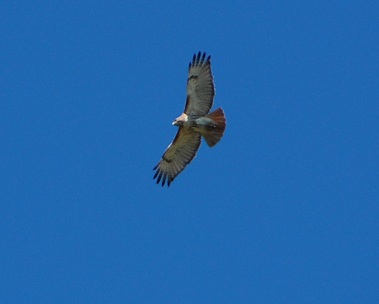
Redtail hawk (Margo D. Beller)

The view of raptors from the top of Pennsylvania's Hawk Mountain, an extremely rugged hike each way, is awesome. No platform here, just jagged rocks. This was one of the many places where sportsmen would see how many hawks they could shoot out of the sky.

That doesn't happen anymore, at least officially. The outcry over such slaughter as well as the killing of birds such as great egrets for their feathers led to the passage of the 1918 Migratory Bird Act. No more raptor target practice. Birds such as grouse, woodcock, ducks and geese can be hunted, but only during limited times of the year and with a strict limit on how many you can kill, just as with the deer and bear.

According to the U.S. Fish & Wildlife Service: For over a century, wildlife conservation laws and regulations have been enacted to keep our bird populations healthy. As part of our mandate to conserve birds and their habitats, we administer the Migratory Bird Treaty ActMigratory Bird Hunting and Conservation Stamp Act and the Bald and Golden Eagle Protection Act. These acts are at the foundation of the Migratory Bird Program.


Hawk feathers (Margo D. Beller)
Among the artifacts in my museum of collected oddities are three feathers. I see, but don't usually collect, feathers all over my yard and from all kinds of birds. But these three feathers (at left) were found while I was hiking and for some reason I took them. From the pattern, it looks like they came from a Cooper's or a sharp-shinned hawk, presuming these are tail feathers, but I can't be sure. They are fascinating to study.

But was my taking them illegal? Under the law what happens when you kill, say, a Canada goose during hunting season? Can you collect its feathers for sale?

According to this site, created by a person who sells feather art, some situations are legal, some are not. One of my friends, who is handy with crafts, recently found feathers from a great blue heron that was preening in one of her trees. She is angry at what she sees as hypocrisy -- that she can shoot a bird for supper but can't use its feathers for art and commerce.

So she won't be hawking her wares anytime soon. I, meanwhile, will be waiting for autumn to come for real and the north winds bringing the great raptor push southward. Feathers will be flying.


Tuesday, September 20, 2016

Hawk-Watching Season, Up Close and Personal

Of all the suburban front yards this Red-tail hawk had to fall on, it had to choose mine.

This morning - cool, foggy, humid - I was doing my usual chores around the house and beyond. Around 7:30, as I was bringing brush to the pile at the curb, I saw this creature watching me.
Red-tail Hawk, Sept. 20, 2016 (Margo D. Beller)

I have found Red-tails on the property, but usually up in the trees. This one should not have been on the ground.

We looked at each other, warily. I walked close  enough to see its tail was brownish red, so this was likely a juvenile. (I also took this picture, which MH cropped.) I could also see one of its legs in front of it, its sharp, killer talons gleaming in the dew.

This was now a very interesting problem for me.

One does not expect to see a wild animal on the lawn, much less an injured one. As suburbs build farther and deeper into the woods and former farms of my congested little New Jersey, animals and birds are going to get displaced, often with tragic consequences. We're going to see them, and they us. Sometimes what we see are big bears or deer. Other times it's an injured bird. Humans can do stupid things when confronted with a situation like this.

I don't know what higher power guided this raptor to the one house on the block that knew what to do next, but I do know that somehow this bird was injured in such a way that it was alive, alert, able to stand and flap its wings but not fly. And a raptor that can't fly is a raptor that starves, becomes dehydrated or is harassed (or worse) by a larger predator.

This is not the first time I've found an injured Red-tail either. Long ago, working in coastal Jersey City, a place where skyscrapers went up like weeds and weedy fields disappeared under the umbrella of "progress," I was walking near my office and found a Red-tail hunkered down in plantings next to one of the new, "luxury" apartment buildings that sprang up with the view of Manhattan across the Hudson River.
One of the times it attempted to fly. (RE Berg-Andersson)

My first call was to get the number of The Raptor Trust, one of the state's best-known bird rehabilitation centers. However, the Trust is located in Millington, in Somerset County, and could not send anyone out to where I was in Hudson County. Call the police, they said.

So I went inside the building. When you have a "luxury" tower, you have a concierge and this man didn't bat an eye - he called the local animal control people from a number in his files. Reassured, I left.

I have no concierge at my house, but I also knew that while closer to the Trust's office, it would not be open before 9am. The Trust is a private organization that depends on donations to continue doing its good work. Many birds of all types have been mended and released into the wild. Many have died. Some stay at the Trust to be used to show we humans what happens when we tear up trees, put up big buildings or drive too fast without see (or caring) about what is walking or flying in front of us.

Birds have so many ways to die in the wild. Nature is cruel. This bird could've been clipped by a speeding car while chasing prey, injuring its wing. It could've been attacked by a two- or four-legged creature bigger and perhaps armed. It could've gotten confused in the fog and banged into a tree or a house. To me there is nothing sadder than seeing a bird of prey dead on the side of the road after hitting one of the many high-profile vehicles on one of the many major highways that bisect one of the most crowded states in the U.S.

I called The Raptor Trust and, as expected, left a message. The Trust accepts birds 24 hours a day but we'd have had to find a large box, throw a blanket on the bird, put it in, tape it shut, drive to the Trust office and then pull the bird out and put it into a heated carrier for when the staff arrived.

No way MH and I would pick up a scared bird whose talons or beak are designed to rip through skin and which weighs several pounds and has a 54-inch wingspan.

So this time I called our local police. All they could do would be monitor the situation and call the Trust. What about Animal Control? I asked.

Connie from Animal Control cages the hawk. (Margo D. Beller)
Turns out they called that number, too, according to the detective who showed up to do that monitoring and keep any people (or their dogs) away from the hawk. I later learned that thanks to the many budget cuts, our town does not have its own animal control office but contracts with a service that handles two counties and is based many miles from us although is close to the Raptor Trust.

So we waited. The detective left, Connie from Animal Control called to say she was on the way. We stood and watched the hawk like a hawk, making sure it wasn't bothered. At one point a murder of American crows started squawking and this Red-tail surely knew crows will mob a hawk to get it away from its family group. The hawk became extremely agitated, got up and flapped furiously. But all it could do was hop off the lawn and to the shaded walkway where it was less noticeable.

Ninety minutes after I found the bird, Connie arrived. She let the bird see her and watch her fold a fitted sheet in such a way that she could throw it over the bird. Her first attempt failed but her second was successful. Once in the dark, the hawk calmed down. Connie put it in a cage that was big enough to keep it comfortable in its sheet but not so big where the bird would flap and possibly do more damage.

By 9:30am, she was gone, on the way to the Trust - which had called me back while Connie was putting the hawk into the cage.

I tried to imagine what the bird was "thinking" while it sat there, watching me and others hover around it. Do birds feel fear? Yes. That's why it was warily watching me and then trying to get away from what it perceived as danger.
How I prefer to see Red-tails. (Margo D. Beller)

Are they able to tell the difference between a helpful me and someone with a gun trying to shoot it out of the sky for sport, as locals used to do on what is now Hawk Mountain Sanctuary at this time of year, when the raptors used the warm winds to save energy flying south along ridge lines? No, it does not. Which is why you should go to The Raptor Trust's website and read the section on how to handle injured or orphaned birds of all sizes if you should find one.

Better yet, call your police or animal control people.

This is hawk-watching season, ironically, and I got a chance to see a Red-tail up close and personal. I can only hope this one can be mended, avoids future hazards and makes its way back into the wild, to be seen aloft and admired by those of us below.

Sunday, September 20, 2015

Crossing Paths With Pete Dunne

“Some birds are not meant to be caged, that's all. Their feathers are too bright, their songs too sweet and wild. So you let them go, or when you open the cage to feed them they somehow fly out past you. And the part of you that knows it was wrong to imprison them in the first place rejoices, but still, the place where you live is that much more drab and empty for their departure.”  -- Stephen King

Pete Dunne was scheduled to be at the New Jersey Audubon's Scherman Hoffman sanctuary yesterday, Sept. 19. I wasn't able to attend, anxious to do a lot of walking in the woods after a homebound work week. I wanted to find warblers making the trip south for the winter, not stand on a concrete porch in the middle of hundreds of people broiling in the cloudless sun and watch migrating raptors high aloft, listening for some insight from this man, the co-author of the seminal "Hawks in Flight" and a number of other books. 

Pete Dunne in 2012 (Margo D. Beller)
I wasn't there, and there is a strong chance he didn't show up. However, I can still visualize the scene because I was there in 2012, and I saw the crowd and I saw his enjoyment in calling out what hawks were passing through and bestowing identification tips. I saw him patiently listen to all the birding stories and he even answered a question or two of mine, asked in my role as writer of the Scherman Hoffman blog.

However, in March 2013, Dunne had a stroke. In 2014, after much rehabilitation, he stepped down as head of the Cape May Bird Observatory, which he built from nothing to a major destination for anyone with a serious interest in finding and identifying birds. He has become NJ Audubon's "Birding Ambassador." 


He also stepped down as editor of New Jersey Audubon's magazine (in which I've had one article published and have another in production). In 2011, another time we crossed paths, I got his phone number and called the man, who cheerfully talked to me about what kind of articles they would publish, if I could come up with anything. He was encouraging but made no commitment.


I did not mention that phone call when I talked briefly to Dunne in 2012 on the Scherman hawk platform. He talks to a lot of people in the course of a given day. For the same reason, this past May I did not remind him of our previous conversations when MH and I spent a weekend in Cape May that happened to coincide with the day of the annual World Series of Birding -- an event Dunne helped create.


(I first crossed path with Dunne when a friend at work loaned me Dunne's 1986 book "Tales of a Low-Rent Birder." I had never heard of Dunne, and I was only starting to get interested in bird watching thanks to the feeder my brother-in-law and his wife had given us for a housewarming present in 1994.)

The Friday we drove to Cape May -- the southernmost point of New Jersey and a prime feeding spot for birds flying north after they cross Delaware Bay -- was our wedding anniversary. The next day was the WSB. That day we rose early (we had a lot of stops to make our one full day there) and went to Higbee Beach, a large piece of property, and arrived just as a tour bus was loading up with birders trudging out of the Higbee fields.

Pete Dunne, Scherman Hoffman hawk platform, 2012 (Margo D. Beller)
"Looks like there's a Carolina wren in your future," said the tour leader as the little bird sang. Pete Dunne, of course, looking as energetic as if he had risen from a refreshing nap. No cane. No sign of the weakness in his left side. Dunne used to travel the state during the WSB from midnight to midnight with a group - at one point including another bright light of the birding universe, Roger Tory Peterson - but now he was sticking closer to home in Cape May, with a large tour group in a larger white bus.

MH and I got to Higbee no later than 7 am and here's Dunne's group just finishing their visit, heading on to one of Cape May's many other birding locations. They had to have started right at dawn, which means Dunne had to have gotten them in the bus no later than 5 am.


Pretty impressive. 

We saw a lot of very good birds on our own that day, and it was the best birding we did this past spring. (Spring migration was not very good in northern New Jersey, and autumn migration is shaping up to be as bad thanks, in part, to the drought.) I wouldn't have minded Dunne pointing out a bird I usually can't identify rather than a Carolina wren, one of my favorite birds and one I can identify in my sleep.


Yesterday's walk, meanwhile, yielded very little in the way of interesting birds aside from catbirds, a blue-gray gnatcatcher and five types of woodpeckers (mainly heard, although the pileated was seen, just barely, flying overhead). While not at a hawk platform we did have plenty of turkey and black vultures taking advantage of the hot, dry air to swoop and soar. We even had a broadwing hawk, seen from the Griggstown Grasslands, which we visited before getting to the Delaware & Raritan Canal. After our walk around the grassland we walked along the canal and back, about 3 miles. 


We got back to our car exhausted.

I bet up on that hot, sunny platform Pete Dunne didn't even break a sweat.


Sunday, February 15, 2015

Backyard Feeder Drama

This weekend has not only been Presidents Day weekend and Valentine's Day weekend but the weekend of the Great Backyard Bird Count run by, among others, the Audubon Society and Cornell. These counts are useful as a way of getting the average person as well as the avid birdwatcher involved in reporting what they see and how many, which helps the scientists get an idea of what species are increasing and which are on the decline.

Adult sharp-shinned hawk with prey in hole (Margo D. Beller)
This particular day, Sunday, Feb. 15, the wind has been howling and I've had to go out twice to re-set a feeder in danger of being blown off the pole. I came downstairs at 7:30 a.m. and the birds were already all over the 4 feeders I left out despite the risk of wind. It is wicked cold out, wind chills in the minus numbers and even the enclosed porch's thermometer is showing me 10 degrees.

In short, it's cold and the birds gotta eat to survive.

The early risers are there - cardinals, chickadees, titmice - and a few surprises including a pair of American goldfinches and a Carolina wren that nestled inside the house feeder as the wind rocked it like a cradle. When things calmed it flew to the suet feeder and took advantage of the pounding a larger hairy woodpecker had given the near-frozen fat to take a few nibbles before flying off. I like Carolina wrens and if I had been outside I am sure I'd have heard it singing from somewhere nearby.

But I did not go outside. And at 8am, just as a cloud of house sparrows and house finches descended to push off the birds I do like, there was a gust of wind and a sudden large bird in the yard I just knew to be an accipiter and all the birds scattered. The bird flew to a low branch, giving me a perfect view of it. I saw it was an adult (gray feathers, red breast), male (smaller than the female) sharp-shinned hawk with its rounded head and square tail.

Juvenile Cooper's hawk (Margo D. Beller)
Accipiters are the most feared birds in this area. The sharpy and its larger cousin, the Cooper's hawk, are lightning fast and agile enough to fly between trees in a forest, going after birds, squirrels and other smaller animals. I have seen sharpys fly out of a bush. They seem to come from nowhere (unlike the larger red-tailed hawk, a buteo, which either hovers in the air or sits atop a pole or tree before dropping down to grab prey in an open area like a highway).

The sharpy sat for 10 minutes before catching another gust of wind out of my backyard. It took another 20 minutes for any birds to return to the feeders, and I was not surprised they were the intrepid chickadees and their cousins the titmice.

When I told MH about the sharpy he reminded me what it says in one of my reference guides, "Birds at Your Feeder," when it comes to sharp-shins and Cooper's - they like birds at your feeder.

We have hawks fly through at all times of the year, going after birds, squirrels and chipmunks. We've had a small flock of turkey vultures that somehow found a frozen rabbit carcass in a corner of my yard. We've had broadwing hawks, red-tails and even a juvenile northern goshawk, the largest of the accipiters, that somehow found its way to a low branch in my backyard for a day.

I find the accipiters most interesting. When they are young they are brown, streaky and not very good at catching prey. We've seen several near-misses over the years including the time an American tree sparrow flew out of our caged feeder just as a juvenile Cooper's hit it from the other side. It sat atop the feeder stunned, and I took a picture. I've seen juvenile Coopers on a branch on one side of a tree trunk trying to grab at a squirrel on the other side. It would be funny to watch if it wasn't a life and death struggle. The hawk wants to eat, the squirrel wants to live.
Juvenile Cooper's hawk (R.E. Berg-Andersson)

But accipiters have to learn fast if they want to survive and by the time the streaked breast goes red and the brown feathers turn gray they know how to hunt very well - unfortunately for the junco and the chickadee and the mourning doves I've seen picked off in the yard over the years.

The only thing that kept today's sharp-shinned hawk from catching any of the many birds at my feeders was that sharp wind blowing it off course. Today, the little birds got away. Tomorrow?

I've no doubt that sharpy found something in another yard to fill its crop and allow it to live to hunt another day.

Sunday, September 21, 2014

Birding Without Trying

I admit it, I am getting to the age where I have stopped caring about a lot of things. For the purpose of this post I will restrict those things to birding.

There was a point when I didn't think twice - ok, maybe I thought once or twice - about getting up before dawn, eating just enough to keep the stomach growling down and then taking my gear and myself out to one of my favorite spots to look for migrant birds. Usually this was in the spring when the gaily colored warblers and others would be flitting around in trees starting to bud or leaf out and singing territorial songs that would make them a bit easier to find.

In autumn, when the birds are in duller colors and flying south, my bird watching would be less in the forests than at a hawk platform, where you don't have to get up as early and, if you are lucky, you can get to a good spot with a minimum of hard climbing.

Atop rocky Hawk Mtn. (RE Berg-Andersson)
This autumn was the first when I did not have a great desire to go to Pennsylvania's Hawk Mountain, one of the best places in the east to watch migrating raptors, but one of the harder places to climb to the top. Our first time there was magical - warblers in the forests lower in elevation, almost no crowds for a long time once we joined the counters at the top of the North lookout. Even the trip down the mountain allowed us to find a new bird for us, a Bicknell's thrush.

The second time, a few years later, was harder. No birds of note in the woods on the way up or down, but even if there were the rocky path was treacherous, and I nearly fell several times. I fear falling. People my age who fall break bones and mentally go into a tailspin, as my vibrant 90+ year old friend did after falling and breaking his ankle.

So this year I've restricted my hawk watching to New Jersey's Scott's Mountain, where one drives to the top of the mountain, pulls out her lawn chair and sits with a convivial group of people who have a fine view to the north.

I've also had no desire to rise early and go to the woods. My wood walking has been in the afternoons. Sometimes you get lucky late in the day and the birds are flying about trying to get a last meal before dark, when they will either bed down or take off to the south.

Still, for me to not go outside on the weekend after a week indoors working is anathema. So this past Saturday, MH and I went down the Jersey Shore.

We specifically timed the trip to avoid the "season," when the traffic is horrendous on the highways and on the beach. Unlike a lot of coastal areas in other states, almost all of New Jersey's beaches are regulated to make the towns money, and you can't sit on a beach and look at the water unless you pay for a beach pass, or are staying in a motel. That doesn't include the cost of parking.

We also specifically looked for an area not made famous, or infamous, by Snooki and her cohorts.

There was one more requirement: It had to be close enough to an area where we could do some birding later in the day or if we got restless. But our primary purpose was to sit on the beach and just relax for at least as many hours as it took to drive down.
My chair awaits. Strathmere beach, Sept. 21, 2014 (Margo D. Beller)
It has been a long time since MH and I just sat on a beach -- it was the year after we got married, when we stayed on Cape Cod and discovered the hard way the lotion we'd brought was old and useless. We've sat for short periods on town benches looking at beaches - Mexico Beach on the Florida panhandle comes immediately to mind, as do many areas along the coast of North Carolina - but not in NJ. We either bird or avoid.

I won't keep you in suspense any longer - we found that place in the northern part of Cape May County, about 20 miles from Cape May itself and all its birding temptations. The town is Strathmere, the beach requires no pass and the parking is free. The town is just north of the busier Sea Isle City, which that day was having a huge Irish heritage festival (who knew?), the kind of noisy, booze-fueled thing shore towns throw to draw visitors and just what we wanted to avoid.

We sat on the beach for over three hours. While the rest of the area beyond the dunes was warming to the upper 70s, we sat with a strong wind in our faces and clouds overhead keeping us cool enough where a fleece jacket was not out of place.

We were nearly alone. We had parked along the road, near the temporary toilet - another consideration for when I go birding now - and walked on the stairs up and over the dune to sit just at the high tide line. We had just passed the low tide point and ahead of us was a large flock of sanderlings running to and from the surf, feeding. I put my binoculars in my lap and every so often would pick them up to look at these shorebirds. At one point I looked more closely and realized there were other, smaller birds mixed in with them - semipalmated plovers, semipalmated sandpipers and one least sandpiper.There may have been others but, as I said, I wasn't there to look for birds.

Around us flew herring and Franklin gulls, several types of terns and two ospreys hovering over the same area as human surfcasters and for the same reason - fishing for supper.
 
After leaving for a late lunch we drove down to Stone Harbor's Wetlands Institute and found tricolored and little blue herons, black-crowned night-herons, great and snowy egrets and a variety of shorebirds in the impoundments. We were looking for birds and were not disappointed.

But sitting on the beach was for me. The birds came without my seeking them. I had a day of few people and the aggravations they cause (aside from having to drive on New Jersey's notorious highways for a few hours each way), with little noise aside from the roar of the wind and surf in my ears.

Is this anti-social behavior a good thing? Maybe not. But for one day I got as close to heaven as I am likely to get while maintaining a pulse.