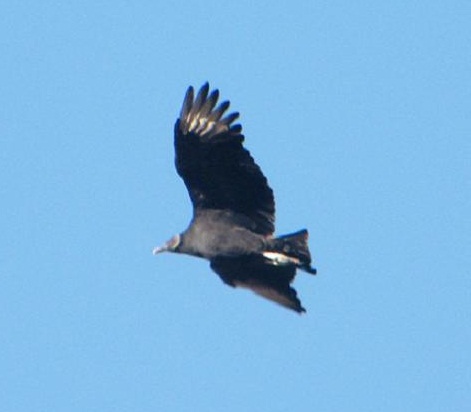
Cape May

Cape May
(RE BERG-ANDERSSON)
Showing posts with label turkey vulture. Show all posts

Sunday, January 5, 2020

High-Flying Vultures

It is a cold morning made colder by a strong wind. Where I am walking - an old railroad embankment now a paved, linear park - the river barely ripples because the trees on either side are blocking the wind from it and me. Only a pair of mallard ducks are on the river, more disturbed by me standing still and looking at them than the people running along the path, with and without dogs.
Turkey vulture, Sandy Hook, NJ, 2018 (RE Berg-Andersson)
There is not much else going on in the wind aside from a brief call by a jay. Then I look up and there is my third turkey vulture of the morning.

I have written about turkey vultures in the past. I've always been impressed by how an ungainly, ugly bird that lives on dead animals looks so graceful and majestic when it flies. Its wide wings are held back, making it look like a giant V in the sky. I heard Pete Dunne describe turkey vultures once as a man walking a tightrope, his arms held up to keep his balance. It is an accurate description.

In a strong wind a turkey vulture wobbles as it fights to stay aloft and in the direction it wants to go. On days like this, turkey vultures are the only birds I expect to see flying. Others, even redtailed hawks, are more likely to stay in the bushes or perched in the low branches of a tree to stay out of the wind.

Why do turkey vultures fly in gusty winds? To eat, naturally. But hawks need to eat, too, and I don't usually see them in gales. I went looking through the internet and found this explanation, which you can believe or not:

One way of looking at the flight behavior of Turkey Vultures, is that they are the one species which flies “with” the wind, while other raptors fly “through” the wind. 

That's one way to look at it, although I've seen plenty of hawks flying "with" rather than "through" the wind. The experts at Cornell's Ornithology Lab note these vultures fly low and slow to smell out carrion, so perhaps the high winds are bringing the smells of breakfast to wherever the big birds roosted for the night, prompting them to take off.

Vultures aloft, Sandy Hook, NJ, December 2019
(RE Berg-Andersson)
Turkey vultures like wide-open spaces, so unless you have a particularly big yard with something dead in it, you are not likely to find them there. (I have never hosted turkey vultures in my yard except one spring, after the snow had melted, when they found a dead, frozen rabbit the day after I did. I made sure they took their snack elsewhere.)

Finding them sunning themselves on your roof on a cold winter morning or roosting in large numbers in your large trees is another matter.  I've seen many such vulture roosts, some in my neighborhood. As you would expect, most people don't want these reminders of death hanging around their roofs or trees because, as with all creatures, what goes in one orifice eventually comes out another, and 70 pooping vultures can make quite a mess.

Better to watch them aloft in the wind, doing what they must to survive.

Saturday, November 3, 2018

I Am Thoreau

"Each town should have a park, or rather a primitive forest, of 500 or a thousand acres, where a stick should never be cut for fuel, a common possession forever, for instruction and recreation."

-- from the journal of Henry David Thoreau

There are two times when I am especially glad to be at home, working at irregular hours if at all -- when the day is gray, rainy and cold (keeping me inside anyway) and when the day is glorious (and I want nothing more than to be outside).


Autumn color, 2018 (Margo D. Beller)
In October, the weather went from September warm to November cold before settling on "normal" - whatever that is anymore. The continued rain had kept most of the trees leaves green but in the last week, with the return of "normal," the trees that hadn't lost all their leaves have suddenly popped with color. 

For the longest time in my backyard the white oak, normally the last tree to color, was the first. But now the elm is glowing gold, the red oak leaves are scarlet, the Norway maple went crimson and the small sugar maple in the corner by the compost pile is a brilliant yellow. Of course, now the wind has started howling and the trees are dropping leaves quickly.

During this week, I went out to the local park to enjoy some of this foliage while it lasted, on a clear and cold day where the blue of the sky made the colors so grand I was even more glad to be alive than usual.

"The question is not what you look at, but what you see.” -- Thoreau

Walking along the cobblestoned memorial path took me past the crab apple trees filled with berries, which were being scarfed down by robins. I don't get robins in my yard much unless they show up in the dogwood or the viburnun and other hedges before the squirrels can get to the fruit. But here they were in their glory. There were also starlings gathered at the tops of trees and on telephone wires. 


Maple in the park (Margo D. Beller)
Then they suddenly flew off and when I studied them closely I saw why - a sharp-shinned hawk was in their midst. The starlings veered one way, the small accipiter another. It wasn't interested in a starling meal.

Thoreau, in his books and journals, writes about the restorative qualities of being in nature, and the importance of slowing down and paying attention to what you see and hear. When I go into the woods now I tend to walk slowly although when I am with MH and his balky knees I tend to walk on ahead and then stop to look and listen while he catches up. Here in this park, next to my town's library, I can see the brook has risen almost to the top of its banks because of the recent rain. I can hear the soft notes of the white-throated sparrow. I can enjoy the turkey vultures sailing around in the wind.

And then one lands in a treetop before my approach prompts it to fly to the top of a telephone pole, where it spreads its wings and hangs out. I stop to watch it and take a picture to show MH. Around me are cars driving too fast in the road, people power-walking, joggers, dog walkers. None are aware of this big, black bird sitting over their heads. They are more disturbed by my standing there, presuming they notice me at all (which most do not).


Turkey vulture (Margo D. Beller)
This is the moment when I do not miss having a "regular" job that takes me away from my home for 12 hours a day and keeps me in a state of stress between my obligations and my commute. (I've done train and car; it makes no difference.) Yes, I don't make the money I once did and I don't get the benefits. Thoreau had the same problem. If he had his way he'd always be in the woods, measuring the depth of Walden Pond, watching the birds, talking to the neighbors about the animals or fish they hunted. 

But even Thoreau had to make a living once in a while to help out his family besides his writing. He ran a school in Concord. He taught the children of Ralph Waldo Emerson's brother in Staten Island, NY. He taught Emerson's own children. He lectured. He surveyed. He sold pencils made in his father's factory. "Work" was a necessary evil and he did it as little as possible.

“You must live in the present, launch yourself on every wave, find your eternity in each moment. Fools stand on their island of opportunities and look toward another land. There is no other land; there is no other life but this.” --Thoreau

When I can't take hours out of my day to go outside, I feel terrible. Having read Laura Dassow Wells' 2017 biography "Thoreau: A Life," I know Thoreau never felt he wasted time walking the Concord roads during a full moon or traveling to a much wilder Cape Cod than you'd find now. He felt the wasted time was the time he spent working at a job. 


Crab apples (Margo D. Beller)
I am almost 20 years older than Thoreau was when he died in 1861. On my worst days, I can walk outside and feel better, almost as though I did not have any health problems. Of course, I feel it later. But seeing a bird I've never seen before, or seeing one I haven't seen for years is wonderful. When my city friends wonder at what I know of birds, I tell them I was not born with this knowledge, I had to seek it out in the field and then my reference books. Just as Thoreau did.

I am lucky there are so many parks within walking or driving distance of my home, and that I have the strength and stamina (and companion) to enjoy them. I am lucky I have enough money and no debt to afford this current state of my life. I allow myself to be surprised by what I find rather than tick birds off a list. 

I would never compare my powers of observation to Thoreau's. I have the advantage of strong binoculars, detailed field guides and land set aside for hiking that is not someone's private property. But Thoreau had the advantage of a (then) small town where he was known, indulged and allowed to wander. He did not have paved highways and fast cars and industrial noise and lights polluting the sky. He could see more, even if he was not always correct about what he was seeing. It informed his writing, which is why "Walden" and his other books are still read generations after his death.

You can decide for yourself if wandering has made me, like him, a better writer. But I do feel like a better person.

“How vain it is to sit down to write when you have not stood up to live.”  -- Thoreau


My Walden Pond - Reservoir, Central Park of Morris County
(Margo D. Beller)

Monday, December 22, 2014

Where Are the Vultures?

Gloomy days bring gloomy thoughts, especially around the time of the year-end holidays. Where did the months go?

In recent weeks many of my friends have lost loved ones. As I write the first day of winter officially begins around 6 pm ET. It's dark and cold at 5 pm. For a variety of reasons we can't visit our families for the holidays, although we will be dining with a good friend nearby. It has been weeks since we've had a day that started sunny and stayed that way. A huge mid-week storm is expected, which will test our new roof and deer fencing.

Holiday card montage by Margo D. Beller
Last year around this time I wrote a post for another blog about how many of my friends contact me, and I them, once a year through holiday cards. This year I notice we didn't get cards from some of those friends, and I wonder if all this time they've been sending us cards only because we sent them cards first. We only had 20 cards on hand to send out this year. One friend sent us an ecard and three sent us cards before we sent out ours. The vast majority have not bothered but we have sent the cards to them.

Why is that? Do they dislike us now? Are they too used to putting all their news on Facebook? Have they reached that age where they want to simplify, simplify? Or are they just waiting to hear from us to see if we are worth the effort to go out, buy a card, write a note, sign it, address an envelope, seal it and put on a stamp?

One gloomy thought among many.

Here's another: Where are the roosting vultures?

From 2012 into 2013, on my early morning walks, I would see them in a small, sunny meadow on the old Greystone property trying to warm up before flying off to seek a meal. Then came last winter's heavy and almost continual snows. It was hard and sometimes dangerous to walk from my house to this part of the property (thank goodness sidewalks have been put in along the main road within the last year) and so I avoided this area all winter.

Turkey vulture (R.E. Berg-Andersson)
Now I wonder if the vultures did, too.

When the grass grows long the vultures don't hang out in the field. They want to see what's coming. (Canada geese do that, too, which may be why the grass is not mowed.) I would find a few turkey or black vultures in trees along the road, soaking up the sun on a dewy, cool morning. I was expecting the vultures to come back to the field once the grass was mowed but that hasn't happened.

Why? I have my theories, all of which involve  distruction of habitat.

1. There are fewer dead deer to feed them.

2. The state of New Jersey (which holds this parcel while my home county holds most of the now-parkland around it) waited too long to mow.

3. Last year's snow forced the vultures to other areas they like better.

4. The many people using what was once a mental institution and is now a county park made it too noisy (there is a playground, ball fields and cross-country track) and uncomfortable for the raptors to hang around.

5. Nearby residents who didn't want vultures warming themselves on their roofs on cold mornings took measures - either on their own or with state help - to force them off.

Black vulture (R.E. Berg-Andersson)
Vultures are far from endangered and even at Greystone they aren't completely gone. Every so often a couple of black vultures or a turkey vulture will suddenly rise from the Greystone property beyond my neighbors' houses. It's possible they are just roosting in other sunny areas, rising from the still-green hemlocks where they sleep to get a little protection from the elements. Or I'm not looking around at the right times.

But I miss seeing all those vultures running around the field in the sun like chickens, or sitting in trees in groups, their wings spread to dry and warm in the rising sun. Vultures are ugly up close and their need for dead animals to eat and survive disgusts many.

But aloft these big birds soar majestically and I enjoy watching them. Their absence adds to my winter gloom.


Monday, November 17, 2014

The Birds of War

In my last post, I noted my thoughts on war, inspired by our vacation visiting the battle sites at Gettysburg (plus a day trip to Antietam and the preserved town of Harpers Ferry).

I noted that it was humbling to stand and look at a wide open field and hear absolutely nothing, while seeing monuments that look like they were placed haphazardly but in reality connote where a regiment - cavalry, battery, infantry - was placed in readiness for battle.

However, there was something else I discovered. Bluebirds like battlefields.
Bluebird on monument. (Margo D. Beller)


Ok, maybe not battlefields per se, but farm fields where there are lots of insects. I saw more bluebirds at the various areas of the three-day Pennsylvania battle than I have at my local Great Swamp.

And it wasn't just bluebirds. At the edges, in the brush near battle monuments, were white-throated sparrows and juncos. At the edges of forests were cardinals and tufted titmouse. In the trees over the tourists climbing over Little Round Top and looking down on the Devil's Den and the Slaughter Pen were white-breasted nuthatch and song sparrow. In the long shadows of late afternoon, two pairs of Carolina wrens had their own civil war in the trees near a monument to Gen. Slocum on Culp's Hill. A northern harrier flew over the Peach Orchard. In the pine trees of the military cemetery, where Lincoln made his famous address, Carolina chickadees chittered and fed. In a tree near another field, a Cooper's hawk allowed me to take its picture.

Most fittingly, squadrons of black and turkey vultures used the warm air rising off the field where Pickett's forces charged the Union position on the ridge on the other side. The Confederacy was repulsed on this, the final day of battle, July 3, 1863. Gen. Lee and his forces slipped away down the Hagerstown Road on July 4 - Independence Day - not followed by his opposite number, Gen. Meade. The war would last until April 1865.
Wooly bear (photo by Margo D. Beller)
The birds have adapted to the conditions of the farm field thanks to its preservation by the U.S. government. The town of Gettysburg, just beyond the battlefield, by comparison, is rife with house sparrows, starlings and pigeons.

There were more than birds. There was the whir of insects, the wooly bear in the road and, at the base of the statue to the 11th Pennsylvania regiment, its mascot Sallie. This dog protected the dead for several days until the bodies could be retrieved. I visualize the dog charging the vultures no doubt drawn by the blood and stench of human and horse bodies decaying in the July heat.

Sallie (photo by Margo D. Beller)
It is ironic that this bronze statue of Sallie - who was killed in the later battle of The Wilderness - placed at the bottom of a granite monument and facing the battlefield rather than the road should somehow humanize the battle, and the sacrifice of soldiers in this pivotal battle of the war to save the union. (My thanks to "Hallowed Ground" by James McPherson, who mentions Sallie and where to find her in his tour of Gettysburg.)

The birds and insects I'm hearing and seeing around me also send a message: Life goes on.


Saturday, November 9, 2013

Musings

There are times I feel like the character in "Bleak House" by Charles Dickens, who runs around the country agitating on behalf of starving children in Africa while her own children are neglected at home.

I have been doing a lot of writing lately in other blogs, on a variety of subjects, at the expense of this one, my own.

One blog is that of the Scherman Hoffman sanctuary of New Jersey Audubon. One is run by a couple of women for those 50 and older, WriteSideof50. And then there are my more political observations in the Morris Plains Patch.

I am glad to be doing so much writing, even tho' I am not paid for this effort. It is forcing me to use my skills as a reporter, writer and editor for a larger public than this humble blog has received. It is forcing me to use my brain in a creative way, even as I am busily trying to keep the house running, work eight hours for a job that does pay me and rake off this week's blanket of black locust pods.

Just a few of the seeds found raking. (photo by Margo D. Beller)
The last time I wrote here, I discussed how I wanted to punch in the nose the person who decided black locusts made good shade trees. Now, several weeks and many passes with the rake later, I want to kill that person.

For WriteSide, I made raking sound rather pastoral, a metaphor for the teamwork of a long and successful marriage. MH and I go out, get in each other's way, but somehow we wordlessly figure out what we have to do to get the pods and the many, many leaves that have fallen to the curb. We work together as a team. When done, we celebrate by going out to lunch and then collapsing at home, aching.

Well, besides raking, another thing we did together today was remove leaves from the gutters - rather, he went up the ladder to remove leaves, I stood at the bottom and held the ladder to keep it secure.

One year as we were doing this and I heard a yellow-bellied sapsucker, my sixth woodpecker of the day.

This year, a flock of 13 black vultures (and one turkey vulture) suddenly appeared over our house, circling for over five minutes.
Black vulture ( photo by R.E. Berg-Andersson)

I know better - vultures eat carrion, not live men pushing leaves out of gutters - but I involuntarily shuddered. MH and I are in our 50s and not getting any younger. We are closer to the end than the beginning. I didn't want him falling and hurting himself, or worse. There will come a time when this and many of the other chores we do will have to be done by others, for a fee.

I was very happy when he was back on terra firma.

I am also happy to be traveling for the next week away from the pods, acorns, leaves, bills, job and neighbors. I am hoping to come back relaxed and refreshed, at least for a couple of days. If we see some unusual birds, so much the better.

I promise to write about them here first.


Saturday, February 2, 2013

An Ugly Beauty, Part 2

On Dec. 17, 2011, I wrote a blog post about the turkey vulture and its southern cousin the black vulture.

I noted how I was walking through the Greystone property and found a large flock of vultures on the ground, running after each other. I had only known of vultures circling overhead or roosting in groups in tall trees.

Turkey vulture, picture by R.E. Berg-Andersson
Since then I have been learning new things about these raptors that fly so gracefully but look so ugly when close up, especially when eating roadkill.

For one thing, one of my favorite authors, Margaret Maron, in her most recent Deborah Knott mystery, "The Buzzard Table," uses information provided by the Turkey Vulture Society as headers for each chapter. Yes, there is a Turkey Vulture Society. Lots of interesting data.

The book cover shows turkey vultures circling a house, but aside from the section headers the "buzzards" are not identified as turkey vultures at all. That miffed me. As a birder, I want precise information! My husband makes fun of me for this - we'll be watching a commercial and what interests me is not the car, say, but trying to identify the hawk flying in the background.

Anyway, there is a reference to the white feathered tips of the vultures' wings, which makes me think they could be black vultures, more likely to be seen in North Carolina, where this book takes place.

Closer to home, I've been studying the vultures that populate parts of the old Greystone mental hospital property in Parsippany, NJ - not so much their feeding or breeding habits as there are lots of places to learn about these birds, including Cornell's Lab of Ornithology - but how they deal with cold.

Last year, I thought the vultures would roost in evergreens in cold before moving to bare deciduous trees to warm up before flying in search of food. Turns out vultures are much smarter than that.

Black vultures roosting on a building bordering the
Greystone property, a picture I took.
During our recent cold snap in New Jersey-  the longest period of subfreezing cold we've had for 13 years - I would take a morning walk every few days. I would get the paper and come back along a route that would take me to the old Greystone property - now Central Park of Morris County - via a side street. I realized vultures don't like the cold any more than I do.

Some of them, particularly the black vultures, would be found on home roofs in the sun, where the heat coming out of the chimney would provide warmth. When the property was a mental hospital, vultures might've congregated on the roofs of the hulking stone buildings where the patients were kept. Those buildings are now gone.

But there is also a large mixed flock that congregates on the ground in an area where trees block the cold wind from the north and west but not the rising sun from the east. They also stay low in the trees, particularly on windy days. I thought these were just black vultures, which are smaller and have silver heads, but when a few would fly up and circle before coming back I would see the white along the wings' trailing edge and realize it was a turkey vulture.

Black vulture - notice the white wing tips.
Photo by R.E. Berg-Andersson
As more and more black vultures made their way north, you'd think they'd be competing with the larger, red-headed turkey vultures. But apparently they have learned that in some situations it is smarter to band together, at least when roosting at night. Grackles do the same thing in winter, forming large flocks that roost on the ground with starlings, redwinged blackbirds and cowbirds. It's a matter of protection.

When it is warm, however, I have noticed the black vultures roost in one group of trees while the turkey vultures stay in another. The status quo is preserved.

Luckily for the vultures, the park provides the space to keep them safely away from humans. Fifty vultures might look imposing in a tree but they are a major hassle if they are in YOUR backyard tree. So far there's been no clamor to get rid of the vultures, a protected species under federal law.

So what can we all learn from the vulture?

In tough times it is better to band together because there's safety in numbers.

When you're a stranger in town, it is better to learn from the locals than try to impose your way on them.

Keep your head down in rough weather.

Oh, and maybe don't look too closely at what your neighbor is eating.

Tuesday, January 1, 2013

New Year's Observations


I.

New Year’s Day is the perfect time to walk not far from home into Central Park of Morris County, what used to be the Greystone property. There are no competitive events. There are no earthmovers working where there once were trees. Plus, it had been a while for me.

Did Sandy take down these trees or the county?
First thing I noticed, besides the wind suddenly hitting me in the face on Central Ave. because of the lack of trees, was a fence has been put around the terraced field that has been under construction for months, the kind of fence designed to keep a batted or kicked ball from rolling down the hill and into the road. So things are moving along. There is now curbing in spots, too.

I kept going west on Central Ave. and got better views of what’s behind the fence as I got closer to the old administration building. Quite a lot of ball fields are being fit into this area, and they will create quite a lot of noise and traffic when finally completed.

But on the other side of the street was something that surprised me - more cut-down trees. What could this be? Perhaps this is the county’s dumping ground for many of the trees blown over by Sandy. So many trees lost, they had to go somewhere.

I’d rather that was the reason for the destruction than plans for an auxiliary parking lot.

I also noticed Sandy had blown out several of the upper windows in the administration building. This is sad to see. Those open windows will let in more of the elements - such as birds looking to get out of the cold - and will hasten the decay and destruction of this huge stone hulk. It is on state land, but the state has proved by its inaction that it has other things on its mind besides the building’s preservation.

More blown out windows, more decay for the old Greystone
administration building.
II.

I have no doubt that as I was spending New Year’s Day walking on Central Ave. many birders were racing around tallying their “first of year” birds. Yet another list that means nothing in the general scheme of the world but means a lot when you are a birder and want to announce something - anything - to other birders via the various lists.

FOY cardinal. Whoo-hoo!

I was not expecting a lot of bird activity at Greystone. Cutting down trees isn’t the best way of drawing birds and in winter there‘s not a lot to feed them. Yet, some birds were around.

The huge population of turkey and black vultures were roosting in a copse of trees or flying to these trees as I walked. Vultures will fly in the wind - a bird’s got to eat - but they don’t usually do a lot on a cold, cloudy day since they have to work harder to stay aloft in the absence of warm air currents from the ground.

As I've written before, there is something majestic about a flock of 70 or so of these large, dark birds (with their bare, ugly heads) in several trees - unless it’s your trees. Then it becomes a big mess.

A few years ago I was driving back at dusk from hiking not far from home, in Morris Township. I was stopped at a red light. Ahead of me it seemed a lot of turkey vultures were flying in low. I crossed the intersection and stopped across from a house and was startled to count at least 75 turkey vultures in the backyard spruces. Weeks later I brought my husband to the same area at dusk and there they were - if not more of them.

Late last year I was in the same area and stopped at the house, curious. All the spruces had been cut down. That’s one way of dealing with vulture overpopulation.
Some of Greystone's vulture population, Jan. 1, 2013

As I watch on Central Ave., most people walk or ride under the vulture-laden trees and ignore what’s above them.

The county is also leaving the Greystone population alone, at least for now. Despite the mess they leave on the roofs of the few standing structures the birds have plenty of space (again, for now). Also, they don’t attack living things. They have a useful function most of us would consider pretty disgusting: They are nature’s sanitation crew. Dead deer, bear or fox in the road and you can‘t get a human crew out to dispose of it? No problem.

They are lucky enough to be among the few birds in an increasingly overdeveloped area that not only have a continuous source of road kill but have found enough habitat - in this case Greystone - to support them.

III.

Death was not far from my mind the last week of 2012. First, we found out about the death of an old friend from whom we’d been estranged for five years. He took to the grave whatever it was that had so upset him he refused to speak to us.

Then my husband and I came down with flu. Was the deep, continual coughing the worst or the onset of fever chills? Hard to say, but there comes a time when you start wishing the whole thing was OVER.

But we survived.

The last day of 2012 was the first time I was able to take a morning walk and, coming after the first significant snow we’d had in over a year, the walk gave me much to think about.

I don’t know where I’ve seen more of man’s inhumanity to man - the 13 months I spent driving Interstate 80 to and from work every morning and evening, or the previous 18 years spent walking the streets of my little town to and from the commuter train.

In the car I faced death from drivers who are distracted by the phone, the need for speed, an argument with a passenger, a GPS that says TAKE THIS EXIT (so the driver must then cut across three lanes of traffic).

They cut me off when they don‘t signal a lane change, wouldn’t let me in when I was trying to enter the highway, or used a lane that’s about to end to pass me on the right in order to cut ahead. They think everyone on the road is out to get them and they are the only sane driver present. They believe the commercials for their ultimate driving machines.

But while walking in rain, wind, ice and snow I faced people who got every last bit of snow from their driveways but barely touched their sidewalks. People who used snowblowers on the sidewalks but couldn’t be bothered to do a point where I could step into the street (forcing me over slippery hills of piled-up snow).

I would be walking home in the dark, lit flashlight in hand, past a huge pile of leaves the homeowner had put in the street, with a car going much faster than the 25-mile-per-hour speed limit giving me the barest of clearances as he or she rushed by. Sometimes the car would be coming at me as I was in the middle of what became a one-lane street because of huge leaf piles on both sides.

And in summer were the people who set their sprinklers so high (and ran them so long during the day) the sidewalks would get as wet as their lawns, forcing me into the street. Once, in the middle of a downpour, I got a shot of water in my face UNDER my umbrella from one of these sprinklers. Not pleasant.

Again, I lived. Now, the dark street I no longer have to walk every night has a sidewalk on one side, put in last year. It has been a blessing. If only I had had this luxury when I was walking home in the dark all those autumns!

But on the last day of 2012 I was destined to be disappointed by some of my neighbors yet again. You’d think I’d have learned. While many took their responsibilities seriously, a few homeowners either didn’t bother to clear their new sidewalk of snow or had taken one pass with a small shovel to do the bare minimum. Either way, the result was a slippery mess.

In the Brooklyn of my youth the police would fine you for not clearing the sidewalk, so people did it. But that was Brooklyn, part of nitty-gritty New York City. Out here fining someone for being selfish, lazy or stupid is just not done.

Saturday, December 17, 2011

An Ugly Beauty

To paraphrase Casey Stengel on baseball, if you hang out in the great outdoors long enough you’re bound to see something you’ve never seen before.

That happened to me one early Saturday morning.

I usually walk up to Collins Road and into the Greystone - sorry, Central Park of Morris County - property. At the other end of the road, just beyond where Collins joins Central Ave., there is a large tree overlooking Thompson Pond.

Usually this tree is covered with turkey vultures.

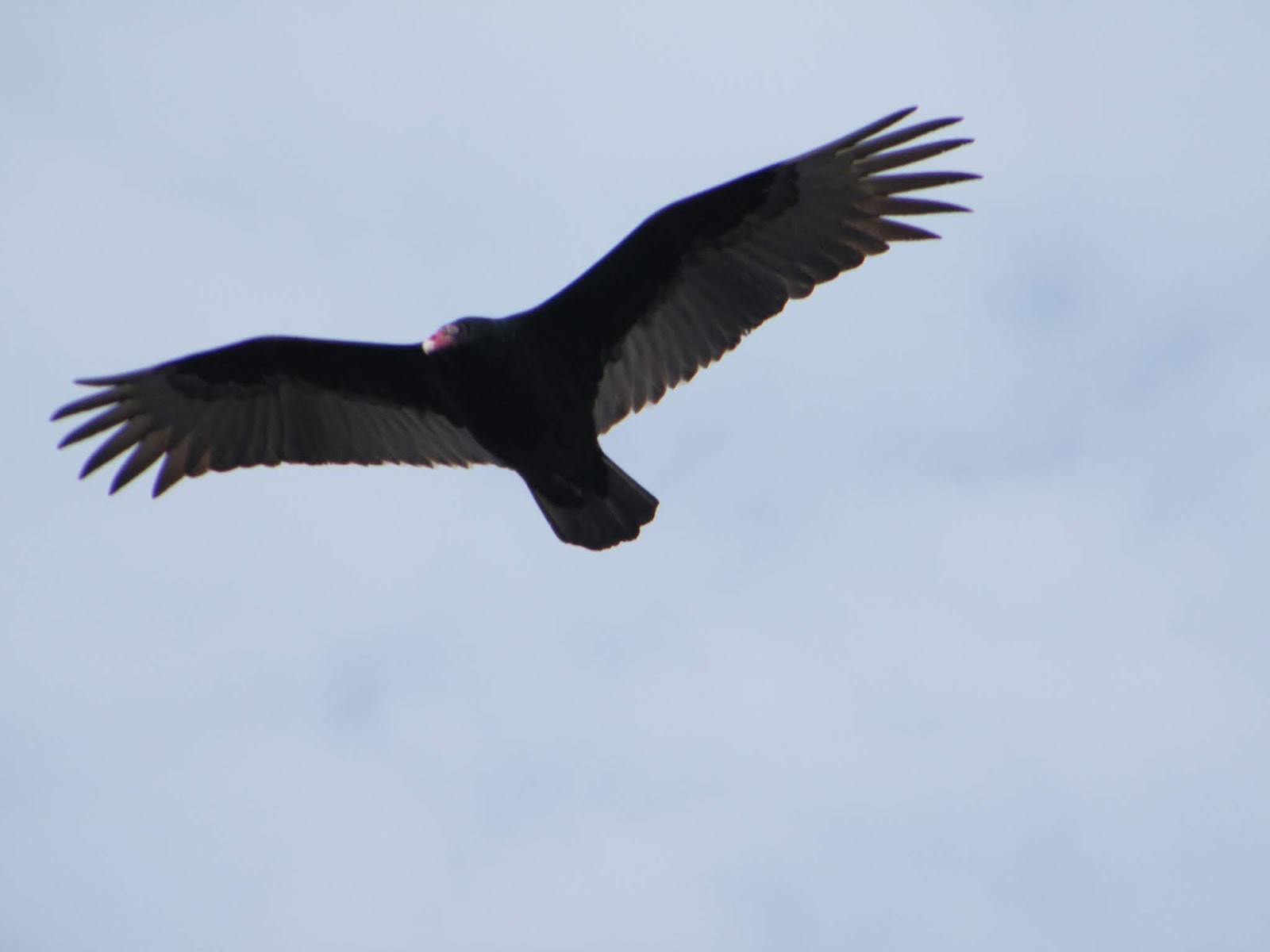
The turkey vulture is a very ugly bird. It has a red, bare head, giving it only the slightest of resemblances to Ben Franklin’s choice for national symbol. The head is bare because the vulture eats dead meat and you don’t want to be messing up feathers sticking your head into a bloody, rotting carcass.

When the turkey vulture sits in a tree above you and spreads its wings you know it is a very big bird indeed. Usually you will see one or two hunting together but at dusk they form big roosting flocks, like the one at Greystone.

So when I took my walk the first surprise was the turkey vultures were not in the usual tree but in a number of big trees along Central Ave. The usual tree was filled with black vultures.

Black vultures are an interesting story. They used to be seen only south of the Mason-Dixon line but have been gradually heading north, perhaps as the Earth warms.

These vultures are smaller and have white “fingers” at the wing tips, unlike the border of white trailing feathers on the turkey vulture. They are also stockier and can be mistaken for redtails and other buteos in flight.

Unlike the turkey vulture it dips its wings while flying and usually travels in flocks. It is an ugly bird with a silver-gray head, also bare for eating dead meat. I was driving on a back road once and about 10 of these were on a dog carcass, a revolting sight.

Then again, if people are going to let their animals loose, what do they expect? Once it is hit by a speeding car, a vulture will make quick work of it.

And there is plenty of dead meat to go around, as the dead deer and squirrels and woodchucks and possums and cats and even bears on New Jersey’s roadsides can attest.

You might ask, what were these two types of vultures doing that cold morning of my walk?

They were drying their wings from the night’s dew and warming themselves as they waited for updrafts that would keep them aloft.

Ever feel stiff on a cold morning? Well, on cold, calm mornings vultures and other daytime raptors have to wait until their wings are light and buoyant enough to fly. You don’t want to be weighed down as you seek your breakfast.

Besides the surprise of finding two types of vultures within a block of each other, the next surprise was discovering many of the turkey vultures were also on a sandbank in the pond. Vultures don’t eat live fish and they don‘t swim. I can only guess all the other prime spots - the very large, strong trees or the nearby building roof to support their weight - were taken.

I walked on, but there was one last surprise in store.

I came home the way I went out, and when I got to the pond most of the vultures had left, or so I thought. But I found them on a sunny grass field up Central Ave., chasing each other around like Canada geese.

I’ve never seen this type of vulture behavior. Try to imagine a green field black with very large vultures spreading their wings to dry, chasing each other away, making grunt calls.

It was an ugly sight, but a natural one. After all, vultures have their place in the world. They are Nature‘s sanitation crew. As my husband says about critters that interfere with my bird feeders, they gotta eat, too.

We may not like what vultures represent - the end of life, disposal of the body, the subsequent decay - but that’s the balance of life and death.

By the time I got home some of the turkey vultures were already circling in the clear, blue sky, and for a moment even these ugliest of birds looked beautiful to this Earth-bound creature.