To paraphrase Casey Stengel on baseball, if you hang out in the great outdoors long enough you’re bound to see something you’ve never seen before.
That happened to me one early Saturday morning.
I usually walk up to Collins Road and into the Greystone - sorry, Central Park of Morris County - property. At the other end of the road, just beyond where Collins joins Central Ave., there is a large tree overlooking Thompson Pond.
Usually this tree is covered with turkey vultures.
The turkey vulture is a very ugly bird. It has a red, bare head, giving it only the slightest of resemblances to Ben Franklin’s choice for national symbol. The head is bare because the vulture eats dead meat and you don’t want to be messing up feathers sticking your head into a bloody, rotting carcass.
When the turkey vulture sits in a tree above you and spreads its wings you know it is a very big bird indeed. Usually you will see one or two hunting together but at dusk they form big roosting flocks, like the one at Greystone.
So when I took my walk the first surprise was the turkey vultures were not in the usual tree but in a number of big trees along Central Ave. The usual tree was filled with black vultures.
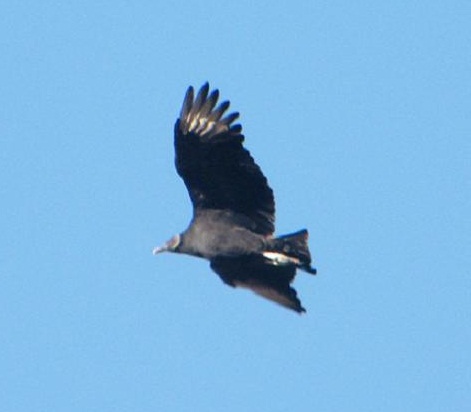
Black vultures are an interesting story. They used to be seen only south of the Mason-Dixon line but have been gradually heading north, perhaps as the Earth warms.
These vultures are smaller and have white “fingers” at the wing tips, unlike the border of white trailing feathers on the turkey vulture. They are also stockier and can be mistaken for redtails and other buteos in flight.
Unlike the turkey vulture it dips its wings while flying and usually travels in flocks. It is an ugly bird with a silver-gray head, also bare for eating dead meat. I was driving on a back road once and about 10 of these were on a dog carcass, a revolting sight.
Then again, if people are going to let their animals loose, what do they expect? Once it is hit by a speeding car, a vulture will make quick work of it.
And there is plenty of dead meat to go around, as the dead deer and squirrels and woodchucks and possums and cats and even bears on New Jersey’s roadsides can attest.
You might ask, what were these two types of vultures doing that cold morning of my walk?
They were drying their wings from the night’s dew and warming themselves as they waited for updrafts that would keep them aloft.
Ever feel stiff on a cold morning? Well, on cold, calm mornings vultures and other daytime raptors have to wait until their wings are light and buoyant enough to fly. You don’t want to be weighed down as you seek your breakfast.
Besides the surprise of finding two types of vultures within a block of each other, the next surprise was discovering many of the turkey vultures were also on a sandbank in the pond. Vultures don’t eat live fish and they don‘t swim. I can only guess all the other prime spots - the very large, strong trees or the nearby building roof to support their weight - were taken.
I walked on, but there was one last surprise in store.
I came home the way I went out, and when I got to the pond most of the vultures had left, or so I thought. But I found them on a sunny grass field up Central Ave., chasing each other around like Canada geese.
I’ve never seen this type of vulture behavior. Try to imagine a green field black with very large vultures spreading their wings to dry, chasing each other away, making grunt calls.
It was an ugly sight, but a natural one. After all, vultures have their place in the world. They are Nature‘s sanitation crew. As my husband says about critters that interfere with my bird feeders, they gotta eat, too.
We may not like what vultures represent - the end of life, disposal of the body, the subsequent decay - but that’s the balance of life and death.
By the time I got home some of the turkey vultures were already circling in the clear, blue sky, and for a moment even these ugliest of birds looked beautiful to this Earth-bound creature.
Cape May
(RE BERG-ANDERSSON)
Showing posts sorted by relevance for query ugly beauty. Sort by date Show all posts
Saturday, December 17, 2011
Saturday, February 2, 2013
An Ugly Beauty, Part 2
On Dec. 17, 2011, I wrote a blog post about the turkey vulture and its southern cousin the black vulture.
I noted how I was walking through the Greystone property and found a large flock of vultures on the ground, running after each other. I had only known of vultures circling overhead or roosting in groups in tall trees.
Since then I have been learning new things about these raptors that fly so gracefully but look so ugly when close up, especially when eating roadkill.
For one thing, one of my favorite authors, Margaret Maron, in her most recent Deborah Knott mystery, "The Buzzard Table," uses information provided by the Turkey Vulture Society as headers for each chapter. Yes, there is a Turkey Vulture Society. Lots of interesting data.
The book cover shows turkey vultures circling a house, but aside from the section headers the "buzzards" are not identified as turkey vultures at all. That miffed me. As a birder, I want precise information! My husband makes fun of me for this - we'll be watching a commercial and what interests me is not the car, say, but trying to identify the hawk flying in the background.
Anyway, there is a reference to the white feathered tips of the vultures' wings, which makes me think they could be black vultures, more likely to be seen in North Carolina, where this book takes place.
Closer to home, I've been studying the vultures that populate parts of the old Greystone mental hospital property in Parsippany, NJ - not so much their feeding or breeding habits as there are lots of places to learn about these birds, including Cornell's Lab of Ornithology - but how they deal with cold.
Last year, I thought the vultures would roost in evergreens in cold before moving to bare deciduous trees to warm up before flying in search of food. Turns out vultures are much smarter than that.
During our recent cold snap in New Jersey- the longest period of subfreezing cold we've had for 13 years - I would take a morning walk every few days. I would get the paper and come back along a route that would take me to the old Greystone property - now Central Park of Morris County - via a side street. I realized vultures don't like the cold any more than I do.
Some of them, particularly the black vultures, would be found on home roofs in the sun, where the heat coming out of the chimney would provide warmth. When the property was a mental hospital, vultures might've congregated on the roofs of the hulking stone buildings where the patients were kept. Those buildings are now gone.
But there is also a large mixed flock that congregates on the ground in an area where trees block the cold wind from the north and west but not the rising sun from the east. They also stay low in the trees, particularly on windy days. I thought these were just black vultures, which are smaller and have silver heads, but when a few would fly up and circle before coming back I would see the white along the wings' trailing edge and realize it was a turkey vulture.
As more and more black vultures made their way north, you'd think they'd be competing with the larger, red-headed turkey vultures. But apparently they have learned that in some situations it is smarter to band together, at least when roosting at night. Grackles do the same thing in winter, forming large flocks that roost on the ground with starlings, redwinged blackbirds and cowbirds. It's a matter of protection.
When it is warm, however, I have noticed the black vultures roost in one group of trees while the turkey vultures stay in another. The status quo is preserved.
Luckily for the vultures, the park provides the space to keep them safely away from humans. Fifty vultures might look imposing in a tree but they are a major hassle if they are in YOUR backyard tree. So far there's been no clamor to get rid of the vultures, a protected species under federal law.
So what can we all learn from the vulture?
In tough times it is better to band together because there's safety in numbers.
When you're a stranger in town, it is better to learn from the locals than try to impose your way on them.
Keep your head down in rough weather.
I noted how I was walking through the Greystone property and found a large flock of vultures on the ground, running after each other. I had only known of vultures circling overhead or roosting in groups in tall trees.
![]() |
| Turkey vulture, picture by R.E. Berg-Andersson |
For one thing, one of my favorite authors, Margaret Maron, in her most recent Deborah Knott mystery, "The Buzzard Table," uses information provided by the Turkey Vulture Society as headers for each chapter. Yes, there is a Turkey Vulture Society. Lots of interesting data.
The book cover shows turkey vultures circling a house, but aside from the section headers the "buzzards" are not identified as turkey vultures at all. That miffed me. As a birder, I want precise information! My husband makes fun of me for this - we'll be watching a commercial and what interests me is not the car, say, but trying to identify the hawk flying in the background.
Anyway, there is a reference to the white feathered tips of the vultures' wings, which makes me think they could be black vultures, more likely to be seen in North Carolina, where this book takes place.
Closer to home, I've been studying the vultures that populate parts of the old Greystone mental hospital property in Parsippany, NJ - not so much their feeding or breeding habits as there are lots of places to learn about these birds, including Cornell's Lab of Ornithology - but how they deal with cold.
Last year, I thought the vultures would roost in evergreens in cold before moving to bare deciduous trees to warm up before flying in search of food. Turns out vultures are much smarter than that.
![]() |
| Black vultures roosting on a building bordering the Greystone property, a picture I took. |
Some of them, particularly the black vultures, would be found on home roofs in the sun, where the heat coming out of the chimney would provide warmth. When the property was a mental hospital, vultures might've congregated on the roofs of the hulking stone buildings where the patients were kept. Those buildings are now gone.
But there is also a large mixed flock that congregates on the ground in an area where trees block the cold wind from the north and west but not the rising sun from the east. They also stay low in the trees, particularly on windy days. I thought these were just black vultures, which are smaller and have silver heads, but when a few would fly up and circle before coming back I would see the white along the wings' trailing edge and realize it was a turkey vulture.
![]() |
| Black vulture - notice the white wing tips. Photo by R.E. Berg-Andersson |
When it is warm, however, I have noticed the black vultures roost in one group of trees while the turkey vultures stay in another. The status quo is preserved.
Luckily for the vultures, the park provides the space to keep them safely away from humans. Fifty vultures might look imposing in a tree but they are a major hassle if they are in YOUR backyard tree. So far there's been no clamor to get rid of the vultures, a protected species under federal law.
So what can we all learn from the vulture?
In tough times it is better to band together because there's safety in numbers.
When you're a stranger in town, it is better to learn from the locals than try to impose your way on them.
Oh, and maybe don't look too closely at what your neighbor is eating.
Subscribe to:
Posts (Atom)


