Cape May

Cape May
(RE BERG-ANDERSSON)
Showing posts with label plants. Show all posts

Thursday, April 16, 2026

Spring Wonders

In the small gap between the winter's foot of snow and the advent of unusual April heat in my part of the country, we had spring.

In early March the weather warmed enough to melt the last of the snow, including what was piled at the top of the driveway. The crocus bloomed, the snowdrops struggled to bloom and the daffodils started growing through the winter debris. In the space of two days I could finally clear the front garden beds and cut down the dried ornamental grasses so the daffodils growing in this area could be seen. Six months' worth of collected brush was put at the curb.

Dogwood buds, before they opened and the leaves appeared.
(Margo D. Beller)

I had time to again marvel at how my perennials are able to survive an unusually cold and snowy winter to grow again in the spring without any assistance from me. Then the temperature again became very cold.

That did not stop the plants from growing or the birds from singing in the early morning. The robins, Carolina wrens and jays were particularly active. Woodpeckers proclaimed their territories by drumming against trees. Despite the cold I went outside with Merlin to do a census of what was in the vicinity. (Two days ago I saw the first report of house wren in the area. My husband helped me put up the nest box. A wren came to investigate a day later and I heard one sing this morning.)

Slowly the temperature warmed. The maple tree flowered. The viburnum and pear tree started leafing, as did the lilac. At the very end of the Lenten period there were flowers on the Lenten Rose (hellebore). The dead, brown leaves started falling off the euonymous shrubs, revealing the fresh green and yellow foliage the deer will try to get at through the fencing.

Spruce continues to stand tall and, once again, has put out cones. He hosted some unusual winter visitors this year - a pair of red-breasted nuthatches. I stand in awe of him, seeing how much he has grown since he was planted in late 2007.

However, the other tree planted at that time, the dogwood, continues to concern me. Ever since having more than half of the dogwood cut down I wait to see if the remaining live half will bloom and leaf out. This year I could see flower buds but would they open? Thanks to the heat that came upon us during the last week and a couple of brief but heavy rain showers, the buds have started opening and the leaves are growing.

The apple tree starting to show leaves. It now is covered in blossoms.
(Margo D. Beller)

And then there's the old apple tree. Last year the tree leafed, bloomed and then one big branch went dead. As with the dogwood, I had the dead part cut down. Would the tree survive?

So far it looks like it has. The tree started growing leaves and, as of today, there are blossoms. Each flower is a potential apple. But I am still watching to see how the tree progresses as the season continues. The pear tree, meanwhile, has many flowers in the upper branches I can't get at to cut back. I hope the squirrels get to the fruit because, as I found out years ago, the branches of the pear can't withstand the weight of a bear.

After all the snow the plants appear to be doing quite well despite the current heat. The azalea buds are about to open. The grape hyacinth is thriving in a way I have not seen in years. The lilies and peony are growing so fast I've had to put in supports sooner than expected. 

The New England aster I planted last year is leafing but I am not sure if the lavender has survived, or if I killed the anemone. I've put the anemone in a different pot with fresh soil in what I hope is a better place in the yard. I will be watching for signs of life. If it is alive it won't flower until autumn.

By which time the spring wonder of my garden will have long been replaced by the tedium of weeding and thoughts of putting the garden to bed before another winter.  

Monday, June 9, 2025

Aw, Gnats!, or When the Outside Comes In

A lot of people like summer. They want the heat, they want to wear as little in the way of clothes as possible and they want to go to the beach. They enjoy working in the garden, harvesting their vegetables and cutting flowers. 

I do that, too, but I do not like summer. I do not like heat and humidity, I stay covered to avoid skin cancer and, after once nearly drowning in a pond, I stay away from the water unless it is to stand on the shore and look for seabirds on or over it.

A fungal gnat that crawled through the screen but
could not get through the glass on the back door.
(Margo D. Beller)

Also, I don't like most insects, especially the biting kind. When I went to Troy Meadows the other week, during the waning spring migration time, I was set upon by black flies as I tried to step carefully around lakes of muddy water in the middle of the main, unpaved road. This week was no better at Great Swamp, when I took a friend there on her day off. When we weren't roasting in the sun we were waving away insects in the shade.

And I'm not even talking about mosquitos, the unofficial state bird of New Jersey. After all the rain we've had the mosquito eggs should be hatching just about now and the young will be hungry. 

But what I especially do not like is when certain insects make their way onto my enclosed porch, where I sit in my chair with my coffee and enjoy the breeze (including from a fan) without worrying about being bitten - unless something gets inside.

Mosquitos that get in are caught and killed. Large flies are shown an open door and encouraged to leave. Spiders are left alone because their webs catch the smaller bugs. Lady bugs are put outside where they can eat the aphids that bother some of my flowers. But the black blister beetle, which unlike the many other types of beetles in this state I find on the porch, are removed in one way or another. No-see-ums? Well, there's not much I can do about them except keep the fan blowing on me.

And then there are the fungal gnats.

Until last August I had never heard of these flying pests. They don't bite but they do lay eggs - a lot of eggs. I would catch a gnat and put it outside. Then I'd find more. Finally, I discovered an infestation of gnats in the bag of sunflower seeds I'd been using when I had feeders out. This caused a lot of bother. I stopped releasing the gnats and turned to smashing them. I dumped soil out of the plants I had put on the porch for the summer and repotted them before taking them into the house. (I did not do this for one unwieldy plant I put outside, then took inside, then had to decide whether to kill it, then cut it down after it put out new growth from the bottom.)

Going to extremes last year.
(Margo D. Beller)

Finally, I turned to chemical warfare. That did the trick, but I could not sit on the porch for a week.

So imagine my dismay when, a day after putting my plants on the porch earlier this month, when it was finally warm enough to do so, I started finding gnats again. How were they getting in?

When I had bought fresh bird seed I had also bought a pail with a lid that locks, so they weren't coming from there. Any pot that had even a trace of soil in it was in a corner of the porch under a tarp. Could they be squeezing through the mesh screens where I had windows open? That was likely. I closed all the windows and took the plants back into the house after spraying them with a solution to kill any possible eggs.

There is not much more I can do now except to kill what I can reach or hope they get stuck in a spider web

Last year's spiders helping me out with the gnats.
(Margo D. Beller)

Why are the gnats trying to come onto the porch, months ahead of when they infested my porch last year? Are they trying to get away from hungry birds like the house wrens? Has it been too hot or too wet for them this year? Is it global warming? We're not even in the heat of July yet.

When we had an infestation of carpenter ants in our bathroom in 2022, which I wrote about in September, that had been a particularly dry season and the ants were looking for water. This year we've had plenty of water, maybe too much so, and twice I've caught an ant in the bathroom. My husband has put out poisoned bait and we've had no problems since then.

With the plants safely inside I didn't feel the need to nuke the porch again. But when one of the gnats somehow came inside the house and into my den the other night I went nuclear, making sure the den doors were closed so I could kill it before it could go to where I keep the plants. I thought I was successful but a night later what I hope was the same one flew across the room, attracted by the lights. This one I know I caught, with a well-aimed paperback book. But I'll be spraying the plants and using yellow sticky tape for the rest of the summer.

How did the gnat, or gnats, get into the house? Probably hitched a ride on me. I'll have to be vigilant about that now, too.

Thursday, September 26, 2024

Spruce Asks Another Question

The other morning I was putting out the bird feeders. As I shook out the large white plastic bags the feeders were in, the nearby Blue Spruce called me over. 

"Margo," said Spruce Bringsgreen, "I have a question."

"Again?" I said, smiling.

The porch plant, with Spruce watching from
around the corner (Margo D. Beller)

"I've been watching you putting feeders on those poles for years. Why are you now bringing them out in bags?"

"You are very observant," I said.

"Well, I am very tall and I can see quite a lot," he said modestly.

So I explained about the gnats I had been removing from the enclosed porch in one way or another since early August, how I had found the containers of sunflower seed to be infested with them, prompting me to put the seed outside in a trash bag, which squirrels soon discovered. So I bought a large plastic pail with a lid that locks to put the seed. My plan had been to keep it outside until all the seed was gone. Then I went out one morning to find it on its side - my guess is a raccoon could smell the seed and knocked the pail around to get the lid to pop off. (At least it wasn't a bear.) Since then I've kept the seed pail indoors.

I bring the feeders in nightly because of that possibility of a bear passing through the yard. But I knew from taking the lid off the pail that those gnats I had seen had laid hundreds, if not thousands, of eggs, and now the worm-like larvae were on the move. Every time I unlocked the lid I'd find them crawling on its underside as well as up the sides of the pail - where I also found spiders helping me out with webs that trapped them. I would wipe out the larvae and the webs but find more of both the next time I took off the lid a day or two later.

Gnat larvae on the underside of the seed pail lid, some of
them in spider webs. (Margo D. Beller)

But that also meant there were likely larvae in the seed in the feeders. Hence the bags to keep larvae that get out of the feeders from crawling around the porch and getting into the one source of soil still available - the big plant.

"Yes, I can see Brother Tree from here," Spruce said, referring to the plant that had started life small and I allowed to grow so tall it needs an upside-down tomato cage and support poles to stand. "I hadn't seen him for a while."

Well, I told him, I had to make a decision on what to do with the plant because it was too big and unwieldy to take it from its pot and replant it in fresh soil. So my husband (MH) and I used the hand truck to put it outside on the patio, leaning against the house. It was there when I bombed the porch with insecticide. It was there when the overnight temperatures dipped into the 40s. 

Finally, realizing I could not bring myself to kill it, and once the smell of the spray had dissipated, MH and I brought the plant back inside. It now stands in the far corner of the porch where it can get two hours of morning sun, which is how Spruce sees it.

"And what about when winter comes?" he asked.

Well, I said, MH and I are getting too old to deal with bringing the plant over the step from porch to house, then rolling it to the sunny front room and then up three steps to put it into position, all with the plant falling back like a ragdoll onto my shoulder and back. The porch will keep the plant sheltered and a few degrees warmer than the outside air but it won't keep it warm when the temperatures fall below freezing. 

(Margo D. Beller)

So it either lives or it doesn't, I said. I still find the occasional gnat on the porch, most of which come in when I go out. The yellow sticky tapes have trapped gnats and I spray the soil with hydrogen peroxide to kill any eggs. But I can do no more for this plant.

"That's a shame," said Spruce. "At least it's alive."

"Yes," I said. "We'll see what happens to it - and the gnats - once winter comes."

Tuesday, September 10, 2024

Autumn Garden Colors

 I've written before about the flowers I have seen during autumnal hikes. Yellow goldenrod, pink joe-pye weed, and purple asters are favorites, as is the humble snakeroot, a white wildflower blooming now that I've allowed to grow in profusion in a corner of the garden. 

The other morning I went outside to cut a couple of purple coneflowers to add to a bouquet and realized just how many of the plants blooming now in my garden are varying shades of pink and purple. 

In spring the dominant colors in the front yard are yellow and white - daffodils, crocus, snowdrops - with a little blue from glory of the snow. Then come the deep pink of the rhododendrons and lilies, the reds of the azaleas, the white of the daisies and the yellow of the coreopsis.

In the back, meanwhile, these colors also include the pink of bleeding heart, ornamental onions, coral bells and perennial geranium. There is even some purple from columbine.

But those flowers are all gone or soon will be gone, and now the dominant color is pink or purple. (All pictures by Margo D. Beller)


It took several years of trying before I succeeded in growing purple coneflowers. The plant would grow and then some sort of fungus would turn the leaves black. But this one has grown well for years.


We had a wonderful landlady at our first apartment and she, like just about everyone else in the area, grew Rose of Sharon. Hers were purple. When I put in new plantings I bought two to frame the bay window. When they bloomed they turned out to be a very pale pink with a mauve center. One of the plants didn't last a year but the other one spawned a daughter plant behind it I dug up and moved to replace the other one. This one is the original.


I once had a friend who, for various reasons, had to break up her urban garden. She begged me to take in some of her plants, which I did. Of the plants that are still around is this liriope, which I've since divided into three plants, all of which produce spikes of purple flowers in autumn. The plants have lasted longer than the friend.


Sedum is a succulent that produces clusters of pink flowers that attract the bees. It is also a favorite of deer, which is why it is behind deer netting. It is also very easy to root - if I break off a piece by accident I can put it in water and have another plant, which is why I have a number of sedums in two netted areas in the front yard. The pink on this plant will get deeper as the cold sets in.

Also blooming pinkish purple now are the Russian sage and the butterfly bush, the latter now considered an invasive plant. But I keep it anyway, cutting it back before winter snow can bend a branch low enough to affect the netting.

Of course, there are also plenty of blooming weeds around the garden and soon enough the trees will turn colors and drop their seeds and leaves. Then it is time to close up the garden for the winter.

Saturday, September 23, 2023

Autumnal Thoughts

As I write, a tropical storm named Ophelia hit the North Carolina coast and will slowly make its way north. While still many miles away, rain and strong winds are currently lashing my northeast-facing windows. The fact it took a very long time for this storm to get strong enough to finally be named while being big enough to be constantly pointed out by local and national weather forecasters is, to me, another manifestation of the, shall we say, unusual weather afflicting us in recent years. 

This pot of coleus will eventually come inside. (Margo D. Beller)

This storm will not be like October 2012's Hurricane Sandy, which hit even my inland New Jersey area with storm-force winds that ripped off one of my window shutters and put us into cold darkness for two days. Sandy was, according to the federal weather agency NOAA the "second-largest Atlantic storm on record, and affected the East Coast from Florida to Maine, as well as states as far inland as West Virginia, Ohio, and Indiana. The storm made landfall in southern New Jersey on Oct. 29, 2012, battering the densely populated New York and New Jersey region with heavy rains, strong winds, and record storm surges."

Ophelia shouldn't be nearly that bad, and the raw, wet conditions we're facing now are nicer, by comparison, than earlier this year when the wildfire smoke blown south from Canada turned the skies over New York City orange. And then there were the fires in Hawaii that killed hundreds of people, mainly older people. The Environmental Protection Agency, in the emotionless prose of a federal bureaucracy, has even provided a report on the key threats of climate change on older people, including heat illnesses, respiratory illnesses, insect-related diseases (including ticks), water-related illnesses and, my personal favorite, mental health issues.

A couple of the zinnias I grew from seed and
cut for my kitchen. I will grow more next year.
(Margo D. Beller)

So an older person not only has to contend with physical and emotional issues but environmental ones far beyond his or her control. In my case, there is the shortening of the days and knowing at some point there will be leaves to rake, gutters to have cleaned and a garden to cut down and put to bed. My husband (MH) and I now hire people to clear the gutters and get rid of the leaves (tho' I've been known to go after the blanket of pods that falls on the front lawn), but I, however, am the one doing the work on the garden, and that work gets harder each year.

I finally had someone come over with a chainsaw to cut off the dead parts of the dogwood. Two-thirds of the tree was removed. The remaining part is still filled with leaves slowly going red. It is struggling to stay alive. As am I.

What remains of the dogwood. (Margo D. Beller)

In past blog posts I have mentioned walking among the autumn weeds and enjoying the autumnal colors. I've even mentioned the feeling of peace when cutting down the garden. Nowadays I don't feel that enjoyment, likely because as I get older it gets harder and I feel the resulting muscle pains for longer. (MH, having ceded his grass-cutting duties to paid help to spare his balky knees, is much happier.) 

This year's wet summer - not as bad for us as for New England - has been a boon for my flowers, keeping the red spider mites and the white flies away (unlike last year). It has also benefited the weeds, which proliferated until the unusual September heatwave we had subsided and I could go out and pull them. 

I guess what bothers me even more than climate changes I can't control and the aches and pains of my older body is the inevitability of it all. The summer ends. The birds fly south. The leaves fall. The days grow shorter. The plants must be cut back or brought inside from back porch or front yard before the winter cold can kill them. Daylight savings time ends (this year on November 5). The year ends. 

Life ends. But not anytime soon for the world or for me, I hope.


Sunday, June 11, 2023

Catching Up in the Garden

Last week, New York City had the dubious distinction of having the dirtiest air in the world because of the smoke blown on winds out of the north from wildfires that continue to rage throughout Canada. At its worst, the smoke made the sun look deep orange, kept the temperature to the mid-60s (F) and turned the sky brownish-yellow. The smell of burning wood was thick.

Stargazer lilies, supported by a tomato
cage, protected by deer fencing.
(Margo D. Beller)

Living as I do 35 miles or so due west of the Big Apple, I could not avoid this manifestation of the continuing harm of what is now called "climate change," but I still refer to as global warming. (I know there are differences between the two terms but the overall destructive effect is the same.) There has been very little rain anywhere in my area, and apparently the same is true of Canada.

This is not the first time smoke has filled the skies over my part of New Jersey. Usually the smoke comes from wildfires in the southern part of the state, such as in the Pine Barrens, during extremely dry periods during the summer. The smoke is blown north on hot winds from the south. This year will likely be no exception because with the lack of rain those fires continue, unfortunately.

But this thick yellow smoke from Canada was unprecedented. A persistent low off the eastern coast kept pulling the smoke into my region until the air was toxic to breathe for those of us in "vulnerable" groups, who were urged to stay inside with the windows closed. I was under house arrest, for the most part. If I absolutely had to go outside, I kept it short and wore a mask. 

Blooming viburnum (Margo D. Beller)

The world continued on without me, of course. People were urged to limit their pets' time outside but the wild animals - including birds - were still out there foraging for food, both for themselves and for their young. Somehow they managed, but I have to wonder about the effect of that poisonous air.

When the smoke finally cleared, literally, it was with relief I could go back outside. I walked around the yard and found some flowers had faded - the rhododendron, irises and the peony - while others were blooming (viburnum, salvia and stargazer lilies) or growing to the point where they would soon bloom (butterfly weed).

Meanwhile, what I thought were peppers growing from the seeds I'd planted a few months ago are not peppers. I'm not sure what they are. I've moved those pots to make more room for the pots of marigolds and zinnias that are definitely growing from seed. 

I don't know what this is but it isn't
a pepper. (Margo D. Beller)

The apple tree is filled with growing fruit that has been getting knocked to the ground, still too raw to be usable. I'm not sure if the squirrels are searching for ripe apples to slack their thirst of if the tree is dropping apples to save energy because of this drought. Maybe both. 

I also took note of the birds. One of my few trips outdoors was to make sure the water dish was full. It drew a pair of goldfinches, a song sparrow and a jay. (I'm sure there were others, including squirrels, but I didn't see them.) Every so often I would see the resident cardinals and catbirds hunting around the yard. Overhead I heard cedar waxwings and chimney swifts, hunting for seeds or insects. 

Apples in tree (Margo D. Beller)

And, of course, I was able to see what was happening with the house wrens. Based on their activity the eggs had hatched but the young were still small enough for either parent to go inside to feed them. When the young get bigger they will jostle for position and the parent will only be able to feed the one or ones that can push to the nest box opening. Right now the parents go in with food and come out, sometimes with chick poop, which must be removed to keep bacteria out of the nest. I estimate two or three young are in the nest.

As I watch the wrens following their instincts to feed their young so they will one day (soon?) fledge, feed themselves and continue the cycle, I have to wonder why it is that humans, the top of the food chain and the only creatures capable of creating weapons - and now weather conditions - to destroy themselves, are considered to be so damned superior.

This cropped picture was taken through my porch screen. if you look
carefully you will see the parent wren over the box. Less
obvious is the wren looking out from inside.
(Margo D. Beller)


Sunday, July 9, 2017

Weeds

Weeds are flowers, too, once you get to know them.
    -- A.A. Milne

Ground ivy (Margo D. Beller)
Summer is a time when daisies, brown-eyed susans, some flowering shrubs and other plants are at their peak. But it is also the time when I start to take note of all the weeds in my lawn, flower garden and in the waste areas along the road.

Any flower that is in the wrong place is a weed. So when you see the familiar yellow dandelion flower in your lawn, and you know that soon there will be the uglier seed head, it is time to go out and eradicate it before there are more.

My main lawn problems are ground ivy, quack grass, sorrel and assorted vines, some of which can be poisonous when handled.

I have a book that identifies weeds and tells you how to pull them out, their bad qualities and how you can use some of them. That is how I learned that lamb's quarters, picked when small, can be used like its cousin, spinach.

Knotweed and another common roadside weed I can't identify.
(Margo D. Beller)
Some weeds I leave alone. One year a clump of lamb's ears came over from a neighbor and started growing in my garden. I dug it up, moved it to another, unnetted area and it has since thrived, spread and flowered. Deer don't like it but the bees do.

However, most weeds I would not want in the yard. I don't mind clover or the yellow ground cover called cow vetch or its pink cousin the crown vetch, used by many to hold dirt on a hillside, but Japanese knotweed is invasive and will grow everywhere.

Some invasive plants can be useful. Raspberries, for instance, or wild rose. Both spread widely and, at least in my yard, I am carefully pulling them out of the wrong place because they both are covered in very sharp thorns and thus have to be picked when very small. I spent an afternoon recently crouched behind my rhododendron, behind the deer netting (always fun, gardening behind deer netting), because along with the many rose of sharon seedlings and wild mint (both active spreaders) was at least one wild rose.
Raspberries (Margo D. Beller)
But if you go along the roadside and find raspberries growing, pick your fill but carefully. They taste as good as the ones from the store. I have some wild strawberries in places in the yard and the small berries, while not as large or sweet, are tasty. But, again, they are not growing in the "wrong place" and so I leave them alone. What I don't eat, the birds or deer assuredly will.

Milkweed (Margo D. Beller)
Milkweed is another useful plant you'll find blooming along the road now. Butterflies, particularly the endangered monarch butterfly, lay their eggs on them and the resulting caterpillars feed on the leaves. Many organizations give away seeds to encourage more of these flowers, and many towns plant them in parks and other areas where they can spread. There is also butterfly weed, an orange milkweed, but this is a plant where once you have one growing it is not easy to move it because of the long taproot. But it draws butterflies the same way.

Five-leaved Virginia creeper and three-leaved poison ivy
(Margo D. Beller)
Thanks to my guides I now know a bit more about vines, but not that much more. There is one vine with oval leaves I see waving its tendrils as it grows tall enough to grab onto something, usually a rose bush where removing it can be a painful experience thanks to the thorns.

I've learned the vine I find every so often in my hedge is belladona, which has purple berries that are poisonous. The vine, if grabbed with bare hand, will make you itch so put your gloves on.

Another common visitor is the Virginia creeper. It has five leaves and will grow up trees, around yards and generally all over the place. Unlike the trumpet vine, it does not provide the lovely orange flowers that draw hummingbirds. Or at least not in my yard. The leaves will turn dark red and it will produce blue berries for the birds but I usually don't let them get that far.

Dead areas of my lawn are quick to fill with ground ivy, quack grass and other weeds I can't identify except for the three-leaved clover-like leaves of the wood sorrel, another weed (like young dandelion greens) you can use for supper if you like. There are many other weeds in many other shapes that I can't recognize. I pull them out just the same.

Maple sapling (Margo D. Beller)
Even trees can be a problem if they are growing in the wrong place. Sometimes squirrels or chipmunks bury their nuts and don't get back to them, or forget about them. Then I walk around the yard and find small oaks, beeches, elms or the occasional poplar from another yard. These get pulled out, too, although once I tried planting an oak sapling with nut still attached in a pot. A chipmunk dug it up and took the nut, leaving the rest to die.

But for me the absolute worst is poison ivy.

Thanks to all the rain this past spring, it seems to be everywhere. If left alone it will climb up trees and get so thick it will kill them. I have to be very careful when I pull it out or if I spray it. If you do get into poison ivy you have 20 minutes to wash the affected area with cold water to have any hope of avoiding itching.

However, earlier this year, despite my best efforts, a bit of rash came up on my right arm two days later and lasted for weeks. It was after that I started using weed killer, which may seem like an extreme measure, and is surely less than ecological, but it is better than my arm getting covered with an itchy rash or my lawn covered with this pest.

Poison ivy covering tree (Margo D. Beller)
Many wild and native plants are good. They need less in the way of water or food and they look pretty. Many, such as yarrow, have been "cultivated" so their more destructive traits are bred out and they can sit in your garden and not take over while looking pretty. And deer don't eat native plants. (I wish they would take out some of that knotweed.) If a wild New England aster or more goldenrod springs up in my yard this fall, I'll be leaving it alone.

However, when it comes to weeds I do not like, I do my best but pulling or spraying them is a losing battle. I can only hope to keep them under control enough for the plants I like to survive. I can put mulch down to smother them, dig them out by the roots or spray them but they will always come back if there is a bit of dirt, some sunlight and water to make them grow. They are survivors. They will be around long after I am no longer in this house.

Saturday, April 8, 2017

Growing My Own

Though I do not believe that a plant will spring up where no seed has been, I have great faith in a seed. -- Henry David Thoreau

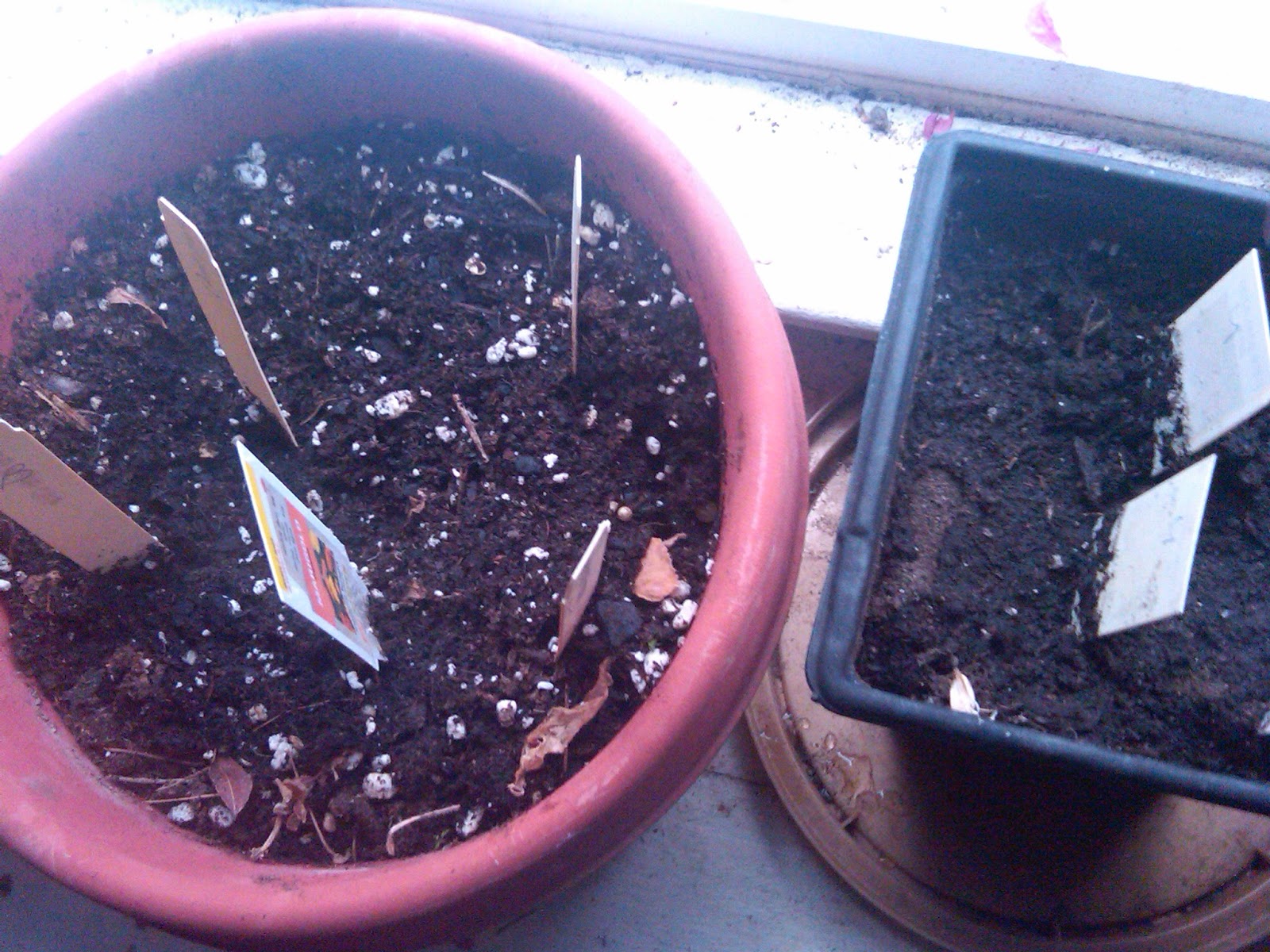
Sitting on my window sill in my sunny front room are two pots filled with pepper seeds. I am being rather adventurous with what I hope to grow -- long cubanelle peppers, some hybrid bell peppers, a couple of mildly hot peppers and a lot of my favorite, a sweet, long frying pepper called Italia. 

Last year I managed to get two Italia seeds to grow and put them outside with the previous year's pot of peppers that I thought I had killed when I brought it inside, not knowing it was infected with white flies. It lived despite my hacking it back and then spending some time in quarantine on my enclosed but not insulated back porch, and provided me with extra peppers. (I tried to keep them inside over this winter but the white flies were fierce and they all had to go.)

So far this year I have had little success with the seeds.

This year's pepper seeds. (Margo D. Beller)
I gave a friend seeds from one of last year's Italia peppers and hers are growing. Of course, she has a nice window sill over her sink facing in a direction that provides bright light. She also planted them in mid-February, which is not the usual planting time in NJ but we had a spate of April-like days. She was lucky. By the time I put a few older seeds in a pot, warm February became a cold March and, despite being on a sunny window sill, nothing came up.

So now I have two pots filled with seeds that are not quite as old, and I am waiting. If any seedlings come I will wait for them to get big enough to be put in larger pots and then put outside, protected from digging chipmunks and hungry deer. 

Why do this? Because it costs me nothing but some time, soil, a pot and water and in return I get some peppers for my cooking. I buy fewer peppers and know exactly what is going into growing them. And like my flower gardening, I find I enjoy growing these vegetables.

Two of last year's Italias. (Margo D. Beller)
My grandfather was a gardener, and while I have an affinity for flowers and house plants I inherited from him, I have never been as successful as he was in growing tomatoes. Peppers have been another matter. Several years ago a friend insisted on us all going to a pepper farm he'd read about in central New Jersey. We bought plants. I potted mine and it grew and produced very well, though I wasn't crazy about the type of pepper I had bought. 

It was several years later that I bought, and grew, an Italia. Its fruits have a lot of seeds and some little voice told me to save some of them. Good thing I did because as this pepper farm got more writeups in the local foodie press, more people ordered peppers online or came to the store, as we did, to buy plants. Italia is usually sold out now. I've grown it from seed ever since. One pepper can create a garden of new plants thanks to all those seeds.

I tried other peppers but the results were mixed - one potted pepper plant grew to the size of a small tree and produced no peppers. I kept it over the winter just to see what would happen and the next year got all of four peppers, none of which were any better than the Italia. 

So that is why I grow my own.

Meanwhile, I know there are ways to induce growth. There are special potting mixes, special lights. I don't bother. My friend has bright daylight and potting soil containing her own compost. So do I. The only thing that might make a difference is the age of the seeds. Usually that is not a factor unless I've been storing them - in little packets made from paper toweling - improperly.

Anyway, I have no room for these grow lights, either in my front room or in my half-basement, where the plants would get too much heat from the furnace. 

As The New Yorker's Katharine S. White says in her 1959 column "Before the Frost" about taking care of house plants in winter without using grow lights, "Though I am willing to be a floor nurse, I have no intention of becoming an electrician."

So I watch and wait and hope April gets warmer and at least one seed sprouts. If it is an Italia, so much the better.


Tuesday, April 4, 2017

Onward and Upward in My Garden

After finishing a collection of letters between garden writers Katharine S. White of North Brooklin, Maine (and the New Yorker) and Elizabeth Lawrence of Charlotte, NC (and the Charlotte Observer), I was inspired go to back and re-read my copy of Ms. White's New Yorker columns "Onward and Upward in the Garden," which was the title of her 1979 collection, edited by her husband (E. B. White) and published two years after her death.
Clockwise from bottom - Christmas cactus, trout begonia, a pot holding the Chinese
evergreen, orchid, humidifier, amaryllis (Margo D. Beller)
I read this book of columns many years ago after reading an interesting biography of KSW by Linda H. Davis. I found the collection in a used bookstore in Marblehead, Mass., and the owner was so impressed by my knowledge of White and gardening (learned, in part, by watching my paternal grandfather) she gave me the book. (It didn't hurt that MH was buying other books for himself. Bookstores never go hungry when he visits.)

It was not long after reading this book the first time that I found the book of letters, in another used bookstore (this time I paid for it).

Ms. White is a woman after my own heart. She claims she knows nothing much about gardening but she knows what she likes and the simpler the better. She is not shy about stating her opinions. She complains that the harsh Maine winters kill many of her plants but she buys more anyway, for use indoors and outdoors. Despite increasing physical infirmities, she just can't help herself.

She says she has no room for the potted plants she brings inside; that is my complaint, too. Our house faces southwest and our front room (originally a company room but used mainly to hold books and CDs) holds my plants, either on the large window sill or on some nearby tables where the plants get light but not direct sun. There are several different ecosystems in this one room, and unfortunately the other south-facing rooms aren't big enough to hold a plant table along with the other furniture.

Books, geranium in its hanging pot and a small pot of cactus to its right.
(Margo D. Beller) 
The one orchid I have - a moth orchid, a gift from an orchid-loving friend who thought I would love it as much as she - would do very well in one of my humid, windowed bathrooms, but both face north and are rather dark. My enclosed porch, where every summer I put the plants that, like the orchid, need light but not sun, faces north and is not insulated for all-year use. So in winter my orchid stands near a small humidifier, which also helps the nearby Chinese evergreen and another huge plant I can't name that started out as a little guy in a pot on the desk of a co-worker who left it behind when she went to another job.

Most of my plants I did not buy but are either gifts or orphans I took in - the latter include a red annual geranium that was pulled from a window box of a restaurant in town and dropped on the sidewalk, a pot of snake plants that I inherited from my maternal grandmother, miniature cactii from an office move, a coleus pulled from a planter in the middle of Times Square (it is very easy to take cuttings and root them in water. I now have great-granddaughter plants from the original.), a trout begonia from a friend's office (this one is also very easy to root) and a jade plant from the late father of a friend of a friend who didn't know what to do with it.

From left to right: begonia (with pink flowers), rosemary, citronella plant,
rescued geranium, 2 pots of pepper seed and one of two
great-granddaughter coleuses. (Margo D. Beller)
All of these plants have thrived and, in the case of the snake plant, grown almost too well. Recently I received a gift basket of houseplants from my mother-in-law, I bought a second geranium for its hanging pot (and then couldn't bring myself to dispose of the plant when it started flowering) and a small rosemary plant that is now a huge rosemary plant, so huge I could cut some, root it and give the daughter plant to the same friend who gave me the orchid. Another friend was eager to unload some of her citronella plant and I battle it each summer to keep it from overgrowing.

It can be a hassle to take care of so many plants, but it is certainly easier than fussing with deer netting while testing my knees and my back putting in or tending to outdoor plants.

As KSW says, "I find that the chief pleasure of growing things indoors is that it can be a natural process - a simple way to bring nature into the house."

She reads garden catalogs like literature, and I reminded MH that our one visit to White Flower Farms in Litchfield, Conn., was because of her many references to the company. She also cites, among others, Wayside Farms. Both are still around and now have websites popping with plants. But KSW sought a real catalog to thumb through and dream over. You can still do that, too.

I won't be doing it, however, because, as she would be the first to admit, that way madness lies.

Sunday, April 10, 2016

Return to Life and My Stand Against the Disposable Society

Every spring, when the worst of the cold is over and the snow has finally melted, I am amazed at what survives in my garden and saddened by what does not.

Despite neglect or doing something wrong out of ignorance, the perennials come back and I am both humbled and thankful.

The same is true for house plants. When I accept a house plant as a gift from a friend or rescue a plant someone has cruelly ripped from a planter and then thrown on the sidewalk - the bulk of my house plants are one or the other - I have to think long and hard about where to put it so it can get the most (or the least) amount of light. I have to hope the plant doesn't mind being watered only once a week or that in winter there will be a lot of dry heat and not a lot of moisture.

One of those plants is an orchid I thought I had killed because I uprooted it when it didn't have to be uprooted, cut back what I later realized was a lot of its root system and then fed it at the wrong time. Somehow that plant has survived, and this year is the second straight it will flower.

Last week, I wrote about the mistreatment of my peppers and my cannas. The cannas saddened me in particular because I knew better. I knew that if you took a tropical plant and put it on a porch where it can get down to the single digits overnight, it is not going to be happy. What I didn't realize was putting a plastic sheet or two and a blanket over the pot would keep in moisture on a plant that was supposed to be allowed to dry out.

I moved the pots indoors, into a sunny part of the one room where I can place all my house plants, and hoped for the best.

Two of the five pieces of growing canna, April 2016 (Margo D. Beller)
Well, when I wrote about them last week I thought they were dead. And then one evening I looked into one of the pots and saw two signs of life! Two little bits of green poking out of the pot, which was solidly packed with roots and corms. A few days later, I pulled the pots onto a tarp on my enclosed porch and started poking around -- which meant dumping the solid clump from the pot, using a saw to cut into it and then a spade to pull the sections apart.

I found five growing pieces of canna. I had planned to divide what was in the pot this spring anyway and so filled the pot with soil and put in the five pieces so they would have plenty of room to stretch out and grow. Cannas can get pretty big and after a few years they grow into each other to create a solid mass.

I looked very carefully at what I turned out of the other pot but saw nothing growing.

Now, it is always possible there will be growth in what I'm composting. My keeping it in the deep freeze might've put the plant into a deeper hybernation than I realized. If that is the case, when I put it all in the compost pile I won't be surprised if I see a mass of large, green canna leaves growing, which I can then either pull up and plant elsewhere or leave alone, a kind of zombie canna graveyard.

Why do I mention all this?

First, because I am relieved I am not a plant killer.  Second, because once again, Nature will take care of itself if Man (or me) doesn't mess around with it.

Most times people buy plants, keep them for a while and then throw them in the trash. This is a waste of your money, the plant grower's time and the compostable material in the plant.

When I take care of my plants, when I keep them going far beyond what the label says (and that includes "annuals" I've kept going for years), I am taking my stand against being part of a disposable society that doesn't think twice about putting in the garbage furniture, bicycles, plants or other things that can be donated to others for repair and resale or gifting.

My front room is full of life, and it is another thing that gives me a reason to live.

Sunday, April 3, 2016

Owning Up to My Mistakes (Garden Division)

When something goes wrong, I'm the first to admit it/The first to admit it, and the last one to know
-- Paul Simon, "Something So Right"

Throughout my career I have always owned up to my mistakes. If through arrogance or misunderstanding I cause an error, I admit it.

That is why in this post I am going to own up to a couple of major garden mistakes that have resulted in the death of all but two plants. That is also why I am not going to show any pictures. I don't see anything interesting in showing a pot of dead plant.

There garden fatalities involve two types of plants that need warmth to survive: canna and pepper.

I'll start with the pepper.

For years I've ignored conventional wisdom that says you grow your pepper plants, you harvest the peppers and when winter comes you pull up the plant, put it in compost and either start new seeds or buy a seedling the next year.

I have always grown peppers in pots. I have not cared to endure the rigors of digging and fencing a vegetable garden, although I always envy those neighbors with the time, energy and strength to do so. Putting a plant in a pot and putting that pot behind deer netting is much easier, plus I can keep it in the sunny front of my house and it looks like just another plant to those neighbors who are anal about "keeping up appearances."

When winter has come, I have brought those pepper pots indoors and put them in my sunny front room. The plants usually do better the next year when I put them back out front. One year I was foolish enough to bring in five different types of peppers. No more. I play God. If it is a plant whose peppers I enjoyed, it will get saved.

This past winter I had inside one plant I was hoping to keep going for the third year and another I had grown from seed.

Unfortunately, last year I bought a basil from a grocery store and either the plant itself or the weather conditions created a major whitefly infestation. The flies themselves are annoying but when they are busy sucking on the leaves and laying eggs they create a "honeydew" that will eventually kill the host's leaves and thus the plant.

As I dealt with the basil, the flies took flight and infested the tomato I had growing. As I later found out, they also were all over the two peppers I had in the house.

During the worst of the winter the flies were either dead or dormant. However, as the days turned warmer and longer, the flies made themselves known all over the plants (which were still producing small peppers). When they started flying to my other house plants, I knew it was time to act.

I put garbage bags over the peppers and got them outside and behind the netting. I took out the plants where flies were going - they like the underside of big, soft leaves - and made sure to inspect and clean out the plants before bringing them indoors. I sprayed the peppers and left them in what at the time was a pretty warm day.

Unfortunately, the weather turned windy and cold and despite my best efforts at protection, the older one died. Peppers need overnight temperatures of at least 50 degrees to survive. They weren't getting them. So I put the pots on the enclosed back porch, where there was sunlight for about 6 hours in the morning, composted the dead plant and left the other one - until yesterday, when I saw the forecast called for daytime and evening temperatures way below 50 degrees.

So that plant is in the kitchen, where the natural light is dim and defuse but at least the plant is warm. The flies are dead and gone but the few leaves I didn't rip off look terrible, and I don't know if this plant will survive until, say, May. So I have three seeds of this type of pepper (I save seeds for this reason) in a pot on the sunny window sill as a hedge.

And now the canna.

Cannas are tropical plants grown more for their foliage than their flowers, which tend to show up in spikes during the hottest, most humid part of the summer. When I was first given them by a now-former friend, she told me that after frost killed the foliage to dig the plants up and wrap them in newspaper and put them in a cool, dry place.  I did that and lost about half of them.

The next year I put the cannas in a big pot. They did almost too well -- soon they were so crowded together I had to divide them. Now I had two big pots. I would give them away or compost them. Composting them created what I called "zombie" cannas - they were growing in the compost pile. So I would dig them out and put them in the ground and just leave them there over the winter. They would die, but I would still have my pots because I would bring them into my sunny front room and put them in a corner out of the sun. Inevitably, they'd start growing anyway.

Well, this year I didn't want them taking up space in the sunny front room. I had no room in my overjunked garage and my small basement is quite warm because of the furnace. So to my shame, I put them in the warmest part of my enclosed porch and covered them with plastic sheets and then a blanket. This was the absolute worst thing I could've done.

First, the temperature on the porch, even in the warm area against the kitchen where I put the pots, got down to the teens at one point. Second, the plastic sheets kept in the moisture rather than letting the plants dry out, as they would've done wrapped in newspaper. By the time I pulled them into the house and put them in the sun in the front room, they were dead. I have watered them to see if there is life but there has been nothing. By the end of the week, they'll be composted.

Ironically, I did one other wrong thing that has kept one canna alive. This was a zombie I pulled out of the compost at the end of last summer, potted and then brought into the house and kept going over the winter. It got no "rest" in its pot, which is the reason why you dig them up and let them dry out in the first place. It seems to be growing just fine.

No one is every going to confuse me with a master gardener. But I do learn from my mistakes -- once I realize them.