Cape May

Cape May
(RE BERG-ANDERSSON)

Sunday, June 5, 2011

The Wren Days of Summer

There comes a time when you have to acknowledge spring migration is over.

No more blackpoll warbler, whose squeaky-brake call was heard for two weeks in the backyard. No more large flocks of goldfinches jockeying for position at the thistle feeder.

Far fewer birds are singing at dawn. The other day as I was hiking in the neighborhood I heard a strange song, then spotted a goldfinch. He wasn't singing but the male indigo bunting at the top of the spruce was.

But that's the exception. At this time of year birders leave the woods and head to the shore to look at the peeps and waders. The birds sit in the open and, if you can put up with the biting flies and mosquitoes, you don't have to work as hard at seeing something.

This is the season of the breeders. In my brother-in-law's New Hampshire woods, the black-throated green and blackburnian warblers still call to protect their nesting territory, the wood thrush and veery sing all day and the yellow-bellied sapsucker drums loudly on branches.

In my area, we have cardinals, catbirds, chipping and song sparrows and loads of robins. The chickadees, titmice and nuthatches sing every so often but they are more concerned with feeding young behind the thick tree canopy. If I didn't have suet out I might not be seeing downy, hairy or redbelly woodpecker.

Thankfully, there are wrens.

The carolina wren, such as this one from last winter, has a very loud song for such a little bird. If fed during the worst of winter, it will hang around all year. In the last week I have heard a carolina wren singing from the next street. One of the reasons why I love carolina wren is it sings all the time - in winter's cold, in summer, in breeding season. So this one is singing and is likely proclaiming his territory.

The other breeding wren is the house wren, which comes up in spring after wintering far to the south. (This year's current singer is at the top.) Years ago a friend gave me a small decorative bird house and for the hell of it I hung it in one of my apple trees. To my delight a house wren and mate raised a family in it. It was not meant to be a real birdhouse so it was not a surprise that it broke apart after a few years.

At that point I went to the local Audubon office and bought this wren house.
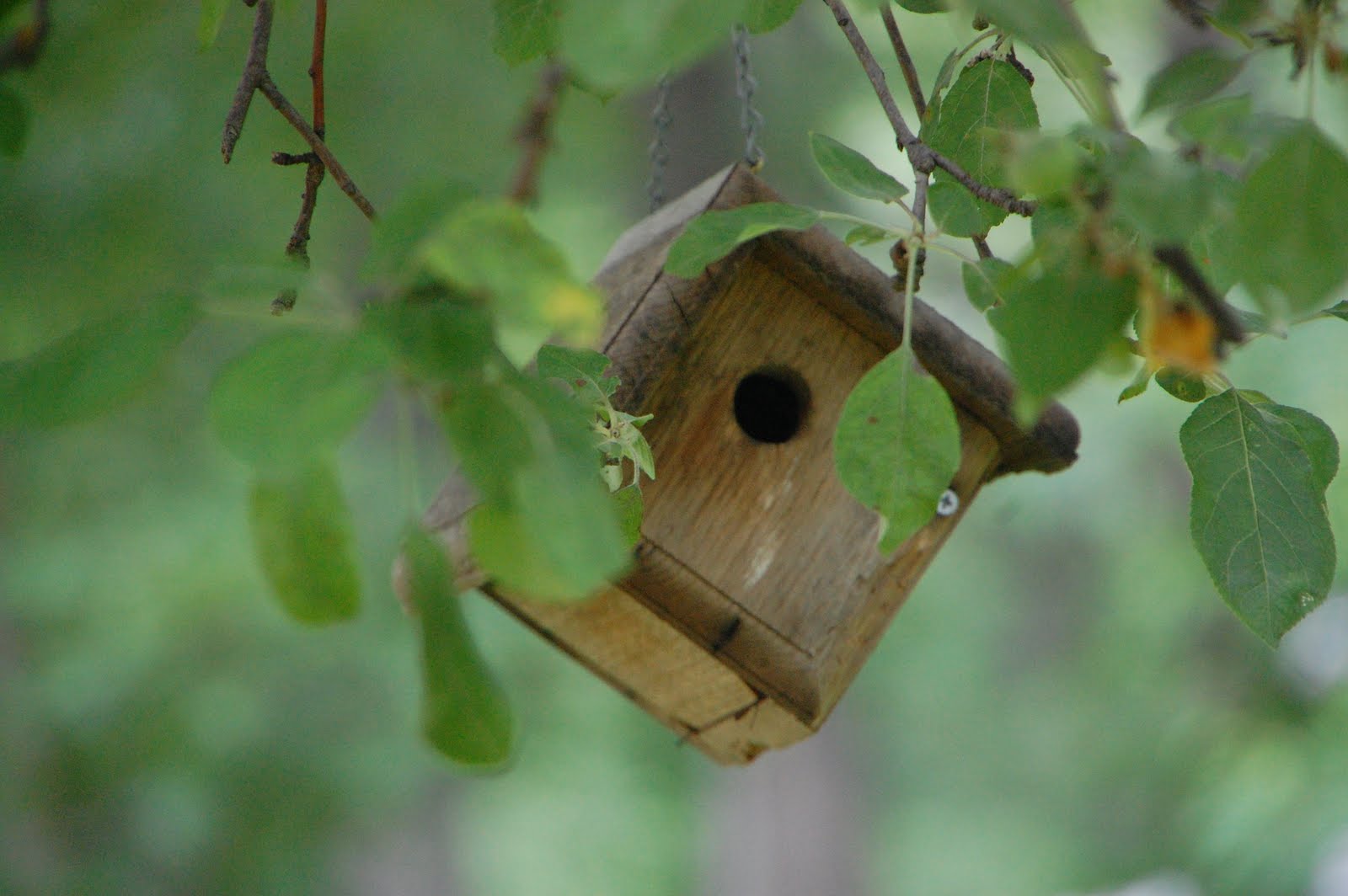
I wait for "house wren" to show up on area birding lists and then put the house up. Usually within a few days there is activity and later a brood or two. (The opening is too small for the carolina wren.)

This year, as with everything else during a cold and wet spring, things were different. It seemed to take a long time for a house wren to discover the box and then after a few days it was silent. A week would go by and then there would be early morning wren song.

If you look at the house above you'll see a bit of stuff coming out the bottom - nesting material. I see a pair of wrens going in and out of the box but I don't hear any cheeping. At this point I am just glad to have them at all. It is nice to be awakened by a house wren's bubbly song rather than the alarm clock. It is nicer to hear the house wren nearby and the carolina wren a block or so away.

As I get ready to take the feeders in for the season the wrens will be my summer solace.

Saturday, May 14, 2011

Slowing down

Today, as I was working in my garden, I heard the "squeaky brake" call of the blackpoll warbler. I've been hearing Old Blackpoll alot this week, singing high in the trees near my office and around the yard.

If you can find it you would see a bird that looks a lot like a chickadee but does not flit about as the 'dee does. This is the male blackpoll and he is a slow and steady gleaner of bugs in the upper tree canopy. So is the female but she is alot plainer, as most female birds are so they can blend in while on the nest.

Blackpolls have always impressed me because they have one of the longest migration routes of any bird, including other warblers.

But here is the significance of the blackpoll for me: It is one of the last of the warblers to pass through my area northbound. That means from now on, migration is slowing down.

Oh, there will still be birds passing through for a few more weeks. Also, places like the Great Swamp and Delaware Water Gap will host numbers of breeding birds through the summer.

But for me it isn't the same as spring, when you hear your first black-throated green of the season.

This year has been different.

This year, I haven't heard a black-throated green. When I read the bird reports I learn northern New England and southern Canada are seeing influxes of birds weeks earlier than usual. Were they pushed up by the wacky weather we had this spring, strong winds from the west and south or the unexpected warm days making them think they'd better get a move on?

This year seems different for me, too.

Maybe I'M the one slowing down. I am getting older. My neck hurts more and longer when I look up at treetops for too long, my legs tire from what seems like endless stops and starts and it gets harder to wake at dawn on a Saturday after a busy, busy work week.

Are you working harder than ever to keep your family fed and bills paid nowadays? Me, too. The pressures never end.

Intense work-week pressures used to send me into the woods on weekends. But I am at another job now and, while busy, things are not as intense.

Or perhaps I am even getting a bit bored with the eastern birds I find each year. I surprised myself to realize that with the exception of the Wilson's warbler in spring and the Connecticut warbler that tends to pass through my area in fall I've seen and/or heard every Eastern warbler, including the Swainson's that I saw a year ago on a Florida barrier island.

That trip might've been the highlight of my birding life thus far. Lovely sunrises, as you can see above. Great food on the Panhandle. You could stand still and within 30 minutes see 30 birds, some at eye level. It was my first time seeing (rather than hearing) a worm-eating warbler, for instance.

After that, trying to see a flitting shape high in the leafed-out trees on a cold spring morning through binoculars you can't get focused fast enough seems very old indeed.

MH told me he is relieved I am slowing down, that I am less obsessed by birding and can "take it or leave it" and do more resting on the weekends.

My husband sees that as a good thing, but as I listened to the blackpoll today for some reason the thought left me rather sad.

Saturday, May 7, 2011

In the dark

For about five years I would have to get up at 3:45 a.m. to catch a 5:20 a.m. train and be at the office in Jersey City by 7 a.m. I always woke in the dark and most of the time I walked in the dark, too. The short period of a month before and after Memorial Day would allow me to walk at dawn and listen to the singing of warblers, finches and the Big 4 of robin, cardinal, song sparrow and catbird. (The most I have heard at one time those dawn mornings over the years was 23 different types of bird.)

Since changing to more normal hours I've come to appreciate what I had while walking in the dark. I learned the constellations and traveled with a moon shadow. Most house lights were off and except for adults delivering newspapers from their cars (no more the boy or girl on the bicycle), I was usually alone in my travels. Unlike life in New York City, the only thing I feared most during these trips was spooking a skunk. I was never sprayed, thankfully, even when I practically kicked a young one sitting at the edge of a dark road.

Seeing deer was a given, although the 15 that ran out of a yard in a freight train-like line stopped me in my tracks. I've also seen racoon, possum and red fox, including one that sat literally in the intersection of two roads until I walked close to it.

If you go out at night when the sky is clear and the moon is full during migration season you can see the birds cross the moon and - listen carefully - hear the flight calls. I'm not experienced enough to be able to tell you what I am hearing, but just hearing them is a thrill.

But what I miss most, however, is the calling owls.

I heard what you would expect - the hoo-hoo-hoo of the great horned owl, the whinny of the screech owl.

But I have heard the screech owl actually screech (it isn't pretty) and once I heard the "who cooks for you, who cooks for you all" of the barred owl.

And then there was the time I heard the most unearthly screaming, sounds that were not of this world. I have since learned they came from a barn owl that must have been passing through and decided to sit in a tree over our town's brook.

Nowadays I come home in daylight and once in the house I stay put. When it gets dark I am usually getting ready for bed. But there are times I get up in the night and stand by an open window, hoping to hear one of the owls.

I was lucky once - a brood of noisy great horned owls yowling in my backyard. I threw on a robe and ran out and listened. Momma Owl saw me, of course, and I could hear the yowling move off when I tried to see them. I never did.

Maybe it's the degree of difficulty that makes night owls so special. MH and I once saw a snowy owl on a pier in Piermont, NY, where it had been for some weeks drawing a crowd. It looked bored when we saw it. Snowys hunt by day so seeing this was easy. So was the short-earred owl we saw at a grasslands in upstate New York.

More difficult, and thus more satisfying, was seeing long-earred owl. I wrote last time about the ones at Great Swamp but the first one I saw was in Central Park, and I had come in just to see it. Marie Winn was kind enough to let me know where in the Pinetum it was but it was still hard to see.

But there was a woman on a bench with her small dog and she painstakingly guided my eyes to the dark shape in the pine. I thanked her profusely. She said she and several other park regulars were being very protective of the owl, and I can understand why.

It might be time to start taking night walks again...

Saturday, April 16, 2011

Don't take your guns to the swamp

It has only been in the last couple of years that I have begun bringing a camera with me when I go birding. Until then I was content to have only my 10x50 Nikon binoculars and use the camera in my brain to record notable images.

With digital cameras suddenly everyone became a nature photographer. That's fine if you are trying to prove you saw something unusual such as this pinkfooted goose my husband, MH, photographed early in March in a private park in Washington Township (Bergen County), NJ.

But a lot of photographers are doing it for profit, either by selling those photographs as stock images to be used in calendars and the like or to put on their personal photography pages and garner the ensuing glowing comments.

If you want to do that, fine. But what I CAN NOT STAND is when someone takes his or her gun-like lens and aims it practically in the face of a bird, creating unnecessary stress and ruining it for other birders when the bird takes off.

There have been many instances of this selfish and cruel behavior on the part of people who want a picture that badly. For instance, a few years ago the birding lists were full of angry birders screaming about a rare boreal owl in Central Park that had been there for a few weeks but finally left after a man set up a camera and used a bright flash (by day, yet) to take a picture practically in the face of the roosting owl.

I have witnessed several such instances, two of them at the Great Swamp in New Jersey.

An aside: Fifty years ago, the plan was to make this 7,500-acre gem straddling Morris and Somerset counties into an airport. Environmentalist Helen Fenske created a grassroots movement to stop that plan. Every time a plane flies over the swamp I shudder. The new visitor center is named for Helen Fenske.

Another birder and I were at the Heronry Overlook parking lot watching a mature bald eagle sitting in a tree close by. Suddenly, we saw a man with a rifle-like camera lens walking in an off-limits area closer and closer to the tree, snapping away, until the eagle flew off.

We started yelling at him and he was completely amazed and confused at our reaction. What was the big deal? He only wanted a picture of an eagle. (The eagle eventually returned after the idiot left, but to a tree much farther away and only identifiable thanks to its white head.)

The second example involved a couple of long-earred owls that decided one winter to roost in a cedar tree very close to Pleasant Plains Road, practically at eye level, not far from the Fenske office.

The swamp is not far from my home so my husband and I drove over and found the owls easily thanks to a couple of birders there. Most birders know to give owls some space during the day since they are resting for the night's hunting. Not the guy there with another gun-like lens, standing real close to the alarmed owls as he took his pictures.

This begs the question, why stand that close if you are using a telephoto lens?

I asked him that question, and told him to get the hell back across the road. MH and the man's wife were afraid we were going to get into a fight, and it was very close. But he moved back. MH and I took our own pictures from across the road. I thought I had gotten through to Mr. Photographer until I looked in the rear-view mirror as we drove off and there he was, up in the owls' faces again. I wasn't surprised to learn not long after that at least one of the two had flown off. I can only hope the second owl, when it left, hadn't been scared off by other inconsiderate birders lusting for that special photograph.

There hasn't been an extended stay by a long-earred owl along that part of Great Swamp since, as far as I know. Owls have long memories, too.

What's the worst birding transgression you've ever seen? Tell me at bellerbirder@gmail.com

Monday, April 4, 2011

The concrete jungle

I worked in Jersey City, NJ's third-largest city (some would say second-largest), from 1999 until my office moved to midtown New York in 2009. The office building was on the Hudson River and had once been a freight building for goods brought east by railroad. It was surrounded at one time by other freight buildings and railroad tracks. When it became an office building the tracks were paved over and taller buildings started going up.

The area continued to change in the 10 years I worked there. Tracks were put IN, this time for a light rail system. Larger office (and, later, residential) buildings went up. But for a time, within walking distance, you could still find large vacant lots and large plantings in residential yards and along commercial sidewalks. That's where the birds were.

I knew things were going to be interesting the first spring I walked along the Hudson and found a red-eyed vireo in a tree. It looked as surprised to be where it was as I was to find it.

At other times, in another weedy field a block from my office, I found more than just the usual sparrows, starlings and pigeons. In winter there were white-throated sparrows. In spring there were black-capped chickadees and American redstart. One summer I found a kestrel. In fall, a northern parula hung around for three days and I found four winter wrens. (I've seen more winter wrens in Jersey City than I've seen in the woods.)

Farther away I found a weedy field full of hungry American goldfinches. Van Vorst Park has had a lot of birds over the years I visited, including rubycrowned kinglet, Tennessee warbler, Blackburnian warbler, eastern peewee (calling from a tall tree) and, during a hot summer when sprinklers watered the gardens, a pair of mallards.

What was once New Jersey's tallest building, 101 Hudson, has hosted a nesting box for peregrine falcons, which have raised several generations thanks to Jersey City's generous pigeon supply. The screen shot below is from http://www.state.nj.us/dep/fgw/peregrinecam/jcp-still.htm

Along the Hudson I'd find brant and canada geese, redbreasted merganser and other ducks. Landscaping at a waterfront apartment complex at the end of Warren Street during spring migration was very good for warblers - I had black-throated blue, yellow and common yellow-throat on one visit - and herons, including a little blue heron.

But it all changed after Sept. 11, 2001. Businesses displaced by the destruction of the World Trade Center started moving to Jersey City (temporarily, as it turned out). The high rents of New York drove people to the factory lofts and new apartment towers. The weedy fields, including the one a block from the office and those along the light rail tracks, were filled in. No fields, no birds. Even Van Vorst park lost half its garden space to a dog park. Those living closer to the canal park used that for a dog run, their unleashed mutts scaring the birds out of view.

Birding became impossible. So I was not that upset when we learned the office would be moving to another concrete jungle, midtown Manhattan. Without the birds, Jersey City was just another big, ugly city.

The only thing I have missed is the mighty Hudson River out my window.

Friday, April 1, 2011

Strange paradise

I took a commuter train to work at jobs in New York City and then Jersey City almost every weekday for 10 years before I noticed the Meadowlands.

Unlike Central Park, this is no man-made wilderness but until the last decade or so it was a man-made disaster. Towns dumped their garbage. Industrial complexes dumped toxic chemicals in the Hacksensack River and the many small creeks. The tallest point, known by some as Snake Hill, was shaved down, as you can see in this photo my husband took. It was a mess.


New Jersey Transit tracks plow through a section of it once it leaves Newark. When I took the train in I read the newspaper. Coming home I read a book or slept.

One afternoon when we passed through the Meadowlands I happened to put down my book and looked out the window to my right. In a tree over a canal was a redtailed hawk. I was stunned. A redtail? Here?

What had I been missing all this time?

Quite a lot, I learned. Since then I always put the paper or book down when we go through this little slice of the Meadowlands and have been rewarded by seeing, among many others, greenwinged teals, shoveler ducks, great and snowy egrets, great blue herons, redtails, assorted sandpipers, osprey and, thanks to the train going very slowly, a least bittern.

You haven't lived until a harrier is flying parallel to your train at the same speed, at eye level.

Robert Sullivan published an excellent book in 1998, "The Meadowlands," about the area's history and the fight to clean it up, bringing back the fish and frogs that in turn drew the birds. Bill Sheehan, the Hackensack Riverkeeper, and his group (www.hackensackriverkeeper.org/) have been working hard to keep the area from further abuse - suing companies found dumping, running eco-tours to highlight the area's beauty. (I've taken one; they're great.)

In Lyndhurst, the Richard W. DeKorte park, part of the NJ Meadowlands Commission, was carved out of several dumping sites, It provides a large, liquid rest stop for migrating waterfowl and shorebirds next to a gas pipeline while raptors, including roughlegged hawks and bald eagles, cruise over the aptly-named Disposal Road. (You can check sightings on the park blog, http://meadowblog.typepad.com/.)

Sometimes it pays to put down the newspaper (or the BlackBerry) and connect with the world around you.

Do you have a favorite unlikely birding spot? Let me know at bellerbirder@gmail.com

Thursday, March 24, 2011

A bird in the bush

When Marie Winn wrote about the redtailed hawk nicknamed Pale Male in "Red-Tails In Love" she showcased birding in Central Park, a place that was coming through bad times along with the City of New York.

Central Park couldn't have had better press agents than Marie Winn and Pale Male.

When I got her book from the library I discovered almanac data in the back - what birds have been reported at particular times of year, for instance - and maps of the park. Maps were the key to getting me, and particularly my husband (MH, for short), into the park. I bought the book in paperback and one day MH and I came in from NJ to bird Central Park.

It is a big park, stretching from 59th Street north to 110th Street and from Fifth Ave. on the east to Eighth Ave. on the west. You can walk in anywhere and immediately get lost unless you can keep the tops of the old apartment towers in sight (and sometimes you get lost anyway). Despite its natural beauty, every single thing in the park - the trees, the rocks, the flowers - were trucked in and placed as per the design of Frederick Law Olmstead and Calvert Vaux.

About the only things not placed there by man are the birds passing through, drawn by an island of green in the middle of the concrete city after a long flight. Most of those flights are by night, but some birds fly by day. One time MH and I were walking south on 6th Ave. as night was coming on and a black-crowned night-heron was flying north on 6th Ave., obviously headed for some body of water within the park.

We've also found oddities, such as this male wood duck I photographed swimming with the mallards at the Pond in the southern end of the park. Two males spent this past winter here, even when much of the water was iced over.

Marie's book also identified the places where warblers could be found within the wooded area known as the Ramble.

Warblers are a post unto themselves. In spring they flit in the highest parts of the leafing trees or skulk under bushes. Many are brightly colored, having yellow somewhere, and the males look distinctly different from females (not the case in the fall, which presents its own identification challenges).

Warblers bring out the birders in droves, particularly in Central Park. When an unusual warbler shows up in the park, that number goes up exponentially.

A few years ago one of those vistors was a bright yellow bird with a big dark eye and solid gray wings, a prothonotary warbler. When we were in Florida we saw them in the swamps as often as we see white-breasted nuthatches in the backyard. In Central Park it was a big deal.

I don't fly across the country when a rarity is seen but if I am in the area anyway, I'll check it out. A warm spring weekend day was my excuse for the prothonotary.

This one had been seen along the western shore of a body of water known as the Lake, which one passes on the way to one of the entrances to the Ramble. The prothonotary was seen. It was sorta seen. It had just been missed, according to the birding lists. A little golden needle in a big green haystack.

So we weren't expecting much, being new birders. We walked along the water's edge and down to one of the rustic benches. We looked to the north and suddenly the bird flew out of the bushes on the shoreline and onto a rock jutting into the water, almost daring us to take a picture. Of course we had no cameras with us (or even a cellphone with a camera).

Wow, that was easy, MH said. Are they all that easy?

As we now know, no way. But I admit to some pleasure that day when another birder rushed up while we were birding in the Ramble and asked if we'd seen the prothonotary, rushing away when we said we had, and where. He'd sought it for hours. We saw it in minutes.

Sometimes it is better to be lucky than good.

What was your easiest bird sighting? Let me know at bellerbirder@gmail.com