Cape May

Cape May
(RE BERG-ANDERSSON)
Showing posts with label redtail hawk. Show all posts

Sunday, August 10, 2014

A bird in the bush 3/24/11

Back on May 27, 2012, I rather stupidly deleted the links of many of my older posts -- not understanding why the headlines of the posts were hyperlinked. I've learned a lot since then, such as linking and spacing and captions. 

But when I was trying to find an older post for a newer one, I realized it was time to start republishing the lost posts, and restore the links.  I will be doing this over the next few days, but I am starting with some of the oldest ones.


When Marie Winn wrote about the redtailed hawk nicknamed Pale Male in "Red-Tails In Love" she showcased birding in Central Park, a place that was coming through bad times along with the City of New York.


Central Park couldn't have had better press agents than Marie Winn and Pale Male.


When I got her book from the library I discovered almanac data in the back - what birds have been reported at particular times of year, for instance - and maps of the park. Maps were the key to getting me, and particularly my husband (MH, for short), into the park. I bought the book in paperback and one day MH and I came in from NJ to bird Central Park.


It is a big park, stretching from 59th Street north to 110th Street and from Fifth Ave. on the east to Eighth Ave. on the west. You can walk in anywhere and immediately get lost unless you can keep the tops of the old apartment towers in sight (and sometimes you get lost anyway).
Despite its natural beauty, every single thing in the park - the trees, the rocks, the flowers - were trucked in and placed as per the design of Frederick Law Olmstead and Calvert Vaux.

About the only things not placed there by man are the birds passing through, drawn by an island of green in the middle of the concrete city after a long flight. Most of those flights are by night, but some birds fly by day. One time MH and I were walking south on 6th Ave. as night was coming on and a black-crowned night-heron was flying north on 6th Ave., obviously headed for some body of water within the park.

We've also found oddities, such as this male wood duck I photographed swimming with the mallards at the Pond in the southern end of the park. Two males spent this past winter here, even when much of the water was iced over.

Marie's book also identified the places where warblers could be found within the wooded area known as the Ramble.

Warblers are a post unto themselves. In spring they flit in the highest parts of the leafing trees or skulk under bushes. Many are brightly colored, having yellow somewhere, and the males look distinctly different from females (not the case in the fall, which presents its own identification challenges).

Warblers bring out the birders in droves, particularly in Central Park. When an unusual warbler shows up in the park, that number goes up exponentially.
A few years ago one of those vistors was a bright yellow bird with a big dark eye and solid gray wings, a prothonotary warbler. When we were in Florida we saw them in the swamps as often as we see white-breasted nuthatches in the backyard. In Central Park it was a big deal.

I don't fly across the country when a rarity is seen but if I am in the area anyway, I'll check it out. A warm spring weekend day was my excuse for the prothonotary.
This one had been seen along the western shore of a body of water known as the Lake, which one passes on the way to one of the entrances to the Ramble. The prothonotary was seen. It was sorta seen. It had just been missed, according to the birding lists. A little golden needle in a big green haystack.

So we weren't expecting much, being new birders. We walked along the water's edge and down to one of the rustic benches. We looked to the north and suddenly the bird flew out of the bushes on the shoreline and onto a rock jutting into the water, almost daring us to take a picture. Of course we had no cameras with us (or even a cellphone with a camera).

Wow, that was easy, MH said. Are they all that easy?

As we now know, no way. But I admit to some pleasure that day when another birder rushed up while we were birding in the Ramble and asked if we'd seen the prothonotary, rushing away when we said we had, and where. He'd sought it for hours. We saw it in minutes.

Sometimes it is better to be lucky than good.

Monday, September 17, 2012

Earthbound

There comes a time every September when a cold front pushes through, the wind comes out of the north and the sky clears to a cloudless, brilliant blue.

Sept. 11, 2001 was one such day, unfortunately.

But so was this past Saturday, Sept. 15. It was a day many of us in the birding community were awaiting because it means many of the birds that migrate south to Central and South America in fall would be on the move, that north wind giving them a big push and allowing them to conserve their energy in flight.

Mid-September is when broadwing hawks, the smallest of the buteos (a group that include redtails), travel south in the greatest numbers. Having a cold front pass through in mid-September and on a Saturday made it ideal for people like me to travel to one of the many hawk platforms in New Jersey and hope for a good show.

Pete Dunne
It was by dumb luck that I found out Pete Dunne - NJ Audubon official, prolific author and hawk identification master - was going to be at Scherman Hoffman in Bernardsville, NJ, at the sanctuary’s platform to watch for hawks, and hawk his newly revised second edition of his 1988 book “Hawks in Flight: The Field Identification of North American Migrant Raptors,” written with David Allen Sibley and Clay Sutton.

Scherman Hoffman, a New Jersey Audubon sanctuary, has one of the easier hawk platforms to get to - you take an elevator to the third floor. No climbing unless you take the stairs.

Having Dunne up there was both fascinating and depressing. He knows his stuff and his enthusiasm is contagious. Somehow, he always saw the incoming raptors. He’d be autographing books, or talking to people about their birding experiences or imparting wisdom on the way to tell the difference between a turkey vulture and an eagle in flight (the vulture looks like a man walking a tightrope) and suddenly he’d call out, “There are birds by that comma to the left of the cloud, about to come into the blue!”

What? Which cloud? What comma? What birds?

You would think something big like an eagle would be easy to see high up on a clear day, but you’d be wrong. Broadwings, despite the distinctive white stripe in the tail and black border on the wings, are even harder to ID when they are way up there unless, like Dunne, you can tell it by its shape.

(Broadwings are compact and more elegant than the larger redtail, which Dunne considers “lumpy.” The fans of Pale Male would likely disagree.)

What we were waiting for here on terra firma are the kettles, those groups of anywhere from a few to a few hundred broadwings that circle in a group on a rising warm current of air and then circle around (as tho’ being stirred in a kettle) and use the centrifugal force to give them more speed when they stream out.

As we mere mortals started getting frustrated - where ARE they? - Dunne talked us through, at one point standing behind a woman and literally raising her binoculars until she could see them.

OOOH.

“Thousands of people would kill to have what we have right now,” he said of watching hawks in the sunshine, the birds more easily visible as the clouds increased.


A local "lumpy" redtail, hanging out watching the hawk watchers.
The hardest part was standing for hours, desperately looking for a speck (at one point looking straight up), straining eyes, neck and back - especially the back - while trying to figure out what kind of bird we were seeing. After all, that's why we were there. I envied the couple who not only brought chairs but lunch in a cooler bag. They were in for the long haul and they were going to be comfortable.

The birds, meanwhile, soar above you, untethered to the land, seemingly weightless. For the moments I watch them I forget I am heavy, earthbound, as “lumpy“ as one of those redtails Pete Dunne made fun of.

Everyone needs to look up once in a while. Too often we go about our daily lives, in a rut, moving from point A to point B, and fail to see what’s flying over as we drive the highway or sit in the house with a videogame.

People need to learn. They need to get a book - maybe one of Dunne’s or one of the thousands of books now out there to help you find, identify or bring to your garden just about every type of bird out there - and learn something about birds and, by extension, something of the world around us.

At one point on the increasingly crowded platform, a young man of 16 started peppering Dunne with questions about the redtails he’d been seeing in his yard. As Dunne patiently answered his questions, looked at his photos and made approving noises about his illustrations of birds, I asked the teenager’s father about him.

His son has been birding since he was very small. They are always traveling around, the father driving and the son taking pictures. The father travels a lot for work, he said, and it is not unusual for him to take the red-eye flight home, get his son and go birding.

“So one day I’m in Singapore and the next I’m in Great Swamp,” he said with a smile, watching his hyperactive son.

It is good to see someone young and interested. Too often my husband and I are among the younger people in a crowd of birders. Interested young people won't sit by and do nothing when stupid people try to "overdevelop" the land or pollute the water or air.

Older people, if they have grown children and are lucky enough to have the time and be comfortable financially so they can afford the books and cameras and binoculars, will likely make up the bulk of those attending the conference Dunne is spearheading for New Jersey Audubon out of Cape May Oct. 26-28, a major money maker.

He’ll be charging people for the same tutorial he gave for free in Bernardsville.

Too often we are earthbound in our thinking. We are not the only species around. We are all interconnected.

That’s why we who are fascinated by birds stand or sit on the tops of mountains or man-made platforms and watch the hawks. We are all trying to survive. They are moving high above life’s constant turmoil from breeding grounds to below the equator where it will be summer while we have winter. We walk the Earth, also trying to get from point A to point B as well as we can.

While they face more danger, I think the birds do it with more style.

Sunday, May 6, 2012

Saying Goodby

By the time you read this I will have worked my last day for a media company in Bergen County. It was a freelance writing and editing job, and I had hoped my boss would get me hired on staff. He had thought that too, but instead the job has been eliminated. Or so I’m told. This place is consistent in its inconsistency.


Harold aloft,  April 30, 9:40 am

What I will miss most, besides the obvious paycheck and a lot of fine people, will be the birds.

On the morning of my last day at work, I went to Flat Rock Brook in Englewood, N.J., and had the best birding in years. I will miss this place, one of the last remaining areas of Palisades forest, high above the overdeveloped streets and ostentatious homes. There had been a thunderstorm overnight and the migrating birds were forced to interrupt their flight north to rest and feed at Flat Rock until conditions improved.

I walked my usual route and heard towhee and scared up a black-throated blue warbler with a grub in its beak. I continued up the hill to a meadow and was surrounded by birdsong, so much I had to listen hard to distinguish the myrtles, the black-throated green warbler and the parula. In the trees, with my binoculars, I found magnolia warbler, scarlet tanager, warbling vireo,common yellow-throat, black and white warbler. Thanks to this fallout I was seeing two weeks of birds in an hour. Magic. I was late to work but I didn't care.

I will miss the robins that decided the rhododendron in the enclosed courtyard of my now-former office was a fine place to put a nest. I found it by accident when I took a break and watched as a male robin chased a female and mated with her, then she - holding nest material in her beak all the while - went behind that particular plant. I went inside and, sure enough, from behind the glass I could see her snug in her nest. 

Maud on the nest, April. 30, 9:40am

The other morning I looked out and the female was picking up scraps dropped by sloppy diners. In the nest were four blue eggs, robin’s egg blue eggs. Unless you see these jewels you don’t appreciate why the color was given that name. I am sorry I won’t be able to watch the eggs hatch and see the parents take care of them.

I will also miss the fall migration when almost every day one or more raptors used the warm, thermal winds off the Palisades to stay aloft and used the Hudson River as a highway pointing south. Accipiters, falcons, vultures, buteos. When I left my previous job in midtown Manhattan one guy I know told me I’d enjoy birding the Palisades, and he was right.

I will even miss the noisy, silly killdeers that call as they fly over the parking lot of my office. Last year the pair raised two chicks but this year they have been faced with several calamities - one chick fell down into a sewer, too far for me to reach it even if I could lift up the heavy metal grate. (I only know this happened because the adults and a second chick were noisily fluttering around the grate and I came over and looked down. I felt helpless.)

Killdeer on the parking lot.
A few days later the adults were flying over the lot, alarmed, and I did not see the other chick. Did it fall down the sewer, too? Or was it hit by a car? Or was it snatched up by a predator?

Which leads me to Harold and Maud. I’ll miss them the most. It was a thrill finding the redtail hawk nest and I was enjoying watching one flying around hunting while the other sat on the eggs, which must've hatched by now.

As time has gone on the trees have leafed out and it has gotten harder to find the nest, even for me. This is as it should be. This hawk nest should not be disturbed. But I did want to see the young, see Harold and Maud taking turns going out to catch some food and feed them.

Well, being an optimist at heart, I know the nice thing about birding is you can always find something good anywhere, and I will have more time - when I'm not job hunting - to explore areas closer to home or to drive to new areas and see what’s in the trees.

Sunday, April 1, 2012

Harold and Maud

When Pale Male, the redtailed hawk made famous in story and song, chose to put a nest on the side of a ritzy Fifth Avenue apartment building on Manhattan island, he made it very easy on birders.

The nest is high on the building and not obscured by trees. It is easily seen by binoculars or scope - or even by eye, if you know where to look - from a bench near the Hans Christian Andersen statue on the east side of Central Park, near the Conservatory Water where kids race model boats.

At this time of year, when Pale Male and his female of the moment - he's lost a few mates over the years - are trying to create or are raising the next generation, the bench draws a big crowd. Those afar can follow their exploits via a number of websites including that of Marie Winn, who wrote the book on Pale Male.

In the wild, redtails and other hawks are not usually so accommodating. The idea is to hide the nest from predators, including people whose idea of a good time is shooting raptors with guns or, in the case of one unfortunate turkey vulture I and others saw flying in central New Jersey, an arrow.

But sometimes the hawks will show you where the nest is, inadvertently, and it is up to those of us given this gift to protect it.

Look closely to see the redtailed hawk on the nest.
That’s why I’m not going to tell you where Harold and Maud (named for the 1971 movie, but without the e in her name) put their nest in Englewood Cliffs, NJ.

I do a lot of walking on my lunch break out of a desire to be outside and exercising in daylight after hours behind the computer in a windowless pit of a room. Before my part of the company moved to the pit, our desks were in a sunnier locale and every so often I would see a redtailed hawk fly over the parking lot in back, sometimes perching in a tree close by.

Being close to the Palisades, the majestic cliffs along the west shore of the Hudson River north of the George Washington Bridge, there is always a good chance of seeing turkey vultures, redtails and peregrine falcons. During fall migration last year there were bald eagles, sharp-shinned and cooper’s hawks and the occasional osprey and great blue heron. All of them were following the Hudson south, using the warm air off the cliffs to stay aloft.

But there is a local raptor population, too. On a recent break I was heading across the parking lot to the back door when a redtail flew over my head and perched on the end of the building. Having only my cellphone camera, I tried to get closer for a picture. Just as I was about in the right place another redtail flew into a tree across the lot and this one flew over and they mated for a few seconds, then flew off separately.

I wonder if there’s a nest somewhere close by, I thought.

I put it out of my mind until a week later when I was on another walk across the lot and a redtail flew over. That made me wonder where the nest was.

There are limited choices thanks to being such a built-up area where trees are cut down in favor of bigger houses, highways and office parks and what's left over has to be "preserved." There's a small bit of woods to the north, a smaller bit of woods to the west and the woods left as a border on either side of the Palisades Interstate Parkway, which was built atop the cliffs and runs into New York. To the south you’re heading to the busy Englewood Cliffs-Fort Lee-George Washington Bridge area.

For some reason, intuition perhaps?, I started looking at the trees to the west, from a corporate parking lot. Just as I found a suitable candidate the female hawk landed in it, the male landed on her, they noisily mated for a few seconds and then the male flew to the tree next to me and preened over my head!

It is an amazingly public nest but the public doesn’t notice. The next day I looked at the nest from another vantage point on a street and watched as people biked, walked or jogged under it, not noticing the nest or the hawks flying around. Most people don’t. If they see something they may briefly wonder what it is and then go back to their own earthbound lives.

One of the hawks circled high overhead, then swooped down and landed in a tree not particularly close to the nest. I knew it could see me - redtails have excellent vision, much better than humans, to snag squirrels and other things on the ground from a high perch - and wasn’t going to tip me off to the nest. So I walked on and made my way down the street and came back to my original vantage point in the parking lot. I noted the best place to stand, knowing I would later be taking some pictures, including the one above, with my telephoto lens.

Each day I have stopped to look for a few minutes during my break, staying just long enough to find the nest and see what's happening. Each time one of the redtails has been in the nest, which means there are eggs to keep warm. Hunkered down in the nest I can't tell if it's Harold or Maud because they take turns incubating and it is only when they fly that you see the female is bigger than the male to accommodate those eggs she'll be laying.

I don’t know if I will be able to see the miracle of several redtailed hawk chicks peering over the edge of the nest or watch them fledge. At some point the trees will leaf out and obscure them.

I can only hope the nest isn’t blown down, the tree isn’t cut down or the chicks don’t fall down. I hope I am not noticed in my vigil in these days when standing with binoculars in a parking lot is looked on with suspicion by Security. In any event I don't stay long. I don't trust people when it comes to nature. Most are too selfish, too inclined to do what they want, when they want and not give a damn about the consequences to others. That behavior runs the gamut from sterile landscape plantings to cutting down healthy but apparently inconvenient trees to overdoing the pesticides to putting the cat out at night.

It's not like Pale Male up there on his building ledge with his loyal, devoted fan club. Still, I find the experience of watching Harold and Maud just as thrilling.

Sunday, January 15, 2012

Winter Birding

To everything there is a season, and that is true for birding.

Spring and autumn get all the press because that is when the warblers and other tropical migrants pass through on their way north to their breeding areas of choice, or south to the warmer and buggier areas when it is cold up here. Summer is when a lot of birders go to the shore for relief and shorebirds.

I happen to like winter birding when the leaves are off the trees, the cold is bracing and the crowds are sparse. (A lot of birders follow the birds to South America to enjoy summer there.) That doesn’t make the birding any less interesting, especially this year when the unnaturally warm winter weather prompted a lot of migrant birds to hang around a lot longer than usual.

There are lot of birds that show up in New Jersey when the cold comes on. They consider New Jersey warm enough for them, a funny concept to remember when we are shivering from what we consider arctic winds!

Some of these are regular winter visitors. The junco, for instance. This slate-gray and white little guy - and in New Jersey it is always a guy because the browner females fly farther south for the winter (perhaps the males stay farther north so they can get to the breeding areas quicker) - is a pretty reliable indicator winter is coming on.

The white-throated sparrow below is another winter regular. The male’s white “eyebrows” and the yellow spot on either side of the bill and above the eyes get brighter as the winter goes on. Unlike the junco, males and females winter together, and you will hear the high whistling “O Sam Peabody, Peabody, Peabody” of the males as the territorial battles begin.

There are other winter birds not as common. The American tree sparrow, for instance, with its distinctive reddish cap and bi-colored bill, gray on top and yellow below.

The rough-legged hawk is a bird of the tundra, and when winter comes on it sometimes flies south to grassland areas, even urban landfills such as the one abutting the DeKorte Park in Lyndhurst, N.J., near the Meadowlands.

Snowy owl is another uncommon winter visitor and finding one is always a big occasion. This owl is, as the name implies, very white, hangs out in the open and hunts by day, unlike most other owls. This year, among the many recorded, a snowy has been at the Merrill Creek Reservoir in Warren County, NJ, for weeks.

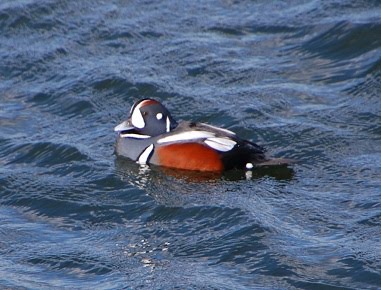
Winter also means ducks. The common eider and the harlequin duck are standard winter ducks at the rocky jetty of Barnegat Light. If you look on a local pond before it freezes the chances are you will find all sorts of interesting ducks including one or more of the mergansers plus ruddy, canvasback and ring-necked duck.

But just about any waterfowl is likely to show up in any unfrozen water, even along the Hudson River shoreline between Hoboken and Manhattan, which is about as urban as it gets.

As I said, one big advantage of winter birding is the leaves are off the trees. Redtail hawks are easy to see from a great distance when they sit in a bare tree, and it makes it easier to find the white-breasted nuthatch calling from a limb over my head.


But perhaps the best thing about winter birding is you don’t have to even go outside if you don‘t feel like it. If you have a feeder out - better still, many feeders holding different types of seed and suet - the birds will come to YOU as you have your hot cup of coffee on a frosty morning.

Try it and you’ll be amazed by what you can see.

Sunday, November 27, 2011

Raking

Despite nearly 20 years in suburbia I still find the leaf blower to be at best a necessary evil and I try to use it as little as possible.

The first time I go out after the leaves start to drop I use the lawn mower to mulch them. The next time, after more leaves are down, I convert my electric leaf blower into a mulching vac and crunch up as many as I can stuff into the compost pile.

But after the pile gets filled I must use the blower to herd the leaves closer together to save some time and energy before I use my rake and tarp.

Unfortunately, I am in the minority. Most of my neighbors have lawn services that use leaf blowers, huge fans and tractors to shove the leaves into huge piles at the curb. The din is painfully loud and the gas smell pervasive. At least they finish quickly.

Those doing it themselves have their own blowers and fans that are just as bad and take longer to finish. My neighbors must work when they have free time and if that means going out as night is falling and working in the dark, so be it.

When I pull out the rake I am purposely slowing myself down. I can go out early and work quietly. I am not wasting energy but I am getting needed exercise. I can listen to the birds.

Also, I get time to think. Here are some things I have thought while raking:

1. I always know where my neighbor’s property ends and mine begins during leaf-blowing season because he will not go one inch further.

2. A pristine lawn won’t last more than a day before leaves come back on it, even if using a lawn service. So why fuss about it? “Let’s not finesse it,” my husband often tells me as we work.

3. Speaking of MH, raking is a nice way of bonding with your spouse. Every year MH and I start by getting in each other’s way but without saying anything we develop a pattern: he makes smaller piles, I sweep them into the tarp. Then we lug the tarp to the curb. The job goes faster and we rejoice in its completion together.

4. The birds aren’t happy when I work near the feeders but they are very happy when I clear the big leaves and uncover the bugs.

5. If you stop every so often you might find something interesting. One year it was a brown creeper heading up a tree. This year it has been a redtail hawk being harassed by crows and 15 black vultures circling over the house.

6. You can see how the lawn is doing up close, including where the mushrooms have come up, the ground ivy has taken over and the skunks have been digging for grubs.

7. Wind is the ultimate leaf blower. If I go out on a windy day I figure out the direction and rake accordingly. It amazes me how someone will try to fight the wind, wasting time and energy. Life is too short.

8. I would love to meet the person on the Shade Tree Commission who decided having locust trees on my street would be a great idea. Locust leaves are too small to be effectively blown or even raked, and the female trees usually have hundreds of hanging seed pods that fall and blacken the lawn. Luckily, this year was the one in three when the female tree on my property produced only a few pods. I would like to punch that commissioner in the nose.

9. Why don’t more towns require leaves be bagged? It’s hard enough driving on leaf-clogged streets, harder still to walk on streets without sidewalks where leaves on both sides make a two-way road into one lane. In the years I would walk home from the train every night I feared the oncoming car at my back that wouldn’t slow down. Luckily, I lived to tell the tale. When my town comes through the crew leaves almost as much behind as it picks up. I would think collecting ecologically approved brown bags of leaves would be more efficient and quicker.

10. You are going to see your neighbors and they are going to see you, whether you like it or not. So wave and be friendly. It might be the last time you see them until next fall.

Thursday, March 24, 2011

A bird in the bush

When Marie Winn wrote about the redtailed hawk nicknamed Pale Male in "Red-Tails In Love" she showcased birding in Central Park, a place that was coming through bad times along with the City of New York.

Central Park couldn't have had better press agents than Marie Winn and Pale Male.

When I got her book from the library I discovered almanac data in the back - what birds have been reported at particular times of year, for instance - and maps of the park. Maps were the key to getting me, and particularly my husband (MH, for short), into the park. I bought the book in paperback and one day MH and I came in from NJ to bird Central Park.

It is a big park, stretching from 59th Street north to 110th Street and from Fifth Ave. on the east to Eighth Ave. on the west. You can walk in anywhere and immediately get lost unless you can keep the tops of the old apartment towers in sight (and sometimes you get lost anyway). Despite its natural beauty, every single thing in the park - the trees, the rocks, the flowers - were trucked in and placed as per the design of Frederick Law Olmstead and Calvert Vaux.

About the only things not placed there by man are the birds passing through, drawn by an island of green in the middle of the concrete city after a long flight. Most of those flights are by night, but some birds fly by day. One time MH and I were walking south on 6th Ave. as night was coming on and a black-crowned night-heron was flying north on 6th Ave., obviously headed for some body of water within the park.

We've also found oddities, such as this male wood duck I photographed swimming with the mallards at the Pond in the southern end of the park. Two males spent this past winter here, even when much of the water was iced over.

Marie's book also identified the places where warblers could be found within the wooded area known as the Ramble.

Warblers are a post unto themselves. In spring they flit in the highest parts of the leafing trees or skulk under bushes. Many are brightly colored, having yellow somewhere, and the males look distinctly different from females (not the case in the fall, which presents its own identification challenges).

Warblers bring out the birders in droves, particularly in Central Park. When an unusual warbler shows up in the park, that number goes up exponentially.

A few years ago one of those vistors was a bright yellow bird with a big dark eye and solid gray wings, a prothonotary warbler. When we were in Florida we saw them in the swamps as often as we see white-breasted nuthatches in the backyard. In Central Park it was a big deal.

I don't fly across the country when a rarity is seen but if I am in the area anyway, I'll check it out. A warm spring weekend day was my excuse for the prothonotary.

This one had been seen along the western shore of a body of water known as the Lake, which one passes on the way to one of the entrances to the Ramble. The prothonotary was seen. It was sorta seen. It had just been missed, according to the birding lists. A little golden needle in a big green haystack.

So we weren't expecting much, being new birders. We walked along the water's edge and down to one of the rustic benches. We looked to the north and suddenly the bird flew out of the bushes on the shoreline and onto a rock jutting into the water, almost daring us to take a picture. Of course we had no cameras with us (or even a cellphone with a camera).

Wow, that was easy, MH said. Are they all that easy?

As we now know, no way. But I admit to some pleasure that day when another birder rushed up while we were birding in the Ramble and asked if we'd seen the prothonotary, rushing away when we said we had, and where. He'd sought it for hours. We saw it in minutes.

Sometimes it is better to be lucky than good.

What was your easiest bird sighting? Let me know at bellerbirder@gmail.com