Cape May

Cape May
(RE BERG-ANDERSSON)
Showing posts with label white-throated sparrow. Show all posts

Friday, October 6, 2023

Cleaning Up After The Trees

 In October, a maple tree before your window lights up your room like a great lamp.

-- John Burroughs

October, the year's tenth month (with a name reflecting when it was the eighth month under the Roman calendar), is a time of transition. October is when you really notice it is darker later in the morning and earlier in the evening. October is when the weather switches from over 80 degrees one day to cold enough to break out the winter quilt the next. 

The acorn doesn't fall far from the tree - a small sample of
what I have been sweeping up from the patio.
(Margo D. Beller)

October is when the pumpkins, squashes and dried corn threshes start showing up on suburban doorsteps with the September mums. You realize you are closer to the end of the year than the beginning, and you wonder if there will be more snow this year than last.

For me, October is when I start thinking about bringing plants back into the house and putting up storm windows. I notice fewer catbirds in the yard but hear white-throated sparrows. Raptors are on the move and I see skeins of Canada geese overhead, heading south. Soon I will be putting out more seed feeders and suet.

The "flowers" on the ornamental grasses are the
best they've been in years. (Margo D. Beller)

Yes, there are also the colorful autumn leaves that send people into their cars to drive north to Vermont or the Adirondacks or other such hotspots. In my yard the red leaves of the maple and the dogwood, the brown of the white oak, the yellow of the elms and the scarlet of the red oak will be very pretty, at least for a short while. And then the usual October winds will blow them off the trees to become that much more mess to be cleaned up. 

Yes, October is when things start falling out of trees.

This week, the summery days gave way to foggy, cool nights and my sleep has been continually interrupted by the sharp rap of oak acorns falling on the enclosed porch's roof. The squirrels are foraging in the trees by day, and by night the trees must figure it's time to spread some seeds all over the ground beneath them to perpetuate the species. 

The dropping does not cease. Sometimes, if the acorn hits a metal gutter, it can sound like a gunshot. Most of the time, however, it sounds like someone is banging into something in the night.

Two types of nuts falling from my trees. (Margo D. Beller)

Despite the noise I am glad I have this roof over my porch. I have friends with open decks who are forced to huddle under the picnic table umbrella as acorn bombs drop from the sky. When my in-laws lived in New Jersey the big oak next to the driveway regularly pitted the old family sedan, making it look like it had been in a hail storm.

My problem is when the acorns make it hard to walk to the feeder pole or the water dish. That is why I have gone out on the patio three times - so far - to herd marble-like oak acorns with my broom into my large garden pail, lug it to a corner of my yard and dump it for any squirrel, chipmunk, deer, woodpecker, jay or crow that might want a snack.

But there are many, many more acorns all over the lawn, and even when I am drinking coffee on the porch, congratulating myself on a job well done, I hear the acorns continuing to drop. It will be like this for weeks.

What hangs up will eventually come down. (Margo D. Beller)

It is not the tree's fault, of course. It is just trying to survive. If the trees were in the woods this would be a barely noticed process. But these trees are not in the woods, they border the property of my suburban yard. And so I notice big time.

There are some years when there are many more acorns than there are squirrels, like this year. There are some years there are many more squirrels than there are acorns, like last year. This boom and bust is not as random as it may seem.

Acorns are seeds and they are dropped by the oaks to make more trees. But the seeds are also food. The more food there is, the more an animal eats and then the more it breeds. More animals mean more food is needed. When seeds are plentiful, everyone is happy - the animals and the trees. But if there are too many animals and not enough seeds, there will be a decrease in new trees. That seems to prompt trees to shut down making seeds, which then cuts back on the animal population because there is less food.

The technical name for this boom and bust cycling is masting. According to the New Jersey Conservation Foundation, mast is the fruit of forest trees, in this case acorns. During "mast" years, the trees "go into overdrive, producing enormous amounts of nuts." Then comes the bust, a year or more when there are very few nuts produced.

How the pretty autumn leaves will eventually end up...
(Margo D. Beller)

Why does this happen? Again, from the Foundation:

Scientists don’t know the exact trigger for mast years, but it most likely has to do with climate events in past stressful years. Trees may produce an abundance of offspring as a hedge in case the stressful times continue. Stressors may include droughts, heat waves, or cold spells.

I'm no scientist but I know there is a lot of wacky stuff going on in the atmosphere around the world - a rare tropical storm in California, abundant wildfires in Canada, deadly floods in Libya. We are on pace to have the hottest year on record after having the hottest past few months on record.

... and the pods. (Margo D. Beller)

Closer to home, this has been a very wet year. The same abundance of rain that has helped keep my dogwood tree alive, produced the "flowers" on my ornamental grasses for the first time in years and kept the spider mites and white flies off my flowers likely produced favorable conditions for the oak trees to produce acorns after a year when not many were produced. The old trees have grown and now more of their branches are above the porch roof, something I didn't notice until the acorns started raining down heavier than usual this year. 

The oaks are not alone, of course. Many other trees are now dropping their seeds, including the bane of my existence, the black locust. October is when I notice how many of the long, black pods are hanging, waiting for some signal or gust of wind to drop like a blanket over my lawn. Like the acorns, eventually they will all come down and be swept away, to be forgotten until the next October. 

Monday, February 18, 2019

Backyard Bird Census

Every year, the Cornell Ornithology Lab in New York and the national Audubon Society hold a Great Backyard Bird Count during the Presidents Day weekend. As the name implies, the idea is to encourage people to go outside or watch bird feeders and count how many of which types of birds show up.

White-throated sparrow (Margo D. Beller)
It is a chance for non-scientific types such as me to collect data that help the real scientists track movements of birds around the world and see which types of birds are on the increase and which are declining.

For me, it is a chance to do a census of which birds are in or calling near my house.

I am not a counter most of the time. It is enough to put "titmouse" in my notes rather than "3 titmice seen between 9 am and 9:15am." But I try to do this for the count at least one day during the four (Friday through Monday) days it's held.

I've already learned a few interesting things:

So far I've seen a marked decrease in the number of house sparrows. This could be for any number of reasons. It could be they are going to other feeders where people are using cheap millet seed these sparrows can more easily eat rather than the sunflower seeds I use, which they would have to crack open. It could be because there is a large number of house finches in the yard (I saw as many as nine at one time, all over both feeders). With all that competition there could be less incentive for the sparrows to hang around. (Although they will nest in anything including street lamps and under a window air conditioner. I know of one large sparrow flock using a row of forsythia on one street I walk on my way to the post office.)

Jay (Margo D. Beller)
I have seen no more than one or two blue jays at a time. There was a point a few weeks ago when there were as many as six taking turns hitting the house feeder, making it swing violently as they took off. Jays, like other birds, have a pecking order and if a jay comes out of turn it is swiftly forced off by another. Were those other jays just passing through?

I have seen or heard no Carolina wrens from my yard lately. These little brown and gold-fronted birds are the only wrens that will hang around my part of the country during winter - as long as they can find food. I know in past counts I've found at least one. There was one I heard during a hike and one calling quite some distance from my house one morning a few weeks ago. I am hoping the recent polar vortex didn't affect the wren population.

I have seen no juncos in the yard lately. That is another bird that will be out of the yard for weeks but then suddenly shows up in small numbers. However, the number of white-throated sparrows has remained fairly steady. Usually there is at least one I see or hear. Yesterday there were five, most of them checking for dropped seed bits under the feeder. When winter starts they tend to stay in the bushes but as the cold wears on they become a lot less shy. For instance, there is one that has made it his business to fly into the house feeder and eat there. It will not leave for the house finches and reluctantly leaves for the bigger cardinals and jays. As the winter goes on the male's white throat and the white "eyebrows" and yellow near the eyes will get so bright they can be easily seen in the dusk. This is the white-throat's breeding colors. Although white-throats have been known to remain in the New York metro area (in such places as Central Park, for instance), most will fly off to their northern breeding territories as spring approaches.

Red-headed woodpecker, North Carolina
(RE Berg-Andersson)
There is always a chance something unusual will be around to count. One year during the count, walking along a part of Patriots Path, I encountered a redheaded woodpecker, a southern bird that has been slowly moving north in its range as climate change makes the world warmer. For the redheaded, the challenge is finding the dead trees it needs for roosting. When I found it, it was noisily flying around one that was surrounded by water, just like its usual swamp (caused by the nearby Whippany River flooding). At the time, the sighting was unusual enough for my report to be questioned by the scientists, but I convinced them of my accuracy. Now, however, these birds have been found more often in New Jersey, with a confirmed nest in the dead trees of Troy Meadows.

I doubt one will show up in my yard this year but, given the increasing warmth of the world and destruction of its usual habitat through so-called development, next year is always a possibility.

Saturday, December 20, 2014

Winter Birds

I don't know what it is but there has been something about the latter half of this year that has made me disinclined to write here, for which I am sorry for my few but patient readers. Aside from my recent visit to Gettysburg I have not been inspired by much, and those birds I see at the feeder are the ones I always see at the feeder.

So I will note them to the world.

According to the annual winter finch forecast, it will be a so-so winter. No major flights south for pine or evening grosbeaks or either type of crossbill, perhaps there will be some pine siskins and purple finches. All of them fly south when the seed crops in their more usual northern territories are poor. (MH and I saw a couple of female purple finches at our house feeder early in December, but none recently.)

Female cardinal, male house finch, junco. (Margo D. Beller)
  

Then again, if the red-breasted nuthatch did come to my feeder, it would find a lot of competition and likely go elsewhere.

At the moment I have 3 feeders up (a fourth will go up once it starts snowing in earnest because it holds more seed), 2 of which hold sunflower seed. In the dawn one of my favorite birds, the cardinal, comes to feed, soon followed by the black-capped chickadee family that roosts in my hedge and their cousins the titmice. A white-breasted nuthatch or two will fly in for a seed and red-bellied and downy woodpeckers will get some suet.

However, soon enough the seed eaters will be chased off by a flock of what I consider pest birds - house sparrows, house finches, jays and mourning doves.

There are people who enjoy feeding whatever bird comes to their feeders, no matter how much of a pig it makes of itself. I do not.

With the exception of the jay, which dive-bombs the feeder to stuff its crop with seed and then flies off, these pests will just sit in the feeder and eat, dropping seed bits down to the squirrels, fighting off the other small birds and the skittish cardinal. The mourning dove is a recent pest. Once it figured out how to jump off the feeder's roof and sit on the perch it hogs the space and just sits there, using its thin bill to find parts of seed already broken.

These are the times when I go on the porch and knock on the window to scare them all off.

The chickadees, titmice and nuthatch have learned they can then rush to the feeders, grab the seed and go.
Black-capped chickadee (Margo D. Beller)

Also at this time of year, grackles, starlings and blackbirds end their mating pairing and join together in huge flocks that wheel about in the sky. Several times during the colder months a flock that can be anywhere from 12 to 2000 will descend on a lawn, poke under leaves, in grass and in feeders for food and then take off, only to land a few lawns on and repeat the process, making a racket in the process.

If I am in my office (with the screen open for the sun's warmth) and see them across the road, I am quick to get downstairs and pull in the feeders. By that time there are usually a few hundred on my back lawn. One of my feeders is in a squirrel-proof cage and the suet feeder hangs upside down (not a natural position for a starling or grackle) but the house feeder is exposed. Once the feeders are safely inside I am fascinated to watch all this mass of black birds, and relieved when they decide to move on.

Other winter visitors are more benign. When the chipping sparrows have left, their cousins the juncos arrive. In New Jersey, the gray juncos are all males. Junco females, which are brown, fly farther south than the males, who presumably stay in places like NJ so they can get up to the far northern breeding territories faster come spring.

There was a time when I really wanted to see a junco, and the first one I did see was in New Hampshire. I laugh to think of that because there hasn't been a winter in the 20 or so I've been in this house when a junco didn't show up, trying to find seed bits on the ground before the squirrels get them.
White-throated sparrow (Margo D. Beller)

White-throated sparrows are the other winter migrant. They show up around the time the catbirds leave. Unlike the juncos, both sexes overwinter in my yard and throughout the region. They are big, like their cousin the song sparrow, but do not have the messy streaking or central spot. Instead, they have white or tan "eyebrows" and the tell-tale white throat. When breeding season approaches, the males' white gets very bright and you can see bright yellow at the end closest to the eye. The territorial song has been described as "oh, Sam Peabody, Peabody, Peabody" or "oh sweet Canada, Canada Canada" depending on whether you are.

White-throats scratch around under the feeder, although sometimes I see them in the house feeder or in the caged feeder, pulling out seeds or seed bits. Decades ago, as it was going to dusk, I looked at the birds under the caged feeder and found a rare surprise - the larger, redder fox sparrow with the white-throats. Other years I've found white-crowned sparrows under there.

Finally, when you have so many birds - pest and otherwise - hanging around a feeder, you are going to find raptors.

Cooper's hawk (Margo D. Beller)
The other week I was watching the birds eating when the finches scattered and one chickadee seemed frozen in the caged feeder. This can't be good, I thought, and I walked outside just as a Cooper's hawk flew into the yard. It saw me, hung a U and took off for a nearby tree. By this point the chickadee had taken shelter in a bush and there was a lot of nervous calling. Finally, off flew the Coop.

We've also found the smaller sharp-shinned hawk munching on a mourning dove in the snow. MH has seen redtails dining on squirrel. One year we had several turkey vultures on the lawn after they found rabbit that had died under some hedges in the corner. In January, if I care to rise way before dawn, I might hear great-horned owl hooting its territorial call as mating season begins.

So winter isn't a dead season, even if it feels like it to me, especially at times when there are many feet of snow on the ground as we had last year.

I'll have to remember the words of poet William Blake:

In seed time learn, in harvest teach, in winter enjoy.

Sunday, August 10, 2014

The Concrete Jungle 4/4/11

Back on May 27, 2012, I rather stupidly deleted the links of many of my older posts -- not understanding why the headlines of the posts were hyperlinked. I've learned a lot since then, such as linking and spacing and captions. 

But when I was trying to find an older post for a newer one, I realized it was time to start republishing the lost posts, and restore the links.  I will be doing this over the next few days, but I am starting with some of the oldest ones.


I worked in Jersey City, NJ's third-largest city (some would say second-largest), from 1999 until my office moved to midtown New York in 2009. The office building was on the Hudson River and had once been a freight building for goods brought east by railroad. It was surrounded at one time by other freight buildings and railroad tracks. When it became an office building the tracks were paved over and taller buildings started going up.


The area continued to change in the 10 years I worked there. Tracks were put IN, this time for a light rail system. Larger office (and, later, residential) buildings went up. But for a time, within walking distance, you could still find large vacant lots and large plantings in residential yards and along commercial sidewalks. That's where the birds were.

I knew things were going to be interesting the first spring I walked along the Hudson and found a red-eyed vireo in a tree. It looked as surprised to be where it was as I was to find it.

At other times, in another weedy field a block from my office, I found more than just the usual sparrows, starlings and pigeons. In winter there were white-throated sparrows. In spring there were black-capped chickadees and American redstart. One summer I found a kestrel. In fall, a northern parula hung around for three days and I found four winter wrens. (I've seen more winter wrens in Jersey City than I've seen in the woods.)

Farther away I found a weedy field full of hungry American goldfinches. Van Vorst Park has had a lot of birds over the years I visited, including rubycrowned kinglet, Tennessee warbler, Blackburnian warbler, eastern peewee (calling from a tall tree) and, during a hot summer when sprinklers watered the gardens, a pair of mallards.

What was once New Jersey's tallest building, 101 Hudson, has hosted a nesting box for peregrine falcons, which have raised several generations thanks to Jersey City's generous pigeon supply. The screen shot below is from http://www.state.nj.us/dep/fgw/peregrinecam/jcp-still.htm


Along the Hudson I'd find brant and canada geese, redbreasted merganser and other ducks. Landscaping at a waterfront apartment complex at the end of Warren Street during spring migration was very good for warblers - I had black-throated blue, yellow and common yellow-throat on one visit - and herons, including a little blue heron.

But it all changed after Sept. 11, 2001. Businesses displaced by the destruction of the World Trade Center started moving to Jersey City (temporarily, as it turned out). The high rents of New York drove people to the factory lofts and new apartment towers. The weedy fields, including the one a block from the office and those along the light rail tracks, were filled in. No fields, no birds. Even Van Vorst park lost half its garden space to a dog park. Those living closer to the canal park used that for a dog run, their unleashed mutts scaring the birds out of view.
Birding became impossible.
So I was not that upset when we learned the office would be moving to another concrete jungle, midtown Manhattan. Without the birds, Jersey City was just another big, ugly city.

The only thing I have missed is the mighty Hudson River out my window.

Sunday, January 15, 2012

Winter Birding

To everything there is a season, and that is true for birding.

Spring and autumn get all the press because that is when the warblers and other tropical migrants pass through on their way north to their breeding areas of choice, or south to the warmer and buggier areas when it is cold up here. Summer is when a lot of birders go to the shore for relief and shorebirds.

I happen to like winter birding when the leaves are off the trees, the cold is bracing and the crowds are sparse. (A lot of birders follow the birds to South America to enjoy summer there.) That doesn’t make the birding any less interesting, especially this year when the unnaturally warm winter weather prompted a lot of migrant birds to hang around a lot longer than usual.

There are lot of birds that show up in New Jersey when the cold comes on. They consider New Jersey warm enough for them, a funny concept to remember when we are shivering from what we consider arctic winds!

Some of these are regular winter visitors. The junco, for instance. This slate-gray and white little guy - and in New Jersey it is always a guy because the browner females fly farther south for the winter (perhaps the males stay farther north so they can get to the breeding areas quicker) - is a pretty reliable indicator winter is coming on.

The white-throated sparrow below is another winter regular. The male’s white “eyebrows” and the yellow spot on either side of the bill and above the eyes get brighter as the winter goes on. Unlike the junco, males and females winter together, and you will hear the high whistling “O Sam Peabody, Peabody, Peabody” of the males as the territorial battles begin.

There are other winter birds not as common. The American tree sparrow, for instance, with its distinctive reddish cap and bi-colored bill, gray on top and yellow below.

The rough-legged hawk is a bird of the tundra, and when winter comes on it sometimes flies south to grassland areas, even urban landfills such as the one abutting the DeKorte Park in Lyndhurst, N.J., near the Meadowlands.

Snowy owl is another uncommon winter visitor and finding one is always a big occasion. This owl is, as the name implies, very white, hangs out in the open and hunts by day, unlike most other owls. This year, among the many recorded, a snowy has been at the Merrill Creek Reservoir in Warren County, NJ, for weeks.

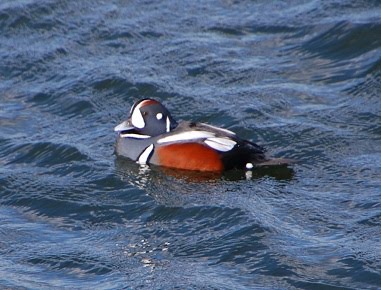
Winter also means ducks. The common eider and the harlequin duck are standard winter ducks at the rocky jetty of Barnegat Light. If you look on a local pond before it freezes the chances are you will find all sorts of interesting ducks including one or more of the mergansers plus ruddy, canvasback and ring-necked duck.

But just about any waterfowl is likely to show up in any unfrozen water, even along the Hudson River shoreline between Hoboken and Manhattan, which is about as urban as it gets.

As I said, one big advantage of winter birding is the leaves are off the trees. Redtail hawks are easy to see from a great distance when they sit in a bare tree, and it makes it easier to find the white-breasted nuthatch calling from a limb over my head.


But perhaps the best thing about winter birding is you don’t have to even go outside if you don‘t feel like it. If you have a feeder out - better still, many feeders holding different types of seed and suet - the birds will come to YOU as you have your hot cup of coffee on a frosty morning.

Try it and you’ll be amazed by what you can see.

Monday, April 4, 2011

The concrete jungle

I worked in Jersey City, NJ's third-largest city (some would say second-largest), from 1999 until my office moved to midtown New York in 2009. The office building was on the Hudson River and had once been a freight building for goods brought east by railroad. It was surrounded at one time by other freight buildings and railroad tracks. When it became an office building the tracks were paved over and taller buildings started going up.

The area continued to change in the 10 years I worked there. Tracks were put IN, this time for a light rail system. Larger office (and, later, residential) buildings went up. But for a time, within walking distance, you could still find large vacant lots and large plantings in residential yards and along commercial sidewalks. That's where the birds were.

I knew things were going to be interesting the first spring I walked along the Hudson and found a red-eyed vireo in a tree. It looked as surprised to be where it was as I was to find it.

At other times, in another weedy field a block from my office, I found more than just the usual sparrows, starlings and pigeons. In winter there were white-throated sparrows. In spring there were black-capped chickadees and American redstart. One summer I found a kestrel. In fall, a northern parula hung around for three days and I found four winter wrens. (I've seen more winter wrens in Jersey City than I've seen in the woods.)

Farther away I found a weedy field full of hungry American goldfinches. Van Vorst Park has had a lot of birds over the years I visited, including rubycrowned kinglet, Tennessee warbler, Blackburnian warbler, eastern peewee (calling from a tall tree) and, during a hot summer when sprinklers watered the gardens, a pair of mallards.

What was once New Jersey's tallest building, 101 Hudson, has hosted a nesting box for peregrine falcons, which have raised several generations thanks to Jersey City's generous pigeon supply. The screen shot below is from http://www.state.nj.us/dep/fgw/peregrinecam/jcp-still.htm

Along the Hudson I'd find brant and canada geese, redbreasted merganser and other ducks. Landscaping at a waterfront apartment complex at the end of Warren Street during spring migration was very good for warblers - I had black-throated blue, yellow and common yellow-throat on one visit - and herons, including a little blue heron.

But it all changed after Sept. 11, 2001. Businesses displaced by the destruction of the World Trade Center started moving to Jersey City (temporarily, as it turned out). The high rents of New York drove people to the factory lofts and new apartment towers. The weedy fields, including the one a block from the office and those along the light rail tracks, were filled in. No fields, no birds. Even Van Vorst park lost half its garden space to a dog park. Those living closer to the canal park used that for a dog run, their unleashed mutts scaring the birds out of view.

Birding became impossible. So I was not that upset when we learned the office would be moving to another concrete jungle, midtown Manhattan. Without the birds, Jersey City was just another big, ugly city.

The only thing I have missed is the mighty Hudson River out my window.