Cape May

Cape May
(RE BERG-ANDERSSON)

Wednesday, August 16, 2023

Food for Flight

As usual, the year is flying by. It is now August. For many birds, nesting is complete and the young have dispersed. The days are starting to get shorter and the winds are coming out of the north. Instinct tells them it is time to head south for the winter.

Jewelweed (Margo D. Beller)

Birds travel light, literally and figuratively. A hummingbird weighs less than an ounce. An osprey can weigh up to four pounds. Even the biggest birds can be thrown off course by high winds and heavy rains, making their travel perilous, especially when they have to fly over open water such as the Gulf of Mexico or the Atlantic Ocean.

They also don't travel with a cooler filled with snacks. They have to depend on whatever foods they can find when they land after a day (diurnal flyers such as hawks) or night (most small birds including warblers) of flying. For the osprey, that means fish. For other raptors, that means small mammals or birds (which is why most small birds travel at night). For the smaller birds, that includes insects, the seeds and fruits ripening now, and whatever they might find at people's feeders.

The privet shrubs in my backyard are filled with small, round, black berries favored by such fruit eaters as robins, mockingbirds, catbirds and cedar waxwings. The wild cherry tree has also attracted birds because it is fruiting, which is good because the viburnum and dogwood are not going to provide much to eat this fall. There are also red berries all over the yew hedge.

In my travels I have seen plenty of food Mother Nature has put out for migrating birds.

Hop hornbeam with hanging seeds (Margo D. Beller)

There's the hop hornbeam, for instance. I would never have even noticed this tree had I not almost walked into a low-hanging branch and noticed the seeds dangling from it. Once I identified this tree I found it everywhere - on hillsides, along river banks. It is an understory tree, meaning it grows below the canopy of larger trees. Apparently it thrives on being left alone, which may be why they were planted years ago by municipal parks departments. I've seen cardinals and cedar waxwings eating the seeds from this tree. 

There are also nectar-filled or seeding flowers. Thistle and goldenrod bloom now, and when they go to seed they will feed goldfinches, sparrows and other seed eaters. Weeds are also a wonderful source of seeds, including the ragweed that torments my sinuses and always seems to come back no matter how much it is mowed or pulled out.

The cardinal flower has a gentle spike of red flower and prefers moist areas, which is why I see it near streams and why I've had no luck growing it in my garden. Hummingbirds are attracted by the color and feed on the pollen. Another hummingbird favorite is jewelweed. This one also favors wet areas along stream banks or bogs but unlike the cardinal flower it is orange-yellow. However, its flower is a trumpet that attracts the hummingbird. Apparently it is also used to make medicine, but thankfully no one has touched the stands of jewelweed I've seen attracting hummingbirds, bees and insects.

Cardinal flower (Margo D. Beller)

These food sources are not everywhere, of course. The insect population is in decline, which will have a devastating effect not only on birds but on humans because most of our food needs to be pollinated by bees and insects when it is first flowering. Ocean waters are much warmer than they should be this summer. According to NOAA, we are in an El Nino year. That means:

Our global climate models are predicting that the warmer-than-average Pacific ocean conditions will not only last through the winter, but continue to increase. There is a good chance—approximately 2 in 3—that the peak Oceanic Niño Index this winter will match or exceed 1.5 °C, our informal threshold for a “strong” El Niño event.

El Nino, according to NOAA, is a "naturally occurring climate pattern associated with warming of the ocean surface temperatures in the central and eastern tropical Pacific Ocean, which can significantly influence weather patterns, ocean conditions, and marine fisheries worldwide."

When the Pacific Northwest is as hot as Houston, when wildfires destroy millions of acres of forests and homes, when parts of the U.S. have not gone below 100 degrees F in months, when New England is hit with tornadoes, when the mid-Atlantic states are hit by several 100-year floods in one season, what is a "naturally occurring climate pattern" anymore?

I just hope the birds make it.


Thursday, July 27, 2023

Summer Doldrums

This seems like more of a hellish summer than usual, which is what I think every year. Summer is always a time when I stay indoors with the air conditioner on if the heat and humidity get to extremely uncomfortable levels. Even when it is cool in the very early morning I have to dress in long sleeves and head covering, my pants tucked into my socks, to protect myself from the many insects that would otherwise bite any uncovered area.

Summer flowers - coneflower, zinnias, daisies,
coreopsis (Margo D. Beller)

This year's weather has produced enough rain to make me glad I did not call for the sprinkler to be turned on, and to produce mushrooms in the lawn. It has kept my half-dead dogwood tree alive and given my yard guy gainful employment.

The rain has been good for my cannas and my flowers, including the zinnia and marigold seeds I planted. With the daisies, coreopsis and conflowers blooming now I can finally cut my own bouquet instead of paying to make one at the farmstand I frequent for summer vegetables. The rain also prompted enough weeds to force me to pull them from all over the garden over the course of three early mornings, before the sun, humidity and my sore body drove me inside.

I gave up on what I had thought were pepper seedlings. They were weeds, so I'll be buying my peppers this year.

Not a pepper after all. (Margo D. Beller)

And then there is the continual prospect of smoke from Canadian wildfires mixing with the usual high levels of ozone each time the wind comes out of an otherwise pleasant northwesterly direction. Will the fires continue into the fall when the migrants start heading south?

It has been hard to get myself walking in this weather, even harder to go listen for birds. At this time of year it's rare I find a bird that I couldn't find in my backyard, so I don't usually bother. In the backyard the robins are going after ripe fruit in the black cherry tree, the catbird family members chase each other around the yard, and chipping and song sparrows call from the trees. I hear the cardinals in the morning and have a brief temptation to put out seed for them. But then I remember these birds eat the insects that plague me and don't need my seed now.

I could follow the usual flock of birders down the coast and look for the shorebirds that spend the summer in New Jersey. But the one time we went shorebirding in summer we were attacked by greenhead flies, which meant staying in the car with the windows up as we drove the tour road. 

So I sit on my porch in the early morning with the fan on, sipping my coffee as my neighbors go off to work or get their kids ready for camp. That is how I see the cardinals, robins, catbirds and occasional others in my yard. (The hummingbird feeder has yet to draw a single bird, unfortunately, even with the pink flowers in bloom near it.)

Wren nest box (Margo D. Beller)

Then there is the house wren box. A few weeks ago, long after the first pair of wrens and their young departed, another pair actively investigated the box and seemed ready to use the old nest inside. Then, once again, something happened. 

After a few days when I wasn't on the porch I came out one morning to find a male singing loud and long but no activity at the box. In fact, over the next few days if a female showed up he chased her away. We went away for a few days but as of yesterday he was still around, tho' not singing as loudly or as often. I am no expert on house wren behavior despite all the writing I do about them, so I have no idea what is going on. 

In a few weeks the male will be gone and the box will be brought down and emptied. The summer heat will be a distant memory, I hope.

Wednesday, June 28, 2023

Another Season of Wrens and Apples (and Squirrels)

Right now, on the cusp of July, birdsong is heard once again in my yard.

Apples (Margo D. Beller)

That's because the young that had been protected in their nests by their parents are now flying around after them, begging for food. The parents, in turn, send out contact calls to make sure everyone stays together. Now, about a month after the northbound migrants moved through and the nesting birds went silent, I am hearing songs or calls again: catbird, song sparrow, titmouse, house finch, white-breasted nuthatch, cardinal, assorted woodpeckers. Some of these birds may have second broods, but for now the emphasis is on teaching the first brood to take care of itself.

The house wrens in my yard have also been on the move. Once again I did not see the moment when the young, no doubt cramped in such a small space in hot, humid weather, took off after their parents. On Friday morning, June 23, the parents were busy feeding the young, hanging outside the box except for when one would go inside to clean out the poop. I could see the heads of the young as they came to the opening and looked out. They seemed very agitated.

On Saturday morning, June 24, we had a deluge for the first time in weeks. I stayed inside. When it was over I went outside to pull out stubborn weeds from my front walkway (stubborn because of long taproots, which gave easily in the soggy soil). When I walked to my compost pile to dump them I heard the scolding of a house wren, then the dry, rattle-like calls of young. Sure enough, as I sat to rest on my porch, I watched the nest box and saw no activity. Once again, these birds had flown. 

Empty nest (Margo D. Beller)

My guess is they flew Friday afternoon. Since then they have been moving between my yew hedge and the shrubby area near my compost pile. In fact, today, when I went to that shrubby area to pull out a tree branch to add to my brush pile, five wrens jumped out! A parent and four young? Two parents and three young? All young? I don't know. I quickly left the area and they settled down.

Here is a video I found that shows five wrens fledging. (The video lasts about five minutes. The site is not associated with mine.)  

Meanwhile, the apple tree has brought forth a prodigious amount of fruit, right on time. I am usually busy picking apples from late June into early July. People I know with their own apple trees think it odd that my apples are not ready for harvest in the fall. However, doing a bit of searching, I found that there are many types of early apple varieties. I'm not sure which of them is mine.

Starting last week, I was knocking apples down with an extension pole because thanks to the tree pruning in January the lower, more easily reached branches are gone. I've managed to fill a bucket with enough apples for me to make apple sauce, when I get around to it. For now, the fruit is stored in my cellar.

(Margo D. Beller)

The squirrels always seem to know when the apples are ripe and they have been eating the fruit regularly. I am also making regular visits, but to dispose of what they've eaten and dropped before the deer (or bear?) can get to it. Sometimes there is even fruit for me. I cut into one of the apples I picked up today and it doesn't taste particularly sweet - almost all the apples are on the green side - but for a hungry or thirsty squirrel they will do.

I have taken down what large fruit I can reach. I must now depend on squirrels, or one of the many intense thunderstorms we've been suffering through this week, to knock down any other apples. Then I must get them before the deer.

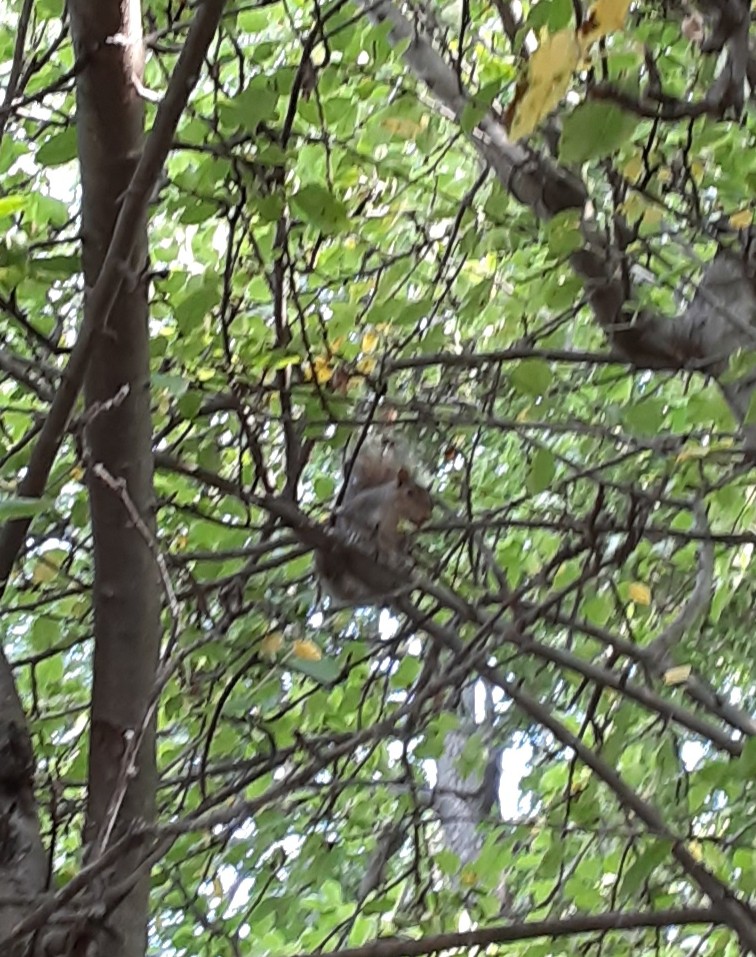
Treed squirrel (Margo D. Beller)

It is gratifying to me that, after all these years, the apple tree continues to produce despite heavy pruning (and whacking at the branches by me). I'm sure the squirrels are happy about it, too. We'll all enjoy it while it lasts.


Saturday, June 17, 2023

Growing Concern

I like trees. I've written about my despair when they are cut down, including by me. But after a recent walk I had to wonder about the unintended consequences of planting some trees in a particular area.

Saplings, May 2023
(Margo D. Beller)

In the Central Park of Morris County not far from me a field was planted with tree saplings a number of years ago. All you could see were rows of protective tubing. In autumn 2021 I went for a walk in that area after a long absence and noticed the saplings had grown tall enough to be seen above the tubing.

The other week I went back and the saplings were even taller. I could now identify many of the trees including tulip poplars, maples, even at least one sweetgum. What happens when they all grow up, I wondered. Tulip poplars alone can grow 70 to 90 feet tall and have a 35- to 50-foot spread. It is also a fast-growing hardwood tree, which might explain why it was planted here.

Saplings, November 2021
(Margo D. Beller)

I can't remember exactly when Morris County put in the saplings. It could've been after hurricane Sandy blew through in 2012 and toppled trees in this field, once part of a working farm associated with the old Greystone hospital. The saplings could've been planted as part of the work the county did when it took over the land to turn it into a multi-use park.

The field in the aftermath of Hurricane Sandy in 2012,
which might be the reason more trees
were planted. (Margo D. Beller)

During that time, the old hospital buildings including the wards, the farm and the Kirkbride administration building came down. Old or damaged trees came down with them. (Many other trees that came down in a different area were neither sick nor damaged. They were in the way of a very large planned soccer field.) 

This old farm field usually draws a lot of birds depending on the season. In past years I've found different types of sparrows, warblers, vireos and thrushes. But now I have to wonder what will happen when the trees grow to their full height. The area is already changing. The grasses around the saplings have not been cut and have become very long and weedy. This is good for some birds but not for others. 

Once the trees have grown and darken the area it will change even more. Will there be more forest dwellers? Bird that look for insects or build nests in treetops? I fear the sparrows and other grassland birds that prefer wood edges to deep woods will go elsewhere. 

I'll just have to see what happens when those trees throw shade.

Sunday, June 11, 2023

Catching Up in the Garden

Last week, New York City had the dubious distinction of having the dirtiest air in the world because of the smoke blown on winds out of the north from wildfires that continue to rage throughout Canada. At its worst, the smoke made the sun look deep orange, kept the temperature to the mid-60s (F) and turned the sky brownish-yellow. The smell of burning wood was thick.

Stargazer lilies, supported by a tomato
cage, protected by deer fencing.
(Margo D. Beller)

Living as I do 35 miles or so due west of the Big Apple, I could not avoid this manifestation of the continuing harm of what is now called "climate change," but I still refer to as global warming. (I know there are differences between the two terms but the overall destructive effect is the same.) There has been very little rain anywhere in my area, and apparently the same is true of Canada.

This is not the first time smoke has filled the skies over my part of New Jersey. Usually the smoke comes from wildfires in the southern part of the state, such as in the Pine Barrens, during extremely dry periods during the summer. The smoke is blown north on hot winds from the south. This year will likely be no exception because with the lack of rain those fires continue, unfortunately.

But this thick yellow smoke from Canada was unprecedented. A persistent low off the eastern coast kept pulling the smoke into my region until the air was toxic to breathe for those of us in "vulnerable" groups, who were urged to stay inside with the windows closed. I was under house arrest, for the most part. If I absolutely had to go outside, I kept it short and wore a mask. 

Blooming viburnum (Margo D. Beller)

The world continued on without me, of course. People were urged to limit their pets' time outside but the wild animals - including birds - were still out there foraging for food, both for themselves and for their young. Somehow they managed, but I have to wonder about the effect of that poisonous air.

When the smoke finally cleared, literally, it was with relief I could go back outside. I walked around the yard and found some flowers had faded - the rhododendron, irises and the peony - while others were blooming (viburnum, salvia and stargazer lilies) or growing to the point where they would soon bloom (butterfly weed).

Meanwhile, what I thought were peppers growing from the seeds I'd planted a few months ago are not peppers. I'm not sure what they are. I've moved those pots to make more room for the pots of marigolds and zinnias that are definitely growing from seed. 

I don't know what this is but it isn't
a pepper. (Margo D. Beller)

The apple tree is filled with growing fruit that has been getting knocked to the ground, still too raw to be usable. I'm not sure if the squirrels are searching for ripe apples to slack their thirst of if the tree is dropping apples to save energy because of this drought. Maybe both. 

I also took note of the birds. One of my few trips outdoors was to make sure the water dish was full. It drew a pair of goldfinches, a song sparrow and a jay. (I'm sure there were others, including squirrels, but I didn't see them.) Every so often I would see the resident cardinals and catbirds hunting around the yard. Overhead I heard cedar waxwings and chimney swifts, hunting for seeds or insects. 

Apples in tree (Margo D. Beller)

And, of course, I was able to see what was happening with the house wrens. Based on their activity the eggs had hatched but the young were still small enough for either parent to go inside to feed them. When the young get bigger they will jostle for position and the parent will only be able to feed the one or ones that can push to the nest box opening. Right now the parents go in with food and come out, sometimes with chick poop, which must be removed to keep bacteria out of the nest. I estimate two or three young are in the nest.

As I watch the wrens following their instincts to feed their young so they will one day (soon?) fledge, feed themselves and continue the cycle, I have to wonder why it is that humans, the top of the food chain and the only creatures capable of creating weapons - and now weather conditions - to destroy themselves, are considered to be so damned superior.

This cropped picture was taken through my porch screen. if you look
carefully you will see the parent wren over the box. Less
obvious is the wren looking out from inside.
(Margo D. Beller)


Monday, May 29, 2023

Summertime

 In summer, the song sings itself.

-- William Carlos Williams

Since I last wrote, we've had a roller-coaster month of May. There were days of rain so heavy it flooded my favorite walking trail. There were days that were much colder than usual, including one when I needed to protect my plants from possible frost. Then it turned hot and very, very dry. My husband and I did some traveling. I was downsized out of a job. Many of my early plants bloomed and faded, only to be replaced by others including the rhododendron, the irises and the peony. I accomplished several big garden projects - including weeding, creating a border trench, and removing and replacing deer netting and fencing - to my physical detriment. The lawn grass became very long but it was cut before any pregnant deer would want to drop a fawn on the lawn, which has happened in the past around now.

Rhododendron (Margo D. Beller)

And spring migration came to an end.

It is always with sadness that I acknowledge it's over. I think of what birds I found and what I didn't find. In my part of New Jersey the northerly winds in late April into early May seemed to have kept down the number of migrants passing through. The radar I looked at showed the birds flying north, bypassing most of my state, taking the path of least resistance. When we visited family in New Hampshire and stayed at a motel by Lake Sunapee it was a pleasure to sit on the screened deck at dawn and listen to the birds I had missed in my area. Except for our annual trip to Old Mine Road to listen for the birds that breed in the high terrain of the northwestern part of New Jersey, the only birds I have found lately are local breeders.

When it finally became warm enough I planted my pepper seedlings and moved the house plants to the enclosed back porch. In the backyard I went from two seed feeders and one suet feeder to one seed feeder and the hummingbird feeder. But there were nights it got cold and one when it got very cold, and that night I covered the pots and the peony, which had flower buds about to open. 

Peony, when the buds opened (Margo D. Beller)

Now, on Memorial Day, the so-called start of summer, it is hot. Yesterday I took in the last seed feeder and washed it out. Until then it had been drawing pairs of white-breasted nuthatch, cardinal, jay, goldfinch, house finch and song sparrow, the last one an unusual feeder bird for my yard. Now, the yard is quiet except for resident birds including the catbird. The birds should be either sitting on eggs or ready to do so.

That brings me to the annual saga of the yard house wren.

Every year the story is different. This year I hung the nest box in a different area of the dogwood tree than last year. In the past it only took a few days for a bird to come. But with this year's winds it took several weeks for a house wren to even show up in the yard, much less investigate the box. Early in May, just before we went on vacation, I saw a wren with a stick in its mouth go into the box. If it was a male, it was "dressing" the potential nest site to show its mate. Its mate would decide if she liked the location. If she did, she would bring in more sticks to create the nest. So I don't know if the wren was a male or female because they look alike.

My favorite walking path under water after
two days of very heavy rain. It has
since dried. (Margo D. Beller)

Fast-forward 10 days. I returned to work only to learn I and a number of others were out of a job. I spent time on the porch. What I saw from there were two house wrens actively shuttling back and forth with food to the box. According to the Cornell Ornithology Lab, incubation is nine to 16 days and the nesting period is 15 to 17 days. Maybe I had misjudged when the nesting period began?

Then, something happened.

We had a few cold mornings, including that very cold morning I mentioned when I had to protect my plants. The shuttling stopped. I didn't see much of the wrens. Recently, as I listened to the male singing from a nearby bush, the female came out of the nest box. But there was no active shuttling. She would return with food and go back inside. She would not come out again for a long time. 

I have no camera in the box so I can only guess at what is happening. 

Scenario 1: The young they had been actively feeding got big enough to fly, left the nest and the pair started a second brood.

Scenario 2: Something killed the young - the cold, a predator - and the pair immediately started a new brood.

Scenario 3: This is an entirely different pair of house wrens.

Wren box in its 2023 location
(Margo D. Beller)

In all the time I've put out a nest box I have never had a pair of wrens have one brood, raise the young, get them to leave the nest and hunt for themselves, and then the pair start a second brood. There would not have been enough time for that process, or for an entirely new pair of wrens to have found the box and lay eggs.

I lean toward scenario 2. Most likely the young had grown too big for the female to get inside the box and sit on them when the temperature dropped to the low 30s and so they died of the cold. Less likely is a predator getting to the young. One of the advantages the nest box provides is the small opening - too small for a cowbird to drop in an egg or admit a predator any larger than an extremely small snake

However, it would not have deterred disease from entering and sickening the young birds fatally. That's another possiblity.

At present I go outside in the morning when it is cool. I hear the male wren singing his territorial song. The female appears with food and goes into the box. After a while, when the male sings, perhaps telling her it is safe to do so because he is nearby, she will leave the box to hunt and then fly back and enter the box. The male stays in the area.

Perhaps in a week the pair will be shuttling to and from the box to feed young. This summer I'll have more time to watch for it. 

Sunday, April 30, 2023

Life and Dying in the Backyard

Every spring I am surprised by my plants coming back after the winter. This year is no exception despite temperatures that reached the 80s in February and the 30s in April, with very little snow but lots of rain. Although some plants did not get as tall or as showy as usual, they did flower. The same is true of the trees and the shrubs. Both the apple and the pear trees have flowered, despite being severely cut back early this year. Where there are flowers there will be fruit, albeit fruit too high for me to easily pick.

Dogwood flowers in 2016 (Margo D. Beller)

This post will focus on one particular tree.

I have lived in my house for over 25 years. In my suburban neighborhood "woods" means trees on the property border. Any trees planted in the front or back yards have been put in by the homeowner. Over the years I've had to cut down yard trees for various reasons. I have, however, planted two trees - the blue spruce we nicknamed Spruce Bringsgreen and a flowering dogwood.

I planted the dogwood because in the fall it is supposed to produce red berries for the birds. Since that tree was planted in 2007 I've learned berries are not guaranteed. Like the other flowering plants, it depends on the weather. Some years there would be lovely pink flowers on the dogwood. But that did not necessarily mean berries would follow. Some years yes, some years no. The fresh green leaves would go red in the fall. 

Dogwood berries, 2019. Note the discoloration
in the autumn leaves. (Margo D. Beller)

Since planting that tree I took it as a given that once established it would always be there. But like any other living thing, trees die. Sometimes they are killed by man, who cuts them down or pollutes the air. Sometimes they are killed by insects, as was the ash tree I had to cut down because of the emerald ash borer. Sometimes, however, they are killed by bacteria or fungus.

I don't remember when during the winter I first began to notice one branch was missing some of its bark but I did eventually notice, especially when more bare patches began to appear. I became alarmed when the apple and pear trees, the viburnum, the forsythia and the lilacs started leafing out and the dogwood remained bare. I thought the tree was dead.

My first indication something was wrong.
(Margo D. Beller)

I was going to write about it here. I even had a name for my post - Dead as a Dogwood.

But reports of the dogwood's demise were premature - after a recent heavy rain it started to leaf out.

Not everywhere, however. The part of the tree where the bark has come off remains bare, as are a few of the lower branches. 

I did some research into dogwood diseases, and to my horror discovered there are quite a few. The one that appears the closest to what is happening with this tree has the awful name of "crown canker."

Hoping for the best, I wrapped the lower part of the tree to prevent the bark that was just starting to flake from getting worse. I used my lopper on some of the lower branches and will have to use a saw or chainsaw on other parts. Because the tree went straight to leafing there will be no flowers. The leaves are small and I doubt there will be fruit. I don't even know if the tree will be alive next year.

(Margo D. Beller)

As I looked at some of the pictures I've taken of this tree over the years I realize the signs were there: discoloring in the leaves, the irregular production of fruit. It was not until the bark started falling off that I realized this tree is sick. Should I have used the sprinkler last year instead of letting the grass go brown and deprive the tree roots of water during the summer drought? Should I have added more mulch to what I had already put down at the base of the tree? 

Dogwood leaves, 2023 (Margo D. Beller)

I don't know. This year I'll use the sprinkler more and I'll use my saw on the dead branches. The tree may be disfigured but I hope it will recover. Or it may die. Living things die, even trees.

In the meantime, as I have for the past two years, I have put up the house wren nest box on one of the living dogwood branches. I heard a wren singing the other morning as I put out the feeders. The bird investigated the box, then flew to another yard. Will it be back? That, too, is unknown.