Cape May

Cape May
(RE BERG-ANDERSSON)

Sunday, June 2, 2019

The Further Adventures of a Suburban Backyard

The house wren sang incessantly starting at dawn. I did not mind the wake-up call. Considering I thought the nest box was abandoned, this is music to my ears.

Things happen so fast in my backyard that I must restrain myself from writing every day because I am sure to be proven wrong. Such is the case after last week's post when I needed to update on the fawns being led off the lawn by their mother. I am now sure the one that appeared under the apple tree after the doe had led off one of her twins was Fawn 1, the one that started to follow me thinking I was its mother. I didn't know where it had gotten to once I got on the porch. It must've remembered Mom's instructions to lie down under a tree surrounded by high grass and wait for her.

Wren nest box (Margo D. Beller)
Neither fawns nor doe have been seen since and MH was able to mow the grass over several days this week when the rains held off.

But there were other dramas in my backyard that literally changed by the day.

The late afternoon of Memorial Day - a sunny, clear and windless day - I came out to get the feeder and found the female cardinal on the ground, her head smashed from hitting the side of the screened porch. The flies were already doing their own feeding when I shoveled up the body and deposited it under a shrub on the other side of my flood wall, the usual place where I place any dead birds or animals I find. (They decompose very quickly.)

Cardinals mate for life, and it was sad to see the male cardinal coming to the feeder as usual and not seeing its mate. However, I was sure that would change and two days later I was not surprised to see an adult female started coming to the feeder with the male. What did surprise me, however, was the begging young that appeared on the floodwall: not a cowbird, as I'd thought, but a juvenile cardinal after all. Like the adult, this bird was brownish (to better blend in) and had a small crest and red tail but its bill was gray rather than red. That will change as the bird matures, as will its coloring if this is a male.

While it is easy to tell the red cardinal male from the browner female, the same can't be said about house wrens.

Female cardinal from another year (Margo D. Beller)
Last week, I was unsure if I was going to have to clear an abandoned nest from the box I hang every year in the apple tree. I had seen one individual that would softly "scold" and then fly into the box. I presumed that was a female. I wondered how she would survive as a single parent, especially if she was sitting on eggs. There had been a singing male at the box a week ago but he turned out to be a one-day wonder.

A few days later another male started singing and this one was more persistent. It sang all around the box, sat just outside the opening, even stuck its head in. It sang for most of the day and at one point I saw it and the female flying around the yard. The singing has continued and today (Sunday) I see twigs sticking through the opening of the box, a sign the nest has been enlarged. If there were dead eggs from her first mate, they've likely been removed.

All this activity has me wondering about many things.

How does a mother deer communicate with its young to tell it to stay in a particular area until she comes back?

How did the male cardinal advertise his availability to another adult female after losing his mate?

Why did the female house wren accept this particular male rather than the earlier one (presuming this wasn't the earlier one returning)?

Some things I can infer. Instinct plays a heavy role. The fawn that followed me saw me as a big creature like its mother. Once the real mother showed up, the fawn followed her off my property.

The female cardinal accepted the young cardinal even tho' it was not hers because instinct tells her to do so. Besides, this pair might have their own brood once the youngster can feed itself.

Blossoming apple tree with nest box (Margo D. Beller)

The female house wren knew it would need a partner, even one that only lasts one season, if she was to lay eggs, brood them into hatching and raise them so they could fledge and take care of themselves. Unlike other birds where the male's responsibility ends at conception, male house wrens help feed and protect the young, usually three or four to a brood. So she needed a new mate.

Now I await the sound of peeping wren young. I hope the birds are hatched, brooded and fledged before the annual summer race between me and the squirrels to harvest the apples now quickly growing around the nest box.

Saturday, May 25, 2019

The Secret Life of a Suburban Backyard (with two updates)

Who knows what goes on behind the picket fence?

The typical suburban backyard is not very interesting. The large lawn is mowed down to a small height. The weeds are either dug up by hand or bombed with chemicals. The shrubs are not particularly showy and designed to require little in the way of maintenance. Those with a fenced-in yard put the dogs out in good weather. Humans are only out there when they use the grill or perhaps play with toddlers.

Fawn 1, May 25, 2019 (Margo D. Beller)
Perhaps I am stereotyping my neighborhood but that's how my neighbors' properties appear to me. I doubt any of them know what the birds are doing in their trees and shrubs or the critters on their lawn unless they notice browsing damage or the waste left behind.

This morning I was distracted by three wildlife dramas I noticed taking place in my suburban backyard. One was quickly resolved, one is ongoing, one I don't know how it will end.

Drama One: Twin Problems

The first involved deer, this time twin fawns about a day old.

While most people think of Memorial Day as the unofficial start of summer, I think of the period as birthing time for does. I have found day-old fawns on the property every few years and I am usually on MH to get out and mow the grass before it can be turned into a nursery. MH likes to leave the grass longish so it will protect itself from the sun's heat.

But since I was the one who mowed the backyard only a week ago, I can't blame him for what happened when the rains made the grass grow back quicker than I expected.

I put out a bird feeder this morning and noticed grass matted down from a deer that used it as a B&B. I walked to the back door and listened to the many birds - robins, catbirds, cardinals, a few types of warblers. My reverie was broken when a big doe bounded across the yard into my ornamental grass garden, knocking over plants. I noticed the size and deep in my brain must've remembered another big doe. I shooed her away.

About 15 minutes later, I saw two fawns under the dogwood. I remembered the other big doe - the one who came to nurse a crying fawn that had been left in our long grass several years ago.

Fawn 2 (Margo D. Beller)
I don't know why but I went out to get the fawns to move off my lawn to someplace less open to the street. On their spindly legs they slowly went to a border shrub and hunkered down. I went inside. Later I went out and there they were again. One soon bedded down under the dogwood, invisible unless you knew where to look. The other, however, was far more active and started heading toward the street.

I have protection against grown deer and smaller pests like squirrels and rabbits around some of my garden beds but I didn't want this little thing to get caught so I went out to shoo it back to its sibling. To my shock it started after me thinking I was its mother! I ran back to the porch.

Later, I went into the front yard to make sure this fawn hadn't gotten caught in the netting. There was Mom looking at me from the lawn across the street. I was not surprised to see her about 15 minutes later leading off a fawn, preumably the one that had been under the dogwood. Since I didn't see the other one anywhere, I am hoping she took care of that one, too.

Drama over, at least for now. Soon the fawns will grow and, like any curious child, will come to explore. Any plants not covered with netting will be sampled, including supposedly "deer-resistant" plants. I've had many bites taken out of such plants and that's why this year what I can move are behind some kind of barrier.

(Update: I later found one of the fawns under my apple tree. I left it alone and went out for the afternoon with MH. I don't know which fawn it was but it was gone when we returned. I know the whole family will return after dark and bed down in the lawn until we can mow it.)

Drama Two: An Alien

For some time now I've been hearing the sound of begging from a forsythia shrub. Today, while repairing damage done by the big doe mentioned above, I saw the cardinal pair at my flood wall followed by a begging bird nearly as big as they.

Cowbirds struck again.

I don't like cowbirds, as I've often stated, because the female lays her egg in another bird's nest. This egg frequently hatches first and then destroys the competition. So the parents feed this alien until it gets big enough to feed itself, at which point it somehow knows to find other cowbirds and start the cycle all over again.

Male cardinal (Margo D. Beller)
By now I usually take in the feeders but this year I've been slowly decreasing the number, in part to allow the parent cardinals to find seed to give them the strength to find insects to feed this voracious youngster (cowbirds don't eat seeds). First the suet was removed and put into the freezer. Then the caged tube feeder came in. Now the house feeder remains. Few birds are coming to it when insects are so plentiful.

This cardinal pair, however, seems so dependent on the seed I provide the male is frequently on the pole as I open the back door to put out the feeder. The male feeds on one side, the female the other. Then the chick starts begging and one has to fly off to attend to it. There are no babysitters to help out this family.

Drama Three: Evict or No? 

We recently returned from a week away to find a strange situation at the house wren box I put out every year. The male, which had been singing up a storm in late April into early May, appeared to be gone. A bird I presumed to be the female would make a soft scolding call from a nearby hedge, fly to the box, go in and stay put for a long while. I wondered, is there a nest going and are the eggs hatched or did something happen?

The other day I saw the bird leave the box for a bush. I didn't see it come back.

Today, for the first time in a long time, a male house wren was singing around the backyard. It flew into the apple tree and around the box. It came to the opening and looked but did not go in. Significantly, nothing flew out to chase him off and there was no cheeping. The male wren flew to several places in the yard, singing. It came back to the box and again looked in without entering. Now, it is gone and I don't know if it will return.

My quandary - Should I empty the box so another wren pair can start over? Or, as MH said as I fussed about the twin fawns, will nature take its course?

House wren from another year (Margo D. Beller)
Several years ago, a chickadee took over the box before a house wren could find it. I came up my driveway one evening to find what looked like a squirrel tail streaming from the box opening. It was the chickadee's nest of fur. It had been pulled out by a wren, which soon filled the box with its stick nest.

But if there is already a stick nest in the box (filled with dead eggs or, worse, a dead bird), the wren isn't going to go to the trouble of pulling it out and starting over. It will just find another sheltered place. If I want another pair to use the box this year, I'll have to empty it.

For now, I'm leaving the box alone to see what happens. I'll let you know what develops next in this suburban wildlife drama.

(Update: I took in the feeder for the night and walked over to the box. An adult wren quickly flew out and scolded me. I apologized and went back into the house. So the box isn't empty, at least for today. But what will happen tomorrow?)

Sunday, May 19, 2019

What We Found After a Week Away

Time isn't the main thing, it's the only thing.
   -- Miles Davis

In the greater scheme of things, a week is a very small period of time. It comes and goes before you know it. But after a recent week away we returned to find major changes had taken place in the small bit of ecology I call my backyard and in the behavior of the birds that live in it.

Before we went away the first full week of May to chase the northbound migrants closer to their breeding grounds, I could go out early in the morning and hear or see a host of birds feeding on the strands of seeds hanging from the oak trees. The locust trees appeared bare. The forsythia, lilacs and quince were flowering. The grass was just starting to green and grow.

Blackpoll photo by jerryoldenettel is licensed under CC BY-NC-SA 2.0 

Where we traveled it was unusually cool and rainy most of the time. The one day of full sun and spring-like warmth, the weathercasters warned, "Don't get used to it." They were right - the cold returned. But while we were away our part of NJ got a lot of rain and a lot of heat.

So when we returned last Sunday we found our lawn had turned into a long, bushy meadow, complete with matted-down areas where the deer had rested unmolested. The forsythia, quince and lilac flowers were done. The apple tree lost its blossoms and was in full leaf. Same with the dogwood. I found the irises, azaleas and rhododendron flowering and the cannas had sprouted. And the weeds were, as usual, everywhere.

The front-yard locust tree leaves came out and the backyard oak and maple trees are now casting lush green shade. Several of the bushes, including the viburnum I planted three years ago, jumped in size. The wrongly named "dead area" was filled with overgrown wild onion, wild rose, garlic mustard, ragweed and plants I can't name. In another corner of the yard, the space was filled with wild strawberries.

All this happened in a week.

As for the birds, the white-throated sparrows left when the feeders were taken in. Others came back once I put the feeders back out but they have other concerns now. I hear young begging for food when a parent returns to the hidden nest. One nest must be cardinals, based on the activity of the adult pair. While the young will only be fed protein-rich insects, the parents are coming to the feeder for the quick energy they can get from the sunflower seeds.

Robin's nest, found on the stairs
leading to the observation platform,
Montezuma (NY) NWR (Margo D. Beller)
The male house wren that could be heard daily before dawn before we left is silent. When I go outside to look at the nest box a wren will scold me from a hedge nearby and then, when I back off, fly into the box but it does not immediately come out. This means the wren is an adult who must sit on a nest full of eggs. Is this bird a female or male? Wrens of both sexes look the same. A single parent will have to work that much harder to get food for the brood (and itself) plus protect the nest.

As for the migrants, in the last couple of days I have been hearing the squeaky-brake call of the blackpoll warbler, a call I associate with the end of migration. This little bird, which has a superficial resemblance to the black-capped chickadee, has a very long migratory route and is one of the last to pass through my area on its way north. So migration is basically over, as far as my yard is concerned.

This past week it was time to catch up on bills, groceries and the yards. MH and I mowed the long, seeding grass and I spent several cool, wet early mornings pulling weeds (far from all of them) and untangling some of the plants growing into the deer netting before they could open flowers that would get stuck. I potted the vegetable and herb seedlings bought before we left and put them behind fencing in a sunny part of the yard. You'd hardly know we'd been away, presuming anyone had noticed.

For the moment we can relax and enjoy our bit of property before summer's heat and humidity comes back with a vengeance and the yard will need attending to again.

Saturday, May 4, 2019

Following New Jersey's Passaic River

This post is based on one that originally ran on August 5, 2015, on the blog of New Jersey Audubon's Scherman Hoffman sanctuary. The NJA blog was significantly overhauled since then and the archives were deleted. However, I was able to keep a copy so this can again see the light of day.

Recently, MH and I went to the Great Swamp. It is spring, and I wanted to see what might've been hanging around. I also wanted to get MH out and walking. I took him to a 0.6 mile loop toward the back of the property where the education center named for Helen Fenske is located. (Fenske led the call to keep the area a swamp rather than turn it into the New York metro area's fourth major airport.) This trail was flat and cindered so he could walk it easily.
Passaic River, Bernardsville, NJ, not far from the source. (Margo D. Beller)
I have been on it before and usually take the left fork. With MH we went right, and almost immediately were on the banks of the Passaic River, the natural border between Morris County, where we stood, and Somerset County on the other side.

While I scanned the banks for birds, MH voiced his amazement. "I never knew this was so close to the Fenske Center," he said. "I've lived in New Jersey almost all my life and never knew this was here." MH's nickname is Mr. Map because he uses (and collects) maps and is rarely ever lost, so finding a river someplace unexpected really threw him.

This happened once before, when I wrote a post for the NJ Audubon blog on the Passaic River. One of the Scherman Hoffman sanctuary trails goes along the river. One autumn day, driving to the place, I saw the river through the trees. When I got home I pulled out one of MH's detailed maps and realized that when I passed Liddell's Pond, I was passing the source. I showed MH the map and he was amazed. "I never knew that was the source," he said.

We both learned a lot from the post, as you'll see below:

Every river, even the mighty Mississippi, starts small. Water bubbles to the surface from underground and gravity brings it downhill. As it rains, the waters rise, the flow increases and brooks and streams are created. They feed larger water forms that have become rivers.

Before highways took us from Point A to B, New Jersey and the other original 13 colonies were wooded wilderness. It was hard traveling over the land so people and their goods got from one town to the other via river. If you remove the highways from a map of New Jersey and look at where the state's original towns were located, the importance of rivers becomes more obvious.

For a small state, there are many rivers, among them the Delaware on the state's western coast, the Hudson on the east and, within, the Raritan and the Hackensack.

What these rivers have in common, besides their importance in trade and transportation, is they are natural borders between states and counties.

The border between New Jersey's Morris and Somerset counties is the Passaic River. "Passaic," if you believe Wikipedia, is from the Lenape word "pahsayèk," which has been variously attributed to mean "valley" or "place where the land splits." There are many sources where you can learn more about the river's history, starting with the formation about 11,000 years ago of the Ice Age's Glacial Lake Passaic.

At 80 to 90 miles (depending on which source you use), the Passaic is one of the the longest rivers in New Jersey, starting in Mendham, Morris County, and ending up the much larger river that drops in a giant waterfall at Paterson and flows by Newark before emptying into New York Bay.

The river is very noticeable if you are walking Scherman's yellow-blazed River trail. At this point the Passaic is about the size of a large brook and filled with rocks. Water draws bugs, and the Passaic is no exception. Birders put up with this because bugs draw the birds that feed on them. The movement of the river draws flycatching phoebes and the Louisiana waterthrush, which have nested at Scherman for years.

Passaic River plants (Margo D. Beller)
The river ecosystem encourages such plants as trout lily, Canada mayflower, cinnamon ferns and skunk cabbage, one of the first plants to grow in spring. Rivers are a source of life.

I've heard the distinctive rattling of a belted kingfisher flying back and forth along the river looking for fish. The river provides birds and other creatures a place to bathe and feed. Families come to Scherman's part of the Passaic to sit on the shore and cool off during a hot summer day.

The part of the Passaic at Scherman is clean water. But the part at the Newark end is not and its tortured industrial history reminds us rivers can be killed quickly.

Many of suburban New Jersey's rivers are threatened by too many suburban houses and homeowners who over-treat their lawns with chemicals that not only kill beneficial insects but run off in heavy rains into storm sewers and from there to rivers.

That's nothing compared to the lower Passaic. If the upper Passaic is Dr. Jekyll, the lower Passaic is Mr. Hyde.

It has been a major chemical dumping ground for decades, filled with toxins that have hurt people living downriver. Paterson, for instance, was once known as the Silk City because of its mills. That was a long time ago. More recently it has been a byword for crime, urban decay and, thanks to its many now-closed factories, the creator of the "toilet river" that was the Passaic.

As a 2009 New York Times article put it: "The Passaic begins in the clear trout streams of rural Morris County, provides drinking water to 3.5 million New Jersey residents, reaches a peak at the Great Falls of Paterson and then devolves at the end of 80 increasingly foul and dispiriting miles into a dark, malodorous industrial sink."

Six years later I wouldn't eat any fish caught in Paterson.

(Margo D. Beller)
If you go to Scherman Hoffman to hike the trails you are what has become known as an ecotourist. It is a big business in some parts of the world. Towns in New Jersey have been catching up to the concept. The people running the cities and towns along the Passaic, whose people got sick from the chemicals in their air and water, have been literally trying to clean up their act, promoting ecotourism opportunities such as fishing, kayaking, and in the case of Paterson visiting the Great Falls, which only recently became a federal park.

Environmental groups have used the river as a teaching aid. The Hackensack Riverkeeper, for instance, within the last few years has run an ecotour that takes people up the urban end of the Passaic. As with their trips up the Hackensack - another river trying to recover from nearly being killed by industrial pollutants dumped into the Meadowlands marshes - the idea is to show the importance of the river and and how fragile the river's health is still.

Things are slowly improving for the lower Passaic, despite the long time it takes to get a polluting company to pay for river cleanup and government inefficiency.

At the upper Passaic, along the Scherman Hoffman River Trail, we don't have that problem -- at least not yet. It is easy to forget the clean, Dr. Jekyll, suburban one and the polluted, Mr. Hyde, urban one are the same river. But it is connected. The upper Passaic is healthy because its headwaters are not in an industrial area. But it wouldn't take much - say a farm sold to developers who build a massive condo development in a watershed, as many would like to do in the New Jersey Highlands - to do a lot of harm.

Rivers are fragile and their health shouldn't be taken for granted.

Thursday, May 2, 2019

Waiting for Rosie

When May comes, there are many things for me to expect. Mother's Day. Daylight extending to 8 pm and later in New Jersey. Our wedding anniversary.

In the bird world, early May is when we can expect to see a rose-breasted grosbeak (or five) at the house feeder.

Rose-breasted grosbeak pair, May 2013 (RE Berg-Andersson)
"Almost time," MH told me today. "The feeder is full? I hope they come while we're home."

MH is particularly eager to see these large birds because they are colorful, he knows what they are without my telling him and he likes to take their picture. The male is striking, with black and white wings and back, rose coloring on the breast and a large, pinkish bill for crunching seeds. The female is equally striking, despite the dull brown designed to hide her (and the nest) in foliage. However, she has distinct white eyebrows and brown streaking on the breast.

This grosbeak is a relative of the black-headed grosbeak, a western bird, and the evening grosbeak usually found in the north. The evening grosbeak looks like a goldfinch on steroids and that is the same feeling I get when I look at the female rose-breasted grosbeak because she looks like a much, much bigger version of a female purple finch, including the white eyebrow.

The first year I kept the house feeder filled into May, we had two females followed by five males. It was quite a sight to behold. Since then, I've found these birds usually arrive in our part of the country in early May, although occasionally in late April. (I've only just started seeing reports in the New Jersey bird lists today as I write this, the last day of April.)

2 males showing how they got their name. (RE Berg-Andersson)
There have been times when I have heard the grosbeak before seeing it. It has a sweeter, faster, slightly higher in pitch song than a robin. It usually catches me off-guard, particularly if I am hearing other birds in the woods. You have to pay attention. It will sit and sing for a long time, then fly off and you'll hear the song from another direction. If you're lucky, there will be two males "battling" in song, filling the woods with sweetness. They'll hang around the yard as long as the feeders are out, but can more reliably be found in my favorite hiking areas.

There are many other migrants passing through that are almost as colorful although many don't sing as well. Thrushes are passing through including the wood thrush, of which Henry David Thoreau said, "This is the only bird whose note affects me like music." One early morning in New Hampshire I walked in woods and heard five birds' flute-like songs, seemingly one per tree. In their midst was the higher, more ethereal sound of the hermit thrush. A thrush-like bird, the veery, has what sounds to me like an electronic song that can sound eerie in the woods. 

Three on the feeder, 2013 (RE Berg-Andersson)
And then there are the warblers, which don't really warble at all but buzz in unique patterns that can help you identify them, presuming you can see them high in trees or low in the brush. These birds don't hang around my yard but stop maybe a day to eat on their way north to more suitable habitat.

For now, we wait on the rosies. 

Tuesday, April 30, 2019

Stakeout!

When I was a kid, I'd watch (in black and white) the daily 4:30 (pm) movie on over-the-air TV, the only kind we had back then. The movies would be cut up to fit into 90 minutes including commercials. One type of movie I enjoyed was the gangster film, usually with Jimmy Cagney or Humphrey Bogart in his pre-"Casablanca" days.

"Black-headed Grosbeak male" by K Schneider is licensed under CC BY-NC 2.0
Usually, there would be one scene where the cops (or the feds) would be in a car or van outside where the gangsters were holing up, waiting for someone to arrive or depart. This would be the "stakeout" scene.

Recently, I was part of a stakeout. It didn't involve criminals but one particular bird.

The black-headed grosbeak is a bird of the west. Like its relatives the evening grosbeak and the rose-breasted grosbeak, this bird has a large, thick bill for crunching seeds. A male, like the bird seen above (not the bird of this stakeout), had been reported at the feeder of a house not that far from mine, as the crow flies.

Whenever an "accidental" bird shows up, it makes me wonder how that happened. Was it caught up in the recent strong winds and blown too far east? That is most likely. But who really knows? What is known is that once the bird was reported, birders came running to the house. The owner, who was kind enough to publicize the bird's sudden appearance at his feeder, allowed people to walk up his driveway and wait for the bird to appear. From what I gather from the number of the eBird reports I read, quite a number of people did in the first weekend.

I waited until mid-week, once I determined how to get to this particular house in the hills of Morris Township, NJ.

I arrived with one man as several people left. The bird was coming at 45-min. intervals and had left 10 minutes before, we were told. We walked up the driveway to find a couple sitting on folding chairs. They had seen the bird but were staying because they had driven all the way up from Forked River, about 35 miles away, and wanted to see more.

Roseate spoonbill, 2018 (Margo D. Beller)
This is the first thing I learned about a stakeout: bring a chair. Luckily, the woman wanted to stand and I wound up in her chair for the next hour and 10 minutes. Others showed up as we sat and tallied the other birds in the yard: purple finches, house finches, robins, titmice, among others. Two men had cameras on tripods supporting very large and long telephoto lenses. I can understand them wanting a record of a rare bird sighting. One man said he had come up from Metuchen, not as far as Forked River but not close by either.

I have mixed feelings about seeing these accidentals. While it is nice to see these birds close to home, I wonder what happens to them next. Usually it is only one bird that arrives and many times it is a juvenile. It is on its own in a strange place and won't be mating. One hopes that if it survives it will use the maps in its head to get back to its usual territory.

However, now I don't have to go west to see a black-headed grosbeak, just as I don't have to go south to see a roseate spoonbill or white pelican or to Europe to see a northern lapwing.

When the grosbeak arrived, it was high in an oak tree, eating seeds. When I saw it from below I thought it was a robin at first, until I saw the white on the wing, which a robin lacks. I pointed it out and everyone hurriedly trained their cameras or binoculars on it. Unfortunately for my neck and the photo people, the bird stayed high and did not come to the feeder where it would've provided a striking picture. I watched it for 10 minutes until I could take no more of the pain in my neck. I thanked the man for his chair and he thanked me for being first to see the bird.

I took my leave even as others were arriving. The bird was seen for the rest of that week and into the next weekend. Now, according to what I see on the bird lists today, it left as suddenly as it appeared. My hope is it flew to a more hospitable environment and will give other people a chance to see something wondrous.

Saturday, April 27, 2019

A Very High-Tech Treasure Hunt

This post is based on one that originally ran on March 22, 2015, on the blog of New Jersey Audubon's Scherman Hoffman sanctuary. The NJA blog was significantly overhauled since then and the archives were deleted. However, I was able to keep a copy so this can again see the light of day.

The other week, MH and I went to a relatively close-by park that was once the estate of the billionaire Doris Duke. Since her passing her mansion has been torn down and other buildings have been made more ecologically friendly. In fact, the whole park is a model for eco-friendliness. For instance, we went looking for a newer trail map and discovered these are not printed anymore, to save on paper. (Luckily, we had brought our old paper map.) A tram that would take people to some of the more notable landmarks on the property had been discontinued to save on fuel and pollution (and the cost of maintenance, no doubt).

Duke mansion (Margo D. Beller)
I mention all this because one brochure that was available related to geocaching. What is that, you might ask? It is a form of treasure hunt except you use your mobile phone's GPS to locate the prizes at specific locations. According to one site I found, there are 4,422 geocaches in my area alone.

No thanks.

However, others love this stuff, not just in my area but all over the world. Since this is an activity that you do by getting off your couch, leaving your home and getting outside, preferably into nature (albeit with a phone in your face), there are some nature organizations that want to take advantage of the foot traffic and don't mind hosting some of these geocaches if it promotes their parks. Duke Farms, I now know, is one of them. At least in 2015, so was the Scherman Hoffman sanctuary of New Jersey Audubon.

Here is what I wrote about geocaching for the Scherman Hoffman blog. I took all the pictures:

The treasure hunt has gone high-tech.

The Northern New Jersey Cachers (NNJC) held a “meet and greet” at Scherman Hoffman on May 31, a unique partnership between a group dedicated to expanding interest in using satellite technology to find caches and a sanctuary that, as its website says, is “focused on nature.”

If you see an inherent contradiction here, you’re right.

For this treasure hunt, called geocaching, you need global positioning satellite, or GPS. Ever since the Clinton administration stopped scrambling government satellite data, the use of GPS has exploded.

According to NNJC President John Neale, once GPS took off it was just about inevitable some techie wonk would make a game with it. That happened in 2000, in Oregon, when a couple of hikers found an old bucket in the woods. Instead of passing it by and forgetting about it, they put the coordinates -- good old longitude and latitude -- on a website for others to find.

From those humble beginnings the movement has grown to 220 countries, 2.5 million active caches and over 6 million geocachers worldwide, according to geocaching.com. Neale told me that in New Jersey alone there are 16,000 caches. His group has over 500 members and there are separate organizations that cover central and south Jersey.

The cache can be anything, of any size. Some are big enough to fit into ammunition boxes. Some are “nano-caches” that can be easily concealed in big cities. Griggstown Grasslands has caches concealed in the false bottoms of a few bird boxes. Typically, it’s a plastic lock box that contains a pencil and pad of paper for signing your name. The cache can be anything from a toy Jeep (many are sponsored by Chrysler dealerships - it’s good publicity) to a manhole cover. If you take the cache you must leave something of equal or greater value.


Then you log your finding in your logbook and log the experience at the geocaching.com website.

So on a lovely Saturday morning more than a dozen people chatted, ate cookies baked by one of the long-time cachers and waited for the coordinates of the 10 Scherman Hoffman caches to “go live” so the hunters could check their phones and then their GPS and start hunting. 

The event was intended to bring newbies and more experienced geocachers together. Neale said that besides being a fun activity for people of all ages there is a competitive aspect. Case in point: One older man he pointed out is ranked ninth in the world in finding geogaches. Like a lot of cachers, this man goes by an alias, IMSpider. Neale - whose own alias is Old Navy - told me IMSpider took up caching with a vengeance after his wife died years ago. Now he doesn’t even bother using the pencil when he finds the caches, he stamps his name.

Any birder who has been involved in the annual World Series of Birding or has read The Big Year or To See Every Bird on Earth knows that competitive aspect too well.

Bird watching has also become more high-tech. There are bird calls that can be stored on mobile phones for checking in the field as well as GPS, high-tech cameras and sites such as New Jersey Audubon’s eBird, which allows you to check what has been found and where, including coordinates.

We’ve come a long way from a walk in the woods.

Ironically, that’s how Neale got into geocaching. Neale loves to hike and gained a love of nature traveling with his mother when she worked at Watchung Reservation. She worked with Dorothy Smullen, now a teaching naturalist at Scherman Hoffman and the point person on the meet and greet.

Smullen said the route of the caches runs along the Dogwood (Red) trail, crosses the driveway heading toward the vernal ponds near the NJ Audubon headquarters building at 9 Hardscrabble and then along the River (Yellow) trail (see below). Each cache has letter(s) inside the box tops. When unscrambled, the letters complete a phrase that cachers can use for a discount on some merchandise in the Scherman Hoffman store. Cachers could also buy a collectible "path tag" with the NJ Audubon logo to keep as a souvenir or drop at their next cache.

The Passaic River running through the Scherman Hoffman sanctuary.
Smullen told me the hope is the cachers discover the sanctuary, see the beauty of the place and then come back. Many of the cachers I spoke with had never been to Scherman Hoffman before, much less Bernardsville, NJ, where it’s located.

Once the cache coordinates were published, I followed one small group (2 men, 1 woman and 2 boys) to the first location. “Third boulder from the trail,” one of the men read from his phone. (Warning: In the woods, you’re likely to lose your cellphone signal.)

The boys started counting and then turning over rocks somewhat off the path. By the time they had found the cache we were joined by a larger group, who now - one by one - signed their names in the cache notebook. IMSpider used his stamp and then strode off to the next cache, up the steep hill, other cachers scrambling to keep up.

Among them were Carmine and Maria, of Jersey City and Mountainside, who have been geocaching for a year. “That guy is hardcore,” Carmine said of IMSpider with some awe as he puffed up the hill. Maria told me she’s a teacher. Trying to find some way of engaging her tech-literate students, she read about geocaching in a magazine and got them involved. That’s how she and Carmine got into it.

I think I told Carmine and Maria as much about Scherman Hoffman as they told me about their geocaching.


By this time we’d gotten to the top of the hill. But instead of veering left along the Red trail, the group continued on Patriots Path (the White trail) into the Cross Estate, which is not part of the private Scherman Hoffman but is part of the federal National Park Service's Morristown National Historical Park (Jockey Hollow).

This brings up one of the problems I find with geocaching. The official route might’ve been along the Red trail but if the GPS says the quickest way is cutting through a federal park, you follow it. Neale told me people placing caches are supposed to get permission from landowners and at least warn states and the federal government there will be caches and people looking for them. But that does not stop people from using shortcuts.

One geocacher told me he does not believe in bushwhacking and puts all his caches within five feet of a trail. He also gives clear clues on the geocaching website so people don’t harm the environment looking for the cache.

I gather he is unusual.

Just as you will see birders putting themselves and the environment in danger by bushwhacking after a bird, you will see people put caches in inappropriate places and searchers do quite a bit of harm -- despite the organization’s rules to the contrary.

It’s part of the “game’s” competitive spirit, I guess.

Scherman Hoffman Director Mike Anderson told me geocachers inundated New Jersey’s Kittatinny Valley State Park with caches. Before the state knew it, hundreds of people were overrunning the park.

That’s the main reason NJ Audubon got involved with the NNJC -- to have some sort of control and minimize that kind of damage, Anderson said. NNJC maintains the caches. NJ Audubon trail maps, program schedules and other flyers were there for the taking, to encourage NNJC members to come back again.

I’m not sure that will happen.

Leader with box turtle
The cachers running up the hill were too busy following the leader -- IMSpider -- to stop and listen to the birds around them or even notice the beauty of the woods.

Not everyone is like this, of course. I later found a geocacher alone on the river trail - unlike others, he came from the area - who said he doesn’t like finding caches in packs because it takes the fun out of it when others find them first. However, he showed less interest in the nearby veery I pointed out than in his ringing cellphone.

As with everything else, it is too easy to forget technology is merely a tool. Too often I see people use an iPod - even in the car - to block out the world, or stare at a game on their phone to avoid eye contact on the street. And don’t get me started on drivers blindly following GPS instructions to the exclusion of sense.

I do not use GPS (MH is my GPS) and I was glad when the cachers left me alone in the woods with the birds.

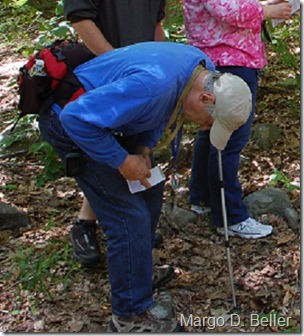
Earlier that morning I had been on the weekly bird walk with naturalist Stephanie Punnett. Our group stopped for long periods of time listening to and looking at all sorts of birds. At one point one of the younger group members looked down instead of up and found a wood turtle.

Wood turtles are threatened in NJ, and Punnett said this female was new to her because it hadn’t been marked for tracking. She put it in her bag so it could be marked and then returned to the same spot to get on with its life.

Now this was a cache worth finding.