Cape May

Cape May
(RE BERG-ANDERSSON)

Saturday, May 19, 2018

Catching Up

Spring is usually a very busy period for me because birds are heading north to breed and I want to see and hear as many as I can. Now that I am on a much more flexible schedule, I was looking forward to having the time to do that.

However, this spring was not the usual spring in my part of the world.

After having a warm February we had a cold, wet March followed by a roller coaster of weather in April. Plants that had started growing too soon in the heat were stopped in their tracks by the cold. In March we had several nor'easters within a two-week period. The first brought down trees with hurricane-like winds. The second brought down 20 inches or so of wet snow that buried the early flowers and took down my protective fencing in one area.

Apple tree after the storm, March 10, 2018. (Margo D. Beller)
Even after the snow melted in March, it was too cold for me to consider being outdoors and repairing the winter damage to the garden. So I rigged the fences as best as I could to protect my shrubs from hungry deer. I hoped for the best.

In early April I'd finally had enough and went outside to survey and do some repairs. There was a lot to repair besides the fencing. Luckily, the early bloomers were still very much alive and were soon followed by the vast array of daffodils. Slowly, very slowly, the other plants started growing or, in a couple of places, not growing. Was it winter kill or did the squirrel do damage where it could get into the area? I'll have to wait and see next year.

Meanwhile, where were the migrant birds? Reports were few in April. The lack was understandable. After all, if you are a bird that weighs less than an ounce and you meet a 35 mph headwind, you're not traveling very far, no matter what your instincts tell you.

So I concentrated on putting in new fence posts and new netting to protect the three garden areas where, in my ignorance as a new homeowner long ago, I had put some flowers and shrubs that deer find delicious, particularly when they are in bloom. I had not planned to do all three beds - one of them had been done in October and had to be redone because of the snow - and it was a long, tiring job to do that once I had weeded the beds and pulled out leaves, twigs and other debris.

Once that was done, and I recovered the use of my limbs and back, I could concentrate on the birds. Thus it was in early April and not the more normal mid-March when I saw one of the earliest migrants, a phoebe. The bird made it easy on me by appearing in my apple tree early one foggy morning while I sat on my porch.

Same apple tree, now with flowers and wren box. May 7, 2018
(Margo D. Beller)
Now it is May and the floodgates have opened. The maples, oaks, apple and dogwood trees have flowered and leafed out. Even my peppers, potted and put outside, are flowering and showing signs of production.

The birds, like the tree pollen, flooded the area at once. For instance, the day after I read a report of a house wren in a nearby area I put up the wren box. The day after that, a bird appeared to claim it. He's been singing ever since and a female is in the nest. There'll be young soon.

This has been the same with other birds. They are making up for lost time, quickly nesting and mating.

Nowadays I have the time to listen to the dawn chorus and get an idea what birds are around. I can go walking in nearby parks and find all sorts of visitors and sometimes find multiples of the same type of bird. By the rivers, there are yellow warblers hunting and calling "sweet, sweet, I'm so sweet." In the woods are red-eyed vireos with their monotonous "here I am, look at me, up here, in a tree" call. One day this week I found three male scarlet tanagers and one female in adjacent treetops (for good measure I found a male cardinal and could compare the shades of red on the feathers).

It's truly the most wonderful time of the year, when it's finally allowed to come around.

Friday, May 18, 2018

A Walk in the Woods

Let's take a walk together, Reader. It is humid but cool and still cloudy after the rain. MH doesn't want to leave the house and test his balky knees, so let us be traveling companions this time. We will go to a local county park called Patriots Path, and because I don't want to muddy my sneakers we'll walk along one of its paved areas.
Patriots Path (Margo D. Beller)

There are paved paths and unpaved paths, deep woods and hills to climb over if we walked the whole thing. We will only walk one relatively small area. We'll see trees and a host of plants, some of which are now blooming. There are even bears, although I've only come upon one once, in a different area, and this one was more scared of me than the other way around and just kept going.

You and I will keep an eye out for bear and an ear out for birds.

This place is not far from my home. When I have a tremendous need to get out of the house, as I usually do during the northbound bird migration time, I come here to walk, relax and test my memory when the birds call. Like a great blue heron seeking a meal, we can stand very still for a while or walk slowly and find out if that slight movement in the tree over there is something common, like a catbird, or more unusual, such as a blue-gray gnatcatcher.

Let us begin.

We are in luck. Besides being cool and cloudy today there is no one else parked in the lot except mine and one other car. That means there should not be many joggers, dog walkers or mountain bikers passing through while we are on the path.

Notice all the water. It rained heavily last night and this area is prone to flooding. There are even mosquitoes to annoy us.

Marsh marigold (Margo D. Beller)
Everything is so green and lush from all the rain, more like mid-summer than late May. There are all the weeds growing. Lamb's quarter, a form of spinach that is rather tasty when eaten when it is small. There are ones to avoid including garlic mustard, swamp cabbage, Virginia creeper and, yech, poison ivy. We have other colors, too. There are yellow dandelion and marsh marigold. These pink flowers look like a form of geranium. These small whitish flowers are hepatica, I believe, a buttercup.

Lots of robins and catbirds flying everywhere, and a calling great-crested flycatcher (FWEEP!) and what's that reddish-brown bird that has flown to that tree up the path? A veery, cousin to the robins and other thrushes. They skulk on the ground but have a lovely, electronic-sounding song.

Stop and listen a minute. I can make out singing yellow warbler, song sparrow, American redstart and - there! - the sweet, fast song of a rose-breasted grosbeak! They came through our yard earlier this month to use the feeder. We had at least two males and two females but they nest elsewhere, not suburban yards like ours. And what is that in the distance? Sounds like the "tea kettle, tea kettle, tea kettle" of a Carolina wren, one of my favorites.

Mosquito breeding ground (Margo D. Beller)
So many birds, it's hard to separate one call from another sometimes. And there are likely many more birds around here that aren't calling and so I can't see them because of the foliage.

Some people think the state bird of NJ is the mosquito (it's really the American goldfinch) and the one that just got into my face and made me miss the bird calling from the branch overhead seemed about as big as a bird. That's the problem with birding at this time of year. I know there are birds around but the tree foliage makes it hard to see them and once there is rain the mosquitos, gnats and other insects hatch and only make things worse.

So let us return to the car.

Hold on. Did you see that branch move? That is another problem. Unless a bird is singing, it is hard to know what's around until you see a bit of movement. Was that the breeze or a bird? And which bird would be moving on the ground between the bushes? Stand here quietly with me. It is moving along...slowly...slowly. Ah, good, it has come to a place where I can see it and turned its head - a male common yellowthroat warbler. See the mask? He acts like a wren but sings "witchety, witchety, witchety."

Now there are more dog walkers and here at the lot there are more cars. School will be letting out soon and the rush hour traffic will pick up. It's already getting noisy. Time to put the binoculars away and head home. But wait, did I just see a mallard male quietly swimming? Yes I did, somehow.

Always something. Always.

Thursday, May 17, 2018

Gone Birding

I like fishing. Not actual fishing - I like the peace and quiet of being at sea. It's different.
- Rafael Nadal


At this time of year, when the trees are leafing out and the migrant birds are heading north to their breeding grounds, I walk slowly through the woods, stopping every few minutes or even few steps to listen. Most of my birding seems to be done by ear at this time of year because the foliage makes it difficult to see birds up in the treetops scavenging for food. Unless I happen to see movement, a quiet bird is invisible to me.

Being patient while birding can be like fishing. 

When MH and I used to visit the house his parents would rent in New Hampshire every summer, I'd see his father going down to the end of the dock with his chair and his fishing pole and just sit quietly, staring at the water. When he got a nibble, he'd pull in the fish and then toss it back. He'd also do this when joined by his grandchildren.
Great blue heron (RE Berg-Andersson)
He wasn't there to catch fish for supper. I suspect he was there to get away from family members who got a little too noisy for his tastes, or he wanted some calm and quiet to recover from his days as a commercial loan officer at a busy New Jersey bank.

I know that feeling, too well.

So I was away from home, walking alongside the river and listening for the returning migrants I would expect to find in this area: yellow warbler, phoebe, blue-gray gnatcatcher, Baltimore oriole. They were all there plus some surprises, yellow-throated vireo and prairie warbler among them. Had I been jogging on the path with headphones on or walking through quickly, in my own little world (as I see many do), I'd have missed all of that. I am not out for exercise, although I know walking is good for me. I am there for the peace and the quiet and the birds.

On this recent walk along the river I was passed by an older man who responded to my hello. 

Seeing my binoculars he asked, "Have you seen the great blue heron? I'm a fisherman, but he's a much more patient one than I am."

Yes, I have seen the great blue heron, I told him, just not that day. 

This heron is a common bird wherever there are rivers, ponds or marshy areas. The great blue will stand stock-still for long, very long, periods of time - unlike most human fishermen - and can be easy to miss because its blue-gray coloring helps it blend in with its surroundings when it's at the water's edge. If a fish or frog happens to get within its reach, it snaps it up in its long, orange bill. Or it will stalk its prey, slowly moving on its long legs.

The great blue, unlike its smaller relatives such as the great egret, snowy egret, green heron and little blue heron, will spend the winter in my part of New Jersey where it can find food. I found one once in the middle of a snowy field near an unfrozen river, to its consternation. This bird looks almost prehistoric, like a modern pterodactyl. 

But when it flies it looks majestic. According to National Geographic, these herons are 3.2 to 4.5 feet in size and have a wingspan of 5.5 to 6.6 feet. When they fly they tuck in their necks and their long legs stream behind, making them look like a giant S. Up close they can scare the hell out of you when they take off, as one lurking bird did when MH passed too close on a nearby path. These birds can fly fast, at 20 to 30 miles an hour.

When they go fishing, however, they are much, much slower. And so am I, when I am fishing for birds. 

Monday, April 16, 2018

Dawn Chorus, With Junco

It is a cold dawn with slight fog as I stand on my back patio, listening. There are many robins singing, the occasional high peal of a cardinal. They are greeting the day in their own ways, proclaiming "I am here, this is my territory, stay away unless you are a potential mate."

Singing cardinal (Margo D. Beller)
Robins are the early birds that catch the worms, but there are others in this dawn chorus that join in as more daylight comes. More cardinals, the "here, here" of a titmouse, the "oh Sam Peabody, Peabody, Peabody" of a white-throated sparrow now in breeding colors (his throat and "eyebrows" are a very bright white and you can see the yellow close to the eyes, an area known as the lores).

In the old days, when I walked early in the morning to the train to take me to work, I would listen to the birdsong. Some birds I could easily recognize, others I would come to learn over the course of a decade. The chatter of goldfinches, the "tea kettle, tea kettle" of a Carolina wren and the cascading warble of its smaller relative, the house wren. The "hey sweetie" of a black-capped chickadee or the raucaus "thief!" of the blue jay. It took years of searching trees and walking through the woods to learn which calls were made by which bird.

White-throated sparrow in nonbreeding coloring
(Margo D. Beller)
Now, standing still in the growing light, I hear Canada geese, the high-pitched squeal of a red-bellied woodpecker, the three-note "tzee-tzee-tzee" of a golden-crowned kinglet, the drumming against four different trees by woodpeckers proclaiming their territories. Here are the mourning dove, the fish crow, the larger American crow and the rattle of cowbirds. The slight differences in call between a downy woodpecker and the larger, nearly identical hairy woodpecker.

Once in a while there is something unusual -- a sharp-shinned hawk flap-flap-soaring overhead, a raven's guttural croak, the high-pitched "hank" of a white-breasted nuthatch. The longer I stand outside, the longer I hear another soloist come to the foreground of this chorus. For me it ends as I am going inside to warm up and get some coffee and a flicker does its long laughing call.

Spring is my favorite time of the year. The birds are noisier as they start looking for a suitable nest site and a mate. The migrants are passing through my area, heading north from their wintering grounds. Ruby-throated hummingbirds have been reported as far north as New Jersey, despite our unusually cold March and April weather. When the instinct says go, you go.

Depending on where you are located, you will hear different birds calling in the dawn or at dusk. My patch is a suburban town in New Jersey. In a few weeks, if I'm lucky, I might hear the softer songs, clicks and buzzes of the warblers and other migrant birds foraging in the treetops as the first rays of the rising sun hit that area. There are many songs I still can't identify, even after all these years.

House finch in feeder, junco at top right, female
cardinal at top left (Margo D. Beller)
One of the interesting "problems" I have is telling the difference between four different birds whose songs are very similar. What I heard the other morning as part of the dawn chorus was a small black and white sparrow with a pink bill called a junco or, to give it its formal name, a dark-eyed junco. This is a winter visitor, and in my part of the country it is only the male birds hanging around. The browner females stay farther to the south. The idea, I think, is the males can get north and find the best territories faster if they stay farther north. So they and the white-throats come to the feeders in winter and are soon replaced by summer visitors including the catbird and the chipping sparrow.

The junco's call is soft, high in pitch and musical. The chipping sparrow will call more loudly, longer and the call is not as musical. Some refer to it as "dry." To me, and this dates me, it sounds like a person using two fingers to tap tap tap on a manual typewriter keyboard, kind of mechanical. As noted, the chippy arrives around the time the junco is making ready to leave and you'll often hear their calls during that time.

Chipping sparrow in nonbreeding coloring (Margo D. Beller)
There are two other summer visitors with similar musical calls, so I have to work my memory a little harder to remember them. I don't have many pines growing around my area and I don't live near a swamp, so I have to travel elsewhere to hear pine warblers or swamp sparrows. Pine warbler song is high in pitch and very sweetly musical. The ornithologists at Cornell describe the swamp sparrow call as "a slow trill consisting of two or more pitches repeatedly sung essentially at the same time." To me it sounds like a chippy or a junco.

As problems go, trying to remember the different songs of four birds is a minor but enjoyable challenge.

Thursday, April 12, 2018

Triumph and Disaster

Every spring I am pleased to hear the dawn chorus of birds and amazed when things start growing in my garden, particularly after a very cold and/or snowy winter. This year, "winter" seemed to concentrate itself in the month of March. But even now, in April, it has been colder than average here in New Jersey.

Glory of the snow, April 2018 (Margo D. Beller)
Still, no matter the year my first reaction in spring is usually the same: "Wow! Look who's here! You survived!"

First come the crocuses and the snowdrop. Both bloomed when they were supposed to, in late February, as the first daffodil shoots started coming up during some unusual warmth. Then came the March cold and four nor'easters, the second dumping 20 or so inches of the white stuff. But the snow melted and these flowers re-appeared and continued to bloom.

Then came the glory-of-the-snow, a small blue flower with a white center I planted in one part of the garden years ago and then moved, only to forget where I put it until it suddenly showed up. It does so every April.

Another surprise: Last year I bought a peony root and put it in a large pot. It did not do very well. I left it in the pot for most of the summer until I read more about how it likes to grow. Since deer allegedly don't eat it - peony flowers are showy and highly perfumed - I dug a hole and put it in one area of the garden I do not net. I marked it with a small flag and hoped for the best. Walking over to the compost pile one recent morning I checked and found two small, red shoots. Signs of growth! I hope the deer don't discover them.

Look closely. There are two red shoots here. Maybe the deer
will miss them. (Margo D. Beller)
One year I put the cannas I keep in two pots on my enclosed porch for the winter, covered in plastic. I later learned I had made two big mistakes - cannas are supposed to be kept cool but not subfreezing, and they are not supposed to get damp or they will rot. Plastic covering kept them damp and that winter the average temperature on the porch was 32 degrees. It took some time but the plants, once divided, managed to survive and grow. Since then I've stored them in the garage, which provides more shelter.

But for every triumph there seems to be a disaster.

This year the potted rosemary kicked the bucket after 10+ years of providing me with fresh herbs. Did it get too much water or two little? Too much dry house heat? I don't know. I did nothing different than I had in previous winters but even perennials die at some point. So now I have a glass jar full of dried herbs after I took off as many leaves as possible before struggling to get the plant out of the pot and into compost.  A friend let me take two cuttings of her plant, which had come from my plant, and I'll try growing rosemary again.

Then came the white flies.

I have a bad habit of trying to keep so-called "annuals" going over the winter. This started when I kept one pot of peppers indoors and the next year it grew more and bigger peppers. So each year I keep at least one pot of peppers. I have also been known to try to keep annuals going beyond most people's expectations. I kept a mum going for over 10 years, for instance. This past winter I tried that with begonias, coleus and ageratum, with little success. The begonias, ageratum and two of the six coleus died.

Last fall I found a tomato plant growing near my compost pile, perhaps a seed sown by a chipmunk or squirrel. I dug it up and put it in a pot. It grew very fast -- too fast. It had to be caged, staked and tied. It started to flower in December. Unfortunately, like all tomatoes, I discovered it was a white fly magnet.

The previous winter I had a terrible time with white flies. They infested all the plants, which had to be taken outside and shaken, cleaned and quickly brought back. The peppers were banished to my enclosed porch until I could put them outside. They were composted that fall.

Tomato, before composting. (Margo D. Beller)
This time I had kept two plants going, one of which provided me with small but good peppers during the winter. The other has started growing its own fruits. No flies, or so I thought, until I accidentally kicked one of the pots as I cleaned up rosemary debris after moving that pot. I had noticed but ignored some important clues. Some of the pepper leaves had started to brown. "Honeydew" was showing up on the front window. Now I had flies and, worse, I had hundreds of flies on the suddenly wilting tomato.

So the peppers were whisked outdoors, shaken and put on the back porch, where they were wrapped against the cold expected that night. The tomato was taken to the front yard, hit with a spray of water and put behind the deer netting, wrapped. The next morning the peppers were brought indoors, even though there are still some flies around. The tomato was a disaster. I put it on the enclosed porch and today it went back to the compost pile.

From compost came ye and to compost will ye return. I'll be buying my tomatoes from the farm market.

Sunday, April 1, 2018

Signs of Destruction, Signs of Life (Updated)

(Updated with a postscript at 9:30 a.m. on Monday, April 2, 2018)

The weather people say March 1 is the beginning of meteorological spring. The calendar says spring begins around March 20.

Flowering maple, March 31, 2018 (Margo D. Beller)
This year, for me, spring began on March 30 when it was mild enough for me to sit outside on my patio in my robe and listen to the dawn chorus of robins, cardinals, two types of crows, titmouse, mourning dove and Canada geese. Except for where the snow had been piled the highest, all of it was gone, I could see the flowers on the maple trees and Ifelt as though winter was finally over.

But that mildness meant something else -- migrating birds.

It seems like a lifetime ago that we had warm weather, but it was only the end of February when MH and I went down to Barnegat Light to take pictures, walk the beach and celebrate an unusually warm day. Then March came and with it four nor'easters. The first brought the strongest winds since Hurricane Sandy in 2012, toppling trees and taking out power lines. The second brought about 20 inches of snow, pummeling my fence posts and burying the snowdrops and crocus that had begun to blossom. The next two were glancing blows, giving us "only" about six inches.

In the last week, however, the temperatures, while still below normal for March, were above freezing and the snow slowly melted. The winds started blowing up from the south. I could see the winter damage to be repaired. The snowdrops and crocus reappeared and continued blooming, now joined by an assortment of daffodils. The iris showed signs of life. The feeder birds were joined by others I only see when they pass through in spring or autumn.

Damage from the second nor'easter (Margo D. Beller)
I sat on my patio and heard a golden-crowned kinglet's call as it followed the chickadees through the yard. Then came the soft "seeees" from a flock of cedar waxwings up in one of my trees. (I could not see them until they took off in a group.) A phoebe flew to a lower branch in the apple tree looking for insects. It flicked its tail a couple of times and then took off. I rarely get phoebes in my yard because they prefer areas near water. But a hungry phoebe that has just arrived and not picked a nesting territory yet is not choosy.

For many people, phoebes are the first migrant of spring, soon followed by tree and barn swallows, chipping sparrows and palm warblers.

The mild air coming from the south opened the floodgates for northbound migrants unable to head to their breeding grounds because of the persistent cold blasts that had pummeled us up until that moment.

Sewer line, across from dog park (Margo D. Beller)
So on Saturday I went for a walk. I started on the fringes of what I still call Greystone, even though it is now officially the Central Park of Morris County. There were 27 cars parked at the dog park, which meant at least 27 people and 27 dogs. But of course there were more because people were bringing their spouses and/or their children and many had more than one dog.

As they enjoyed their time outside my attention was drawn to the other side of the road, where it was obvious there had been a lot of destruction, all of it man-made. During the winter I had seen pipes laid out along the road. Now they were all buried underground and a sewer manhole had been put in near the brook. The trees closest to the road, the brush that once hid birds, the dead stump where I saw a pileated woodpecker hunting for carpenter ants, gone.

Worse, the little tree that had been struggling to grow on its small hillside for years was gone, buried under rubble or uprooted. Despite the birds chirping around me, I was saddened. I do not know why this sewer was put in by this town (next to mine) but I do know roads are being put in to expand the park's use. Perhaps a larger bathroom facility is planned? As usual, when there is development even in a park something goes by the wayside. Farther up the road there were woods where I once found a variety of birds including bluebirds and several types of flycatcher. They are gone now, replaced by a large field for soccer.

March 31, 2018. A tree once stood here (Margo D. Beller)

February 2018. (Margo D. Beller)
More people and dogs, fewer trees. More soccer fields, fewer places to walk in quiet. Parks don't pay taxes so to pay their way they must offer a range of activities. Even the most famous Central Park, the one in New York City, does that. But that Central Park is far larger than this one, and this expansion closer to home rankles.

I continued on. A pair of mourning cloak butterflies flew by as I watched the cowbirds, which will soon be dropping eggs in other birds' nests, to the detriment of the nests. Once I left the shade of the trees and the calls of song sparrows and cardinals the sun beat down from a cloudless sky. I was not the only one out. People running, people walking dogs, people raking or blowing last year's leaves off their lawns, kids playing in the yard. Men in long shorts and women in sweatshirts while I, not quite believing it could be so warm at last, was in my light parka, small binoculars in the big pocket. Turkey vultures and fish crows flew overhead. The first forsythia flowers were blooming.

Spring is here. The signs are everywhere from the birdsong to the heightened outdoor activity and the noise that goes with it. The days are getting longer and at some point the temperatures will go from below average to where they are supposed to be.  Each year at this time I am amazed that winter or my lack of care didn't kill off my garden plants.

It is time to start planning on repairing fences, putting down wood chips, pulling weeds and moving the pots of peppers and tomato outside. Time to plan on rising and traveling to the nearby hot spots early to listen for arriving migrant birds. Planning is conditional, however. I plan to do this and other things but I know nothing is certain, including the warmer weather.

Already I've seen reports there will be snow tonight. It's April, TS Eliot's cruelest month.  I've barely begun my garden cleanup.

Postscript: Yes, it snowed. Again.

April 2, 2018 (Margo D. Beller)

Wednesday, March 7, 2018

Through a Lens, Darkly

Common merganser male in flight (RE Berg-Andersson)
One of my good friends is a noted writer and photographer. He has gotten better as he has taken more pictures and improved his equipment. (I bought one of his digital cameras that I later gave to MH when I bought a more professional model with a telephoto lens.) Recently, he sent along an article from a photography website detailing techniques for photographing birds in flight.

It was an interesting article, if you want to learn about "continuous focus mode" and "drive mode" or f-stops and things like that. I do not have that kind of bent. I am of the "point and shoot and hope I'm in focus" school of bird photography.

Northern harrier (Margo D. Beller)
When I was a callow student back in journalism school I took a photography course and one of my assignments was to take a picture of something in motion. So I had one of my roommates ride by me on her bicycle over and over as I trained my camera on her and took her picture in such a way to show her clearly while the background was in blurred motion. I also tried pointing my camera at a particular spot and when my roommate rode by snapped the picture, usually with mixed results.

Although I never became a professional photographer, some of what I learned has stayed with me. With digital photography you can take literally hundreds of shots a second and sometimes catch what I want. This has been a boon to MH, too, who graduated from my friend's digital camera to a later model that had a faster shutter speed.

So if I am walking along a beach and suddenly a flock of purple sandpipers rears up, I point, hope the automatic shutter focuses on one of the birds and then keep shooting away for at least one good picture. If a black vulture flies over my head and soars in the wind, it is usually easy to get that picture - provided the lens doesn't go into infinity and then I can see nothing.

Purple sandpipers (Margo D. Beller)
Photographing birds is, for me, one of the hardest things I do. In fact, most times I just take the binoculars, find the bird, point it out to MH and then hope he can take a good picture. If we are visiting a place we're not likely to see again for a long time, I will take my camera. The long lens has helped me take pictures of everything from roosting long-earred owls to a pine warbler to a group of cedar waxwings chattering high in a treetop.

When the birds sit, even if they fidget, there is a good chance I can get that picture. If they suddenly take off, I can get a great shot or I can get a blur or I can get a picture with no bird at all. If there is a harrier flying close to the ground looking for a meal, I focus on it and follow along and squeeze the shutter again and again.

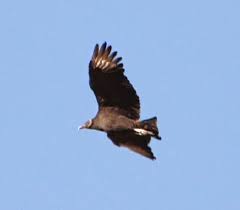
Black vulture (RE Berg-Andersson)
In the time before Roger Tory Peterson illustrated his field guides with pictures that plainly show a bird's identifying field marks, anyone who wanted to study or paint birds had to shoot them with a gun. J.J. Audubon writes of having to shoot several birds of one species in order to pin them in realistic poses and draw them before the bodies started decaying. He would often decry the waste when his crew would shoot hundreds of birds just for the sport.

It is for that reason why birds such as the passenger pigeon became extinct. It is why a rich woman had to buy what is now the Hawk Mountain sanctuary to stop local farmers and others from climbing to the top and shooting raptors out of the sky as they used the warm winds of autumn off the mountain ridges to migrate south.

Now you can identify a bird using your binoculars or telephoto lens, and everyone has a camera if they have a cellphone. You will see people out on the trails "shooting" everything including birds, flowers, themselves. The professional bird photographers are still out there with their big lenses and tripods wrapped in cammo as they patiently wait for just the right "shot."

There's money to be made from the right photograph: Calendars. Illustrating articles on how to take pictures of birds.
Pine warbler (Margo D. Beller)
I don't make money on my photos. They are strictly for me and this blog. I enjoy having a record of birds I have seen. I enjoy the challenge of even finding the bird and then trying to take its picture, if I care for one. It can be fun and it can be frustrating.

But no matter how good my pictures are, I know they will never be as good as the ones in my mind's camera lens.