Cape May

Cape May
(RE BERG-ANDERSSON)

Tuesday, April 4, 2017

Onward and Upward in My Garden

After finishing a collection of letters between garden writers Katharine S. White of North Brooklin, Maine (and the New Yorker) and Elizabeth Lawrence of Charlotte, NC (and the Charlotte Observer), I was inspired go to back and re-read my copy of Ms. White's New Yorker columns "Onward and Upward in the Garden," which was the title of her 1979 collection, edited by her husband (E. B. White) and published two years after her death.
Clockwise from bottom - Christmas cactus, trout begonia, a pot holding the Chinese
evergreen, orchid, humidifier, amaryllis (Margo D. Beller)
I read this book of columns many years ago after reading an interesting biography of KSW by Linda H. Davis. I found the collection in a used bookstore in Marblehead, Mass., and the owner was so impressed by my knowledge of White and gardening (learned, in part, by watching my paternal grandfather) she gave me the book. (It didn't hurt that MH was buying other books for himself. Bookstores never go hungry when he visits.)

It was not long after reading this book the first time that I found the book of letters, in another used bookstore (this time I paid for it).

Ms. White is a woman after my own heart. She claims she knows nothing much about gardening but she knows what she likes and the simpler the better. She is not shy about stating her opinions. She complains that the harsh Maine winters kill many of her plants but she buys more anyway, for use indoors and outdoors. Despite increasing physical infirmities, she just can't help herself.

She says she has no room for the potted plants she brings inside; that is my complaint, too. Our house faces southwest and our front room (originally a company room but used mainly to hold books and CDs) holds my plants, either on the large window sill or on some nearby tables where the plants get light but not direct sun. There are several different ecosystems in this one room, and unfortunately the other south-facing rooms aren't big enough to hold a plant table along with the other furniture.

Books, geranium in its hanging pot and a small pot of cactus to its right.
(Margo D. Beller) 
The one orchid I have - a moth orchid, a gift from an orchid-loving friend who thought I would love it as much as she - would do very well in one of my humid, windowed bathrooms, but both face north and are rather dark. My enclosed porch, where every summer I put the plants that, like the orchid, need light but not sun, faces north and is not insulated for all-year use. So in winter my orchid stands near a small humidifier, which also helps the nearby Chinese evergreen and another huge plant I can't name that started out as a little guy in a pot on the desk of a co-worker who left it behind when she went to another job.

Most of my plants I did not buy but are either gifts or orphans I took in - the latter include a red annual geranium that was pulled from a window box of a restaurant in town and dropped on the sidewalk, a pot of snake plants that I inherited from my maternal grandmother, miniature cactii from an office move, a coleus pulled from a planter in the middle of Times Square (it is very easy to take cuttings and root them in water. I now have great-granddaughter plants from the original.), a trout begonia from a friend's office (this one is also very easy to root) and a jade plant from the late father of a friend of a friend who didn't know what to do with it.

From left to right: begonia (with pink flowers), rosemary, citronella plant,
rescued geranium, 2 pots of pepper seed and one of two
great-granddaughter coleuses. (Margo D. Beller)
All of these plants have thrived and, in the case of the snake plant, grown almost too well. Recently I received a gift basket of houseplants from my mother-in-law, I bought a second geranium for its hanging pot (and then couldn't bring myself to dispose of the plant when it started flowering) and a small rosemary plant that is now a huge rosemary plant, so huge I could cut some, root it and give the daughter plant to the same friend who gave me the orchid. Another friend was eager to unload some of her citronella plant and I battle it each summer to keep it from overgrowing.

It can be a hassle to take care of so many plants, but it is certainly easier than fussing with deer netting while testing my knees and my back putting in or tending to outdoor plants.

As KSW says, "I find that the chief pleasure of growing things indoors is that it can be a natural process - a simple way to bring nature into the house."

She reads garden catalogs like literature, and I reminded MH that our one visit to White Flower Farms in Litchfield, Conn., was because of her many references to the company. She also cites, among others, Wayside Farms. Both are still around and now have websites popping with plants. But KSW sought a real catalog to thumb through and dream over. You can still do that, too.

I won't be doing it, however, because, as she would be the first to admit, that way madness lies.

Saturday, April 1, 2017

Signs of Leaf

When the last of the snow from the "Blizzard of 2017" finally melted or was washed away by this week's heavy rain, MH rushed out to walk the property, gimpy knees and all, to put fertilizer on the lawn.

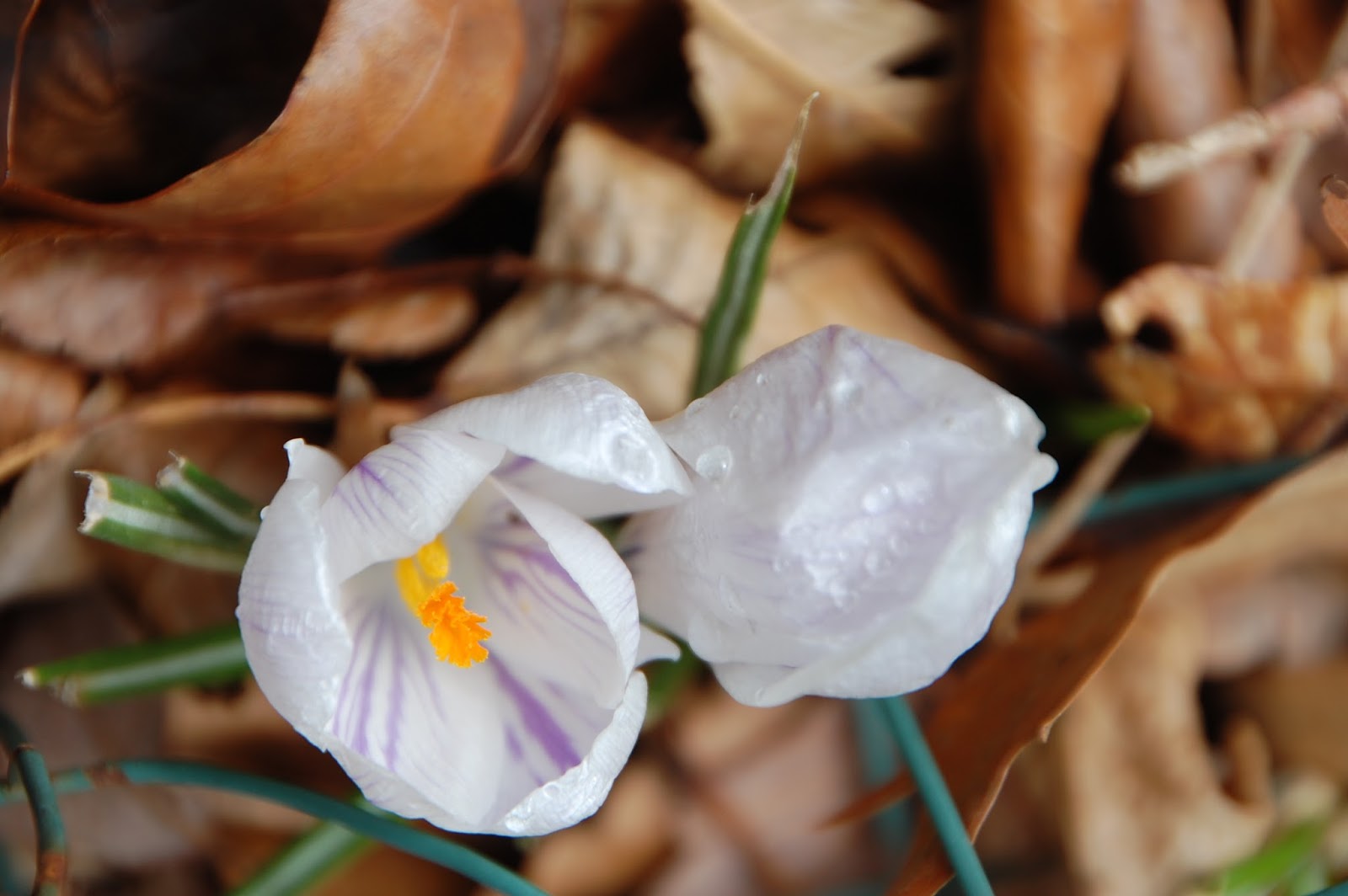
Fading white crocus - April 1, 2017 (Margo D. Beller)
He was not alone. Several men I saw - and it is usually men, either homeowners or hired - were doing the same or using leaf blowers to push off last year's detritus. It must be some sort of innate call of the wild.

I, meanwhile, took a walk around the garden and found - once again, despite my neglect - signs of life, although in most cases these were more signs of leaf.

I am currently rereading the letters of garden writers Katharine White (for the New Yorker; she was the wife of E.B. White) and Elizabeth Lawrence (for the Charlotte (NC) Observer). Their intense discussions of flower borders, little bulbs and the wreckage in the gardens caused by weather or failing bodies that just can't keep up seems even more relevant to me now than the first time I read this, several years ago.

Glory of the snow - April 1, 2017 (Margo D. Beller)
So, inspired by them, I, too, walked the property, eager to see what was doing well and what was not.

We had a warm February and that had started some plants growing way too early. Then the cold and snow came with March, and many of the plants went into suspended animation. The yellow crocuses hung around quite a while but the snowdrop came and went. Small narcissus started blooming but several of the larger daffodils caught mid-bloom when the cold came looked bedraggled. Before the blizzard I cut them and put them in water inside, to prolong their life. I did the same with a couple of branches of forsythia, another early bloomer.

Now, more daffodils are growing; more of the white, pink and purple crocus have appeared; and a little blue glory of the snow reminded me of its existence once the snow melted. But some of the daffodils in flower are much smaller than they should be. The leaves of the butterfly bush I rushed to cut back in mid-February as they proliferated are now dried up and I wonder if they will grow again. The forsythia looks very poor and the quince buds are still waiting for the weather signal to open. Same with the dogwood buds.

Budding dogwood - April 1, 2017 (Margo D. Beller)
However, all the rain has started the ornamental onions, the bleeding heart and the lilacs growing, the irises are getting taller, the tulips that had stopped growing have restarted, and all of these should open on time.

The birds have also been active. Goldfinches visit the feeder, the males just starting to show their breeding yellow feathers and black "cap" on the head. Cardinals and titmice are singing up a storm. Robins are everywhere. I walked along the Whippany River the other day with MH and we counted eight phoebes, a very early migrant. More birds will be coming north once things warm up, the trees leaf out and the bugs start flying. 

I would love to put in more early spring bloomers for the color but, except for the daffodils, they can be eaten by hungry deer, which have been browsing on my lawn for whatever little bits of grass they can get since the smaller shrubs are behind netting, along with the budding azaleas. It takes a lot of effort to kneel down and put in plants, particularly when dealing with deer netting.

Daffodils with newly growing bleeding heart at left (Margo D. Beller)
Neither White nor Lawrence mention deer, although White mentions red squirrels and other critters getting into some of her flower beds over the Maine winter. Lawrence despairs of bringing order to unruly beds. I'd love to have that problem of too many flowers. But while I inherited my grandfather's affinity for plants, I don't seem to have his stamina, at least at present.

What I do have is a huge desire to buy plants and put them in pots, both inside (where I have many flowering plants crowding my one sunny window sill) and out (behind netting). In my garage are boxes of canna roots and one dahlia I did just about everything wrong on and yet it flowered. I have seeds I have collected from vegetables and flowers. One of my friends has pepper seedlings growing on her window sill. She put hers in during the warm spell. Mine went into soil when it turned cold and have yet to come up in their pot.

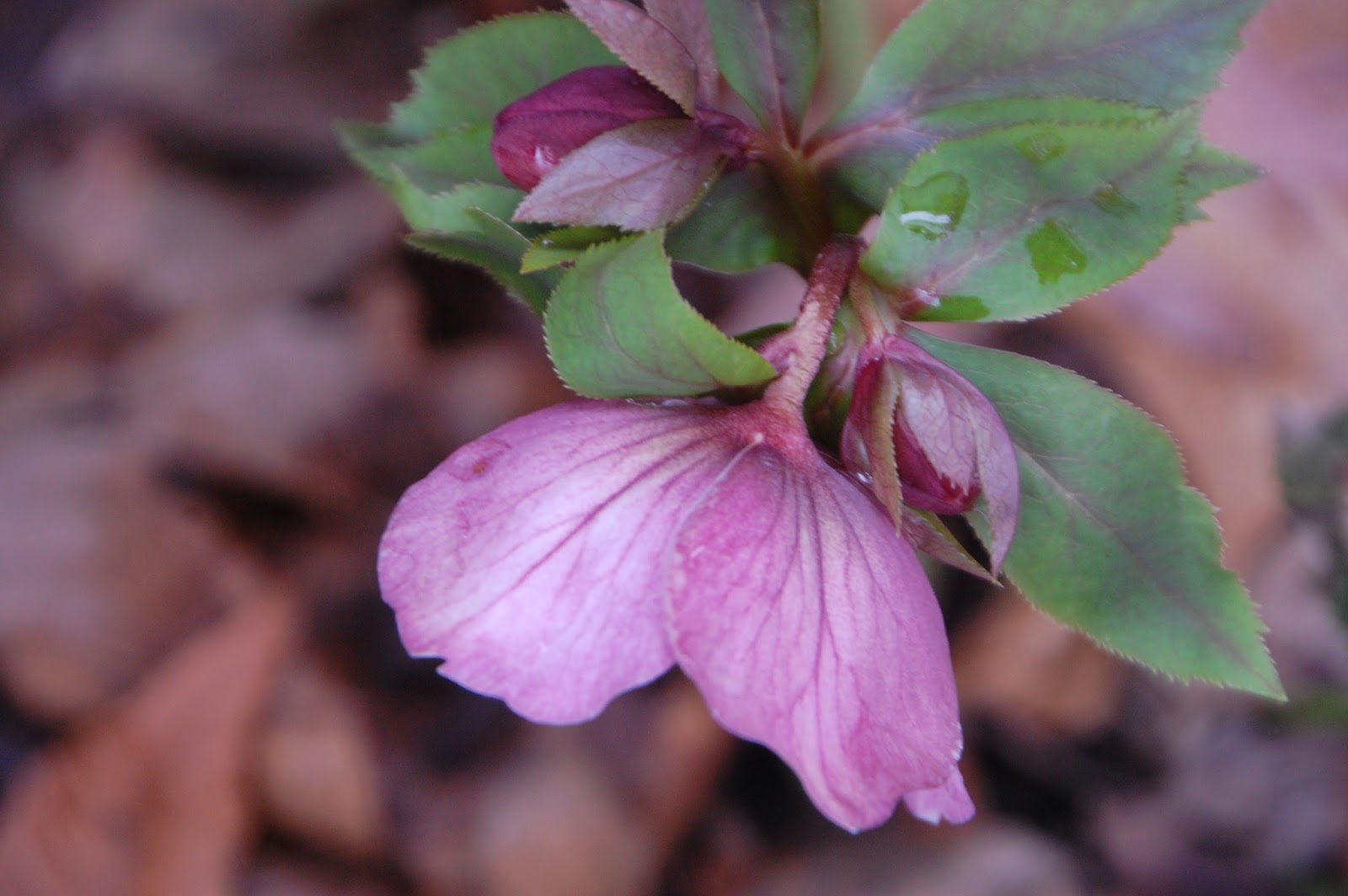
I discovered this lenten rose (helleborre) flower on the morning of April 1, the first time the plant has flowered in years. (Margo D. Beller)
Luckily, I have more than enough seeds to try again and wait for those signs of life, or leaf, to remind me of rebirth and renewal.


Sunday, March 12, 2017

Owls I Have Known

One evening, I came outside to look at the night sky and an eastern screech owl was sitting on my fence post. We looked at each other. It was close enough to touch. Perhaps it realized that because it turned and flew off in that incredibly silent way owls have, thanks to the construction of its wing feathers.

That was serendipity. More typical was the other night when I was part of a group of people shivering in the dark, hoping our guide would be able to fool an eastern screech owl into calling for us as the temperature started on its long march below freezing.

As we stood in the snow waiting, I noticed the moon was nearly full and when wind blew aside the clouds I could see the constellations Gemini, Orion and Perseus. There is no Owl constellation and, ultimately, we heard no owls on this prowl.

That's the way it goes. As MH constantly reminds me, the birds aren't waiting for us -- especially when these nocturnal raptors can hide in plain sight in the dark as easily as they can when they roost in the daytime.

But it is not impossible. In fact, on the way to the Owl Prowl a great horned owl flew over the road ahead of us.

Another time, in the middle of an afternoon, walking on a boardwalked trail, a great horned owl flew over my head, landed in a tree long enough for me to identify it and then flew off. And there was the great horned owl duet I heard by chance one predawn morning in January, as the male - in one of my backyard trees - called to its mate some distance away as I was locking the front door to head off to work.

Driving in the Great Swamp one afternoon, I stopped to see what a woman was seeing through her binoculars. It was a barred owl, one of the few owls with dark rather than yellow eyes. It had a rather benign look on its face -- but that is just an illusion, just as it is an illusion to think of some of the smaller, round-headed owls are cute and cuddly.

They are not.

Take this screech owl (below) that MH photographed in Delaware in 2010. We missed it - another couple asked if we had seen it and were kind enough to lead us to it.

Eastern Screech Owl (RE Berg-Andersson)
This 8-inch owl, which looks like a great horned owl that shrunk in the wash, may look like a friendly little guy but like the bigger owls it has asymmetrical ears - those tufts sticking up are feathers, not its ears - the better to hear its next meal scurrying around, even under snow. It has sharp talons for killing and a sharp bill. Like all owls it will eat its meal whole, later regurgitating a hard pellet containing all the bones and other parts it can't digest.

Also like other owls the screech owl is not only good at not being seen at night, it is very good at hiding in plain sight in daylight. As you can see with this owl, it is in a cavity, poking its head out. Other owls hide themselves to roost by standing close to the trunk of a tall evergreen, or even a small, thickly foliaged shrub (if it is one of the smaller owls, such as the saw-whet owl). I was once in the Great Swamp, in an area where someone told me he'd seen a barred owl. I stood and looked but saw nothing...until it flew out. Its coloring and spotting had blended in with the mottled bark of a spruce.

It was likely right in front of me, having a good laugh...if owls could laugh. They do make other sounds -- whinnying (screech), hooting (great horned), barking (barred), hissing (barn owls) and tooting (saw-whet). In the middle of the night, those sounds can range from strange to downright scary, especially if you can't see the source.

Some owls hunt in daylight. The snowy owl, for instance, has the long summer days of the arctic tundra. But when the winter food supply crashes, this owl of the north will some south to find a meal. Several years ago there were many sightings of snowy owls, a phenomenon known as an irruption. This one below was seen at New Jersey's Island Beach State Park.

Snowy owl (RE Berg-Andersson)

People think snowy owls are cute and cuddly, too. They remember Hedwig, the snowy owl of Harry Potter's at Hogwarts. Gift shops run by New Jersey Audubon and the National Audubon Society will sell you a stuffed snowy. But don't let the round head and body and the big, yellow eyes fool you into doing something stupid. These are raptors, just like the redtail hawks and peregrine falcons. In fact, here is some video of a snowy fighting off a falcon.

Other owls hunt at dawn or at dusk. The first time I ever saw a short-eared owl it flew over our car as we were driving on a road through a marsh at dusk on the way to Cape May. (It was the odd silhouette that helped me identify this bird.)

When I think about it, I have seen and/or heard quite a number of different types of owls, both by day and by night. Sometimes it is better to be lucky than good.

Sunday, March 5, 2017

Drilling Down

If you keep your eyes open you can learn something you didn't expect in the darndest of places.

Rain barrels donated by Ocean Spray (Margo D. Beller)
Recently I attended a program on how to build your own rain barrel. I learned that an inch or so of rain off an 800-square-foot roof will drain about 600 gallons of water. Your average rain barrel holds 50 gallons of water. More barrels mean more water saved for your flowers and the lawn instead of using the sprinkler or the hose in the hottest part of summer when there might be water restrictions.

That was good to learn. But what I didn't expect was what I was reminded about changing sexual roles.

Ocean Spray had donated 15 barrels for this program put on by New Jersey Audubon's Scherman Hoffman sanctuary, with a Watershed Ambassador (I learned I live in Region 6) from the Americorp service partnership of federal and private groups. When it came time for the hands-on part of the program, it was fascinating to see who did what.

Mrs.  Cavagrotti drills her rain barrel (Margo D. Beller)

Shop class - using machine tools, carpentry, hands-on stuff like that - wasn't offered to girls back in my day. We had to make do with "home ec," or learning to cook and sew so when we grew up we could efficiently run a household, presumably one with kids.

Looking back, I kinda wish I'd learned carpentry. I've had to pick up knowledge of machine tools along the way via the School of Trial and Error.

Don't ask me to build my own birdhouse. I have no circular saw. But if you need a curtain rod put up, I'll bring over my tool set.

At this program there were couples and single women of different ages.

For one couple the man was the driller and the woman steadied the barrel for the hole that would eventually hold a caulked faucet. But for another couple - who happened to be Ambassador Alexandra Cavagrotti's parents - there was no doubt who was in charge of the drill.

"Have you done one of these before?" I asked Mrs.Cavagrotti (unfortunately, I didn't get her first name). "I've built whole houses," she replied. I can believe it watching her. Her husband held the barrel.

As the noise made the room seem more like a mechanic's garage than a bird sanctuary class room, I noticed a couple of women I'd put in their 40s or early 50s. One grabbed the offered drill. "I don't want to sound sexist but have you ever used one of these before?" I asked. "Yes," she said. "You get such a feeling of satisfaction from using a drill."

I can understand that feeling. No need to call and then wait for a man to do a simple project and then pay him. Once you've used a drill, you realize the power - in more ways than one - in your hands.

But that is a recent attitude, relatively speaking. One older woman waited for Cavagrotti or one of her co-Ambassadors (who speak on the importance of water and conservation at schools and other programs) to come over and drill the hole. However, one younger woman impatiently waited for one of the three drills so she could customize her own barrel.

My drill set, with bits (Margo D. Beller)
At my house, MH is a master of the electric hammer and screwdriver (I prefer the manual type), but wouldn't touch the drill when I wanted to put up curtains, finally, in two south-facing rooms one summer. I'm glad he didn't. After some mistakes the curtains are up and so is a new towel rack. I also used the reverse function to take out some old, stripped screws.

When she was growing up my mother, who became a doctor at a time when that was actively discouraged, didn't use power tools. That was the province of her brother, the engineer. When she married my father she found a man who couldn't screw in a light bulb if his life depended on it. She learned the basics of home repair from his father. Since she was my role model in many things, I took it from there. But I didn't go the final step until MH handed me the drill and said, "This is YOUR project."

So if you want to learn something about rain barrels, check the Rutgers University Cooperative Extension Water Resources Program at www.water.rutgers.edu.

If you want to learn something about yourself and self-esteem, pick up a power drill.

And take some shop classes.

Sunday, January 15, 2017

Dust in the Wind

Generations come and generations go, but the earth remains forever. -- Ecclesiastes 1

Nothing is permanent in this world. This is a law of nature that transcends all things, including blowhards about to become President of these United States.

In my little New Jersey town I only have to walk a few miles to what used to be the property of the state-run Greystone psychiatric hospital. I have not written much about Greystone lately because once the old Kirkbride building came down, all the protests and shouting ended. The hospital moved to state land at the western-most part of the property and the much of the rest was sold for $1 to become Central Park of Morris County.

Kirkbride, as it was. (Margo D. Beller)
MH and I took our walks, thinking it odd that there was just a lot of space at the end of the road behind a storm fence instead of the hulking, stone building, a building it took close to a year to take down because it was put up to last.

There had been plans to build housing here, doing lip service to the preservationists by promising to use part of the old building to house a mental health museum. However, the whole plan died, thankfully. It would've created too much traffic and cost to provide services in one of the few, large, open spaces in a crowded part of northern Jersey. 

The other day I drove us to the end of the road and discovered the fences were gone and big boulders or huge tree logs lined the edge to keep out ATVs. However, there were no signs saying people could not walk in there. And that is what we did.

Looking south -- The ground had been frozen but recent rain made it muddy and spongy in parts. (Margo D. Beller)

Looking north -- It is hard to believe I am standing where one of the largest, continuous foundations in the world once stood. (Margo D. Beller)

Looking west -- You can't see it well here but there is a road between the hill and the field. On the other side of the road and to the right is what is now Greystone hospital. (Margo D. Beller)

Looking east -- You can see the rocks and logs put in to keep ATVs out. Beyond is Central Ave. heading back to my town. (Margo D. Beller)
I stood on this field for a long time, even as MH went back to the car. It took a very long time to take the building down, remove the mountains of stones, fill in the former foundation, put in grass and then leave it all alone until it was deemed time to remove the fences, that the danger to people like me was past.

I stood here, thinking of the human condition. Here was this huge building, built to last as I said, and then it's gone, as if it never even happened.

Dust in the wind.

We can build our monuments to ourselves, our legacies, but when circumstances intervene - a change in presidential administration, global warming, a nuclear holocaust or just everyday dying - it all means absolutely nothing in the long run.

This field, where I look forward to hiking and looking for birds when winter is finally done, is proof of that.

Monday, December 26, 2016

A Holiday Wish

As the year draws to a close, remember that each new year has the promise of being better than the one before.

Already the days are getting slightly longer because we've passed the first day of winter. Soon there will be more light, flowers and other plants will grow again and the birds will be on the move -- migrating, singing, coming to your feeder in beautiful arrays of breeding color.

2016 was not a good year for my health but I know from several tests and exams that 2017 is going to be a much better year for me. Soon I will be the same age my mother was when she died, and I am more than grateful to the Almighty for the time I've had and the time yet to come.

The future, particularly here in the United States, may look scary but I am hopeful humanity will win out over bellicosity and 140-character acts of cruelty.

May you and yours have a joyous new year filled with hope, light and the promise of a new day.

Sunrise over Appalachicola, Florida. (Margo D. Beller)

Monday, December 12, 2016

December in My Soul

Winter finally arrived in New Jersey, bringing with it arctic air, biting wind and even a bit of snow.

Winter is not one of my favorite times. Snow and ice make it harder to walk. Shorter days mean I can't do as much outdoor activities, such as birding, as I would like. Longer periods of darkness make it hard to get up at my usual early hour.

The journey begins, 12/10/16 (Margo D. Beller)
I've had health problems this year, and sometimes I don't feel like myself, which can be depressing. Winter makes that feel worse.

So this weekend, with the threat of more snow looming, I decided to go out and see what was flying around. I went to Great Swamp.

The Swamp is a large piece of land that is mainly run by the U.S. government although there are smaller parts run by Morris and Somerset counties.

My trip was to the federal area, which is in two parts - the "management" area where hunting is allowed in season and underbrush is burned or severely cut back (in short, managed) and the "wilderness" area where maintenance is minimal. The wilderness area is more of a challenge, but I didn't want a challenge when it was very cold. You get to be a certain age and you think of what happens if you're alone and fall and can't get up or, in the case of one unfortunate man I once worked with, you slip into the Passaic River and your body isn't found until winter is over.

My usual winter hiking attire. (RE Berg-Andersson)
It is scary getting older. You don't move as fast, even when driving a car. You forget things. Moving around seems harder and more painful. You feel weighed down. For that reason, I eschewed the frozen mud and rocky trails of the wilderness area and took the more wide-open trails of the managed area.

I started with one area of the Swamp where one trail is a boardwalked loop and thus is very popular with parents with children and those who want an easy stroll. At the time I visited it was super cold and relatively early so there were few people around. However, I wanted the second trail to the duck blind, which is partially boardwalked, partially frozen ground.


(As I was lacing up my boots a couple drove up in a powder blue Jaguar. They looked at me and moved to the boardwalked trail, which I expected. But they seemed perturbed by my orange hat, boots and walking stick because they kept stopping to look back at me. Maybe they thought I would try to steal their car. By the time I came back the car was gone, presumably with them.)

I was the only one in this area. I walked slowly and quietly to listen for calls. It was the first time in a while I felt like myself, completely in sync with all around me -- alive. I scanned the sky for hawks and was pleased when a redtailed hawk hovered over my head and then flew to the top of a tree, allowing me a long look.

Frozen - 12/10/16 (Margo D. Beller)
The waters were frozen solid enough for the juncos to skate on the surface as they picked at whatever infinitesimal things they could find to eat. The titmice were as much on the ground as they were in the trees.

The duck blind showed large water fowl way out in the swamp - Canada geese, mute swans, noisy mallards and a few black ducks that decided to fly in. I've been at this blind in many seasons. One year, a channel was open in the frozen water and down it swam pintails, green-winged teals and American wigeons in a sort of parade. Not now. If these smaller ducks were in the far distance with the big guys I couldn't see them.

Passing over the bridge on the way back, I thought of the time one spring when the thick ice started to melt, cracking like rifle shot. Then I looked up to see a flock of snow geese heading north. But now all was ice. A small flock of titmice and white-breasted nuthatch were hunting for food along with two gold-crowned kinglets. This is why I look at everything, because you never know who might be tagging along with the more familiar birds.

Redtail over parking lot. (12/10/16)
Back at my car, I drove to another part of the Swamp, the tour road created out of what used to be part of a mapped street, Pleasant Plains Rd. At other times I've seen harriers over the fields, yellow warblers building nests and bluebirds singing from their boxes. This time a winter visitor, a fox sparrow, popped up from the brush just long enough for me to admire its coloring. I found another one farther up the road in a flock with its cousins - song sparrows, white-throated sparrows and juncos.

It is tempting when it is cold out, especially after a serious medical condition, to stay holed up all winter like the bears in their dens. It can be depressing to do that, making you feel trapped, the furnace heat drying out your skin and making your eyes tear.

You might as well be dead.

So when the damp, drizzly November in my soul turns to cold, hard December, I account it high time to get out of the house and go birding as soon as I can.

Call me Crazy. But at least I'm happy.