Cape May

Cape May
(RE BERG-ANDERSSON)

Sunday, February 9, 2020

A Plague (of Grackles) on My Lawn

The invasion of my neighborhood began at approximately 3:45 on the afternoon of Friday, Feb. 7.

The day started with a heavy rain, which was predicted to end with snow showers, strong winds and plunging temperature. The change in air pressure was already giving me a massive sinus headache, which was why I was working from home.

As the wind picked up and the snow showers blew in I went out to dump a week's worth of compostable material into the pile before it froze. That's been one of the advantages of a winter short on snow but with lots of rain and, for the most part, temperatures above average - I could dump my compost into the big pile in the corner of my yard rather than start stockpiling pails on the enclosed porch until the snow melted and the pile defrosted.

Grackle invasion, Feb. 7, 2020 (Margo D. Beller)
Coming back to the porch, I saw about a dozen robins and maybe half that many grackles on my lawn. Then I saw more grackles on a lawn on the next street. Then they were everywhere, flying from tree to tree over my head, and making a ton of noise.

I expected this and wasn't happy. I don't like grackles. They will attack the feeder, and each other, as they work to get at and devour all the food, keeping the birds that usually visit the feeder away in the process. If you see one grackle, you can be sure you'll soon have more. Grackles stay in very large flocks in winter, as do many other types of birds including the starlings, cowbirds, blackbirds (both red-winged and rusty in this part of the country) and even robins I've seen following grackle flocks. There is safety in numbers, a better chance of finding food with more pairs of eyes and, when hundreds of birds huddle together in a large space like a pasture or field, warmth.

When I've had invasions in my yard they have generally been just before or just after the snowfall of a more typical winter. In autumn the birds kick aside the fallen leaves to see what's underneath. In late February or March, any snow is generally melting, the ground is softening and the rising groundwater forces worms and insects to the surface.

When I speak of "grackles" I am referring to the common, or purple, grackle, so named because when the light shines on its iridescent black feathers they look purple. There are other types of grackles, depending on whether you are near the ocean (boat-tailed grackle) or in the southwestern part of the U.S. (great-tailed).

Friday's invasion came during an unusually (for this area) less-cold period. We have not been (as yet) set upon by the polar vortex and, as I said, we have not had much snow, certainly not the heavy snow topped by ice that had squirrels so desperate for food one year they could jump over the baffles, grab the feeders and try to pry open the protective caging.

Does increasing daylight trigger these invasions? Was the less-cold weather a factor? Is global warming to blame? I don't know.

Another view that can't begin to show the large number of birds.
Margo D. Beller)
Recently, there have been reports of thousands of grackles converging on areas across the country. In New Jersey, birders from Mattawan to Madison have reported thousands on their feeders and lawns. MH told me of a very large number he saw while running errands, less than a mile away from home, in one of our town's parks a day or so before the Friday invasion. Maybe that same group decided to check out my part of town.

Because I was standing in my backyard, those flying in went to the front yard and the yards across the street and beyond to hunt for food, as you can see in my photographs. The pictures can't begin to show the full extent and, of course, you can't hear hundreds of grackles making their usual noises - a kind of rusty-hinge cackle and a sharp "chuck!" - or the thunder of hundreds of birds taking off at once.

Like the starlings you will see in winter swirling around in the sky and looking like a single organism, grackles somehow can communicate to each other it's time to move, and fast. So when I stepped out the front door to take my pictures, several hundred took off from my property to the next yard, which is where I photographed them. The sight was fascinating as well as horrifying. Had I not seen the massing while my feeders were out there would've been dozens of big birds trying to get at the seed and the suet even though, with the exception of the house feeder, the feeders I use are not configured to allow big birds that don't like hanging upside down from feeding. But that doesn't stop them from trying.

As I watched from my front door all I saw were grackles, although other smaller black birds could've been among them. If you're a smaller bird of similar habit, following a large flock of grackles feeds and protects you, too. I do know that around the side of my house was the original group of robins, doing the same picking at the ground as the larger birds while staying well away from them. Did the robins follow the grackles or the other way around?

One last thing about grackles and their cohorts that is an unfortunate truth but a truth nonetheless - if 50 robins showed up on my lawn I'd find that charming, a sign that spring would soon be upon us. If I see 50 black birds, it looks evil. There is a reason Alfred Hitchcock used a "murder" of big, black American crows to attack children in a playground in his film "The Birds." To paraphrase one birder recently on the (private) NJ birder Facebook page, I tried to turn the grackles into cardinals to enjoy the spectacle but it just didn't work. Black is associated with evil and seeing hundreds of grackles covering the lawns and creating a major din was evil.

Groups of robins don't look nearly as evil. This picture was taken on
Long Island in November 2017.
(Margo D. Beller)
This was, without doubt, the biggest invasion with the largest number of black birds on my suburban lawn since our first year as homeowners, when I went to the backyard to investigate a creaking noise and found hundreds of grackles, starlings, cowbirds and perhaps some blackbirds, which took to the trees at my approach and stayed there, making a racket, until they started flying off in small groups for other areas that could accommodate such a large flock. If I'm not around, MH is under standing orders to watch for grackles and bring in all feeders if he sees an invasion underway.

Soon, all these birds - like the other, more colorful types I go out of my way to find in the woods during migration- will pair, mate, nest and create more. Then the large flocks will regroup.

The morning after the invasion, sitting on my porch in the cold sunshine, a group of about 30 grackles flew over my yard. They didn't stop, to my relief, as I watched the cardinals, woodpeckers and titmice at the feeders.

By the way, a flock of grackles is called a "plague." That's as good a way as any to define what I saw Friday.

Sunday, January 26, 2020

Limits to Technology


I don't go out of my way to be continually plugged in. My old car has a radio I can tune and a player for one CD at a time. There is no dock for continuous music from an iPod, nor do we use satellite radio. I keep using my 10-year-old phone, a BlackBerry, because it has a real keyboard for sending short messages rather than a touch screen. It has a decent camera and I can read emails. I can't "interface" with some sites anymore because BlackBerry has become a dinosaur, sort of like me, but those are sites I don't miss. 

BlackBerry, photographed using my tablet (Margo D. Beller)
Unlike the people I see on my various trains to work now, or on the busy streets of New York City, I can't monitor social media on my phone - no Facebook, no Twitter, no cat videos, nothing. I can listen to music I've loaded on it but most of the time I use the phone for what I consider its primary use - as a way to make a call (although now I also use it to text).

That said, I am no Luddite. I've had to learn how to use technology in order to stay gainfully employed. I recently bought a small tablet I can use when I travel or if I don't care to go upstairs to my laptop, itself an improvement from the "old days" of two decades ago when I had a full computer rig with drive, monitor and keyboard. My laptop is lighter and has more power than the old rig, but even here I prefer using an outside keyboard and a mouse, both of which have wires I plug into ports. (Yes, I've learned what a port is.)

Technology has also invaded the birding world beyond taking a decent pair of binoculars out into the field. 

Bird-centric technology is everywhere, starting with the apps. There are apps you can put on your souped-up phone to send your bird sightings directly to e-bird, the service run by Cornell University's Ornithology Lab and the National Audubon Society that lets you record your lists, check what's happening at "hotspots" around the world or in your backyard, and read bird-related news. You can load field guides into your phones rather than lug around your copy of the 1947 Peterson guide. You can download thousands of bird songs to check what you are hearing at that moment rather than trying to figure it out later. You can use the Global Positioning Satellite, or GPS, on your smart phone to go into the woods and presumably not get lost because you'll be able to check where you are and the type of terrain you might be stepping onto. 

Tablet, photographed using my BlackBerry (Margo D. Beller)
Even binoculars have changed. You can buy them with night vision to find that great horned owl hooting at you at midnight. There are digital binoculars that act like digital cameras so, in the words of one site, "you will not just be able to view objects but also you will be able to record them." 

I admit, some of this stuff could be helpful, especially as I get older. So why don't I use it? The cost is one reason. And the more bells and whistles, the more things that can go wrong and/or break, just like with some of the high-tech cars.

Another reason: I like to use my brain. 

It seems too much like work to go charging into the woods headlong after some reported rarity and depend on an app you might not be able to access if you don't have a signal. Too many people go into places where they are not supposed to go because they think they can get out as long as they have the app. It is like the drivers who pay no attention to road conditions, expecting the car to think for them. 

If I need to know where I am, I study a map - a paper one. Or I travel with MH, aka Mr. Map, who will either know from studying a paper map where we're going or will check his phone, which is a bit smarter than mine. I prefer to "listen" to my sore knees, my lack of breath, my fatigue and know when to turn around and go back before it's too late.

My Nikon 10x50, non-tech binoculars (Margo D. Beller)
If I am looking for a bird I'm hearing, I use my non-tech binoculars. They can't help me see at night, they can't automatically send my data anywhere, but they help me see what I am looking for, at least most of the time (especially since upgrading to 10x50s).

Again, I've learned to live with technology. But I've also learned technology has its limits. So do I.


Thursday, January 16, 2020

Rediscovering Where I'm From

New York is an enjoyable city to walk in if you have comfortable shoes, keep an eye out for wheeled and human traffic and don't mind the babble around you of many different languages from people talking into their phones.

I was born in New York, specifically the borough of Brooklyn. To us, Manhattan was "the city." It is where you went to work. It is where you went to leave home and become independent. It is where you went to see a Broadway show or visit a museum or other attraction. Lately, it has become a place to occasionally find unusual birds.

House sparrow pair, Central Park (Margo D. Beller)
After many years working from home in New Jersey, I now work in Manhattan. Last time I was on the west side of midtown. Now I am on the east side, which has a completely different vibe.

I am rediscovering this city. As when I was a child taking the subway in from Brooklyn with my mother, I find myself looking up at the top of the very tall buildings to see the decorated parts you can't otherwise see from ground level.

One such day I was heading east toward the area of the United Nations. Before crossing the street I looked north along Lexington Ave. and up at a colorful skyscraper that was not a glass box or a so-called pencil building. A dark figure sat atop the tower. At first I thought it was a redtailed hawk, maybe the famous Pale Male or one of his many progeny. But later it occurred to me it could've just as easily been a peregrine falcon, a raptor I've seen atop many a skyscraper or bridge, using these man-made structures as its more usual cliff top.

Unfortunately, I had no binoculars with me to know for sure what I was seeing. However, any raptor would have an easy time picking off pigeons, squirrels or rats in some of the city's park areas, including that oasis of green in the midst of concrete, Central Park.

Past Central Park pond visitor - male wood duck (at top)
with mallards (Margo D. Beller)
One day I walked north on Fifth Ave. in midtown, relieved the holiday tourists finally went home. I had no particular place to go, just a desire to stretch my legs and get some air after being in the office in the morning. At noon, church bells rang from St. Patrick's and, up the block, St. Thomas. They were generally ignored but I stepped to the side and listened as the lunch-hour workers and visitors rushed past me, the high-end retailers and those trying to get a handout.

What does this have to do with birds, you might wonder.

I had not planned on visiting Central Park but it was such a nice day and I was so eager to rediscover this city of my birth that I continued up Fifth Ave. until the retailers gave way to expensive hotels and apartments and there was the park. The mood changed and the pace slowed. I looked in the trees and saw pigeons and starlings, two of the three most common birds seen in Manhattan along with house sparrows. I knew I was near the Pond at the park's southern end, so I walked over to see if anything unusual was around.

Pigeons, Central Park (Margo D. Beller)
In winters past one of my favorite ducks, the colorful wood duck, has been there, hanging with the usual mallards and Canada geese. One notable year, a Mandarin duck was at the Pond and became such a sensation people created a Twitter feed and a website about it. Mandarins are colorful and New Yorkers have always gone ga-ga over colorful celebrities in their midst.

However, during my visit there were no colorful creatures. There was a great blue heron watching for lunch from a branch low over the water at the edge of the Hallett Sanctuary, an area of the park kept locked except for small, restricted tours. In the water were a couple of American coots, black and white birds that might look like ducks but are actually related to more chicken-like birds such as rails, according to the Cornell Ornithology Lab. Although they will hang out in ponds with ducks, their feet are not webbed. Instead, according to Cornell, "each one of the coot’s long toes has broad lobes of skin that help it kick through the water. The broad lobes fold back each time the bird lifts its foot, so it doesn’t impede walking on dry land, though it supports the bird’s weight on mucky ground."

Central Park carriages, where a cardinal flew across. (Margo D. Beller)
It stunned me to find the coots, but I should not have been surprised. Central Park is known for the unusual birds that pass through on their way north or south, depending on the time of year. It would've been easy for me to just keep walking and looking for more interesting birds while ignoring the many people visiting the park and its attractions including the nearby zoo, or walk farther up Fifth Avenue and see if Pale Male is still around

Unfortunately, my lunch time away from work is limited so on that day I restricted myself, noting the mourning dove with the pigeons, the white-throated sparrows with the house sparrows and the calling male cardinal that flew over the line of horse-drawn carriages waiting for fares. 

The park isn't going anywhere and, for now, neither am I. I'll be back.

Sunday, January 12, 2020

Pecking Order and the Mob

When a redbelly comes by, everything else scatters
 (Margo D. Beller)
Not long after putting out the house-shaped feeder the other morning, a male cardinal came by for a few seeds. He was soon followed by three house finches, two of them male. They sat atop the feeder while the cardinal sat and ate. One of the male house finches found its way to the other side of the feeder and started to eat, until a female downy woodpecker showed up and chased him off. She grabbed her seed and flew off to either eat it or hide it somewhere for another time. The house finch tried again, only to be chased off by the returning downy.

Meanwhile, the cardinal stayed put and pecked at the other house finches if they tried to take a seed from his side. When he would grab a seed and jump up on top of the feeder pole to eat - his usual habit - he would quickly jump down and chase off the finches if they came down for seeds. It was only when the larger, more aggressive blue jay came in that the cardinal left, along with the finches. When the jay flew off, the finches returned. A female cardinal came to eat on the other side from where the jay had been. She, however, allowed the house finches to grab seeds and take off.

Titmouse about to be chased off by a white-breasted nuthatch
(Margo D. Beller)
Then the titmice started arriving, grabbing seeds and flying off between visits by the jay. Finally, a redbellied woodpecker flew in, scattering the female cardinal and the smaller birds, including some house sparrows and juncos that had been attracted to my yard by all the action.

Why am I detailing this?

Because it illustrates two different types of bird behavior - the pecking order and mobbing.

Cornell University's Ornithology Lab published an interesting article at the end of 2018 about which birds are "top dog" when many converge on the same feeder. (Pecking orders are also found within the same bird species, but that's a topic for another post.) Usually, size matters, as the example of the male cardinal chasing off the house finches shows. Sex might matter, too, as shown by the female cardinal that was not as aggressive toward the house finches as her mate.

Cooper's hawk looking for
birds at the feeder
(Margo D. Beller)
However, behavior is also important. Jays are more aggressive than cardinals and sometimes even woodpeckers, in my observations. Small titmice and chickadees will hang back but then zip in and grab a seed to take elsewhere when given an opportunity. The small white-breasted nuthatch will take a seed and go, but it will also chase out slightly larger birds and sometimes spread its wings and try to make itself look bigger to keep other birds away when it is trying to get a seed.

As for the feeder mobbing, to me it seems when a big, colorful bird - jay, cardinal, redbelly - comes to the feeder, this is when all the other, smaller birds in the area want to show up and then start mobbing the feeders once the bigger birds are gone. In my example, this is what happened when the house sparrows and juncos showed up. It is a sort of feeding frenzy where these birds may fear getting nothing with the big guys around and so rush in en masse once they get a chance.

At some point, when the cardinals, jays and woodpeckers must've had their fill, the house sparrows and house finches, which will sit and eat and do little else, must've come back because I found the feeder nearly empty when I took it in at night. It is the reason why, until this recent mild weather, I usually put out at least one other feeder that only small birds can use to let them eat when the bigger birds swoop in.

Of course, when the raptors show up for a meal they aren't looking for seed, they're looking for the birds at my feeder. Then the mob disperses and the pecking order is forgotten for the moment.

Sunday, January 5, 2020

High-Flying Vultures

It is a cold morning made colder by a strong wind. Where I am walking - an old railroad embankment now a paved, linear park - the river barely ripples because the trees on either side are blocking the wind from it and me. Only a pair of mallard ducks are on the river, more disturbed by me standing still and looking at them than the people running along the path, with and without dogs.
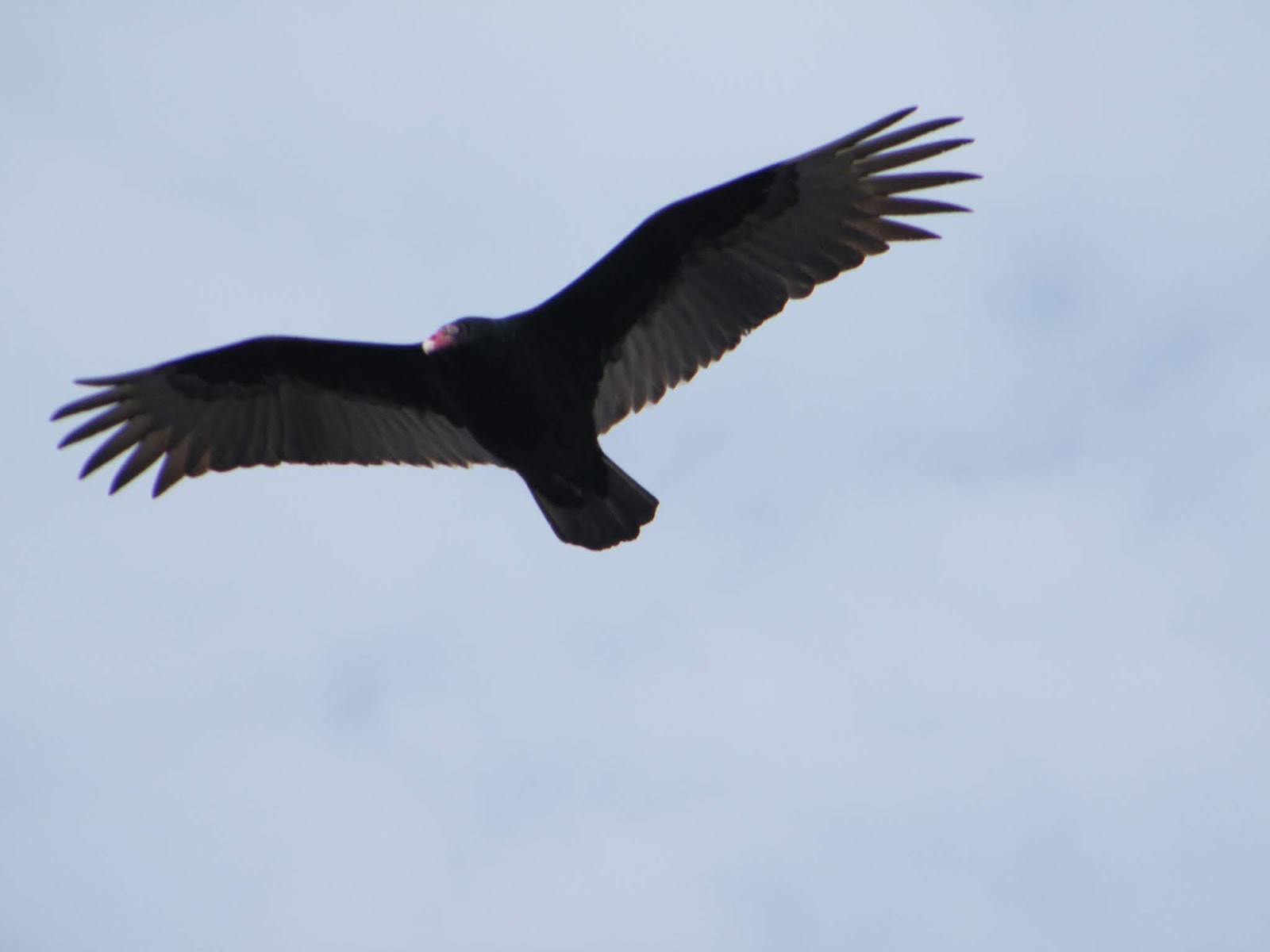
Turkey vulture, Sandy Hook, NJ, 2018 (RE Berg-Andersson)
There is not much else going on in the wind aside from a brief call by a jay. Then I look up and there is my third turkey vulture of the morning.

I have written about turkey vultures in the past. I've always been impressed by how an ungainly, ugly bird that lives on dead animals looks so graceful and majestic when it flies. Its wide wings are held back, making it look like a giant V in the sky. I heard Pete Dunne describe turkey vultures once as a man walking a tightrope, his arms held up to keep his balance. It is an accurate description.

In a strong wind a turkey vulture wobbles as it fights to stay aloft and in the direction it wants to go. On days like this, turkey vultures are the only birds I expect to see flying. Others, even redtailed hawks, are more likely to stay in the bushes or perched in the low branches of a tree to stay out of the wind.

Why do turkey vultures fly in gusty winds? To eat, naturally. But hawks need to eat, too, and I don't usually see them in gales. I went looking through the internet and found this explanation, which you can believe or not:

One way of looking at the flight behavior of Turkey Vultures, is that they are the one species which flies “with” the wind, while other raptors fly “through” the wind. 

That's one way to look at it, although I've seen plenty of hawks flying "with" rather than "through" the wind. The experts at Cornell's Ornithology Lab note these vultures fly low and slow to smell out carrion, so perhaps the high winds are bringing the smells of breakfast to wherever the big birds roosted for the night, prompting them to take off.

Vultures aloft, Sandy Hook, NJ, December 2019
(RE Berg-Andersson)
Turkey vultures like wide-open spaces, so unless you have a particularly big yard with something dead in it, you are not likely to find them there. (I have never hosted turkey vultures in my yard except one spring, after the snow had melted, when they found a dead, frozen rabbit the day after I did. I made sure they took their snack elsewhere.)

Finding them sunning themselves on your roof on a cold winter morning or roosting in large numbers in your large trees is another matter.  I've seen many such vulture roosts, some in my neighborhood. As you would expect, most people don't want these reminders of death hanging around their roofs or trees because, as with all creatures, what goes in one orifice eventually comes out another, and 70 pooping vultures can make quite a mess.

Better to watch them aloft in the wind, doing what they must to survive.

Wednesday, January 1, 2020

New Year, Old Birds

I'd like to state for the record that my first bird on the first day of the first month of 2020 was a male cardinal at the house feeder. As usual he came, took a seed and then ate it from the top of the feeder pole. When finished, he took another and went back to the top of the pole. I don't know why he doesn't just sit in the feeder unless it is to watch for other cardinals or predators.

Female bufflehead duck, Sandy Hook, NJ (RE Berg-Andersson)
There is a tradition among birders that on the first day of the new year they go out and record the birds they see. For many, they are getting ready to embark on a Big Year where they set a goal of seeing as many birds as possible in a year, be it in one place or around the world. Others, however, just like making lists of what birds they see and when. This isn't necessarily part of their Life List because their "first" birds are usually common ones seen around the house. They may do it just to keep track.

Usually, I am not one of them. Weather is one reason. Two New Years ago, the weather was frigid and I was content to be home. Last year, rain soaked the area on New Year's Eve and I had no inclination to trudge through mud.

But this year, with my time limited by working away from home, I felt restless so, after seeing the cardinal, I ventured into the cold wind of January and met one of my friends who was at nearby Speedwell Lake in Morristown with his photo club.

We walked the path to the wider part of the lake. Few birds on the water, even fewer in the trees. But there was a pair of bufflehead ducks and, in an inlet, a few Canada geese.

I decided to go to another place near me to see how many "first" birds I could find. The answer: not many.

Cold, desolate and not the best place to find birds on a windy day. Jan. 1, 2020.
(Margo D. Beller)
That's how it goes some days, but I was in a truly bad place to try to find birds on a cold, windy day. I was in a county park that was once the Greystone psychiatric hospital. It is a wide-open piece of property with little to block a strong wind. Worse, the county has been cutting down ash trees to limit the damage caused by the emerald ash borer. Just like a year ago, the fallen trees have been left on the ground, pulled away from what is normally a cross-country running track. But cross-country is over for the season and the big machinery that pushed the cut trees aside churned up the path to make it nearly unwalkable for the rest of us. (That did not stop the many people there walking their dogs, however.)

A few birds could be found, mainly sparrows and woodpeckers, but the more unusual birds I've seen here before when the sheltering grasses and weeds were taller and there were many more trees were long gone. I was glad to get back to my warm car and get to my warmer home.

For the record, these are my "first" birds of 2020:

Cardinal

Bufflehead ducks

Canada geese

Song sparrow

American crow

Redbellied woodpecker

White-throated sparrow

Downy woodpecker

Turkey vultures

Rock doves (pigeons)

It can only go up from here.

Sunday, December 29, 2019

Summing Up My Life List

With the new year fast approaching, I was thinking about all the unusual birds I was able to see this year.

Life list (Margo D. Beller)
Every serious birder keeps a "life list" of birds seen, from the humble to the rare. As life lists go, mine is rather small - 352 - for someone who has sought out birds for more than a decade. Much of my list includes the birds we see every day but this year I was able to see a record (for me) high of four "new" birds because I had the time to do it. I was irregularly employed this year, and when I did work it was from home. So it was easy to make the time (tho' not always so easy to get MH to join me).

It seems every year a number of birds not found in my part of the world show up, either blown off course by strong winds or a bad sense of direction.

My life list is a photocopy of the list at the end of the 1947 edition of Roger Tory Peterson's guide to finding eastern birds. This is still considered by many to be the best birding guide ever published because it introduced Peterson's system of identifying field marks. But in 1947 many birds had different names and since then new birds were "created" when the birding bigwigs decided to split what had been one species into two or more (or vice versa). On my list I've also added many western birds I've seen in my travels. Several of my "new birds" this year are ones I realized I had not added when I first saw them: The Wilson's storm petrel and the pomarine jaeger seen from a whalewatch boat out of Gloucester, Mass., were numbers 350 and 351. My list has become so marked up and confusing (my photo is of the front page, not the marked-up back page) I've had to transfer the information to a bound volume MH bought me for that purpose, which is how I discovered the omissions.

I can go many years between finding "life birds." For instance, I saw No. 344, a Connecticut warbler, in October 2013, and No. 345, a roseate spoonbill, in May 2018. It was not for lack of trying. Many times we've gone to where a rarity was reported only to be disappointed, such as the boreal chickadee we were told we had just missed at the feeders of the Merrill Creek reservoir in March.

It was in December 2018 my employment became irregular, and that is how I was able to leave home and find these birds originally found by others:

No. 346 was a female Barrow's goldeneye, a western duck discovered at Merrill Creek. We traveled there on a very cold day in March 2019 for the duck and the boreal chickadee. The duck turned out to be easier thanks to the sun spotlighting the duck's round, brown head and yellow bill, and the arrival of Henry Kielblock, the founder of the Scott's Mountain hawkwatch located at that very parking lot. He had driven up to see the duck, pointed it out to us and then realized who we were (we visit this hawkwatch at least once a year in the fall). After he drove off, a pair of redhead ducks flew in, an unexpected bonus.


No. 347 was a black-headed grosbeak, another western bird, reported at a feeder not too far from my home. Many had already seen and photographed it by the time I drove over in April. I learned that when you "stake out" a bird, bring a chair. I had not, but a kind man who had driven up with his wife from central Jersey gave me his seat as we waited from the top of the homeowner's driveway. We were soon joined by others. It was 45 minutes before I looked up and saw the bird's black head and orange breast (the file photo above is of a female, notable for the wide white "eyebrow"). It never came down to the feeder and I had a bad case of "warbler neck" but after watching it for 10 minutes I left satisfied.

No. 348 was a Henslow's sparrow that came from the midwest to the sprawling grassland preserve known as Negri-NepoteGrasslands are in decline as they are built upon for housing developments, office parks and warehouses. Many had seen the Henslow's sitting in a particular shrub singing away, but when we walked out to the area on a very hot July 6 we almost missed it - it was hunkered down atop a different shrub nearby and not singing as it tried to stay out of the way of several redwinged blackbirds. But I saw the identifying field mark - a dark spot near the eye - and that would have to do.

No. 349 was an upland sandpiper, another bird in decline because of decreasing grasslands. On Aug. 24 we followed the directions given in the various bird reports and parked at the Burlington County (NJ) fairgrounds. There were already several people there, one with a spotting scope. I scanned the area with binoculars but only found a large number of killdeers. The man motioned us over and showed us the upland sandpiper. He then pointed out a couple of sanderlings (usually found on beaches), a pectoral sandpiper and a golden plover. We've often found birds thanks to the kindness of strangers.

The last of the new birds, No. 352, was a Nelson's sparrow on Oct. 12. The Nelson's is one of those birds created when the birding bigwigs decided to split the sharp-tailed sparrow into two types, the Nelson's and the saltmarsh. Both look very much alike. I had seen saltmarsh sparrows in a marsh in southern Maine years ago but was never completely sure if that's what they were. That changed when I found the Nelson quite by accident as I trailed MH hurrying (for him) back to our car as we were completing the Liberty Loop trail near the Wallkill River at the NJ-NY border. When I am seeking birds I walk far slower than MH with his gimpy knees, and as I was approaching the last curve something flew up and looked at me from the top of a shrub. It had a lot of yellow-orange in its face and neck, so I knew this was an unusual bird. I looked in my books and realized I had finally seen a Nelson's, which can be found at freshwater marshes.

There are birds I seek out every year but this year I found a number of birds I haven't seen in years - blue grosbeak, Tennessee warbler, least flycatcher - on trips I took alone to places relatively close by. That was when I would be restless because of my underemployment and needed to get out to give my days a sense of purpose.

But now I have a new job that takes me away from home, and my birding time is again limited to weekends. I'll have to make the most of the time I have.