Cape May

Cape May
(RE BERG-ANDERSSON)

Monday, July 22, 2024

A Wren by Any Other Name

As we approach August, families have been passing through my yard - small flocks of robins, flickers, grackles, chipping sparrows, all pecking at the ground for food. Birds are also flocking to the cherry tree, where the berries have become ripe enough to consume. The robins, catbirds and jays have been joined by raucous families of titmice as well as the occasional house finch.

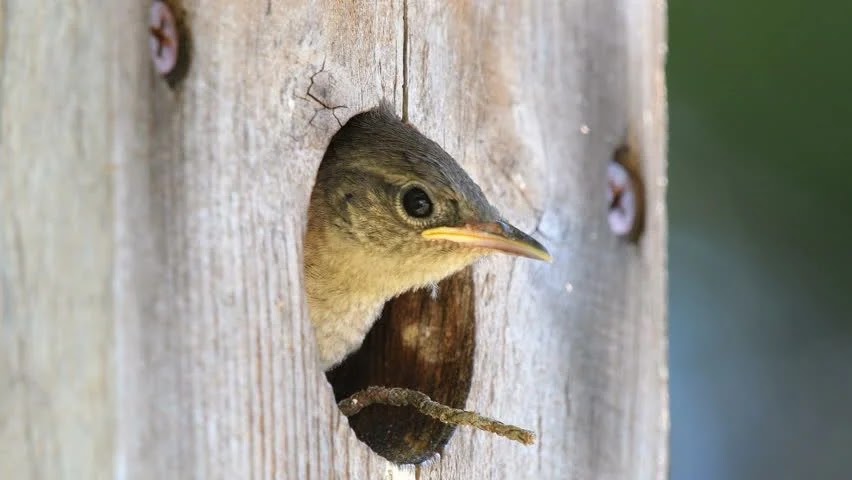
Over at the house wren box, the young - I'm guessing there are at least two in this brood - are now big enough that the parents feed them from outside, except when one (usually the female) goes in to remove poop. I can hear the cheeping of hungry young through the open window while I sit on my enclosed porch.

Northern House Wren, aka one of my backyard birds.
(Margo D. Beller)

Many types of birds, including the house wrens and the robins - have multiple broods in a season. Many more are one and done. At this point of the summer, some species of birds are already heading south to their winter feeding grounds. More will be on the move in August into September, including warblers, shorebirds and raptors.

At that point it will be time for people like me to prepare our gardens for winter and put out feeders for the birds passing through and those that will be spending the cold months in and around my yard.

It is at this point of the summer that the American Ornithological Society's (AOS) Committee on Classification and Nomenclature of North and Middle American Birds publishes its "check-list supplement." This benign-sounding document in reality contains what could be radical realignments of the way birds are categorized. Many types of birds previously considered separate species can be "lumped" into one - decreasing the number of birds to record on a Life List. Other birds have been found to be separate species and so are "split," thus increasing the number of birds to be sought by birders.

Here are a couple of examples.

The small common redpoll, which I've seen only during some winters in New Hampshire when they come farther south because of the lack of food in their usual territories are now considered the same species as a paler redpoll I've never seen and is considered a rare visitor to northern U.S. states, the hoary redpoll.

Meanwhile, the Audubon's shearwater, a bird that looks like a large gull and lives its life over the open ocean, is now five species of shearwater, only one of which (the Sargasso shearwater) is found in North American waters. The cattle egret, which is found in farm fields rather than at the edges of water, is now the Western and the Eastern cattle egret. AOS says they are different in plumage. The Western is what is found in the Americas, the Eastern in Asia and Australia.

Normally these changes in taxonomy don't interest me because they involve birds I don't see often or are not likely to see unless I travel to a completely different part of the world.

But the change to the house wren did interest me.

Where there was once one "house wren" there are now six: the northern house wren, the southern house wren, the Cozumel wren, the Kalinago wren, St. Lucia wren, St. Vincent wren and the Grenada wren.

According to the press release announcing the changes:

This split was a long time coming. Some of the island species, in particular, look and sound very different. Some sound so different that people who are intimately familiar with House Wrens from the mainland don’t even recognize their songs as being from a wren! Indeed, that was my experience on my first visit to Cozumel. Speaking of the island species, it was very nice to see this sentence in the acknowledgements of the supplement: “We thank Kalinago Chief Lorenzo Sanford and the Kalinago Council for permission to use ‘Kalinago’ in the English name for the newly recognized species Troglodytes martinicensis.”

Note that “Brown-throated” Wren of Mexico and the far sw. United States is included in Northern House Wren, so there is no additional species for the ABA Area. Northern and Southern house wrens switch over in Veracruz and Oaxaca, where they look different (warm “Brown-thoated” Northerns vs. grayish Southerns) and use different habitats (highland vs. lowland). Kalinago Wren was originally found on Dominica, Martinique, and Guadeloupe but persists on only the first island. The other species are found on their namesake islands.

So the birds in my yard are Northern House Wrens. 

Of course, the birds don't know what we humans call them. If they could understand the human need to classify they likely wouldn't care either. Neither do I. I'll continue to call the birds in my yard "house wrens" even after they fly south for the winter.

Saturday, July 13, 2024

Heat, Humidity and House Wrens

When it is so hot and humid outside I must stay indoors with the air conditioner on for most of the day, I try to imagine what it is like for the house wrens in my yard.

This past week the western half of the United States has been baking under brutal heat, with wildfires sparked. Meanwhile, in my half of the United States, we just got through more than five days where the temperatures were in the 90s and the humidity made the air feel like 105 degrees F.

House wren (Public domain photo)

Weather like that is dangerous. Weather like that keeps people like me inside and extremely uncomfortable unless I have the air conditioner on.

In weather like that I can't even keep a water dish outside because when the sun hits it late in the day the water becomes undrinkable. I can only go out to walk in the very early morning when the air, while still humid, is 20 degrees cooler than what it is forecast to hit for the high. If it is raining in the early morning, as it has for a couple of mornings, I am stuck inside and start to feel caged and anxious, not the best company for my husband.

In weather like that I feel sorry for the First Responders and others who must be outside to do their jobs. I used to travel to work but I would leave in the early morning, sit on a (usually) air conditioned train and then walk into an air conditioned office. The heat would not become an issue until my walk home from the train. But I was younger then and didn't think twice about being in an inferno. Now, I do.

This most recent heat wave wasn't the first this summer. There was a heat wave in June. And there will be a new one starting July 14. And August is weeks away. You can blame El Nino, La Nina, climate change, global warming - whatever you want to call it, it's hot. The Earth won't cool anytime soon without drastic actions.

So I look at the house wrens with amazement and admiration.

I could tell when Mother Wren was sitting on eggs because she would zip into the box and disappear for long periods of time. If it was especially hot, she would sit at the edge of the box and stick her head out of the opening. Then, she'd fly out to get herself a meal while her mate called from nearby, watching the nest.

She sat inside the box because that is what she has to do to protect her young. She keeps cool by panting, sitting by the box opening but also by flying into the shade to hunt for her food. Unlike people, she doesn't have any choice in the matter of how she spends her days. 

Two days ago I could tell the eggs had hatched because she started making more trips into and out of the box. Even Father Wren came to the opening and leaned in, feeding young. More recently he has gone in and out of the box, tho' not as quickly and surely as his mate. They are regurgitating food into the young birds' mouths and taking poop out to keep the nest clean.

Just as I saw with this year's first brood, soon the young will get big enough to move around the inside of the nest and will start jostling each other to get the food when the adults bring it.

Meanwhile, on the other side of my enclosed porch, I've seen only one hummingbird, a male, back in June. It came to the pink coral bell flowers, ignored the feeder I had out and flew off. I've seen none since. Usually I see females in July, when they are also seeking food for their young. Unlike the house wrens, male hummers don't hang around once mating is accomplished.

Where are the hummingbirds?

Toad, 2024 (Margo D. Beller)

So far this month I've seen nothing, and the pink flowers that had been blooming have faded and are mostly done thanks to an unusually hot summer that prompted many of my flowers to bloom at the same time instead of one after the other. The apple tree that provided me with enough fruit to make eight cups of sauce had its last apple plucked by a squirrel on July 5, about a week earlier than usual. Over the years the last apple day has been getting earlier and earlier as the weather has gotten hotter and hotter.

Luckily, the hot weather has also brought out another important source of food for young birds - insects, as well as insect eaters such as dragonflies. And toads.

Last week, a day after several weeks' worth of grass growth was finally cut, I went on the patio and pushed at the cover on my charcoal grill to tuck it in. Something jumped. It was an American toad, common in the east. It was dark and blended into the black cover's folds in the shade where I had put the grill. When I moved the grill it jumped out to the paving stones. 

I am guessing the combination of losing the long grass and the high heat and humidity forced it to find shelter where it could. It hung around for long enough to determine I wasn't going to bother it (I was watching from inside) and then it was gone.

This is not the first time we've had a toad visit our patio in July. 

(RE Berg-Anderson)

In fact, this American toad showed up on the fourth of July 10 years ago, tho not in the folds of the grill cover. It had somehow gotten into the bottom section of the composter I keep on the patio. When I moved the composter to sweep out leaves that had gotten behind it, out jumped the toad.

I can't imagine how this 2014 toad, bigger than the one I discovered last week, managed to get inside the composter. But out in the wild, I guess any port in a storm will do. I expect Mr. Slither to show up any day now, basking in the heat of the paving stones.

Sunday, July 7, 2024

Road Scholar

When I retired from the journalism business I wondered what I was going to do to fill the time once spent working. Do what you enjoy, I was told by friends and magazine articles.

Well, that means birding. But what kind of paying job could I get in the birding business? Not many that I would want to do, as it turns out.

Hitting the road. (RE Berg-Andersson)

I have great admiration for people who study birds for a living. I don't mean everyday birders like me, I mean those with hard-core knowledge. They know a primary from a secondary (a bird's outer and closer to the body flight feathers), a mantle from a tertial (feathers on a bird's back) and a gape from a gonydeal spot (the fleshy edges at the base of a gull's mouth and the spot, often red, on some large gulls).  

All these definitions come from Richard Crossley's field guide to Eastern birds. Crossley is hard-core. So is David Allen Sibley. So was Roger Tory Peterson. They don't just look at birds and identify them, they know their every part. All have written extensive guides.

Other hard-core birders go beyond identification and want to handle the birds in the cause of science. So I looked into becoming a bird bander. It turns out there are rules - a lot of rules.

I found a free, online course in bird banding offered by the U.S. government. Once I registered I looked at the study materials in each module. For instance, there is the 69-page North American Banders Study Guide published by the North American Birding Council. It begins with a Code of Ethics and then goes on to detail such things as the permits needed for banding (migratory birds are protected by federal statute), how to handle a bird, how to open a bird's bill, capturing and extracting birds from mist nets and how to prevent bird injuries and fatalities, among many, many other things.

Duck banding at Eastern Neck Wildlife Refuge.
(Public domain image from the U.S. Fish and Wildlife Service)

I would also have to go through the Handbook of Field Methods for Monitoring Land Birds by C. John Ralph and others from the U.S. Department of Agriculture. This book is 47 pages.

When I started the course I discovered I would not be watching a video of a person talking to me and handling actual birds, but listening to a script as I followed along with notes put up on the screen. I quickly got bored.

OK, says I, I don't want to go through the process of becoming a registered, licensed bird bander. What about volunteering to help out the bird bander?

A contact sent me the link to the Ornithology Exchange listing all kinds of jobs. Most of them require experience as well as advanced science degrees no way covered by my Bachelor of Science degree. The closest hotspots to me for those who monitor, trap and tag migratory birds are on Lake Ontario or Lake Erie. 

Here is one such place, in Erie, Pennsylvania. The job would be an assistant to the bander and would pay about $5000 for seven days a week over eight weeks of work starting in September. I would need my own car to get me from the office to the field site. Nothing is mentioned about where I'd be staying for those eight weeks.

Then I read on and found this:

The most successful of candidates will also: Have previous environmental interpretation experience and/or teaching skills. Be comfortable using various social media platforms to relay information regarding EBO’s banding program in a manner consistent with NABC guidelines. Hold NABC certification at the banding assistant level or higher

Applicants should possess a positive attitude, be comfortable interacting with the general public on a frequent basis, be prepared to work long hours in sometimes adverse conditions (heat and humidity, biting insects), be meticulous in record keeping, and be in good physical condition. Successful candidates will have experience extracting, handling, and banding songbirds. This includes: 1) At least one season at a high-volume station (2,500+ birds/month). Volunteer experience also acceptable and 2) Successful solo extraction of 400 birds minimum. (emphasis added)

So much for that bright idea.

I also considered the Cornell Ornithology Lab's online ornithology course on comprehensive bird biology (for which I'd need another expensive textbook). But I had no interest in that, or even in the Lab's more general online bird-related courses.

Pete Dunne in 2012 (Margo D. Beller)

I was an average student, and I went into a field where having a BS (and an ability to cut through the BS) was enough. Everything I learned after that has come from actual experience, the University of the Street. And I remembered that the great Pete Dunne, a man I've met, the author of many books and once the sanctuary director of New Jersey's Cape May Bird Observatory, did not have an advanced degree in ornithology. He was just some guy with a great interest in birds who, according to his "Tales of a Low-Rent Birder", lucked into the job. 

The same is true for the writer Kenn Kaufman, who started birding as a young boy and then, as a teen, hitchhiked all over America to see every bird he could find. He wrote about that in "Kingbird Highway," which became a bestseller and led to a career as a bird guide, then as a writer and illustrator and editor of field guides.

Leg band (Public domain image from the
Michigan Department of Natural Resources)

Do I expect to become a famous birder like these guys and many others, or even a YouTube influencer for fun and profit? No. But I can't see myself trading in the time I've missed by working indoors staring into a computer for time spent indoors following an online course. Life is too short. I'd much rather be outside in the field, scoping out a hotspot or even just walking along a road in my town, learning from life. 

Wednesday, June 26, 2024

Chipmunks and Squirrels and Deer (Oh, No!)

I want to talk about some of my neighbors, Not the two-legged ones I'd rather ignore. No, I mean the four-legged ones that make gardening even more of a challenge than it needs to be.

But first, a house wren update. Since my last post, no sooner had the one house wren chick fledged but the adult male - at least I think it is the same male - started singing up a storm all over the yard. It was once again setting his territory for his next brood - house wrens have two each year, tho' I haven't always seen two broods in my yard. He is also "fighting" in song another house wren male that has been singing from a yard across the street recently. I have seen the wren in my yard chase off other birds getting too close to the nest box including house sparrows, jays, catbirds, Carolina wrens and that neighboring house wren.

The male wren on the dogwood branch, between
couplings. (Margo D. Beller)

In the midst of his singing he found a mate - the same as before? - and the female has set about making the box her own, clearing out some stuff and replacing it with some twigs and grasses to line the nest for her eggs when they come. There has been frequent coupling in the dogwood tree so there are no eggs at the moment. 

Now back to the neighbors.

My main problem with chipmunks is they dig, and they are small enough to get under or around my deer fencing. So I find deep holes dug around my plants, usually just after I plant them in the ground or in a pot. If I catch the damage in time I can put the plant back in and save it but that doesn't always happen. I discovered one chipmunk continuously dug up a canna I kept putting back in - when I figured out it wanted a spot for a tunnel hidden by the peony I moved the canna. Another time I came out the front door and a chipmunk jumped OUT of the cage I had put around my pepper and basil plants and a couple of annuals to protect them from the digging. So much for that brilliant idea.

The cage and all but one potted plant (a zinnia) are now stowed inside, either on the enclosed porch or in my sunny front room. (The pepper plant has a nice-sized fruit growing on it and I don't want it seized by the rodent.) Now I am thinking that next year I won't have many pots of plants outside.

Why do chipmunks dig? Maybe to create tunnels for transportation for themselves and their young or to look for acorns they may have planted in these or similar pots last year or to put new acorns in for the winter. Whatever the reason, they create havoc in my garden.

Squirrel in apple tree, caught in the act.
(Margo D. Beller)

Squirrels are too big to follow the chipmunks behind the netting and don't want to get caught in an area they can't escape. But they do climb. They climb into the dogwood to look at the nest box (and are chased away by the male wren). Thanks to the fur coat squirrels always wear they get very hot and very thirsty. Over the past few years squirrels have managed to break or damage water containers I hang in the pear tree by acrobatically grabbing the container with front paws while hanging onto the tree with rear paws. That's when they pull the container down.

One of the water containers squirrels have
damaged over the years.
(Margo D. Beller)

They also really, really like apples.

The old apple tree has been showing signs of stress in recent years, ever since I last had it pruned. This year it produced a lot of blossoms, to my surprise, and that means a lot of apples. The tree dropped many apples on its own early on, and the recent strong winds have blown down more. However, usually it is the squirrels that let me know when the apples are ripe. The climbing begins and I must once again try to get as many apples as I can for myself before the squirrels, which are very sloppy eaters. In this current hot and humid weather they have been particularly active, tho' not as bad as the time I came outside and six squirrels jumped out of the tree. Yet.

If I don't pick up what the squirrels drop the deer get them and leave a mess of their own. I throw chewed apples into the corner of the yard near my compost pile.

From 2018. The apple is now showing signs of stress but
it still produces fruit for me ... and the squirrels.
(Margo D. Beller)

I am sure those apples are feeding that fawn that found its way behind my deer fencing. The other week fawn and doe were passing through my backyard and when I came out the fawn took off, running in circles until its mother led it across the street. Did I give it PTSD? Good. It is because of the deer I must struggle under and over and even around the deer fencing around my garden plots.  

These are the most common critters, although this yard has seen the occasional coyote, bear and, too often, cats that must be some neighbors' pets because they look too neat to be feral. I can almost forgive the trouble animals cause me because they are doing what they do in order to survive. The two-legged ones are another matter.

Saturday, June 15, 2024

An Empty Nest

Once again, things have changed.

On Tuesday, June 11, I watched as the house wren parents flew to the box. But I soon realized there was only one chick. That chick had learned very quickly that if it stayed by the opening, it would get the food. When it went back inside the box I did not see multiple bodies moving around. I had figured there were two. Now there was one.

As I watched, the chick leaned so far out of the box I feared it would fall and be snatched up by a predator. It was not only eager for food, it looked like it was eager to investigate the world beyond the nest. This chick had developed nicely and was obviously eating well based on all the poop its mother was removing to keep bacteria out of the nest. This one is ready to fledge, I told myself.

Empty wren box, 2024
(Margo D. Beller)

I was busy with other things for the rest of the day, but when I came out Wednesday morning, the box was quiet. No feeding, no head out the opening. I hoped the chick survived.

Thursday morning when I walked outside the porch to the patio I heard the male wren singing, the female wren warning of my appearance and the chick begging. They were in shrubbery in the opposite corner of the yard from the nest. They would later move back and forth along the area behind the flood wall between my property and the neighbor's. This is the same area where last year's wren family foraged for a few days before scattering. Then, another pair (or the same one?) took over the box.

I am not sure how to feel about this year's pair having only one chick rather than the usual three to 10. Were there others that died because their sibling blocked them from getting any food? 

If you do a google search you will find lots of articles explaining house wrens, their nesting and mating habits. But one thing is obvious: In the wild, it is the strongest that survive. Chicks that grab the food live, their weaker brothers don't. 

It is the same reason why female cowbirds drop eggs into another type of bird's nest. These eggs hatch sooner and the chick grows bigger by grabbing all the food or pushing other chicks out of the nest. Then the cowbird grows, fledges and leaves to join up with other cowbirds. How they know to do this after growing up in another type of bird's nest is a mystery.

What isn't a mystery is that, for now, this year's house wren box is open for a new tenant.

Monday, June 10, 2024

A Not-So-Quiet Time in the Yard

Now that it is June there is very little birdsong at dawn. Birds have already set their territories and picked a mate. It is the time to build a nest, lay some eggs and wait for the eggs to hatch. Then the brooding and feeding begins.

The house wrens using the box I hung in the dogwood tree are busy feeding their young. It has been interesting to watch from my enclosed porch. Both Mom and Dad fly to the box with an insect in their bills but feed the young differently. Dad stays outside the box and feeds whichever chick has pushed its way to the opening, then he flies off for more food. Mom more often goes inside the box, perhaps to feed a chick (she also removes poop to keep the box clean). 

Papa Wren on the feeder pole (right) within sight of the nest.
(Margo D. Beller)

Now that I have stopped hanging feeders for the summer Dad uses the poles to watch the nest or to survey the yard below to grab an insect for his young, He frequently sings his song softly as if to let his mate and their chicks know he is on the case.

There are times Mom comes to the box and sits inside for a long time, which makes me wonder if there are only two chicks, which would be a smaller than usual brood. If there were three growing chicks they would take up a lot more room. Or maybe Mom is just taking a break. I can only guess from where I'm sitting.

Wrens are not the only birds feeding young, of course. While the chicks are small the parents are flying around seeking food. I don't go looking for nests but when a female bird zips to a spot and disappears, such as the female Baltimore oriole that flew past my binoculars as I looked at her mate, the nest becomes obvious. In this case she disappeared into a pouch nest hanging over the road, practically over my head. The pouch hung among the leaves on a thin branch and would be invisible to someone just walking along.

They look so small and cute, until they get behind
your deer fencing. (From 2019; Margo D. Beller)

Which is the intent. Life is dangerous for birds at all times anyway. For baby birds it is even more dire because there are many predators - avian and mammalian - that eat them. Once the young are encouraged by their parents to leave the nest they follow the adults and loudly beg for food. That makes them more obvious and that much more vulnerable.

The wrens in my yard are using a structure I put up for them, but house wrens get their name because they will build a nest in just about anything including places where you wouldn't expect a wren would want to nest, such as a flower pot.

They take advantage of human structures. So, I learned once again, do the deer.

The fawn was hiding behind this cage. It had
protection on three sides and an overhang to keep
it dry from the rain. Unfortunately, I opened the front door, 
blocking the escape route. (Margo D. Beller)

At this time of year the does that gave birth in late May are also caring for young. I have detailed in the past the times I have found fawns on my front or back lawns where they were placed by their mothers to keep them away from predators. I've found fawns in some strange places, usually in my back yard, but in recent years I hadn't seen any.

Until this week.

A couple of afternoons ago we had a heavy rain that lasted all of two minutes. But because it was heavy I went outside to check on my plants. No problems in the back, where years ago I put an old hose into an opening to block any doe from thinking about putting a fawn behind the yew plants, as one did the previous year.

How I think I solved the problem of deer getting
behind the back plot in 2021. So far it
has worked. (Margo D. Beller)

I opened my front door and the storm door. That's when I saw the spotted fawn that was curled up behind the cage where I put annuals to protect them from chipmunk digging and deer snacking. 

Before I could go back inside the fawn jumped up and pushed itself behind the deer fencing. Then it ran away from me. It could not escape - remember, this netting was put up to keep deer out - and bleated for its mother. The rain started again and I ran inside for my coat. The fawn continued pushing against the netting.

Some of the plants and their supports that got upended when the 
fawn tried to get away. The lilies later bloomed just fine.
(Margo D. Beller)

It kept moving and calling for its mother as I ran to the other end of the fence to pull up some of the posts so it could escape. However, it found its own way out, pushing up the garden staples securing the netting to the ground. It ran to my yew hedge, heaving in fear. Then it took off down the yard before turning and running at full deer speed behind a house across the street, no doubt to where its waiting mother called to it. 

I set about repairing the damage - which was minimal, thankfully - and reset the fence posts and garden staples, thanking the fawn for inadvertently showing me weaknesses that it would, as an adult, use to destroy some of the very plants it rushed by, such as the Stargazer lilies and the Shasta daisies. I banged more poles into the area where the deer got in and later blocked the area where the fawn had curled up with a large pot.

As I worked one of the house wrens scolded me from nearby.  "Oh go take care of your nest and let me take care of mine," I told it.

Saturday, June 8, 2024

Birding With Merlin

It's always nice when I can go birding with my husband (MH) or with friends. The more eyes and ears to find and identify the birds, the better.

But what if the friend coming along isn't human?

Merlin home screen (Margo D. Beller)

So it was that MH and I recently traveled with the free Merlin app, provided by the birding experts at Cornell University's Ornithology Lab.

Merlin is the name of a falcon, halfway in size between the small American kestrel and the larger peregrine falcon. It is also one of the names, depending on whose legend you're reading, given to the wizard who tutored the boy who became King Arthur. To many birders, Merlin is a rather magical tool.

For me, not so much. 

I had resisted downloading this app ever since it was introduced in 2014. For decades I have gone out into the field with my binoculars, looked at a bird and then identified it after pouring over my many reference books. Or, more often, I listen to a call, try to find the bird, make a note of the pattern and then use one of my CDs of bird songs to identify it.

In the two decades or so I've been indulging in this lunacy I think I've done pretty well. Certainly my friends seem to think I'm an expert.

However, when MH and I did our annual spring day trip to Old Mine Road, a road in the northwestern corner of New Jersey that runs from Worthington State Forest into the federal Delaware Water Gap National Recreation Area, I found myself more overwhelmed than usual by the sheer number of breeding birds that come here in May and sing their territorial songs while setting up housekeeping. 

This has been especially true with warblers. There are many whose call I've heard very often so the bird is easy to identify: the "sweet-sweet-I'm-so-sweet" of the yellow, the "teaCHUR, teaCHUR" of the ovenbird, the "witchety-witchety" of the common yellow-throat. 

Merlin list of birds it heard (Margo D. Beller)

However, there are 35 types of warblers that pass through New Jersey each Spring and Fall, and many I rarely see, much less hear, so I am not as good identifying them. The magnolia, the Cape May or the bay-breasted warblers, for instance, have high, thin calls that are very tough for me to hear.

So after reading enough reports of birds that I could've identified had I heard them or knew what they were, I downloaded the app to help me. The first time I used it, at one of my favorite birding places, the Great Swamp, MH was so impressed he downloaded it, too.

Merlin has two identification features: a microphone for recording songs and a camera for taking a picture of a bird. I have not used the camera. As for the microphone, the app plainly states the microphone is most effective if you are standing in a quiet area near the bird you are trying to identify.

This is not what I have been doing.

Much of the time I've used it the phone was in a pocket as I walked. When I'd stop to check the phone Merlin would either show me a list of birds it "heard" or I'd find the app had closed because something rubbed against the touchscreen the wrong way. It is extremely difficult for me to hold the phone in one hand, a walking stick in the other and then want to quickly use the binoculars to see something moving. Especially on a rocky hillside. Going down.

If I hear something unusual, however, I stop (in a safe place), hold the phone and see what pops up. After using this app 10 or so times in very different birding locations, here is what I've learned:

There are times I can hear and identify a bird before Merlin. 

There are times Merlin hears a bird call I don't hear (which prompts me to try listening really, really hard. Half the time I still don't hear it).

There are times Merlin hears a bird call I don't hear until later in my walk and at another location. 

There are times Merlin makes a mistake, such as the catbird it identified as a red-eyed vireo and the yodeling female wood duck (which I later saw) identified as a killdeer.

There are times Merlin does not hear at all the sound I'm hearing.

Birders I've consulted on Facebook have been unanimous in saying Merlin is a less-than-perfect tool, and they never, EVER, report the birds the app "hears" and they don't. Rely on your experience, is their thinking. I agree. 

Merlin has its uses, just as the cellphone has its uses. The trick is knowing when to shut them off and go on with your life (or your birding).