Cape May

Cape May
(RE BERG-ANDERSSON)

Friday, October 6, 2023

Cleaning Up After The Trees

 In October, a maple tree before your window lights up your room like a great lamp.

-- John Burroughs

October, the year's tenth month (with a name reflecting when it was the eighth month under the Roman calendar), is a time of transition. October is when you really notice it is darker later in the morning and earlier in the evening. October is when the weather switches from over 80 degrees one day to cold enough to break out the winter quilt the next. 

The acorn doesn't fall far from the tree - a small sample of
what I have been sweeping up from the patio.
(Margo D. Beller)

October is when the pumpkins, squashes and dried corn threshes start showing up on suburban doorsteps with the September mums. You realize you are closer to the end of the year than the beginning, and you wonder if there will be more snow this year than last.

For me, October is when I start thinking about bringing plants back into the house and putting up storm windows. I notice fewer catbirds in the yard but hear white-throated sparrows. Raptors are on the move and I see skeins of Canada geese overhead, heading south. Soon I will be putting out more seed feeders and suet.

The "flowers" on the ornamental grasses are the
best they've been in years. (Margo D. Beller)

Yes, there are also the colorful autumn leaves that send people into their cars to drive north to Vermont or the Adirondacks or other such hotspots. In my yard the red leaves of the maple and the dogwood, the brown of the white oak, the yellow of the elms and the scarlet of the red oak will be very pretty, at least for a short while. And then the usual October winds will blow them off the trees to become that much more mess to be cleaned up. 

Yes, October is when things start falling out of trees.

This week, the summery days gave way to foggy, cool nights and my sleep has been continually interrupted by the sharp rap of oak acorns falling on the enclosed porch's roof. The squirrels are foraging in the trees by day, and by night the trees must figure it's time to spread some seeds all over the ground beneath them to perpetuate the species. 

The dropping does not cease. Sometimes, if the acorn hits a metal gutter, it can sound like a gunshot. Most of the time, however, it sounds like someone is banging into something in the night.

Two types of nuts falling from my trees. (Margo D. Beller)

Despite the noise I am glad I have this roof over my porch. I have friends with open decks who are forced to huddle under the picnic table umbrella as acorn bombs drop from the sky. When my in-laws lived in New Jersey the big oak next to the driveway regularly pitted the old family sedan, making it look like it had been in a hail storm.

My problem is when the acorns make it hard to walk to the feeder pole or the water dish. That is why I have gone out on the patio three times - so far - to herd marble-like oak acorns with my broom into my large garden pail, lug it to a corner of my yard and dump it for any squirrel, chipmunk, deer, woodpecker, jay or crow that might want a snack.

But there are many, many more acorns all over the lawn, and even when I am drinking coffee on the porch, congratulating myself on a job well done, I hear the acorns continuing to drop. It will be like this for weeks.

What hangs up will eventually come down. (Margo D. Beller)

It is not the tree's fault, of course. It is just trying to survive. If the trees were in the woods this would be a barely noticed process. But these trees are not in the woods, they border the property of my suburban yard. And so I notice big time.

There are some years when there are many more acorns than there are squirrels, like this year. There are some years there are many more squirrels than there are acorns, like last year. This boom and bust is not as random as it may seem.

Acorns are seeds and they are dropped by the oaks to make more trees. But the seeds are also food. The more food there is, the more an animal eats and then the more it breeds. More animals mean more food is needed. When seeds are plentiful, everyone is happy - the animals and the trees. But if there are too many animals and not enough seeds, there will be a decrease in new trees. That seems to prompt trees to shut down making seeds, which then cuts back on the animal population because there is less food.

The technical name for this boom and bust cycling is masting. According to the New Jersey Conservation Foundation, mast is the fruit of forest trees, in this case acorns. During "mast" years, the trees "go into overdrive, producing enormous amounts of nuts." Then comes the bust, a year or more when there are very few nuts produced.

How the pretty autumn leaves will eventually end up...
(Margo D. Beller)

Why does this happen? Again, from the Foundation:

Scientists don’t know the exact trigger for mast years, but it most likely has to do with climate events in past stressful years. Trees may produce an abundance of offspring as a hedge in case the stressful times continue. Stressors may include droughts, heat waves, or cold spells.

I'm no scientist but I know there is a lot of wacky stuff going on in the atmosphere around the world - a rare tropical storm in California, abundant wildfires in Canada, deadly floods in Libya. We are on pace to have the hottest year on record after having the hottest past few months on record.

... and the pods. (Margo D. Beller)

Closer to home, this has been a very wet year. The same abundance of rain that has helped keep my dogwood tree alive, produced the "flowers" on my ornamental grasses for the first time in years and kept the spider mites and white flies off my flowers likely produced favorable conditions for the oak trees to produce acorns after a year when not many were produced. The old trees have grown and now more of their branches are above the porch roof, something I didn't notice until the acorns started raining down heavier than usual this year. 

The oaks are not alone, of course. Many other trees are now dropping their seeds, including the bane of my existence, the black locust. October is when I notice how many of the long, black pods are hanging, waiting for some signal or gust of wind to drop like a blanket over my lawn. Like the acorns, eventually they will all come down and be swept away, to be forgotten until the next October. 

Sunday, October 1, 2023

Where Are The Birds?

The other day, the one day last week that was not cold, dark and rainy, I went for a long walk as much for exercise as for seeing what birds were around. I went to my usual patch, a linear park not far from me called Patriots Path

Patriots Path (Margo D. Beller)

After more than an hour of walking and listening to jays, robins, cardinals, catbirds, Carolina wrens and many other of the more common birds of the area, I was on my way back to the car when I was stopped by a woman walking her dog. "Are you looking for birds?" she asked, looking at my binoculars.

This has happened before, and I wondered if she was going to tell me about seeing some strange bird she couldn't identify. But no. What she said was, "Have you noticed there are fewer birds? Is something environmental happening to them?"

I wasn't sure by "environmental" whether she meant chemicals killing birds, which is certainly a major hazzard. So are cats, both those domestic ones allowed to roam outdoors by their owners and the feral ones I sometimes see passing through my yard.  

To her I blamed the weather, specifically Tropical Storm Ophelia and other storms that have blown through the eastern United States. When Ophelia was going up the coast, the winds were mainly out of the east. If a bird was trying to head south, I said, it would likely go west to avoid the headwinds. "The midwest is probably seeing a bumper crop of birds," I said.

She seemed reassured and thanked me.

A potential bird hazzard, if allowed outside.
(Margo D. Beller)

After I got home I thought about our conversation. Besides chemicals and cats there is the possibility of birds being blown into trees by high winds. Or hit by cars as they fly low across the road (robins and sparrows are prone to this, I've found). 

Then I found this article, which gave me another perspective - a hurricane - Lee - so strong the birds were blown across the Atlantic Ocean to Europe, where "common" birds I find daily in my travels are "rarities" over there. Lee, a category 5 storm, blew hard along the East Coast, and I expected to see reports of birds showing up in places where they are normally not found.

That happened with flamingos after Hurricane Idalia, when the pink birds associated with Florida and the tropics started being reported in Wisconsin, Texas and Ohio. One area's "common" is another's "rarity," even within the United States. But I never expected birds to be blown so far to the east by Hurricane Lee.

So are there fewer birds? Depends on where you go. Back in my area I have found lots of the more common birds and, once in a while, a migrant bird passing through on its way to its southern wintering grounds. But that is because I have taken myself outside to look for them. I don't usually go birding in the rain. I don't even put out feeders in the rain. And we've had a ton of rain lately.

The rain-swollen Whippany River along Patriots Path.
(Margo D. Beller)

Maybe the woman I spoke to sees fewer birds now than before because she is out more often with her dog in all types of weather and has more of a basis of comparison. Maybe what she sees confirms what Audubon has warned about the decline in U.S. birds.   

Where are all the birds? I have to believe they are still out there. You and I just have to go find them.

Saturday, September 23, 2023

Autumnal Thoughts

As I write, a tropical storm named Ophelia hit the North Carolina coast and will slowly make its way north. While still many miles away, rain and strong winds are currently lashing my northeast-facing windows. The fact it took a very long time for this storm to get strong enough to finally be named while being big enough to be constantly pointed out by local and national weather forecasters is, to me, another manifestation of the, shall we say, unusual weather afflicting us in recent years. 

This pot of coleus will eventually come inside. (Margo D. Beller)

This storm will not be like October 2012's Hurricane Sandy, which hit even my inland New Jersey area with storm-force winds that ripped off one of my window shutters and put us into cold darkness for two days. Sandy was, according to the federal weather agency NOAA the "second-largest Atlantic storm on record, and affected the East Coast from Florida to Maine, as well as states as far inland as West Virginia, Ohio, and Indiana. The storm made landfall in southern New Jersey on Oct. 29, 2012, battering the densely populated New York and New Jersey region with heavy rains, strong winds, and record storm surges."

Ophelia shouldn't be nearly that bad, and the raw, wet conditions we're facing now are nicer, by comparison, than earlier this year when the wildfire smoke blown south from Canada turned the skies over New York City orange. And then there were the fires in Hawaii that killed hundreds of people, mainly older people. The Environmental Protection Agency, in the emotionless prose of a federal bureaucracy, has even provided a report on the key threats of climate change on older people, including heat illnesses, respiratory illnesses, insect-related diseases (including ticks), water-related illnesses and, my personal favorite, mental health issues.

A couple of the zinnias I grew from seed and
cut for my kitchen. I will grow more next year.
(Margo D. Beller)

So an older person not only has to contend with physical and emotional issues but environmental ones far beyond his or her control. In my case, there is the shortening of the days and knowing at some point there will be leaves to rake, gutters to have cleaned and a garden to cut down and put to bed. My husband (MH) and I now hire people to clear the gutters and get rid of the leaves (tho' I've been known to go after the blanket of pods that falls on the front lawn), but I, however, am the one doing the work on the garden, and that work gets harder each year.

I finally had someone come over with a chainsaw to cut off the dead parts of the dogwood. Two-thirds of the tree was removed. The remaining part is still filled with leaves slowly going red. It is struggling to stay alive. As am I.

What remains of the dogwood. (Margo D. Beller)

In past blog posts I have mentioned walking among the autumn weeds and enjoying the autumnal colors. I've even mentioned the feeling of peace when cutting down the garden. Nowadays I don't feel that enjoyment, likely because as I get older it gets harder and I feel the resulting muscle pains for longer. (MH, having ceded his grass-cutting duties to paid help to spare his balky knees, is much happier.) 

This year's wet summer - not as bad for us as for New England - has been a boon for my flowers, keeping the red spider mites and the white flies away (unlike last year). It has also benefited the weeds, which proliferated until the unusual September heatwave we had subsided and I could go out and pull them. 

I guess what bothers me even more than climate changes I can't control and the aches and pains of my older body is the inevitability of it all. The summer ends. The birds fly south. The leaves fall. The days grow shorter. The plants must be cut back or brought inside from back porch or front yard before the winter cold can kill them. Daylight savings time ends (this year on November 5). The year ends. 

Life ends. But not anytime soon for the world or for me, I hope.


Friday, August 25, 2023

Spruce Has A Question

I am now beginning to read reports of warblers passing through the area again. Southbound migration begins! To find these birds I will have to go elsewhere. I do not live in a forest. The only trees are those left by the developers of my suburban neighborhood on the border between my property and my backyard neighbor, and those trees that were planted by the previous owners of my home or by me. I see birds but not many migrants.

Sick dogwood (Margo D. Beller)

I was looking at one of those trees the other day, the dogwood that is not doing so well. It is not completely dead, and I still have hope that by cutting off the dead branches the rest will survive and perhaps bloom next year and produce food for the birds.

As I looked, the Colorado blue spruce I planted nearby called me over.

"Margo, the human across the street cut back my brother spruce. Why? He looks awful!"

Exposed tree, partially
covered by neighboring trees.
(Margo D. Beller)

I looked over and saw what he saw. Spruce branches had been cut, gathered and dumped at the curb. The tall Norway spruce looked like a dowager raising her long skirt to reveal her skinny legs. 

Around the tree were small shrubs. Perhaps they had always been there and the new homeowner - more of a hands-on gardener than the previous guy ever was - wanted the small shrubs to be seen. Or the lower branches got in the way of his mowing, or the cars using the driveway. I don't know. I don't talk about such things with my neighbors because it isn't my business, just as the deer netting protecting my flowers isn't theirs. Call it suburban etiquette. 

Some of the plants protected by deer netting
(Margo D. Beller)

I looked back at my tree, nicknamed Spruce Bringsgreen. He is now 16 years old and, I would guess, about 50 feet tall. His upper branches provide shelter for roosting birds in winter and occasionally one builds a nest in him during the spring. But his lower branches, I admit, do get in the way. When my husband used to do the lawn the branches would get caught in his mower. (That isn't an issue with the mower our lawn guy drives around the yard now, apparently.) So I would trim one or two branches, which did not give easily to my lopper. Spruce is one tough tree.

Spruce's lower branches (Margo D. Beller)

The lower branches also shelter a variety of weeds including my nemesis, ground ivy, mainly to the edge where the weeds can get some sun and where Spruce's dropped leaves aren't creating a thick mat. Spruce's "leaves" are prickly, as they are on all spruces (which is why deer don't eat them), and that means I can expect to be scratched despite my best efforts to cover myself. 

Still, cutting back one-third of the tree seems to me a bit much. 

"Spruce," I said, "I do not know why the humans in this area do things like that. They seem to cut down what appear to be healthy trees for no reason I can figure out. But sometimes there is a reason. You'll remember I had to cut down that dead ash earlier this year. People plant things and they also uproot things, sometimes big things like that spruce. But rest assured I will never do to you what he did to your brother. I promise."

It might be my imagination but Spruce seemed to stand taller after that.

Spruce Bringsgreen standing tall (Margo D. Beller)


Wednesday, August 16, 2023

Food for Flight

As usual, the year is flying by. It is now August. For many birds, nesting is complete and the young have dispersed. The days are starting to get shorter and the winds are coming out of the north. Instinct tells them it is time to head south for the winter.

Jewelweed (Margo D. Beller)

Birds travel light, literally and figuratively. A hummingbird weighs less than an ounce. An osprey can weigh up to four pounds. Even the biggest birds can be thrown off course by high winds and heavy rains, making their travel perilous, especially when they have to fly over open water such as the Gulf of Mexico or the Atlantic Ocean.

They also don't travel with a cooler filled with snacks. They have to depend on whatever foods they can find when they land after a day (diurnal flyers such as hawks) or night (most small birds including warblers) of flying. For the osprey, that means fish. For other raptors, that means small mammals or birds (which is why most small birds travel at night). For the smaller birds, that includes insects, the seeds and fruits ripening now, and whatever they might find at people's feeders.

The privet shrubs in my backyard are filled with small, round, black berries favored by such fruit eaters as robins, mockingbirds, catbirds and cedar waxwings. The wild cherry tree has also attracted birds because it is fruiting, which is good because the viburnum and dogwood are not going to provide much to eat this fall. There are also red berries all over the yew hedge.

In my travels I have seen plenty of food Mother Nature has put out for migrating birds.

Hop hornbeam with hanging seeds (Margo D. Beller)

There's the hop hornbeam, for instance. I would never have even noticed this tree had I not almost walked into a low-hanging branch and noticed the seeds dangling from it. Once I identified this tree I found it everywhere - on hillsides, along river banks. It is an understory tree, meaning it grows below the canopy of larger trees. Apparently it thrives on being left alone, which may be why they were planted years ago by municipal parks departments. I've seen cardinals and cedar waxwings eating the seeds from this tree. 

There are also nectar-filled or seeding flowers. Thistle and goldenrod bloom now, and when they go to seed they will feed goldfinches, sparrows and other seed eaters. Weeds are also a wonderful source of seeds, including the ragweed that torments my sinuses and always seems to come back no matter how much it is mowed or pulled out.

The cardinal flower has a gentle spike of red flower and prefers moist areas, which is why I see it near streams and why I've had no luck growing it in my garden. Hummingbirds are attracted by the color and feed on the pollen. Another hummingbird favorite is jewelweed. This one also favors wet areas along stream banks or bogs but unlike the cardinal flower it is orange-yellow. However, its flower is a trumpet that attracts the hummingbird. Apparently it is also used to make medicine, but thankfully no one has touched the stands of jewelweed I've seen attracting hummingbirds, bees and insects.

Cardinal flower (Margo D. Beller)

These food sources are not everywhere, of course. The insect population is in decline, which will have a devastating effect not only on birds but on humans because most of our food needs to be pollinated by bees and insects when it is first flowering. Ocean waters are much warmer than they should be this summer. According to NOAA, we are in an El Nino year. That means:

Our global climate models are predicting that the warmer-than-average Pacific ocean conditions will not only last through the winter, but continue to increase. There is a good chance—approximately 2 in 3—that the peak Oceanic Niño Index this winter will match or exceed 1.5 °C, our informal threshold for a “strong” El Niño event.

El Nino, according to NOAA, is a "naturally occurring climate pattern associated with warming of the ocean surface temperatures in the central and eastern tropical Pacific Ocean, which can significantly influence weather patterns, ocean conditions, and marine fisheries worldwide."

When the Pacific Northwest is as hot as Houston, when wildfires destroy millions of acres of forests and homes, when parts of the U.S. have not gone below 100 degrees F in months, when New England is hit with tornadoes, when the mid-Atlantic states are hit by several 100-year floods in one season, what is a "naturally occurring climate pattern" anymore?

I just hope the birds make it.


Thursday, July 27, 2023

Summer Doldrums

This seems like more of a hellish summer than usual, which is what I think every year. Summer is always a time when I stay indoors with the air conditioner on if the heat and humidity get to extremely uncomfortable levels. Even when it is cool in the very early morning I have to dress in long sleeves and head covering, my pants tucked into my socks, to protect myself from the many insects that would otherwise bite any uncovered area.

Summer flowers - coneflower, zinnias, daisies,
coreopsis (Margo D. Beller)

This year's weather has produced enough rain to make me glad I did not call for the sprinkler to be turned on, and to produce mushrooms in the lawn. It has kept my half-dead dogwood tree alive and given my yard guy gainful employment.

The rain has been good for my cannas and my flowers, including the zinnia and marigold seeds I planted. With the daisies, coreopsis and conflowers blooming now I can finally cut my own bouquet instead of paying to make one at the farmstand I frequent for summer vegetables. The rain also prompted enough weeds to force me to pull them from all over the garden over the course of three early mornings, before the sun, humidity and my sore body drove me inside.

I gave up on what I had thought were pepper seedlings. They were weeds, so I'll be buying my peppers this year.

Not a pepper after all. (Margo D. Beller)

And then there is the continual prospect of smoke from Canadian wildfires mixing with the usual high levels of ozone each time the wind comes out of an otherwise pleasant northwesterly direction. Will the fires continue into the fall when the migrants start heading south?

It has been hard to get myself walking in this weather, even harder to go listen for birds. At this time of year it's rare I find a bird that I couldn't find in my backyard, so I don't usually bother. In the backyard the robins are going after ripe fruit in the black cherry tree, the catbird family members chase each other around the yard, and chipping and song sparrows call from the trees. I hear the cardinals in the morning and have a brief temptation to put out seed for them. But then I remember these birds eat the insects that plague me and don't need my seed now.

I could follow the usual flock of birders down the coast and look for the shorebirds that spend the summer in New Jersey. But the one time we went shorebirding in summer we were attacked by greenhead flies, which meant staying in the car with the windows up as we drove the tour road. 

So I sit on my porch in the early morning with the fan on, sipping my coffee as my neighbors go off to work or get their kids ready for camp. That is how I see the cardinals, robins, catbirds and occasional others in my yard. (The hummingbird feeder has yet to draw a single bird, unfortunately, even with the pink flowers in bloom near it.)

Wren nest box (Margo D. Beller)

Then there is the house wren box. A few weeks ago, long after the first pair of wrens and their young departed, another pair actively investigated the box and seemed ready to use the old nest inside. Then, once again, something happened. 

After a few days when I wasn't on the porch I came out one morning to find a male singing loud and long but no activity at the box. In fact, over the next few days if a female showed up he chased her away. We went away for a few days but as of yesterday he was still around, tho' not singing as loudly or as often. I am no expert on house wren behavior despite all the writing I do about them, so I have no idea what is going on. 

In a few weeks the male will be gone and the box will be brought down and emptied. The summer heat will be a distant memory, I hope.

Wednesday, June 28, 2023

Another Season of Wrens and Apples (and Squirrels)

Right now, on the cusp of July, birdsong is heard once again in my yard.

Apples (Margo D. Beller)

That's because the young that had been protected in their nests by their parents are now flying around after them, begging for food. The parents, in turn, send out contact calls to make sure everyone stays together. Now, about a month after the northbound migrants moved through and the nesting birds went silent, I am hearing songs or calls again: catbird, song sparrow, titmouse, house finch, white-breasted nuthatch, cardinal, assorted woodpeckers. Some of these birds may have second broods, but for now the emphasis is on teaching the first brood to take care of itself.

The house wrens in my yard have also been on the move. Once again I did not see the moment when the young, no doubt cramped in such a small space in hot, humid weather, took off after their parents. On Friday morning, June 23, the parents were busy feeding the young, hanging outside the box except for when one would go inside to clean out the poop. I could see the heads of the young as they came to the opening and looked out. They seemed very agitated.

On Saturday morning, June 24, we had a deluge for the first time in weeks. I stayed inside. When it was over I went outside to pull out stubborn weeds from my front walkway (stubborn because of long taproots, which gave easily in the soggy soil). When I walked to my compost pile to dump them I heard the scolding of a house wren, then the dry, rattle-like calls of young. Sure enough, as I sat to rest on my porch, I watched the nest box and saw no activity. Once again, these birds had flown. 

Empty nest (Margo D. Beller)

My guess is they flew Friday afternoon. Since then they have been moving between my yew hedge and the shrubby area near my compost pile. In fact, today, when I went to that shrubby area to pull out a tree branch to add to my brush pile, five wrens jumped out! A parent and four young? Two parents and three young? All young? I don't know. I quickly left the area and they settled down.

Here is a video I found that shows five wrens fledging. (The video lasts about five minutes. The site is not associated with mine.)  

Meanwhile, the apple tree has brought forth a prodigious amount of fruit, right on time. I am usually busy picking apples from late June into early July. People I know with their own apple trees think it odd that my apples are not ready for harvest in the fall. However, doing a bit of searching, I found that there are many types of early apple varieties. I'm not sure which of them is mine.

Starting last week, I was knocking apples down with an extension pole because thanks to the tree pruning in January the lower, more easily reached branches are gone. I've managed to fill a bucket with enough apples for me to make apple sauce, when I get around to it. For now, the fruit is stored in my cellar.

(Margo D. Beller)

The squirrels always seem to know when the apples are ripe and they have been eating the fruit regularly. I am also making regular visits, but to dispose of what they've eaten and dropped before the deer (or bear?) can get to it. Sometimes there is even fruit for me. I cut into one of the apples I picked up today and it doesn't taste particularly sweet - almost all the apples are on the green side - but for a hungry or thirsty squirrel they will do.

I have taken down what large fruit I can reach. I must now depend on squirrels, or one of the many intense thunderstorms we've been suffering through this week, to knock down any other apples. Then I must get them before the deer.

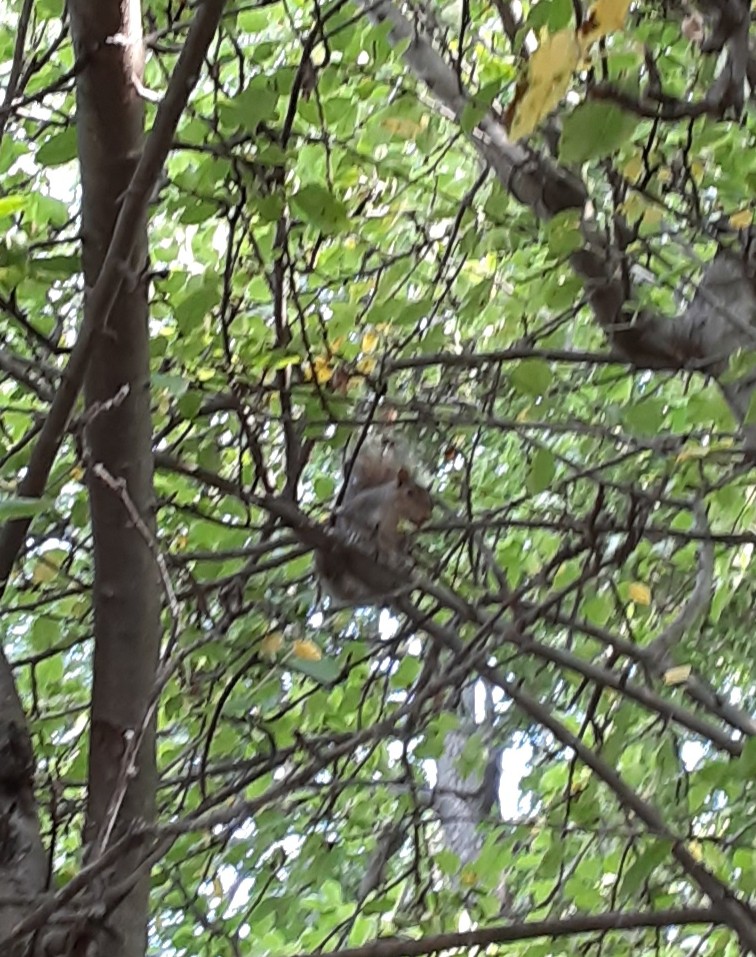
Treed squirrel (Margo D. Beller)

It is gratifying to me that, after all these years, the apple tree continues to produce despite heavy pruning (and whacking at the branches by me). I'm sure the squirrels are happy about it, too. We'll all enjoy it while it lasts.