Cape May

Cape May
(RE BERG-ANDERSSON)

Sunday, February 12, 2012

Geese on the Grass (Alas)


To paraphrase Paul Simon, the other day it was my birthday and I hung one more year on the line.

I got up that morning and went outside before getting ready for work. Two cardinals were battling it out musically. The songs signify “this is my territory” to other males and “I can sing louder and longer and be a better provider” to females. These songs should not be sung in mid-February but with this year’s unusual weather all bets are off.

Just before going inside I heard the honking of Canada geese. A small flock was taking off from the small stream behind my neighbors across the street on the county Greystone property.

How most people see Canada geese.
These were local geese, and they were heading someplace close such as one of the town ponds or the elementary school ballfield. They'd be back at dusk, like commuters.

We've all seen the long Vs of migratory geese heading north in spring and south before winter. Many times geese will fly south from the tundra to a lake in upstate New York or New Jersey, only to have to move on after that water freezes. You can tell they are migrants because the flock is very large and very high in the sky.

The local geese, despite being in New Jersey for generations, also get restless, that instinct that says “we must move” during migration times and “we must find more food” during the winter not quite extinguished.

All Canada geese look the same so when huge flocks gather in parks or office lawns, one can’t shoot them because they are protected by federal law. Some companies use dogs to scare the geese away, pushing the problem to another office park, or silhouettes of men or dogs on the lawns, the suburban equivalent of a scarecrow that works about as well when the geese realize nothing is moving.

Geese like short grass so they can see predators coming, making manicured lawns or decorative ponds perfect habitats.

There was a lot of screaming in New York City when scores of Canada geese were captured on a pond in Brooklyn’s Prospect Park and killed. As they do with the rampant deer herds, these people seem to have a romantic notion of "nature" and prefer blaming mankind and leaving the creatures alone or controlling their numbers with “birth control.” For geese, that means finding a nest, somehow getting the parents away from it (no easy task - a well-aimed swat of a wing can break your arm and geese also bite) and shaking the eggs to keep them from forming chicks (thus the parents sit on eggs that never hatch).

There aren’t enough people in the world to do this, and that doesn’t get rid of the geese already around, eating the grass and leaving behind long, green, cigarette-shaped souvenirs. And then there's always next year.

I am for balance, and more than agree it was man  - with his unchecked expansion into hundreds of acres of woods to create suburban sprawl - who created this problem. But  leaving hundreds of Canada geese to flock on - and mess up - hiking trails, business “campuses” and “office parks” is extremely unbalanced, not to mention a health hazard.

In the Bergen County, N.J., town where I work the neighboring company did nothing to discourage the four geese hanging around its fake pond, cropping the lawn and leaving their droppings on the grass. Geese mate for life and have large families.The population grew and the lawn service worked around them. When summer ended and the lawn service put its mowers away for the season, the undisturbed geese had no reason to leave. In fact, others joined them. Sometimes they wander onto my employer's property. It hasn't helped there's been no snow for force them to leave.

 
There are more geese behind me and to the left that you can't see in my picture.
I enjoyed walking the paths between that office and mine, but the picture shows why that has ended. When the geese finished cropping the grass near the pond they moved on. They crossed the footpaths and driveways, leaving their many calling cards. What used to be a long, pleasurable hike became an obstacle course. If I wasn’t shooing 35 geese out of my way I was stepping carefully around droppings everywhere, including bordering public sidewalks. I now stick to the concrete parking lots.

I do not understand why this company and others that go to a lot of expensive trouble to keep the lawns mowed, fed and watered in summer allow geese to literally make a big mess everywhere when the weather gets cold. Maybe it's because no executives walk on the paths, or those employees who do figure the crap literally comes with the territory. Maybe no one wants to be known as anti-goose.

Maybe they shouldn't have sought a perfectly manicured lawn in the first place.

Geese are out of control in recreational parks and fields, too, which means a lot of people are walking or playing in goose droppings. Worse, some people believe it is their civic duty to feed the geese, which only encourages them to stay and make more of a mess.

Canada geese are not the only pests, of course. The populations of a lot of creatures have exploded thanks to man's incursion into what had been untouched lands, usually at the detriment of other species. The deer herd is huge in my area, for instance. In other areas of the country alligators are showing up in people's pools or coyotes snatch little dogs out of backyards. Bears are killing chickens or breaking into homes and bird feeders or feeding from Dumpsters. Skunks and racoons have also discovered people are rather sloppy when it comes their garbage.

Don’t get me wrong, I do like Canada geese. Seeing wave after wave fly in at dusk over the only unfrozen water of Schwartzwood Lake one winter a few years ago was thrilling. Watching a very long skein of geese way up and calling as they fly in migration always stops me in my tracks.

But those are migrants and the others are local pests. As my husband likes to say, in the suburbs we call our rats deer and our pigeons Canada geese.

We created this situation. There aren't enough natural predators to make a dent in this population. We must do something to put nature back in balance, even if that means rounding the geese up and “harvesting“ (oh, the euphemisms!) the meat for homeless shelters. Alot of people are as emotionally - sometimes dangerously - against hunting geese, as they are against hunting deer or bear. But I see no other way around the issue.

In the meantime, watch where you walk.

Sunday, February 5, 2012

Birding With Disabilities

One takes so much for granted in this world. Walking, for example.

Towards the end of his life my father couldn’t get around very well because of Parkinson’s disease. He walked unsteadily but would use a wheelchair for longer distances or attending a family function. One day when I was visiting I decided I would wheel him over to the waterfront four long blocks away, to get him out of the house.

It was an eye-opener for me. The sidewalk cracks and ruts I could cross with nary a thought would get the wheels of the chair stuck, forcing me to strain to push the chair out and jostling him around in the process. Curbs - few were adjusted for wheelchairs as they are now - were another hurdle to be carefully surmounted.

He never complained - we eventually did get to Sheepshed Bay and later I rolled him back home in the street, which was more dangerous but smoother - but I know he would’ve preferred being driven. Even when he could walk better he preferred driving to walking, including to his medical office a block away.

I thought of my father recently when one of my friends happened to mention going up to New Jersey Audubon's Scherman Hoffman refuge in Bernardsville to get something from the store - seed, a feeder, I can’t remember - and had taken her uncle. He is another man who won’t go very far on foot (although he doesn’t have Parkinson’s) and so uses a wheelchair. My friend wanted to get him out of the house and away from the television. While she was inside shopping, she said, her uncle had stayed in the car.

If you enjoy birding or even just taking a long walk, anything that limits your independence can be terrible, and having a disability can be the worst thing to happen. But it can also be a challenge to spur you to overcome it - if you want to do so.

At Scherman Hoffman the handicapped have their own entrance to the education center, from the upper lot to the second floor. From there they go to a classroom or can take an elevator down to the store or up to the outside platform. My friend’s uncle could’ve gotten out of the car and gone, slowly, into the building. But he felt safer in the car.

I contrast him with a woman I’ve met in my birding travels who also can’t get around very well but has a completely different attitude - she birds from her car. She drives to an area and just sits with her binoculars and waits for the birds to come, sometimes for hours at a time. She told me she has seen quite a lot that way, and she is happy with that because otherwise she would not be able to go birding.

Considering the hilly area where it is located, going down the Scherman trails and into the woods is impossible for those who need wheels or are unsteady on their feet. There are no boardwalked trails as can be found in state or federal nature areas such as the Great Swamp or Cape May Point State Park. The older people I see using the trails at Scherman are steady on their feet and not in wheelchairs.

Luckily, a lot of organizations know that as those of us of the Baby Boom generation get older, we don’t want to be kept captive by our disabilities. If you go to a search engine such as Google and type in “birding tours for the handicapped” you will find a host of websites providing tours for those in wheelchairs, the disabled or the elderly. There is even a group, “Birding for All,” with chapters in the UK and the US, that seeks to “improve access for people with disabilities to reserves, facilities and services for birding.”

This is a wonderful thing. Since we can’t make ourselves younger (at least physically; mentally is another matter), if you can’t take yourself out to the woods for a quiet stroll the next best thing, I think, is to go on a tour with others like you who have good (birding) and bad (the pain, etc.) in common and are equally focused on retaining their independence.

I haven’t tried these services linked below, but I might have to once I get too old to get around much anymore. I put them out there for what you can learn from them.

Links:
http://www.birdingforall.com/

http://wildlifetourism.org.au/disabled_birding_tours/

http://www.myhandicap.com/travel-mobility-disabeld-people.html?gclid=CPetxcDnna0CFcfe4AodOF68OQ

http://www.guidedtour.com/?gclid=CJ3xhsXnna0CFQcQNAod6GZQoA

It is a scary thing to lose one’s independence and mobility. I guess that’s one reason people like to look at birds soaring aloft, defying gravity and so free. Icarus wanted to fly so he built wings held together by wax but got too close to the sun, the wax melted and he plummeted to Earth and died. The Wright brothers wanted to fly and created what has become a big silver bird that is such a hassle to get to and ride in that I’d rather drive or take the train.

There are times, like the other day, when I take a long hike with my binoculars and long-lensed camera around my neck and after a while feel very tired. Then something flies over - is that a redtail? - and I get my second wind.

I’d rather be tired on my feet walking than sitting inside at my desk staring into a computer.

Would my father have grown to share my interest in birds had I been a birder back then and driven him to the Bay and sat with him and my binoculars, pointing out gulls and other birds? I’d like to think he’d have at least tried to see and expand his horizons through learning something new, as I did when I pushed his wheelchair so long ago.

Saturday, January 21, 2012

Dum Spiro Sparrow

I was not surprised to draw back the kitchen curtains to find birds all over my four backyard feeders. We were having our first snowstorm of 2012 and the first since the freak Halloween storm in October.

January 2012

The birds were fighting each other as much as they were eating. Within sight were three pairs of cardinals jockeying for position at the house feeder; at least one redbelly, downy and hairy woodpecker each taking turns at the suet; and a host of house sparrows, whitethroats, house finches and juncos at these and the other two feeders, with mourning doves below and a quick hit occasionally by a family of jays.

When the house sparrows hogged the feeder and kept chickadees, nuthatches or titmice out for too long, I’d go on the porch to spook them off so the others could feed. Thanks to one neighbor no longer filling his feeder and another who is slow to refill when his empties, I get a lot of visitors in my yard. I don’t mind this - feeding birds is my way of saying thanks for all the pleasure I get seeing these and others in the wild.

But the birds could care less about my so-called generosity. They are just trying to survive.

When they chase each other or sit at the feeders and open their beaks and hiss or spread their wings in an attempt to look bigger, they are trying to get what they can before it‘s gone. The birds that can’t get to the seed directly will go down to the squirrel baffle or to the ground and peck at the bits of seed dropped by the sloppy ones above. Some have even started imitating the woodpeckers and hanging under the suet feeder, an unnatural feeding position for, say, a sparrow.

It is evolution in action. Those that can adapt will survive.

Birds have lived and died without human help for centuries. That I happen to put out feeders is a bit of luck for the birds that consider my yard their territory, or that have stopped briefly on the way to someplace else.

This storm is not very bad compared with last winter, when we had many more storms and so much snow that stayed unmelted for so long the birds were desperate and I could not keep the feeders filled fast enough. Cardinals, usually quite placid birds, were shrieking at others once they were on the house feeder, the one of the four that can accommodate them. If you don’t eat, you don’t live.

It is the same with people.

As I stand in my warm house after a hot breakfast I am more than aware there are people who do not have a roof over their heads and can only eat through the generosity of houses of worship or the community organizations, some to which I donate money, that feed them.

I am also more than aware that in this crazy world we are living in, I and my neighbors are only one disaster away from being homeless and hungry, too.


A rare moment of peace in a life of toil.
 Many of us who lost our jobs have been searching for months, trying to find anything that can use our talents, frequently losing out to those - usually younger and more mobile, without the same ties of house payments and kids in school - who are willing to work for far less in salary.

Some of us are lucky enough to get a job but it is only temporary, because many big employers have discovered it is cheaper to rent an employee through a staffing company and not pay benefits than it is to put someone on staff. There are always enough people searching for work to hire when the contracted worker is forced to leave.

Some of us work in jobs that are becoming more oppressive. We are being told that suddenly, after many years there, we don’t measure up, and if we don’t work harder and longer and change what we’re doing we will face disciplinary review. We are forced to have weekly meetings with supervisors monitoring our “progress,” and may be told if we don’t accept a buyout we will be fired and get nothing.

This was the reason why the message of that ragtag bunch of kids that became Occupy Wall Street resonated with so many of us in mainstream America.

We are told from birth to work hard and save and we will be wealthy and happy. So we work and we are then told we need this and must have that and so must spend and don’t save and don’t think about old age and retirement. We charge and get into debt. When our employers cut back benefits or end them altogether or fire us at a time of increasing prices for gas and basic foodstuffs like eggs and milk, we are on the edge of the precipice.

We think we were shafted because we followed the rules and the deck was stacked against us from the start.

The birds don’t care what goes on below them. As long as they can avoid predators and find a meal and a branch on which to roost through a cold night, they will live to fly another day and breed when spring comes.


Spring seems a long way off.

Today I learned something from my husband. Not only is the state bird of South Carolina one of my favorites - the carolina wren - but the state motto is Dum spiro spero - While I breathe, I hope. Spero is the root of the word despair - no hope.

Hope is the thing with feathers, wrote poet Emily Dickinson.

When MH told me this phrase I heard it as dum spiro sparrow.

That is another reason why I feed the birds - for a short time I can forget about this life of despair and concentrate on something with feathers.

Sunday, January 15, 2012

Winter Birding

To everything there is a season, and that is true for birding.

Spring and autumn get all the press because that is when the warblers and other tropical migrants pass through on their way north to their breeding areas of choice, or south to the warmer and buggier areas when it is cold up here. Summer is when a lot of birders go to the shore for relief and shorebirds.

I happen to like winter birding when the leaves are off the trees, the cold is bracing and the crowds are sparse. (A lot of birders follow the birds to South America to enjoy summer there.) That doesn’t make the birding any less interesting, especially this year when the unnaturally warm winter weather prompted a lot of migrant birds to hang around a lot longer than usual.

There are lot of birds that show up in New Jersey when the cold comes on. They consider New Jersey warm enough for them, a funny concept to remember when we are shivering from what we consider arctic winds!

Some of these are regular winter visitors. The junco, for instance. This slate-gray and white little guy - and in New Jersey it is always a guy because the browner females fly farther south for the winter (perhaps the males stay farther north so they can get to the breeding areas quicker) - is a pretty reliable indicator winter is coming on.

The white-throated sparrow below is another winter regular. The male’s white “eyebrows” and the yellow spot on either side of the bill and above the eyes get brighter as the winter goes on. Unlike the junco, males and females winter together, and you will hear the high whistling “O Sam Peabody, Peabody, Peabody” of the males as the territorial battles begin.

There are other winter birds not as common. The American tree sparrow, for instance, with its distinctive reddish cap and bi-colored bill, gray on top and yellow below.

The rough-legged hawk is a bird of the tundra, and when winter comes on it sometimes flies south to grassland areas, even urban landfills such as the one abutting the DeKorte Park in Lyndhurst, N.J., near the Meadowlands.

Snowy owl is another uncommon winter visitor and finding one is always a big occasion. This owl is, as the name implies, very white, hangs out in the open and hunts by day, unlike most other owls. This year, among the many recorded, a snowy has been at the Merrill Creek Reservoir in Warren County, NJ, for weeks.

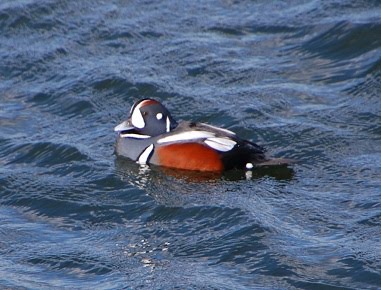
Winter also means ducks. The common eider and the harlequin duck are standard winter ducks at the rocky jetty of Barnegat Light. If you look on a local pond before it freezes the chances are you will find all sorts of interesting ducks including one or more of the mergansers plus ruddy, canvasback and ring-necked duck.

But just about any waterfowl is likely to show up in any unfrozen water, even along the Hudson River shoreline between Hoboken and Manhattan, which is about as urban as it gets.

As I said, one big advantage of winter birding is the leaves are off the trees. Redtail hawks are easy to see from a great distance when they sit in a bare tree, and it makes it easier to find the white-breasted nuthatch calling from a limb over my head.


But perhaps the best thing about winter birding is you don’t have to even go outside if you don‘t feel like it. If you have a feeder out - better still, many feeders holding different types of seed and suet - the birds will come to YOU as you have your hot cup of coffee on a frosty morning.

Try it and you’ll be amazed by what you can see.

Sunday, January 8, 2012

Jeremiad

There is no more graphic proof of global warming than the annual weather chart published in the New York Times every January. This year's edition was published today.

“New York City’s Weather in 2011,” which is compiled from Accuweather data, shows five record temperature highs for the year; record rainfall in May, June and August (the month of Hurricane Irene); record snowfall in January; the snowiest October and a tie for the least snowy December.

There were no record temperature lows.

This data, found only in the physical newspaper and not online, is for Central Park in New York City. My husband, the more scientifically inclined of the two of us, collects it. He showed me several years' worth of his collected annual charts, and we’ve been warming for some time. The last record low temperature was in January 2004.

Near the end of November 2011 it reached 70 degrees in New York City, a record, while one day in mid-December tied a record at 62 degrees. Between those points there were 15 days (not consecutive) of above-average temperatures. I saw a lot of people walking around in shorts enjoying the relative warmth during that time, telling TV news reporters how they hate snow, hate the cold and hope neither comes.

News flash: Winter in this region is supposed to be cold and snowy. I don't know about you but during those few below-average days during this period I heard a lot of bitching about having to deal with what seemed like extreme cold but was not when you look at the cumulative chart. It just felt that way after all that abnormal warmth.

Here’s another example: Bryant Park, one of the busiest parks in midtown New York City, has had some unusual birds hanging around including one or two of the largest warbler, the yellow-breasted chat. A lot of birds were also reported hanging around elsewhere in New York City as well as in central and southern New Jersey.

According to the New York Times chart, 2011 had the sixth-wettest September on record followed by the snowiest October, helped by the pre-Halloween storm (this picture is from the start of that storm) that destroyed still-leafy trees and left millions, including me, without power for anywhere from hours to weeks. Normally the birds that can’t migrate south at that time of year die because they can‘t get the food or the warmth they need this far north.

When the temperatures started rising late last year the birds in these warmer-than-usual areas found bugs, still-flowering plants plus the usual bird feeders to keep them alive. Birders were very happy about these unusual winter birds after complaining how all the rains and strong winds early in the year made for a mediocre spring migration - as in, there was little to see because the birds flew around the storms or got a helpful, strong push past this region.

This birder thinks we are in a world seriously out of balance, or koyaanisqatsi.

Extreme or lack of snowfall: My plants were buried under a mountain of plowed snow into February. Relatives in Minnesota and New Hampshire recently told me ski resorts were hurting in December because they didn't have any snow.

High winds and rain: Hurricane Irene hit New Jersey as a tropical storm. A tropical storm is one level below the lowest level of hurricane. So it wasn’t a big deal, right? Tell that to someone living along the Pompton, Passaic or Millstone rivers who is still trying to recover from water damage or having a house swept away.

Extreme heat: According to the Times’ chart, New York City had two consecutive record highs in July of 104 degrees and 100 degrees. The days leading up to and following those highs were also above normal, making July the fifth-warmest on record. When it is so hot, you need a lot of water. We did not run our sprinklers but as the grass went brown our lawn-worshiping neighbors did, usually in the middle of the day when it does the least good. Thanks to the unusually high amount of rain we had in March, April and May, we had no summer drought and the neighbors could get away with this wasteful behavior.

Meanwhile, many parts of the Midwest were hit with flooding from rain-swollen rivers. Many others were hit with a severe drought creating modern-day dust bowls. Texans were praying for some of Irene’s rains to put out wildfires destroying acres of land, to no avail. Crops were destroyed, cattle couldn‘t be fed. Prices of bread, fruit and dairy are going up.

There are people who believe there is no such thing as global warming. There are others who would do anything to sacrifice our air and water to cut dependence on OPEC oil during these hard economic times. They see hydraulic fracturing - fracking, for short - into rock for oil or gas as our savior, despite its potential to pollute vital groundwater.

They want to rip up the Earth to do this drilling, this century’s version of the clear-cutting that scarred the coal country of Pennsylvania and West Virginia. (Overdevelopment is another form of clear-cutting, for instance in New Jersey.) They also want to build more roads and factories and gut the regulatory power of the Environmental Protection Agency, claiming companies would be more productive and expand their workforce if they didn't have to think about emissions or safety requirements.

Sorry, but this American worker still wants clean air to breathe and clean water to drink.

This country is all about the short-term fix and no long-term planning or even thinking about the consequences of our actions as we consume, consume, consume.

You buy fuel-guzzlers and wonder why gas is so expensive, roads are in disrepair and there is so much traffic. You pave over the woods and wonder why there is damage from increasingly common "100-year floods" caused by runoff when the heavy rains hit. You put houses where none should ever have been built and pour more concrete that holds more heat, helping create this unnatural endless summer. You run inefficient, dirty factories, then blame the laws protecting citizens from your pollution for "forcing" you to leave the country and your workers behind.

It is frustrating. I do what I can - including trying to make you think with this blog - but I’m only a cog in this whirling machine, alarmed by how fast we’re going, how we are doing things to go faster rather than slowing down, wondering how we’ll keep going and when we’re going to break down.

The usual cliche to write at this point is that you reap what you sow.
I wanted to find where in the Bible that is written and found it in Galatians 6:7-8.

But I found something else in my research, in Genesis 8:22. It‘s supposed to be comforting, about the balance of life:

While the earth remains, seedtime and harvest, cold and heat, summer and winter, day and night, shall not cease.

How much longer do we have?

Monday, January 2, 2012

How to Look like an Expert

As a birder I consider myself an enlighted intermediate rather than an expert. Compared with the pros - the David Sibleys, the Pete Dunnes, the Kenn Kaufmans and Roger Tory Petersons - I am a rank amateur. But compared with my nonbinding friends I am a genius, the go-to person for identifications.

I know better. I was not born with this expertise. Where I grew up in Brooklyn I remember exactly five birds: robin, cardinal, jay, pigeon and “sparrow,” the common House Sparrow (which technically isn’t a sparrow at all but an Old World weaverbird that might’ve stowed away on the Mayflower). Since moving to the suburbs with my husband my bird universe has expanded, as did my curiosity about what was coming to the feeders.

When I didn’t know something I looked it up. As I bought different types of guides I learned more. As with anything you WANT to learn more about, the information stuck.
Then I would go out into the field and apply that knowledge to what I'd read. The more I went out, the more I learned and the more that made me curious, which would send me back to the books, etc., etc.

The problem today seems to be a population - we who grew up with television as a nanny and sedative and our kids and grandkids after - that is passive and wants to be told rather than be active and get a book and look it up or actually go outside in the cold and explore.

The Internet has prompted more activity, yes, but when it comes to learning something the Internet has a lot of information that is not necessarily true but still gets taken at face value.

I encourage you to question everything you read, including me.

Anyway, when I am talking to someone and the subject of birding somehow comes up, I usually get this:

“You’re a bird watcher? I saw this bird…”

I don’t know how birding became such a big deal but I find a lot more people at least interested in what they are seeing, if not the actual practice of taking a camera or binoculars out into the field. Like television, it is easier if someone tells you.

But I’m no genius, and usually when they have described what they’ve seen my curiosity is piqued enough to ask the following questions - questions you, too, can ask if you ever are in such a situation.

How big is it? As big as a robin, sparrow or other bird you see a lot more often?

Where was it when you saw it? In a tree? Flying over you?

Where were YOU when you saw it? Standing on a beach? Walking through a forest? Crossing the street?

After determining size and location, I move on to color. Was it a solid color or were there wing bars or speckling or a different color on the bird’s breast than on its back and/or wings?

What color was its bill? Was it thin and sharp like a starling or large and wide like a cardinal?

Was it all by itself or was it with others of its kind? Or was it with others more familiar to you?

Was it calling? What did it sound like to you?

Sometimes you can get stumped. At a recent party the hostess described a bird a guy pointed out to her that to me sounded exactly like a starling except for one detail - a green breast.

In this part of the world, bright green is not that common a bird color although there are many birds with greenish backs or flycatchers that are olive green. Bright green is more common a color on birds like parrots from the jungles and rain forests, where they can easily blend into the canopy.

(Many areas of the greater New York metro area have colonies of monk parakeets, which are bright green. But even tho’ they likely started out as someone’s pet that got loose, bred and eventually went feral, parakeets are easy to identify.)

Starlings have no green in them, but they are iridescent and if the light hits the right way they can look greenish or purple. My friend later emailed me a picture the guy had sent her and, yes, it was a starling.

More typically, after I go through all the questions and provide my best guess I get either “Wow. Interesting” or “Oh, well thanks.”

Kind of a letdown sometimes. But that’s how reputations are made.

Saturday, December 24, 2011

Resolution

We’re at that time of year when most of us resolve to do things better, differently or both.

I don’t make resolutions as a rule - I gave up “lose 30 pounds by my birthday” or “read ‘War and Peace’” years ago. But it is part of human nature to want what you don’t have if you think it will improve your life.

I find it comforting even established birders feel that way.

Don Freiday, for instance. I met Don once, long ago when he ran N.J. Audubon’s Scherman Hoffman sanctuary. He then moved on to run the Audubon sanctuary in Cape May and is now tending to the federal Forsythe National Wildlife Refuge not far (as the gull flies) from Atlantic City. He has also been writing a blog that features his musings, photography and tips on bird identification.

He recently posted how "I wish I had” been faster with his camera, been elsewhere when a rarity had been reported or been able to do more birding when he had to work. Since he works at one of New Jersey’s best birding spots, this wish is particularly sad.

The blogosphere being what it is, I wrote him a comment to commiserate. There are too many things “I wish I had” been able to do, too.
His response: Margo and all - it is indeed a universal desire. Maybe it's time to look forward - "I hope I do. . ."

Good advice.

It’s a waste of time and energy to fuss over the bird too far to clearly identify or the rarity you missed by an hour in your local hotspot or the more common bird that everyone sees regular as clockwork except for you (in my case a saw-whet owl).

Instead, we should all focus on the good things we have and look forward to what new things we can accomplish. Right now there are cardinals and chickadees at the feeders but come spring there could be more unusual birds passing through, maybe even something new.

Be thankful to have the stamina for long walks or whatever hobby you do to escape from the daily grind, and keep feeling the excitement of discovering something interesting that might be around the corner.

Stop wishing and start doing. That’s the best resolution.

Have a happy, healthy holiday.