As a birder I consider myself an enlighted intermediate rather than an expert. Compared with the pros - the David Sibleys, the Pete Dunnes, the Kenn Kaufmans and Roger Tory Petersons - I am a rank amateur. But compared with my nonbinding friends I am a genius, the go-to person for identifications.
I know better. I was not born with this expertise. Where I grew up in Brooklyn I remember exactly five birds: robin, cardinal, jay, pigeon and “sparrow,” the common House Sparrow (which technically isn’t a sparrow at all but an Old World weaverbird that might’ve stowed away on the Mayflower). Since moving to the suburbs with my husband my bird universe has expanded, as did my curiosity about what was coming to the feeders.
When I didn’t know something I looked it up. As I bought different types of guides I learned more. As with anything you WANT to learn more about, the information stuck.
Then I would go out into the field and apply that knowledge to what I'd read. The more I went out, the more I learned and the more that made me curious, which would send me back to the books, etc., etc.
The problem today seems to be a population - we who grew up with television as a nanny and sedative and our kids and grandkids after - that is passive and wants to be told rather than be active and get a book and look it up or actually go outside in the cold and explore.
The Internet has prompted more activity, yes, but when it comes to learning something the Internet has a lot of information that is not necessarily true but still gets taken at face value.
I encourage you to question everything you read, including me.
Anyway, when I am talking to someone and the subject of birding somehow comes up, I usually get this:
“You’re a bird watcher? I saw this bird…”
I don’t know how birding became such a big deal but I find a lot more people at least interested in what they are seeing, if not the actual practice of taking a camera or binoculars out into the field. Like television, it is easier if someone tells you.
But I’m no genius, and usually when they have described what they’ve seen my curiosity is piqued enough to ask the following questions - questions you, too, can ask if you ever are in such a situation.
How big is it? As big as a robin, sparrow or other bird you see a lot more often?
Where was it when you saw it? In a tree? Flying over you?
Where were YOU when you saw it? Standing on a beach? Walking through a forest? Crossing the street?
After determining size and location, I move on to color. Was it a solid color or were there wing bars or speckling or a different color on the bird’s breast than on its back and/or wings?
What color was its bill? Was it thin and sharp like a starling or large and wide like a cardinal?
Was it all by itself or was it with others of its kind? Or was it with others more familiar to you?
Was it calling? What did it sound like to you?
Sometimes you can get stumped. At a recent party the hostess described a bird a guy pointed out to her that to me sounded exactly like a starling except for one detail - a green breast.
In this part of the world, bright green is not that common a bird color although there are many birds with greenish backs or flycatchers that are olive green. Bright green is more common a color on birds like parrots from the jungles and rain forests, where they can easily blend into the canopy.
(Many areas of the greater New York metro area have colonies of monk parakeets, which are bright green. But even tho’ they likely started out as someone’s pet that got loose, bred and eventually went feral, parakeets are easy to identify.)
Starlings have no green in them, but they are iridescent and if the light hits the right way they can look greenish or purple. My friend later emailed me a picture the guy had sent her and, yes, it was a starling.
More typically, after I go through all the questions and provide my best guess I get either “Wow. Interesting” or “Oh, well thanks.”
Kind of a letdown sometimes. But that’s how reputations are made.
Cape May
(RE BERG-ANDERSSON)
Monday, January 2, 2012
Saturday, December 24, 2011
Resolution
We’re at that time of year when most of us resolve to do things better, differently or both.
I don’t make resolutions as a rule - I gave up “lose 30 pounds by my birthday” or “read ‘War and Peace’” years ago. But it is part of human nature to want what you don’t have if you think it will improve your life.
I find it comforting even established birders feel that way.
Don Freiday, for instance. I met Don once, long ago when he ran N.J. Audubon’s Scherman Hoffman sanctuary. He then moved on to run the Audubon sanctuary in Cape May and is now tending to the federal Forsythe National Wildlife Refuge not far (as the gull flies) from Atlantic City. He has also been writing a blog that features his musings, photography and tips on bird identification.
He recently posted how "I wish I had” been faster with his camera, been elsewhere when a rarity had been reported or been able to do more birding when he had to work. Since he works at one of New Jersey’s best birding spots, this wish is particularly sad.
The blogosphere being what it is, I wrote him a comment to commiserate. There are too many things “I wish I had” been able to do, too.
His response: Margo and all - it is indeed a universal desire. Maybe it's time to look forward - "I hope I do. . ."
Good advice.
It’s a waste of time and energy to fuss over the bird too far to clearly identify or the rarity you missed by an hour in your local hotspot or the more common bird that everyone sees regular as clockwork except for you (in my case a saw-whet owl).
Instead, we should all focus on the good things we have and look forward to what new things we can accomplish. Right now there are cardinals and chickadees at the feeders but come spring there could be more unusual birds passing through, maybe even something new.
Be thankful to have the stamina for long walks or whatever hobby you do to escape from the daily grind, and keep feeling the excitement of discovering something interesting that might be around the corner.
Stop wishing and start doing. That’s the best resolution.
Have a happy, healthy holiday.
I don’t make resolutions as a rule - I gave up “lose 30 pounds by my birthday” or “read ‘War and Peace’” years ago. But it is part of human nature to want what you don’t have if you think it will improve your life.
I find it comforting even established birders feel that way.
Don Freiday, for instance. I met Don once, long ago when he ran N.J. Audubon’s Scherman Hoffman sanctuary. He then moved on to run the Audubon sanctuary in Cape May and is now tending to the federal Forsythe National Wildlife Refuge not far (as the gull flies) from Atlantic City. He has also been writing a blog that features his musings, photography and tips on bird identification.
He recently posted how "I wish I had” been faster with his camera, been elsewhere when a rarity had been reported or been able to do more birding when he had to work. Since he works at one of New Jersey’s best birding spots, this wish is particularly sad.
The blogosphere being what it is, I wrote him a comment to commiserate. There are too many things “I wish I had” been able to do, too.
His response: Margo and all - it is indeed a universal desire. Maybe it's time to look forward - "I hope I do. . ."
Good advice.
It’s a waste of time and energy to fuss over the bird too far to clearly identify or the rarity you missed by an hour in your local hotspot or the more common bird that everyone sees regular as clockwork except for you (in my case a saw-whet owl).
Instead, we should all focus on the good things we have and look forward to what new things we can accomplish. Right now there are cardinals and chickadees at the feeders but come spring there could be more unusual birds passing through, maybe even something new.
Be thankful to have the stamina for long walks or whatever hobby you do to escape from the daily grind, and keep feeling the excitement of discovering something interesting that might be around the corner.
Stop wishing and start doing. That’s the best resolution.
Have a happy, healthy holiday.
Saturday, December 17, 2011
An Ugly Beauty
To paraphrase Casey Stengel on baseball, if you hang out in the great outdoors long enough you’re bound to see something you’ve never seen before.
That happened to me one early Saturday morning.
I usually walk up to Collins Road and into the Greystone - sorry, Central Park of Morris County - property. At the other end of the road, just beyond where Collins joins Central Ave., there is a large tree overlooking Thompson Pond.
Usually this tree is covered with turkey vultures.
The turkey vulture is a very ugly bird. It has a red, bare head, giving it only the slightest of resemblances to Ben Franklin’s choice for national symbol. The head is bare because the vulture eats dead meat and you don’t want to be messing up feathers sticking your head into a bloody, rotting carcass.
When the turkey vulture sits in a tree above you and spreads its wings you know it is a very big bird indeed. Usually you will see one or two hunting together but at dusk they form big roosting flocks, like the one at Greystone.
So when I took my walk the first surprise was the turkey vultures were not in the usual tree but in a number of big trees along Central Ave. The usual tree was filled with black vultures.
Black vultures are an interesting story. They used to be seen only south of the Mason-Dixon line but have been gradually heading north, perhaps as the Earth warms.
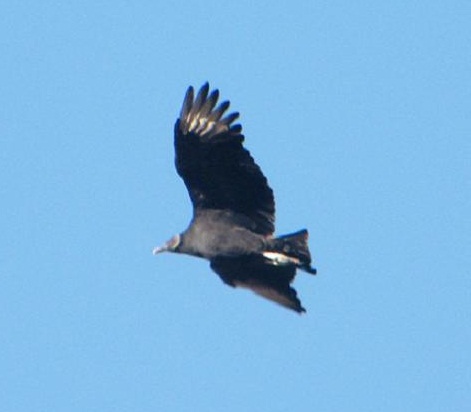
These vultures are smaller and have white “fingers” at the wing tips, unlike the border of white trailing feathers on the turkey vulture. They are also stockier and can be mistaken for redtails and other buteos in flight.
Unlike the turkey vulture it dips its wings while flying and usually travels in flocks. It is an ugly bird with a silver-gray head, also bare for eating dead meat. I was driving on a back road once and about 10 of these were on a dog carcass, a revolting sight.
Then again, if people are going to let their animals loose, what do they expect? Once it is hit by a speeding car, a vulture will make quick work of it.
And there is plenty of dead meat to go around, as the dead deer and squirrels and woodchucks and possums and cats and even bears on New Jersey’s roadsides can attest.
You might ask, what were these two types of vultures doing that cold morning of my walk?
They were drying their wings from the night’s dew and warming themselves as they waited for updrafts that would keep them aloft.
Ever feel stiff on a cold morning? Well, on cold, calm mornings vultures and other daytime raptors have to wait until their wings are light and buoyant enough to fly. You don’t want to be weighed down as you seek your breakfast.
Besides the surprise of finding two types of vultures within a block of each other, the next surprise was discovering many of the turkey vultures were also on a sandbank in the pond. Vultures don’t eat live fish and they don‘t swim. I can only guess all the other prime spots - the very large, strong trees or the nearby building roof to support their weight - were taken.
I walked on, but there was one last surprise in store.
I came home the way I went out, and when I got to the pond most of the vultures had left, or so I thought. But I found them on a sunny grass field up Central Ave., chasing each other around like Canada geese.
I’ve never seen this type of vulture behavior. Try to imagine a green field black with very large vultures spreading their wings to dry, chasing each other away, making grunt calls.
It was an ugly sight, but a natural one. After all, vultures have their place in the world. They are Nature‘s sanitation crew. As my husband says about critters that interfere with my bird feeders, they gotta eat, too.
We may not like what vultures represent - the end of life, disposal of the body, the subsequent decay - but that’s the balance of life and death.
By the time I got home some of the turkey vultures were already circling in the clear, blue sky, and for a moment even these ugliest of birds looked beautiful to this Earth-bound creature.
That happened to me one early Saturday morning.
I usually walk up to Collins Road and into the Greystone - sorry, Central Park of Morris County - property. At the other end of the road, just beyond where Collins joins Central Ave., there is a large tree overlooking Thompson Pond.
Usually this tree is covered with turkey vultures.
The turkey vulture is a very ugly bird. It has a red, bare head, giving it only the slightest of resemblances to Ben Franklin’s choice for national symbol. The head is bare because the vulture eats dead meat and you don’t want to be messing up feathers sticking your head into a bloody, rotting carcass.
When the turkey vulture sits in a tree above you and spreads its wings you know it is a very big bird indeed. Usually you will see one or two hunting together but at dusk they form big roosting flocks, like the one at Greystone.
So when I took my walk the first surprise was the turkey vultures were not in the usual tree but in a number of big trees along Central Ave. The usual tree was filled with black vultures.
Black vultures are an interesting story. They used to be seen only south of the Mason-Dixon line but have been gradually heading north, perhaps as the Earth warms.
These vultures are smaller and have white “fingers” at the wing tips, unlike the border of white trailing feathers on the turkey vulture. They are also stockier and can be mistaken for redtails and other buteos in flight.
Unlike the turkey vulture it dips its wings while flying and usually travels in flocks. It is an ugly bird with a silver-gray head, also bare for eating dead meat. I was driving on a back road once and about 10 of these were on a dog carcass, a revolting sight.
Then again, if people are going to let their animals loose, what do they expect? Once it is hit by a speeding car, a vulture will make quick work of it.
And there is plenty of dead meat to go around, as the dead deer and squirrels and woodchucks and possums and cats and even bears on New Jersey’s roadsides can attest.
You might ask, what were these two types of vultures doing that cold morning of my walk?
They were drying their wings from the night’s dew and warming themselves as they waited for updrafts that would keep them aloft.
Ever feel stiff on a cold morning? Well, on cold, calm mornings vultures and other daytime raptors have to wait until their wings are light and buoyant enough to fly. You don’t want to be weighed down as you seek your breakfast.
Besides the surprise of finding two types of vultures within a block of each other, the next surprise was discovering many of the turkey vultures were also on a sandbank in the pond. Vultures don’t eat live fish and they don‘t swim. I can only guess all the other prime spots - the very large, strong trees or the nearby building roof to support their weight - were taken.
I walked on, but there was one last surprise in store.
I came home the way I went out, and when I got to the pond most of the vultures had left, or so I thought. But I found them on a sunny grass field up Central Ave., chasing each other around like Canada geese.
I’ve never seen this type of vulture behavior. Try to imagine a green field black with very large vultures spreading their wings to dry, chasing each other away, making grunt calls.
It was an ugly sight, but a natural one. After all, vultures have their place in the world. They are Nature‘s sanitation crew. As my husband says about critters that interfere with my bird feeders, they gotta eat, too.
We may not like what vultures represent - the end of life, disposal of the body, the subsequent decay - but that’s the balance of life and death.
By the time I got home some of the turkey vultures were already circling in the clear, blue sky, and for a moment even these ugliest of birds looked beautiful to this Earth-bound creature.
Sunday, December 4, 2011
Six Woodpeckers
You’ll have to forgive my being a little cocky today but in all my years of birding I’ve never had a day like Saturday.
A six-woodpecker day.
I have been known to find six warblers in a day, which is a big deal to me. I have also seen six types of sparrows in one day. But there are many more than six of these seen in this state at any given time.
The six woodpeckers commonly found in my area of New Jersey aren’t all that easy to find, particularly on the same day.
(A seventh - the redheaded woodpecker - is a southern bird that needs specific habitat to survive, in this case stands of dead trees. With the suburban penchant for cutting down any inconvenient tree dead or alive, you have to seek it in a Known Redheaded Woodpecker Location such as the Great Swamp. I usually seem them in winter.)
I was lucky enough to be in the right places at the right times, and it is this combination of luck and surprise with just enough knowledge to make identification possible that makes birding such a joy.
Three of the woodpeckers were gimmes. In the afternoon my feeders brought the six-inch downy, which was chased off by the nine-inch hairy, which was chased off by the comparably sized redbellied woodpecker, like the one here. For more on these go to http://www.allaboutbirds.org
Usually these three are all I see. But not yesterday.
I went walking early into the nearby Central Park of Morris County, once known as the Greystone property. (There is still a Greystone property but it is on the western edge and owned by the state. Where I was is now owned by the county.)
Besides the expected birds I heard the distinctive call of a flicker, a cackling “ahhhrrr.” Flickers are usually seen on the ground and are mostly brown to blend in. I couldn’t find it.
So that’s four woodpeckers.
As I headed home from this walk I stopped when I heard what sounded like the breathy “Wha-wha-wha” of the pileated woodpecker, the largest of the six. It is about the size of a crow and has a most distinctive red crest and black and white body.
These are great to see up close, like the female I saw on a neighbor’s tree, whacking away at it to scoop up the carpenter ants within.
No surprise, that tree rotted and fell over in a storm less than two years later.
If you are old enough to remember the Woody Woodpecker cartoon, his laugh and look were based on the pileated.
Anyway, I stopped and listened. It called, then it called again. I have found pileateds in Greystone before, one mere feet away. So I knew what it was.
That’s five woodpeckers.
Here is where luck morphed into transcendence.
Every winter my husband and I go through the marriage-testing experience of clearing the lower house gutters of fallen leaves. (We don’t do the higher gutters because we want to live to a comfortable old age, and any spillover comes into the lower gutters anyway.)
There I was, not long after the morning walk, holding the large, metal ladder on which MH, bad knees and all, was trying to pull out wet leaves.
Behind me I heard a whinny. Could it be? I heard it again. Yes it was! A yellow-bellied sapsucker!
“Pay attention to the ladder,” MH yelled, somehow sensing I wasn‘t giving 100 percent.
“But it’s a sapsucker!” I responded. “That’s my sixth woodpecker of the day.”
For some reason, perhaps being 15 feet above the ground, he wasn‘t as impressed. “No reckless birding! Concentrate,” he retorted.
At which point the calling bird flew from its tree next door and across the road, out of sight, allowing me to turn back and focus on not becoming a widow.
The sapsucker is a very different type of woodpecker. It has red on the top of its head, like some of the others, but distinctively on its “chin,” too. It drills small, shallow holes in trees, not to pull out insects but to draw the sap on which it feeds. This sap also draws a lot insects, which feeds all the birds. (The sap also feeds hummingbirds when they first arrive during spring migration.)
In spring these shy birds announce their territory as loudly as any other woodpecker, an activity known as drumming.
It’s a simple process: hammer on a branch (or a wood-shingled house) with your sturdy bill to loudy announce “I am here and if you are another woodpecker stay away.”
Find the right sounding board and your message will go far.
And that was the sixth. Does it make me a better birder? No, but it reminds me why I enjoy birding.
A six-woodpecker day.
I have been known to find six warblers in a day, which is a big deal to me. I have also seen six types of sparrows in one day. But there are many more than six of these seen in this state at any given time.
The six woodpeckers commonly found in my area of New Jersey aren’t all that easy to find, particularly on the same day.
(A seventh - the redheaded woodpecker - is a southern bird that needs specific habitat to survive, in this case stands of dead trees. With the suburban penchant for cutting down any inconvenient tree dead or alive, you have to seek it in a Known Redheaded Woodpecker Location such as the Great Swamp. I usually seem them in winter.)
I was lucky enough to be in the right places at the right times, and it is this combination of luck and surprise with just enough knowledge to make identification possible that makes birding such a joy.
Three of the woodpeckers were gimmes. In the afternoon my feeders brought the six-inch downy, which was chased off by the nine-inch hairy, which was chased off by the comparably sized redbellied woodpecker, like the one here. For more on these go to http://www.allaboutbirds.org
Usually these three are all I see. But not yesterday.
I went walking early into the nearby Central Park of Morris County, once known as the Greystone property. (There is still a Greystone property but it is on the western edge and owned by the state. Where I was is now owned by the county.)
Besides the expected birds I heard the distinctive call of a flicker, a cackling “ahhhrrr.” Flickers are usually seen on the ground and are mostly brown to blend in. I couldn’t find it.
So that’s four woodpeckers.
As I headed home from this walk I stopped when I heard what sounded like the breathy “Wha-wha-wha” of the pileated woodpecker, the largest of the six. It is about the size of a crow and has a most distinctive red crest and black and white body.
These are great to see up close, like the female I saw on a neighbor’s tree, whacking away at it to scoop up the carpenter ants within.
No surprise, that tree rotted and fell over in a storm less than two years later.
If you are old enough to remember the Woody Woodpecker cartoon, his laugh and look were based on the pileated.
Anyway, I stopped and listened. It called, then it called again. I have found pileateds in Greystone before, one mere feet away. So I knew what it was.
That’s five woodpeckers.
Here is where luck morphed into transcendence.
Every winter my husband and I go through the marriage-testing experience of clearing the lower house gutters of fallen leaves. (We don’t do the higher gutters because we want to live to a comfortable old age, and any spillover comes into the lower gutters anyway.)
There I was, not long after the morning walk, holding the large, metal ladder on which MH, bad knees and all, was trying to pull out wet leaves.
Behind me I heard a whinny. Could it be? I heard it again. Yes it was! A yellow-bellied sapsucker!
“Pay attention to the ladder,” MH yelled, somehow sensing I wasn‘t giving 100 percent.
“But it’s a sapsucker!” I responded. “That’s my sixth woodpecker of the day.”
For some reason, perhaps being 15 feet above the ground, he wasn‘t as impressed. “No reckless birding! Concentrate,” he retorted.
At which point the calling bird flew from its tree next door and across the road, out of sight, allowing me to turn back and focus on not becoming a widow.
The sapsucker is a very different type of woodpecker. It has red on the top of its head, like some of the others, but distinctively on its “chin,” too. It drills small, shallow holes in trees, not to pull out insects but to draw the sap on which it feeds. This sap also draws a lot insects, which feeds all the birds. (The sap also feeds hummingbirds when they first arrive during spring migration.)
In spring these shy birds announce their territory as loudly as any other woodpecker, an activity known as drumming.
It’s a simple process: hammer on a branch (or a wood-shingled house) with your sturdy bill to loudy announce “I am here and if you are another woodpecker stay away.”
Find the right sounding board and your message will go far.
And that was the sixth. Does it make me a better birder? No, but it reminds me why I enjoy birding.
Sunday, November 27, 2011
Raking
Despite nearly 20 years in suburbia I still find the leaf blower to be at best a necessary evil and I try to use it as little as possible.
The first time I go out after the leaves start to drop I use the lawn mower to mulch them. The next time, after more leaves are down, I convert my electric leaf blower into a mulching vac and crunch up as many as I can stuff into the compost pile.
But after the pile gets filled I must use the blower to herd the leaves closer together to save some time and energy before I use my rake and tarp.
Unfortunately, I am in the minority. Most of my neighbors have lawn services that use leaf blowers, huge fans and tractors to shove the leaves into huge piles at the curb. The din is painfully loud and the gas smell pervasive. At least they finish quickly.
Those doing it themselves have their own blowers and fans that are just as bad and take longer to finish. My neighbors must work when they have free time and if that means going out as night is falling and working in the dark, so be it.
When I pull out the rake I am purposely slowing myself down. I can go out early and work quietly. I am not wasting energy but I am getting needed exercise. I can listen to the birds.
Also, I get time to think. Here are some things I have thought while raking:
1. I always know where my neighbor’s property ends and mine begins during leaf-blowing season because he will not go one inch further.
2. A pristine lawn won’t last more than a day before leaves come back on it, even if using a lawn service. So why fuss about it? “Let’s not finesse it,” my husband often tells me as we work.
3. Speaking of MH, raking is a nice way of bonding with your spouse. Every year MH and I start by getting in each other’s way but without saying anything we develop a pattern: he makes smaller piles, I sweep them into the tarp. Then we lug the tarp to the curb. The job goes faster and we rejoice in its completion together.
4. The birds aren’t happy when I work near the feeders but they are very happy when I clear the big leaves and uncover the bugs.
5. If you stop every so often you might find something interesting. One year it was a brown creeper heading up a tree. This year it has been a redtail hawk being harassed by crows and 15 black vultures circling over the house.
6. You can see how the lawn is doing up close, including where the mushrooms have come up, the ground ivy has taken over and the skunks have been digging for grubs.
7. Wind is the ultimate leaf blower. If I go out on a windy day I figure out the direction and rake accordingly. It amazes me how someone will try to fight the wind, wasting time and energy. Life is too short.
8. I would love to meet the person on the Shade Tree Commission who decided having locust trees on my street would be a great idea. Locust leaves are too small to be effectively blown or even raked, and the female trees usually have hundreds of hanging seed pods that fall and blacken the lawn. Luckily, this year was the one in three when the female tree on my property produced only a few pods. I would like to punch that commissioner in the nose.
9. Why don’t more towns require leaves be bagged? It’s hard enough driving on leaf-clogged streets, harder still to walk on streets without sidewalks where leaves on both sides make a two-way road into one lane. In the years I would walk home from the train every night I feared the oncoming car at my back that wouldn’t slow down. Luckily, I lived to tell the tale. When my town comes through the crew leaves almost as much behind as it picks up. I would think collecting ecologically approved brown bags of leaves would be more efficient and quicker.
10. You are going to see your neighbors and they are going to see you, whether you like it or not. So wave and be friendly. It might be the last time you see them until next fall.
The first time I go out after the leaves start to drop I use the lawn mower to mulch them. The next time, after more leaves are down, I convert my electric leaf blower into a mulching vac and crunch up as many as I can stuff into the compost pile.
But after the pile gets filled I must use the blower to herd the leaves closer together to save some time and energy before I use my rake and tarp.
Unfortunately, I am in the minority. Most of my neighbors have lawn services that use leaf blowers, huge fans and tractors to shove the leaves into huge piles at the curb. The din is painfully loud and the gas smell pervasive. At least they finish quickly.
Those doing it themselves have their own blowers and fans that are just as bad and take longer to finish. My neighbors must work when they have free time and if that means going out as night is falling and working in the dark, so be it.
When I pull out the rake I am purposely slowing myself down. I can go out early and work quietly. I am not wasting energy but I am getting needed exercise. I can listen to the birds.
Also, I get time to think. Here are some things I have thought while raking:
1. I always know where my neighbor’s property ends and mine begins during leaf-blowing season because he will not go one inch further.
2. A pristine lawn won’t last more than a day before leaves come back on it, even if using a lawn service. So why fuss about it? “Let’s not finesse it,” my husband often tells me as we work.
3. Speaking of MH, raking is a nice way of bonding with your spouse. Every year MH and I start by getting in each other’s way but without saying anything we develop a pattern: he makes smaller piles, I sweep them into the tarp. Then we lug the tarp to the curb. The job goes faster and we rejoice in its completion together.
4. The birds aren’t happy when I work near the feeders but they are very happy when I clear the big leaves and uncover the bugs.
5. If you stop every so often you might find something interesting. One year it was a brown creeper heading up a tree. This year it has been a redtail hawk being harassed by crows and 15 black vultures circling over the house.
6. You can see how the lawn is doing up close, including where the mushrooms have come up, the ground ivy has taken over and the skunks have been digging for grubs.
7. Wind is the ultimate leaf blower. If I go out on a windy day I figure out the direction and rake accordingly. It amazes me how someone will try to fight the wind, wasting time and energy. Life is too short.
8. I would love to meet the person on the Shade Tree Commission who decided having locust trees on my street would be a great idea. Locust leaves are too small to be effectively blown or even raked, and the female trees usually have hundreds of hanging seed pods that fall and blacken the lawn. Luckily, this year was the one in three when the female tree on my property produced only a few pods. I would like to punch that commissioner in the nose.
9. Why don’t more towns require leaves be bagged? It’s hard enough driving on leaf-clogged streets, harder still to walk on streets without sidewalks where leaves on both sides make a two-way road into one lane. In the years I would walk home from the train every night I feared the oncoming car at my back that wouldn’t slow down. Luckily, I lived to tell the tale. When my town comes through the crew leaves almost as much behind as it picks up. I would think collecting ecologically approved brown bags of leaves would be more efficient and quicker.
10. You are going to see your neighbors and they are going to see you, whether you like it or not. So wave and be friendly. It might be the last time you see them until next fall.
Sunday, November 20, 2011
Communing with the Cardinals
When my friends ask me which of the many birds I’ve seen is my favorite, I know exactly what to answer.
I have three.
The carolina wren: It sings its lovely songs - it knows a lot of them - all year, even in the coldest, snowiest winter. It flits around the edges of my yard, is wonderfully colored and easy to identify and I always feel honored when it makes an unexpected appearance at my seed and suet feeders.
The black-capped chickadee: This one will explore just about anything, isn’t afraid to hang upside down while gleaning for seeds and has a lovely song that starts up high and comes down. To me it sounds like “Hey, sweetie.” It will come to the feeder, grab a sunflower seed and fly to a nearby bush to eat. It is inquisitive and isn’t afraid to fly close. Even the “dee-dee-dee” call is calming.
But I have to admit the first among equals is the cardinal. The red of the male or the warm brown (red at the crest and bill and tail) of the female look pretty in a green bush or pine tree. The crested bird is big and easy to identify. It is monogamous (like the wren but unlike the chickadee) and when courting its mate he will give her a seed in a way that looks like a kiss. Both birds sing but the male is more obvious, loudly proclaiming from the top of a tree in spring.
What I like best about the cardinal is it is reliable, coming every day at dawn and at dusk.
We all know the phrase about the early bird getting the worm. I think it refers to the robin, which gets up in the dark to call and then to eat. But robins don’t come to seed feeders. When I am up at dawn I can look out at the feeder and know one of the cardinals will be the first bird to visit. If I am lucky enough to be home at dusk I know it will be the last bird to visit.
At these times I like to stand at the kitchen window and watch the cardinals, communing with them, if you will.
They seem so calm and comfortable with each other, like my husband and myself and other long-married couples I know. The gentle “kiss” could be MH greeting me when he first comes downstairs in the morning. The pair fly together, calling with hard “teeks” as if to say, “I am here, where are you?” “I’m right here, where are YOU?”In winter I’ve had as many as four cardinal pairs jockeying for feeding position. Like all birds there is a pecking order, with the most inferior and his mate forced to wait off to the side until the others eat - these birds will sit at the feeder a long time cracking the seeds with their large finch bills - before they can have their meal. (I keep a lot of seed on hand.)
It is easy to put human traits to birds but cardinals aren’t people.
I keep four feeders going in winter but the cardinals, being bigger, can only come to the one that looks like a house. Last winter, when the snows were deep and the neighbors didn’t fill their feeders we had so many finches, sparrows and other birds at ours the cardinals would scream at them and attack. It was a horrifying reminder that Nature isn’t always placid and winter can be much harder on the birds.
Remember that the next time you complain about 4 inches of snow on a weekday morning. At least you know where you’ll get your next warm meal.
Winter aside, there are other hazards like cowbirds (which frequently drop their eggs in cardinal nests), hungry hawks and people who chop down a tree or bush with no thought as to what might be nesting inside.
Cardinals are in no danger of becoming extinct - at least not yet.
Give man the time to think of ways to jar Nature’s delicate balance and perhaps the cardinal, along with the rest of us, won’t be around much longer.
In the meantime I’ll watch for the cardinals to make their regular visits at dawn and dusk, a bit of certainty - for now - in an uncertain world.
I have three.
The carolina wren: It sings its lovely songs - it knows a lot of them - all year, even in the coldest, snowiest winter. It flits around the edges of my yard, is wonderfully colored and easy to identify and I always feel honored when it makes an unexpected appearance at my seed and suet feeders.
The black-capped chickadee: This one will explore just about anything, isn’t afraid to hang upside down while gleaning for seeds and has a lovely song that starts up high and comes down. To me it sounds like “Hey, sweetie.” It will come to the feeder, grab a sunflower seed and fly to a nearby bush to eat. It is inquisitive and isn’t afraid to fly close. Even the “dee-dee-dee” call is calming.
But I have to admit the first among equals is the cardinal. The red of the male or the warm brown (red at the crest and bill and tail) of the female look pretty in a green bush or pine tree. The crested bird is big and easy to identify. It is monogamous (like the wren but unlike the chickadee) and when courting its mate he will give her a seed in a way that looks like a kiss. Both birds sing but the male is more obvious, loudly proclaiming from the top of a tree in spring.
What I like best about the cardinal is it is reliable, coming every day at dawn and at dusk.
We all know the phrase about the early bird getting the worm. I think it refers to the robin, which gets up in the dark to call and then to eat. But robins don’t come to seed feeders. When I am up at dawn I can look out at the feeder and know one of the cardinals will be the first bird to visit. If I am lucky enough to be home at dusk I know it will be the last bird to visit.
At these times I like to stand at the kitchen window and watch the cardinals, communing with them, if you will.
They seem so calm and comfortable with each other, like my husband and myself and other long-married couples I know. The gentle “kiss” could be MH greeting me when he first comes downstairs in the morning. The pair fly together, calling with hard “teeks” as if to say, “I am here, where are you?” “I’m right here, where are YOU?”In winter I’ve had as many as four cardinal pairs jockeying for feeding position. Like all birds there is a pecking order, with the most inferior and his mate forced to wait off to the side until the others eat - these birds will sit at the feeder a long time cracking the seeds with their large finch bills - before they can have their meal. (I keep a lot of seed on hand.)
It is easy to put human traits to birds but cardinals aren’t people.
I keep four feeders going in winter but the cardinals, being bigger, can only come to the one that looks like a house. Last winter, when the snows were deep and the neighbors didn’t fill their feeders we had so many finches, sparrows and other birds at ours the cardinals would scream at them and attack. It was a horrifying reminder that Nature isn’t always placid and winter can be much harder on the birds.
Remember that the next time you complain about 4 inches of snow on a weekday morning. At least you know where you’ll get your next warm meal.
Winter aside, there are other hazards like cowbirds (which frequently drop their eggs in cardinal nests), hungry hawks and people who chop down a tree or bush with no thought as to what might be nesting inside.
Cardinals are in no danger of becoming extinct - at least not yet.
Give man the time to think of ways to jar Nature’s delicate balance and perhaps the cardinal, along with the rest of us, won’t be around much longer.
In the meantime I’ll watch for the cardinals to make their regular visits at dawn and dusk, a bit of certainty - for now - in an uncertain world.
Sunday, November 6, 2011
The Politics of Open Space
Friday morning I got an email from one of my neighbors.
Friends,
We’ve won the fight. Governor Christie has dedicated himself to preserving the 160+ acres of vacated property at Greystone as open space. This means that it will only be used for parks and passive recreation – no housing or commercial development!! As for the historic buildings, we do not yet know their fate. What matters is that no matter [what] happens with the buildings, the land is protected as green open space!
I have written before about the good and bad of living near 600 acres of open space. The old mental hospital was closed in 2000 by another Republican Gov. Christie - Christie Whitman - after years of bad publicity involving abuse of patients. A smaller, more modern facility was built at one end of the state property. The rest of the land, about 400 acres, was sold by the legislature for $1 to Morris County in 2001.
When my husband and I first moved to Morris Plains in 1993 I walked up Central Avenue to the steps of the old administration office, a hulking stone building whose exterior has been used in movies and on TV, including an episode of “House.”
Along Central Ave. were other hulking stone buildings where the patients had been kept. Although empty, the whole area was eerie and I quickly left. Since the county took over many of the large buildings - although not the administration building - have been pulled down. Some of the resulting space is now used for athletic fields. I walk there and it is no longer eerie and I have found a lot of interesting birds.
But after the new hospital was built a lot of that 200 acres of state-owned land was left over.
The governor in power by then, a Democrat by the name of Jon Corzine - the same man who is now in trouble for some bad bets he made on Europe that sent his company, MF Global, into bankruptcy court - thought the land should be sold for housing or commercial use. A group was set up to study the possibility.
This is when the organization created by my neighbor and a lot of others, Preserve Greystone, came into being. New Jersey is already overbuilt. Go to central NJ and count the number of farms for sale or the number of McMansion developments that sprang up on former farm land to get an idea of what could've happened to the Greystone land.
Had Corzine been successful, the little borough of Morris Plains would’ve become a very different place and a lot of us would’ve moved. While Greystone is in Parsippany, most of the traffic, already bad, would’ve been coming though my town’s streets.
But Corzine lost his re-election bid and Chris Christie, whose previous political job before becoming U.S. Attorney under George W. Bush had been on the Morris County Board of Freeholders, was elected. Preserve Greystone waited to see what the new governor would do.
With a reputation for wanting to do as much as possible to bring business to the state, even if that means weakening a lot of the laws that protect our land, water and air, no one could be sure what that would be.
I was amused by his press release, which read in part:
"My Administration is committed to implementing a plan that finally provides a responsible resolution for the future of the shuttered facilities at Greystone Park and the property they sit on. By doing so, we are fulfilling the state’s obligation to clean up this dormant site in an environmentally and fiscally sound manner."
Of course, the man was elected in January 2009 and he waited a helluva long time to decide to be the Housekeeper-in-Chief. With state funding to towns and counties cut hard by his administration it‘s a wonder he found the $27 million to do this cleanup at all.
Or is it?
As I said, I got the email Friday. That day the Star-Ledger ran an article about the Greystone plan.
On Saturday morning I went to the Post Office early and got the mail from Thursday and Friday. In it I found the mailing pictured here.
I got a sick feeling looking at these two Republicans announcing how they and others had procured Greystone’s freedom from development, and urging me and others to vote for them and other Republican candidates.
Notice there is no mention of Preserve Greystone.
Was this all a coordinated plan to help the Republicans stay in power in Morris County - as if the Democrats were putting up much of an opposition?
I have no doubt as to the sincerity of my neighbor’s bipartisan organization and its hard work in giving Christie the push he needed to finally do something.
But I don’t think it is any coincidence the Republican governor should announce this plan the same day the Republican candidates for borough council sent me a mailing proclaiming their part in it.
Politics as usual.
I got the same sick feeling in 2002 when Democrat Jim McGreevey became governor, threatening to undo the legislature‘s approval of that $1 land sale.
He said it was a giveaway to the “rich people” of Morris County and the land should be used for low-income housing. McGreevey knew that while a mainly Republican county, the towns of Morristown, Dover and others tend to vote Democrat. They are not rich towns.
But he was playing to his more solidly Democrat urban base elsewhere in the state.
It was an insult to those of us middle-class Democrats who happen to live in Morris County.
By the way, McGreevey was mayor of Woodbridge Township in Middlesex County before running for governor. Woodbridge is one of the worst examples of overbuilt suburban sprawl in the state.
Politics as usual.
Just like Corzine and his plan for commercializing the remaining state land. Just like the Republicans running for council grabbing the coattails of movements like Preserve Greystone to proclaim their part in the victory.
It’s hard not to be cynical.
At least Greystone remains open, a shelter from suburban sprawl and a buffer against the kind of build-out a lot of other towns allowed, taxing their resources and changing their character.
In this case I guess we of Morris Plains are indeed rich, and very lucky.
Friends,
We’ve won the fight. Governor Christie has dedicated himself to preserving the 160+ acres of vacated property at Greystone as open space. This means that it will only be used for parks and passive recreation – no housing or commercial development!! As for the historic buildings, we do not yet know their fate. What matters is that no matter [what] happens with the buildings, the land is protected as green open space!
I have written before about the good and bad of living near 600 acres of open space. The old mental hospital was closed in 2000 by another Republican Gov. Christie - Christie Whitman - after years of bad publicity involving abuse of patients. A smaller, more modern facility was built at one end of the state property. The rest of the land, about 400 acres, was sold by the legislature for $1 to Morris County in 2001.
When my husband and I first moved to Morris Plains in 1993 I walked up Central Avenue to the steps of the old administration office, a hulking stone building whose exterior has been used in movies and on TV, including an episode of “House.”
Along Central Ave. were other hulking stone buildings where the patients had been kept. Although empty, the whole area was eerie and I quickly left. Since the county took over many of the large buildings - although not the administration building - have been pulled down. Some of the resulting space is now used for athletic fields. I walk there and it is no longer eerie and I have found a lot of interesting birds.
But after the new hospital was built a lot of that 200 acres of state-owned land was left over.
The governor in power by then, a Democrat by the name of Jon Corzine - the same man who is now in trouble for some bad bets he made on Europe that sent his company, MF Global, into bankruptcy court - thought the land should be sold for housing or commercial use. A group was set up to study the possibility.
This is when the organization created by my neighbor and a lot of others, Preserve Greystone, came into being. New Jersey is already overbuilt. Go to central NJ and count the number of farms for sale or the number of McMansion developments that sprang up on former farm land to get an idea of what could've happened to the Greystone land.
Had Corzine been successful, the little borough of Morris Plains would’ve become a very different place and a lot of us would’ve moved. While Greystone is in Parsippany, most of the traffic, already bad, would’ve been coming though my town’s streets.
But Corzine lost his re-election bid and Chris Christie, whose previous political job before becoming U.S. Attorney under George W. Bush had been on the Morris County Board of Freeholders, was elected. Preserve Greystone waited to see what the new governor would do.
With a reputation for wanting to do as much as possible to bring business to the state, even if that means weakening a lot of the laws that protect our land, water and air, no one could be sure what that would be.
I was amused by his press release, which read in part:
"My Administration is committed to implementing a plan that finally provides a responsible resolution for the future of the shuttered facilities at Greystone Park and the property they sit on. By doing so, we are fulfilling the state’s obligation to clean up this dormant site in an environmentally and fiscally sound manner."
Of course, the man was elected in January 2009 and he waited a helluva long time to decide to be the Housekeeper-in-Chief. With state funding to towns and counties cut hard by his administration it‘s a wonder he found the $27 million to do this cleanup at all.
Or is it?
As I said, I got the email Friday. That day the Star-Ledger ran an article about the Greystone plan.
On Saturday morning I went to the Post Office early and got the mail from Thursday and Friday. In it I found the mailing pictured here.
I got a sick feeling looking at these two Republicans announcing how they and others had procured Greystone’s freedom from development, and urging me and others to vote for them and other Republican candidates.
Notice there is no mention of Preserve Greystone.
Was this all a coordinated plan to help the Republicans stay in power in Morris County - as if the Democrats were putting up much of an opposition?
I have no doubt as to the sincerity of my neighbor’s bipartisan organization and its hard work in giving Christie the push he needed to finally do something.
But I don’t think it is any coincidence the Republican governor should announce this plan the same day the Republican candidates for borough council sent me a mailing proclaiming their part in it.
Politics as usual.
I got the same sick feeling in 2002 when Democrat Jim McGreevey became governor, threatening to undo the legislature‘s approval of that $1 land sale.
He said it was a giveaway to the “rich people” of Morris County and the land should be used for low-income housing. McGreevey knew that while a mainly Republican county, the towns of Morristown, Dover and others tend to vote Democrat. They are not rich towns.
But he was playing to his more solidly Democrat urban base elsewhere in the state.
It was an insult to those of us middle-class Democrats who happen to live in Morris County.
By the way, McGreevey was mayor of Woodbridge Township in Middlesex County before running for governor. Woodbridge is one of the worst examples of overbuilt suburban sprawl in the state.
Politics as usual.
Just like Corzine and his plan for commercializing the remaining state land. Just like the Republicans running for council grabbing the coattails of movements like Preserve Greystone to proclaim their part in the victory.
It’s hard not to be cynical.
At least Greystone remains open, a shelter from suburban sprawl and a buffer against the kind of build-out a lot of other towns allowed, taxing their resources and changing their character.
In this case I guess we of Morris Plains are indeed rich, and very lucky.
Subscribe to:
Posts (Atom)