Cape May

Cape May
(RE BERG-ANDERSSON)
Showing posts sorted by relevance for query faith in a seed. Sort by date Show all posts

Friday, March 20, 2015

Faith in a Tree

I write this on the first day of spring, according to the calendar. To meteorologists, "spring" started March 1. Today, March 20, at 7:45pm, will be the vernal equinox, when the sun is over the equator. After this, the Earth will tilt in such a way that the northern hemisphere will get more light and move into summer.

But as I write it is cold and cloudy and snow - a lot of snow - is expected. In fact, at this very moment it IS snowing.

It is a depressing thing. The early flowers - snowdrops and crocus - are open, the daffodils and iris are showing signs of life and I was able to unearth my brush pile when the last of the old snow melted. Even tho we got far less snow than last year, it was colder this winter and it made the snow hard and dreary to look at. I was glad to see it melt away. Now it is back.
MH and last year's snow (Margo D. Beller)

The birds, spurred by the increasing daylight, have been singing. A song sparrow nearby is particularly persistent, as are cardinals, titmice, chickadees and house finches. Woodpeckers have been drumming and calling. In a month, the winter birds - juncos and white-throated sparrows - will be leaving and the summer dwellers and migrants will be passing through New Jersey. I've already seen early birds including brown creeper and gold-crowned kinglet, and skeins of Canada geese have been flying north, sometimes in very stiff March winds.

Spring will come, but right now it is dreary and it is snowing.

I try to find things to lift my spirits. One was on a small hill along one of the roads heading into the Central Park of Morris County, which I still call by its old name, Greystone, from its time as state land surrounding a mental hospital.

The snow was piled heavy on this hillside and it was very cold. But the sun was rising and I saw this little conifer above the snow. Somehow, despite all the deer tracks up and down the hill, this conifer - I can't get close enough to determine what type - wasn't eaten to death. It struck me as a hopeful sign, that despite the long, cold winter, spring would come again and things would grow.

Conifer emerging (2015) Cellphone picture by Margo D. Beller

A few days ago I was walking the same road and now all the snow is gone. The tree is still there, still growing, still untouched by deer. It blended into the hillside so well it really doesn't show up in my cellphone picture, as the winter scene does. I hope the tree survives and becomes very tall, somehow elbowing the oaks and maples aside to get enough lift to reach its full height.

Henry David Thoreau wrote about seeds in a book compiled and published after his death called "Faith in a Seed." In the case of this small tree, something - a squirrel, chipmunk or bird, most likely - picked a seed out of a cone and either planted it or excreted it on this spot, which just happened to have favorable conditions for growing.

What makes this tree so interesting is there are no conifers anywhere around that area. The closest ones - hemlocks, a couple of white pines and larches - are farther along the street. Or perhaps a seed was blown in from the wooded areas on the other side of the road, beyond the brook? Somehow, that seed made it to the right spot and is fighting to stay alive.

So am I. At least, I hope this is the right spot and I hope to survive. It isn't easy in this life.

The Passaic River at Scherman Hoffman (2014), some distance from where David Bird was found. 
(Margo D. Beller)

Fourteen months ago, a man about my age and with whom I had a tangential connection through work, went out for a walk and didn't come back. He lived near the Great Swamp, and by a strange coincidence I was hiking through there the day after he went missing. A woman drove up and handed me a flyer about him. It was later I realized why the name - David Bird - seemed so familiar. How ironic, considering I was out birding.

His jacket was sighted by two men in canoes on the Passaic River, the same Passaic that separates Morris and Somerset counties and runs through another of my favorite birding locales, New Jersey Audubon's Scherman Hoffman sanctuary. Bird's remains were found later and identified through dental records.

A long time ago, in Boston, I interviewed a man from what used to be the Metropolitan District Commission, which, among other things, policed the Charles River. The Charles has been known to freeze hard in winter, and people walk across it. But ice is hard to judge and when it thins people drown. The man told me that every spring his people would go out to find "floaters" - drowned bodies that float to the surface after the ice melts and they lose weight through decomposition.

It took 14 months for Bird's body to float to the surface, more time than usual. If not for his red jacket he might never have been found.

MH worries something like that will happen to me when I go birding alone. I reassure him that when I go alone I go to familiar places and stay on the trail.

But really, how safe are we nowadays in this world? We are all like that little tree, placed by chance upon this Earth, our existence dependent on outside factors beyond our control.

Sunday, October 21, 2012

Faith in a Seed

Friends who used to own boats tell me the best days of a boater’s life is the day he buys it and the day he sells it.

I feel that way about my garden.

Female purple finch. Note the distinctive eyebrow.
Today I put cut down the last of the foliage that turned brown and tattered after this week’s extremely cold nights. The potted plants I took to my enclosed back porch. Moving the pots to the back porch and then inside the house is the last part of a long process that began when I got excited by the sight of the first daffodil and crocus poking their noses through the cold soil in spring.

It was a long, strange growing year - no winter snow, a spring too cold and wet, then a summer too hot and dry before the rains returned and the temperature turned seasonable. I try to keep plants I don’t have to fuss over but inevitably something has to be cut back.

Now, with satisfaction and some relief, I am seeing a light at the end of a long tunnel as I get the garden - and myself - ready for a long winter's rest. As I reset the fence posts I thought of the Robert Frost poem that talked about good fences making good neighbors. I don’t know about my neighbors but I need the fences to keep out the deer. In the back garden, dominated by yew plants, the deer netting will be augmented by burlap once November comes around. The netting makes gardening harder but at least I can enjoy my flowers and shrubs.

Pine siskin (top) and white-breasted nuthatch.
Meanwhile, the feeders are visited by the usual assortment of birds and I can hear others that prefer to stay in the bushes: Carolina wren, white-throated sparrows. Now that winter is coming on I am having some unusual visitors from the north, driven south when the drought hit the trees in Canada -- purple finch and pine siskins.

After the last cutting in my back garden I stood to admire my handiwork.

That's when I saw the weed coming from the seam in the vinyl siding overhead.

Wait. Not a weed. A seedling.

I have found seedlings before, usually oak or elm seedlings that grow when a chipmunk or squirrel buries the nut and then forgets it. I usually pull them up and sometimes plant them elsewhere.

But those are on the ground. Besides coming from an unexpected and inaccessible place, this one was not a tree. It took me a while to realize it was a sunflower, likely from a seed put there by a titmouse or chickadee as part of its winter cache. Who knows when this was “planted?” The week’s recent, excessive rain and milder temperatures sparked the growth.

I admit, my first thought was to pull it out. But I have decided to leave it alone.

This seedling has found a way to thrive despite the odds - winter is coming on, after all - and I figure if it can work so hard to live, the least I can do is leave it alone.

It is inspiring to see such perseverance.

The writer and philosopher Henry David Thoreau wrote, “Though I do not believe that a plant will spring up where no seed has been, I have great faith in a seed. Convince me that you have a seed and I am prepared to expect wonders.”

Whether it survives or not, this little guy is a reminder that life is too short, and we need all the wonders we can get.


Sunday, April 7, 2013

A Leap of Faith

Last month I took some lettuce seeds and put them in a big container of soil and placed it in the sun on my back porch. Lettuce is a cold-weather crop, but the cold was expected to be very bad for late March.

So I kept it sheltered and last week it got warm enough to allow me to put the container outside where it would get more sun and rain. For good measure I took out a pot in which I had placed a runner bean that I hope will grow and twine itself around the pole where I hang a feeder for hummingbirds. That vine, I have found, cuts down on ants that climb the pole and drown when they try to get to the sugar water.


Growing seeds is a leap of faith. You hope they come up in spring. Last October, before Hurricane Sandy, I found this small sunflower seedling coming out from under a roof underhang. A bird, likely a titmouse, had cached it and it had germinated. But it did not survive the winter. It would've been nice had it lasted but I wasn't surprised at its passing.

However, when it comes to my garden, every spring I wonder if last year's plants are going to bloom or flower. Did winter kill them? Did I in my ineptitude? Should I have dug up the cannas rather than leave them? Did I cut back the Jupiter's beard too much?

Hardy plants such as the daffodils and the crocuses come back year after year, sometimes in places where I don't remember planting them, and I am always amazed when the irises come back.

Other plants don't make it. The Glory of the Snow disappeared. So far there's been no sign of the butterfly weed or the salvias. The purple coneflower I potted to save it from a bad location didn't respond.

But some years I get an unexpected gift. One year a lovely Siberian iris sprang up in one of my garden beds. I grow German irises that are brownish and yellow. The Siberian was blue. It was there one year and then gone.

I have a hellebore, also known as lenten rose, and I kept it in a pot in a shady part of the garden. Hellebores have a long taproot and I wanted the flexibility to be able to move it around if necessary. But chipmunks had been digging into the pot and the plant wasn't looking very happy after weeks of snow, ice and rain this winter. So I dug a hole and moved it out of its pot.

Just yesterday I was looking at it and realized it had provided a drooping, purple, rose-like flower, the first since I'd bought it several years ago. Today I looked closer and found a second flower starting to grow. These are my reward for hoping it would grow with room to spread out. My faith in myself as a gardener has been restored.

Birds don't have faith, as far as I know. When their instinct says it is time to fly north in spring, they fly. They show up and eat. They are not expecting to be provided with food.

If they fly to my backyard and don't find berries or worms or insects to eat on my plants, they go someplace else. That's why I have feeders offering different types of seed. That is also why I try to promote a bird-friendly habitat by growing plants with berries, letting a weedy area go to seed and let some leaves pile up in the corners of my yard for birds to pick over for the insects hiding beneathe.

House wren nest box
Today, a mild day that made me think winter might finally be over, I put up the wren box. This is a nest box with an opening just big enough for a house wren. The carolina wren may have a lot of interesting songs but the house wren's bubbling call is pretty in its own way. I enjoy watching the wrens use the box and create a generation (or two) of young. But so far there have been no reports of house wrens arriving in New Jersey. It's too early.

So why did I put out the nest box weeks earlier than necessary?

After an autumn when my part of New Jersey was devastated when acres of trees were pushed down by Hurricane Sandy (resulting in power outages and property damage) and a winter of short periods of intense snow and cold that never wanted to end, I want my world to return to something resembling normal.

I am trusting that with the return of the warm winds out of the south, the house wrens will find their way up to New Jersey, find the box in my yard and stay another season until it is time for them to head south in the fall.

It is my leap of faith.

Saturday, April 8, 2017

Growing My Own

Though I do not believe that a plant will spring up where no seed has been, I have great faith in a seed. -- Henry David Thoreau

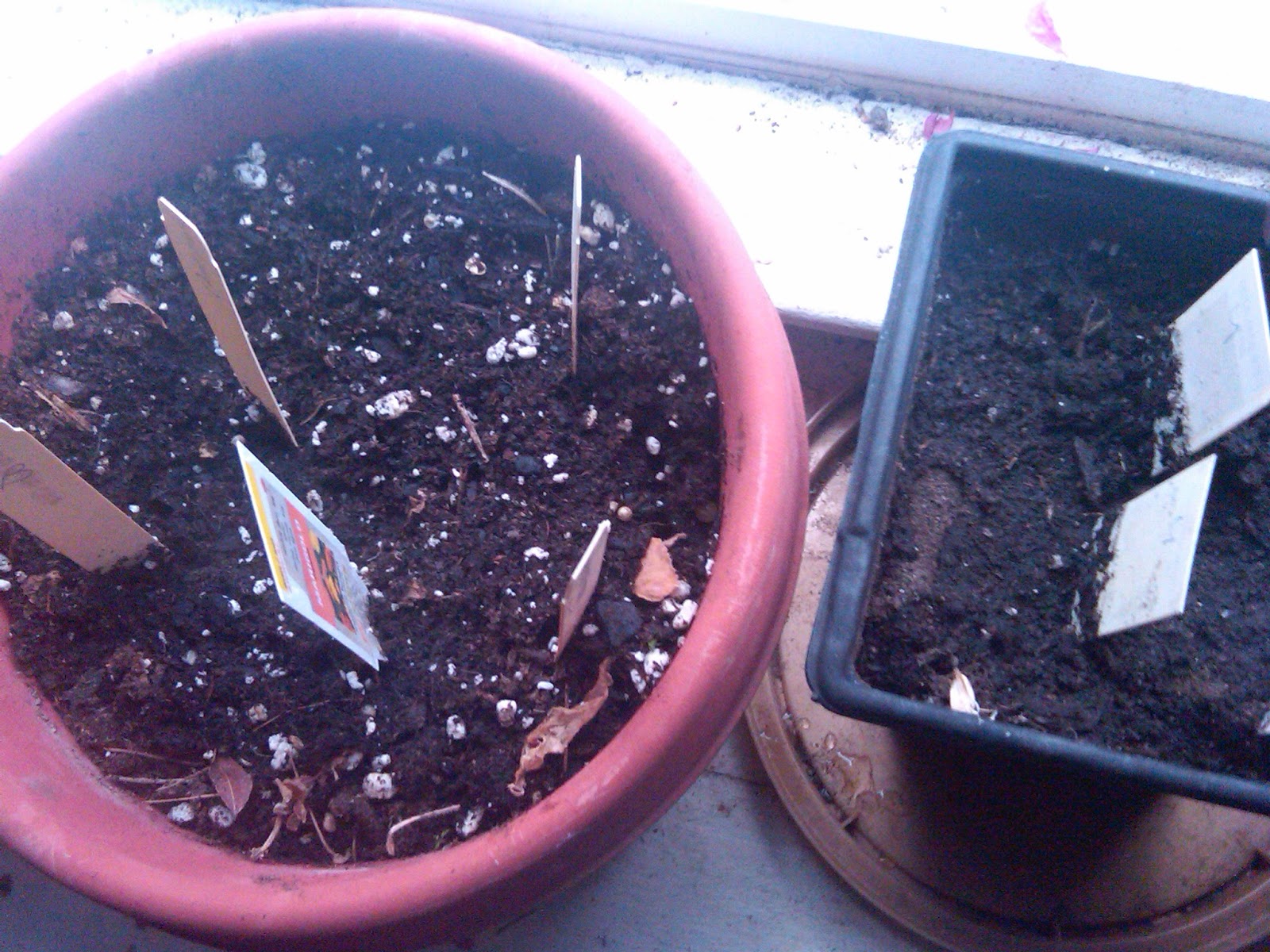
Sitting on my window sill in my sunny front room are two pots filled with pepper seeds. I am being rather adventurous with what I hope to grow -- long cubanelle peppers, some hybrid bell peppers, a couple of mildly hot peppers and a lot of my favorite, a sweet, long frying pepper called Italia. 

Last year I managed to get two Italia seeds to grow and put them outside with the previous year's pot of peppers that I thought I had killed when I brought it inside, not knowing it was infected with white flies. It lived despite my hacking it back and then spending some time in quarantine on my enclosed but not insulated back porch, and provided me with extra peppers. (I tried to keep them inside over this winter but the white flies were fierce and they all had to go.)

So far this year I have had little success with the seeds.

This year's pepper seeds. (Margo D. Beller)
I gave a friend seeds from one of last year's Italia peppers and hers are growing. Of course, she has a nice window sill over her sink facing in a direction that provides bright light. She also planted them in mid-February, which is not the usual planting time in NJ but we had a spate of April-like days. She was lucky. By the time I put a few older seeds in a pot, warm February became a cold March and, despite being on a sunny window sill, nothing came up.

So now I have two pots filled with seeds that are not quite as old, and I am waiting. If any seedlings come I will wait for them to get big enough to be put in larger pots and then put outside, protected from digging chipmunks and hungry deer. 

Why do this? Because it costs me nothing but some time, soil, a pot and water and in return I get some peppers for my cooking. I buy fewer peppers and know exactly what is going into growing them. And like my flower gardening, I find I enjoy growing these vegetables.

Two of last year's Italias. (Margo D. Beller)
My grandfather was a gardener, and while I have an affinity for flowers and house plants I inherited from him, I have never been as successful as he was in growing tomatoes. Peppers have been another matter. Several years ago a friend insisted on us all going to a pepper farm he'd read about in central New Jersey. We bought plants. I potted mine and it grew and produced very well, though I wasn't crazy about the type of pepper I had bought. 

It was several years later that I bought, and grew, an Italia. Its fruits have a lot of seeds and some little voice told me to save some of them. Good thing I did because as this pepper farm got more writeups in the local foodie press, more people ordered peppers online or came to the store, as we did, to buy plants. Italia is usually sold out now. I've grown it from seed ever since. One pepper can create a garden of new plants thanks to all those seeds.

I tried other peppers but the results were mixed - one potted pepper plant grew to the size of a small tree and produced no peppers. I kept it over the winter just to see what would happen and the next year got all of four peppers, none of which were any better than the Italia. 

So that is why I grow my own.

Meanwhile, I know there are ways to induce growth. There are special potting mixes, special lights. I don't bother. My friend has bright daylight and potting soil containing her own compost. So do I. The only thing that might make a difference is the age of the seeds. Usually that is not a factor unless I've been storing them - in little packets made from paper toweling - improperly.

Anyway, I have no room for these grow lights, either in my front room or in my half-basement, where the plants would get too much heat from the furnace. 

As The New Yorker's Katharine S. White says in her 1959 column "Before the Frost" about taking care of house plants in winter without using grow lights, "Though I am willing to be a floor nurse, I have no intention of becoming an electrician."

So I watch and wait and hope April gets warmer and at least one seed sprouts. If it is an Italia, so much the better.


Saturday, October 3, 2015

Bearing With More Trouble

On Sept. 27, six months to the day after the last incident, I was making supper. It was a Sunday early evening, people were enjoying their backyards with their children or taking a late afternoon walk in the sunshine.

I turned around to see if any cardinals were at the house feeder. I planned to take it in by 6:30 pm ET, 30 minutes from that moment, as I have been ever since a bear came into my yard overnight and destroyed one of my feeder poles trying to get to the sunflower seed.

Well, there was no feeder. I cursed, ran out into the backyard and on the next street, ambling northward, was a black bear, about as big as the one MH and I saw from our car on Old Mine Road in the ridges and forests of Sussex County, NJ.

Old Mine Road bear (RE Berg-Andersson)
This time, the bruin had ignored the sock and the cage-enclosed feeder that were filled with thistle put out for what had become a huge flock of goldfinches. It went for the old house feeder. In pulling it the bear had taken off the wrought-iron arm, too, and MH thinks when it fell it spooked the bear off. The house feeder, which hadn't had that much seed in it at the time, was on the ground but unscathed.

After the last attack, I had taken in the feeders for a while and then it was summer and I put a hanging basket on the remaining pole. Eventually, I had gotten a new feeder pole to replace the broken one. Around Labor Day I had started putting out seed. The dry weather conditions made it hard for birds to find food unless they found my feeder, which many of them did.

So did the bear.

Rosebreasted grosbeak on house feeder,
when the pole still had two arms (RE Berg-Andersson)
I have no idea if this was the same one because I didn't see the bear six months before. That attack was overnight. This one was during daylight, when there were lots of people outside, as I said. While I called 911 to alert the police, my neighbor was atop his grandchildren's playground setup, watching. He gave me a thumb's up. His son told me he had seen the bear rip off the feeder arm and then lope off through my backyard, my backyard neighbor's yard and then to the street. A squad SUV drove up that street after the bear but whether it was confronted or just followed into the next town, I do not know.

My brother-in-law the naturalist in rural NH told me he always waits until the snow falls and the bears go into their dens before he hangs feeders - even if that's in December. His feeders are always inside by April 1.

But he is in rural NH. The migrants have long left there. I was feeding a lot of cardinals, goldfinches and chickadees (along with more annoying house sparrows) because seeding plants were dying and there were no bugs because of the drought. Where I live, it might not snow until February. And my last attack had been before April 1.

What to do?

Predators have always been a problem. Accipiters -- Cooper's hawks and sharp-shinned hawks -- and redtailed hawks often haunt the yard. Lately, a cat has been loitering. (It is not feral because it is neat and has a flea collar, but it is not from my street and I have seen it run off through yards across the street and over to another side street, where its owner may live. It doesn't let me get close enough to see any ID tag. I do not understand the old adage about putting out the cat. You don't do that for dogs.)

Cooper's hawk atop feeder (Margo D. Beller)
But I can go outside and chase off a hawk or a cat. When I ran out and saw the bear I realized that had I turned around and run out sooner we'd have been face to face. What would I have done? Would I have been as stupid as the time I went out to chase off a buck in my yard and then quickly backed way when it put its head down intending to charge? In my anger, perhaps.

There are people who love bears so much they would like nothing better than for my neighbors and me to tear down our houses and let the bears roam free, unhunted. That isn't going to happen. Yes, there are houses in areas where they never should've been built, but people are in there now and bears are dangerous. I favor a bear hunt, as I do the annual deer hunt for the same reason - restoring something of a balance.

After a day or so inside, I put the house feeder on the remaining pole arm and put the thistle sock on the other pole. Not having seed outside plus a strong northerly wind seems to have decreased the number of sparrows and goldfinches dramatically to more manageable numbers, thus allowing more of the birds I like to get to the feeders. (We've also had a significant rainfall.)

Is putting out feeders foolishness or an act of faith? I want to feed birds. But I must now be extremely vigilant, at least until a hard winter cold comes. Fool me twice, shame on me. It may not be six months until the next bear encounter.