Cape May

Cape May
(RE BERG-ANDERSSON)
Showing posts with label garden mistakes. Show all posts

Thursday, April 12, 2018

Triumph and Disaster

Every spring I am pleased to hear the dawn chorus of birds and amazed when things start growing in my garden, particularly after a very cold and/or snowy winter. This year, "winter" seemed to concentrate itself in the month of March. But even now, in April, it has been colder than average here in New Jersey.

Glory of the snow, April 2018 (Margo D. Beller)
Still, no matter the year my first reaction in spring is usually the same: "Wow! Look who's here! You survived!"

First come the crocuses and the snowdrop. Both bloomed when they were supposed to, in late February, as the first daffodil shoots started coming up during some unusual warmth. Then came the March cold and four nor'easters, the second dumping 20 or so inches of the white stuff. But the snow melted and these flowers re-appeared and continued to bloom.

Then came the glory-of-the-snow, a small blue flower with a white center I planted in one part of the garden years ago and then moved, only to forget where I put it until it suddenly showed up. It does so every April.

Another surprise: Last year I bought a peony root and put it in a large pot. It did not do very well. I left it in the pot for most of the summer until I read more about how it likes to grow. Since deer allegedly don't eat it - peony flowers are showy and highly perfumed - I dug a hole and put it in one area of the garden I do not net. I marked it with a small flag and hoped for the best. Walking over to the compost pile one recent morning I checked and found two small, red shoots. Signs of growth! I hope the deer don't discover them.

Look closely. There are two red shoots here. Maybe the deer
will miss them. (Margo D. Beller)
One year I put the cannas I keep in two pots on my enclosed porch for the winter, covered in plastic. I later learned I had made two big mistakes - cannas are supposed to be kept cool but not subfreezing, and they are not supposed to get damp or they will rot. Plastic covering kept them damp and that winter the average temperature on the porch was 32 degrees. It took some time but the plants, once divided, managed to survive and grow. Since then I've stored them in the garage, which provides more shelter.

But for every triumph there seems to be a disaster.

This year the potted rosemary kicked the bucket after 10+ years of providing me with fresh herbs. Did it get too much water or two little? Too much dry house heat? I don't know. I did nothing different than I had in previous winters but even perennials die at some point. So now I have a glass jar full of dried herbs after I took off as many leaves as possible before struggling to get the plant out of the pot and into compost.  A friend let me take two cuttings of her plant, which had come from my plant, and I'll try growing rosemary again.

Then came the white flies.

I have a bad habit of trying to keep so-called "annuals" going over the winter. This started when I kept one pot of peppers indoors and the next year it grew more and bigger peppers. So each year I keep at least one pot of peppers. I have also been known to try to keep annuals going beyond most people's expectations. I kept a mum going for over 10 years, for instance. This past winter I tried that with begonias, coleus and ageratum, with little success. The begonias, ageratum and two of the six coleus died.

Last fall I found a tomato plant growing near my compost pile, perhaps a seed sown by a chipmunk or squirrel. I dug it up and put it in a pot. It grew very fast -- too fast. It had to be caged, staked and tied. It started to flower in December. Unfortunately, like all tomatoes, I discovered it was a white fly magnet.

The previous winter I had a terrible time with white flies. They infested all the plants, which had to be taken outside and shaken, cleaned and quickly brought back. The peppers were banished to my enclosed porch until I could put them outside. They were composted that fall.

Tomato, before composting. (Margo D. Beller)
This time I had kept two plants going, one of which provided me with small but good peppers during the winter. The other has started growing its own fruits. No flies, or so I thought, until I accidentally kicked one of the pots as I cleaned up rosemary debris after moving that pot. I had noticed but ignored some important clues. Some of the pepper leaves had started to brown. "Honeydew" was showing up on the front window. Now I had flies and, worse, I had hundreds of flies on the suddenly wilting tomato.

So the peppers were whisked outdoors, shaken and put on the back porch, where they were wrapped against the cold expected that night. The tomato was taken to the front yard, hit with a spray of water and put behind the deer netting, wrapped. The next morning the peppers were brought indoors, even though there are still some flies around. The tomato was a disaster. I put it on the enclosed porch and today it went back to the compost pile.

From compost came ye and to compost will ye return. I'll be buying my tomatoes from the farm market.

Saturday, April 8, 2017

Growing My Own

Though I do not believe that a plant will spring up where no seed has been, I have great faith in a seed. -- Henry David Thoreau

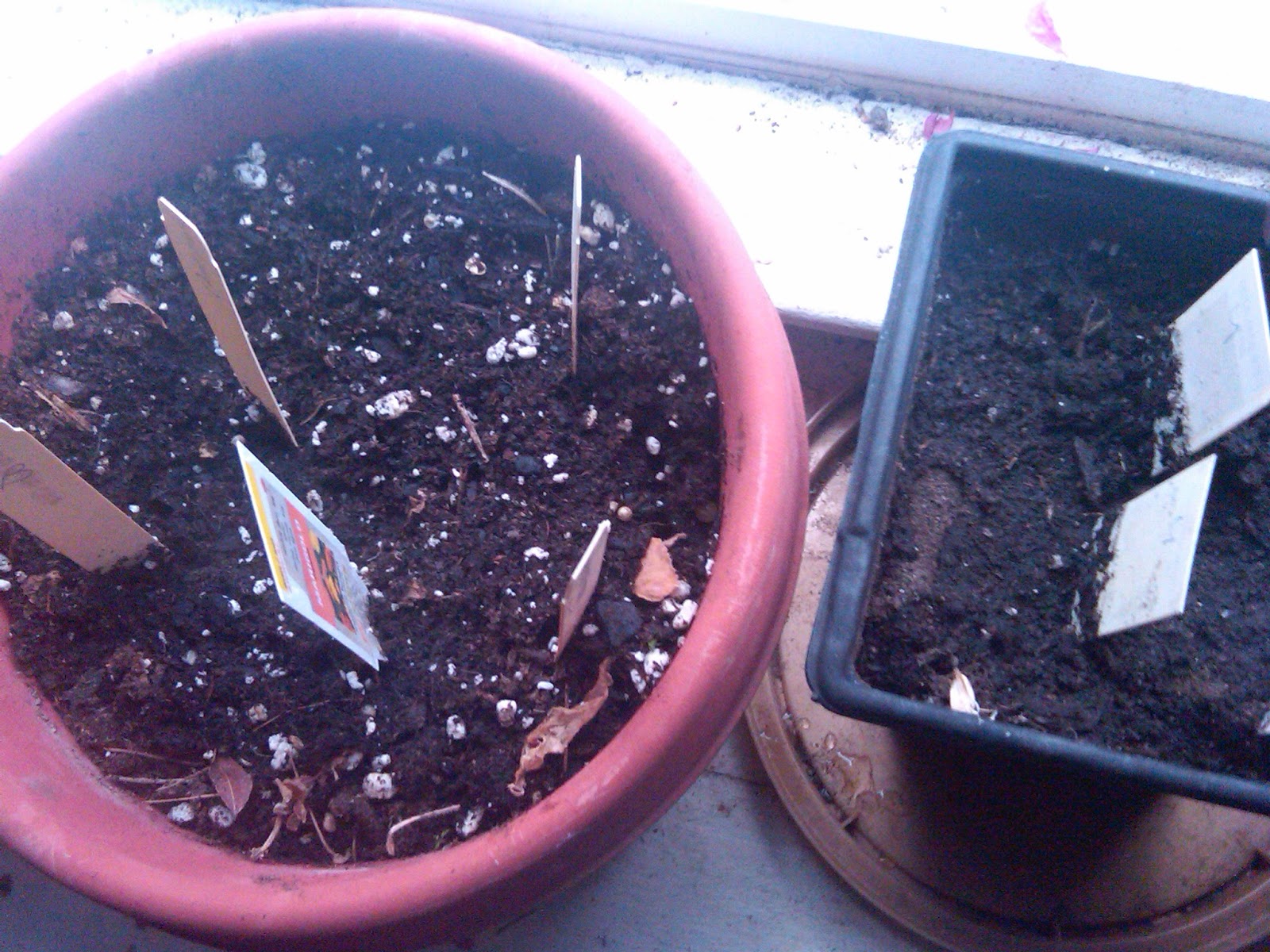
Sitting on my window sill in my sunny front room are two pots filled with pepper seeds. I am being rather adventurous with what I hope to grow -- long cubanelle peppers, some hybrid bell peppers, a couple of mildly hot peppers and a lot of my favorite, a sweet, long frying pepper called Italia. 

Last year I managed to get two Italia seeds to grow and put them outside with the previous year's pot of peppers that I thought I had killed when I brought it inside, not knowing it was infected with white flies. It lived despite my hacking it back and then spending some time in quarantine on my enclosed but not insulated back porch, and provided me with extra peppers. (I tried to keep them inside over this winter but the white flies were fierce and they all had to go.)

So far this year I have had little success with the seeds.

This year's pepper seeds. (Margo D. Beller)
I gave a friend seeds from one of last year's Italia peppers and hers are growing. Of course, she has a nice window sill over her sink facing in a direction that provides bright light. She also planted them in mid-February, which is not the usual planting time in NJ but we had a spate of April-like days. She was lucky. By the time I put a few older seeds in a pot, warm February became a cold March and, despite being on a sunny window sill, nothing came up.

So now I have two pots filled with seeds that are not quite as old, and I am waiting. If any seedlings come I will wait for them to get big enough to be put in larger pots and then put outside, protected from digging chipmunks and hungry deer. 

Why do this? Because it costs me nothing but some time, soil, a pot and water and in return I get some peppers for my cooking. I buy fewer peppers and know exactly what is going into growing them. And like my flower gardening, I find I enjoy growing these vegetables.

Two of last year's Italias. (Margo D. Beller)
My grandfather was a gardener, and while I have an affinity for flowers and house plants I inherited from him, I have never been as successful as he was in growing tomatoes. Peppers have been another matter. Several years ago a friend insisted on us all going to a pepper farm he'd read about in central New Jersey. We bought plants. I potted mine and it grew and produced very well, though I wasn't crazy about the type of pepper I had bought. 

It was several years later that I bought, and grew, an Italia. Its fruits have a lot of seeds and some little voice told me to save some of them. Good thing I did because as this pepper farm got more writeups in the local foodie press, more people ordered peppers online or came to the store, as we did, to buy plants. Italia is usually sold out now. I've grown it from seed ever since. One pepper can create a garden of new plants thanks to all those seeds.

I tried other peppers but the results were mixed - one potted pepper plant grew to the size of a small tree and produced no peppers. I kept it over the winter just to see what would happen and the next year got all of four peppers, none of which were any better than the Italia. 

So that is why I grow my own.

Meanwhile, I know there are ways to induce growth. There are special potting mixes, special lights. I don't bother. My friend has bright daylight and potting soil containing her own compost. So do I. The only thing that might make a difference is the age of the seeds. Usually that is not a factor unless I've been storing them - in little packets made from paper toweling - improperly.

Anyway, I have no room for these grow lights, either in my front room or in my half-basement, where the plants would get too much heat from the furnace. 

As The New Yorker's Katharine S. White says in her 1959 column "Before the Frost" about taking care of house plants in winter without using grow lights, "Though I am willing to be a floor nurse, I have no intention of becoming an electrician."

So I watch and wait and hope April gets warmer and at least one seed sprouts. If it is an Italia, so much the better.


Sunday, April 3, 2016

Owning Up to My Mistakes (Garden Division)

When something goes wrong, I'm the first to admit it/The first to admit it, and the last one to know
-- Paul Simon, "Something So Right"

Throughout my career I have always owned up to my mistakes. If through arrogance or misunderstanding I cause an error, I admit it.

That is why in this post I am going to own up to a couple of major garden mistakes that have resulted in the death of all but two plants. That is also why I am not going to show any pictures. I don't see anything interesting in showing a pot of dead plant.

There garden fatalities involve two types of plants that need warmth to survive: canna and pepper.

I'll start with the pepper.

For years I've ignored conventional wisdom that says you grow your pepper plants, you harvest the peppers and when winter comes you pull up the plant, put it in compost and either start new seeds or buy a seedling the next year.

I have always grown peppers in pots. I have not cared to endure the rigors of digging and fencing a vegetable garden, although I always envy those neighbors with the time, energy and strength to do so. Putting a plant in a pot and putting that pot behind deer netting is much easier, plus I can keep it in the sunny front of my house and it looks like just another plant to those neighbors who are anal about "keeping up appearances."

When winter has come, I have brought those pepper pots indoors and put them in my sunny front room. The plants usually do better the next year when I put them back out front. One year I was foolish enough to bring in five different types of peppers. No more. I play God. If it is a plant whose peppers I enjoyed, it will get saved.

This past winter I had inside one plant I was hoping to keep going for the third year and another I had grown from seed.

Unfortunately, last year I bought a basil from a grocery store and either the plant itself or the weather conditions created a major whitefly infestation. The flies themselves are annoying but when they are busy sucking on the leaves and laying eggs they create a "honeydew" that will eventually kill the host's leaves and thus the plant.

As I dealt with the basil, the flies took flight and infested the tomato I had growing. As I later found out, they also were all over the two peppers I had in the house.

During the worst of the winter the flies were either dead or dormant. However, as the days turned warmer and longer, the flies made themselves known all over the plants (which were still producing small peppers). When they started flying to my other house plants, I knew it was time to act.

I put garbage bags over the peppers and got them outside and behind the netting. I took out the plants where flies were going - they like the underside of big, soft leaves - and made sure to inspect and clean out the plants before bringing them indoors. I sprayed the peppers and left them in what at the time was a pretty warm day.

Unfortunately, the weather turned windy and cold and despite my best efforts at protection, the older one died. Peppers need overnight temperatures of at least 50 degrees to survive. They weren't getting them. So I put the pots on the enclosed back porch, where there was sunlight for about 6 hours in the morning, composted the dead plant and left the other one - until yesterday, when I saw the forecast called for daytime and evening temperatures way below 50 degrees.

So that plant is in the kitchen, where the natural light is dim and defuse but at least the plant is warm. The flies are dead and gone but the few leaves I didn't rip off look terrible, and I don't know if this plant will survive until, say, May. So I have three seeds of this type of pepper (I save seeds for this reason) in a pot on the sunny window sill as a hedge.

And now the canna.

Cannas are tropical plants grown more for their foliage than their flowers, which tend to show up in spikes during the hottest, most humid part of the summer. When I was first given them by a now-former friend, she told me that after frost killed the foliage to dig the plants up and wrap them in newspaper and put them in a cool, dry place.  I did that and lost about half of them.

The next year I put the cannas in a big pot. They did almost too well -- soon they were so crowded together I had to divide them. Now I had two big pots. I would give them away or compost them. Composting them created what I called "zombie" cannas - they were growing in the compost pile. So I would dig them out and put them in the ground and just leave them there over the winter. They would die, but I would still have my pots because I would bring them into my sunny front room and put them in a corner out of the sun. Inevitably, they'd start growing anyway.

Well, this year I didn't want them taking up space in the sunny front room. I had no room in my overjunked garage and my small basement is quite warm because of the furnace. So to my shame, I put them in the warmest part of my enclosed porch and covered them with plastic sheets and then a blanket. This was the absolute worst thing I could've done.

First, the temperature on the porch, even in the warm area against the kitchen where I put the pots, got down to the teens at one point. Second, the plastic sheets kept in the moisture rather than letting the plants dry out, as they would've done wrapped in newspaper. By the time I pulled them into the house and put them in the sun in the front room, they were dead. I have watered them to see if there is life but there has been nothing. By the end of the week, they'll be composted.

Ironically, I did one other wrong thing that has kept one canna alive. This was a zombie I pulled out of the compost at the end of last summer, potted and then brought into the house and kept going over the winter. It got no "rest" in its pot, which is the reason why you dig them up and let them dry out in the first place. It seems to be growing just fine.

No one is every going to confuse me with a master gardener. But I do learn from my mistakes -- once I realize them.