Cape May

Cape May
(RE BERG-ANDERSSON)
Showing posts with label bears. Show all posts

Sunday, January 4, 2026

The Wild West Suburbs

It was an eerie sound. My husband heard it through our closed den window. "That's not a dog," he said. I went to the door and opened it in time to hear a small bit. It was a coyote, howling at that night's full moon. 

A coyote? In a western suburb of New York City? We figured it was singing in the vicinity of our town's community garden and woods beyond the backyards of the homes across our street.

"Coyote (Canis latrans)" by Joshua Tree National Park is marked with Public Domain Mark 1.0.

(Well, maybe it's not so unusual considering coyotes have frequently been seen in the heart of New York City's Central Park and a pair have lived there for years.)

I have seen and heard some interesting things in my suburban town over the years, especially during the years when I'd be walking the streets at 5 a.m. to make a very early train. I've seen and heard owls - screech, great horned, barred, perhaps even a barn owl. I've seen foxes sitting in the middle of an intersection as I approached or trotting down the street.

I've seen raccoons the size of small dogs crossing what would otherwise be a busy street, heading from one backyard to another. I've also seen raccoons popping out of the sewer at the end of my property.

I've sidestepped skunks, including two baby skunks I barely saw. I've had to stop as a herd of 12 deer galloped across the road ahead of me.

And there was the bear I saw after it damaged the house feeder - and ripped off the pole arm - on a sunny late afternoon in October when there were plenty of people outside their homes. And there was the bear that damaged another feeder and the one that damaged my pear tree.

But a coyote howling at the moon? This was a first.

Like a lot of animals, coyotes, members of the dog family like your pet Bowser, have always been around in New Jersey and other eastern states, where some called them "brush wolves." Unlike wolves, coyotes don't hunt in packs. According to the International Fund for Animal Welfare, a coyote's diet "consists primarily of mammals, such as deer and rabbits, but may also include frogs, fish, and other prey, as well as fruits, grass, insects, and carrion."

"fox" by digitalprimate is licensed under CC BY 2.0.

"Mammals" such as pet cats and dogs are also eaten, which is why some towns go berserk when a coyote is spotted. Usually they won't attack - the one time I saw one it quickly skittered away. But some will. 

As for "carrion," I suspect overflowing garbage cans would attract a coyote the way they do skunks, raccoons, bears and crows, among others.

According to a group called Project Coyote, the United States Department of Agriculture’s Wildlife Services accounts for over 64,000 of the hundreds of thousands of coyotes killed each year through hunting bounties, poisoning and hunting, among other ways of death. Despite that, coyotes are not an endangered species. They’re classified as least concern with increasing populations.

If you provide coyotes with an increase in suburban garbage and deer, you'll see more coyotes. It's a wonder I've never heard one here in the neighborhood before.

I've seen a lot of changes in my suburb. When we moved in over 30 years ago you could often see rabbits and red squirrels. I once inadvertently uncovered, then quickly re-covered, a nest of baby bunnies under one of my shrubs. Rabbits used to eat my plants and occasionally would get behind the deer netting. Now I see rabbits only in wide-open areas, such as the Central Park of Morris County. I see more foxes there, too, as well as on my street and sometimes crossing my yard.

The red squirrels I would see were on one street where there was a large white pine. Between the larger and more numerous gray squirrels and the homeowner cutting down the pine the red squirrels disappeared. But they can easily be found in dense pine forests.

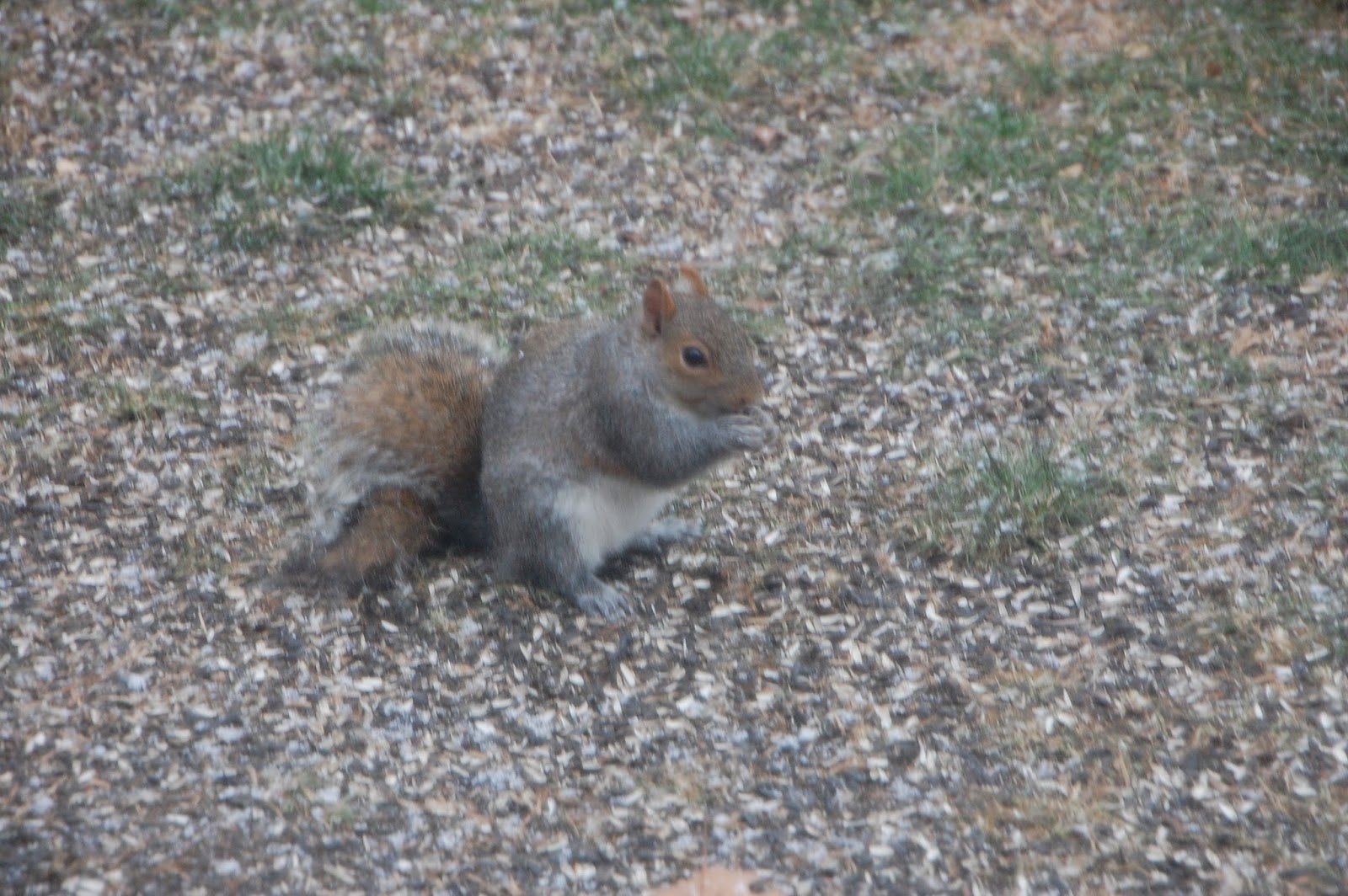
Another animal seen more often in the NJ suburbs,
including my backyard. (RE Berg-Andersson)

My point is the area has changed. More houses, less open land and trees. No hunting except at specified times and locations. The growth of suburbia has promoted the increase in deer and other animals as well as in the predators that eat them. The growth of suburban man-made garbage promotes an increase in animals, like bear, that have found rifling through a garbage can is an easy meal. So there are more human encounters with wild animals.

As encounters go I'd rather hear a coyote singing to the moon.

Sunday, March 14, 2021

Resurfacing

It is hard to believe that a month ago - Valentine's Day - my neighborhood was buried under two feet of snow from the nor'easter Feb. 1. There were several snow storms in February and we were in perpetual white all month. It was only in March the weather started to warm, culminating in one day when the temperature reached nearly 70 degrees F. Now, only the smallest bits of icy snow remain in the shady areas. 

Feb. 22, 2021 (Margo D. Beller)

With the end of the snow, some good and bad things resurfaced.

I looked outside one day and saw one yellow crocus in an area where there should've been more. I quickly yanked away a pot I had put behind the deer netting and there were the rest of them, which had come out of the ground and struggled under the weight of the pot. In a few days they recovered, and with them came some purple crocus. These flowers usually come up in February but were now making up for lost time.

In another bed, the snowdrops - another early bloomer - suddenly appeared and flowered a month late. They are sharing the area with many daffodils, my favorite flowers because of their diversity and their not being palatable to deer or chipmunks. The irises are showing signs of life, as are the rhododendron and the azeleas. The maple trees have started to flower, too.

Those are the good things. But there are also bad.

A deer (I'm pretty sure it was the same one) found a weakness in the netting and devoured every leaf of the yellow and green euonymous bushes. Best as I can figure, a deer put its head through an area not well fastened down the first time. Then, when I fixed that, it got up on its hind legs and pushed the netting down until it could reach over and eat more bushes. Finally, after I fixed that it went around to the side to get the last two it couldn't reach before.

Crocuses, March 14, 2021 (Margo D. Beller)
I went out and chopped the bushes back as far back as I could, something I'll be sure to do next autumn. (I know from experience they will grow back.) The netting has been reinforced and more poles put in to fix what the deer's actions bent. Now there is nothing that will interest a hungry deer until the sedum start to grow.

Let's go back to the good.

While I worked to cut back ornamental grasses and the butterfly bush over the past week I could hear plenty of birds singing or calling - robins, cardinals, a song sparrow, redbellied woodpecker, even one of the earliest migrants, the redwinged blackbird. Very large flocks of grackles flew over, not stopping in my area as they did last February. This morning several skeins of Canada geese were flying north. These are the wild geese, not the ones that have made their home in office parks. Those geese will fly up and around and land, knowing they are supposed to move but not knowing why. The wild geese know the frozen ponds in the north are melting.

Snowdrops (Margo D. Beller)

Now that the snow is gone and the air is warming, more people are walking, and that reminds me I have to get back to walking, too. I did not walk much on my town streets in the cold and the park trails were inaccessible to me because of the deep snow. That snow is now gone, as I discovered this morning. COVID-19 has kept many of us indoors, although we used the cold and snow as an excuse, and so it felt good to walk my favorite trail again to see and hear the birds, not all of which I could've also heard in the backyard.

Finally, now that it is easier for us all to get around, I must take the feeders in at night. It was early one morning at the end of March 2015 I opened my kitchen curtains and saw only one of two feeder poles, the other bent to the ground. I have been bringing the feeders in at night ever since except for when thick snow covers in winter, when the bears should be hibernating. (Six months later, on a warm, sunny, late afternoon, I saw a bear pass through my yard after taking down an arm of the other feeder pole as it tried to take off the house-shaped feeder.) The bears will emerge from their dens hungry and, if a male, seeking new territories. So I'm back to taking feeders in at night.

However, the need to put out feeders in the morning gets me out of bed - resurfacing, you could say - and allows me to hear the birdsong, which will only increase as northbound migrants pass through in the next month. So it's not all bad.

Defoliated shrub (Margo D. Beller)


Monday, February 26, 2018

Old Reliable

I was sitting on my back porch today, watching the continued rain, thinking of how I tend to keep things around for a long time as long as they are in working order. My car is 12 years old. One of my winter hats I've had since I was 10 years old. I can't remember how long ago I bought some of the shirts or coats in my closets. (Some would say I keep MH around for the same reason.)

House feeder with Velcro and duct tape, Feb. 25, 2018 (Margo D. Beller)
Then there is this house feeder.

This simple wood feeder has been attracting birds of all sizes since we received it as a housewarming present well over a decade ago. The first bird it attracted, according to my records, was a "woodpecker," likely a downy but I didn't know its name at the time. The second bird was a tufted titmouse, I learned from my field guide, and using my binoculars I could see the bit of red under its wings and the texture of its feathers.

Seeing these birds prompted me to start studying them in my yard and in the field. After a decade of running around watching and listening I think of myself as an intermediate birder, at least when it comes to the birds I see regularly in my part of New Jersey.

House feeder in better days, with female purple finch (Margo D. Beller)
Like everything else I have kept for many, many years there is fraying around the edges, signs of weathering and a weakening of bonds. I've added other feeders to my collection over the years but I use this one because it does what I want, attract birds. Unfortunately, not all the birds are those I want to attract and this is the only feeder I use that has no protection from squirrels, which I also learned fairly quickly. That is when I put in a feeder pole and a baffle to keep the critters out.

But over time, after many winters in rain, snow and wind, the string has frayed and is now reinforced with Velcro strips and more twine so it doesn't break under the weight of sunflower seeds or the birds that come in ones and twos or more to eat it.

Feeder with curious black-capped chickadee (Margo D. Beller)

Bears have attacked this feeder but have never been able to destroy it, although they have come close. The last such attack, when the bear took down the cast-iron pole's arm as it tried to rip the feeder off, put a hairline crack in the lid. That didn't impede my being able to refill the feeder -- until the freezing rain came a few weeks ago. I tried to open the lid and half of it came off in my hand. But that is why duct tape was invented. The lid is attached again and the feeder can continue to be used.

Those are easy fixes. Fixing the car when parts break down is not so easy and can be expensive. Fixing me when parts broke down over the last couple of years, forcing me to see doctors and go to the hospital, were even harder and more expensive. Just as I do what I can to keep this feeder in one piece - such as taking it in at night when the bears are out of hibernation, as they will be soon - I do what I can to keep MH and me in working order.

But I know we are not young, indestructible or immortal, and that's a hard thing for me to accept. Still, like my feeder we go on, sometimes with duct tape.

Sunday, December 31, 2017

Bearly There

On this last day of 2017 the air temperature is in the teens, some 20 degrees colder than the average for this time of year. When I wake at 6am it is dark and, because I have lowered the heat and it won't come on full until 7 am or so, it is cold. I am curled up under two quilts, a sheet, with one fleece blanket below me and a smaller one over me. MH snores by my side. I am not inclined to rise before 7am and so stay huddled up in a ball until forced to leave my warm bed.

Just like a bear.

(Director Mike Anderson took this picture in 2014 at New Jersey
Audubon's Scherman Hoffman sanctuary in Bernardsville)

Ever wonder why you feel more sluggish at this time of year or eat fewer cold salads in favor of mashed potatoes, squash or anything covered in thick gravy? It is our body telling us that, like the bear, it is time to fatten up before a harsh winter when there is less food to be had and less daylight to find it. When I had to rise at 6am to commute on the train I needed an alarm to jolt me awake. Not now. But even with daylight it is a struggle to leave my "den" for the outside world.

I put out the feeders. Many mornings it is my only reason for getting out of bed.

At this time of year the bears should be hibernating but this intense cold is only recent. It was relatively warm for November into early December and there was a 16-day bear hunt that lasted until Dec. 16, so I thought the bears might be on the move and would menace my feeders and feeder poles, as they have done at least four times that I know of (one of those times a bear nearly destroyed my pear tree as it tried to climb to the one small pear still on it). I have been taking the three feeders in every night. Now I don't have to although I know the deer may put their front hooves on a baffle and attempt to knock the seed feeders enough to drop seeds for them to eat. At least one baffle was destroyed that way.

And yet, the number of bear complaints is down. According to a Star-Ledger article quoting the NJ Department of Environmental Protection, as of Dec. 20, "the activity of 965 black bears has been reported to the DEP, a sharp drop from the 2116 of 2016, the department's bear activity report shows.

"In addition to 261 sightings where nothing happened, 695 bears caused 'damage or nuisance' in 2016, a more than 50 percent drop from the 1,394 problem bears last year.

"In 2016, 722 bear sightings resulted in the animals simply leaving the area without doing anything."

My only reason for rising most mornings
nowadays (Margo D. Beller)
It was in 2016 that the pear tree was damaged. It was in 2015, on a bright late September afternoon, that a bear ambled through my yard, snapped off an iron arm from a feeder pole, nearly destroyed my house feeder and then ambled off to the next street. I guess that is considered not doing anything.

Still, despite the "few" bear sightings and the lower number of bears killed 409 versus 2016's 636, during what might be the last hunt for a while (the incoming governor pledged to suspend the hunt, at least for now), the thought of even one bear foraging in my yard is enough.

No, better to brave the cold at night and in the morning.

The intense cold is as hard on me as the high heat and humidity of summer. Bears have a thick coat to withstand the cold while they hibernate. They have the right idea, which is why you'll find me huddled in my quilts and blankets and flannels on this winter's night.

It is expected to be 5 degrees when I put out the feeders on the first day of 2018. Happy new year. 


Friday, June 23, 2017

Chatting With the Apple Tree

Apple tree (Margo D. Beller)
We have passed the point on the calendar marked "First day of summer" although from a meteorological standpoint, summer began on June 1. There are two hummingbirds at the feeder. I know this because frequently they show up at the same time and one chases the other off. Because they look alike, I can't tell which is the Alpha and which is the Beta. However, one does tend to squeek when it flies off or is disturbed. I heard it from the tree this morning as I was picking apples.

Most apples grow in late summer into autumn. I have one tree that blooms in late April or early May and puts out fruit a few weeks later. Some years, such as last year, drought conditions prompted few flowers and thus fewer apples for me to pick. This year, with all the rain, there was an overabundance of flowers and now you can see the apples growing.

Last year I brought one to a farmer I know and he identified the apple as a sort of Mcintosh, although these are usually ready to be picked in the fall, too. But my apples are usually ready in late June into July. I know this when I see squirrels climbing up, grabbing one and running off with it.

Thus begins an annual routine. I go out with a bucket, pick up whatever the squirrel has dropped and then pick whatever apples look big enough to cook - ideally I'd like them redder but I am in a race against time here - before the deer can come and eat them. The other morning I had just done that when a big doe arrived and started browsing. I chased her off but she did not go willingly.

House wren in apple tree. (Margo D. Beller)
This is suburban life now. At one time deer were afraid of people. No longer.

I do this picking (or picking up) twice a day, in the early morning and at dusk. But judging by all the deer excrement under the tree, I can't get everything.

When we bought the house over 20 years ago, it had been standing at that point 30 years or so. The previous owner must've fancied himself a gardener because he put in five apple trees, a pear and a cherry. He also built up a small, terraced garden with railroad ties. However, he stopped taking care of it, then moved out ahead of a divorce and the ties rotted. Chipmunks nested beneath it. When we had work done on the house and surrounding property, the ties were removed.

However, the trees stayed. The cherry eventually rotted and I had three of the five apples taken down because the fruit was not usable to me but made a big mess in the yard thanks to the squirrels and deer. The fourth, a small tree and the same type as the one that remains, was killed by too much rubbing of antlers against it by young bucks.

Where one tree was removed is now a garden of ornamental grasses and other plants deer tend to leave alone. Where two others were are now planted a dogwood tree and my friend Spruce Bringsgreen. But I kept the last tree because the apples make good sauce or pies. It holds up the house wren box, where the adults are now shuttling back and forth to feed peeping young. It provides some shade. It is a place for birds to perch such as the hummingbird. During the flowering season, I discovered 14 cedar waxwings going after the bugs, or perhaps eating the petals.

But those apples do draw the squirrels and the deer.

Recently I sat outside on my patio, admiring this tree with its growing fruits. I had it trimmed a few years ago but now it is bushier than ever.

I am an old tree, she told me. I have to do much to protect myself and to protect my young. When I have too many, as this year, I must abort many of them while they are still small and hard. It can't be helped. I have to be able to bear more fruit next year and beyond. As you can see I have a gall on my trunk and an opening big enough for a chipmunk to sit in, but I keep going.

I had noticed all those little apples underfoot, I said. I guess a lot of trees do that. I notice the elm over there has dropped a lot of green seeds. I hope the squirrels and chipmunks will get to them later, when they have to be stored for winter.

I do not mind the birds in my upper branches, she continued. I do not mind the nest box you hang on my lower branch so you can watch the birds. I did not mind the yellow-bellied sapsucker that drilled little holes in a ring around my trunk for the sap last spring, the one you kept chasing off. It was trying to survive, too. I have withstood all that. 

I survived a hurricane, the one called Sandy. I have stood in deep snow and in fog and in heavy rain and in such heat that my leaves have turned brown and fallen before their time. I do what I must to survive.

I can understand that, I said. So do I.

What I do not like is you whacking me with a big stick every year, breaking off my branches and making the apples rain down before their time, she said.

I am sorry, I told her, but I am now past the age where I can climb trees or even stand on the upper part of a ladder to gently pick the ripe fruit. The squirrels are not so choosy, especially in those years where we have had high heat for days on end. The squirrels want a sweet drink and will ignore my water dishes for your apples.

I will remove the core and rot before using (Margo D. Beller)
And when they drop partially eaten apples, the chipmunks grab them, which is fine, but then the deer come, which is not. One deer is bad enough but the time I came out to find five of them was a horror. I once used an umbrella to hook your branches and pull them closer. Now, I admit, ever since I got the extension pole for another project, it has come in handy to bring down as many apples as possible at once.

But it is not as if your fruit goes to waste. I put the partially eaten ones into the corner of the yard, where I prefer the deer to poop than in the lawn under you. I throw out the really small or bad ones. I put the rest in the cellar and then, when I have the time, energy and inclination, I make pints and quarts of sauce I can freeze and use for months. I would love to compost the parts I don't use but I don't want a forest of apple trees to grow there.

You took down my child, she said.

Your child was small and destroyed by deer, I said. I would've loved to have had two of you for the apples and the shade, but what else could I do? I am trying to balance having something natural and pretty in my backyard with the new realities of suburban life, where wildlife I never would've imagined are showing up in the yard.

You know a bear was once in the neighboring tree, the one you took down, she said.

Yes, I do. That was the first time a bear visited, to my knowledge, many years before the visit that destroyed my bird feeder pole. I came out and found a large indentation in the ground, a lot of scat and broken branches. It is one of the reasons I later had that tree removed and put in my ornamental grass garden. You saw what a bear did to the pear tree over there.
Damaged pear tree (Margo D. Beller)

Yes, she said, I did, and I appreciated all the work you did to save it. It looks very healthy now. I hope a bear does not decide to climb me for my fruit. A 200-pound bear does a lot of damage to apple tree branches. But if it does, there is nothing much I can do about it. I am a tree. If I am struck down, I can only hope one of my seeds grows to keep my line going.

Do not worry, old tree, I said. As long as I can still get up in the morning and bend down to pick up dropped fruit and pull off apples before anything else can get to them, no bear will destroy you.

But we both know that in this life there are no guarantees, to anything.

No, she replied. There aren't.

Saturday, April 22, 2017

Here Comes Trouble

It is a universal truth that April showers bring May flowers. This year, when February felt like April and March felt like January, we have had a long, dreary, rainy period in April.

Bleeding heart, April 22,2017 (Margo D. Beller)
So it should be no surprise the rain has brought the May flowers early including the bleeding heart, the lilac, the growth spurt of the Lenten rose and the dogwood blossoms. The coral bells are sprouting flower stalks, which means the hummingbirds that enjoy the little pink bells can't be far behind.

However, some surprises are not so delightful - the purple flowers of the ground ivy in the lawn look nice, but the ivy supporting them will get everywhere in the lawn and my flower gardens. I will have to yank out what I can but it never really goes away.

There is also the garlic mustard. My book on weeds and their uses says you can cook the leaves of the plant when it is small, but I'd rather not.

Lenten rose (Margo D. Beller)
Ground ivy flowers in front lawn (Margo D. Beller)

Probably the most troublesome plant, however, is not a plant at all. It is my apple tree.

I enjoy the flowers on this tree, the last of five apple trees that were on the property when we bought it and the one with the best apples, which is why it was not cut down when the sour apples of the other trees drew too many squirrels and deer not particularly neat in their habits.

Last year, weather circumstances were such that we did not have many apple blossoms. Each flower represents a fruit. This year, however, we have lots of blossoms and that means I will be making lots of apple sauce - if I can get to the apples ahead of the squirrels, the birds, the deer and a new nemesis, the bear.

Last August, a bear nearly destroyed my pear tree while trying to get the one pear hanging from it. It was not successful. That was the last (so far) in a string of bear attacks going back to March 2015 after more than 20 years of my living in this house.

This year, despite cutting down two parts of the trunk and then my botching the pruning of the upper branches last summer, there is not only growth but the most flowers I've ever seen on this tree.

Oh boy, more pears, too.

I remember being very happy after I picked last year's pear that the few apples on the tree were gone by June. This year, however, I can expect the bulk of the apples to be ready to pick, or drop from the trees, in late June or early July unless we have a particularly hot May or June that brings out the thirsty squirrels. In the past if they happened to drop a usable apple, I'd save it. If they took a bite and dropped it, which is often the case, I would either throw it out or into another part of the yard for any creature to find.

Now, I have to factor bears into the equation.I won't be throwing apples into the corner of my yard this year.

Apple blossoms (Margo D. Beller)
I could just take down the tree but where's the fun in that typical suburban solution?

The blossoms and apples draw insects and the insects draw birds, including migrating visitors such as the Baltimore oriole, ruby-crowned kinglet and warblers of various types. The regulars - cardinals, titmice, house finches, jays, chickadees - are always around in it, too.

And then there is my special visitor, the house wren.

Every year, when I read reports of house wrens appearing in areas close to mine, the wren box comes out. Then I wait.

Wren house, 2017 (Margo D. Beller)
A week after I put out the box I was coming back from delivering items to the compost pile when I spied a house wren pulling out some debris I hadn't completely removed last winter. Would we have a tenant this year?

I got my answer this morning as I was photographing the apple tree and heard the house wren's gurgling song.

It is hard to describe the song of the house wren. It's not like the "tea kettle, tea kettle" and other repeating calls of its cousin, the Carolina wren. The house wren is a very plain little brown bird, but it will build a nest in just about anything, and the wooden house I provide in the shelter of the apple tree must look very appealing.

2017 house wren (Margo D. Beller)
Usually, by the time the apples are ready to be harvested, the wren brood has flown with their parents to the nearby bushes before eventually dispersing. Too many squirrels in the tree and me knocking apples down with a long rod would be enough to drive any new parent mad, especially one with three to five young looking to be fed at the same time.
 
So when the wrens fly off and the apples ripen I must hope no bears will do to the apple tree what last year's did to the pear tree, which was not pretty.

Yes, I know, the apples are just sitting there and if I didn't use them they would feed all sorts of animals, and the bear is just doing what bears do when presented with a meal in inhabited areas like my small town, be it in a Dumpster, garbage pail or a fruit tree.

The roar of the spring blower. (Margo D. Beller)
There are a lot of aggravations in suburbia - the inevitable "Spring cleanup" when the lawn services come through and use their noisy, gas-belching blowers to take out all the fallen leaves they didn't get last autumn, then put down the weed killer chemicals and the lawn fertilizer and then, of course, comes the mowing and putting down of mulch to cover where the leaves they removed had been. (I don't understand this. The leaves make a perfectly good mulch on their own.)

Now, there's bear.

My city friends think I am nuts - yes, car alarms and gun shots at 3 a.m. are far worse than the drone of any early-morning lawn mower - and my rural friends already contend with bears as well as bobcats, coyotes and many more wild animals, all coming to a wooded area near me soon enough thanks to shrinking habitat and encroaching housing developments.

I'll just have to be faster to the apple tree this year and hope for the best.

Monday, August 8, 2016

...and a Black Bear in a Pear Tree

It happened again, another visit by ursus americanus, better known as the black bear.

This now marks the fourth time I have looked out the kitchen window to discover major damage that could've only been caused by a 200- to 500-pound bear.

Once again, the reason was food.
Pear tree branches down, Aug. 5, 2016 (Margo D. Beller)
Ever since the first attack, either in the late hours of March 26 or the early hours of March 27, 2015, I have been taking bird feeders inside at night, even in the middle of winter when bears should be in dens. I don't put feeders out in summer until August, when I put out a thistle sock for the goldfinches. I take that in at night, too.

That's not what the bear wanted.

What was damaged this time was not a feeder pole but the pear tree just beyond our enclosed porch, on which I hang several water dishes. It has only been in the last several years, when I hadn't cut back some of the longer branches myself or hired someone else to do it, that the tree has flowered in the spring. Flowers mean fruit is coming. Many years the squirrels grab the pears.

This year I found only three pears. One blew down when we had a horrific, non-hurricane thunderstorm (similar to the one that took our power last week). I forgot about the other two.

So when I found the two side trunks cracked and bent over, I realized the bear - for what else could it have been? - had tried to climb up to the remaining pears but had hit the ground when the branches gave way. For whatever reason, it didn't try again, thank goodness, and didn't leave any indentations or "calling cards" for us to find, as happened about 20 years ago when we had more apple trees and woke one morning to find a big branch down on one of them and said indentation and calling card below it. (The tree was one of those removed years ago, replaced with a garden containing ornamental grasses and plants not usually eaten by deer.)

I knocked down the two pears. One was already way past the point where it should've been picked. Here is the other one, which we'll eat at some point.
What the bear was after (Margo D. Beller)

One of the water dishes was still hanging in one of the broken hunks of tree. I estimate 1/3 of the tree had to be sawed off, which was unfortunate because I put in feeder poles based on where the tree is located. The poles are too far away for squirrels to jump to the feeders from the tree while allowing the birds a place to safely eat their seeds or enjoy a drink of water.

Making it worse, this was the same tree I had cut back from the top a few weeks ago, MH manfully holding the ladder against the house as I went up with my lopper to take down branches that were overhanging the enclosed porch and being used as a highway for chipmunks and squirrels.

So having cut off so much, why shouldn't I go out today, a hot and humid albeit cloudy day when I had nothing better to do, and cut off more hunks of this same tree to get the remaining upper branches? I didn't mean to take off hunks, I was merely bending down the branch to cut it better from the ground and the whole thing snapped.

The water dish had to be moved. (Margo D. Beller)


Apparently, pear trees are quite brittle. They can also grow 40 feet high. I did not plant this tree, just as I did not plant the apple trees that I had to cut down because I couldn't keep up with all the fruit on the ground that brought deer and their mess to my yard. Aside from the pear, only one apple tree remains, and thank goodness there was not much fruit this year or the bear might have caused more damage.

If the pear tree survives the summer and winter to bloom in the spring, I'll be amazed. If it goes, the replacement will be a non-fruit tree. As long as the birds get their shelter and water, they'll be fine.

Thursday, January 14, 2016

A Cold, Cruel World

This may be hard to believe, but there are times I leave the feeders inside because I can't deal with the horde of house sparrows. Now that it is getting to feel like winter for real, that group has been joined by an increasing number of house finches.

Unlike the sparrows, which usually flee when they see me come on the porch, the house finches just stay on the feeders in groups, eating. That's all they seem to do, eat. This is common behavior for finches, including the house finch's larger cousins the grosbeaks and the cardinals.

House finch (Margo D. Beller)
However, with the return of wintry cold I find that the lack of neighbors who put out feeders is giving me a bigger pain than usual.

The birds are getting more aggressive. The sparrows have gone back to their bad habits and are hitting the house feeder en masse. Even the cardinal, which can be skittish, is now taking advantage of its larger size to fly in and scatter the finches or sparrows in order to eat. But at most I've only had a male and a female cardinal this year so far, compared with the four pairs we've had in the past.

The cardinals must not like sparrows either. But the pair that has claimed our yard as their territory must eat or die, especially in the cold.

The one creature that is happy about all the sparrows and finches. (Margo D. Beller)
Still, the constant eating by these pest birds, who go through my seed the way a hot knife goes through butter - quickly and destructively - are taking away the joy I had in watching a diverse group of birds in my yard. With such a mob, rare winter visitors to the feeders including the purple finch or the American tree sparrow or the red-breasted nutchatch can't get a beak in edgewise.

If people want me to keep feeding the "poor" birds, they should put up their own feeders. Birds don't need my seed to survive, although it helps, I know.

In fact, thanks to the messy birds, I have a growing number of juncos - a winter sparrow visitor - and squirrels taking advantage of the droppings. I wouldn't mind this if the horde didn't waste so much seed that when it finally flies off - and the other day there must've been 40 of them joining the ones from my yard - they've left nothing for the birds I want to see, including titmice and chickadees.

Titmouse manages to get a seed - Jan. 2016 (Margo D. Beller)
As you can tell, the cold makes me irritable. Unlike the birds I have to fight the internal need to eat more when the days get short and the temperatures drop below freezing. Like the bears (by now, I hope), I feel the need to hybernate. It has been particularly hard this January because in November we had September weather and in December we had October weather. Turn the calendar page and January being January is a shock to the system.

So forgive me if I keep my feeders inside once in a while during this coldest of periods so I can have a rest from refilling them two or three times a day, and force the birds to act like birds and look around for their food. The feeders will be back outside soon enough.


Sunday, November 8, 2015

On Leaves, Birds and Bears

Leaves

Out here in the suburbs it is currently leaf blower season.

I am on my back porch, looking at a clear blue sky on an otherwise perfect autumn day in November. My next-door neighbor, in his shorts and blasting music through his headphones (as I am, if you can call harpsichord Bach "blasting") is using his blower to push the leaves off the grass, perfectly demarcing the edge of his property.

When he is finished, as sure as the sun's position will change, another neighbor will take up the challenge and blow his leaves around for a while. And so it will continue all day in the "quiet" suburb where I live. (At least it's not gunshots or a car alarm - yet.)

Pods and acorns found under the fallen leaves. (Margo D. Beller)
I did the same thing myself yesterday, using the blower to push the elm and maple leaves into piles that MH and I would then rake into blue tarps and dump at the curb for pickup by our town. Unlike the front yard, this is actually easy. In the front yard we have locust trees, one of which is a female tree that gets loaded with long, hard, smelly pods that must be raked down because they are too heavy for our blower. Unlike the previous week, there were few pods so I can pick them up rather than rake and strain my arms.

I was quite pleased with our effort, until I awoke this morning and saw that the wind had changed and it had brought down more pods as well as a lot of the remaining oak leaves. Being a Sunday, the infernal sound of my neighbor's and others' leaf blowers started a little later this morning, 9am instead of 7:30.

This is part of the suburban ritual. As the summer heat starts to fade it is time to pull up the annuals, mow the grass and put out mums. As Halloween nears it is time to put out pumpkins, corn threshes and take the kids to the nearest farm so they can experience something resembling rural life. Then the leaf blowers start. After Thanksgiving, start expecting snow and snowblowers clearing driveways, but sidewalks only begrudgingly.

I try to fight against this ritual as much as I can but I can't avoid the pods or the leaves that thickly mat the lawn and can do some damage if not removed. So every year we rake and every year, the day after we expose the deep green of the lawn, more leaves fall and remind us there is more work to be done and there is always more work to be done.

Like all of life's burdens that never end.

Birds

"Where are the juncos?" MH asked me the other afternoon as we were having our dessert on the porch before the light faded.
Junco (Margo D. Beller)
MH has a more scientific bent than I, and he tracks when the chipping sparrows and catbirds depart to be replaced by white-throated sparrows and juncos, which is a cousin of the sparrow. White-throats and juncos usually start showing up in October. I don't note the exact day but MH has a calendar embedded in his head and to him the juncos were overdue.

I had seen a couple of juncos one afternoon when I went to the feeders to chase off the horde of house sparrows mobbing it. The juncos flew off and I haven't seen or heard one in our backyard or at the feeders since then. I have been hearing the two-note call of the white-throat but have only seen one that took close to a week to get comfortable enough to come out of the bushes and stand on the flood wall. When I chase off the house sparrows it stays put because it is not of the house sparrow clan. (House sparrows are not really sparrows but old-world weaver birds that came along for the ride and proliferated in the new world over these many centuries.)

So I thought about it. Migration in my part of northern New Jersey had been very bad - "good" birds seen in much smaller numbers than usual, storms blowing many birds over New Jersey southward or eastward over oases such as Central Park in NYC. It could be that ever since the last bear attack I've been taking feeders in and so there is no seed available in the very early hours when I've found cardinals and white-throats and juncos like to feed.

White-throated sparrow (Margo D. Beller)
It could also be the horde of sparrows. Unlike the titmouse or the chickadee that grabs a seed and flies off, the sparrows crowd into the house feeder, fighting each other. I now have a second, caged feeder out for the other birds.

Like the unusual warmth we have had the last few weeks (when temperatures fall back to where they are supposed to be, the weather forecasters seem to treat it like some sort of calamity. "It will be 35 degrees colder tomorrow than it was today!!") that I attribute to the wacky weather patterns created by global warming, the sparrow explosion is man-made. A former neighbor kept a feeder going all year long, including the summer, and filled it with millet, a house sparrow's favorite food because it is small and easily cracked open. The abundance of food created a population explosion.

Unfortunately, that neighbor moved out and, after an initial attempt, the people who moved in use the feeder pole more for hanging plants than bird food. So this large sparrow population - which has made nests in trees, shrubs and the spaces next to window air conditions such as my neighbor's across the back yard - are coming to my sunflower seed feeders en masse.

I find myself coming out to refill the house feeder during the day or, if I am sick of the mess, taking the house feeder in, which deprives the cardinals of food because they can't fit into the caged feeder. Then I must go out just before dusk, after the other birds have tucked themselves in for the night, to allow the cardinals a last meal before dark.

So these bigger, more aggressive birds may be the reason the juncos are "late" in arriving. When the real cold comes and the snow falls and I can safely keep the feeders out all night without fearing another visit from a bear, perhaps the winter birds will finally show themselves. Desperation will make even the smallest bird fight a house sparrow.

Bears

In late October, in the middle of the day in the middle of the large county seat's large green, a large bear was spotted in a tree by a police officer. The lunch crowd was immediately ousted from the park and people started taking videos on their phones to post to YouTube. Snarky comments voiced more support for the bear than for the police officer, and comments regarding the color of the bear - black - were made both pro and con, as stupid comments will be made when you don't give your real name.

The bear, meanwhile, stayed put, and from the comments I've read most people were mighty pleased to see a bear in the middle of Morristown. It was a big story that made headlines in newspapers and on the evening news.

I heard this story and knew, just knew, that this bear was the same one that had walked into my yard on a sunny September afternoon on a Sunday when people were in their yards or strolling in the street and grabbed at my house feeder, ripping off an iron feeder pole arm, before ambling across the yard and along the next street, where I managed to see it heading north.

Black bear, 2014 (RE Berg-Andersson)
I also knew that if this 200+ pound bruin had been in the backyard of any of these people, threatening their feeders or, worse, their pets or small children, they wouldn't have been so happy to see a bear in the middle of the day in the middle of a heavily populated area.

The black bear was later tranquilized and brought down by the fire department in a cherry-picker, then taken away. However, while in the past such bears were taken to the far corner of the state, this time it was taken to a Wildlife Management Area not that far (for a bear) from where it was found.

This has happened too many times, and that is why New Jersey has expanded the bear hunt. It has become expected bear will show up on wooded hiking trails or in farms or the backyards of some of the more rural parts of the heavily populated state of New Jersey, but when they start showing up in towns and cities you know the situation is getting out of control.

The "bear people" blame suburbanites such as myself for having bird feeders and garbage pails out. They say we need more "education." I can't speak for the education level of the people watching the Morristown bear but I was quite alarmed they didn't realize this was no TV show but a wild animal loose among them.

Perhaps the state thinks the bear they removed will hang around the WMA in time for the bear hunt. Perhaps they are hoping the bear will get tired of all that wandering and stay put for a while, maybe den in the woods for the winter. But why should a bear remain in a WMA scrounging around for dried berries when it can come into Morristown on a fine, sunny day and dumpster dive the town's many fine restaurants?

Saturday, October 3, 2015

Bearing With More Trouble

On Sept. 27, six months to the day after the last incident, I was making supper. It was a Sunday early evening, people were enjoying their backyards with their children or taking a late afternoon walk in the sunshine.

I turned around to see if any cardinals were at the house feeder. I planned to take it in by 6:30 pm ET, 30 minutes from that moment, as I have been ever since a bear came into my yard overnight and destroyed one of my feeder poles trying to get to the sunflower seed.

Well, there was no feeder. I cursed, ran out into the backyard and on the next street, ambling northward, was a black bear, about as big as the one MH and I saw from our car on Old Mine Road in the ridges and forests of Sussex County, NJ.

Old Mine Road bear (RE Berg-Andersson)
This time, the bruin had ignored the sock and the cage-enclosed feeder that were filled with thistle put out for what had become a huge flock of goldfinches. It went for the old house feeder. In pulling it the bear had taken off the wrought-iron arm, too, and MH thinks when it fell it spooked the bear off. The house feeder, which hadn't had that much seed in it at the time, was on the ground but unscathed.

After the last attack, I had taken in the feeders for a while and then it was summer and I put a hanging basket on the remaining pole. Eventually, I had gotten a new feeder pole to replace the broken one. Around Labor Day I had started putting out seed. The dry weather conditions made it hard for birds to find food unless they found my feeder, which many of them did.

So did the bear.

Rosebreasted grosbeak on house feeder,
when the pole still had two arms (RE Berg-Andersson)
I have no idea if this was the same one because I didn't see the bear six months before. That attack was overnight. This one was during daylight, when there were lots of people outside, as I said. While I called 911 to alert the police, my neighbor was atop his grandchildren's playground setup, watching. He gave me a thumb's up. His son told me he had seen the bear rip off the feeder arm and then lope off through my backyard, my backyard neighbor's yard and then to the street. A squad SUV drove up that street after the bear but whether it was confronted or just followed into the next town, I do not know.

My brother-in-law the naturalist in rural NH told me he always waits until the snow falls and the bears go into their dens before he hangs feeders - even if that's in December. His feeders are always inside by April 1.

But he is in rural NH. The migrants have long left there. I was feeding a lot of cardinals, goldfinches and chickadees (along with more annoying house sparrows) because seeding plants were dying and there were no bugs because of the drought. Where I live, it might not snow until February. And my last attack had been before April 1.

What to do?

Predators have always been a problem. Accipiters -- Cooper's hawks and sharp-shinned hawks -- and redtailed hawks often haunt the yard. Lately, a cat has been loitering. (It is not feral because it is neat and has a flea collar, but it is not from my street and I have seen it run off through yards across the street and over to another side street, where its owner may live. It doesn't let me get close enough to see any ID tag. I do not understand the old adage about putting out the cat. You don't do that for dogs.)

Cooper's hawk atop feeder (Margo D. Beller)
But I can go outside and chase off a hawk or a cat. When I ran out and saw the bear I realized that had I turned around and run out sooner we'd have been face to face. What would I have done? Would I have been as stupid as the time I went out to chase off a buck in my yard and then quickly backed way when it put its head down intending to charge? In my anger, perhaps.

There are people who love bears so much they would like nothing better than for my neighbors and me to tear down our houses and let the bears roam free, unhunted. That isn't going to happen. Yes, there are houses in areas where they never should've been built, but people are in there now and bears are dangerous. I favor a bear hunt, as I do the annual deer hunt for the same reason - restoring something of a balance.

After a day or so inside, I put the house feeder on the remaining pole arm and put the thistle sock on the other pole. Not having seed outside plus a strong northerly wind seems to have decreased the number of sparrows and goldfinches dramatically to more manageable numbers, thus allowing more of the birds I like to get to the feeders. (We've also had a significant rainfall.)

Is putting out feeders foolishness or an act of faith? I want to feed birds. But I must now be extremely vigilant, at least until a hard winter cold comes. Fool me twice, shame on me. It may not be six months until the next bear encounter.