Cape May

Cape May
(RE BERG-ANDERSSON)
Showing posts with label leaf blowers. Show all posts

Saturday, August 10, 2024

Raking

(This post was from 2011. I am reposting it with a fixed link and a picture.)

Despite nearly 20 years in suburbia I still find the leaf blower to be at best a necessary evil and I try to use it as little as possible.

The first time I go out after the leaves start to drop I use the lawn mower to mulch them. The next time, after more leaves are down, I convert my electric leaf blower into a mulching vac and crunch up as many as I can stuff into the compost pile.

But after the pile gets filled I must use the blower to herd the leaves closer together to save some time and energy before I use my rake and tarp. 

Unfortunately, I am in the minority. Most of my neighbors have lawn services that use leaf blowers, huge fans and tractors to shove the leaves into huge piles at the curb. The din is painfully loud and the gas smell pervasive. At least they finish quickly.

Those doing it themselves have their own blowers and fans that are just as bad and take longer to finish. My neighbors must work when they have free time and if that means going out as night is falling and working in the dark, so be it.

When I pull out the rake I am purposely slowing myself down. I can go out early and work quietly. I am not wasting energy but I am getting needed exercise. I can listen to the birds. 

Also, I get time to think. Here are some things I have thought while raking:

1. I always know where my neighbor’s property ends and mine begins during leaf-blowing season because he will not go one inch further. 

Pods I raked to the curb. (Margo D. Beller)

2. A pristine lawn won’t last more than a day before leaves come back on it, even if using a lawn service. So why fuss about it? “Let’s not finesse it,” my husband often tells me as we work.

3. Speaking of MH, raking is a nice way of bonding with your spouse. Every year MH and I start by getting in each other’s way but without saying anything we develop a pattern: he makes smaller piles, I sweep them into the tarp. Then we lug the tarp to the curb. The job goes faster and we rejoice in its completion together. 

4. The birds aren’t happy when I work near the feeders but they are very happy when I clear the big leaves and uncover the bugs.

5. If you stop every so often you might find something interesting. One year it was a brown creeper heading up a tree. This year it has been a redtail hawk being harassed by crows and 15 black vultures circling over the house.

6. You can see how the lawn is doing up close, including where the mushrooms have come up, the ground ivy has taken over and the skunks have been digging for grubs. 

7. Wind is the ultimate leaf blower. If I go out on a windy day I figure out the direction and rake accordingly. It amazes me how someone will try to fight the wind, wasting time and energy. Life is too short.

8. I would love to meet the person on the Shade Tree Commission who decided having locust trees on my street would be a great idea. Locust leaves are too small to be effectively blown or even raked, and the female trees usually have hundreds of hanging seed pods that fall and blacken the lawn. Luckily, this year was the one in three when the female tree on my property produced only a few pods. I would like to punch that commissioner in the nose.

9. Why don’t more towns require leaves be bagged? It’s hard enough driving on leaf-clogged streets, harder still to walk on streets without sidewalks where leaves on both sides make a two-way road into one lane. In the years I would walk home from the train every night I feared the oncoming car at my back that wouldn’t slow down. Luckily, I lived to tell the tale. When my town comes through the crew leaves almost as much behind as it picks up. I would think collecting ecologically approved brown bags of leaves would be more efficient and quicker.

10. You are going to see your neighbors and they are going to see you, whether you like it or not. So wave and be friendly. It might be the last time you see them until next fall.

Sunday, October 31, 2021

Sunday Silence

Once again I'm going old-school, attacking the autumn leaves with broom for my compost pile and the locust pods with rake for the town to take away.

Locust pods, a constant part of the autumn landscape.
(Margo D. Beller)

"Every man looks at his wood-pile with a kind of affection," according to Henry David Thoreau. Thoreau knew that wood ensured surviving a cold winter. However, eventually the woodpile would have to be replenished. It is an annual ritual, as expected as the seasons themselves.

I do not look at the locust pods I must rake every year with anything resembling affection.

It is that time again. I am outside in the early morning cool on a Sunday, enjoying some rare quiet, where the only things I hear are the scraping of my rake, the screams of the jay and the tapping of leaves and pods falling to the street in the breeze. It is rare because at this time of year the air is usually filled with the roar of leaf blowers and the stench of the gasoline that fuels them. But not at this hour on a Sunday. At least, not yet.

As sure as the sun rises in the east, during the weekdays the lawn services have been blowing every last leaf off my neighbors' properties. Those who don't use a service do the same on evenings and weekends. Also like clockwork, the articles have come out either directly blasting the use of blowers or making fun of them. But that makes no difference to those in suburbia who equate success with a neatly cropped, leafless lawn.

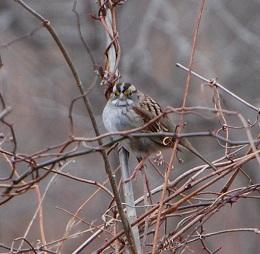
White-throated sparrows have come south to New Jersey.
(Margo D. Beller)
(Two anti-blower articles, as it happens, were sent to me by my brother-in-law, the teaching naturalist. He lets the wind takes care of what leaves fall on his rural NH property. His son, by contrast, uses a gas-powered, backpack-enabled blower on his property. He must wear ear coverings.)

I have a blower, an old, electric-powered model. I find that unless I am blowing leaves into a rough pile for my husband (MH) and me to rake into tarps, it is useless on the heavier pods. So I have been using a broom on the leaves matting the patio and a rake on the pods littering the driveway and the lawn. MH plans to do one last mowing soon to cut the grass he recently fed and mulch the leaves, and I want the pods out of the grass.

As in past years, I silently curse the person who, 40-plus years ago, thought locust trees would be a fine street tree. The locust leaves are very small but their stems fall and clump when raked. The dark brown pod contains the seeds the birds and squirrels and possibly deer eat and then spread through their poop or their digging. 

I recently finished reading a very interesting book on seeds and the lengths plants go to protect the seeds until they are ready to be expelled into the world and create more plants. During the summer the female locust put out greenish pods, some of which dried out and fell to the ground. But the pods didn't start falling in large numbers until they had developed the familiar tough brown casing to protect the seeds. Now, opening one of the pods, my hand was filled with small brown seeds. If I threw them on the lawn I might have a forest before too long.

Part of the fairy ring. (Margo D. Beller)
As I work I see all the ground ivy taking up space, happily fed along with MH's grass. In one area, a strange circle of mushrooms has sprung up, a "fairy ring." I'm not bothering to pick them because they are likely poisonous. The mower will do the work for me. 

There is always some good in doing this raking. It is another thing I do to prepare for the winter when I won't be working in the garden (except for possibly shoveling snow). When I stopped to straighten my back I could enjoy the increasing color of the leaves in my trees - red maple, brownish-yellow oak, yellow elm. The dogwood tree's red leaves haven't fallen but the fruit is long gone, and with it the catbirds. Now I hear the "old Sam Peabody, Peabody, Peabody" of the white-throated sparrow, which finds my part of New Jersey just fine for winter roosting. I am hearing woodpeckers, including a pileated flying over the trees beyond my neighbor's house across the street. The air is cool, the exercise healthy. I've needed exercise after a summer spent mainly indoors due to heat, humidity and illness.

Now I am making up for lost time.  

Black vulture, a southern bird becoming more common
in the north. (RE Berg-Andersson)
At one point something casts a shadow and I look up to see nine or so black vultures circling, Black vulture is a southern species but, like the red-headed woodpecker, it is slowly extending its range northward as the U.S. continues to warm. These birds might be heading south, but maybe not. I also hear Canada geese honking from the nearby community garden. Canada geese migrate but some found suburban yards, parks and office lawns so pleasant they have stayed, bred and become as much of a pest as the deer.

I hear other birds, including a mockingbird making its rasping "this is mine!" call, no doubt guarding a fruiting tree or bush. Smaller birds are flying between the trees looking for insects to pry out of the bark, including the gold-crowned kinglet, another winter bird that typically doesn't hang around my yard. (It prefers pine forests.)

For now, I'm done. Have I removed every pod? No, but most of them. Did I get every leaf off the patio? Not by a long shot. There are plenty more in the trees to come down. They always come down, as sure as day follows night and autumn follows summer.

And, as expected, now I hear a distant leaf blower. By the time I get to the top of my driveway to put the rake in the garage, a second, louder, blower is going nearby. 

So much for Sunday silence.


Saturday, November 5, 2016

Raking It In

“Thinking is learning all over again how to see, directing one's consciousness, making of every image a privileged place.” 
― Albert Camus, The Myth of Sisyphus and Other Essays

The other week we were driving home from a family gathering in New Hampshire. We made a stop at one of New Hampshire's waysides to use the bathroom and stretch our legs. The trees were full of colorful leaves, just past peak in this region of the U.S.

A woman was standing nearby with her dog, which strained to come to me. I walked over and pet it. The woman and I talked. She was in awe of the colorful leaves because where she lives, in Arizona, you don't see fall foliage like that. "Someday I have to bring my grandchildren here so they can see this," she told me as MH walked back to the car. She bade me farewell and walked with her dog to her waiting husband sitting in their van.

(Margo D. Beller)
I thought of that woman as I was raking today. I'd like to have a backyard of cactus.

Autumn leaves are beautiful but they are dying. As the days shorten and the weather turns cold, the trees start sending precious life fluids down to their roots. The green leaves start to turn color and drop to the ground. Some days the leaves fall like rain.

Which is why today I was outside in the early morning cold with my rake, tarp and blower.

I find blowers to be a necessary evil. I have "earmuffs," which look like old headphones, to protect my ears when I use our blower, which is electric-powered and relatively quiet compared with the big leaf blowers and hurricane fans used by the lawn services. I wear them even when I rake, to block out the noise of the neighbors in our bit of suburbia, who in their lawn lust want every last speck of leaf removed.

This was the second Saturday this season I've gone out to rake. MH joined me an hour in last week and we kept banging into each other until we developed an unspoken plan involving raking (him) and blowing (me) and putting tarpfuls of leaves at the curb (both of us).

Less than 24 hours later, a storm blew through with wind and rain, bringing down more leaves and covering our lawn. You'd never know we'd been out there. Just like Sisyphus, we'd have to do it again.

Before the fall - 8 a.m., Nov. 6, 2016 (Margo D. Beller)
This time, after a bad night's sleep, I went out early. I used the rake to pull leaves away from edges and the patio, then pushed them on the tarp. I dragged the tarp around the house to fill it with leaves and then dump it at the curb. Across the road one of my neighbors' lawn guy was unloading his equipment. He looked at me and I half-feared and half-hoped he'd ask me if I needed any help. But he didn't. He went on with his work and I went back to fill another tarpful.

My neighbor with this lawn service used to do it himself, until he had a heart attack. I can understand his hiring someone. There will surely come a time when MH, with his aching knees, and I, with various back problems, won't be able to do this ourselves anymore. Our nephew and nephew-in-law are landscapers, but they live in other states. We have no children or grandchildren to help us. For now, we do it.

Whether I use the rake or the blower, the birds are not happy when I come close to the feeders or the water dishes. The chickadees, titmice and white-breasted nuthatch fly in, grab and go when they think I'm not looking or am far enough away. The house finches, jays and house sparrows stay away. They know I will come after them if they stay too long at the feeders. Left unchecked, they'll just sit and eat until there is no more seed, to the detriment of other birds.

White-breasted nuthatch above, titmouse below. (Margo D. Beller)

But once I get far enough away, they are right back at it.

Raking is a quiet activity. It is a thoughtful activity. Unlike sitting and staring into a computer, raking allows me to concentrate on doing something physical and tangible - getting leaves on a tarp - instead of worrying about the usual intangible things such as whether I still have a job or if I can pay the bills this month. In its way, it is as restful as meditating.

When my arms started to ache, I put on my earmuffs and used my blower to create piles. I do this to give me something of substance to put on the tarp. Blowing leaves to the curb is a waste of time, energy and electricity, although those with those gas-belching fans that roar like a jet engine don't share my concerns.

Sure, they were done in 20 minutes as opposed to the several hours I took. But little by little I filled and moved the tarp, then dumped it, until I had gotten the entire backyard done, by which time MH had come out and started raking the front. I felt very accomplished and rather energized, surprisingly so.

There are times I am depressed. This seems to happen a lot at this time of year. The end of the year is near and the November in my soul, triggered by the same lack of light and cold that bring down the leaves, prompts "what's the point" moments.

I sit and wonder:  What's the point of cleaning the house when it's only going to get dusty again? What's the point of getting dressed when I work at home and don't want to see anyone? What's the point of raking when more leaves are going to come down?

What's the point of living when you're going to die anyway?

When I get to that point, I have to take myself outside. As I rake in the cold, feeling the breeze and seeing the birds flitting about in the now-bare trees, I calm down. We live to push that boulder to the top of the hill, even when it falls down and we have to push it up again.

So I go out with my rake and tend to my little plot in the universe.

Saturday, October 29, 2016

November in My Soul

Whenever I find myself growing grim about the mouth; whenever it is a damp, drizzly November in my soul...then, I account it high time to get to sea as soon as I can.

Herman Melville, "Moby-Dick"

It is sad to think that when it comes to vacations, most Americans either don't take one or make it as short as possible. When they travel, they take their computers, check their phones several times a day for email, Facebook or maps to tell them where to go next.

As I get ready to change the calendar page, I am thinking about my coming vacation. I plan to leave the computer at home and keep the phone off as much as I can.

I did not take one week by choice. If I could afford it - for if I don't work I don't get paid in this freelance life - I'd take several weeks and drive down to check out Florida's birds and the migrants. This would be in April, when the birds are in their breeding plumage and heading north.
Male common merganser duck (RE Berg-Andersson)
But since this is November I am talking about, we are following the ducks and other birds south. Seashore areas in November are very quiet - almost too quiet because many restaurants are closed for the season. However, if you go far enough afield and are willing to eat where the locals do, you won't go hungry, especially south of the Mason-Dixon line.

The ocean roars and the air is chilly on the Outer Banks. People walk on the beach, sometimes with their dogs, but I plan to take along our chairs so MH and I can sit and relax. We have both worked very hard this election year. There will also be some days driving around, looking at the birds of Pea Island and on the Delmarva Peninsula on the way home. 

I can't wait. For now, however, MH and I have been raking.

Weather has zigzagged from very hot to very cold and the trees have dropped their leaves. One day you see brilliant color. The next, it is "past peak" and falling. If my house was in the forest, I'd leave the leaves alone because they make good mulch, providing cover for insects, salamanders and other creatures. 

But I am in suburbia, and for the past few weeks there has been a near-constant droning of leaf blowers. During the week, it is the lawn services. On the weekend, it is the homeowner who is a do-it-yourselfer. MH and I are the latter. We spent several hours in the backyard, where the green grass was buried under oak, elm, apple, maple and pear leaves. We attacked with rakes, tarp and, yes, blower. Big piles are now at the curb. Some other time we will do the front yard, where the locust trees are already bare but the grass can still be seen. And then we'll likely repeat the process again.

Chipping sparrow in non-breeding colors (Margo D. Beller)
Hungry birds have been coming to the feeders. For the past week we've entertained winter visitors - purple finches, male and female, the state bird of New Hampshire. These birds of the north would only be in my backyard if their home regions don't have enough food for them. Will this be a year we also host red-breasted nuthatches and pine siskins? If so they will have to fight the resident house sparrows, cardinals, house finches, chickadees, titmice and white-breasted nuthatches. 

So far the purple finches - a threatened species - have been holding their own.

In the shrubs I hear the white-throated sparrows, which show up in the late summer into fall around the time the catbirds leave. I've also seen their cousins the juncos, which arrive around the time the chipping sparrows leave. When it snows and food becomes harder to find, they will be less skittish and go under the feeders to pick up what the other birds have dropped. The suet is eagerly eaten by woodpeckers - downy, redbelly and the occasional hairy.

My garden is done. What is spent has been cut back and I've done some neatening. All that remains is putting burlap over the deer netting to keep the evergreen shrubs from the deer.

I have three pots of peppers - two grown from seed this year and the one from last year - in the house, no white flies (thank goodness) and covered with flowers and/or growing peppers. I could not leave them outside to die.

White-throated sparrow (Margo D. Beller)
The cannas and other big plants in pots, including a gift dahlia, are on the enclosed porch, going dormant. Soon they'll be in a more sheltered place for the winter. The begonias I potted in the spring are in the house, somehow fit among the house plants I brought in from the back porch earlier. 

The farm market ended its season. After the hard freeze earlier this week, I was amazed to find some coneflowers and snapdragons I could cut to make a decent bouquet, my last of the season. Turnips, tomatoes, lettuce, chard, collards, green peppers and garlic will last for several weeks because they are locally grown minutes from my house, not shipped in from halfway around the world.

With November comes shorter days and longer nights. I can understand why Melville's Ishmael would get restless and go to sea. November is a hard month. When we turn back the clock it is dark at 5 pm. It take more of an effort to get up in the morning when it is dark and cold. I feel old and sad at this time of year, made worse because of recent health and work issues.

And so I await that week of vacation. I need to be restored, at least for a short while.

A sad postscript: the redtail hawk that was the subject of my last post did not survive, despite the best efforts of the people at The Raptor Trust.  

Sunday, November 8, 2015

On Leaves, Birds and Bears

Leaves

Out here in the suburbs it is currently leaf blower season.

I am on my back porch, looking at a clear blue sky on an otherwise perfect autumn day in November. My next-door neighbor, in his shorts and blasting music through his headphones (as I am, if you can call harpsichord Bach "blasting") is using his blower to push the leaves off the grass, perfectly demarcing the edge of his property.

When he is finished, as sure as the sun's position will change, another neighbor will take up the challenge and blow his leaves around for a while. And so it will continue all day in the "quiet" suburb where I live. (At least it's not gunshots or a car alarm - yet.)

Pods and acorns found under the fallen leaves. (Margo D. Beller)
I did the same thing myself yesterday, using the blower to push the elm and maple leaves into piles that MH and I would then rake into blue tarps and dump at the curb for pickup by our town. Unlike the front yard, this is actually easy. In the front yard we have locust trees, one of which is a female tree that gets loaded with long, hard, smelly pods that must be raked down because they are too heavy for our blower. Unlike the previous week, there were few pods so I can pick them up rather than rake and strain my arms.

I was quite pleased with our effort, until I awoke this morning and saw that the wind had changed and it had brought down more pods as well as a lot of the remaining oak leaves. Being a Sunday, the infernal sound of my neighbor's and others' leaf blowers started a little later this morning, 9am instead of 7:30.

This is part of the suburban ritual. As the summer heat starts to fade it is time to pull up the annuals, mow the grass and put out mums. As Halloween nears it is time to put out pumpkins, corn threshes and take the kids to the nearest farm so they can experience something resembling rural life. Then the leaf blowers start. After Thanksgiving, start expecting snow and snowblowers clearing driveways, but sidewalks only begrudgingly.

I try to fight against this ritual as much as I can but I can't avoid the pods or the leaves that thickly mat the lawn and can do some damage if not removed. So every year we rake and every year, the day after we expose the deep green of the lawn, more leaves fall and remind us there is more work to be done and there is always more work to be done.

Like all of life's burdens that never end.

Birds

"Where are the juncos?" MH asked me the other afternoon as we were having our dessert on the porch before the light faded.
Junco (Margo D. Beller)
MH has a more scientific bent than I, and he tracks when the chipping sparrows and catbirds depart to be replaced by white-throated sparrows and juncos, which is a cousin of the sparrow. White-throats and juncos usually start showing up in October. I don't note the exact day but MH has a calendar embedded in his head and to him the juncos were overdue.

I had seen a couple of juncos one afternoon when I went to the feeders to chase off the horde of house sparrows mobbing it. The juncos flew off and I haven't seen or heard one in our backyard or at the feeders since then. I have been hearing the two-note call of the white-throat but have only seen one that took close to a week to get comfortable enough to come out of the bushes and stand on the flood wall. When I chase off the house sparrows it stays put because it is not of the house sparrow clan. (House sparrows are not really sparrows but old-world weaver birds that came along for the ride and proliferated in the new world over these many centuries.)

So I thought about it. Migration in my part of northern New Jersey had been very bad - "good" birds seen in much smaller numbers than usual, storms blowing many birds over New Jersey southward or eastward over oases such as Central Park in NYC. It could be that ever since the last bear attack I've been taking feeders in and so there is no seed available in the very early hours when I've found cardinals and white-throats and juncos like to feed.

White-throated sparrow (Margo D. Beller)
It could also be the horde of sparrows. Unlike the titmouse or the chickadee that grabs a seed and flies off, the sparrows crowd into the house feeder, fighting each other. I now have a second, caged feeder out for the other birds.

Like the unusual warmth we have had the last few weeks (when temperatures fall back to where they are supposed to be, the weather forecasters seem to treat it like some sort of calamity. "It will be 35 degrees colder tomorrow than it was today!!") that I attribute to the wacky weather patterns created by global warming, the sparrow explosion is man-made. A former neighbor kept a feeder going all year long, including the summer, and filled it with millet, a house sparrow's favorite food because it is small and easily cracked open. The abundance of food created a population explosion.

Unfortunately, that neighbor moved out and, after an initial attempt, the people who moved in use the feeder pole more for hanging plants than bird food. So this large sparrow population - which has made nests in trees, shrubs and the spaces next to window air conditions such as my neighbor's across the back yard - are coming to my sunflower seed feeders en masse.

I find myself coming out to refill the house feeder during the day or, if I am sick of the mess, taking the house feeder in, which deprives the cardinals of food because they can't fit into the caged feeder. Then I must go out just before dusk, after the other birds have tucked themselves in for the night, to allow the cardinals a last meal before dark.

So these bigger, more aggressive birds may be the reason the juncos are "late" in arriving. When the real cold comes and the snow falls and I can safely keep the feeders out all night without fearing another visit from a bear, perhaps the winter birds will finally show themselves. Desperation will make even the smallest bird fight a house sparrow.

Bears

In late October, in the middle of the day in the middle of the large county seat's large green, a large bear was spotted in a tree by a police officer. The lunch crowd was immediately ousted from the park and people started taking videos on their phones to post to YouTube. Snarky comments voiced more support for the bear than for the police officer, and comments regarding the color of the bear - black - were made both pro and con, as stupid comments will be made when you don't give your real name.

The bear, meanwhile, stayed put, and from the comments I've read most people were mighty pleased to see a bear in the middle of Morristown. It was a big story that made headlines in newspapers and on the evening news.

I heard this story and knew, just knew, that this bear was the same one that had walked into my yard on a sunny September afternoon on a Sunday when people were in their yards or strolling in the street and grabbed at my house feeder, ripping off an iron feeder pole arm, before ambling across the yard and along the next street, where I managed to see it heading north.

Black bear, 2014 (RE Berg-Andersson)
I also knew that if this 200+ pound bruin had been in the backyard of any of these people, threatening their feeders or, worse, their pets or small children, they wouldn't have been so happy to see a bear in the middle of the day in the middle of a heavily populated area.

The black bear was later tranquilized and brought down by the fire department in a cherry-picker, then taken away. However, while in the past such bears were taken to the far corner of the state, this time it was taken to a Wildlife Management Area not that far (for a bear) from where it was found.

This has happened too many times, and that is why New Jersey has expanded the bear hunt. It has become expected bear will show up on wooded hiking trails or in farms or the backyards of some of the more rural parts of the heavily populated state of New Jersey, but when they start showing up in towns and cities you know the situation is getting out of control.

The "bear people" blame suburbanites such as myself for having bird feeders and garbage pails out. They say we need more "education." I can't speak for the education level of the people watching the Morristown bear but I was quite alarmed they didn't realize this was no TV show but a wild animal loose among them.

Perhaps the state thinks the bear they removed will hang around the WMA in time for the bear hunt. Perhaps they are hoping the bear will get tired of all that wandering and stay put for a while, maybe den in the woods for the winter. But why should a bear remain in a WMA scrounging around for dried berries when it can come into Morristown on a fine, sunny day and dumpster dive the town's many fine restaurants?

Sunday, October 13, 2013

Good, Bad and Raking

Robert Frost wrote, with irony, in a poem that "good fences makes good neighbors."

In my part of town, where we are not supposed to fence the front of our properties to retain something of a "park-like setting," autumn creates an opportunity to remember just where one property starts and another ends.

The leaves fall and you will see one house with an immaculate lawn. The service has come through, many people with lawn blowers and hurricane fans putting leaves to the curb, more or less; or perhaps mowing the grass, mulching the leaves, sucking them into the bag, which is emptied at the curb. The service goes right up to the property line.

One side, pristine green. The other side, my lawn.
Good raking makes good neighbors.
My husband does one final lawn cut, crunching up the first round of fallen leaves to allow them to work into the lawn. After that, we'll be out with our rakes, blower and tarps for the next few weeks, until the town stops collecting what we put out front.

In the backyard we have the maples, elms, apple, pear and oaks shedding leaves. In the front, however, we have black locusts.

I don't know who decided many decades ago to line my street with black locusts. That man or woman could've picked the Bradford pears. These stately trees line my downtown street and perhaps yours. They bloom wonderfully in spring, the leaves turn red in fall and they produce ornamental fruit the birds eat.

Black locusts are not so nice. Their roots push up the curb and the street. The little yellow leaves fall early in autumn and get everywhere, at which point they are tracked into home and garage. The stems also fall and mat on the grass. There are male and female trees, and if you are one of those "lucky" enough to have a female tree, as I am, you have  LOTS of long black pods that must be swept off the lawn or you'll have a forest instead of a park-like setting.

So as I am raking the pods down to the curb every year, I wonder if the person who decided on locusts has a few in his or her front yard and is also raking pods. I would like to meet that person, ask, "Why locusts?" (which are no longer planted in my town because of the damage they cause) and, if I'm in the wrong mood, punch him or her in the nose.

It is literally and figuratively a pain to do this every year, but there is some good that comes from all this raking. I am out of the house, using my arms and legs in much more (to me) useful exercise than lifting weights or riding a stationary bicycle. I am reacquainting myself with my lawn - I can see where the ground ivy is taking over, where the skunks and squirrels have been digging, where MH is going to need to put down more grass seed. I prefer this to paying a lawn service that mows every week whether the lawn needs it or not.

brown creeper
Raking also allows me to hear the birds. As I work, I hear the Canada geese. I look up and see about 10 flying generally north. However, I know these are not migrants. They would be heading south at this time of year, would be in a much larger group and be much higher in the sky. Still, I enjoy watching geese as they fly.
 
One year, resting from my labors, I looked up to find a brown creeper making its way up one of the locust trees, probing the crevices of its bark with its long, thin bill. Unlike the nuthatch, which climbs up and down trees with abandon, the creeper only goes up. Once at the top, it flies to the bottom of the next tree and works its way up again.

This morning as I was raking there were bluebirds - a rare pleasure - and a Carolina wren singing nearby, reminding me that soon I must bring in my plants and put out my feeders.

Winter will be here soon enough. Even with the cold and the darkness at 5pm, I welcome the respite from the garden chores.

Especially the raking.

Friday, October 26, 2012

Waiting for Sandy

Hurricane Sandy, or what the media call "Frankenstorm," is a few days away from hitting somewhere along the Midatlantic. There is a good chance it will strike the Jersey shore, but even if it is not a direct hit we will all be feeling the effects.

October 2011 snowstorm
Didn't we go through this around now, last year? Why yes, we did. Only last time we had a freak snowstorm that hit the leafy trees, pulled them down and disrupted power for a while.

This year the expected cold front won't make it here in time but the moon will be full and the tides would be higher than normal anyway. With the expected very high winds pushing high water there could be severe flooding along the coast, and that includes the tip of lower Manhattan.

Here in my part of New Jersey, my husband, with his scientific way of thinking, has been buying nonperishable groceries, restocking the battery case, refilling the flashlights. This morning I held the ladder as he climbed to the lower roof gutters to pull out debris.

At the same time, here is how many of those in my area were getting ready. They were blowing leaves to the curb.

I have lived in the suburbs for nearly two decades and I still can't understand this lawn lust, this need to water excessively, cut to literally within an inch of the grass's life and blow every last thing off to the street, heedless of whether it impedes a person's or a car's ability to travel down said street.

For me, it is a USELESS and WASTEFUL activity to blow several weeks's worth of leaves to the curb just ahead of a hurricane or tropical storm.

Best-case scenario - the leaves blow back on the homeowner's lawn, forcing him or her to do the job all over again, or pay someone else to do it all over again.

Worst-case scenario - the rivers expected will be blocked from going down the drains, creating ponds in the middle of the street. Already-treacherous travel will worsen. Water may even back up into homes.

The noise from the leaf blower-fans, which are much more power than the electric-powered blower I use only as a last resort, is deafening. As I sit in my home office, making plans for what to do to keep working and living should we lose power, the sound is as loud and as annoying as a continual car alarm or a siren.

Even as these lawn services or homeowners finish, the breeze brings down another handful of leaves. But hey, you've just paid for several big guys to do 10 minutes of work to give you 14 seconds of spiffy green lawn. Hurrah, I guess you're better than me.

I can barely see the grass in my backyard for all the elm, oak and maple leaves but there is no way I am going to go out when more leaves - and perhaps some tree limbs - come down in the storm. There are more important things.

These people will probably also freak out because they can't watch their flat-screen tvs, use their fancy big ovens and may lose what's in their fancy refrigerators.

Barnegat jetty. Will it be enough to protect the coast from Sandy?
Some do plan. There's my neighbor with the big gas-powered generator. Last year he ran his continually. It made a lot of noise and stunk of gasoline but at least he kept his refrigerator and other appliances going.

As these "freak" storms become more common, as even more of those who deny there is anything called global warning start wondering about all these extremes - too much rain, too much wind, too much heat, no snow, too much cold - we've been having, I am going to have to plan to buy a generator, too, for the next storm.

Even in my modest home, if I don't have power, I don't work, and if I don't work, I don't earn money. That is, literally and figuratively, the bottom line.

But at least I do not live near the water. All those people who built homes on barrier islands and those other people who tore down low-lying bungalows to put up high-profile behemoth beach houses should be ashamed of themselves. But they aren't. The builders got their permits and are long gone, and the homeowners will rebuild.

I don't want to wish this storm on anyone, especially anyone on the Delmarva, where I expect to be traveling in a few weeks, but I hope Sandy's blow isn't as hard in New Jersey as I fear it will be.